The Devil’s Star Summary, Characters and Themes
The Devil’s Star by Jo Nesbø is a dark Norwegian crime thriller centered on Detective Harry Hole, a brilliant investigator whose personal life is collapsing just as Oslo faces a terrifying series of murders. The novel combines a serial-killer investigation with police corruption, old betrayals, addiction, jealousy, and revenge.
Harry is not only trying to solve the case but also fighting the consequences of his obsession with the death of his colleague Ellen Gjelten. As ritual clues begin to form a pattern across the city, Harry must decide whom he can trust before the killer, and a dangerous enemy inside the police, destroy everything left in his life. It’s the 5th book of the Harry Hole series.
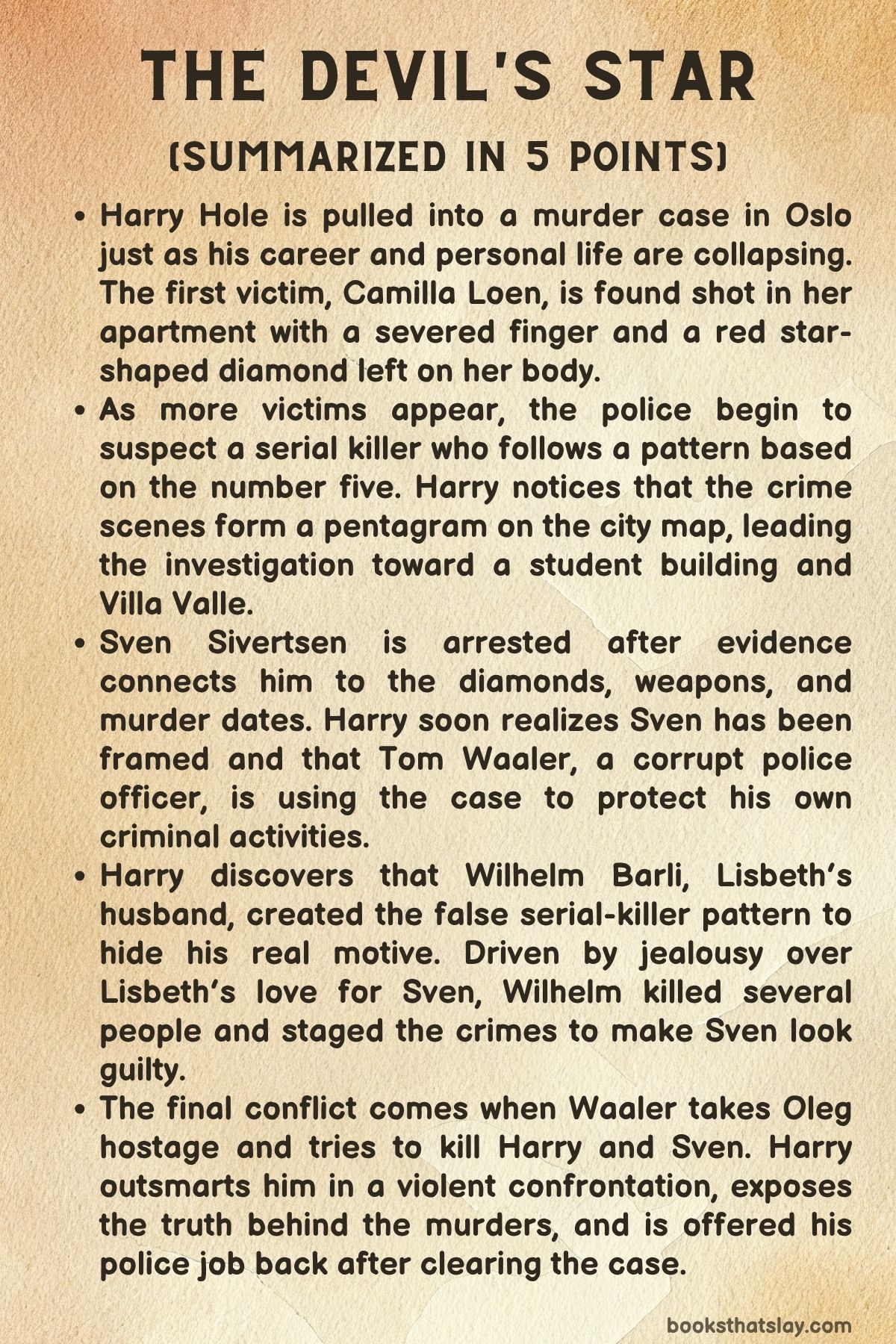
Summary
Harry Hole is close to losing everything when a murder case pulls him back into action. In Oslo, Vibeke Knutsen is at home with her partner, Anders Nygård, when water begins leaking from the apartment above.
At first, the incident seems like a plumbing problem, but Vibeke realizes that the strange lumps in her boiling potatoes are cooked blood. The leak is coming from the upstairs flat of Camilla Loen.
When police enter Camilla’s apartment, they find her dead in the bathroom, shot in the forehead. One of her fingers has been cut off, and a small red diamond in the shape of a five-pointed star is found on her eye.
Crime Squad Chief Inspector Bjarne Møller is short-staffed because many detectives are on summer leave. He assigns the case to Tom Waaler, a polished and ambitious detective, and reluctantly brings in Harry Hole, whose career is already falling apart.
Harry is gifted but damaged by alcohol and by his fixation on the murder of Ellen Gjelten, a colleague and friend. Harry is convinced that Waaler was involved in Ellen’s death and that he is the criminal figure known as “Prince,” but his evidence has collapsed.
His witness withdrew his statement, and Harry’s accusations have left him isolated and close to dismissal.
Harry and Waaler work the Camilla case uneasily. The crime scene suggests Camilla knew her killer because there is no sign of forced entry.
The missing finger and the red star-shaped diamond make the killing seem ritualistic, but there is little evidence. Harry, already drinking again, resists involvement and drifts between the case, his nightmares, and memories of Rakel, the woman he lost because of his obsession.
Rakel and her son Oleg still matter deeply to him, but Harry’s self-destruction has made trust almost impossible.
A second case begins when Wilhelm Barli reports that his wife, Lisbeth, has vanished after leaving home for a brief errand. Harry takes the disappearance seriously despite the short time she has been missing.
He questions Wilhelm and their neighbors, learns about the couple’s theatrical life, and notices details in their apartment, including a chisel. Soon afterward, Møller receives Lisbeth’s severed finger.
It is wearing a ring set with another red diamond star. Camilla’s murder and Lisbeth’s disappearance are now clearly linked.
A third woman, Barbara Svendsen, is killed at a law firm. She is shot in the head after leaving the reception desk to get water for a visitor.
Her ring finger is severed, and another red diamond star is left behind, this time in an earring. A possible clue emerges when a witness mentions a disguised bicycle courier leaving the building.
Harry suspects the killer may be using a courier outfit to move through public spaces without drawing attention. The murders appear to be escalating: a private apartment, a daylight abduction, and then a killing inside an occupied office building.
The investigation begins to focus on patterns. Harry notices that the five-pointed star, or pentagram, keeps appearing around the crimes.
A pentagram has been carved into Camilla’s apartment, drawn on a dusty television screen near Barbara’s workplace, and reflected in the shape of the red diamonds. He realizes that the number five governs the killer’s design.
The murders occur around five o’clock, five days apart, on fifth floors or in locations connected to the number five. When Harry plots the crime scenes on a map of Oslo, the points form a devil’s star.
The pattern reveals two more locations: a student building and Villa Valle, the home of elderly Olaug Sivertsen.
The police prepare a surveillance operation at the student building, believing the next attack will happen there. Beate Lønn is sent to protect Olaug at Villa Valle.
During her watch, Olaug explains that her son Sven lives in Prague and has been visiting her. She shows Beate a brooch Sven gave her, set with a familiar red star-shaped diamond.
Sven immediately becomes the leading suspect. Waaler goes alone to arrest him, while Harry remains at the surveillance site.
But Harry notices a pentagram above one student’s room and discovers that the student, Marius Veland, has already been murdered. His body has been hidden in a sealed storage space.
The student building was not the next site; it was the first. Harry realizes the real next killing must be at Villa Valle.
Sven Sivertsen is arrested at his mother’s house. Evidence found with him seems damning: diamonds, weapons, and proof that he was in Oslo on the relevant dates.
Waaler is celebrated as the hero of the arrest, but Harry suspects that Waaler intended to shoot Sven during the operation and only failed because Beate intervened. Waaler later reveals his true nature more openly.
He leads a secret vigilante organization and wants Harry to join him. He orders Harry to kill Sven in custody using an undetectable poison, arguing that the justice system is too weak and that criminals must be removed permanently.
Harry pretends to go along but instead visits Sven in his cell and tricks him into talking. He makes Sven believe he has poisoned him, then offers a fake antidote in exchange for the truth.
Sven admits to smuggling guns and diamonds but denies the murders. He explains that an anonymous client paid him to deliver star-shaped diamonds and Czech weapons to a park in Oslo at precise times.
Each delivery was timed so that Sven would be in the city when a murder occurred, making him look guilty. Harry realizes Sven is being framed and helps him escape so they can find proof before Waaler silences them both.
Harry hides Sven in the student building while Beate quietly helps him from inside the police. They search for evidence that Sven was merely delivering items, not killing people.
Tourist photographs from the park begin to support Sven’s account. Harry also learns that Sven once had an affair with Lisbeth Barli.
This discovery redirects the case. Harry remembers seeing a honeymoon photograph in Wilhelm Barli’s apartment and connects it to a Prague location linked to Sven.
The real motive is not ritual murder but jealousy.
Harry goes to Wilhelm’s apartment and confronts him. Wilhelm admits that he found letters proving Lisbeth still loved Sven.
Furious at her emotional betrayal, Wilhelm designed an elaborate revenge. He wanted to kill Lisbeth and frame Sven for a series of murders so that Sven would lose his life without dying.
Wilhelm chose random victims to create the appearance of a serial killer, used the pentagram pattern to mislead police, and arranged for Sven’s deliveries to place him in Oslo at the right times. Lisbeth’s body is found hidden inside the waterbed.
Harry also reveals forensic evidence that disproves Wilhelm’s explanation for material found under Lisbeth’s fingernail. Cornered, Wilhelm confesses further, then jumps from the balcony to his death.
Harry then discovers that Toya, Lisbeth’s sister, has also been killed.
Before Harry can process this, Waaler takes Oleg hostage and forces a meeting at the student building. Waaler plans to kill Harry, Sven, and Oleg, then stage the deaths to make Harry look responsible.
Harry prepares as best he can, but Waaler anticipates some of his moves. A violent confrontation takes place around the old lift.
Harry uses the chisel and the handcuffs to trap Waaler’s arm as the lift descends. Waaler’s arm is torn off, and he dies from shock and blood loss.
With Waaler dead, Sven alive, and the real killer exposed, Harry finally clears the case and vindicates his suspicions about Waaler. Møller helps restore order, and the police find more evidence confirming Wilhelm’s guilt.
The Chief Superintendent apologizes to Harry and reveals that his dismissal was never finalized. Harry is offered his job back, but his future remains uncertain.
He has survived the case, protected Oleg, exposed corruption, and solved the murders, yet the ending leaves him alone with the cost of everything he has endured.
Characters
Harry Hole
Harry Hole is the damaged center of The Devil’s Star, a detective whose brilliance is never separated from his self-destruction. He sees patterns others miss, notices details that seem insignificant, and has the stubbornness needed to follow a case even when the official explanation appears complete.
At the same time, he is unreliable, alcoholic, obsessive, and emotionally exhausted. His fixation on Ellen Gjelten’s murder has ruined his relationship with Rakel and placed his career in danger, yet his suspicions about Tom Waaler are not fantasy.
Harry’s tragedy is that he is often right, but his behavior makes it easy for others to dismiss him. His relationship with Oleg reveals the tenderness he tries to protect from the uglier parts of his life.
He wants to be worthy of Rakel and Oleg, but he repeatedly chooses danger, guilt, and investigation over stability. By the end, Harry’s survival depends on his ability to think under pressure, bluff convincingly, and accept help from the few people who still trust him.
He solves the murders and defeats Waaler, but victory does not make him whole. He remains a man who can expose evil outside himself while still struggling against the forces inside him.
Tom Waaler
Tom Waaler is one of the most dangerous figures in The Devil’s Star because he hides corruption beneath discipline, competence, and public respectability. To the police, he appears calm, efficient, brave, and destined for promotion.
To Harry, he is something far darker: a criminal insider who uses his authority as a shield. Waaler’s evil is not chaotic.
He believes in control, hierarchy, and force. His vigilante organization shows that he sees himself as above the law, someone entitled to decide who deserves to live or die.
He is seductive in the way he presents corruption as realism, telling Harry that survival depends on choosing the winning side. Waaler also understands Harry’s weaknesses and tries to exploit them, offering him purpose, money, and belonging at a moment when Harry is professionally and emotionally vulnerable.
His attempt to kill Sven, Harry, and Oleg reveals the full extent of his ruthlessness. Waaler is not merely a corrupt officer; he is a man who has converted justice into personal power.
His death in the lift is brutal but fitting, because his own need for control traps him in a situation he can no longer command.
Wilhelm Barli
Wilhelm Barli is the real murderer behind the false serial-killer pattern in The Devil’s Star, and his character is shaped by jealousy, humiliation, intelligence, and theatrical control. As a theatre producer, he understands staging, timing, audience attention, and illusion.
He applies those skills to murder, creating a performance for the police in which every clue points away from his private motive. Wilhelm’s marriage to Lisbeth is revealed as practical and hollow, at least from her side, and the discovery of her continuing love for Sven destroys his pride.
His revenge is not impulsive. He does not simply want Lisbeth dead or Sven punished; he wants to redesign reality so that Sven is condemned for crimes he did not commit.
This makes Wilhelm especially chilling. He kills strangers not because they matter to him, but because they are useful props in his plan.
His ability to cry, charm, and speak calmly with Harry shows how well he performs grief. Yet beneath that performance is a man consumed by wounded vanity.
His final confession exposes both his cleverness and his emotional smallness. When he jumps to his death, it feels like the last act of a man who cannot bear losing control of the story he created.
Sven Sivertsen
Sven Sivertsen is introduced as the perfect suspect, but he gradually becomes a more complicated figure. He is guilty of smuggling diamonds and weapons, and he has lived with criminal compromise for years.
Yet he is not the Courier Killer. His past explains how he became vulnerable to manipulation: born from his mother’s wartime relationship with a German soldier, raised with the burden of shame and displacement, he later seeks out his father and enters the criminal world through diamond smuggling.
Sven is not innocent in a moral sense, but he is innocent of the murders. His love for Eva and concern for their unborn child make him desperate to clear his name rather than simply save himself.
He is fearful, angry, and sometimes threatening, especially when he turns the chisel on Harry, but his behavior comes from panic rather than cruelty. Sven also functions as a mirror for Harry.
Both men are trapped by Waaler, both are compromised, and both need the truth to survive. His eventual cooperation helps expose Waaler and Wilhelm, but his future remains uncertain because his actual crimes cannot be erased.
Beate Lønn
Beate Lønn is one of the book’s most quietly important figures because she combines forensic skill with moral courage. She is precise, observant, and professionally disciplined, but she is not emotionally cold.
Her loyalty to Harry is cautious rather than blind; she challenges him when he seems obsessed, yet she also recognizes when his instincts deserve attention. Beate’s role becomes especially significant once the official investigation begins to bend under Waaler’s influence.
She is one of the few people Harry can truly trust, and her willingness to help him from inside the system gives him a chance to prove Sven’s innocence and expose the larger corruption. Her confrontation with Waaler during Sven’s arrest is a key moment.
By noticing that Sven has no gun and speaking up, she prevents Waaler from executing him under the cover of police procedure. Beate’s strength lies in her refusal to surrender her judgment to authority.
She may not dominate the room like Waaler or Harry, but she repeatedly makes choices that protect the truth.
Bjarne Møller
Bjarne Møller is Harry’s superior, but his role is more complicated than that of a simple boss. He is tired, pressured, and increasingly unable to defend Harry’s behavior, yet he still understands Harry’s value better than most.
Møller’s frustration with Harry is justified. Harry disappears, drinks, breaks rules, and damages the credibility of the department.
At the same time, Møller knows that Harry possesses rare investigative instincts and that firing him may mean losing the one person capable of seeing the whole case clearly. His decision to release Harry from custody after the church incident shows both compassion and desperation.
Møller often stands between Harry and institutional punishment, but he is not endlessly forgiving. His anger comes from disappointment as much as authority.
By the end, Møller’s support helps bring the truth into the open. He represents the imperfect but still salvageable side of the police system, a contrast to Waaler’s corruption.
Rakel Fauke
Rakel Fauke represents the life Harry wants but cannot easily sustain. She loves him, or at least still feels deeply connected to him, but she refuses to let his alcoholism and obsession consume her household.
Her relationship with Harry is marked by longing, disappointment, and hard boundaries. She has already lived with addiction through Oleg’s father, so she recognizes the signs in Harry and refuses to repeat that pain.
Rakel is not cruel when she pushes Harry away; she is protecting herself and her son. Her anger after Harry takes Oleg near an active crime-related location shows her clear priorities.
Oleg’s safety comes before Harry’s need for redemption or connection. Yet Rakel’s continued openness to Harry, especially when she agrees to the theatre date, suggests that she has not fully given up on him.
She is a reminder that love alone cannot save Harry. He must become someone safe enough to love.
Oleg
Oleg is a child, but he carries major emotional weight in the story. To Harry, Oleg represents innocence, trust, and the possibility of a family life beyond alcohol and police work.
Oleg’s plea for Harry to come home is simple but devastating because it shows how deeply Harry’s absence affects those around him. Oleg trusts Harry in a way adults no longer can, and that trust makes Harry both stronger and more vulnerable.
Waaler’s decision to use Oleg as a hostage is especially cruel because he understands the boy’s symbolic importance. Oleg is not just a victim in danger; he is the person who forces Harry to act with absolute clarity.
During the final confrontation, Harry’s need to save Oleg strips away all hesitation. The boy’s survival allows the story to preserve a small possibility of healing, even after so much violence and betrayal.
Lisbeth Barli
Lisbeth Barli is dead for much of the story, but her life and choices drive the central mystery. At first, she appears as a missing wife, then as another victim in a ritualistic sequence.
Later, she becomes the emotional center of Wilhelm’s motive. Her marriage is revealed to be strained and practical, while her connection to Sven remains emotionally powerful.
The letters Wilhelm discovers show that Lisbeth’s inner life is far richer than the role she occupies in his world. She is a performer, a wife, a lover, and a woman who still longs for a different life.
Wilhelm’s rage comes not only from sexual jealousy but from the discovery that he never fully possessed her heart. Lisbeth’s body hidden inside the waterbed is one of the book’s most disturbing images because it places the truth inside the domestic space where Wilhelm has been performing grief.
Her death exposes the violence that can grow from ownership disguised as love.
Camilla Loen
Camilla Loen is the first victim whose murder draws the police into the pattern. She is presented through traces: her apartment, her neighbors’ impressions, the lack of forced entry, her pregnancy, and the evidence left on her body.
Because she is initially treated as part of a serial-killer design, her individuality risks being swallowed by the pattern. Yet details about her life matter.
She worked in advertising design, had male visitors, and was pregnant when she died. Her murder becomes even more tragic once the truth is known: she was not killed because of who she was in any meaningful personal sense, but because Wilhelm needed a victim at a point on his constructed map.
This makes her death a statement about the coldness of instrumental violence. Camilla is turned into a clue by the killer, but the investigation slowly restores the fact that she was a person before she became part of his design.
Barbara Svendsen
Barbara Svendsen’s murder intensifies the fear around the case because it takes place in a public professional setting. She is a receptionist at a law firm, doing an ordinary task when the killer reaches her.
Her final moments are marked by routine: a request for water, a trip to the lavatory, a small interruption in the workday. That ordinariness makes her death unsettling.
Barbara is not linked personally to Wilhelm’s jealousy, Sven’s past, or Waaler’s corruption. She is chosen because her location serves the pattern.
Her death shows how artificial the serial-killer structure is. The killer creates meaning out of numbers and symbols, but the meaning belongs to him alone.
For Barbara, there is no grand reason, only the terrifying fact of being selected by someone who needs a body to complete an illusion.
Marius Veland
Marius Veland is the hidden first victim, and his death changes the structure of the case. Until Harry finds him, the police misunderstand the order of events and believe the student building is a future target.
Marius’s murder reveals that the killer’s plan began earlier than anyone realized. His forced letters to his parents and neighbors show Wilhelm’s careful control over absence.
Marius is not only killed; his disappearance is staged so that no alarm will be raised. The hiding of his body in a sealed storage space also shows the killer’s practical intelligence.
Marius’s role is important because his death proves that the pattern has been engineered with patience. He is the victim who allows Harry to correct the timeline, and that correction helps lead to the truth.
Olaug Sivertsen
Olaug Sivertsen is tied to the story through history, motherhood, loneliness, and guilt. Her past relationship with a German official during the war shaped Sven’s life and left both mother and son marked by social judgment and emotional distance.
In old age, Olaug lives with memories and stories, finding companionship in her lodger Ina and in Sven’s visits. She is vulnerable, but she is not foolish.
When police warn her that she may be in danger, she responds with a calmness that suggests a lifetime of endurance. Her love for Sven is clear, even though his life has moved far beyond her understanding.
The brooch he gives her becomes a crucial clue, turning a private maternal gift into evidence in a murder investigation. Olaug’s character connects the crimes to older wounds, showing how past shame and family secrets can echo through later generations.
Vibeke Knutsen
Vibeke Knutsen begins as a witness but becomes a revealing presence in Harry’s emotional world. Her recognition that blood is leaking from Camilla’s apartment starts the investigation, and her later conversations with Harry add important details about Camilla’s visitors and the strange atmosphere in the building.
Vibeke is unhappy with Anders and drawn to Harry, perhaps because she senses his loneliness and wants escape from her own relationship. Her proposition to Harry is less about romance than desperation.
Harry’s rejection of her shows that, despite his damage, he still knows whom he truly wants. Vibeke also helps expose the unease around Camilla’s private life, especially through Anders’s odd protectiveness.
She is a minor character, but she reflects the book’s recurring concern with desire, jealousy, and the private tensions hidden inside ordinary homes.
Øystein Eikeland
Øystein Eikeland is Harry’s friend and one of the few people who sees him without professional judgment. As a taxi driver, he exists outside the police world, but he becomes essential to Harry’s survival.
He refuses to simply feed Harry’s self-destruction, even when Harry asks for pills or help in the middle of a crisis. Øystein’s bluntness matters because he tells Harry truths that others either soften or weaponize.
Later, his role in the phone swap allows Harry to evade Waaler’s surveillance long enough to keep working. Øystein is not a heroic investigator, but his loyalty is practical and brave.
He helps Harry not because he fully understands the case, but because he understands his friend.
Toya
Toya, Lisbeth’s sister, is pulled into the tragedy through grief, performance, and proximity to Wilhelm. She takes over Lisbeth’s role in My Fair Lady, stepping into a professional space that still belongs emotionally to her missing sister.
Her connection with Wilhelm after Lisbeth’s death suggests confusion, desire, and perhaps a search for closeness in the middle of shock. Toya’s death is one of Wilhelm’s final acts of violence, showing that his confession of love and pain cannot hide his capacity for cruelty.
She becomes another person destroyed by his need to control the consequences of his crime. Her presence also deepens the theatrical atmosphere around Wilhelm: roles are replaced, grief is performed, and real bodies are hidden behind staged appearances.
Anders Nygård
Anders Nygård is Vibeke’s partner and Camilla’s downstairs neighbor. At first, he seems like an ordinary resident caught in a horrifying discovery, but his reactions suggest deeper discomfort.
He is strangely invested in how people speak about Camilla’s sex life, and his conversation with Harry about divine judgment and the devil’s star reveals a moralizing streak. Anders helps explain the symbolic meaning of the mare cross, giving Harry language for the pattern he is seeing.
Yet he is also a man whose jealousy and possessiveness echo larger themes in the story. He does not become the killer, but his attitudes make him part of the same emotional landscape: suspicion, sexual judgment, resentment, and fear of women’s independence.
Themes
Addiction, Self-Destruction, and the Fight for Control
Harry’s drinking is not treated as a decorative flaw or a simple sign of sadness. It shapes his work, his relationships, his reputation, and his ability to trust himself.
Alcohol gives him temporary escape from nightmares and guilt, but it also places him exactly where his enemies want him: discredited, isolated, and easy to dismiss. His obsession with Ellen’s murder feeds the addiction, and the addiction feeds the obsession, creating a cycle that pushes Rakel away and nearly ends his career.
The book does not suggest that Harry lacks intelligence or courage. In fact, his mind remains exceptionally sharp.
The tragedy is that his gifts survive inside a body and life he keeps damaging. Øystein, Rakel, Møller, and even Waaler all tell Harry versions of the same truth: only he can decide whether he survives.
Waaler twists that idea into a corrupt invitation, while Rakel and Øystein represent its human cost. Harry’s movement toward sobriety during the investigation is fragile, but important.
He does not become cured. He simply proves, for a time, that he can choose clarity when the stakes are high enough.
Justice, Corruption, and the Abuse of Authority
Authority in The Devil’s Star is never automatically trustworthy. The police are supposed to protect the public, but Waaler uses the institution as camouflage for crime.
His power comes not only from weapons or criminal contacts but from credibility. People believe him because he looks like the ideal officer: calm, brave, efficient, and loyal to order.
That makes him more dangerous than an obvious criminal. Waaler’s vigilante philosophy exposes a central conflict between justice and control.
He claims that the legal system fails and that decisive men must remove criminals themselves, but his real belief is that power should answer only to itself. Harry, despite his rule-breaking, stands on the opposite side.
He also distrusts the system, and he knows it can fail, but he does not accept Waaler’s right to become judge and executioner. Sven’s situation sharpens this conflict.
He is guilty of crimes, yet he is also being framed for murders. A corrupt version of justice would erase that distinction.
The book insists that truth matters even when the truth protects someone morally compromised.
Jealousy, Possession, and the Violence of Wounded Pride
Wilhelm’s crimes are born from jealousy, but the jealousy is not limited to romantic pain. It is tied to pride, ownership, humiliation, and the unbearable discovery that Lisbeth’s inner life does not belong to him.
The letters he finds do more than reveal an affair; they reveal that his marriage was not the emotional reality he wanted to believe in. His response is not simply to kill Lisbeth in rage.
Instead, he constructs a vast false pattern in which strangers die, Sven is framed, and the police are turned into an audience for his revenge. This makes his jealousy theatrical and authoritarian.
He wants to control not only Lisbeth’s body but the meaning of her betrayal. Sven must suffer, Lisbeth must be punished, and the world must read the crime through symbols Wilhelm has arranged.
Other relationships echo this theme in smaller ways: Anders’s discomfort around Camilla’s sexuality, Vibeke’s trapped relationship, and Rakel’s refusal to be consumed by Harry’s instability. The story shows how love becomes dangerous when it is treated as possession.
Wilhelm’s downfall comes because he mistakes staging for truth and control for love.
Patterns, Symbols, and the Danger of False Meaning
The pentagram, the number five, the severed fingers, the red diamonds, and the mapped locations create the impression of a ritualistic killer with a mysterious inner logic. Harry’s ability to read patterns is what makes him a great detective, but the case also warns that patterns can be manufactured.
Wilhelm designs the murders so that the police will chase meaning in the wrong direction. The symbols are not meaningless, but their meaning is deceptive.
They are tools used to hide a private motive beneath the appearance of a larger design. This theme gives the investigation much of its tension because every clue is both useful and dangerous.
The devil’s star helps Harry predict locations, but it also keeps the police thinking in terms of a serial killer rather than a jealous husband. The severed fingers seem ritualistic, yet one of them is tied to Wilhelm’s practical need to plant evidence.
The book suggests that intelligence is not enough; interpretation requires humility. Harry solves the case not by admiring the pattern, but by questioning who benefits from it and what ordinary human motive it might be hiding.