The Naked and the Dead Summary, Characters and Themes
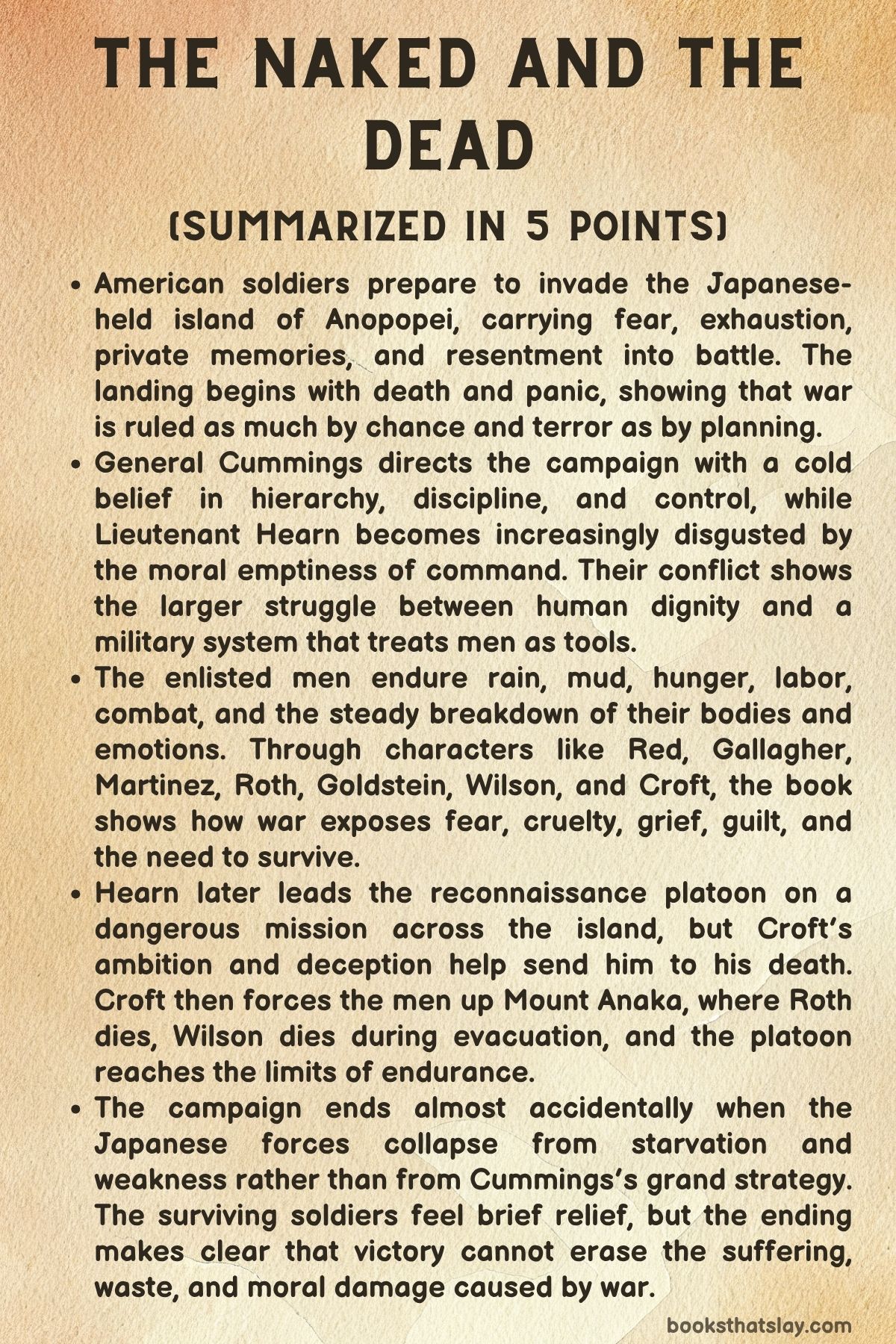
The Naked and the Dead by Norman Mailer is a World War II novel about American soldiers fighting to capture the fictional Pacific island of Anopopei. The book is less interested in glory than in fear, power, exhaustion, class, prejudice, and the way military life reduces men to bodies, orders, and instincts.
Through officers and enlisted soldiers, Mailer presents war as a system that tests every private belief a man has about courage, authority, loyalty, and survival. The story follows a military campaign, but its deepest concern is what happens inside men when violence, hierarchy, and chance rule their lives.
Summary
The story begins on the night before the American invasion of Anopopei, a Japanese-held island in the Pacific. The soldiers aboard the ship know that the next day may bring death, but their fear appears in ordinary, restless ways.
Some men gamble, some complain, some lie awake, and some think about home. Gallagher worries about the money he has lost at poker because he could have sent it to his pregnant wife, Mary.
Wilson thinks about liquor and women. Red goes on deck and looks at the dark island, feeling a strange sadness for the wants and struggles of human beings.
Martinez lies awake in panic, terrified by every sound. Croft, hard and commanding, already seems shaped for violence.
The invasion begins before dawn. The ships fire on the island, lighting the coast with explosions.
The soldiers land more easily than they expected, but relief does not last. As they dig in near the beach, Japanese mortars strike.
Hennessey, a young replacement, becomes terrified, loses control of himself, leaves his hole, and is killed. His death marks the first proof that even a moment of panic can be fatal.
Red finds the body and feels sick, while Croft experiences a sense of power. Martinez, who had feared his own death, finds that his dread has shifted after surviving the landing.
Major General Edward Cummings directs the campaign from headquarters. He sees the island as a problem to be solved through movement, roads, supply lines, and pressure.
The Japanese commander, Toyaku, holds a strong defensive line between the mountains and the sea. Cummings has more troops, but the jungle, rain, heat, and terrain slow every plan.
The enlisted men suffer under the conditions. Their tents leak, the rain soaks everything, and much of their work is dull labor rather than combat.
Croft resents being kept from patrol work. Roth, a new replacement with a college education, feels bitter that the Army treats men like expendable material.
Goldstein tries to remain hopeful, though he too feels the sting of prejudice and uncertainty.
Among the officers, Lieutenant Robert Hearn becomes increasingly disgusted by the class divisions and coldness of command. He serves as Cummings’s aide and finds the General intelligent, controlled, and emotionally distant.
Cummings lectures him about power, obedience, and the need to break men down so they will function properly within the Army. Hearn dislikes the privilege officers enjoy while enlisted men endure the worst suffering.
His resentment grows as Cummings tries to shape him into someone more cynical and authoritarian. The tension between them becomes one of the book’s central struggles: Hearn wants to believe in human dignity, while Cummings believes hierarchy and fear are the true engines of organization.
As the campaign develops, the men experience short bursts of combat followed by long periods of discomfort. They haul heavy guns through mud, dig, wait, drink, argue, and listen to distant artillery.
During one attack, Croft comes alive at the sight of battle. He fires into Japanese troops crossing a river and feels the fierce satisfaction he associates with killing.
Toglio is wounded in the elbow, an injury the men later discuss as the kind of wound that might be enough to send a soldier home. Such conversations show how survival, injury, and escape become part of the soldiers’ daily imagination.
The violence also exposes moral damage. Croft, Red, and Gallagher discover Japanese soldiers hiding in a hollow.
After a grenade attack, one soldier survives. Croft takes him prisoner, gives him food, water, and a cigarette, then shoots him.
Gallagher is shocked, and Red is disturbed by the gap between ordinary human presence and sudden killing. Later, several men go searching for souvenirs among dead bodies.
Martinez takes gold teeth from a corpse but feels guilty afterward. The dead become objects, yet the men cannot fully avoid recognizing the horror of what they are doing.
Gallagher receives devastating news: Mary has died in childbirth. The Army’s machinery handles the event with official procedures, but Gallagher experiences it as an unreal and private collapse.
Letters from Mary continue to arrive, making her death harder to accept. He reads her last letter and breaks down.
His grief merges with his anger, his religious guilt, and his bitterness toward a world that seems to deny him every comfort. Around him, the war continues without pause.
Cummings’s conflict with Hearn worsens. Hearn’s small act of rebellion, leaving a cigarette butt on the General’s clean tent floor, becomes a symbol of resistance.
Cummings forces him to pick it up under threat of court-martial. Hearn obeys but asks for a transfer.
Cummings later arranges for Hearn to lead the reconnaissance platoon on a dangerous mission across the island. Officially, the mission is to scout behind Japanese lines near Botoi Bay.
Unofficially, it also removes Hearn from headquarters and places him under great risk. Cummings considers the possible loss of the platoon acceptable if it serves his larger plan.
Hearn takes command of the recon platoon, which includes Croft, Red, Martinez, Gallagher, Wilson, Roth, Goldstein, Brown, Ridges, Minetta, Stanley, Polack, and others. The men are wary of him.
Hearn wants their respect and tries to speak with them naturally, but they remain guarded. Croft resents having an officer over him and quietly watches for ways to maintain control.
The platoon lands on another part of the island and begins a punishing march through jungle, river, grass, and foothills. The men carry heavy equipment, cut trail, and grow exhausted.
Hearn tries to lead firmly but humanely, while Croft believes hardship must simply be forced through.
The mission grows more dangerous when the platoon approaches a mountain pass. They are fired upon, and Wilson is badly wounded in the stomach.
The men retrieve him and build a stretcher. While doing so, Roth finds a small injured bird and is moved by its helplessness.
Croft, irritated and contemptuous, crushes the bird in his hand. The act horrifies several men.
Red confronts him, and Hearn forces Croft to apologize to Roth. Croft obeys, but the humiliation deepens his hatred of Hearn.
Wilson is sent back toward the beach with Brown, Stanley, Ridges, and Goldstein carrying him. The journey becomes a nightmare of heat, weight, pain, and exhaustion.
Wilson begs for water, but the men know that water may worsen a stomach wound. Brown struggles to keep going and fears that if he breaks down he will lose his authority as a sergeant.
Goldstein and Ridges continue after the others fall behind, driven by duty and endurance. Wilson grows delirious, speaks of women and home, and eventually dies.
Ridges urges him to repent before death. When they try to cross the river, the current carries Wilson’s body away.
Goldstein and Ridges finally reach the beach broken by the ordeal.
Meanwhile, the remaining platoon faces the question of whether to continue. Hearn considers turning back but does not want to fail before Cummings.
Croft suggests sending Martinez to scout the pass. Martinez discovers a Japanese camp and kills a sentry with his knife to escape.
Shaken, he reports the truth to Croft. Croft hides the information from Hearn and tells him the pass is clear.
Hearn leads the men forward and is killed by machine-gun fire. Croft then takes command and orders the men to climb Mount Anaka rather than return.
The climb becomes a test of endurance and domination. Croft is obsessed with the mountain and pushes the men beyond reason.
They are exhausted, bruised, thirsty, and frightened, but his will and their fear of him drive them upward. Roth, physically weaker and already ashamed of his fear, breaks under the strain.
At a narrow ledge, the men jump across a gap one by one. Roth cannot manage it.
Gallagher shouts at him, and Roth jumps, misses, and falls to his death. His final thought is that he wants to live.
Roth’s death shocks the platoon. The men begin to resist Croft, but he still forces them onward.
Gallagher is burdened with guilt for shouting before Roth fell. Martinez is haunted by the Japanese sentry he killed.
Red finally challenges Croft more directly, but when Croft threatens to shoot him, Red backs down and feels humiliated by his own submission. Croft believes he has overcome every obstacle, yet the mountain itself becomes the force that defeats him.
Near the top, the men disturb a hornet’s nest. The attack forces them to retreat.
Croft at last accepts that they will turn back. His hunger to conquer the mountain meets a limit he cannot master.
While the platoon has been suffering on the mountain, the larger campaign ends almost accidentally. Major Dalleson, left in charge while Cummings is away seeking naval support, responds to reports and shifts troops forward.
The Japanese position collapses because the enemy is already starving, undersupplied, and nearly broken. General Toyaku is killed, and the campaign is effectively won before Cummings can execute the grand plan he imagined.
Cummings returns and claims that the invasion of Botoi Bay secured victory, though he knows the truth is less flattering. The result unsettles him because it suggests that his command genius was not the decisive force.
The recon platoon is picked up by boat. At first the men are too exhausted to feel much of anything.
Their suffering has emptied them. When they learn that the campaign is mostly over and that they may have a few months away from combat, their spirits lift.
They sing together, imagining futures beyond the Army. Yet the ending offers no clean victory.
The remaining Japanese soldiers are hunted and killed. Dalleson plans a training program.
Cummings thinks about profit, loss, reputation, and future promotion. The campaign ends, but the system that used these men continues unchanged.
Characters
Major General Edward Cummings
Major General Edward Cummings is the commanding mind behind the campaign and one of the clearest expressions of institutional power in The Naked and the Dead. He is intelligent, disciplined, strategic, and deeply committed to hierarchy.
To him, military command is not only a practical structure but a philosophy of human control. He believes men function best when they fear the authority above them, and he sees obedience as something that must be produced by pressure, humiliation, and deprivation.
Cummings is not a simple brute; his danger lies in his refinement. He can speak elegantly about politics, history, and organization, yet his theories reduce human beings to units of force.
His treatment of Hearn reveals his need to dominate not only bodies but minds. He wants Hearn to surrender liberal ideals and accept the rule of power as truth.
At the same time, Cummings is vulnerable to the idea that his genius may not matter as much as he believes. The campaign’s final outcome wounds his pride because it suggests that chance, enemy weakness, and subordinate action may have done more than his own planning.
His ambition remains alive even after victory, showing a man who measures life through command, reputation, and advancement.
Lieutenant Robert Hearn
Lieutenant Robert Hearn stands between the world of privilege and the suffering of the enlisted men. In The Naked and the Dead, he is an officer by rank but emotionally and morally uncomfortable with the advantages that rank gives him.
He dislikes the casual arrogance of officers such as Conn and Dalleson, and he resents serving under Cummings because the General’s ideas threaten his remaining faith in fairness and individual dignity. Hearn’s conflict is partly political, partly personal.
He wants to reject the class assumptions of his background, but he is not fully free of them. His attempts to connect with the recon platoon show both sincerity and awkwardness.
He wants the men to like him, but he cannot erase the distance created by rank. His command of the mission gives him a chance to act rather than merely object, yet he remains unsure of himself.
His death is caused not only by Japanese fire but by Croft’s deliberate withholding of information, which makes Hearn a victim of both enemy violence and internal military rivalry. Hearn’s importance lies in his refusal to accept Cummings’s worldview, even though he never finds a lasting way to defeat it.
Sergeant Sam Croft
Sergeant Sam Croft is the harshest and most frightening soldier in The Naked and the Dead, a man whose identity is built around force, endurance, and the thrill of domination. He is brave, skilled, and capable under combat conditions, but his courage is inseparable from cruelty.
Croft does not merely accept violence as part of war; he is drawn to it. He feels most alive when killing, controlling, or testing himself against danger.
His execution of the Japanese prisoner shows his moral emptiness with chilling clarity. He can offer food and a cigarette, perform gestures that resemble mercy, and then murder without remorse.
His crushing of Roth’s injured bird is another revealing act because he destroys weakness simply because it irritates him. Croft’s obsession with climbing Mount Anaka turns the mission into a personal contest.
The mountain becomes the object against which he measures his will. Yet he is not all-powerful.
The platoon’s exhaustion, Roth’s death, Red’s resistance, and finally the hornets show the limits of his control. Croft ends with the knowledge that even his hunger has boundaries.
He remains dangerous, but he is no longer unlimited.
Red Valsen
Red Valsen is one of the book’s most thoughtful enlisted men, though he hides his sensitivity behind sarcasm, anger, and detachment. His past has taught him not to trust stability, authority, or emotional attachment.
He has roamed from job to job and place to place, learning that wanting too much only makes a man easier to hurt. In the Army, this hard-earned detachment becomes a survival method.
Red tells himself he does not care about anything, yet his reactions prove otherwise. He feels sick at Hennessey’s death, disturbed by the killing of Japanese soldiers, and angry when Croft crushes the wounded bird.
His compassion is real, but he experiences it almost as a threat because caring can weaken the protective shell he has built. His conflict with Croft is especially important because Red recognizes Croft’s cruelty and wants to resist it.
Still, when Croft threatens him, Red backs down. This moment wounds his pride because it shows him that even his independence can be broken by military force.
Red’s tragedy is not cowardice but the painful discovery that a man can understand oppression clearly and still submit to it.
Sergeant Julio Martinez
Julio Martinez is defined by fear, skill, guilt, and the painful burden of being useful in war. At the beginning, he is terrified before the invasion, sweating in his bunk and imagining disaster.
Yet when action comes, Martinez often performs with competence. His abilities as a scout make him valuable to both Hearn and Croft, and he gains confidence when he is leading others through dangerous terrain.
This contrast between inner fear and outward effectiveness makes him one of the book’s more human soldiers. He is not fearless, but he acts despite fear.
His scouting mission through the Japanese camp is a turning point. He moves with remarkable stealth, discovers crucial information, and kills a sentry with a knife.
The killing saves him, but it also scars him. The blood on his hands and the face of the man he killed haunt him afterward.
Martinez also carries guilt over the gold teeth he took from a corpse, showing that even small acts of moral compromise remain alive inside him. His relationship with Croft is complicated by obedience, resentment, and manipulation.
Croft uses Martinez’s report to engineer Hearn’s death, leaving Martinez caught inside a chain of guilt he never fully chose.
Roy Gallagher
Roy Gallagher is driven by grievance, pride, grief, and a need to believe that life has singled him out for disappointment. He begins as a complaining, resentful soldier who worries about money and thinks often of his pregnant wife, Mary.
His bitterness has roots in his upbringing, his politics, his sense of class resentment, and his feeling that other men receive chances denied to him. The news of Mary’s death in childbirth breaks through his usual anger and leaves him stunned.
The continuing arrival of her letters makes the loss feel unreal, as if time itself is mocking him. Gallagher’s grief does not soften him into peace; it intensifies his confusion and rage.
His later role in Roth’s death adds another burden. When Roth hesitates at the mountain gap, Gallagher shouts at him, and Roth falls.
Gallagher did not intend to kill him, but his words become part of the moment that sends Roth to his death. By the end, Gallagher is left with guilt, fatherhood, religious anxiety, and a future he cannot clearly imagine.
He is a man wounded by events he cannot control and by impulses he cannot take back.
Wilson
Wilson is loud, physical, sensual, careless, and deeply attached to bodily appetite. He wants liquor, women, comfort, and release from discipline.
His past shows a pattern of irresponsibility, especially in his marriage, yet he is not written as merely comic or shallow. His energy makes him vivid among the soldiers, and his fear during guard duty shows how fragile his confidence can be.
When he is wounded in the stomach, his body becomes the center of one of the book’s most punishing ordeals. The loud, demanding man is reduced to pain, thirst, delirium, and dependence on others.
His repeated pleas for water are agonizing because they force the litter bearers into a cruel conflict between mercy and medical caution. Wilson’s dying thoughts return to women, home, and the possibility of another life after war, but those possibilities vanish in the jungle.
His body is finally lost to the river, denying even the closure of proper recovery. Wilson’s death shows how war strips personality down to suffering flesh, while also revealing how much effort other men may spend trying to save someone they do not always admire.
William Brown
William Brown is a sergeant whose authority is always shadowed by insecurity. He talks about responsibility and treating men properly, yet he is full of private fear.
His worries about his wife’s fidelity torment him, and his memories reveal his own sexual betrayals, making his jealousy seem both sincere and hypocritical. Brown wants to think of himself as decent and competent, but combat and strain expose how unstable that self-image is.
While carrying Wilson, he becomes overwhelmed by fatigue, noise, and dread. He fears not only death but collapse: the possibility that he will fail in front of the men and lose the standing his rank gives him.
Brown’s concern for Wilson is genuine, and he refuses to abandon him, but the burden nearly destroys his composure. His character shows the middle ground between authority and vulnerability.
He is neither a cruel commander like Croft nor a rebellious thinker like Red. Instead, he is an ordinary man trying to maintain status, masculinity, and control while fear eats away at him from within.
Roth
Roth is one of the book’s clearest portraits of intellectual and physical vulnerability under military pressure. He is educated, frustrated, and painfully aware that his background gives him no protection in the Army.
He feels reduced to cannon fodder, and he resents the anti-Semitism and class contempt that surround him. His weakness is not only physical, though his body often fails under the demands of the march.
He is emotionally exposed in a world that punishes exposure. The scene with the injured bird reveals his tenderness and need to protect fragile life, but Croft’s destruction of the bird humiliates him and shows how little room the platoon has for gentleness.
Roth’s shame grows because he believes the others see him as weak. On the mountain, this inner burden becomes fatal.
Faced with the gap on the ledge, he cannot force his body to do what fear prevents. His fall is one of the book’s most tragic deaths because his final thought is not abstract courage or patriotic duty but a simple desire to live.
Roth represents the human being whom war judges by endurance alone and then destroys.
Joey Goldstein
Joey Goldstein is patient, dutiful, family-centered, and quietly burdened by suffering. His Jewish identity shapes much of his understanding of endurance, history, and responsibility.
He thinks often of his wife, Natalie, and their son, and these memories give him a future to imagine beyond the Army. Goldstein tries to remain decent in a world that steadily weakens decency.
He is disturbed by the platoon’s coarseness, by prejudice, and by the ways war drains him of confidence. Yet he proves remarkably strong during Wilson’s evacuation.
Alongside Ridges, he continues carrying Wilson after Brown and Stanley can no longer keep pace. His endurance is not dramatic or aggressive like Croft’s; it is quieter and more moral.
He keeps going because someone must. Goldstein’s suffering reaches a breaking point when Wilson dies and the river carries the body away, making all that labor seem almost meaningless.
Still, the effort itself matters because it shows Goldstein’s refusal to abandon another man, even when the war gives him every reason to think such effort will not be rewarded.
Ridges
Ridges is shaped by religious faith, physical endurance, and a simple moral seriousness. He often interprets events through Christian belief, seeing the body, soul, death, and sin as connected realities.
His faith can make him seem naive to other men, especially when he says he would not want to kill a Christian, but it also gives him a structure for compassion and duty. During Wilson’s evacuation, Ridges becomes one of the strongest examples of self-denying persistence.
He helps carry Wilson through heat, exhaustion, and despair, continuing when the task seems beyond human strength. His decision to give Wilson water comes from pity and a belief that comfort may matter more than strict rules when death is near.
When Wilson is dying, Ridges urges him to repent, not as a formal gesture but because he truly believes the soul is at stake. He cannot save Wilson’s life or even preserve his body from the river, but his actions give the dying man a form of care that the Army itself cannot provide.
Ridges represents faith under brutal conditions, limited but not erased.
Minetta
Minetta is young, vain, restless, and openly resentful of military misery. He misses cleanliness, style, comfort, and the social world where appearance mattered.
His hatred of dirt and discomfort makes him seem less hardened than the others, but it also makes him honest about what many soldiers feel. After he is wounded, the field hospital becomes a tempting escape.
Its relative dryness and safety seem better than returning to the platoon, and Minetta tries to remain there by reopening his wound and later pretending to hallucinate. His deception is comic in one sense, but it also reveals a sane desire to avoid being sent back into danger.
When he hears the suffering of severely wounded men and sees death nearby, the hospital loses its appeal. He chooses to return rather than remain among those closer to dying.
Minetta’s character captures the gap between fantasies of escape and the reality that every part of war contains fear. He is not noble in a traditional sense, but his fear and self-interest are deeply recognizable.
Stanley
Stanley begins as a lower-ranking soldier eager to improve his position and test his authority. He is practical, ambitious, and sometimes petty.
His earlier conflict with Red shows his desire to assert himself, though he is not as hard as he wants to appear. Once promoted to corporal, he becomes less deferential, especially toward Brown, and he speaks with pride about a business scam from his civilian life.
This background suggests a man who sees systems as things to be used for personal advantage. Yet combat unsettles him.
When shots are fired near the jungle and Minetta is wounded, Stanley panics and feels an oppressive dread. During Wilson’s evacuation, he helps carry the litter but struggles under the physical and emotional weight of the task.
Stanley is not a villain, nor is he a model soldier. He is a man trying to rise within whatever system contains him, whether business or the Army, but the war exposes the limits of cleverness and ambition when the body is exhausted and death is close.
Polack
Casimir “Polack” Czienwicz is shaped by poverty, street survival, and distrust of respectable authority. His childhood teaches him how to steal, lie, join a gang, and follow stronger personalities when it benefits him.
His past with Lefty Rizzo and the protection racket reveals a social world where loyalty, intimidation, and opportunity matter more than moral law. In the platoon, Polack often appears as a cynical, observant presence.
He listens to others, complains, jokes, and shares the enlisted men’s suspicion of the Army. His background makes him less shocked by corruption or coercion because he has already seen forms of power operating outside official respectability.
Yet military life places him in a larger and more impersonal version of the same pattern: men are pressured, ordered, punished, and used. Polack’s importance lies in how he broadens the book’s social range.
He brings the experience of urban poverty and petty crime into the Army, showing that the platoon is made from many American worlds, all placed under one command structure.
Major Dalleson
Major Dalleson is a loyal career officer who lacks Cummings’s intellectual arrogance but shares the institution’s commitment to procedure and efficiency. He comes from a poorer background and has risen through the Army by discipline, work, and loyalty.
Unlike Cummings, he does not present himself as a grand philosopher of power. He is more practical, more limited, and often aware that he may not be fully equal to the responsibilities placed on him.
Yet when Cummings is absent, Dalleson’s decisions help bring about the collapse of the Japanese position. His success is partly accidental and partly the result of ordinary military competence.
This makes him important because he undercuts Cummings’s belief in command genius. Dalleson does not fully understand the larger meaning of what he has done, and after the campaign he looks forward to training programs and routine.
He represents the Army as machinery: less brilliant than Cummings imagines, but still capable of continuing, adapting, and absorbing victory into procedure.
Toglio
Toglio is a practical, cooperative soldier who often tries to make sense of Army life through facts, statistics, and reasonable adjustment. He believes in getting along and doing what is necessary to advance or survive within the system.
His attitude contrasts with the bitterness of Red, the cruelty of Croft, and the anxiety of men like Martinez and Roth. Toglio’s wound in the elbow becomes important less because of his personal development than because of what it represents to the platoon.
The men discuss such injuries as possible tickets out of combat, turning bodily harm into a strange form of hope. Toglio therefore becomes associated with the soldiers’ desperate calculations about survival.
A wound that would be terrible in civilian life can seem desirable in war if it removes a man from danger without killing or crippling him completely. Through Toglio, the book shows how war distorts ordinary values until injury may look like luck.
Hennessey
Hennessey is a young replacement whose brief presence carries great weight. He arrives just before the invasion and has not had time to harden himself like the older members of the platoon.
His fear is open, bodily, and overwhelming. During the mortar attack on the beach, he panics, leaves the relative safety of his hole, and is killed.
His death is one of the first signs that war does not wait for a man to understand it. Hennessey’s terror is not treated as unusual; rather, it reveals what many men feel but hide.
He lacks the habits, reflexes, and emotional armor that might have kept him still. To Croft, his death seems almost predictable.
To Red, it is sickening and sad. Hennessey matters because he embodies the raw recruit sacrificed before he can become part of the group’s bitter knowledge.
His death teaches the platoon, and the reader, that survival often depends on training, luck, and the ability to control panic at the exact moment when control is hardest.
Wakara
Wakara, the Japanese American translator, occupies a painful and revealing position in the story. He serves in the American Army after being confined by the same country in relocation camps, and this background gives his role a quiet bitterness.
He is used by the military for his language and cultural knowledge, yet his own identity has been treated with suspicion by the nation he serves. His reflection on the dead Japanese soldier’s journal adds a rare moment of inward contact across enemy lines.
The journal’s questions about life and meaning remind him that the enemy soldiers are not only targets but men with thoughts, memories, and private doubts. Wakara’s memories of Japan complicate the simple division between American and Japanese.
He stands at the border of two worlds, seeing more than many around him want to see. Through him, the book acknowledges the racial and moral contradictions of the war effort, especially the way a democratic nation can demand loyalty from people it has already wronged.
Themes
Power, Obedience, and the Making of Military Authority
Command in The Naked and the Dead is not presented as a neutral necessity. It becomes a system for shaping men until they obey even when obedience humiliates, endangers, or morally damages them.
Cummings gives this idea its clearest voice. He believes fear is the foundation of military effectiveness, and he treats hierarchy as a natural law rather than a temporary wartime structure.
His conflict with Hearn shows the psychological side of authority: Cummings does not only want orders followed; he wants opposition inwardly defeated. Croft represents a rougher version of the same principle among enlisted men.
He controls the platoon through intimidation, physical endurance, and the threat of violence. Red’s confrontation with Croft is important because Red understands the injustice of submission yet still yields when faced with force.
This moment shows how power succeeds not because men believe in it, but because they see the cost of resisting. The Army turns authority into atmosphere.
It is present in food distribution, labor assignments, rank, punishment, and even silence. Men learn where they stand, what they may say, and when they must move.
The book’s harshest insight is that obedience can survive after belief has died.
War as the Destruction of Private Identity
The soldiers arrive with histories, marriages, jobs, ambitions, prejudices, regrets, and dreams, but the war steadily reduces those private selves to functions. A man becomes a scout, a litter bearer, a replacement, a sergeant, a body to be moved, or a casualty to be counted.
The background sections matter because they restore what the military system tries to flatten. Red was a wanderer shaped by labor and rootlessness.
Gallagher was a husband, political agitator, and angry son. Goldstein was a father and worker with a family future.
Roth was educated, insecure, and tender. Wilson was irresponsible but full of appetite and memory.
These lives do not disappear completely, but they are pushed under the immediate demands of marching, digging, fighting, and obeying. The tragedy is that the men’s inner worlds remain active even as the Army treats them as replaceable.
Gallagher’s letters from Mary show this cruelty sharply: private time continues elsewhere, but by the time it reaches him, it is already broken. War does not simply kill men; it separates them from the meanings that made them feel like individuals.
Even survival can feel empty when the self has been worn down by fear and fatigue.
Fear, Courage, and the Body Under Pressure
Courage in the story is never clean or simple. Nearly every soldier is afraid, and the book refuses to pretend that bravery means the absence of fear.
Martinez is terrified before combat yet becomes capable when he scouts and leads. Red acts tough but feels dread because he has seen enough death to know his own body is not protected.
Roth’s fear becomes shame because the platoon measures worth through endurance. Hennessey’s panic kills him, but his terror is not alien to the others; it is only more visible.
The body is central to this theme. Men sweat, vomit, soil themselves, ache, thirst, bleed, and collapse.
Wilson’s wound turns him into pain and need. The march up the mountain breaks the platoon down through feet, lungs, muscles, and nerves.
Croft’s power depends partly on his ability to ignore bodily limits longer than others, but even he is stopped when the mountain and hornets make further control impossible. Fear is therefore both mental and physical.
It lives in imagination, but it also lives in the stomach, kidneys, throat, hands, and legs. The book’s view of courage is harsh: men often keep going not because they are fearless, but because stopping may be more dangerous.
Chance, Futility, and the False Shape of Victory
The campaign’s outcome exposes the distance between official explanations and lived reality. Cummings wants victory to reflect his design, but the Japanese collapse because they are already starving, undersupplied, and weakened.
Dalleson’s ordinary decisions, enemy exhaustion, and accident matter more than the grand plan Cummings wants recorded. This does not make the deaths meaningless in a simple way, but it does make them painfully disproportionate.
Hearn dies on a mission shaped by pride and manipulation. Roth dies during a mountain climb that serves Croft’s obsession more than military need.
Wilson dies after a terrible evacuation that cannot even preserve his body. Hennessey dies almost before the campaign begins for him.
These deaths are absorbed into the larger language of success, but the book keeps showing the gap between victory as reported and suffering as endured. The men experience war as mud, heat, fear, wounds, and orders whose purpose they often cannot see.
The official story smooths this chaos into strategy. That smoothing is one of the book’s moral targets.
Victory may be real in military terms, but it does not redeem what happened to the men. The final movement from combat to routine training suggests that the machine continues, ready to turn more private suffering into public achievement.