Shady Hollow Summary, Characters and Themes
Shady Hollow by Juneau Black is a cozy woodland mystery set in a quiet village inhabited by animals who live much like people, with newspapers, cafés, shops, gossip, business rivalries, and social ranks. The story follows Vera Vixen, a sharp reporter for the local newspaper, as she investigates the village’s first murder after a disliked toad is found dead in the millpond.
What begins as a shocking local death soon exposes secrets, affairs, blackmail, fear, and ambition beneath the town’s calm surface. The book blends charm, wit, and danger through a classic murder mystery structure.
Summary
Shady Hollow is a peaceful village in the northern forest, home to woodland creatures who have built a small but busy community around the millpond and the sawmill. The Von Beaverpelt Sawmill powers much of the town’s economy, while Joe’s Mug serves as the center of daily conversation.
The local newspaper, the Shady Hollow Herald, usually reports on harmless village matters, but that changes when Gladys Honeysuckle, a hummingbird gossip columnist, spots the body of Otto Sumpf floating in the millpond.
Otto is a toad known for his sour temper and unfriendly ways, so he is not widely loved, but his death still shocks the town. Vera Vixen, a reporter at the Herald, quickly senses that this is more than an accident.
She goes to the pond, photographs the body, nearby paw prints, and a clean bottle hidden in the reeds. When Deputy Orville Braun retrieves Otto from the water, they discover a knife in his back.
The village is forced to face the fact that a murder has occurred.
Vera begins gathering information while Orville tries to manage the investigation in the absence of Chief Theodore Meade, who is away fishing. Vera learns that Otto recently argued with several creatures, including wealthy sawmill owner Reginald von Beaverpelt and Ruby Ewing, a sheep.
At the same time, suspicion falls on Lefty, a raccoon whose prints were found near the pond. Orville arrests him for questioning, partly to calm the town, though even he doubts Lefty is truly a murderer.
A medical examiner later reveals that Otto was not killed by the knife wound. He was poisoned first, then stabbed after death.
This discovery changes the case completely. The bottle Vera found becomes important because it came from the Bamboo Patch, a restaurant owned by Sun Li, a panda who sells plum wine.
Sun Li identifies the bottle as one Ruby Ewing bought earlier, though Ruby claims she lost it during errands.
As the case grows stranger, Reginald von Beaverpelt is also poisoned. He drinks coffee at the sawmill and collapses, barely surviving.
Sun Li rushes to help and reveals hidden medical knowledge, saving Reginald’s life. His past emerges: he was once a skilled surgeon in his home country but lost his license after a powerful patient died during an operation.
Since coming to Shady Hollow, he has tried to live quietly as a restaurant owner. Sun Li also realizes that a dangerous substance called heartstill, kept in his restaurant, has gone missing.
In small amounts it sedates; in larger doses it can stop the heart. It is likely the poison used on both Otto and Reginald.
Vera continues investigating with help from her close friend Lenore Lee, the raven who owns Nevermore Books. Lenore’s intelligence and caution balance Vera’s boldness, and together they study clues, motives, and alibis.
They consider whether the poisoner wanted to stop the sawmill, whether Otto knew too much, or whether Reginald’s personal life is connected to the crimes. Professor Ambrosius Heidegger, a scholarly owl, gives Vera another useful lead: he saw a creature moving near the pond around the time the wine bottle appeared.
The town becomes fearful. Locks are ordered, rumors spread, and the once-trusting community begins to suspect outsiders and neighbors alike.
Sun Li becomes the target of gossip because of his secrecy and foreign background, though his actions suggest compassion rather than guilt. Meanwhile, the von Beaverpelt family becomes more suspicious.
Edith, Reginald’s dramatic wife, is bitter and controlling. Their daughters, Stasia and Esme, watch the town’s gossip from the edge of privilege and family strain.
Reginald later summons Vera to his mansion and says he knows who poisoned him. He seems frightened and wants Vera to report his story in a specific way, even offering money for the exclusive.
Before he can reveal the name, Edith and the daughters interrupt. Soon afterward, Vera receives an anonymous note telling her to come alone to the old oaks north of town at midnight for a scoop.
Lenore distrusts the invitation and follows from a distance. At the meeting place, no one appears, but a boulder is deliberately rolled down a slope toward Vera.
Lenore warns her just in time, and Vera survives with injuries. The killer has now tried to silence her.
Not long after, Reginald disappears from his sickbed. His family panics when they realize he has left without his pocket watch, something he would never do voluntarily.
A search begins, and his body is discovered in the millpond. Like Otto, Reginald has been poisoned, and his death deepens the fear gripping the village.
Orville finds a raccoon paw print in the von Beaverpelt home and renews his focus on Lefty, who has vanished after being released from jail. The town quickly accepts the idea that Lefty is guilty, but Vera doubts it.
Lefty may be a thief, but he lacks the skill, motive, and nerve for the murders.
At Reginald’s funeral, Ruby Ewing publicly appears in mourning, provoking Edith’s fury. Ruby later tells Vera that she and Reginald were in love and planned to leave town together.
According to Ruby, Edith must have killed him to prevent the affair from becoming public and to keep him from leaving. Ruby also says she was with Reginald in the woods when Otto died and was working at her nursing home when Reginald was killed.
Her grief seems real, but her story raises new questions.
Vera investigates the sawmill finances through Howard Chitters, Reginald’s accountant. Howard reveals strange monthly payments of five hundred dollars to someone listed only as “B. S.” The payments stopped around the time of Reginald’s death.
Vera suspects blackmail. She then turns to Otto’s journals, which are difficult to read because they include coded notes and foreign phrases.
Professor Heidegger helps decode them and reveals the truth: Otto and Ruby were close friends, and Ruby had confessed to him that she was blackmailing Reginald after he ended their affair to protect his marriage and access to Edith’s wealth. The initials “B. S.” point to Ruby herself.
The journals also mention Ruby’s “insurance policy” hidden in a hollow log. Vera realizes Ruby converted the blackmail money into rubies and hid them in the woods.
She rushes out during a storm to find the stash, hoping it will pressure Ruby into admitting what she knows. Instead, Ruby appears with a knife.
She forces Vera to a remote cottage on High Cliff, where she confesses the full truth.
Ruby had intended to poison Reginald first. She hired Lefty to place a poisoned bottle of plum wine where Reginald would find it, but Lefty left it in the wrong place.
Otto found the bottle, drank from it, and died. Ruby discovered the accident and stabbed Otto’s body to make the death look like a violent murder rather than poisoning.
Later, she poisoned Reginald’s coffee, but he survived. When he seemed ready to talk to Vera, Ruby lured him from his mansion, tried to convince him to flee with her, and killed him when he refused.
She also sent the threatening note and pushed the boulder toward Vera.
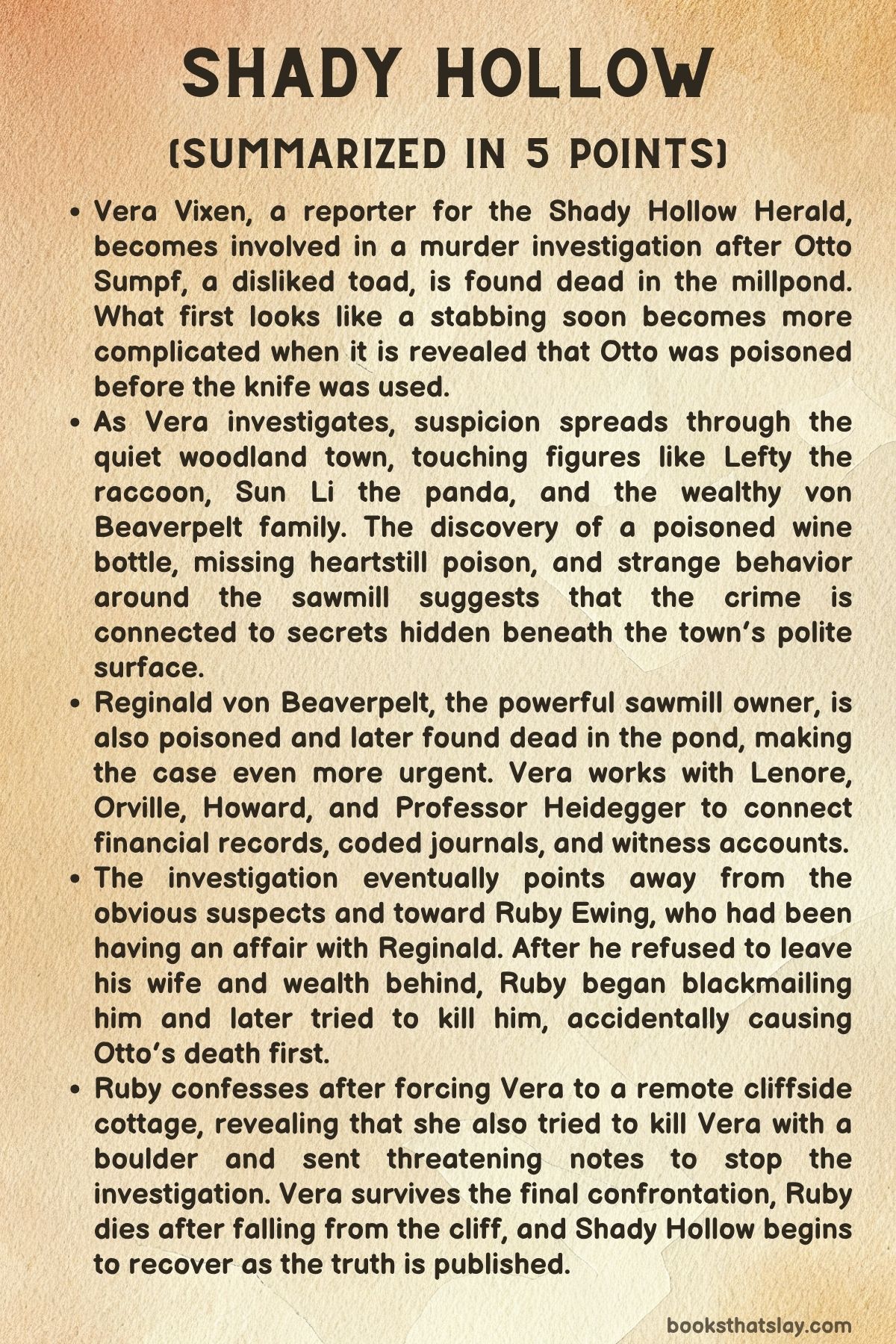
Ruby plans to kill Vera too, but Vera fights back in the dark cottage, escapes through a window, and tries to survive on the cliffside. Ruby attacks again, but during the struggle she slips over the edge and falls to her death.
A search party led by Orville, alerted by Heidegger, arrives and rescues Vera.
Afterward, Vera gives Orville the full account and hands over Otto’s journals as evidence. Ruby’s crimes are exposed, Lefty is cleared, and the village begins to recover.
Edith later explains that the watermarked paper used for Vera’s threatening note came from stationery she had donated to a secondhand shop where Ruby worked, which explains why Vera mistakenly suspected her. Howard is promoted to director of the sawmill, giving the town a more stable future.
Vera writes the case for the Herald and prepares to return to ordinary reporting, though her meeting with Orville hints that her life has changed in more personal ways as well.
Characters
Vera Vixen
In Shady Hollow, Vera Vixen is the central investigator and the moral engine of the book. As a reporter for the Herald, she is curious, persistent, observant, and willing to challenge authority when the truth demands it.
Vera’s strength lies in her refusal to accept easy answers. She doubts Lefty’s guilt when the rest of the town is ready to condemn him, questions the powerful von Beaverpelt family when others hesitate, and keeps following financial, social, and physical clues even after someone tries to kill her.
Her profession shapes her personality: she wants facts, but she also understands timing, public reaction, and the dangers of careless reporting. At times, her courage becomes recklessness.
She goes alone to dangerous meetings, searches the woods during a storm, and puts herself directly in the killer’s path. Yet the book does not present this as foolishness alone.
Vera’s risk-taking comes from a deep belief that the truth matters, especially when fear is pushing the town toward rumor and false accusation.
Lenore Lee
Lenore Lee is Vera’s closest friend and one of the book’s most important voices of reason. As the owner of Nevermore Books, she brings intelligence, patience, and a reflective nature to the investigation.
Lenore does not chase danger as eagerly as Vera does, but she is not passive. She studies photographs, notices details, questions weak theories, and repeatedly helps Vera think through motives and possibilities.
Her friendship with Vera is built on trust, honesty, and shared curiosity, but Lenore is also willing to challenge her when she believes Vera is acting too dangerously. This makes her more than a sidekick.
She is a steadying force who sees what Vera sometimes overlooks: the emotional danger, the personal risk, and the need to slow down. Lenore’s rescue of Vera during the boulder attack proves that her caution is not cowardice.
She acts decisively when it matters, and her loyalty gives the story much of its emotional balance.
Orville Braun
In Shady Hollow, Orville Braun develops from a practical deputy into one of the book’s most capable figures of justice. At first, he is defensive and irritated by Vera’s interference, especially when her reporting exposes gaps in the police investigation.
However, Orville is not foolish or corrupt. He knows Chief Meade is unprepared for a murder case, and he tries to learn proper procedure while managing public fear.
His early arrest of Lefty shows his weakness: he is influenced by appearances and by the need to reassure the town. Over time, though, he becomes more thoughtful.
He listens to Vera, compares notes with her, questions motives, and grows more willing to separate real evidence from public pressure. His relationship with Vera shifts from rivalry to respect, and eventually to a gentler personal connection.
Orville’s arc is one of professional growth. By the end, he seems ready to become the kind of officer the village actually needs.
Ruby Ewing
Within Shady Hollow, Ruby Ewing is one of the book’s most deceptive and tragic criminals. At first, she appears as a grieving sheep caught in a painful affair with Reginald von Beaverpelt.
Her sorrow seems sincere, and her accusation against Edith appears believable because Edith has jealousy, status, and motive. Ruby’s real nature emerges slowly.
She is lonely, proud, wounded, and increasingly desperate. Her love for Reginald turns into resentment when he chooses wealth and security over her.
Rather than walk away, she blackmails him, stores the money in the form of rubies, and later chooses murder when she feels her control slipping. Ruby’s crimes are marked by improvisation as much as planning.
Otto dies because her original plan goes wrong, and her later actions become attempts to cover one mistake with another. Her final refusal to be saved on the cliff suggests a character who would rather choose destruction than face exposure and defeat.
Reginald von Beaverpelt
Reginald von Beaverpelt is a powerful figure whose public image hides insecurity, dependence, and moral weakness. As the sawmill owner, he appears to be the foundation of the town’s economy and social order.
His office, mansion, and influence over local politics make him seem untouchable. Yet the book gradually reveals that his position is less secure than it looks.
His wealth is tied to Edith, his marriage is unhappy, and his affair with Ruby has trapped him in blackmail and fear. Reginald is not innocent in the emotional harm he causes.
He uses Ruby’s love, retreats into his marriage when it benefits him, and tries to control the public story when his life is in danger. Still, he is not the villain behind the murders.
His fear before his death makes him more human, showing a creature who realizes too late that his compromises have placed him in deadly danger.
Otto Sumpf
Otto Sumpf is the first victim, but he is more complex than the village initially understands. To most residents, he is a bad-tempered toad who insults others and keeps to himself near the millpond.
His unpleasant reputation makes it easy for the town to assume that almost anyone might have disliked him enough to want him dead. However, the later discovery of his journals changes the reader’s sense of him.
Otto was observant, intelligent, multilingual, and shaped by a past that included travel, war, and secret service. He noticed things others missed and preserved them in coded notes.
His friendship with Ruby also suggests that beneath his crankiness, he had room for loyalty and connection with fellow outsiders. Otto’s death begins as a mystery about a disliked creature, but it becomes clear that he died because he accidentally stepped into someone else’s plan.
His hidden knowledge becomes crucial to solving the case.
Sun Li
Sun Li is one of the book’s most misunderstood characters. As the owner of the Bamboo Patch, he is respected for his food but also viewed with suspicion because he is private, foreign to the village, and reluctant to explain his past.
The town’s rumors about him show how quickly fear turns difference into guilt. When Reginald is poisoned, Sun Li’s response proves his true character.
He acts with skill, urgency, and compassion, saving a creature who could have been connected to the earlier crime. His past as a surgeon adds depth to him.
He carries shame from an event that destroyed his former life, even though the patient’s death was not truly his fault. By keeping heartstill in his restaurant, he becomes indirectly connected to the murders, but his responsibility is not criminal.
Sun Li represents quiet dignity, exile, and the difficulty of rebuilding a life after public disgrace.
Edith von Beaverpelt
Edith von Beaverpelt is dramatic, proud, jealous, and deeply tied to social appearance. Her behavior makes her an easy suspect.
She is furious about Reginald’s affair, protective of her family’s status, and threatening when Vera asks about her past. Her wealth appears to be the foundation of Reginald’s power, which gives her both motive and means in the eyes of others.
Yet Edith’s role is more complicated than simple villainy. She is controlling and unpleasant, but she is also humiliated by her husband’s betrayal and terrified of losing authority over the life she has built.
Her grief after Reginald’s death may be theatrical, but it is not meaningless. The book uses Edith to show how suspicion can attach itself to people who behave badly even when they are not guilty of the central crime.
Her later decision to promote Howard suggests that she is capable of practical judgment when forced to face reality.
Howard Chitters
Howard Chitters is a quieter but important character whose ordinary anxieties connect the mystery to the town’s economic life. As the sawmill accountant, he sees details that others ignore, including the strange payments that eventually point toward blackmail.
Howard is nervous, overworked, and worried about supporting his large family. His earlier ambitions were set aside when he married and settled in Shady Hollow, which leaves him with a sense of private disappointment.
He does not seek heroism, but his honesty and careful record-keeping become essential to solving the case. Howard’s fear of the mill closing is not selfish; it reflects the dependence of many workers on the sawmill’s survival.
His promotion at the end feels earned because he understands the business better than the powerful figures above him. He represents competence that has long gone unrecognized.
Lefty
Lefty is a thief, but the book carefully separates petty crime from murder. His raccoon identity and criminal habits make him an easy target for public suspicion.
Orville arrests him early because his paw prints appear near the crime scene, and later the town eagerly accepts him as the likely killer after another print is found at the mansion. Lefty’s flaws are real: he steals, takes shady jobs, avoids questions, and runs when frightened.
Yet he is also cowardly in a way that makes murder unlikely. He wants to survive, not dominate anyone.
His involvement in placing the poisoned bottle makes him an unwitting accessory, but he does not understand the purpose of the job. Through Lefty, the story examines how communities often mistake a familiar troublemaker for a true villain because it is easier than confronting a more respectable criminal.
Chief Theodore Meade
Chief Theodore Meade is a symbol of a town unprepared for serious evil. As police chief, he is accustomed to a quiet village where crimes are minor and routine.
When murder arrives, he is overwhelmed and avoids responsibility, leaving Orville to handle the case. His fishing trip and later confusion make him look almost comic, but his weakness has real consequences.
He pushes for simple answers, especially when Sun Li seems suspicious to him, and he releases Lefty without grasping the danger such decisions may cause. Meade is not malicious; he is inadequate.
His role shows that peace can make institutions soft. A town that has never needed strong justice suddenly discovers the cost of not having it.
Professor Ambrosius Heidegger
Professor Heidegger brings learning, pride, and unexpected usefulness to the book. As a vegetarian owl with a formal manner and a high opinion of his own intellect, he can seem pompous.
Yet he is not merely comic. His night habits make him a valuable witness, and his scholarly ability allows him to decode Otto’s difficult journals.
Heidegger’s role is especially important because the solution depends not only on physical clues but also on language, memory, and interpretation. He notices enough near the pond to support Vera’s timeline and later understands enough of Otto’s writing to expose Ruby’s blackmail.
His intelligence may come with vanity, but it also serves justice. He proves that knowledge, even when wrapped in ego, can become practical and life-saving.
Joe
Joe, the moose who runs Joe’s Mug, is the social anchor of the village. His café is where gossip spreads, suspicions grow, and residents gather to make sense of frightening events.
Joe is not an investigator in the formal sense, but he hears things, notices moods, and understands the emotional temperature of the town. His unease after Otto’s death signals that the community has changed.
Unlike many others, Joe does not rush eagerly into accusation. He often offers Vera useful observations while maintaining a sense of privacy and decency, especially in relation to Ruby.
Joe’s importance lies in his steadiness. In a story full of fear and hidden motives, he represents the ordinary kindness and routine that the town wants to recover.
Gladys Honeysuckle
Gladys Honeysuckle is both comic and important. As a gossip columnist, she loves information, drama, and public attention, and her discovery of Otto’s body gives her a terrible kind of prominence.
Her instinct is to tell everyone, but she still recognizes the need to contact the police, which shows that she is not simply careless. Gladys’s emotional reaction to the body appears genuine, and Vera uses that sincerity to dismiss her as a likely suspect.
In the newsroom, Gladys represents the speed at which stories turn into rumor. She can exaggerate, speculate, and spread information faster than Vera would like.
Still, her presence adds life to the village and shows how a small community processes shock through talk, repetition, and nervous curiosity.
BW Stone
BW Stone, the editor of the Herald, is driven by sales, headlines, and the excitement of a major story. He recognizes that murder will sell newspapers and repeatedly pushes for dramatic coverage.
This makes him ethically questionable, especially when Vera worries that sensational reporting will create panic or corrupt witness memories. Yet BW also gives Vera the platform she needs to pursue the truth.
He is not the moral center of the newsroom; Vera is. His role highlights the tension between journalism as public service and journalism as business.
Through BW, the book shows how tragedy can be turned into spectacle, even by those who are not directly cruel. He wants the story, but Vera wants the truth behind it.
Stasia and Esme von Beaverpelt
Stasia and Esme von Beaverpelt reflect the pressures of growing up inside a wealthy, unhappy family. They are sheltered, socially conscious, and accustomed to privilege, yet they are also observant.
Their reactions to their parents reveal different temperaments. Esme is more openly emotional and aligned with her mother, while Stasia shows more private sympathy for her father.
Their visits to Joe’s Mug allow them to witness the town’s gossip from outside their usual social world. They are not central suspects in the final solution, but they help reveal the atmosphere inside the von Beaverpelt household: suspicion, performance, resentment, and fear of scandal.
Through them, the family’s public grandeur appears fragile and tense.
Themes
Truth Beneath Respectability
Reputation controls much of the town’s social order, but the murders reveal how unreliable reputation can be. Reginald von Beaverpelt looks like a successful industrial leader, yet his life is built on dependence, secrecy, an affair, and hidden payments.
Edith appears powerful enough to be guilty, and her jealous anger makes others ready to suspect her, but her unpleasantness does not make her the murderer. Sun Li is treated with suspicion because he is private and foreign to the village, yet he is one of the most compassionate and useful figures in the crisis.
Lefty is a thief, so the town easily imagines him as a killer, even though the real murderer is someone who appears far less threatening on the surface. Shady Hollow uses its mystery to show that social labels often distort judgment.
The respectable can be corrupt, the suspicious can be innocent, and the disliked can possess vital truth. Vera’s work matters because she refuses to let appearances replace evidence.
Fear and the Collapse of Small-Town Trust
The village begins as a place where doors do not need locks and ordinary routines feel safe. Otto’s murder breaks that sense of security immediately.
As more poisonings and attacks occur, fear spreads faster than facts. Residents begin ordering locks, whispering about neighbors, and accepting rumors as likely truth.
Joe’s Mug, once a warm social center, becomes a place where suspicion circulates. Sun Li is judged by gossip about his background.
Lefty is treated as guilty because that explanation feels convenient. Even Vera, who is more careful than most, briefly lets fear and circumstantial signs draw her toward Edith as the likely culprit.
The theme is not simply that murder frightens people; it is that fear changes how a community thinks. It narrows imagination, rewards prejudice, and makes easy answers feel comforting.
The town’s recovery requires more than catching Ruby. It requires rebuilding the habit of patience, fairness, and trust that fear has damaged.
Ambition, Money, and Emotional Compromise
Money shapes many of the book’s central relationships. Reginald’s marriage to Edith is tied to wealth and status, making him unwilling to leave even when he loves Ruby.
Ruby’s love turns into blackmail when she realizes Reginald will not sacrifice comfort and power for her. Howard’s life is also shaped by money, though in a humbler way: he worries about wages, family survival, and the sawmill’s future.
The hidden payments in the account books show how private emotional choices can become public financial corruption. Reginald’s compromises create the conditions for his own destruction.
He wants Edith’s fortune, Ruby’s affection, and public respect all at once, but those desires cannot coexist forever. Ruby’s ambition is more desperate.
She wants compensation for humiliation, security after rejection, and finally revenge when control slips away. The theme shows that money is not separate from emotion.
It becomes the language of power, resentment, fear, and dependence.
Journalism, Justice, and Moral Risk
Vera’s investigation shows both the value and danger of pursuing truth in public. As a reporter, she has access to people, places, and conversations that the police sometimes mishandle or overlook.
Her articles inform the town, pressure officials, and help uncover facts that might otherwise remain hidden. Yet journalism also carries risk.
BW’s hunger for sensational headlines threatens to turn tragedy into entertainment, and early publication of details can spread panic or shape witness memories. Vera herself must decide when to print, when to hold back, and when an accusation lacks enough proof.
Her choice not to publish Ruby’s claim against Edith without corroboration is one of her most responsible acts. At the same time, her commitment to the story places her in physical danger.
The book treats truth-seeking as necessary but not clean or simple. Justice requires courage, restraint, judgment, and a willingness to admit when the most dramatic answer is not the correct one.