The Forgotten Midwife Summary, Characters and Themes
The Forgotten Midwife by Laura Anthony is a historical novel about family secrets, forced separation, institutional cruelty, and the women who refuse to let forgotten lives disappear.
Moving between present-day America and twentieth-century Ireland, the book follows Riley as she investigates the hidden circumstances of her mother’s birth and Margaret Lannigan as she is forced into religious life before becoming an unofficial midwife at a home for unmarried mothers. Their stories are connected by a birth certificate, a pair of knitted booties, and a child taken from her biological mother. The novel examines how truth can survive through memory, objects, letters, and determined acts of resistance.
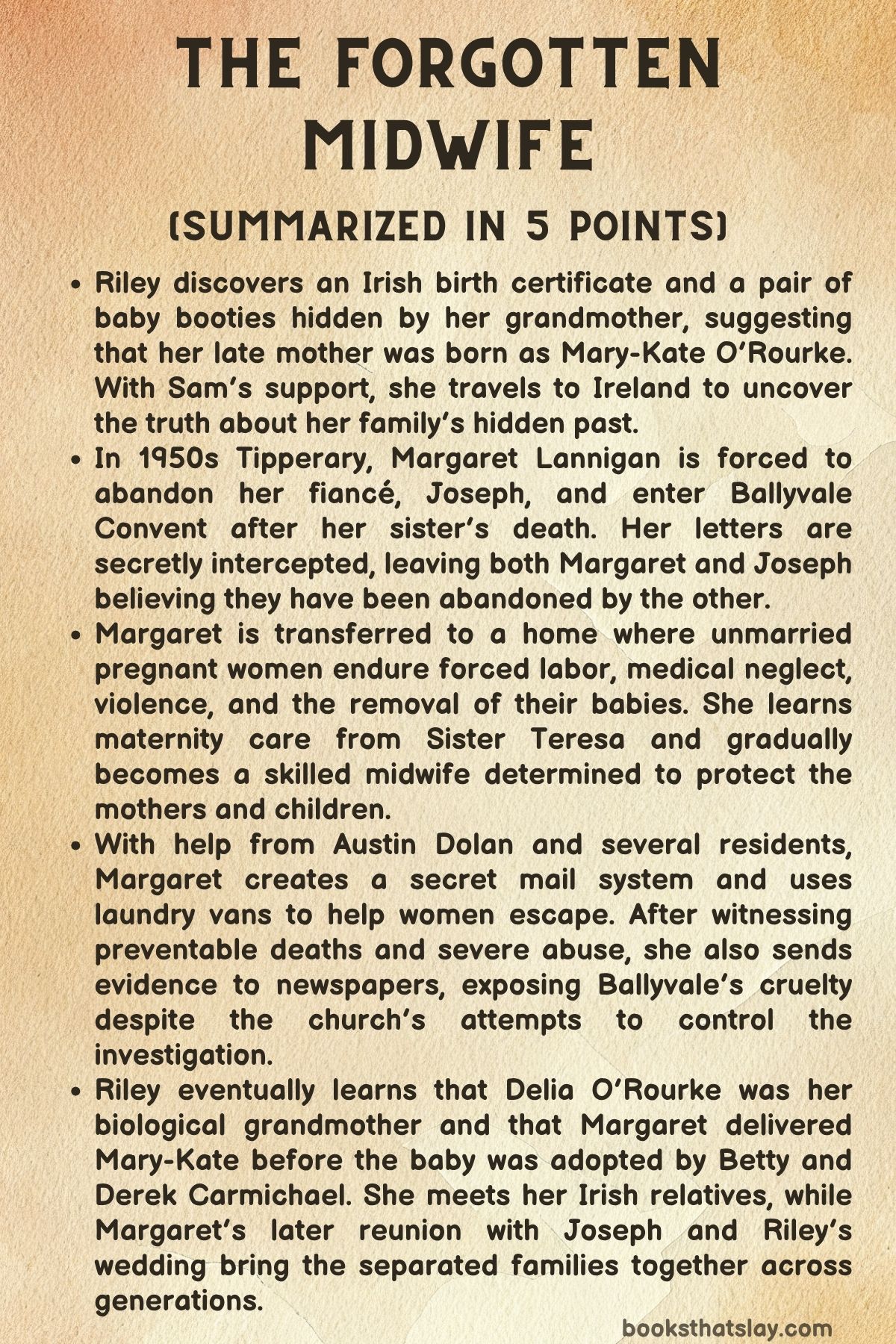
Summary
In present-day New York, Riley is preparing to marry Sam Jefferson and become part of his large, affectionate family. During a bridal appointment with Sam’s mother, Janelle, and his sister, Misty, Riley is reminded of everything she has lost.
Her parents died in a car accident when she was twelve, and her grandmother Betty raised her afterward. Betty now lives in a nursing home because dementia has gradually taken away her independence, memories, and ability to recognize Riley consistently.
When Riley visits Betty after the bridal appointment, Dr. Green tells her that Betty is experiencing an unusually lucid period. Betty recognizes Riley, discusses wedding dresses, and becomes emotional when Riley admits that joining Sam’s crowded family has made her wish she had more relatives of her own.
Betty then directs Riley to an old shoebox containing pale-green baby booties and an Irish birth certificate. The certificate belongs to Mary-Kate O’Rourke, born in Thurles, County Tipperary, on August 1, 1959, which is also the birth date of Riley’s late mother, Stacey Carmichael.
Before Betty can explain the connection, her confusion returns. Riley leaves wondering whether her mother was adopted and why the truth was concealed for more than sixty years.
Sam helps Riley verify that the certificate appears genuine and encourages her to investigate. After receiving little assistance from Irish government offices, they use their honeymoon savings to travel to Ireland and search for Mary-Kate’s family in person.
The historical story begins in rural Tipperary in 1956. Twenty-year-old Margaret Lannigan is happily engaged to Joseph Maloney and dreams of leaving her strict family home for a freer life in Dublin.
Margaret shares a close relationship with her older sister, Sheila, and imagines that they will remain part of each other’s lives after her marriage. Those hopes collapse when Sheila contracts diphtheria and dies despite the family’s prayers and desperate attempts to help her.
The Lannigan family is devastated, but Margaret is given little opportunity to grieve. Her father, Donny, and Father Michaels announce that the eldest daughter in every generation of the family is expected to join the Sisters of Penance.
Sheila had been intended for the convent, so Margaret is ordered to take her place. Her engagement to Joseph, her lack of religious vocation, and her protests are dismissed as less important than family tradition and public respectability.
Margaret is taken immediately to Ballyvale Convent. Although she attempts to escape, caretaker Austin Dolan returns her, and Mother Superior warns that going home would supposedly disgrace her family.
Margaret writes to Joseph, explaining that she has been forced into the convent and asking him to take her away. She sends hundreds of letters over the following years, but none receives a response.
Soon after her arrival, Margaret learns that her parents have died from diphtheria, her brothers have been sent away, and the family home has been sold. Father Michaels cruelly suggests that God took the wrong Lannigan daughter, leaving Margaret emotionally shattered and without any obvious place to return.
Two years later, Margaret becomes a professed nun alongside her friend Joyce. During the ceremony, Father Michaels tells her that Joseph is marrying Margaret’s childhood friend Linda O’Rourke.
Believing Joseph ignored her letters and chose someone else, Margaret remains at Ballyvale. She begins watching wealthy couples arrive at the institution across the road and leave carrying newborn babies.
Her questions disturb Joyce, who reports her during confession. Father Michaels responds by transferring Margaret to the Home for Fallen Girls, where unmarried pregnant women are confined, forced to work in a commercial laundry, and separated from their children.
Margaret meets Sister Teresa, known as Tee, who handles deliveries despite having no formal medical qualifications. The home’s Matron rules through beatings, threats, starvation, humiliation, and exhausting labor.
During Margaret’s first delivery, fifteen-year-old Rosie gives birth to a healthy boy named Daniel. Rosie immediately loves her child and begs to keep him, but the institution has already arranged for the baby to be taken.
Margaret and Tee learn to secure small mercies by appealing to Matron’s concern for productivity rather than compassion. Nevertheless, they cannot stop the removals or provide the medical care the mothers require.
A young resident named Anna goes into premature labor and begins hemorrhaging. Matron refuses to call Doctor Henry because she fears that an outsider might expose conditions inside the home.
Anna delivers a stillborn daughter and dies from blood loss. She and her baby are buried secretly beneath an apple tree on the grounds, without a public record or notification to her family.
Margaret is horrified by how completely a person can be erased. She begins studying medical texts supplied by Austin Dolan, who also brings food, medicines, clothing, and basic necessities using the laundry van.
Margaret eventually discovers that Ballyvale intercepts the residents’ letters. She realizes that her own letters never reached Joseph and that Father Michaels spread the story that she had abandoned her family voluntarily.
Working with Dolan, Margaret creates a secret postal route. The women can now contact relatives through addresses outside Father Michaels’s control and ask for help without their correspondence being confiscated.
A new resident, Delia O’Rourke, connects Margaret directly to her former life. Delia is Linda’s younger sister, and her presence forces Margaret to confront her anger toward Joseph and Linda while recognizing that Delia is an innocent young woman in need of protection.
When Delia experiences a dangerous labor in 1959, Margaret refuses to repeat the mistake that killed Anna. She sends for Doctor Henry despite Ballyvale’s rules, and his intervention saves both Delia and her daughter.
Delia names the baby Mary-Kate O’Rourke. Margaret knits pale-green booties for the child and begins understanding that she possesses the ability and judgment necessary to become a real midwife.
Mary-Kate is taken by Derek Carmichael, an American who plans to surprise his wife, Betty, after years of miscarriages. Derek appears loving and sincere, but his good intentions cannot change the fact that Delia has not freely consented to the adoption.
Delia is forced to prepare food for the man taking her baby and is later locked in isolation as punishment for resisting. To survive the loss, she comforts herself with the belief that Betty will give Mary-Kate the secure and loving childhood Ballyvale would deny her.
Margaret’s resistance becomes increasingly organized. After learning that Bridie cannot be released because no adult male relative will claim her, Margaret hides her inside a laundry sack and has Dolan drive her out in the van.
The successful escape becomes the beginning of a rescue operation. Every few months, another woman is concealed among the laundry bags, given money taken from Ballyvale’s earnings, and transported toward Dublin, Rosslare, London, or another place of safety.
Not everyone can accept the opportunity. Rosie has been so damaged by losing Daniel and being told she is unwanted that she refuses to leave.
Matron later punishes Rosie by tying her barefoot to a tree on a freezing night. Margaret and the other women rescue her, but Rosie’s condition worsens, and she dies at seventeen.
Margaret nearly takes revenge by pouring boiling water over the sleeping Matron, but Delia stops her. Rosie is buried secretly near Anna and the other forgotten dead, strengthening Margaret’s determination to expose Ballyvale rather than become as cruel as its authorities.
Concerned that Delia will also die if she remains, Margaret writes to Joseph’s family. Joseph and Linda arrive within days, and Joseph uses his status as Delia’s adult male relative by marriage to secure her release.
The reunion reveals that Joseph never knew where Margaret had been. Once he learned the truth, he acted immediately, proving that their separation had been deliberately created by Father Michaels and Ballyvale’s control of correspondence.
Margaret gives Joseph’s parents detailed information about the forced labor, stolen babies, medical neglect, physical abuse, hidden deaths, and illegal confinement. Her letters reach newspapers, and a public report finally exposes Ballyvale.
The church responds by placing Father Michaels in charge of the investigation, allowing one of the principal abusers to control the official response. Public outrage fades, but Matron is removed, medical care improves, and fewer women are sent to the home as social attitudes gradually change.
Margaret remains for years because she refuses to abandon those still confined. She becomes a skilled midwife through experience, study, and instruction from Doctor Henry, helping mothers survive births that might otherwise have killed them.
In 1976, Margaret leaves Ballyvale temporarily to attend Linda’s funeral. She sees Joseph again, now a widower, and recognizes that their love survived even though decades of their lives were stolen.
In 1980, Ballyvale finally closes. Margaret delivers its last baby, but this time the mother leaves with her child instead of being separated from the infant.
Father Michaels is dead, the remaining residents are released, and Margaret decides to pursue formal medical training. She leaves Ballyvale carrying the same suitcase she brought more than twenty years earlier and goes to Joseph’s farmhouse.
Joseph welcomes her home. They eventually marry, and Margaret becomes Dr. Margaret Maloney, building a life that the church once tried to deny her.
In the present, Riley and Sam locate Ita Clifford, Linda and Joseph’s daughter. Ita confirms that Mary-Kate O’Rourke became Stacey Carmichael and that Delia never stopped loving the child taken from her.
Riley learns that Delia died only three years earlier, leaving her saddened by how narrowly they missed meeting. At the same time, she discovers a large network of living Irish relatives who have preserved the family’s history.
Ita introduces Riley to the elderly Joseph and Margaret. Margaret recognizes Delia’s features in Riley and tells her about delivering Mary-Kate, knitting the green booties, and watching the baby leave for America.
Eight months later, Riley and Sam marry in the Jefferson family garden. Riley wears Stacey’s altered wedding dress, while Joseph walks her down the aisle and her newly discovered relatives celebrate alongside Sam’s family.
Betty attends but can no longer understand the connection between Riley, Mary-Kate, and the secret she revealed. Even so, the certificate she preserved allowed Riley to recover the history Ballyvale attempted to erase.
Riley enters marriage no longer believing that she has almost no family. She now understands that family can include the people who raised her, the people who welcome her, the ancestors whose stories were hidden, and the relatives whose love survived decades of separation.
Characters
Margaret Lannigan Maloney
Margaret is the central historical character and the moral force of The Forgotten Midwife. She begins as a spirited young woman whose ambitions are modest but deeply personal: marriage to Joseph, a home in Dublin, children, books, dances, and the freedom to determine her own future.
Her removal to Ballyvale destroys those expectations almost overnight. The deaths of Sheila and her parents, the separation from her brothers, and the interception of her letters leave her isolated enough that remaining in the convent appears to be her only realistic option.
Margaret’s rebelliousness is initially expressed through open anger, escape attempts, difficult questions, and refusal to accept Father Michaels’s authority as morally legitimate. Life inside the home teaches her that direct confrontation often gives violent authorities an excuse to punish more vulnerable people.
She therefore develops a disciplined form of resistance. She learns when to appear obedient, how to exploit Matron’s financial priorities, how to move supplies secretly, and how to create communication and escape networks without exposing everyone involved.
Her development as a midwife is central to her identity. She begins with compassion but no skill, and Anna’s death forces her to understand that good intentions cannot compensate for medical ignorance.
Through study, observation, experience, and Doctor Henry’s instruction, Margaret becomes calm and capable during dangerous deliveries. She eventually recognizes midwifery not as an accidental duty forced upon her but as a vocation she has chosen for herself.
Margaret is also shaped by grief that never fully disappears. Sheila, her parents, Rosie, Anna, the stolen babies, Joseph, and the children she never had all remain present in her decisions.
Her strongest quality is her refusal to let grief become passivity. She turns private pain into practical care, preserving names, creating records, assisting mothers, freeing residents, and remembering the dead when official institutions refuse to acknowledge them.
Her near-attack on Matron shows that Margaret is not morally untouched by prolonged exposure to cruelty. She comes close to repeating the violence she hates, and Delia’s intervention prevents revenge from replacing justice.
Margaret’s eventual departure does not erase the decades taken from her. Her reunion with Joseph instead shows that a stolen future can sometimes be reclaimed in altered form, even when lost time can never be restored.
Riley
Riley is the central figure in the present-day storyline of The Forgotten Midwife. Her investigation begins not from historical curiosity but from a personal fear that she is entering marriage with almost no family of her own.
The loss of her parents and Betty’s dementia have left Riley with a fragile connection to her origins. Sam’s large family welcomes her sincerely, yet their closeness also reminds her of the mother, father, and extended relatives she does not have.
The birth certificate forces Riley to reconsider what she knows about Stacey, Betty, and her own identity. Her initial response includes anger because she sees the secret as evidence that the two women she trusted withheld a fundamental truth.
As the investigation continues, Riley develops a more compassionate understanding of secrecy. She realizes that Betty and Derek may have acted from love, fear, social pressure, or uncertainty rather than from a desire to deceive her.
Riley’s courage is quieter than Margaret’s but still important. She risks discovering painful information about adoption, abandonment, exploitation, and family decisions that cannot be reversed.
Her journey to Ireland also represents her willingness to live with complicated answers. She does not reject Betty as her grandmother after learning about Delia, nor does she treat her Irish relatives as replacements for the family that raised her.
By the wedding, Riley has developed a broader understanding of belonging. She accepts that her identity can contain her American childhood, her biological Irish heritage, Stacey’s hidden history, Betty’s love, and the Jefferson family’s welcome without forcing one connection to cancel another.
Sam Jefferson
Sam is Riley’s partner, emotional support, and practical companion throughout the investigation. He responds to the discovery of the birth certificate with patience rather than defensiveness or fear.
When Riley feels betrayed by Betty, Sam offers an alternative explanation without dismissing her anger. He suggests that Betty may have waited for the right moment, may have been trying to protect Riley, or may have lost the ability to explain before she found the courage to do so.
Sam also turns speculation into action. He helps examine the certificate, searches for information, communicates with Irish authorities, and supports using their honeymoon savings for the journey to Ireland.
His importance lies partly in what he does not do. He does not take control of Riley’s search, pressure her toward reconciliation, or treat the discovery as a threat to their wedding plans.
Sam represents a form of partnership based on shared decision-making. His final response to Betty, identifying Riley simply as his wife when Betty can no longer recognize her, reflects his acceptance of Riley’s entire history rather than only its happiest parts.
Joseph Maloney
Joseph is Margaret’s first love and the future she believes she has lost. As a young man, he is respectful toward her family, committed to marriage, and excited about building a life with her in Dublin.
His absence after Margaret enters Ballyvale appears at first to be abandonment. Because Margaret believes her letters are being delivered, his silence becomes one of the deepest wounds created by the institution.
The later discovery that the letters were intercepted changes the meaning of Joseph’s actions. He did not knowingly choose Linda while ignoring Margaret’s pleas; he was told that Margaret had disappeared willingly and had no reliable way to locate her.
Joseph’s marriage to Linda is not presented as betrayal once the truth is known. He built a life based on the information available to him, cared for Linda, raised their children, and responded immediately when he learned that Delia was in danger.
His arrival at Ballyvale demonstrates moral decisiveness. By using his legal position as Delia’s male relative by marriage, he turns the home’s discriminatory release rule into a means of securing her freedom.
Joseph’s enduring love for Margaret is expressed through restraint rather than dramatic declarations. Their reunion after Linda’s death acknowledges both their bond and their responsibility to respect the life Joseph shared with Linda.
When Margaret finally leaves Ballyvale, Joseph’s welcome gives her something she has been denied for decades: a home offered freely. Their eventual marriage cannot recover their youth, but it confirms that Father Michaels did not permanently control the meaning of their relationship.
Delia O’Rourke
Delia is Mary-Kate’s biological mother and one of Margaret’s closest companions inside the home. Her arrival is initially difficult for Margaret because she is Linda’s sister and therefore connected to Joseph’s marriage.
Margaret’s early coldness reveals how unresolved grief can affect innocent relationships. She eventually recognizes that Delia is not responsible for the lies that separated her from Joseph and begins caring for her with increasing devotion.
Delia’s labor becomes a turning point in Margaret’s medical development. By recognizing the danger and summoning Doctor Henry, Margaret prevents Delia from suffering Anna’s fate.
The forced removal of Mary-Kate leaves Delia emotionally devastated. Her decision to imagine Betty loving the baby is not approval of the adoption but a survival strategy that allows her to believe her daughter is safe.
Delia also possesses significant moral strength. She remains at Ballyvale partly because she feels responsible for the other residents, and she later stops Margaret from attacking Matron with boiling water.
By preventing the attack, Delia protects Margaret from becoming violent and from receiving a punishment that might destroy the entire resistance network. Her compassion therefore extends even to the woman trying to avenge Rosie.
After leaving Ballyvale, Delia marries and raises six children. Her later life shows that she was capable of love, family, and stability despite the institution’s claim that unmarried pregnancy made her morally unfit.
Betty Carmichael
Betty is Riley’s grandmother and Mary-Kate’s adoptive mother. Although dementia has taken away much of her ability to communicate, her brief lucid period initiates the entire search.
The shoebox demonstrates that Betty preserved the truth even though she did not speak about it openly. The certificate and booties suggest that she understood the importance of Mary-Kate’s origins and kept physical evidence that could survive after her own memory failed.
Betty’s decision to remain silent is morally complicated. The secrecy denied Stacey and Riley knowledge of their biological family, but the book also presents Betty as a loving mother who may have believed she was protecting the child she raised.
Her history of miscarriages adds emotional context without excusing the adoption system. Betty wanted a child intensely, but she appears not to have known that Mary-Kate was taken from Delia without meaningful consent.
At the wedding, Betty cannot recognize Riley or understand what her preserved documents accomplished. Her condition makes the conclusion bittersweet because she succeeds in returning the truth to Riley but cannot participate consciously in its resolution.
Mary-Kate O’Rourke and Stacey Carmichael
Mary-Kate is the infant whose removal connects the historical and present-day narratives. Renamed Stacey Carmichael, she grows up in America without knowing, or without revealing, the circumstances of her birth.
Her character is largely understood through the effects of her absence. Delia remembers the daughter taken from her, Betty raises her as a cherished child, Riley mourns her as a deceased mother, and Margaret remembers helping bring her safely into the world.
The pale-green booties symbolize the hidden continuity between Mary-Kate and Stacey. They travel with the baby from Ireland to America and later return Riley to the place where her mother’s story began.
Stacey’s life demonstrates how adoption can involve genuine parental love while still originating in injustice. She can be both Betty’s beloved daughter and Delia’s stolen child, and neither truth removes the other.
Sister Teresa
Sister Teresa, usually called Tee, is Margaret’s mentor in the home and the person who first teaches her how to assist during childbirth. She is experienced, realistic, and deeply aware of the dangers created by inadequate equipment and the absence of trained doctors.
Tee’s apparent obedience can initially resemble cowardice. In practice, she survives by pretending to cooperate while quietly reducing pain, extending mothers’ time with their babies, obtaining food, and preventing Matron from becoming even more violent.
She teaches Margaret not to make promises she cannot keep and not to confuse outrage with effective protection. Her caution balances Margaret’s impulsiveness, while Margaret’s courage pushes Tee toward greater resistance.
Their partnership combines experience with determination. Together they improve care, manage emergencies, conceal acts of mercy, organize escapes, and build an alternative community inside an institution designed to destroy solidarity.
Austin Dolan
Austin Dolan begins as the man who returns Margaret after her first escape. His actions make him appear to be an enforcer, but his later conduct reveals a person trying to limit harm while remaining close enough to the institution to help its victims.
As Ballyvale’s caretaker and driver, Dolan possesses access that the confined women lack. He can purchase supplies, obtain medical books, carry letters, transport residents, and move between the home and the outside world without immediate suspicion.
His laundry van becomes central to the escape operation. A vehicle intended to expand the profits produced by forced labor is transformed into a means of liberation.
Dolan is not fearless. His reluctance to tell journalists everything demonstrates how power, reputation, and employment can discourage even sympathetic people from speaking publicly.
Despite that limitation, he repeatedly risks his position through practical assistance. His loyalty is expressed through actions rather than declarations, making him one of Margaret’s most dependable allies.
Father Michaels
Father Michaels is the principal representative of institutional corruption. He uses religion, family tradition, public shame, and male authority to control people whose choices threaten the social order he protects.
He forces Margaret into the convent, intercepts her letters, lies about her disappearance, and helps separate her from Joseph. These actions show that his power depends not only on physical confinement but also on controlling information.
Inside the home, Father Michaels participates directly in punishment and forced adoptions. He treats babies as valuable objects connected to financial donations while describing the transactions as moral rescue.
His cruelty toward Rosie and Delia exposes the emptiness of his religious language. Redemption, obedience, penance, and respectability become excuses for violence rather than principles of compassion.
Father Michaels is especially dangerous because the wider community grants him credibility. Postmen, families, church officials, and employers fear opposing him, allowing his personal decisions to shape the lives of women who have no comparable authority.
The investigation led by Father Michaels after the newspaper report demonstrates institutional self-protection. By allowing an accused abuser to examine his own system, the church creates the appearance of accountability while preserving control.
Matron
Matron governs the home through fear, physical punishment, exhaustion, and humiliation. She values laundry output, silence, and discipline above health, dignity, or human life.
Her violence is both personal and institutional. She is cruel by temperament, but Ballyvale also gives her the authority, secrecy, and vulnerable population necessary to act without meaningful consequences.
Margaret learns that appeals to Matron’s compassion are useless. She must instead argue that an injured or bleeding woman might damage valuable linens, revealing how completely economic priorities have replaced moral concern.
Matron’s treatment of Rosie represents her worst brutality. Cutting Rosie’s hair, threatening her with boiling water, and tying her to a tree are intended to destroy both the girl and the solidarity of everyone watching.
Her removal after public exposure provides limited accountability. She is transferred rather than prosecuted, showing how institutions often relocate abusive figures without fully confronting the systems that empowered them.
Joyce
Joyce begins as Margaret’s friend during their years as novices. She is lonely, bookish, sincere in her faith, and willing to share companionship with Margaret when both women are separated from their families.
Her obedience, however, repeatedly places institutional authority above personal loyalty. She reports Margaret’s questions during confession, helping Father Michaels arrange her punitive transfer.
Joyce believes that submission is evidence of spiritual virtue. This belief prevents her from distinguishing between moral discipline and abuse, especially when wrongdoing is committed by priests or senior religious figures.
Her eventual appointment as Matron brings some improvement because she is less physically violent than her predecessor. Food, rest, maternity care, and access to Doctor Henry improve under her administration.
Joyce therefore remains morally complicated rather than purely cruel. She causes harm through rigid obedience but later creates conditions that allow Margaret and Tee to protect more women.
Rosie
Rosie is fifteen when she gives birth to Daniel and forms an immediate bond with Margaret. Her youth emphasizes how little protection Ballyvale offers to children who are themselves forced into motherhood.
The removal of Daniel becomes the defining trauma of Rosie’s life. Ballyvale then punishes her grief as though loving her child were an act of defiance requiring correction.
Margaret offers her chances to escape, but Rosie cannot believe that a life outside is possible. Years of humiliation and abandonment have convinced her that nobody wants her and that freedom would only expose her to another rejection.
Her death after being tied to a tree demonstrates the psychological and physical consequences of institutional captivity. Rosie is not simply killed by cold exposure; she is destroyed by a system that first removes her child, then convinces her she has nowhere else to go.
The secret funeral restores some of the personhood denied to her. Margaret and the residents remember Rosie as a mother, friend, and young woman rather than as a sinner or unpaid worker.
Linda O’Rourke
Linda is Margaret and Sheila’s childhood friend and later Joseph’s wife. Early in the story, the three girls imagine themselves as inseparable, making Linda’s marriage to Joseph appear especially painful from Margaret’s isolated perspective.
Linda is not responsible for intercepting Margaret’s letters or spreading the story that she ran away. Like Joseph, she builds a life based on false information controlled by Father Michaels.
Her arrival to rescue Delia demonstrates loyalty to her sister and willingness to confront Ballyvale. Although institutional rules deny her legal authority because she is a woman, she participates fully in bringing Delia home.
Margaret’s attendance at Linda’s funeral allows her to move beyond seeing Linda solely as the woman who married Joseph. She recognizes Linda as a loved friend, sister, wife, mother, and victim of the same deception that shaped all their lives.
Ita Clifford
Ita is Linda and Joseph’s daughter, Delia’s niece, and Riley’s biological relative. She becomes the person who translates a mysterious certificate into a living family history.
Her knowledge of Delia’s memories confirms that Mary-Kate was never forgotten. Delia carried love for her daughter throughout her life, even though she had no way to locate her.
Ita welcomes Riley without suspicion or hesitation. Her response gives Riley the acceptance she hoped to find while preventing the investigation from becoming a purely factual search through records.
By preserving Margaret’s letters and introducing Riley to Margaret and Joseph, Ita acts as a guardian of family memory. She helps restore relationships across generations that Ballyvale attempted to separate permanently.
Derek Carmichael
Derek is Mary-Kate’s adoptive father and Betty’s husband. He travels from New Jersey to Ballyvale after saving money for years, believing he is bringing his wife the child they desperately desire.
His sincerity prevents him from being treated as a simple villain. He appears prepared to love and support Mary-Kate, and he may not fully understand how the institution obtained the baby.
Nevertheless, Derek participates in a transaction that denies Delia consent. His good intentions cannot make a coercive adoption just, especially when money is exchanged and the birth mother is punished for resisting.
Derek represents the moral uncertainty surrounding adoptive parents who benefited from secret systems without necessarily understanding their abuses. He gives Stacey a secure family, but that security begins with another woman’s forced loss.
Doctor Henry
Doctor Henry is one of the few outside professionals willing to respond when summoned. His intervention during Delia’s labor saves both mother and child after Margaret recognizes that the situation exceeds her abilities.
He validates Margaret’s medical judgment and teaches her practical techniques. His praise helps her see that she possesses the calmness and intelligence needed for professional maternity care.
His later contribution to the newspaper report suggests that he understands Ballyvale’s conditions are not isolated mistakes. By speaking as an unnamed medical source, he helps give public credibility to claims the church might otherwise dismiss.
Mother Superior
Mother Superior initially participates in Margaret’s confinement by accepting her as a novice and refusing to let her return home. She places obedience and the avoidance of scandal above Margaret’s freely expressed wishes.
At the same time, she displays more compassion than Father Michaels. She encourages Margaret to write to Joseph, recognizes her intelligence, and later tells her that the women across the road need someone with her courage.
Her decision to send Dolan after Margaret may have been intended to prevent Father Michaels from imposing harsher punishment. This does not make Margaret’s confinement acceptable, but it shows that Mother Superior attempts to reduce harm within a system she does not openly challenge.
Sheila Lannigan
Sheila is Margaret’s older sister and closest companion. Their shared reading of Little Women represents affection, imagination, and the private world they create within their strict household.
Her death begins Margaret’s forced transformation. Because Sheila had been designated for the convent, Margaret is treated as a replacement rather than as a grieving sister with her own future.
Sheila remains emotionally present through her dresses, the unfinished blanket, Margaret’s memories, and the damaged copy of Little Women. Margaret’s later protection of the Ballyvale residents can be understood partly as an attempt to offer other young women the sisterly care she lost.
Donny Lannigan
Donny is Margaret’s father and a man deeply concerned with religion, obligation, and public reputation. He can show generosity, as when he secretly pays a poor family’s church dues, but his compassion remains limited by his submission to institutional authority.
His decision to send Margaret to Ballyvale demonstrates the danger of valuing family tradition above a child’s autonomy. He treats her engagement, wishes, and grief as secondary to what Father Michaels and the community might think.
Donny is not presented as entirely without love, but his love is distorted by fear of shame. His authority helps Father Michaels remove Margaret without legal challenge or meaningful preparation.
Mary Lannigan
Mary is Margaret’s mother and a woman whose ability to protect her children has been weakened by her husband’s authority and the church’s influence. During Sheila’s illness, she briefly challenges Donny by insisting that a doctor is needed rather than only a priest.
After Sheila’s death, Mary copes through relentless domestic work. Preparing food and washing dishes allow her to remain active when stillness would force her to face the full weight of her grief.
She helps Margaret pack for Ballyvale and runs after the departing car, showing that she does not willingly accept the separation. Yet she cannot overcome the combined authority of Donny, Father Michaels, and the family’s religious tradition.
The Lannigan Brothers
Matthew, Colm, and Finbar represent the family relationships taken from Margaret when she is sent away. As children, they respond to Sheila’s death through anger, fear, prayer, and dependence on their surviving sister.
Finbar’s plea that Margaret not disappear like Sheila reveals how her removal affects those left behind. From his perspective, two sisters vanish within days of each other, one through death and one through adult decisions he cannot understand.
Matthew later becomes the first brother to reconnect with Margaret through the secret mail route. His letter confirms that the family was deliberately misled about her disappearance.
Colm’s entry into the priesthood shows that the pattern of imposed religious duty continues beyond Margaret. His later departure and marriage suggest that the family’s younger generation can eventually reject obligations that once appeared unavoidable.
Bridie
Bridie is trapped because her father refuses to claim her and the institution requires an adult male relative to authorize release. Her situation demonstrates that confinement has little to do with rehabilitation and everything to do with patriarchal control.
Her anger helps produce the laundry-sack escape plan. By demanding immediate action, she pushes Margaret and Dolan to convert an improvised idea into a successful rescue.
Bridie’s freedom proves that the home’s systems can be used against it. Her escape also gives hope to women who have no relatives willing to help them.
Lucy and Joe
Lucy is one of the residents who receives an official release when her eighteen-year-old brother, Joe, arrives to claim her. Her joy demonstrates how completely freedom depends on the actions of male relatives rather than on the women’s behavior or welfare.
Joe’s willingness to help his sister contrasts with families who abandon daughters at Ballyvale. Lucy later offers Bridie a place in London, extending the support she received to another former resident.
Their actions create a network beyond the institution. Escapees do not simply disappear; they begin helping others establish lives outside Ballyvale.
Anna
Anna’s death exposes the lethal consequences of Ballyvale’s secrecy. She needs medical assistance, but Matron refuses to call a doctor because protecting the institution’s reputation is treated as more important than saving her life.
Her stillborn daughter is buried with her beneath an apple tree. The absence of a funeral, marker, or family notification demonstrates how easily the home erases people who might become evidence against it.
Anna remains present in Margaret’s later decisions. Her death motivates Margaret to study medicine, summon Doctor Henry for Delia, and refuse obedience when a mother’s life is at risk.
Sister Bernadette
Sister Bernadette offers Margaret limited companionship during her early convent years. Her nervousness when discussing the laundry indicates that she knows something troubling exists across the road but lacks the courage or authority to confront it.
She represents the many ordinary members of institutions who sense wrongdoing but avoid asking direct questions. Her kindness is genuine, yet it remains restricted by obedience and fear.
John and Ita Clifford
John Clifford is one of the first people in Ireland to recognize the significance of Mary-Kate’s certificate. His guarded response signals that the name belongs to a painful history still remembered in the local community.
He takes Riley and Sam to Ita rather than attempting to explain the story himself. His choice allows the family member with the deepest knowledge to reveal the truth carefully and personally.
Janelle and Misty Jefferson
Janelle and Misty represent the warmth of the family Riley is joining. Their affection initially intensifies Riley’s grief because their mother-daughter relationship reminds her of Stacey’s absence.
Janelle responds to Riley’s sadness with sensitivity rather than demanding an explanation. Misty later cares for Betty during the wedding, showing that the Jefferson family accepts Riley’s existing relationships rather than asking her to leave them behind.
Together, they demonstrate that a new family does not need to replace an old one. Their welcome gives Riley security while she investigates the parts of her identity that remain uncertain.
Father Edgeworth
Father Edgeworth appears near the end of Ballyvale’s history and represents a different use of religious authority. Rather than preserving the institution at any cost, he arranges its closure, sale, and the safe release of the remaining residents.
His actions cannot repair the harm committed over decades, but they show that authority is not automatically abusive. Its moral value depends on whether it protects institutions or the people placed under their control.
John-Joe Lynch and Padar Brinkly
John-Joe Lynch helps transport Margaret to Ballyvale and later acquires the Lannigan family farm. His presence during her removal shows how local men assist the church’s control even when they are not members of the clergy.
Padar Brinkly, the singing postman, represents community complicity through fear. He refuses to bypass church control of the mail, allowing Ballyvale to isolate women whose families may be searching for them.
Neither man possesses Father Michaels’s level of authority, yet their cooperation helps make his power effective. The book shows that abusive systems survive through numerous small acts of compliance as well as through the decisions of obvious leaders.
Themes
Control of Women Through Shame and Respectability
The women in The Forgotten Midwife are controlled by a social order that treats female sexuality, pregnancy, grief, and independence as threats to family reputation. Margaret is forced into religious life because refusing a generational convent tradition would supposedly disgrace the Lannigans, while the unmarried mothers are confined because their families want pregnancy hidden from public view.
Shame becomes a tool that transfers responsibility away from men, families, clergy, and institutions. The young women are called fallen even when many have been abandoned, coerced, abused, or denied any realistic choice, while fathers and male partners remain largely outside the institution’s punishments.
Respectability also determines whose suffering is considered acceptable. Families may know that homes like Ballyvale are harsh, but they prefer concealed cruelty to the public knowledge of an unmarried daughter’s pregnancy.
The release rule makes this control explicit because an adult male relative can free a woman regardless of her condition, while the woman herself has no authority to leave. Lucy is released when her young brother arrives, Delia leaves through Joseph’s status, and Bridie remains trapped because no qualified man will claim her.
Margaret’s resistance challenges the belief that reputation has greater value than human life. By sending letters, preserving names, contacting newspapers, and organizing escapes, she forces private suffering into public awareness and gives the women authority over stories that others tried to control.
Motherhood, Adoption, and Forced Separation
Motherhood is presented as a relationship created through love, care, memory, and responsibility, but the novel refuses to treat all forms of motherhood as interchangeable. Delia is Mary-Kate’s biological mother, Betty becomes the mother who raises her, and Margaret is the woman who delivers her and protects Delia during the separation.
The adoption therefore contains both genuine love and serious injustice. Derek and Betty desperately want a child and appear capable of providing Mary-Kate with security, yet their happiness is made possible by a system that denies Delia meaningful consent.
Ballyvale attempts to reduce babies to objects that can be transferred from socially condemned women to approved married couples. Donations, secrecy, false travel stories, and the suppression of birth information turn adoption into a controlled transaction.
The mothers’ grief exposes the failure of that system to recognize emotional bonds. Rosie’s destruction after Daniel is taken and Delia’s effort to imagine Mary-Kate being loved show that separation continues long after the baby leaves.
Riley’s investigation restores the relationship that the adoption records erased. She does not reject Betty after discovering Delia, because recognizing her biological grandmother does not invalidate the woman who raised Stacey.
The story ultimately argues that honest adoption must preserve truth rather than depend on silence. Love can exist in more than one family, but it should not require the forced disappearance of another mother.
Memory, Records, and the Recovery of Hidden Lives
Ballyvale’s power depends on making people disappear from both public view and historical memory. Letters are confiscated, deaths are unrecorded, bodies are buried without markers, names are changed, and babies leave Ireland with stories designed to conceal their origins.
Physical objects resist that erasure. Mary-Kate’s certificate, the green booties, Margaret’s letters, Sheila’s dresses, Little Women, and the apple trees above the graves carry information that official authorities refuse to preserve.
Memory is shown as fragile but persistent. Betty’s dementia prevents a complete explanation, yet one lucid conversation is enough to place the evidence in Riley’s hands.
Margaret becomes a keeper of memory because she understands that witnessing is a form of resistance. When she cannot stop Rosie’s punishment or Anna’s burial, she remembers what happened and later records the larger pattern.
The newspaper report marks the movement of private memory into public history. Although the institution avoids full accountability, its victims are no longer entirely absent from the record.
Riley’s journey completes that process on a family level. She returns Mary-Kate to the O’Rourke history, learns Delia’s name, meets Margaret, and carries the truth into another generation.
The theme suggests that recovery does not require perfect records. A single document, object, letter, remembered face, or surviving witness can reopen a history that powerful people believed they had successfully buried.
Resistance, Solidarity, and Reclaimed Freedom
Resistance begins with Margaret’s refusal to believe that religious authority is automatically moral. Her early attempts are impulsive, but years at Ballyvale teach her that effective opposition requires patience, alliances, information, and careful judgment.
Solidarity is dangerous to the institution because isolated women are easier to control. Rules against touching, comforting, corresponding, or forming close friendships are designed to prevent the residents from recognizing their collective strength.
The women resist by creating precisely the relationships Ballyvale forbids. They share food, clothing, stories, books, medical knowledge, grief, and secret plans.
Small acts gradually become an organized system. Dolan brings supplies, Tee bends rules, Margaret studies maternity care, the residents protect one another, and letters reconnect women with relatives who were told they had disappeared.
The laundry van is the clearest symbol of reclaimed power. A machine serving forced labor becomes the vehicle through which women escape, carrying them away inside the same sacks that once represented their exploitation.
Resistance also requires moral restraint. When Margaret nearly attacks Matron, Delia stops her from allowing justified anger to become cruelty.
The novel does not present freedom as a single dramatic victory. Public exposure fails to close Ballyvale immediately, some residents remain too traumatized to leave, and reform occurs slowly.
Even so, every saved mother, surviving baby, delivered letter, recorded name, and successful escape weakens the institution’s claim that nothing can change. Freedom is built through repeated decisions to protect one another when official systems refuse to do so.