The Fourth Option Summary, Characters and Themes
The Fourth Option is a modern conspiracy thriller centered on Chris Walker, a former Navy SEAL and CIA operative whose private battle with trauma is interrupted by a request for help from the family of his closest friend.
Written by Jack Carr and M. P. Woodward, the novel combines covert operations, political corruption, corporate crime, organized narcotics trafficking, and a deeply personal search for purpose. As Walker investigates the suspicious death of an aspiring journalist, he uncovers a network protected by police officers, pharmaceutical executives, cartel leaders, and compromised federal officials. The story examines what remains when trusted institutions abandon justice and individuals must decide how far they will go to restore it.
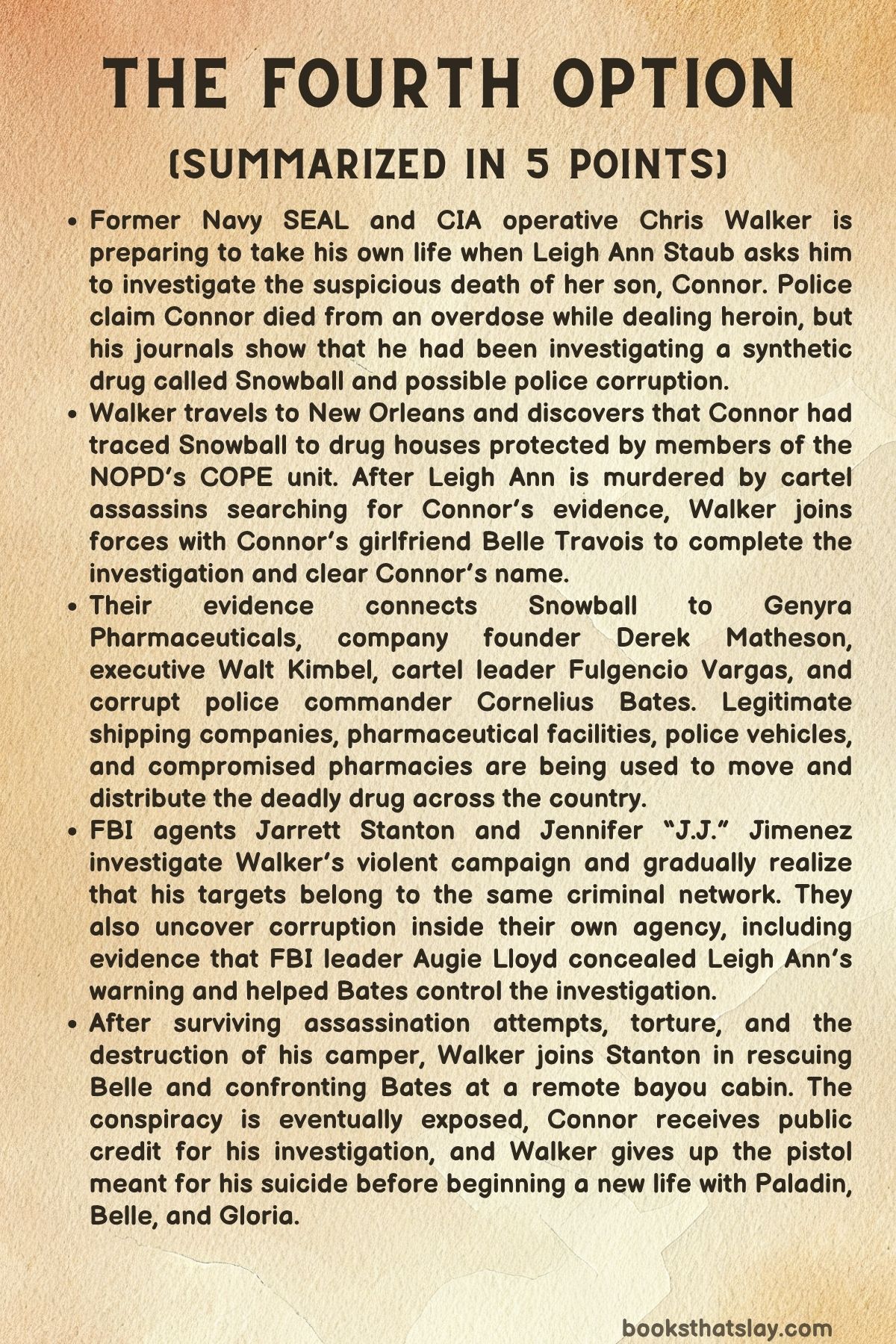
Summary
Former Navy SEAL and CIA Ground Branch operative Chris Walker sits inside his customized Volkswagen camper on Washington State’s Pacific coast, preparing to end his life. Years of combat, a traumatic brain injury, and the death of his closest friend, John Staub, have convinced him that his existence has lost all meaning.
Walker has arranged money and instructions for the care of Paladin, his Belgian Malinois, and has even called the tribal police to report the location of his own body. Just before he can complete the act, he receives an urgent message from John’s widow, Leigh Ann Staub.
Although Walker pulls the trigger, the bullet misses his head and tears through the camper’s roof. Shaken by his survival, he calls Leigh Ann and learns that her son, Connor, has died under suspicious circumstances in New Orleans.
Police claim Connor overdosed while transporting heroin, but Leigh Ann refuses to believe that explanation. Connor was an aspiring journalist who had spent more than a year investigating unexplained overdoses, a synthetic drug called Snowball, suspicious financial relationships, and possible police corruption.
Leigh Ann asks Walker to uncover the truth because John once told her that Walker was the one man she could trust during a crisis. Burdened by his guilt over John’s death, Walker agrees to travel to New Orleans and treat the investigation as one final mission.
During the journey, Walker remembers his years in Afghanistan with John and CIA officer Leonard Fisk. Walker and John had recruited Naji Mansour, an Afghan rug merchant who agreed to provide intelligence about Taliban and Haqqani figures in exchange for protection and eventual relocation to the United States.
Naji repeatedly delivered valuable information, helping American forces locate dangerous targets. However, the CIA continued postponing the visas promised to Naji, his wife Rina, and their daughters, Fatima and Zahra, because officials considered him more useful inside Afghanistan.
When Walker and John discovered that the United States was preparing to withdraw while leaving Naji behind, they decided to extract his family without authorization. They believed that a personal promise carried a moral responsibility even when the government refused to honor it.
The rescue attempt ended in disaster. Naji was killed during an ambush, Rina died when a roadside bomb destroyed one of the vehicles, and John was mortally wounded alongside Fatima.
Before dying, John gave Walker his Tudor watch and ordered him to save Zahra. He also asked Walker to protect Leigh Ann and Connor, leaving Walker with a promise that became the defining burden of his life.
In New Orleans, Walker visits the graves of John and Connor before meeting Leigh Ann. She gives him Connor’s journals, which contain coded names, overdose records, financial symbols, hospital information, and references to a police officer known as Slate.
Walker studies Connor’s car and quickly doubts the official claim that Connor transported the heroin found near its spare tire. He begins exploring the Lower Ninth Ward, where Connor had traced Snowball to trap houses operating under police protection.
After confronting several young criminals who attempt to rob him, Walker learns that officers connected to the NOPD’s COPE unit collect money and drugs from dealers. The information confirms that Connor had discovered more than ordinary street-level trafficking.
At the same time, Genyra Pharmaceuticals chief executive Derek Matheson arrives in New Orleans to celebrate a new cancer center funded by his company. Genyra presents itself as a source of medical hope, but Matheson is secretly connected to Salvadoran cartel leader Fulgencio Vargas.
Vargas’s criminal money once rescued Genyra from financial collapse. In return, Genyra’s commercial systems now help supply, package, and distribute Snowball through a network combining legitimate pharmaceutical operations with cartel-controlled businesses.
Matheson’s executive Walt Kimbel manages the corporate side of the arrangement. Lieutenant Cornelius Bates and selected COPE officers protect shipments, operate distribution houses, remove witnesses, manipulate evidence, and prevent honest investigators from reaching the truth.
Connor had identified several of these officers before he was killed and framed. Leigh Ann unknowingly placed herself in greater danger when she sent information about suspected police corruption to District Attorney Irene Isaacson.
Walker also meets Mirabelle Travois, known as Belle, who was Connor’s girlfriend and closest investigative confidante. Belle understands Connor’s coded financial records and insists on helping Walker finish the work that cost Connor his life.
Before they can fully decipher the evidence, cartel assassins attack Leigh Ann’s home. Walker kills the gunmen but arrives too late to save Leigh Ann, whose murder destroys the last member of John’s immediate family and turns Walker’s investigation into a personal war.
Bates takes control of the crime scene and constructs a false account connecting Leigh Ann’s death to Connor’s supposed involvement in drug trafficking. He begins using police technology, informants, surveillance systems, and honest officers to hunt Walker under the appearance of a legitimate investigation.
FBI Assistant Special Agent in Charge Jarrett Stanton and Special Agent Jennifer “J.J.” Jimenez are assigned to the case. They notice that Connor’s alleged overdose, Leigh Ann’s murder, the disappearance of evidence, and the deaths of corrupt officers form a pattern that local authorities appear determined to ignore.
Walker and Belle attempt to purchase Snowball from a protected trap house. When Belle is captured, Walker storms the building and discovers two police officers directly operating the location.
He kills the officers, rescues Belle, and gathers drug samples, phones, weapons, and records. Connor’s claims are now proven, but Walker’s violence allows Bates to portray him as a cop killer rather than a witness exposing police corruption.
Belle’s accounting skills connect the drug network to Dorado Freight, a shipping company handling imports from Vargas’s Nectar sugar business. Walker enters Dorado using a forged police identity but is discovered and nearly executed inside a shipping container.
Paladin attacks Walker’s captors, allowing him to escape with shipping records and digital evidence. The material reveals that Dorado is a transfer point through which cartel cargo enters legitimate corporate and pharmaceutical channels.
Bates’s officers locate Walker’s camper and ram it into the Mississippi River while he and Paladin are sleeping. Drawing on his underwater training, Walker finds a SCUBA tank, frees Paladin, and escapes the sinking vehicle.
Walker kills one of the attacking officers and realizes that the camper, which had served as his home, library, weapons cache, and refuge, is permanently lost. Rather than weakening his resolve, the attack eliminates the last remaining connection to his former life.
Belle studies Dorado’s records and identifies Detective Howard Gormley as a major link between imported shipments and corrupt police distribution. Walker captures Gormley, extracts information about the network, and destroys much of Dorado during an attack by cartel gunmen.
He then captures Walt Kimbel, who reveals the full supply chain. Nectar shipments conceal criminal materials, Dorado receives them, corrupt police transport them, and Genyra’s systems help prepare and distribute Snowball through compromised pharmacies across the country.
Kimbel admits that Matheson approved the partnership when Genyra needed money. He also confirms that Connor’s investigation threatened the entire enterprise and that Leigh Ann’s murder was part of the effort to recover and destroy the evidence.
Walker kills Kimbel using fentanyl patches, giving him a death resembling those suffered by Snowball’s victims. He then attacks Nectar’s riverfront facility, destroying loading equipment and storage silos to disrupt Vargas’s supply system.
The attacks place Matheson, Vargas, Bates, and their political allies under increasing pressure. As their organization begins collapsing, they push for Walker to be officially classified as a domestic terrorist so that any officer can kill him without learning what he has uncovered.
Stanton and J.J. discover that DEA agent Javier Gonzalez was murdered after investigating Snowball’s international connections. They begin to understand that Walker is following the same trail and that his targets consistently belong to the network responsible for Connor, Leigh Ann, and Gonzalez.
Their suspicions expand to FBI Special Agent in Charge Augie Lloyd. District Attorney Isaacson reveals that she forwarded Leigh Ann’s warning about corrupt police officers to Lloyd, yet Lloyd concealed the message and continued directing investigators to share information with Bates.
Walker and Belle relocate to an isolated Travois family cabin in the bayou. There, they organize Connor’s journals, Dorado records, photographs, corporate filings, and political donations into a complete map connecting Genyra, Nectar, Vargas, Bates, Kimbel, and compromised officials.
Bates hires Zarak Fazli, a former Afghan Zero Unit fighter whose family was murdered after the American withdrawal. Fazli blames the United States for abandoning Afghan partners and sees Walker as a representative of the system responsible for his suffering.
Fazli captures Walker at the cabin, binds him, and tortures him with electrical shocks. When Belle arrives, Fazli overpowers her as well and waits for Bates to join them.
Bates takes control of the torture and openly confesses his role in Connor’s framing, Leigh Ann’s murder, the Snowball operation, and the effort to create a false public narrative. He believes Walker can be blamed for every killing while the real conspirators remain protected by their offices.
Stanton and J.J. reach the cabin after independently tracing the Travois property. Cartel gunmen ambush them, critically wounding J.J. and bringing Stanton inside, where Bates explains his plan to kill everyone and manufacture evidence supporting an official story.
Walker has allowed his captors to believe that the torture has left him helpless. He suddenly breaks free, kills Fazli with a traditional Afghan knife, releases Stanton, and retrieves an old shotgun from the cabin.
Walker and Stanton fight together to rescue Belle and eliminate the remaining cartel gunmen. Their alliance represents a temporary union between extralegal action and lawful investigation against enemies who have corrupted both systems.
J.J. dies from her wounds despite efforts to save her. Bates escapes in his vehicle, and Stanton allows Walker to pursue him because Bates could still manipulate responding officers, contact Lloyd, or erase the truth.
Walker catches Bates on a rain-soaked swamp road and forces his vehicle into the mud. During their final confrontation, Bates attempts to convince Walker that he destroys everyone he tries to protect and that Leigh Ann knowingly used him as a weapon.
Stanton arrives and informs them that J.J. has died. Bates offers Stanton a place in the conspiracy, invokes due process when it benefits him, and reaches for a gun after Walker deliberately gives him one final choice.
Walker and Stanton fire together, killing Bates. Their shared action ends the authority of a man who used law enforcement not merely to commit crimes but to determine which version of reality the public would be permitted to believe.
Three months later, evidence gathered by Connor, Belle, Walker, and the FBI leads to widespread arrests. Matheson, Vargas, Lloyd, and other participants face prosecution, while Genyra collapses and cooperating witnesses provide information about the organization.
J.J. receives posthumous honors, and Connor is publicly credited with uncovering the Snowball conspiracy. His reputation is restored, allowing the story he died pursuing to reach the public.
Walker tells Stanton the truth about Naji, John, Zahra, and the unauthorized Afghan extraction. He also gives Stanton the pistol he once intended to use on himself, surrendering the instrument associated with his planned death.
With his original camper destroyed, Walker buys another vintage Volkswagen and returns to Belle and Gloria. Paladin runs to meet him, and Walker follows with his guitar, choosing companionship, purpose, and an uncertain future instead of suicide.
Characters
Chris Walker
Chris Walker is the central character and the moral, emotional, and philosophical foundation of The Fourth Option. A former Navy SEAL and CIA Ground Branch operative, he possesses exceptional combat abilities, mechanical intelligence, patience, and an instinctive understanding of dangerous environments.
His outward discipline conceals profound psychological damage. The explosion that killed John and members of Naji’s family left Walker with a traumatic brain injury, fragmented memories, survivor’s guilt, and the conviction that everyone placed under his protection eventually dies.
Walker uses philosophy to organize experiences that might otherwise overwhelm him. His references to Plato, Camus, Nietzsche, Stoicism, fate, free will, and the nature of panic are not signs of detached intellectualism but methods for controlling fear and giving structure to suffering.
His investigation begins as a temporary reason to postpone suicide. As the Snowball conspiracy expands, however, he gradually moves from fulfilling a debt to defending people who may never know his name.
Walker’s violence is both his greatest capability and his central moral danger. He kills corrupt officers, cartel gunmen, corporate facilitators, and criminal administrators with remarkable efficiency, but the novel repeatedly questions whether purpose can excuse the authority he claims over life and death.
His relationship with Belle, Gloria, Stanton, and Paladin restores his connection to other people. By giving away the pistol meant for his suicide, he accepts that survival does not require complete healing or certainty; it requires choosing another day despite unresolved pain.
Paladin
Paladin is Walker’s Belgian Malinois, tactical partner, emotional anchor, and most dependable companion. His awareness of danger repeatedly saves Walker from ambushes, intruders, and moments when Walker’s own judgment is weakened by trauma.
The dog’s importance extends beyond his operational value. Paladin interrupts Walker’s suicide attempt, remains beside him during long journeys, assists in combat, escapes the submerged camper with him, and offers affection without demanding explanations.
Walker often finds it easier to respond to Paladin’s needs than to recognize his own desire to live. Caring for the dog gives him a practical responsibility that challenges his belief that nothing remains worth protecting.
Paladin also represents loyalty without institutional conditions. Unlike governments, agencies, corporations, and police units, he does not abandon his partner when that partner becomes inconvenient or damaged.
John Staub
John Staub is Walker’s closest friend, former operational partner, and the source of the promise that drives the entire story. His humor, family devotion, and willingness to challenge authority create a warmer contrast to Walker’s reserved and philosophical personality.
John initially warns Walker against making intelligence work personal, but he ultimately joins the unauthorized effort to save Naji’s family. His decision demonstrates that he shares Walker’s belief that promises made to vulnerable people create obligations that cannot be cancelled by administrative convenience.
Even while dying, John concentrates on protecting others. He gives Walker his watch, orders him to save Zahra, and asks him to care for Leigh Ann and Connor.
His request becomes a crushing burden because Walker interprets every later tragedy as proof that he failed John. Yet John’s memory eventually does more than produce guilt, since it also guides Walker toward loyalty, courage, and renewed responsibility.
Leigh Ann Staub
Leigh Ann is a respected medical professional, John’s widow, Connor’s mother, and the person whose request prevents Walker from completing his suicide. Her belief in Walker reflects both her trust in John’s judgment and her recognition that ordinary authorities have already failed her son.
She refuses to accept the convenient story that Connor was a heroin dealer and addict. By examining hospital records, death certificates, and his notebooks, she becomes the first person to preserve his investigation rather than his officially manufactured reputation.
Leigh Ann is courageous, but her faith in institutional channels leaves her vulnerable. She contacts the district attorney because she believes a responsible public official will investigate police corruption, never realizing that her warning will pass through a compromised federal superior.
Her murder destroys Walker’s hope of completing the mission without losing another member of John’s family. It also exposes the conspiracy’s willingness to kill respected citizens and then use their loved ones’ reputations to justify the crime.
Connor Staub
Connor is physically absent from the main investigation, yet his intelligence and determination control its direction. An aspiring journalist preparing to attend Columbia, he wants to prove himself by publishing a significant investigation before leaving New Orleans.
He notices that unexplained overdoses are being misclassified and begins tracing Snowball through hospitals, neighborhoods, financial records, police behavior, and corporate relationships. His coded notebooks demonstrate caution, persistence, and an understanding that individual crimes are connected to a larger system.
Connor’s flaw is not recklessness alone but his belief that evidence will eventually protect itself. He understands that the story is dangerous, yet he continues working without fully revealing the scale of the threat to Leigh Ann or Belle.
After his murder, corrupt officers attempt to transform him from investigator into criminal. The eventual publication of his findings restores his identity and confirms that his work was strong enough to threaten powerful institutions.
Mirabelle “Belle” Travois
Belle is Connor’s girlfriend, investigative partner, and the person who converts his coded records into usable financial intelligence. Her background in accounting and information systems allows her to recognize relationships that Walker’s operational training cannot easily identify.
She initially distrusts Walker because of his secrecy, weapons, and military behavior. Once she sees his commitment to Connor and survives the trap-house rescue, she accepts him as a partner without becoming submissive to his authority.
Belle repeatedly refuses the role of passive victim. She follows Walker, challenges his decisions, enters dangerous locations, resists Fazli during captivity, helps stabilize J.J., and continues Connor’s work despite knowing that the same network may kill her.
Her developing bond with Walker gives both characters something they had lost. She gains a protector who respects her abilities, while he gains a relationship based on present trust rather than old guilt.
Gloria Travois
Gloria is Belle’s grandmother and one of the novel’s strongest sources of stability, humor, and domestic warmth. She recognizes Walker’s dangerous history but judges him according to how he treats Belle and Paladin rather than according to appearances or official accusations.
Her home provides food, shelter, medical care, and a temporary sense of family. These ordinary acts become important because Walker has spent years living without a permanent community.
Gloria also handles police and federal questioning with intelligence and confidence. She protects Belle without becoming careless, using apparent simplicity, family conversation, and social observation to keep authorities from controlling the encounter.
Her acceptance shows Walker that belonging does not always require an explanation of every past failure. Sometimes it begins with a meal, a place to recover, and the assumption that a damaged person may still deserve care.
Jarrett Stanton
Jarrett Stanton is a principled FBI leader whose methodical approach initially places him in contrast with Walker. He believes in evidence, procedure, institutional accountability, and the possibility that law can function despite political pressure.
Stanton’s strength lies in his willingness to notice details that others dismiss. He questions Walker’s behavior at the Federal Building, the convenient explanation of Connor’s death, the missing trap-house bodies, Bates’s polished statements, and Lloyd’s determination to define Walker as the main threat.
His investigation forces him to confront the possibility that loyalty to an institution may require resisting its compromised leaders. By withholding information from Lloyd and Bates, he moves outside normal procedure while trying to preserve the deeper purpose of the law.
The final confrontation with Bates changes Stanton permanently. His decision to fire alongside Walker is morally difficult, but it reflects his conclusion that Bates has turned due process into another weapon for protecting corruption.
Jennifer “J.J.” Jimenez
J.J. is Stanton’s investigative partner and one of the novel’s clearest examples of professional courage. She is perceptive, direct, emotionally intelligent, and less vulnerable than many colleagues to charm, rank, or political presentation.
Her interviews with Bates reveal her ability to detect rehearsed explanations and behavioral inconsistencies even before physical proof becomes available. She recognizes that Bates’s confidence is designed to control investigators rather than assist them.
J.J. also understands the human motivations surrounding Walker and Belle. She sees that Belle is protecting someone who saved her, while Walker’s pattern of violence targets a specific criminal system rather than random members of the public.
Her death at the cabin gives the investigation a severe personal cost. The posthumous recognition she receives confirms her integrity, but it cannot erase the tragedy of an honest agent being killed because compromised authorities denied her institutional protection.
Cornelius Bates
Cornelius Bates is the primary local antagonist and the clearest expression of corrupted authority in The Fourth Option. As commander of the celebrated COPE unit, he enjoys public praise for reducing crime while secretly controlling officers involved in narcotics distribution, evidence destruction, murder, and intimidation.
Bates does not regard himself as an ordinary criminal. He believes that his badge gives him the power to decide what counts as evidence, who will be called a victim, and which explanation the public will accept.
His confidence grows from years of controlling crime scenes, police databases, officers, informants, and political relationships. Because he can transform murder into an official report, he assumes that truth has no independent power.
Bates’s sadism becomes fully visible at the bayou cabin. Once protected from witnesses, he tortures Walker, threatens Belle, humiliates Stanton, and boasts about the deaths he helped arrange.
His downfall begins with his inability to understand loyalty. He assumes that everyone is motivated by money, fear, career protection, or personal survival, leaving him unprepared for people willing to risk themselves for truth or one another.
Derek Matheson
Derek Matheson is the founder and chief executive of Genyra Pharmaceuticals. Publicly, he is celebrated as a visionary businessman and philanthropist whose company produces life-saving treatments and supports medical institutions.
Privately, Matheson is vain, controlling, verbally abusive, and obsessed with branding, admiration, stock value, and personal status. He evaluates humanitarian work according to the praise it brings him rather than the lives it improves.
His criminal decisions arise from ambition and fear of failure. When Genyra faced financial crisis, he accepted Vargas’s money and allowed legitimate pharmaceutical systems to become part of a national narcotics operation.
Matheson continually places responsibility on subordinates such as Kimbel and Bates. His inability to accept moral ownership does not reduce his guilt, since he knowingly benefits from deaths while presenting himself as a protector of human health.
Walt Kimbel
Walt Kimbel is Genyra’s chief commercial officer and the administrator who turns Matheson’s criminal agreement into an operating system. He connects executives, cartel suppliers, freight companies, pharmaceutical facilities, corrupt police officers, and political contacts.
Kimbel is calmer and more practically intelligent than Matheson. He understands the conspiracy’s vulnerabilities, manages disputes, controls information, and attempts to keep each participant from seeing the complete structure.
His professionalism makes him especially disturbing because he treats addiction, murder, and corruption as logistical concerns. He does not need Bates’s cruelty or Vargas’s threats to cause immense harm; he only needs spreadsheets, supply routes, and institutional access.
When captured, he presents himself as a reluctant facilitator trapped by stronger personalities. Walker rejects this excuse because Kimbel repeatedly chose efficiency and profit over the lives destroyed by the system he maintained.
Fulgencio Vargas
Fulgencio Vargas, known as Cuchillo, is a Salvadoran businessman whose legitimate sugar company conceals his role as a cartel leader. He uses respectable commerce to move criminal material while using violence to enforce cooperation.
Vargas rescued Genyra financially, but his investment created permanent control over Matheson. He repeatedly reminds the executive that the company’s public success rests on cartel money and that no amount of corporate prestige can dissolve that debt.
Unlike Matheson, Vargas does not require the illusion that he is serving humanity. He understands the enterprise as a combination of power, leverage, fear, and profit.
His anger after Walker destroys Dorado and Nectar reveals the limits of his authority. Vargas can intimidate executives and purchase protection, but he cannot easily defeat an opponent who does not fear death, money, prosecution, or reputational damage.
Irene “Icy” Isaacson
Irene Isaacson is the New Orleans district attorney and an ambitious candidate for governor. She is intelligent, persuasive, politically skilled, and capable of turning public events into demonstrations of leadership.
Her connections to Matheson, Genyra, charitable organizations, and major donors create serious ethical concerns. Even when she lacks full knowledge of Snowball, her political career benefits from money and crime-reduction narratives produced by compromised people.
Icy’s decision to forward Leigh Ann’s warning to Lloyd appears to be a genuine attempt to avoid local police corruption. However, her failure to examine the network around her helps create the conditions in which Leigh Ann is exposed.
She represents the danger of ambition operating too close to hidden criminal power. The book does not establish her as fully innocent or fully complicit, instead showing how political self-interest can make a person useful to criminals without requiring complete knowledge of their activities.
Leonard Fisk
Leonard Fisk is the CIA case officer who helps recruit Naji and represents the institutional mindset that Walker eventually rejects. He is intelligent, experienced, and capable of understanding the risks faced by intelligence assets.
Fisk nevertheless treats protection as conditional upon continued usefulness. He promises Naji relocation but accepts repeated delays because the Agency benefits from keeping him in Afghanistan.
When Stanton questions him, Fisk offers a sanitized account of Walker’s past and describes the unauthorized extraction primarily as a procedural failure. His language reduces betrayal, death, and grief to administrative complications.
Fisk is not presented as a theatrical villain. His importance comes from showing how severe moral harm can result from ordinary institutional habits, divided responsibility, and the belief that no individual official is personally accountable.
Naji Mansour, Rina, Fatima, and Zahra
Naji Mansour is an Afghan rug merchant who risks his life and family because he believes American promises. His intelligence repeatedly helps locate dangerous militants, making him one of the most productive assets in the Afghan sections of the story.
Naji’s request is simple: protection and eventual relocation for Rina, Fatima, and Zahra. The CIA’s refusal to honor that agreement transforms his service into exploitation.
Rina and Fatima receive less individual development, but their deaths show that the consequences of intelligence decisions extend beyond the recruited source. Families bear risks they did not design and often cannot escape.
Zahra survives because Walker carries her from the wreck after John’s final order. Her survival becomes both evidence that Walker saved someone and a permanent reminder of everyone he could not rescue.
Zarak Fazli
Zarak Fazli is a former Afghan Zero Unit fighter whose family was murdered after the United States withdrew. His rage comes from a real betrayal similar to the one that destroyed Naji’s family and Walker’s faith in the CIA.
Fazli therefore functions as a dark reflection of Walker. Both men were trained by powerful institutions, abandoned after service, and left with grief that official explanations could not resolve.
Their paths separate in how they direct that pain. Walker turns his abilities against people actively operating the Snowball network, while Fazli accepts Bates’s money and threatens Belle, Stanton, and others who had no role in his family’s abandonment.
Walker understands Fazli’s grievance even while killing him. Their confrontation shows that justified anger does not automatically make every target legitimate or every act of revenge morally defensible.
Augie Lloyd
Augie Lloyd is the FBI Special Agent in Charge whose compromised leadership leaves Stanton and J.J. exposed. He receives Leigh Ann’s warning, hides it from the investigators assigned to her murder, and repeatedly directs them to cooperate with Bates.
Lloyd uses the language of national security and public protection to classify Walker as a domestic terrorist. This framing allows the conspiracy to redirect attention from Genyra, Snowball, and police corruption toward the man attacking them.
His betrayal is especially damaging because federal authority appears to offer an escape from compromised local policing. By corrupting that final channel, Lloyd helps convince Walker and Stanton that ordinary escalation through official systems cannot guarantee justice.
Howard Gormley
Howard Gormley is one of Bates’s most trusted criminal officers. He helps manipulate investigations, remove bodies, use police databases for unlawful searches, transport Snowball materials, and arrange Walker’s apparent drowning.
Gormley’s behavior shows how routine corruption has become inside Bates’s circle. Murder and evidence disposal are discussed as ordinary assignments rather than exceptional acts.
His fear of Walker grows after the river attack fails. When captured, he provides crucial information about Dorado, Nectar, Bates, and Kimbel, but cooperation cannot erase his active participation in the network.
Officer Dupuis
Dupuis assists Gormley in disposing of bodies and attacking Walker’s camper. Although less powerful than Bates or Gormley, he willingly participates in acts that protect murderers and prevent forensic examination.
His nervousness suggests that he understands the danger of the organization he has joined. However, fear does not lead him to withdraw or expose the conspiracy.
His death during Walker’s escape from the Mississippi demonstrates how corrupt subordinates become expendable. Bates relies on such officers while offering them no meaningful protection once the organization begins collapsing.
Carolyn Boyle
Carolyn Boyle is a Genyra marketing executive who initially appears accustomed to Matheson’s bullying and corporate obsession. She works inside the company’s polished public structure without understanding the full criminal foundation beneath it.
As Matheson and Kimbel lose control, she begins seeing evidence of activities far beyond ordinary executive misconduct. Her perspective shows how legitimate employees can remain close to corruption while being deliberately excluded from its most dangerous details.
Her eventual cooperation helps investigators prosecute the surviving conspirators. This decision distinguishes her from executives who continue protecting the company after understanding the human consequences.
Javier “Gonzo” Gonzalez
Javier Gonzalez is a DEA agent and former associate of John whose investigation follows the same trail later uncovered by Connor and Walker. Walker seeks his help because he believes Gonzalez may understand regional cartel activity and provide legitimate federal support.
Gonzalez has already been murdered in Mexico, where his mutilated body is intended as a warning to other investigators. His death demonstrates that Snowball’s protectors are capable of reaching beyond Louisiana and killing federal personnel.
Although he does not appear alive in the main story, his work helps Stanton and J.J. confirm that Walker’s claims are connected to a genuine international operation. He represents another honest investigator removed before his evidence could reach a trustworthy authority.
Themes
Institutional Betrayal and Personal Responsibility
Promises carry consequences even when governments, agencies, and corporations decide that honoring them is inconvenient. Naji risks everything because American officers promise safety, yet the CIA continues using him until evacuation becomes politically and administratively difficult.
Walker and John refuse to accept the idea that institutional policy eliminates personal responsibility. Their unauthorized attempt to save Naji’s family becomes the moral origin of The Fourth Option, establishing the belief that individuals must answer for commitments made in the name of larger organizations.
The same pattern returns in New Orleans. Police officers use their public authority to protect drug trafficking, Genyra converts medical systems into criminal infrastructure, and FBI leadership prevents honest investigators from reaching the truth.
Responsibility becomes difficult to assign because every participant claims to be only one part of a larger process. Matheson blames Vargas, Kimbel presents himself as an administrator, Bates hides behind law enforcement, and Fisk treats abandonment as an Agency decision rather than his own choice.
The novel rejects this division of guilt. Institutions act through individuals, and individuals remain morally responsible for what they approve, conceal, facilitate, or allow.
Walker’s campaign begins when he decides that personal obligation survives institutional failure. His methods remain morally troubling, but his refusal to deny responsibility separates him from the officials who continually describe preventable deaths as unfortunate outcomes of systems no one supposedly controls.
Justice Beyond Corrupted Systems
Law and justice repeatedly separate from one another as the investigation progresses. Bates possesses legal authority, controls evidence, directs police units, and determines official narratives, yet he uses every power associated with law enforcement to protect murder and narcotics trafficking.
Walker has no legal authority, but he identifies the guilty parties, rescues captives, preserves Connor’s evidence, and destroys parts of the Snowball network. This contrast creates the novel’s central moral tension without suggesting that vigilantism is automatically righteous.
Walker’s executions, interrogations, and bombings bypass trials, proportional punishment, and public accountability. Even when his targets are guilty, he makes irreversible decisions based on evidence he controls and standards he defines.
Stanton represents the possibility that law can recover its purpose when honest individuals resist compromised leadership. His investigation depends on procedure, documentation, interviews, forensic patterns, and cooperation, but those tools become effective only after he stops obeying officials who are actively misdirecting him.
The final confrontation with Bates brings these approaches together. Stanton and Walker fire at the same moment because neither lawful arrest nor personal vengeance alone can fully describe the situation.
The story leaves discomfort rather than simple approval. It asks what justice requires when courts, police departments, corporations, and federal offices are being used to manufacture innocence for the powerful and criminality for their victims.
Trauma, Purpose, and the Choice to Live
Walker begins the story believing death is the only remaining decision over which he has control. Combat trauma, brain injury, John’s death, and the collapse of his trust in the CIA have turned survival into repetition without meaning.
His philosophical reflections show an effort to understand suffering without being consumed by it. Camus, Nietzsche, Stoicism, mythology, and questions about free will become tools for separating immediate pain from final judgment.
Paladin provides the first practical resistance to suicide. The dog needs Walker, senses his emotional collapse, and repeatedly forces him to respond to a living presence outside himself.
Leigh Ann’s request then gives Walker a limited purpose. He does not initially choose life in a broad or hopeful sense; he merely postpones death long enough to complete one obligation.
That temporary mission gradually expands. Protecting Belle, exposing Snowball, rescuing Stanton, honoring Connor’s work, and preventing future overdoses give Walker reasons that are rooted in present relationships rather than past guilt.
His recovery does not erase trauma or excuse the destruction he causes. The ending instead presents survival as an active, unfinished choice that can exist alongside damage, shame, and uncertainty.
Giving Stanton the suicide pistol is therefore more significant than any physical victory. Walker does not declare himself healed; he removes the instrument of final surrender and returns to music, companionship, travel, and responsibility.
Power, Corruption, and the Control of Narrative
The conspiracy survives because its participants control the stories attached to events. Connor is changed from journalist to addict, Leigh Ann becomes a victim of her son’s supposed criminal associations, and murdered cartel gunmen are used to support a false account of private drug violence.
Bates understands that control over evidence allows him to control public memory. Bodies disappear, records are altered, weapons are planted, and official reports transform organized corruption into isolated criminal incidents.
Matheson relies on a different form of narrative control. Genyra presents medical hope, charitable investment, scientific advancement, and civic responsibility while its commercial systems assist a drug operation that causes widespread death.
Icy’s political events also demonstrate how public language can conceal uncertain foundations. Crime statistics, charitable donations, hospital dedications, and campaign speeches produce an image of progress while compromised relationships operate behind the stage.
Connor threatens the network because journalism can connect facts that institutions keep separated. His notebooks unite overdose records, police identities, corporate transactions, shipping companies, hospital information, and campaign money into one understandable account.
Belle and Stanton ultimately preserve that work by turning private evidence into a public story. Restoring Connor’s name matters because justice requires more than arresting perpetrators; it also requires correcting the false identity imposed on the person who discovered their crimes.
The struggle is therefore fought over both physical survival and interpretation. Whoever controls the final account can decide who is remembered as a hero, victim, terrorist, criminal, or respectable leader.