Daughter of Mine by Megan Miranda Summary, Characters and Themes
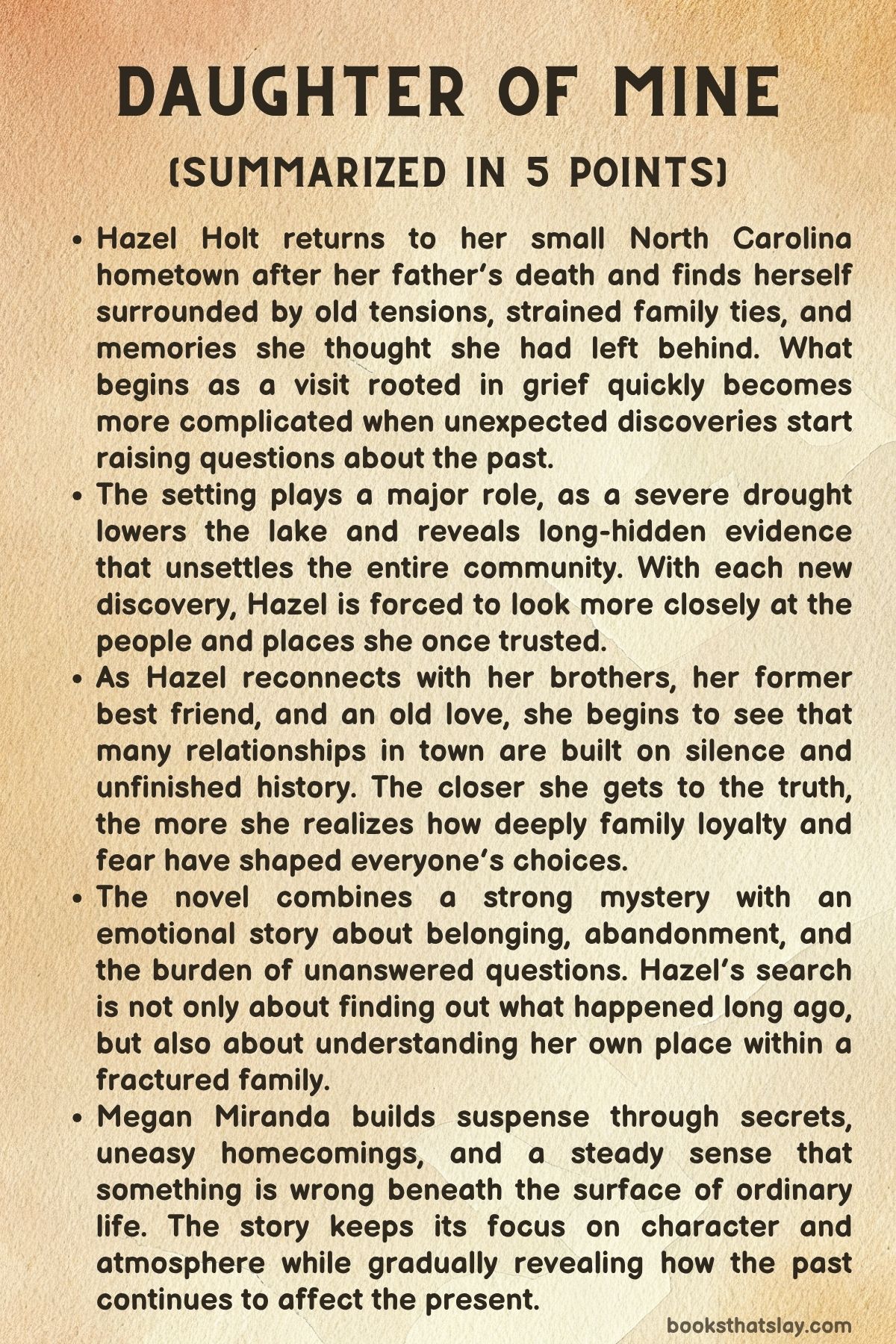
Daughter of Mine by Megan Miranda is a suspense novel set in a small North Carolina town where a long drought exposes more than dried lakebeds. Hazel Holt returns home for her adoptive father’s funeral and expects only grief, family tension, and unfinished memories.
Instead, the lowering water reveals a car tied to her mother’s disappearance, and that discovery starts a chain of questions about the Holt family, old secrets, and the stories this town has chosen to live with. The novel blends family drama, buried trauma, and a steady mystery as Hazel tries to understand who she is, what really happened years ago, and why the past still has such a strong hold on everyone around her.
Summary
Hazel Holt returns to Mirror Lake, North Carolina, after the sudden death of her father, Perry Holt, a respected local detective. She has spent years building a life in Charlotte and keeping distance between herself and the town that shaped her.
Back home, she finds the usual strain waiting for her: her bond with her older brother Gage is uneasy but intact, while her younger brother Caden meets her with resentment. Hazel is also forced into close contact with Jamie, Caden’s wife and Hazel’s former best friend, and with Nico Pritchard, the boy she once loved and never fully got over.
Perry’s funeral should have been the focus of Hazel’s return, but the drought has dropped the lake enough for a submerged car to be found, pulling the police away and setting a restless mood over the town.
Soon after the funeral, Hazel learns that Perry left his house to her alone. The decision shocks her, angers her brothers, and gives the inheritance a weight that feels larger than money.
Hazel spends the night in the house and notices signs that others have already been going through Perry’s belongings. She also finds a gun she did not know he owned.
The house feels wrong to her, as if it is holding back information. That sense grows stronger when she joins the family in sorting through Perry’s things and begins to remember old wounds, especially around her mother, Libby Sharp.
Hazel was not Perry’s biological child. Years ago, Libby entered the Holt family, won Perry’s trust, and then vanished after draining his accounts.
The town remembered her as a fraud who ran away and abandoned her daughter. Hazel has carried that version of the story all her life, along with the pain of being left behind.
But while watching her niece Skyler at the lake, Hazel discovers a second submerged car near the Holt property. When it is pulled from the water, two blue suitcases are found in the trunk.
Hazel recognizes them as her mother’s. The suitcases are empty, and that detail changes everything.
If Libby ran away, why would her luggage be left behind in a car hidden at the bottom of the lake?
Hazel starts asking questions the town would rather leave alone. Police officer Serena Flores and her father, Detective Al Flores, speak with her about Libby’s disappearance.
Hazel shares what little she knows, including that her mother once lived under another name and feared a man from her past named Joe Lyons. But Hazel also begins to suspect that the danger came from much closer to home.
At the same time, Jamie disappears after a fight with Caden, and Hazel becomes increasingly uneasy. Caden brushes off Jamie’s absence, but Hazel senses that something is badly wrong.
Back in Charlotte, Hazel cannot let the discovery rest. She returns to Mirror Lake and begins retracing old connections.
Jamie’s mother, Sonny, hints that women leaving the Holt men is almost a pattern in the family. She reminds Hazel that Perry’s first wife, Audrey Holt, died years earlier in what was said to be a bicycle accident.
That claim begins to look weak when Hazel later finds an old family photo showing Audrey beside a car that resembles one recovered from the lake. The pattern becomes hard to ignore: Perry’s first wife is dead, Hazel’s mother disappeared, and both stories seem tied to missing vehicles and buried evidence.
Hazel also realizes someone has been inside Perry’s house. Smoke detector batteries are missing.
Windows are left open. Her business partner notices a figure in one of the house photos Hazel sends from outside.
A hidden crawlspace reveals access points between rooms, and Hazel finds jewelry that once belonged to Audrey tucked away below the house. These are not random traces.
Someone has been moving through the property, hiding items, and watching her.
Meanwhile, outside curiosity grows. A pair of amateur true-crime content creators arrive by boat hoping to document the mystery, and their footage later captures a dark figure slipping into Hazel’s house.
Hazel feels trapped between official silence and public spectacle. She turns to local people she half trusts, including Nico and retired detective Pete Henderson.
Nico becomes close to her again, but she learns he has kept major information from her. Years earlier, his father had investigated Audrey’s death and suspected it was not an accident.
Nico also knew Libby’s car was in the lake and said nothing, believing the truth might destroy families already damaged by old violence.
The most important shift comes when Hazel finds a second letter written by Libby. For years Hazel believed her mother left a short note asking forgiveness.
Now she discovers that note was only part of the original message. The full version shows Libby intended to return for Hazel.
She warned that they were being watched, told Hazel to pack light, and suggested they were in danger. Hazel finally understands that her mother did not abandon her by choice.
Something stopped her from coming back.
Hazel’s investigation now turns from suspicion to certainty: Libby was trying to escape, Jamie found proof of that attempt, and someone has been trying to erase the evidence. Jamie had hidden Libby’s full note and planned to show Hazel, but after someone searched her house looking for it, she panicked and ran.
At the same time, the mystery around a missing teenage boy named Max Falkner begins to connect to hers. Photos developed from an instant camera reveal local teens had been sneaking into homes at night as part of a reckless game, taking pictures of themselves while residents slept.
One of the photos shows Jamie terrified. Later, Max’s body is found below the overlook known as the Barrel.
Jamie had startled him there and fled, afraid no one would believe the death was accidental.
As Hazel keeps pushing, more truths rise. Pete finally tells her what happened to Audrey Holt.
Audrey had planned to leave Perry. On the night she died, Perry went after her with his sons in the car.
Audrey and the vehicle collided, killing her. Rather than face the consequences, Perry covered up the accident with Pete’s help, and the car was eventually hidden in the lake.
This confession explains Perry’s guilt and his sons’ damaged memories. It also explains why Hazel’s brothers have spent years protecting a version of the past instead of confronting it.
Hazel then discovers that Gage and Caden have each hidden pieces of the truth in different ways. Gage found Libby’s original letter years ago and concealed it because he believed Perry had killed Libby too.
He later created a shortened copy to give Hazel some kind of closure and even sent the blank postcard from Mexico so she might think her mother had survived. Caden, burdened by what he knew about Audrey’s death, had once told Libby enough to frighten her.
The brothers were not united in a plan so much as trapped by fear, guilt, and loyalty to their father.
The final truth, however, points beyond Perry. Hazel uncovers money hidden behind mirrors in Perry’s office and realizes he meant for her to find not only the house, but what was concealed inside it.
His will gave her both the property and its contents, almost as if he knew she would be the one willing to force the truth into daylight. When the lights go out during a storm and Hazel is locked out of the house, the last mask drops.
The real architect behind the violence is her uncle Roy.
Roy reveals that Audrey had been leaving Perry for him. After Audrey’s death, Roy used the secret to blackmail Perry.
Libby later discovered financial wrongdoing in Roy’s firm and planned to leave town with Hazel, but Roy killed her to keep her quiet. He was also behind later crimes, including Sonny’s death and the attempt to silence Hazel.
He has spent years pulling strings, using the fear and shame inside the Holt family to protect himself.
Roy plans to kill Hazel and stage it as suicide, but Caden arrives and interrupts him. In the confrontation, Caden is shot.
Hazel escapes toward the lake, and Roy follows. In the water, where so many secrets have been hidden, Roy loses control and is dragged under by the current.
Hazel survives, and with Roy gone, the full story can finally surface. Caden admits his own part in setting events in motion long ago, and Hazel tells him that Libby meant to take all the children with her, not only Hazel.
That truth gives him a measure of peace.
In the aftermath, Libby’s remains are found on Roy’s property, and the family is forced to rebuild itself on honesty rather than silence. Hazel, Gage, and Caden agree to share the house and Perry’s money equally.
The place that once held suspicion, grief, and hidden evidence becomes a home again, filled with family life. For Hazel, the return to Mirror Lake begins as a reluctant visit for a funeral but ends as a reckoning with identity, betrayal, and love.
She comes home expecting to bury the past and instead uncovers it, piece by piece, until she can finally see both her parents and herself more clearly.
Characters
Hazel Holt
Hazel Holt stands at the center of the novel’s emotional and investigative force. She returns to Mirror Lake carrying years of distance, resentment, and unresolved grief, and that distance shapes the way she sees everyone around her.
She has built a life elsewhere, yet the town still holds authority over her memory, especially in relation to her mother’s disappearance and her complicated place in the Holt family. She is not Perry’s biological daughter, and that fact has clearly influenced how she understands belonging, loyalty, and rejection.
Her return for her father’s funeral is supposed to be temporary, but once hidden evidence begins to surface, Hazel becomes the one person unwilling to accept the town’s official version of events. Her role is not just that of investigator.
She is also a daughter trying to recover her own life story from lies, omissions, and half-truths.
What makes Hazel especially compelling is the way her professional instincts and emotional wounds work together. Her experience in home renovation is not a random trait.
It reflects her larger function in the story: she notices structure, hidden access points, patched surfaces, and things concealed behind walls. She reads houses the way she reads people.
That sharp eye allows her to detect the physical signs of intrusion and secrecy, but it also makes her unusually alert to the moral damage inside the family. Hazel is often suspicious, and sometimes she is harsh in her judgments, yet the novel makes that defensiveness feel earned.
She has spent years living with the belief that her mother chose to leave her. Once she begins to understand that this story was false, her entire sense of self changes.
Her arc is therefore not just about solving a mystery. It is about reclaiming dignity from abandonment and finding out that what wounded her most deeply was also a lie.
Hazel’s relationships reveal the different pressures acting on her. With Gage, she wants honesty but keeps finding control, silence, and paternalism.
With Caden, she faces hostility, selfishness, and old bitterness, yet she also comes to see the frightened child still inside him. With Jamie, there is old friendship, rupture, and a buried loyalty that survives even after estrangement.
With Nico, there is attraction and history, but also disappointment when she realizes he too has protected secrets instead of trusting her with the truth. Hazel is strongest when she refuses to let affection excuse concealment.
By the end, she emerges not as someone who has escaped pain, but as someone who has earned clarity. She becomes the person who finally stops the cycle of silence that shaped the family for years.
Perry Holt
Perry Holt dominates the story even after death. His absence drives the plot, but his past decisions determine nearly every conflict that Hazel uncovers.
Publicly, Perry is remembered as a respected detective, a community figure, and a father whose sons followed him into law enforcement. That reputation matters because it explains why the town is so ready to protect his image.
Yet as the truth surfaces, Perry becomes a far more complicated figure, one shaped by guilt, weakness, concealment, and a damaged sense of love. He is not presented as a simple villain.
He caused immense harm, especially through the cover-up of Audrey’s death and through the atmosphere of fear that shaped his children’s lives, but he is also shown as a man crushed by the consequences of what he did.
The inheritance is one of the clearest clues to Perry’s character. Leaving the house and its contents to Hazel alone is not simply an act of affection or fairness.
It reads as a final decision made by a man who understood that his sons were too invested in protection and denial to uncover the truth. Hazel, by contrast, would ask questions.
She would see what was hidden. Perry appears to have arranged matters so that she would be forced into contact with the secrets buried in the house, the money in the walls, the gun, the jewelry, and the history attached to all of them.
This does not absolve him. It shows that even at the end, he remained indirect.
He wanted truth to come out, but he did not have the courage to speak it plainly while alive.
Perry’s failures as a father are central to his characterization. He allowed his sons to carry traumatic knowledge without giving them a healthy way to process it.
He also failed Hazel by letting her grow up under a false story about Libby’s disappearance. At the same time, the novel suggests that his relationship with Hazel contained a form of recognition that his relationships with his sons did not.
He seems to understand that she has a different moral strength, a greater ability to face what hurts. That choice gives Hazel a painful inheritance, but it also becomes a last confession in the form of property and silence.
Perry represents a man whose authority once held the family together on the surface while quietly poisoning it underneath.
Gage Holt
Gage initially appears to be the most stable and reliable of the siblings. Hazel has always looked up to him more than to Caden, and for much of the story he seems calmer, more competent, and more measured than his younger brother.
He does not explode in the same obvious way, and that difference can make him seem trustworthy. Yet Gage’s character becomes more troubling as the truth emerges because he embodies a quieter form of control.
He withholds information, makes decisions on behalf of others, and convinces himself that concealment is a form of protection. In this way, he reflects the family pattern more deeply than he first appears to.
Gage’s moral weakness lies in the fact that he understands more than he says and still chooses silence. He found Libby’s original note years earlier and hid it.
He sent Hazel a shortened version that gave her only partial understanding. He even mailed the blank postcard from Mexico to let her believe her mother might still be alive somewhere.
These actions are not cruel in a simple sense. They come from guilt, fear, and a misguided wish to shield Hazel from a truth he himself could not fully face.
But the effect is devastating. He shapes Hazel’s life through a false story and denies her the right to know what happened to her own mother.
His behavior shows how damaging “protective” secrecy can become when it crosses into manipulation.
The story also connects Gage to the burden of being the eldest son in a family ruled by male authority. He witnessed trauma at a young age and learned that survival depends on preserving the structure around him.
Even when that structure is built on lies, he clings to it. His actions with the jewelry, the note, and the household contents reveal someone who manages evidence rather than confronting it.
That instinct may come from loyalty to Perry, but it also shows how deeply he has absorbed the family’s habits. By the end, Gage is not beyond repair, but he is forced to face the fact that restraint and maturity are not the same as honesty.
His character is a study in how silence can look reasonable while still causing lasting harm.
Caden Holt
Caden is introduced as difficult, combative, and self-absorbed, and Hazel’s perspective makes him one of the most abrasive presences in the story. He is quick to anger, deeply resentful about the house, and openly hostile toward Hazel.
His marriage appears unstable, and his reactions often seem childish or aggressive. At first, he can easily be read as the family’s most obvious problem.
Yet the deeper the story goes, the more Caden becomes a portrait of damaged memory and emotional distortion. He is still responsible for his cruelty, but the novel gradually reveals how much of his adult behavior has been shaped by childhood trauma and long-term guilt.
As a child, Caden was present during the event that killed Audrey. That experience clearly scarred him, and the story suggests he suffered for years afterward in ways that were never properly addressed.
Instead of healing, he grew up inside a family culture where silence replaced truth. That emotional environment helps explain why he lashes out, why he reacts with suspicion, and why he clings to anger as a defense.
He is not emotionally articulate, so everything comes out sideways as accusation, possessiveness, and hostility. His marriage to Jamie reflects these flaws.
He tries to control rather than understand, and he fails to notice the scale of her fear when she disappears.
Caden becomes more sympathetic once it is revealed that he had told Libby about Audrey’s death. That confession reframes him.
He was not merely mean or selfish; he was a child carrying knowledge that frightened him, and he passed it on in a way that may have put Libby in danger. For years, he seems to have lived under the weight of that possibility without fully understanding it.
His final act changes the moral shape of his character. When Roy threatens Hazel, Caden intervenes and is shot.
In that moment, he breaks from the pattern of avoidance and chooses protection in a real, immediate way. He does not become gentle or easy, but he becomes human in fuller terms.
His arc shows how a person warped by secrecy can still act with courage when truth finally strips everything down to its essentials.
Jamie Holt
Jamie serves as one of the story’s most important missing figures, even before the reasons for her disappearance are known. Her absence creates suspense, but her role is larger than that.
She stands at the point where old secrets collide with present danger. Once Hazel’s best friend, Jamie has become emotionally distant from her, largely because of Hazel’s past interference in Jamie’s relationship with Caden.
That old fracture matters because it makes Jamie’s silence feel personal as well as mysterious. Still, the discovery that Jamie had found Libby’s full note and intended to share it with Hazel reveals that some trust remained beneath the damaged friendship.
Jamie’s character is defined by fear, but not weakness. She becomes frightened because she has real reason to believe someone is watching her, searching her house, and trying to recover evidence.
Her response is messy and imperfect, yet understandable. When she runs after startling Max at the overlook, her panic grows into a full disappearance.
She believes she could be blamed for his death, and that fear exists alongside her knowledge that someone dangerous may also be pursuing the letter she found. The novel treats her not as irrational but as someone reacting to pressure that would overwhelm almost anyone.
Her disappearance therefore echoes the pattern of other women in the story who try to leave threatening circumstances and find themselves trapped by male violence or control.
Jamie also serves as a contrast to Hazel. Both women are trying to survive the damage created by the Holt family, but they respond differently.
Hazel moves toward investigation, while Jamie moves toward hiding. Neither response is simplistic.
Jamie’s retreat shows how isolating fear can be, especially when the men around her either dismiss her distress or cause it. Her treatment by Caden underscores that emotional neglect can be as dangerous as direct threat when it prevents someone from being heard.
By the end, Jamie’s decision to turn herself in and tell the truth matters because it restores some agency to her. She is not just a missing wife or frightened witness.
She becomes one of the people who helps move the story out of confusion and into disclosure.
Nico Pritchard
Nico embodies memory, desire, and disappointment. As Hazel’s former boyfriend and longtime emotional connection to the town, he carries the charge of unfinished history from the start.
His presence reactivates Hazel’s past, especially the part of herself tied to secrecy and intimacy. He is often physically nearby, helpful in moments of danger, and willing to step into the investigation when asked.
That makes him easy to view as a possible source of comfort or alliance. Yet Nico’s character is defined by a serious contradiction: he wants closeness with Hazel while also withholding information that directly concerns her life.
His background is essential to understanding him. Nico grew up with his own inheritance of secrecy through his father, another detective who had privately investigated Audrey’s death.
The hidden room full of case materials shows how deeply the older generation’s concealed knowledge shaped the next. Nico inherits not only evidence but suspicion, and he responds by trying to manage what Hazel knows rather than trusting her with it.
His silence about the car in the lake is one of the clearest betrayals in the novel because it is not abstract. It concerns Hazel’s mother, her past, and her right to understand her own life.
Nico tells himself he stayed quiet to protect his father’s memory, but the choice reveals moral hesitation and emotional cowardice.
At the same time, Nico is not empty or false. His bond with Hazel is real, and the story allows room for tenderness, attraction, and mutual recognition between them.
They understand each other partly because both grew up in households marked by hidden evidence and official narratives that did not feel true. But their connection is limited by the very thing that once drew them together: the allure of secrecy.
Hazel eventually sees that their relationship has often depended on what is unsaid, and once the stakes become life-and-death, that pattern is no longer tolerable. Nico therefore represents the difference between intimacy and trust.
He can offer emotional familiarity, but until very late, he cannot offer full honesty.
Libby Sharp
Libby exists for much of the novel as a story told by others: con artist, drifter, thief, woman who used Perry and abandoned her daughter. That reputation shapes Hazel’s identity because Hazel has had to live inside the space Libby left behind.
The power of Libby’s character comes from the slow dismantling of that reputation. As the mystery unfolds, the novel asks what happens when a child’s deepest wound turns out to be based on a lie.
Libby becomes not an absence to resent, but a silenced woman whose intentions were distorted after her death.
The full note is the key to her characterization. It shows urgency, fear, and maternal commitment.
She planned to return for Hazel, believed they were being watched, and understood that staying in town was dangerous. That message transforms Libby from a figure of abandonment into a figure of interrupted escape.
Even details that once supported the old story begin to shift in meaning. The empty suitcases suggest not a woman who packed and fled, but a staged disappearance.
Her use of different names now reads less as mere deception and more as evidence of a life spent surviving unstable or threatening men. Her past may indeed include grifting and reinvention, but the novel refuses to reduce her to those traits alone.
Libby also matters symbolically because she shows how easily women can be rewritten by communities eager for neat explanations. Once she disappeared, it was convenient for people to believe she ran.
That judgment protected powerful men and placed blame on the missing woman. Hazel’s search restores Libby’s complexity and humanity.
By the end, Libby becomes not only Hazel’s mother but a person with plans, fears, and an active will to protect children from danger. Her recovery from false memory into truth is one of the novel’s most moving acts of correction.
Roy Holt
Roy is the story’s hidden center of corruption. For much of the novel, he appears in the familiar role of uncle, lawyer, and family adviser.
He offers legal guidance, comments on the will, and presents himself as a practical mediator trying to calm disputes among the siblings. That appearance is important because it allows him to move through the family’s grief and confusion without drawing suspicion.
He benefits from seeming stable, useful, and above conflict. In reality, he is the character who best understands how to manipulate fear, guilt, and inherited loyalty for his own protection.
What makes Roy especially disturbing is that he is not driven by a sudden outburst or a single desperate act. He has built a life around concealment and leverage.
Audrey’s death gave him power over Perry, and he used that power through blackmail. When Libby discovered financial misconduct, he killed her to preserve himself.
Later, when Hazel began uncovering the past, he moved again to silence anyone who might expose him. His evil is not chaotic.
It is calculated, patient, and opportunistic. He knows how to exploit the emotional damage already present in the family, pushing siblings against each other and letting old suspicions do part of his work for him.
Roy also represents the darkest version of patriarchal authority in the novel. Unlike Perry, whose guilt seems to erode him, Roy shows little sign of remorse.
He sees women as problems to be managed and truth as something to be controlled through intimidation or murder. His final confrontation with Hazel exposes the full scale of his violence, but it also shows his overconfidence.
He assumes the family’s long habit of silence will keep protecting him. Instead, Hazel’s refusal to submit breaks the system he relied on.
Roy is therefore more than the final culprit. He is the embodiment of what happens when power is allowed to hide behind respectability for too long.
Audrey Holt
Audrey Holt is a haunting presence whose death shapes the family long before Hazel begins asking questions. Officially, her death was treated as an accident, and that version of events allowed the town to move on.
But Audrey matters precisely because the official story stripped her of agency and reality. As the truth emerges, she becomes not a tragic footnote but a woman trying to leave an unhappy or dangerous marriage.
Her movement toward escape places her in direct continuity with Libby and Jamie, linking the women of the story through risk, fear, and the struggle to get free.
Audrey’s importance also lies in the effect her death had on the boys. Gage and Caden were present in the car when she was struck, and that trauma shaped their entire emotional development.
The lie told afterward trapped them inside a childhood memory they were never allowed to process openly. In this sense, Audrey’s character extends beyond her own life and into the damaged moral world her death helped create.
Her loss becomes the family’s original wound, one that poisons later relationships because it is never honestly named.
The revelation that Audrey was leaving Perry for Roy adds another layer to her role. She was not only trying to escape one man but moving toward another who would later become even more dangerous.
That irony deepens the tragedy around her. She sought change and instead became the center of a cover-up, then a source of long-term blackmail and decay within the family.
Audrey’s character shows how women can be erased twice: first by violence, then by the story told afterward.
Skyler Holt
Skyler is one of the few figures in the novel associated with innocence, but she is not merely decorative. She functions as a quiet truth-bearer in a story full of adults who hide, distort, or deny.
Her actions help uncover major evidence, including the submerged car and the note Jamie entrusted to her. Because she is a child, adults often underestimate what she notices and what she remembers.
That underestimation allows important truths to remain near her until Hazel is ready to see them.
Skyler’s presence also softens the emotional climate of the story. Hazel’s affection for her reveals Hazel’s capacity for care, patience, and protectiveness.
In scenes with Skyler, Hazel is less guarded and more openly tender, which makes those moments important for character contrast. Skyler reminds readers what is at stake in the struggle over family truth.
The danger is not only about the past. It is also about what kind of future children inherit when adults choose silence over honesty.
At a thematic level, Skyler represents continuity without corruption. The older generations pass down trauma, secrets, and defensive habits, but Skyler’s role suggests the possibility of something different.
Once the truth comes out, the family can begin again in a space where a child does not have to carry hidden terror the way Gage and Caden once did. Her small but meaningful role keeps the story tied to renewal as well as damage.
Serena Flores
Serena Flores occupies an uneasy position between professional duty and inherited loyalty. As a police officer investigating the lake discoveries, she seems at first to offer Hazel a route toward official truth.
She is capable, observant, and directly involved in the case. Yet as the novel continues, Serena becomes a reminder that institutions are made up of people whose judgments are shaped by family ties, local history, and emotional allegiance.
She is not openly malicious, but she is limited by what she is willing to pursue.
Her interactions with Hazel show this tension clearly. Serena asks questions and follows leads, including the one connected to Joe Lyons, but she also discourages Hazel from pushing too far.
At crucial points, Hazel senses that Serena is more committed to preserving local structures than to fully unsettling them. That hesitation matters because it reflects the broader culture of Mirror Lake, where reputation and continuity often matter more than exposure.
Serena’s relationship with her father, Al, reinforces this. She belongs to a law-enforcement legacy much like the Holt sons do, and that inheritance shapes her blind spots.
Serena is therefore an effective secondary character because she is not simply helpful or obstructive. She is conflicted.
She stands for the possibility of justice constrained by community pressure. Her role strengthens the novel’s larger question about whether truth can emerge through official channels when those channels are themselves entangled with the past.
Pete Henderson
Pete Henderson initially appears to be a minor source of town gossip, but he gradually becomes one of the most morally complex witnesses in the story. As a retired detective, he belongs to the same generation of men who made crucial decisions in the aftermath of Audrey’s death.
Unlike Roy, Pete is not driven by greed or domination, yet he still participated in concealment. He helped Perry cover up the fatal collision and later supported the decision to hide the car.
His guilt is quieter than Perry’s but still significant. He is a man who compromised truth once and has lived long enough to understand the cost.
Pete’s eventual confession is important because it comes from weariness rather than righteousness. He no longer wants to carry old secrets, and he sees Hazel as someone who has the right to know.
That makes him different from the other men who withheld information under the excuse of protection. He does not try to control what Hazel does with the truth once he speaks.
Instead, he accepts that disclosure may damage the dead, the living, and the town’s memory of itself. That acceptance gives his character a measure of moral recovery, though not innocence.
Pete also functions as a bridge between public narrative and buried history. He has access to what happened, but he also understands how stories were managed afterward.
Through him, the novel shows how ordinary complicity helps large lies survive. He is not the mastermind, but without people like him, the central deceptions would have been harder to sustain.
Sonny Varino
Sonny Varino appears briefly but leaves a strong impression because she speaks truths that others avoid. As Jamie’s mother, she has seen enough of the Holt men to recognize patterns that Hazel is only beginning to piece together.
Her comments about wives leaving, strained marriages, and the town’s history with women who never truly escape are some of the novel’s clearest warnings. Sonny comes from the social margins of the story, and that position allows her to speak with a rough honesty that more respectable figures avoid.
Her vulnerability is equally important. Sonny struggles with addiction and economic instability, and those conditions make her easy for others to dismiss.
Yet the story treats that dismissal as dangerous. She knows more than people assume, and her death becomes one more example of how quickly vulnerable women can be erased when powerful men need silence.
The fact that Roy was her dealer and later had reason to fear what she might say gives her role tragic weight.
Sonny’s character sharpens the novel’s social vision. Truth does not always live with the respectable or the officially trusted.
Sometimes it survives in people the town has already decided not to listen to. Sonny’s warnings matter because they come from lived experience rather than theory, and Hazel understands their meaning too late.
Themes
Family as a Structure Built on Silence
Family in this novel is not presented as a naturally safe or nurturing unit. It is shown as a structure that can preserve warmth and belonging on the surface while hiding fear, manipulation, and emotional damage underneath.
The Holt family, in particular, is shaped by things that are never said directly. Audrey’s death is covered up rather than mourned truthfully.
Libby’s disappearance is turned into a simple story of abandonment. The sons grow up with pieces of knowledge they cannot carry properly, and Hazel grows up with a false explanation that wounds her identity.
What links these experiences is not just pain, but a pattern of silence passed down as if it were duty.
This silence affects each family member differently. Gage turns concealment into management.
Caden turns it into rage and emotional confusion. Hazel turns it into distance, leaving town and trying to build a life outside the family’s shadow.
Perry turns it into guilt and indirect gestures rather than confession. Even acts that look protective are exposed as harmful once examined closely.
The novel argues that secrets inside a family do not remain contained. They shape self-worth, memory, relationships, and the capacity to trust.
Children raised in that atmosphere do not simply inherit facts; they inherit habits of avoidance, suspicion, and emotional distortion.
At the same time, the story does not reject family altogether. Its ending matters because it imagines a family rebuilt not through denial but through exposure.
Once the truth comes out, the house can become shared space rather than contested territory. That resolution does not erase the damage, but it suggests that family becomes livable only when it stops requiring lies for survival.
The emotional force of this theme comes from the contrast between inherited silence and chosen honesty. The novel suggests that blood, marriage, and history are not enough on their own.
A real family must be able to bear truth, even when truth changes how the past is remembered.
The Damage Caused by Protective Lies
One of the novel’s strongest ideas is that lies told in the name of protection often become more destructive than the truths they replace. Again and again, characters hide information because they believe disclosure would be too painful, too destabilizing, or too dangerous.
Perry hides the reality of Audrey’s death. Gage withholds Libby’s note and invents partial closure for Hazel.
Nico stays quiet about the car in the lake. Pete helps bury evidence to preserve lives already in motion.
Even smaller acts of concealment follow this pattern. Each person tells himself that silence is kinder than exposure.
The story steadily proves otherwise.
Hazel’s life shows the cost most clearly. She grows up believing her mother abandoned her willingly, and that belief becomes one of the deepest wounds in her identity.
It affects how she views herself, how she understands attachment, and how she navigates rejection. The truth, when it arrives, is painful, but it is also liberating because it removes a false burden she has carried for years.
The same dynamic applies elsewhere. Gage’s attempt to protect Hazel from uncertainty actually traps her in a false story.
Nico’s attempt to preserve his father’s memory destroys Hazel’s trust in him. The novel insists that protective lies do not freeze pain in place.
They distort it, prolong it, and pass it into new relationships.
This theme also expands beyond the personal and into the institutional. Police narratives, local gossip, and family myth all participate in the same mechanism.
Official stories become a way to keep people calm, cooperative, and emotionally manageable. But the novel refuses the idea that peace built on falsehood is meaningful peace.
Instead, it shows that unspoken truth keeps working in hidden ways, producing anxiety, suspicion, and repeated harm. By the end, the exposure of truth is disruptive, but it is also the only thing that stops further violence.
The novel’s position is clear: there is no real protection in a lie that requires others to live in confusion.
Women Living Under Surveillance, Threat, and Misjudgment
A striking pattern across the story is the way women are watched, doubted, controlled, or rewritten by the people around them. Libby is remembered as a con artist who ran.
Audrey is reduced to an accident victim. Jamie is dismissed as overreacting when she is actually frightened for good reason.
Sonny is easy for others to ignore because of addiction and class position. Hazel herself is repeatedly warned off, doubted, and treated as if her questions are the real problem.
These women differ in background, temperament, and circumstance, yet they are linked by the way their vulnerability is interpreted through male authority rather than on their own terms.
Surveillance appears in both literal and psychological forms. There are actual intrusions into homes, hidden routes into the house, missing batteries, photographs of people while they sleep, and the sense that someone is always just out of sight.
But the theme goes beyond physical watching. Women are also monitored through judgment.
Their actions are quickly assigned familiar meanings: running away, being unstable, being irresponsible, causing trouble. These interpretations protect men and institutions by shifting attention away from what women are trying to escape or reveal.
The story therefore examines not only violence itself, but the social habits that make violence easier to hide.
Hazel’s investigation becomes powerful partly because she refuses those imposed readings. She does not accept that Libby simply abandoned her.
She does not accept that Jamie’s disappearance is only a domestic spat. She does not accept official discouragement when the facts feel wrong.
Her role as the person who keeps asking questions turns this theme into a struggle over narrative control. Who gets to define what happened to women in this town?
Who benefits when they are dismissed, romanticized, or blamed? By answering those questions through the mystery, the novel exposes how often danger is hidden inside ordinary assumptions about female behavior.
It also suggests that recovery begins when women’s fear, memory, and intuition are finally taken seriously.
Inheritance Beyond Money or Property
Inheritance in the novel begins with Perry’s will, but it quickly becomes clear that the most important inheritances are not financial. Hazel receives the house, and that decision sets events in motion, yet what she truly inherits is a burden of hidden history.
The property contains clues, evidence, and unfinished moral work. The siblings also inherit emotional patterns from the older generation: secrecy, guilt, loyalty to male authority, and damaged ideas about what it means to protect a family.
The novel uses the house not just as a material asset but as a symbol of everything passed down without explanation.
Each sibling receives a different legacy. Hazel inherits exclusion, then truth-seeking.
Gage inherits responsibility distorted into control. Caden inherits trauma that hardens into aggression and confusion.
These are not chosen roles, and part of the drama comes from watching each of them struggle within the identities the family assigned. Even the town participates in inheritance.
Children follow parents into law enforcement. Old reputations shape new investigations.
Younger people grow up inside stories created long before they were old enough to question them. This makes inheritance feel social as well as familial.
It is not only what parents leave to children, but what a community teaches people to carry forward.
What gives this theme depth is the way the ending transforms inheritance from a source of control into a chance for repair. Perry’s money and the house could have deepened resentment, yet once the truth is known, those assets are redistributed in a way that reflects mutual recognition instead of competition.
More importantly, the family has an opportunity to stop passing down silence. Skyler will not have to inherit the same atmosphere of fear if the adults around her choose openness.
The novel finally suggests that inheritance is never limited to objects. People inherit stories, loyalties, wounds, and moral habits.
The real question is whether they repeat those inheritances unchanged or decide to alter them. In that sense, Hazel’s journey is about receiving the past without becoming trapped inside its terms.