The Veiled Kingdom Summary, Characters and Themes
The Veiled Kingdom by Holly Renee is a fantasy romance set in a brutal fae kingdom shaped by fear, secrecy, and rebellion. At its center is Nyra, a young woman raised as a royal but cast aside because she appears to have no magic in a land where power decides worth.
After fleeing the palace, she is pulled into the world of rebels fighting her father’s rule. The story combines court cruelty, hidden identity, political unrest, and a tense attraction between enemies who do not know whether to trust each other. It is a dark, emotional story about survival, power, and choosing who to become.
Summary
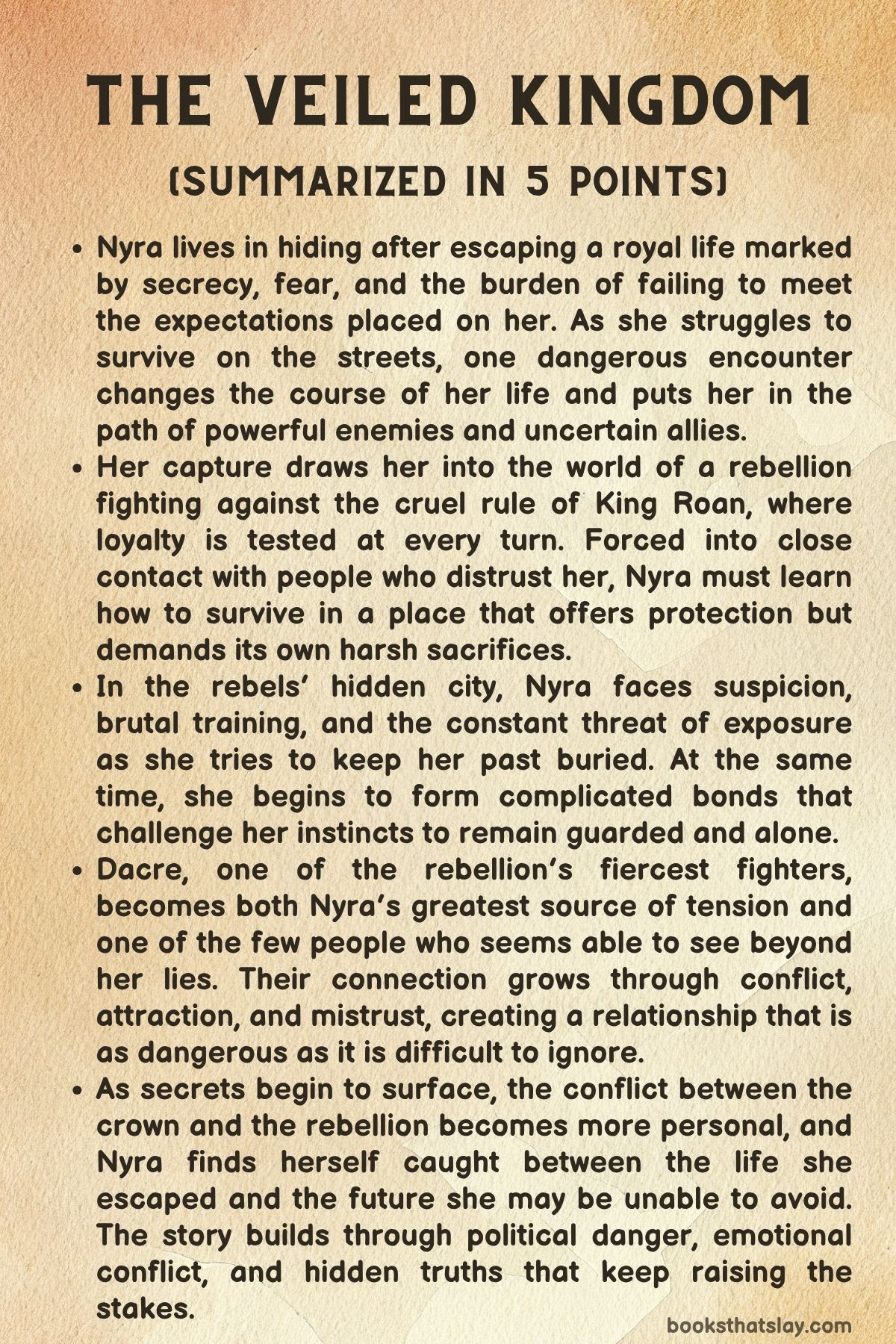
The story follows Nyra, who is living in hiding after escaping the palace of her father, King Roan. Though she is his daughter, she grew up shut away and treated as a shameful secret because she never showed the magical ability expected of a fae royal.
In Roan’s kingdom, magic is not only valued but demanded. Citizens must surrender a portion of their power in a tithe, and those who cannot or will not comply are killed.
Nyra has spent much of her life under this threat, knowing that if her lack of magic becomes widely known, she will be exposed as weak and useless in her father’s eyes. After a rebel attack on the palace gives her the chance to flee, she survives on the streets by stealing, lying, and keeping her true identity hidden.
Her fragile life falls apart when guards catch her after a theft and notice the rebel mark on her wrist. She is thrown into a dungeon cell, where she becomes caught up in a rescue led by Dacre, one of the rebellion’s strongest fighters.
Dacre is trying to save his sister, Wren, from imprisonment, but when Wren refuses to leave another prisoner behind, he takes Nyra with them as well. From the start, there is suspicion between them.
Dacre senses something unusual about her and does not trust her story. Nyra, meanwhile, knows that if he or the rebels learn who she really is, she could become a weapon, a hostage, or a corpse.
Dacre, Wren, and their ally Kai bring Nyra to the rebellion’s hidden city, a secret settlement built beneath the world above. The place is both beautiful and unsettling, filled with ancient structures, bridges, vines, and lanterns glowing in the dark.
It is also a place ruled by pressure and violence. Nyra quickly learns that the rebels are not gentle heroes.
They claim to fight cruelty, but they also kill without hesitation and demand loyalty. Dacre proves this when he executes a recruit who refuses to join them.
Nyra is disgusted by his brutality and sees that the rebellion has its own hard edges, even if its enemies are worse.
Because Nyra claims to have no magic, Dacre places her among the warriors for training. He assumes she is lying, since it is almost unheard of for a fae to reach adulthood without any power.
Nyra enters this new life carrying fear on every side. She hates her father for his cruelty, for the way he treated her mother, and for the abuse he inflicted on her.
Yet she also cannot trust the rebellion, especially because its leader, Davian, is obsessed with finding the lost princess and using her for his cause. Nyra lives in constant dread that her bloodline will be discovered.
In the hidden city, she grows closer to Wren, who becomes her friend and roommate. Through Wren, Nyra learns more about the rebellion’s losses.
Wren and Dacre’s mother died during the earlier palace raid, and their father has given himself over completely to the rebellion since then. Wren understands what it means to be wounded by a parent’s choices, which helps her connect with Nyra.
Their friendship gives Nyra her first sense of safety in a long time.
At the same time, Nyra’s connection with Dacre becomes more charged. Their relationship begins in conflict.
He pushes her in training, mocks her weakness, questions every answer she gives, and watches her too closely. She argues with him, challenges his ideas, and refuses to be intimidated, even when she is physically outmatched.
Yet beneath the hostility is a powerful attraction. Dacre finds himself unable to stop thinking about her, and Nyra, despite knowing he could become dangerous to her, is drawn to him as well.
This tension deepens through shared moments that lower their defenses. Dacre heals her injuries at the hot springs, and Nyra is shaken by the contrast between his roughness and his care.
Later, when she ends up in his room, he sees the scars left by the abuse she suffered and demands to know who hurt her. She does not tell him the truth, but his anger at her pain changes something between them.
For Dacre, Nyra stops being only a suspicious outsider. For Nyra, Dacre becomes someone who sees her wounds without turning away.
Still, trust remains out of reach. Dacre knows she is hiding pieces of her past, and Nyra knows he remains loyal to a movement that would use her if it knew her name.
Matters become more complicated when another warrior, Eiran, shows interest in Nyra. Dacre’s jealousy becomes obvious, and Nyra begins to see how much his feelings are slipping beyond his control.
Their attraction leads to a heated encounter away from the others, where desire finally breaks through restraint. Even then, secrecy remains between them.
The political danger around Nyra rises when she joins a mission outside the hidden city. There, Davian meets a contact inside the king’s forces, but the meeting goes wrong when the man recognizes Nyra.
He identifies her as the missing princess before dying, and Davian turns on her at once, grabbing her by the throat and demanding answers. Though Nyra survives the confrontation, the moment makes clear how quickly her life could end if the rebellion fully confirms who she is.
Dacre is furious when he sees the marks Davian leaves on her and defies his father by healing her himself, despite his long refusal to use that power after failing to save his mother.
Soon afterward, a turning point arrives when Dacre takes Nyra beyond the hidden city and trains her at the coast. During their lesson, he pushes her until something dormant inside her finally breaks free.
Nyra releases a blast of magic, shocking both of them. For Nyra, it is the first proof that she is not empty after all.
For Dacre, it confirms that she has either lied to him or hidden something even from herself. The discovery changes the stakes of everything.
Nyra is no longer simply a mysterious girl from the palace. She is a woman with power, and power always has consequences in this world.
As Nyra struggles to understand her newly awakened magic, her bond with Dacre continues to intensify. They circle each other through anger, desire, and moments of emotional honesty.
Nyra finally tells him that her father was responsible for the scars on her body, revealing part of the truth she has hidden for so long. Dacre is horrified by what was done to her and increasingly torn between his duty to the rebellion and his growing need to protect her.
The crisis comes when a secret message from Dacre’s grandmother reaches him. The note confirms what he has begun to suspect: Nyra is in fact Princess Verena, the king’s lost daughter.
It also makes clear that she is no longer protected within the palace and must be kept safe. Davian already knows enough to see the danger.
He accuses Dacre of endangering the rebellion by rescuing and growing close to her, and he orders Dacre to bring her in. Dacre is trapped between obedience to his father and loyalty to the woman he has come to care for.
When Dacre returns to Nyra, he is shaken and conflicted. Instead of immediately turning her over, he gives in to his feelings and they sleep together.
In the middle of that intimacy, however, the truth comes out: Dacre reveals that he knows she is Princess Verena. The moment shatters Nyra’s sense of safety.
What had felt like closeness becomes betrayal. Dacre then tells her to run before his father sends him after her.
Faced with the collapse of trust and the certainty of danger, Nyra flees.
The book ends with Nyra once again forced into escape, but now everything has changed. Her identity is no longer safe, her magic has awakened, and her connection with Dacre has become both her greatest comfort and one of her greatest risks.
The rebellion, the crown, and her own past are closing in on her at the same time, setting up a conflict in which love, loyalty, and survival can no longer be separated.
Characters
Nyra / Verena
Nyra is the emotional and moral center of The Veiled Kingdom, and her character is shaped by contradiction from the very beginning. She is a princess who has lived like a discarded child, a fae born into a powerful bloodline yet raised under the shame of seeming powerless.
That conflict defines nearly every choice she makes. She has learned how to survive through secrecy, restraint, and quick thinking because her life in the palace taught her that weakness is punished and exposure is dangerous.
Her years in hiding have made her resourceful, suspicious, and emotionally guarded. At the same time, she is not hardened to the point of cruelty.
She still reacts with horror to suffering, still questions violence even when committed by those who oppose a tyrant, and still wants to believe there can be a life beyond fear. This balance between toughness and vulnerability makes her feel fully human rather than simply heroic.
What makes Nyra especially compelling is that her struggle is not just external. She is not only running from her father or hiding from the rebellion.
She is also trying to understand who she is when the identities forced on her no longer fit. In the palace, she was the king’s failure, the daughter without visible magic, the hidden problem that threatened royal appearances.
On the streets, she became a thief and survivor. In the hidden city, she is seen as a possible traitor, recruit, liar, or weapon.
None of these roles allow her the dignity of self-definition. Her journey is therefore one of recovery as much as escape.
She has to reclaim a self that was buried under abuse, secrecy, and fear. Even her use of the name Nyra carries emotional meaning because it ties her to her mother and to a softer part of herself that still longs for belonging.
Her relationship with power is one of the most revealing aspects of her character. Because she has lived without magic for so long, she has built her identity around absence.
She expects rejection, assumes she will be judged as lesser, and views discovery as a threat rather than a liberation. When her power finally appears, it does not instantly make her confident.
Instead, it shakes the fragile structure by which she has understood herself. The awakening of her magic forces her to face both possibility and danger.
It means she is not empty, but it also means she is now more valuable to people who might use her. This makes her arc more complex than a simple story of hidden strength.
Her magic does not erase her trauma. It changes the terms of her survival, but it does not solve the emotional damage caused by years of cruelty.
Nyra’s relationships also show how carefully her character is built. With Wren, she allows friendship and honesty to return in small pieces.
With Dacre, she is drawn toward desire, anger, and trust all at once, which reveals how deeply she longs to be seen even while fearing what that visibility could cost her. Her instincts are often divided between retreat and closeness.
That emotional tension gives her scenes a sharp energy because she is always measuring risk. Even when she chooses intimacy, she never fully abandons self-protection.
By the end, she stands as a character who is stronger than she knows, wounded in ways that still shape her, and increasingly unable to remain hidden. Her story is not only about discovering power but about learning whether she can live as a person rather than as someone else’s secret, shame, or prize.
Dacre
Dacre is built as a figure of force, discipline, and danger, but the deeper layers of his character reveal a man who is far less certain than he appears. He has been shaped by rebellion, trained to act decisively, and admired as a warrior by those around him.
On the surface, he seems like someone who knows exactly where he stands. He kills when he believes it is necessary, questions weakness, and expects obedience.
Yet beneath that hard exterior is a person carrying grief, disappointment, and unresolved anger toward both his enemies and his own family. He is loyal to the cause he was raised in, but he is not at peace within it.
His mother’s death remains a defining wound, and his father’s cold devotion to rebellion has left Dacre with a model of manhood built on sacrifice without emotional care.
One of the strongest aspects of Dacre’s characterization is the way his authority is undercut by emotional instability. He is respected by others, but when Nyra enters his life, his control begins to fray.
His suspicion toward her is real, yet it quickly becomes entangled with attraction, protectiveness, and possessiveness. He does not know how to deal with desire in a way that is emotionally honest, so it often emerges through taunting, command, and jealousy.
This does not make him simple or romantic in an easy sense. It makes him volatile.
He is someone who has spent his life turning feeling into action and turning uncertainty into aggression. Nyra challenges that method because she resists his dominance, questions his righteousness, and awakens emotional needs that do not fit the rigid world he has accepted.
His relationship with healing is especially important. Dacre carries healing magic from his mother, but he stops using it after failing to save her.
That failure has clearly become a private symbol of inadequacy, one that stands in contrast to his image as a powerful warrior. When he chooses to heal Nyra, it is not just an act of care.
It is also a return to the part of himself he has avoided because it reminds him of loss. In that sense, Nyra does not merely attract him; she reopens pieces of him that he has buried.
This is one reason his connection to her feels so destabilizing. She pulls him toward tenderness in a life built around hardness.
Dacre’s deepest conflict lies between loyalty and conscience. He wants to honor his father, protect his sister, and serve the rebellion, but he increasingly sees the moral damage within that world.
Davian’s behavior, especially toward Nyra, exposes the rebellion’s descent into obsession and brutality. Dacre is forced to confront the possibility that the movement he serves may no longer represent justice in the way he once believed.
That crisis becomes sharper when he learns Nyra’s true identity. His feelings for her do not erase his training or his obligations, which is why he makes choices that are painful and compromised rather than cleanly noble.
He becomes a tragic kind of romantic figure because he is divided against himself. He wants to protect her, wants her, distrusts her, and still cannot break free from the structure of duty that formed him.
His character works because he is not a fantasy of certainty. He is a man trying to hold together violence, love, grief, and inherited purpose, and failing to do so without causing harm.
Wren
Wren brings warmth, emotional intelligence, and balance to the story. In a world shaped by suspicion and brutality, she often acts as the bridge between people.
She is a rebel like her brother, but she does not carry his harshness in the same way. She has suffered deeply, especially through the loss of her mother and the emotional distance of her father, yet she remains open enough to form genuine connections.
Her friendship with Nyra becomes one of the most stabilizing relationships in the narrative because it is built on shared grief rather than political advantage. Wren sees Nyra as a person before she sees her as a puzzle, and that instinctive generosity makes her crucial to the emotional structure of the story.
Wren’s strength is easy to underestimate because she is not presented with the same dominating energy as Dacre or Davian. Yet she is quietly formidable.
She trains, fights, and survives in the rebellion’s world, but she also retains the ability to question the people around her. She does not idolize her brother in the way many others do, and she is willing to name the damage caused by her father’s single-minded devotion.
This gives her a grounded perspective that many of the other characters lack. She is neither naive about the rebellion nor fully consumed by it.
Because of that, she becomes one of the few people who can offer Nyra both safety and realism.
Her bond with Nyra also reveals how loneliness works across class lines. Though one is a hidden princess and the other a rebel fighter, both know what it means to grow up in the shadow of parental pain.
Wren understands abandonment in emotional terms, while Nyra understands it through secrecy and abuse. Their conversations show how women in the story often carry the emotional truth that men around them refuse to face.
Wren is not just a supportive side character. She represents an alternative mode of strength, one rooted in loyalty without blindness and affection without control.
Davian
Davian is one of the clearest examples of how a righteous cause can become corrupted by obsession. As leader of the rebellion, he should stand as a counterforce to King Roan’s cruelty, and in some ways he does.
He fights against a regime built on terror, magical exploitation, and murder. Yet the more he is shown, the more obvious it becomes that rebellion has consumed his humanity rather than refined it.
He has lost his wife, placed the movement above his children, and narrowed his thinking until everything is judged by usefulness to the cause. That narrowing is what makes him so dangerous.
He is not cruel for pleasure in the same way Roan appears to be, but he has become capable of terrible acts because he no longer treats people as ends in themselves.
His treatment of Dacre and Wren shows how completely he has failed as a father. He commands rather than nurtures, expects sacrifice rather than offering comfort, and seems emotionally unavailable even in moments when his children most need him.
The death of his wife should have deepened his bond with them, but instead it appears to have pushed him further into fanaticism. This does not make him emotionless.
On the contrary, he is driven by grief, rage, and desperation. The problem is that he has allowed those feelings to justify whatever he believes necessary.
His fixation on finding the lost princess is part of that pattern. He sees her not as a young woman shaped by violence and secrecy but as a political asset.
His attack on Nyra is one of the moments that most clearly exposes his moral decline. Faced with the possibility that she is the missing royal, he responds not with caution or strategy but with immediate physical domination.
That reaction reveals how thin the line has become between him and the kind of ruler he opposes. Davian is effective as an antagonist not because he lacks reason, but because his reasons have swallowed his compassion.
He stands for the frightening possibility that resistance to tyranny can reproduce tyranny when it forgets the value of individual lives.
King Roan
King Roan is the source of much of the story’s violence, not only politically but psychologically. He rules through fear, extracting magic from his people and murdering those who cannot meet his demands.
This alone would make him a brutal monarch, but his role as Nyra’s father gives his cruelty a more intimate and disturbing dimension. He does not merely fail his daughter.
He hides her, resents her, punishes her, and scars her in attempts to force from her the power she does not seem to possess. His treatment of her turns the palace from a royal home into a site of imprisonment and terror.
That personal abuse mirrors the wider violence of his kingdom, suggesting that his political rule is an extension of the same hunger for control he practices in private.
Roan’s need for power appears tied to image as much as authority. Nyra’s lack of visible magic threatens the illusion of royal perfection, so he conceals her existence rather than accept her as she is.
This makes him a ruler who cannot tolerate any sign of weakness, difference, or unpredictability. Even family must be shaped into symbols that serve his rule.
His forcing of the queen toward another dangerous pregnancy also reveals how completely he treats others as instruments. Love, care, and grief have no visible place in his decisions.
Everything is subordinated to legacy, dominance, and magical power.
Despite not occupying every scene, Roan’s presence stretches across the entire story. He exists not only as a king but as a trauma that lives inside Nyra.
Her fear, secrecy, and difficulty trusting others are all linked to what he did to her. He becomes more than a villainous father.
He embodies a form of patriarchal power that makes worth conditional, turns children into extensions of ambition, and confuses fear with loyalty. His character helps explain why Nyra struggles to accept care and why the rebellion’s own violence feels so unsettling.
She has already lived under a man who demanded submission in the name of order.
Kai
Kai serves as one of the quieter but more dependable figures in the rebellion. He may not dominate the emotional center of the story, but his presence matters because he often functions as a stabilizing force amid the volatility of characters like Dacre and Davian.
His magical abilities and skill in combat show that he is an important operational member of the rebellion, yet what stands out most is his awareness of the tensions around him. He notices Dacre’s moods, understands the political pressures within the hidden city, and often seems to grasp more than he says aloud.
This restraint gives him a distinct role. He is not impulsive, nor is he driven by ego.
Kai’s friendship with Dacre appears grounded in long familiarity. He can warn, observe, and comment in ways others cannot, which suggests a bond built on trust.
He does not challenge Dacre in dramatic fashion, but he does serve as a quiet check against extremes. In a narrative full of emotional escalation, that quality matters.
He also helps reveal Dacre’s interior state by being one of the few people close enough to witness changes in him. Through Kai, the reader sees how unusual Dacre’s attachment to Nyra really is.
At the same time, Kai’s place in the rebellion shows the collective nature of the struggle. Not every rebel is given a grand emotional arc, but figures like him remind us that movements are sustained by people who observe, assist, and endure.
His character adds texture to the hidden city by showing that not all loyalty takes the form of dramatic speeches or visible leadership. Some of it is built through competence, endurance, and knowing when to speak.
Eiran
Eiran introduces a different kind of masculine energy into the story, one that highlights Dacre’s possessiveness and Nyra’s emotional uncertainty. He is flirtatious, confident, and openly interested in Nyra, which makes him both a genuine character and a narrative contrast.
Where Dacre often communicates through challenge and command, Eiran offers a more direct form of attention. This does not necessarily make him deeper or safer, but it does create another possibility in Nyra’s social world.
His interest shows that she is not seen only through suspicion. She is also desirable, noticeable, and capable of drawing affection outside the intense orbit of Dacre.
Eiran’s role is especially effective because he exposes underlying tensions. Dacre’s jealousy becomes more visible when Eiran enters the picture, and Nyra’s responses show that she is trying to understand her own desires rather than simply surrendering to the strongest force in the room.
Eiran is not developed with the same emotional weight as the central figures, but he matters because he gives shape to choices, rivalries, and perceptions inside the hidden city. He also reflects the competitive culture among the rebels, where status, skill, and personal desire often overlap.
Micah
Micah represents the fragile life Nyra built during her time in hiding. He is tied to her life on the streets, to improvisation, theft, and friendship outside royal identity.
His importance lies not in political power but in what he symbolizes. With him, Nyra is not a princess, a weapon, or a rebel recruit.
She is simply a girl trying to survive. That makes his presence emotionally significant even when he is absent from much of the action.
He marks a period in her life where identity was reduced to necessity but also freed, in some ways, from the suffocating expectations of palace bloodlines.
He also shows how loneliness pushes people into makeshift forms of family. Nyra cannot tell him who she really is, yet they still share trust and mutual dependence.
The fact that she worries about him later reveals how deeply she values that bond. In a story full of political manipulation, Micah stands for connection formed at ground level through hardship.
He reminds the reader that Nyra’s life did not begin when she entered the rebellion. She had already built attachments, habits, and emotional debts in the dangerous freedom of the streets.
Mal
Mal contributes to the hardness of the hidden city and helps define the culture into which Nyra is forced. She is stern, disciplined, and quick to remind Nyra that trust has not been earned.
Her behavior may seem cold, but it fits the rebellion’s environment, where secrecy is necessary and emotional softness can be seen as a liability. She gives the sense of someone fully formed by conflict, a person who has absorbed the values of vigilance and order until they shape every interaction.
Through her, the story shows that women in the rebellion are not automatically kinder or more emotionally available than the men. Some have survived by becoming just as severe.
Her presence matters because she reinforces the pressure Nyra faces from all sides. There is no easy sisterhood waiting for her in the hidden city.
Acceptance must be earned, and even then it may remain conditional. Mal helps create that atmosphere.
She is not a central emotional figure, but she strengthens the world by showing how rebellion has become a system with its own rules, gatekeepers, and harsh expectations.
Camilla
Though Camilla is no longer alive during the main events, her influence remains strong through memory and emotional consequence. As Dacre and Wren’s mother, she represents a lost version of family life that was warmer, more balanced, and more humane than what remains after her death.
Her absence reveals the damage that rebellion has inflicted not only on bodies and politics but on the home itself. Dacre’s inability to heal after failing to save her shows how central she was to his identity.
Wren’s grief and Davian’s transformation are also shaped by her loss, though each responds differently.
Camilla’s significance lies in contrast. She seems to have been both loving and strong, someone who held together the emotional life of her family even within a violent political struggle.
After she is gone, Davian becomes more rigid, Dacre becomes more burdened, and Wren becomes more openly aware of what has been lost. In that sense, Camilla is not only a memory of maternal love but a measure of how far the surviving characters have drifted from wholeness.
Nyra’s Mother
Nyra’s mother, the former queen, is another absent figure whose emotional importance is substantial. She appears in memory as the opposite of Roan’s brutality.
Her death leaves Nyra without protection in the palace and deepens the sense that royal life was not merely lonely but structurally unsafe for women. The fact that she was pushed toward another pregnancy against medical advice reveals the violent logic of dynastic power.
Even as queen, she was not allowed bodily autonomy or safety. Her death therefore carries both emotional and thematic force.
It is personal tragedy shaped by political entitlement.
For Nyra, her mother remains tied to tenderness, loss, and identity itself. The name Nyra is linked to her, which gives the adopted identity a deeper emotional root.
This connection helps explain why Nyra clings so strongly to certain memories and why the revelation of her true status is emotionally complex rather than empowering in a simple way. Her mother represents a lost possibility of love within the palace, which makes Roan’s cruelty feel even more devastating.
Themes
Power as Control, Extraction, and Possession
Power in The Veiled Kingdom is not presented as an abstract virtue or a neutral resource. It is shown as something tied to ownership, force, and hierarchy from the opening pages onward.
King Roan’s rule makes this plain through the magical tithe, a system that turns the people’s gifts into a source of state control. Magic is not treated as a wonder to be nurtured but as a commodity to be taken.
The kingdom’s political order depends on extraction, and those who cannot produce enough are treated as disposable. This creates a world in which value is measured by what can be surrendered, weaponized, or displayed.
In that kind of society, power is never only about strength. It is about who gets to define worth and who pays for that definition with their body.
This theme also shapes the private lives of the characters. Roan’s abuse of his daughter reveals the most intimate face of domination.
He does not simply want Nyra to possess magic; he wants her body and identity to confirm his authority. Her failure to manifest power threatens his image, so he responds with concealment and violence.
The same logic appears elsewhere in altered forms. Davian wants the lost princess because she can shift political outcomes.
Dacre’s early interactions with Nyra are often marked by the assumption that she is hiding something valuable that must be exposed. Again and again, the story shows people treating power as something to seize from others, interpret for them, or control on their behalf.
What makes this theme especially rich is that Nyra’s eventual awakening of magic does not read as uncomplicated triumph. Her power appears at the very moment when her personal and political vulnerability are already reaching dangerous levels.
This means the arrival of magic does not equal freedom. Instead, it raises the stakes around her body and identity.
She becomes more visible, more desirable, and more threatening within systems that already reduce people to usefulness. The story therefore questions the fantasy idea that discovering one’s hidden power automatically solves suffering.
Here, power attracts possession. It can become another reason for others to claim authority over a life.
Even desire is shaped by this theme. Several emotionally charged scenes are written around command, control, and resistance, showing how deeply the culture of force has entered personal relationships.
The story does not separate politics from intimacy. The same world that teaches rulers to extract from subjects teaches people to express desire through dominance and testing boundaries.
This gives the novel a darker emotional climate and reinforces the idea that power is not just held by institutions. It moves through family, loyalty, romance, and fear.
By presenting power as something people use to define, wound, and claim one another, the narrative creates a world where the struggle is not merely to become strong, but to imagine forms of strength that do not rely on possession.
Identity Shaped by Secrecy and Reinvention
Identity in this story is unstable, concealed, and often split between inner truth and outer performance. Nyra lives under layers of false naming, partial confession, and careful silence because survival requires her to become unreadable.
She is the king’s daughter, yet she cannot safely live as a princess. She is born Verena, but emotionally attached to the name Nyra through her mother and through the self she built outside royal walls.
She has spent so long hiding parts of herself that identity stops feeling like a stable fact and becomes a shifting arrangement between memory, fear, and circumstance. This makes the question of who she is much more complicated than a secret lineage reveal.
She is not simply waiting for her “real” identity to be restored. She is living with several selves, each created under pressure.
The story treats secrecy as both protection and damage. Hiding allows Nyra to stay alive, but it also leaves her unable to fully trust others or inhabit intimacy without reservation.
Every relationship is shaped by what she cannot say. Her friendship with Micah exists without the truth of her past.
Her bond with Wren grows in the shadow of what remains concealed. Her relationship with Dacre becomes charged partly because he senses a hidden self within her and cannot stop trying to force it into the open.
This means secrecy is never passive in the novel. It actively structures emotional life.
It decides who gets close, what can be shared, and when tenderness turns into risk.
The theme becomes more powerful because other characters are also caught in forms of fractured identity. Dacre presents himself as a decisive rebel warrior, yet internally he is divided by grief, doubt, desire, and anger toward his father.
Davian is publicly a liberator but increasingly behaves like a tyrant in waiting. Wren occupies the role of rebel daughter and fighter, but she also sees the emptiness beneath the ideals of the movement more clearly than many others do.
In this way, identity is not unstable only for the hidden princess. The entire social world is made of masks people wear to survive institutions, expectations, and inherited loyalties.
Nyra’s magic deepens this theme because it disrupts the identity she has constructed around lack. For years, she has understood herself as the one without power, the one hidden because she is different in the wrong way.
When magic appears, it does not simply reveal a truth that was always whole. It collides with the story she has told herself in order to endure.
That collision is deeply unsettling. The self she built in response to absence must now adjust to unexpected possibility, and the people around her immediately reinterpret her through that new fact.
Identity in the novel is therefore not essence waiting to be uncovered. It is something repeatedly rewritten under pressure from bloodline, violence, memory, and desire.
The result is a story deeply interested in how a person survives when truth itself has become dangerous.
Violence and the Moral Corrosion of Survival
Violence in this narrative is never confined to the battlefield. It appears in government policy, family relationships, rebellion strategy, punishment, and desire.
The world is built on repeated acts of force, and this constant exposure changes the moral language available to the characters. People are not simply deciding between good and evil.
They are living in conditions where survival itself can erode judgment. This is one of the most compelling dimensions of the book’s darker atmosphere.
No group escapes contamination. The monarchy is openly brutal, but the rebellion also carries its own forms of cruelty, coercion, and dehumanization.
Nyra’s viewpoint is especially important in revealing this theme because she has seen violence from more than one angle. She knows the intimate terror of palace abuse and the larger horror of a king who murders citizens for failing to meet impossible demands.
When she arrives among the rebels, she expects opposition to that cruelty to look morally clearer than it does. Instead, she witnesses summary execution, manipulation, and suspicion.
Dacre’s killing of a recruit who refuses to join shocks her because it forces her to confront the fact that resistance does not automatically produce justice. The story refuses the comfort of simple moral camps.
It insists that people can be victims of oppression and still commit acts that reproduce the logic of domination.
Davian embodies this moral corrosion in especially sharp form. Grief, political urgency, and repeated loss have narrowed his world until he can justify almost anything in the name of liberation.
His attack on Nyra is not presented as an isolated failure of temper but as the outcome of a long process in which the cause has become more sacred than individual lives. Roan represents cruelty tied to entitlement, while Davian represents cruelty tied to desperation and righteousness.
The contrast matters because it shows two different routes by which violence becomes normal. One emerges from power secure in itself; the other from power still seeking victory.
Neither is innocent.
The personal relationships in the story are also shaped by this damaged moral environment. Characters often test, provoke, or dominate one another because tenderness has become hard to separate from threat.
Even moments of care are marked by prior harm, as when healing follows injury or emotional closeness appears after episodes of fear and conflict. The result is a world where survival teaches people to normalize extremes.
Bodies bear scars, but so do habits of feeling. Trust is difficult because nearly everyone has been trained by violence in some form.
What makes this theme resonate is that the story does not suggest people are doomed to brutality by nature. Instead, it shows how systems of fear and prolonged struggle distort ethical behavior over time.
Characters still long for gentleness, safety, and love, but they often reach for those things with damaged hands. Violence, then, is not only an event in the novel.
It is an atmosphere that enters language, desire, loyalty, and identity. The story asks what kind of person one can remain when every path to survival seems to demand some compromise with harm.
Desire, Trust, and Emotional Risk
Desire in The Veiled Kingdom is never merely romantic attraction. It is tied to fear, secrecy, vulnerability, and the risk of being known.
Nyra and Dacre’s relationship carries so much tension because both are drawn to each other at the exact moment when trust is least available. He is part of a rebellion that could use or destroy her if her identity is confirmed.
She is hiding truths that challenge everything he believes about loyalty, enemies, and duty. This means attraction develops in a field already charged with danger.
Their connection is not comforting from the outset. It is unstable, confrontational, and emotionally risky, which gives it intensity but also moral complication.
One of the most interesting things about this theme is how often desire appears alongside acts of perception. Dacre studies Nyra, questions her, notices her scars, senses that she is withholding something.
Nyra, in turn, sees the grief beneath his arrogance, the care beneath his aggression, and the fractures in his loyalty to the rebellion. They are drawn not just to each other’s bodies but to the mystery and damage each carries.
In that sense, desire becomes a form of recognition. It exposes where emotional defenses are weakest.
Neither of them falls into love through ease. They move toward each other because each senses something unresolved in the other that mirrors their own instability.
Trust, however, develops far more slowly and never fully arrives. This is essential to the story’s emotional design.
Nyra cannot safely surrender knowledge of herself, and Dacre cannot free himself from suspicion because his entire life has trained him to detect danger. Their moments of intimacy therefore carry the charge of partial surrender rather than mutual security.
Care is genuine, but it remains entangled with power, jealousy, and hidden information. That is why the revelation of Nyra’s identity lands with such force.
It does not simply expose a lie. It confirms that their desire has grown in a space where truth was always unstable.
This theme also connects strongly to trauma. Nyra’s history makes closeness difficult because being seen has often led to pain.
Dacre’s history makes tenderness difficult because loss and failure have taught him to cover feeling with control. When they move toward intimacy, they are not just choosing one another.
They are testing whether closeness can exist without immediate destruction. The story often answers that question ambiguously.
There are moments of comfort, healing, and emotional honesty, but there are also moments where desire becomes tangled with dominance, resentment, or betrayal.
What gives this theme depth is that it refuses sentimental simplification. The novel does not pretend that attraction automatically creates trust or that emotional vulnerability appears cleanly between wounded people.
Instead, it shows desire as something that can open the door to care while also making betrayal more devastating. To want someone is to risk being changed by them, exposed before them, and wounded through them.
In this story, that risk is heightened by politics, secrecy, and violence, which makes intimacy feel both precious and unstable.