After Dark Summary, Characters and Themes
After Dark by Haruki Murakami is a short, strange, night-bound novel set in Tokyo between midnight and dawn. It follows Mari Asai, a guarded college student spending the night outside her home, and her sister Eri, a former model trapped in an unnatural sleep.
Around them move musicians, hotel workers, gangsters, office workers, and women living under threat. The novel shifts between realistic encounters and dreamlike scenes, using the city after midnight as a space where hidden fears, loneliness, violence, and fragile connections come to the surface. It is quiet, eerie, and deeply concerned with how people remain separate yet somehow linked.
Summary
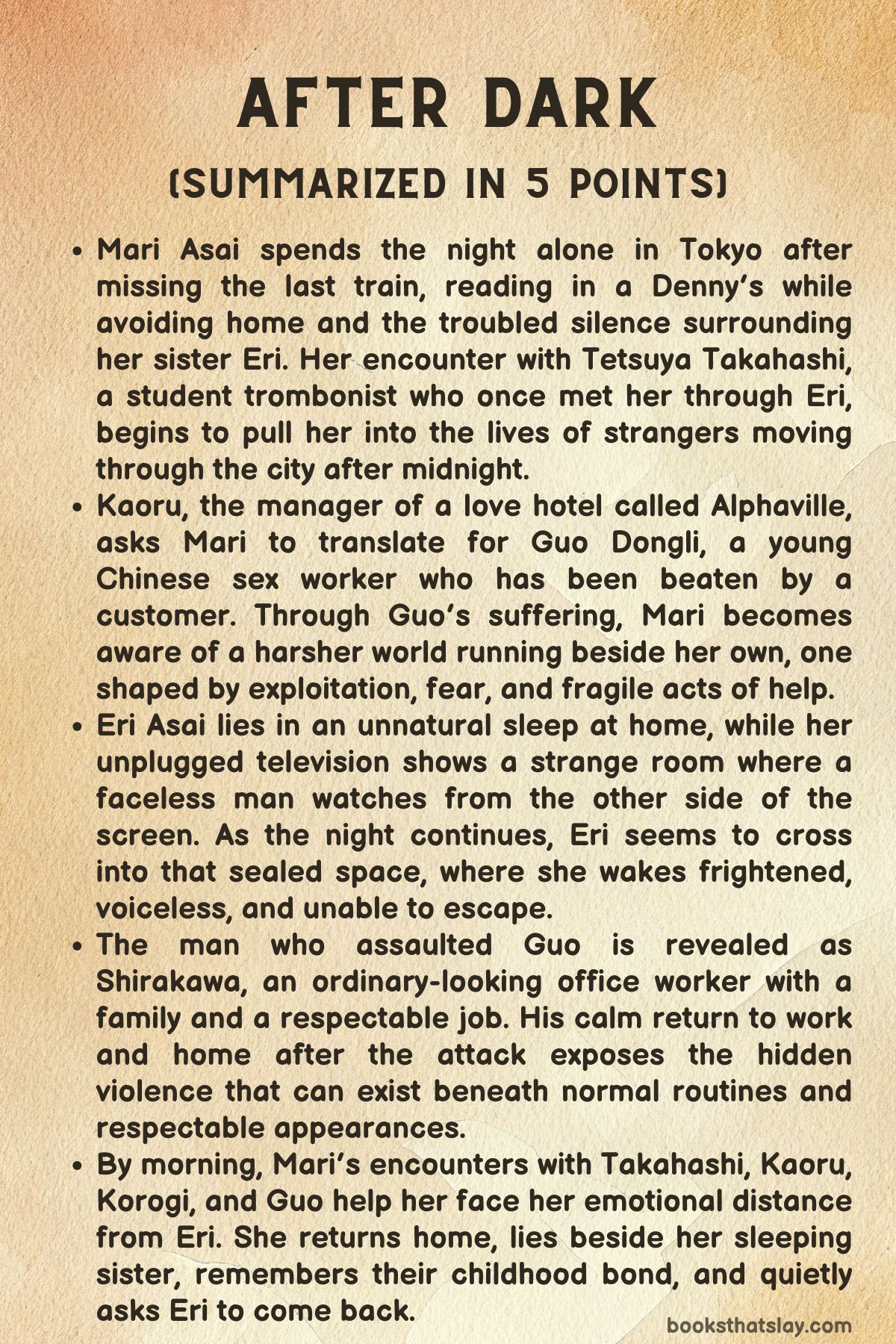
After Dark takes place over one night in Tokyo, beginning just before midnight and ending shortly after sunrise. The story opens in a busy Denny’s restaurant in an entertainment district.
Mari Asai, a nineteen-year-old college student, sits alone with a large book, drinking coffee and smoking while waiting for morning trains to begin running again. She has no clear desire to go home.
Her night seems carefully planned around avoidance: she wants to stay awake, remain anonymous, and pass the hours in public places.
A young trombonist named Tetsuya Takahashi enters the restaurant and recognizes her. He had met Mari two years earlier on a double date involving her older sister, Eri.
Takahashi remembers Mari as quiet, intelligent, and difficult to approach, while Eri was strikingly beautiful and already used to being admired. Mari is guarded with him, but their conversation slowly becomes easier.
Takahashi tells her about his music, his love of jazz, and his upcoming practice session. He gives her his phone number before leaving, sensing that something may be troubling her.
The novel then shifts to Eri Asai’s bedroom. Eri lies in a deep, unnatural sleep.
Her room is clean, spare, and oddly impersonal, decorated mainly with photographs from her modeling work. A strange watching presence observes the room as if through a camera.
At midnight, the unplugged television in Eri’s room begins to glow. An image gradually appears: a bare room, possibly an office or classroom, where a man sits silently.
His face cannot be clearly seen. The television seems less like a machine than a window into another space, and the sleeping Eri appears connected to it in some unknown way.
Back at Denny’s, Mari is approached by Kaoru, the manager of a nearby love hotel called Alphaville. Kaoru has been sent by Takahashi because she needs someone who speaks Chinese.
A young Chinese sex worker named Guo Dongli has been badly beaten by a customer and cannot explain what happened in Japanese. Mari reluctantly follows Kaoru to the hotel.
There she meets Komugi and Korogi, two women who work the overnight shift with Kaoru.
Mari translates for Guo, who is also nineteen. Guo explains that her customer attacked her after discovering she had started her period, then stole her clothes, purse, and phone before leaving without paying.
Kaoru gives Guo fresh clothes and lets her make a phone call. A hard-looking man connected to the Chinese gang that controls the sex workers arrives to collect her.
He pays only a small part of the room charge and leaves after making a quiet threat toward Kaoru. The encounter leaves Mari shaken.
Guo is the same age as her, yet their lives could hardly be more different. Mari feels an unexpected connection to her.
Kaoru takes Mari to a bar afterward, and the two talk. Mari explains that she studies Chinese and hopes to become a freelance translator.
She speaks about growing up beside Eri, whose beauty shaped the family dynamic. Their parents treated Eri as the pretty one and Mari as the smart one.
Mari absorbed the idea that she could not rely on her appearance, and the pressure damaged her confidence. She eventually withdrew from ordinary school and found relief at a Chinese school in Yokohama.
Kaoru, a former professional wrestler, tells Mari about her own past and offers her a safe place to rest at the hotel. Mari instead wants to keep reading until dawn.
Meanwhile, the mystery around Eri grows stranger. The man on the television becomes clearer, though his face remains hidden under something like a mask.
He stares through the screen into Eri’s room. Later, Eri vanishes from her bed in the real room and appears asleep inside the room shown on the television.
The other space resembles an empty version of an office, and time continues moving there. The man watches her without touching her.
The sense is not of a normal dream but of a crossing between worlds.
Kaoru searches the hotel security footage and finds the customer who assaulted Guo. He looks ordinary: a clean, middle-aged office worker in a trench coat.
Kaoru prints his image and calls the number Guo used, reaching the gangster who picked her up. She gives him the information, not for money, but because she wants the man found.
The man’s ordinary appearance disturbs Kaoru more than an obviously violent face would have. His normality makes the attack seem even colder.
The attacker is revealed as Shirakawa, a skilled employee at a company called Veritech. He works late in his office, listening to classical music and speaking calmly to his wife on the phone.
He promises to bring home low-fat milk for their children. Nothing in his manner suggests the violence he committed earlier, except for pain in his right hand.
He later sorts through Guo’s stolen belongings, takes back his money, throws her bloodstained clothes into a garbage bag, and leaves her phone in a convenience store dairy section. His careful disposal of evidence is chilling because it is so practical and emotionless.
Takahashi meets Mari again during a break from band practice. They talk at a family restaurant and later in a park where he feeds stray cats.
He tells her he plans to quit serious music and study law. Attending criminal trials changed him.
He once thought there was a clear wall between ordinary people and criminals, but watching the trials made that wall seem uncertain. He began to feel that society itself can become a strange creature capable of swallowing people and reducing them to roles.
His interest in law comes from wanting to understand that power.
Mari and Takahashi also discuss Eri. Takahashi once had a long conversation with Eri, during which she confessed that she wished she and Mari were closer.
Mari is surprised; she had always felt distant from Eri and assumed the separation was natural. Takahashi suggests that Eri may have suffered in ways Mari never understood.
Mari reveals that Eri has been sleeping for two months. She announced one day that she was going to sleep for a long time, and since then she has remained in bed.
Doctors have found no medical explanation. Food disappears and clothes change, so something in her continues functioning, but the family never sees her awake.
Inside the television space, Eri wakes. She finds herself trapped in a silent, sealed room.
The windows show no real world outside, the door will not open, and even her pounding makes little sound. She finds a pencil marked “VERITECH,” linking her prison to Shirakawa’s workplace.
She fears that something inside her is being stripped away and that she may become only a passage for outside forces. She believes sleep might return her to her own world, but she has slept too deeply and cannot easily escape.
Eventually the image breaks down, and she disappears from view.
At Alphaville, Mari rests in a room with Korogi. Korogi admits she is hiding from dangerous people and no longer uses her real name.
She shows Mari a scar on her back and says the ground under a person’s life can collapse without warning. Mari, moved by Korogi’s honesty, tells her about Eri’s sleep.
Korogi thinks Eri may be sleeping because of some burden she cannot face. She advises Mari to remember good things about her sister.
Memories, Korogi says, can help people survive.
Mari then recalls one of her few warm memories of Eri. As children, they were trapped together in an elevator.
Mari was terrified, but Eri held her tightly and comforted her, acting as the brave older sister despite her own fear. That memory becomes important because it proves their bond was once real, even if it has been buried for years.
As dawn nears, Takahashi finds Guo’s abandoned phone ringing in the convenience store and answers it. A man threatens him, saying he will never get away.
Takahashi knows the call is not meant for him, yet the words unsettle him. The threat seems to attach itself to anyone who touches the phone, showing how violence and fear can pass from one person to another by chance.
Takahashi walks Mari to the station and asks to see her again. Mari is surprised by his interest, but he tells her he wants to know her better.
She reveals that she is leaving soon for Beijing on an exchange program and is frightened. He promises to write to her and wait until she returns.
Their parting is quiet but hopeful.
Mari goes home and enters Eri’s room. Eri is still asleep.
Mari gets into bed beside her, rests against her, and begins to cry. She senses the broken flow between their lives starting to connect again.
She kisses Eri and whispers for her to come back, then falls asleep beside her. The television flickers briefly.
Outside, Tokyo wakes into morning. The night’s strange events fade into daylight, but not completely.
In the final moment, Eri’s lips twitch slightly, suggesting that Mari’s return, her memory, and her renewed desire for connection may have begun to reach her.
Characters
Mari Asai
Mari Asai is the emotional center of the novel’s night journey. She begins as a guarded, withdrawn young woman sitting alone in a late-night restaurant, using books, coffee, cigarettes, and distance as shields against other people.
Her choice to stay out until morning is not simply teenage rebellion; it is a way of escaping the suffocating atmosphere at home, where her sister Eri’s unexplained sleep has made ordinary family life unbearable. Mari has grown up in the shadow of Eri’s beauty, shaped by parents who treated her as the clever but less attractive daughter.
This has made her self-conscious, sharp, and defensive. She often responds to kindness with suspicion because she has learned to protect herself from judgment.
Yet Mari is not cold. Her ability to speak Chinese pulls her into Guo Dongli’s crisis, and this encounter changes the direction of her night.
Through Guo, Mari sees another nineteen-year-old woman living under far harsher conditions than her own. This does not make Mari feel superior; instead, it awakens compassion and an unexpected sense of shared existence.
She begins the night trying to isolate herself, but she gradually becomes connected to strangers: Kaoru, Korogi, Takahashi, and Guo. Each conversation forces her to see herself more honestly.
Mari’s relationship with Eri is the deepest wound in her character. She believes she and Eri belong to separate worlds, yet she is also haunted by the possibility that she abandoned her sister emotionally.
Her memory of being trapped in an elevator with Eri gives her a way back to tenderness. By the end of After Dark, Mari’s decision to lie beside Eri is quiet but meaningful.
She stops observing her sister from a distance and physically returns to her. Her tears suggest guilt, love, fear, and relief at once.
Mari does not solve the mystery of Eri’s condition, but she begins to repair the human bond that may help Eri return.
Eri Asai
Eri Asai appears physically passive for most of the novel, yet her presence shapes nearly everything around her. She is described as beautiful, silent, and almost unreal in her sleep.
Her bedroom reflects a life emptied of personal warmth: it is neat, controlled, and decorated with images of herself as seen by others. This suggests that Eri’s beauty has turned her into an object long before the strange television world claims her.
She has been looked at, photographed, admired, and defined from outside, but the novel hints that she has struggled to develop a stable inner self.
Her sleep is both literal and symbolic. On the surface, she has withdrawn from ordinary life for two months, leaving her family helpless and confused.
On a deeper level, her sleep appears to be a refusal to continue performing the role assigned to her. Eri has been the beautiful sister, the model, the admired daughter, and the one who seemed to possess everything Mari lacked.
But Takahashi’s conversation with her reveals that Eri is not satisfied or whole. She wants closeness with Mari and seems unable to communicate that desire properly.
Her condition suggests emotional exhaustion and a loss of identity.
The television scenes externalize Eri’s inner crisis. When she is transported into the sealed room, she wakes into a world where she cannot speak, escape, or make herself heard.
The room resembles an office connected to Shirakawa, linking her imprisonment to the novel’s wider world of systems, violence, and impersonal modern life. Eri’s fear that she may become merely a channel for outside forces captures the danger of losing oneself completely.
Her final small movement suggests that she is not gone forever. She remains suspended between absence and return, and Mari’s renewed closeness may be the first sign that Eri can move back toward life.
Tetsuya Takahashi
Tetsuya Takahashi is one of the novel’s most humane figures. At first, he seems casual and talkative, a lanky student musician who wanders through the night with his trombone case and an easy way of speaking.
His humor and odd stories make him seem light, but beneath that surface he is thoughtful, lonely, and morally alert. He notices people carefully.
He remembers Mari from a meeting years earlier not only because she was Eri’s sister, but because she made a quiet impression on him. His attention to details, from music to food to emotional hesitation, reveals a character who tries to understand the world through small signs.
Takahashi’s love of jazz shows his attraction to freedom, rhythm, and improvisation, but he also knows his limits. He admits that he is not talented enough to become a professional musician and plans to leave the band to study law seriously.
This decision is not merely practical. His experience watching criminal trials has shaken his assumptions about the division between good people and criminals.
He begins to see that ordinary people can be drawn into violence, judgment, punishment, and social machinery in ways they do not fully control. His interest in law grows from fear and curiosity about these forces.
His relationship with Mari develops through patient conversation rather than dramatic romance. He does not force intimacy, but he gently challenges her isolation.
He tells her what Eri said, listens to her fears, and treats her seriousness as intelligence rather than gloom. His background also explains his sensitivity.
Losing his mother young, living with a father who had been imprisoned, and feeling like an orphan even after gaining a stepmother have made him aware of emotional instability. He is drawn to Mari because he recognizes her guardedness and darkness without being frightened by them.
By the morning, he becomes a possible link to a different future for her: not a rescue, but a promise of continued contact.
Kaoru
Kaoru is tough, practical, and protective, but her hardness is rooted in experience rather than cruelty. As the manager of Alphaville, she operates in a world of sex work, late-night danger, shady customers, gang control, and people who cannot easily call the police.
She understands the rules of this underground environment and knows when to act, when to be cautious, and when to accept risk. Her physical presence and blunt speech make her seem intimidating at first, but she quickly emerges as one of the novel’s most morally solid characters.
Her past as a professional wrestler is important because it explains both her strength and her damage. She once lived through performance, pain, physical risk, and public attention.
Her wrestling career ended after injury, and the money she earned went toward family obligations rather than personal freedom. This background gives her a rough sympathy for people who have been used by others.
She does not sentimentalize Guo’s suffering, but she refuses to ignore it. Her anger at the man who assaulted Guo comes from a clear sense that someone must answer for what he did, even if legal justice is not available.
Kaoru also acts as a bridge between strangers. She brings Mari into Guo’s situation, introduces her to the hidden life of the hotel, and later tries to keep her safe.
Her kindness is never soft or polished; it appears through action, payment, shelter, and protection. She speaks bluntly to Mari about beauty, fear, and danger, offering the kind of practical affirmation Mari rarely received from her family.
Kaoru’s character shows that care can exist in harsh places and that people who live outside respectable social spaces may possess a stronger ethical instinct than those who appear respectable in daylight.
Shirakawa
Shirakawa is one of the most disturbing characters because his violence is hidden beneath ordinary respectability. He is a middle-aged professional with a good job, a wife, children, refined tastes, and a controlled manner.
He listens to classical music, works late, speaks politely on the phone, buys milk for his family, and seems like a responsible company man. This normal appearance makes his brutality toward Guo more frightening.
He is not presented as a visible monster. He is someone who can move smoothly through offices, hotels, taxis, and convenience stores without attracting suspicion.
His treatment of Guo reveals a deep split between outer order and inner violence. After assaulting her, he does not collapse into guilt or panic.
Instead, he calmly disposes of her belongings, retrieves his money, throws away her clothes, and abandons her phone. His actions are methodical, as if he is solving a work problem.
The pain in his hand is the only physical trace of the attack, and even that becomes something he manages privately. His ability to return to domestic life after such cruelty suggests a terrifying compartmentalization.
Shirakawa also represents the violence hidden inside modern systems. His company, Veritech, is associated with sterile offices, late-night work, exhaustion, and impersonal efficiency.
The mysterious connection between his workplace and Eri’s sealed television room suggests that his world is not separate from the novel’s dreamlike threat. He is tied to spaces where people are stripped of voice and agency.
His family life does not redeem him; instead, it emphasizes how easily brutality can coexist with social normality. Shirakawa’s character forces the reader to confront the idea that danger may wear the face of routine, discipline, and professional success.
Guo Dongli
Guo Dongli appears briefly, but her presence has a lasting effect on the story. She is a nineteen-year-old Chinese sex worker who has been beaten, robbed, and abandoned in a hotel room.
Her youth is crucial because it links her to Mari. They are the same age, but their circumstances are drastically different.
Mari has family problems, insecurity, and fear, while Guo faces direct physical violence, exploitation, and control by criminal networks. This contrast does not reduce either character’s suffering; instead, it enlarges Mari’s understanding of what vulnerability can mean.
Guo’s situation exposes the hidden economy of the night city. She is not protected by ordinary institutions.
The police are not a simple option. Her movements are controlled by men who treat her as property, and even those who help her must negotiate with danger.
Her limited ability to communicate in Japanese makes her even more exposed. Mari’s translation is therefore not just linguistic; it becomes an act of recognition.
Through Mari, Guo is able to tell what happened to her, and her pain becomes legible to others.
Although Guo leaves the narrative early, her stolen phone continues to carry danger after she is gone. The threats made through it attach themselves first to Takahashi and later to a store clerk, suggesting that violence does not stay neatly contained around its original victim.
Guo’s character shows how easily a person can be pushed to the margins of visibility, yet still affect the lives of strangers. For Mari, Guo becomes a mirror and a call to empathy.
She makes Mari aware that connection can arise suddenly, even between people who may never meet again.
Korogi
Korogi is one of the novel’s most quietly tragic characters. She works at Alphaville under an alias, having abandoned her real name because she is hiding from dangerous people.
Her chosen name, meaning cricket, suits her life in the margins: small, alert, nocturnal, and difficult to catch. She has the manner of someone who has survived by staying unnoticed.
Unlike Kaoru’s open toughness, Korogi’s defense is secrecy. She understands that identity itself can become unsafe.
Her conversation with Mari reveals the depth of her fear. She once lived an ordinary life with office work, but something caused the ground beneath that life to collapse.
She warns Mari that stability can vanish without warning, a lesson she has learned physically and emotionally. The scar on her back makes her past impossible to dismiss as vague anxiety.
She is not being dramatic; she has been marked by people who may still be looking for her. Yet the novel does not turn her into a simple victim.
She remains observant, kind, and capable of offering wisdom to Mari.
Korogi’s thoughts on memory are especially important. She believes memories help people continue living, even when the present is frightening.
This idea guides Mari back toward her childhood memory of Eri in the elevator. Korogi cannot fix her own life, but she helps Mari find a possible way to repair hers.
Her tenderness is cautious but real. She shares her secrets with Mari because she senses that Mari will understand them, even though they are strangers.
In a story full of isolation, Korogi shows how brief trust can become deeply meaningful.
Komugi
Komugi plays a smaller role than Kaoru and Korogi, but she helps define the atmosphere of Alphaville. Her name, meaning wheat, gives her an earthy, ordinary quality that contrasts with the strange events surrounding the hotel.
She works the night shift with Korogi and Kaoru, handling the practical demands of a place where privacy, secrecy, and crisis are part of the job. Her teasing of Kaoru over technology shows the familiar rhythm among the women, suggesting that their workplace has its own rough form of companionship.
Komugi’s importance lies partly in how she normalizes the hotel environment. Through her, Alphaville is not merely a symbolic setting or a place of danger; it is also a workplace where tired women joke, argue, watch screens, and manage problems.
Her presence helps show that the night city is sustained by people performing labor that daylight society often ignores. She does not receive a major confession scene, but she contributes to the sense of a hidden community among women who know how unsafe the world can be.
She also acts as a witness. Along with Korogi and Kaoru, she watches the security footage, studies the man who hurt Guo, and reacts to the involvement of the Chinese gang.
Her caution helps balance Kaoru’s anger. Komugi understands that revenge, even when deserved, may bring consequences.
Her character reminds the reader that survival in this world often depends on practical judgment. She may not transform the plot on her own, but she helps create the moral and social space in which Mari begins to change.
The Man with No Face
The Man with No Face belongs to the novel’s surreal dimension. He sits silently in the room visible through Eri’s television, watching her with unreadable focus.
His face is hidden by something like a tight mask, which makes him less an individual than a figure of blank surveillance. Because his expression cannot be read, his intentions remain terrifyingly uncertain.
He does not need to act violently to create fear. His steady gaze is enough.
He can be understood as a symbol of impersonal control. He watches Eri while she sleeps, and later she is drawn into the room he occupies.
His facelessness suggests the loss of human identity, both his own and Eri’s. He may represent the gaze that has followed Eri throughout her life: the camera, the public, the modeling world, male attention, social expectation, and the pressure to exist as an image rather than a person.
In this sense, he is not one man but a concentrated form of being watched.
His connection to the television also matters. He exists through a screen, in a space between reality and image.
That makes him part of the novel’s concern with mediation: people see one another through surfaces, roles, photographs, security cameras, screens, and memories. The Man with No Face is frightening because he removes the comfort of ordinary explanation.
He is not defeated or understood. He appears, watches, vanishes, and leaves behind the feeling that unseen forces continue operating beneath everyday life.
The Chinese Gangster
The Chinese gangster who collects Guo is a figure of menace, discipline, and controlled violence. He arrives on a motorcycle, speaks little, and immediately makes clear that he belongs to a world where threats do not need to be loud.
His attitude toward Kaoru is cold and dismissive, especially when he pays only a token amount for the hotel room. Yet he is not careless.
He listens, evaluates, and later accepts the security image of Shirakawa. His presence shows that Guo’s world is controlled by structures far more dangerous than any single customer.
He is not presented as heroic, even though he may pursue the man who hurt Guo. His motive is not simple justice.
Guo is part of a criminal operation, and violence against her is also an offense against that operation’s control. Still, his pursuit of Shirakawa creates a strange moral pressure in the story.
The legal system is absent, the police are avoided, and punishment may come from people who are themselves dangerous. This complicates any easy division between good and bad.
His phone threats after Guo’s cell is abandoned are especially significant. The threat reaches the wrong people, but its language feels universal: no one can run forever.
This turns him into more than a plot figure. He becomes the voice of consequence moving through the night.
The guilty man does not hear the threat directly, while innocent bystanders do. That misdirection captures one of the novel’s darkest ideas: violence spreads unevenly, and fear often lands on people who did not cause the original harm.
The Narrating Camera
The narrating camera is not a conventional character, but it behaves like a presence with its own role in the story. It observes Tokyo from above, moves through rooms, studies bodies, notices objects, and sometimes includes the reader in its watching.
At first it seems neutral, as if it only records what happens. Yet its attention is selective and charged.
It lingers on Eri’s sleep, the television, Shirakawa’s office, empty streets, and the hidden spaces of the night city.
This perspective changes the reader’s relationship to the story. Instead of entering only one character’s mind, the reader becomes part of a watching consciousness.
That creates distance, but also unease. The novel repeatedly asks what it means to observe suffering without being able to intervene.
When Eri is trapped behind the television screen, the narrative presence can see her fear but cannot help her. At one point, its neutrality breaks, and it seems to want to warn her.
This failure gives the camera a strange helplessness.
The narrating camera also connects separate lives. It moves from Mari to Eri, from Alphaville to Veritech, from restaurants to streets to bedrooms.
Through this movement, the novel suggests that people who appear unrelated may still be part of the same field of night, memory, violence, and longing. The camera’s final rise over Tokyo reinforces the sense that the city contains countless hidden stories.
It watches, but it cannot heal. Human connection, not observation alone, offers the only real possibility of return.
Themes
Isolation and the Need for Human Connection
Many characters exist behind some form of barrier: Mari behind her book and guarded speech, Eri behind sleep, Korogi behind an alias, Shirakawa behind respectability, and Guo behind language and exploitation. The night city intensifies this separation because people move through the same streets without truly meeting one another.
Restaurants, convenience stores, hotels, offices, and train stations are public spaces, yet they often feel lonely. Mari’s journey matters because it gradually breaks through this loneliness.
At first, she wants only to remain undisturbed until morning. Takahashi’s conversation, Kaoru’s request, Guo’s suffering, and Korogi’s confession all draw her out of that protected solitude.
Connection in the novel is rarely easy or complete. People speak across gaps of class, language, age, trauma, and personality.
Mari translates Guo’s words but cannot change her situation. Takahashi listens to Mari but cannot solve Eri’s sleep.
Korogi confesses her fear but remains trapped in hiding. Still, these imperfect exchanges matter.
They create moments in which people are seen as human rather than as roles: student, sex worker, hotel manager, customer, sister, criminal, beauty. After Dark suggests that connection may begin in brief acts of attention.
A conversation, a memory, a translation, a walk to the station, or lying beside a sleeping sister can become a way of resisting emotional disappearance.
The Hidden Violence Beneath Ordinary Life
Violence in the novel does not belong only to dark alleys or openly criminal spaces. The most brutal act comes from Shirakawa, a polished office worker with a family, a steady job, and refined habits.
His ordinariness is central to the novel’s disturbing power. He is not marked as dangerous by appearance.
He moves through the city as a respectable man, yet he has beaten Guo, stolen her belongings, and calmly erased evidence of his crime. This contrast exposes the weakness of judging morality by social surface.
The love hotel and the office appear to belong to different worlds, but the story draws them close. Alphaville is associated with sex work, gang control, and nighttime danger, while Veritech appears clean, corporate, and rational.
Yet Shirakawa carries violence from one space into the other. His aching hand, the stolen phone, the Veritech pencil, and the strange connection to Eri’s television room all suggest that respectable systems can conceal forms of harm.
The office is not safer simply because it is orderly.
The novel also shows how violence spreads beyond its immediate target. Guo is the direct victim, but Mari is emotionally affected, Kaoru takes risks, the gangster begins a search, Takahashi receives a threat meant for someone else, and even an ordinary store clerk is pulled into the chain.
Harm does not remain private. It travels through objects, memories, fear, and social networks.
The story’s quiet horror lies in this idea: violence can be committed by ordinary people, hidden by ordinary routines, and passed on to strangers who never asked to enter its path.
Identity, Performance, and the Self as an Image
Several characters struggle with the difference between who they are and how they are seen. Eri is the clearest example.
Her beauty has made her visible, but that visibility has not given her a secure identity. Her room contains modeling photographs, images of herself shaped for public consumption, yet it reveals little about her private life.
She has been looked at so intensely that she seems to have become distant from herself. Her sleep can be read as a refusal to continue appearing for others.
Mari’s identity has been shaped in contrast to Eri’s. She was treated as the intelligent but less beautiful sister, and that role left lasting marks on her self-esteem.
Her study of Chinese and her plan to become a translator are attempts to build a self outside the family’s narrow categories. She wants a world where she can function by skill, discipline, and independence rather than appearance.
Yet she still carries the pain of being compared. Her guarded personality is partly a defense against being reduced to someone else’s idea of her.
Other characters also live through assumed or divided identities. Korogi has abandoned her real name to survive.
Kaoru once performed as a professional wrestler, turning her body into a public spectacle before injury ended that role. Shirakawa performs the part of the responsible worker and family man while hiding violent impulses.
The Man with No Face represents identity erased altogether. Through these figures, the novel presents selfhood as fragile.
People are shaped by names, jobs, bodies, family expectations, photographs, and secrets. The question is whether they can recover a self beneath those roles, or whether the role eventually replaces the person.
Night, Thresholds, and the Unseen City
The story’s nighttime setting is not just background. The hours between midnight and dawn create a threshold where ordinary rules weaken and hidden realities become visible.
After the last train leaves, the city changes. People who belong to daylight routines disappear, and others take their place: musicians practicing in basements, hotel workers, sex workers, gangsters, exhausted employees, clerks, and solitary students.
The night reveals a version of Tokyo that polite society depends on but rarely acknowledges.
This threshold quality also shapes the novel’s supernatural elements. Eri is between sleep and waking, presence and absence, the real room and the television room.
Mari is between adolescence and adulthood, home and departure, Japan and China, isolation and connection. Takahashi is between music and law, drifting and commitment.
Korogi is between her old identity and her hidden life. Even Shirakawa exists between family man and criminal.
The night becomes the time when these in-between states are exposed.
Morning does not erase what has happened, but it changes its visibility. Garbage trucks arrive, trains begin, workers commute, and the city resumes its ordinary face.
Yet memories of the night remain in corners, objects, bodies, and relationships. Mari returns home changed.
Eri’s lips move slightly. Takahashi waits for future contact.
The city wakes, but the reader understands that the unseen world has not vanished. It has simply withdrawn beneath daylight surfaces.
The theme suggests that reality is layered, and the lives people notice during the day are only part of what the city contains.