After Ever After Summary, Characters and Themes
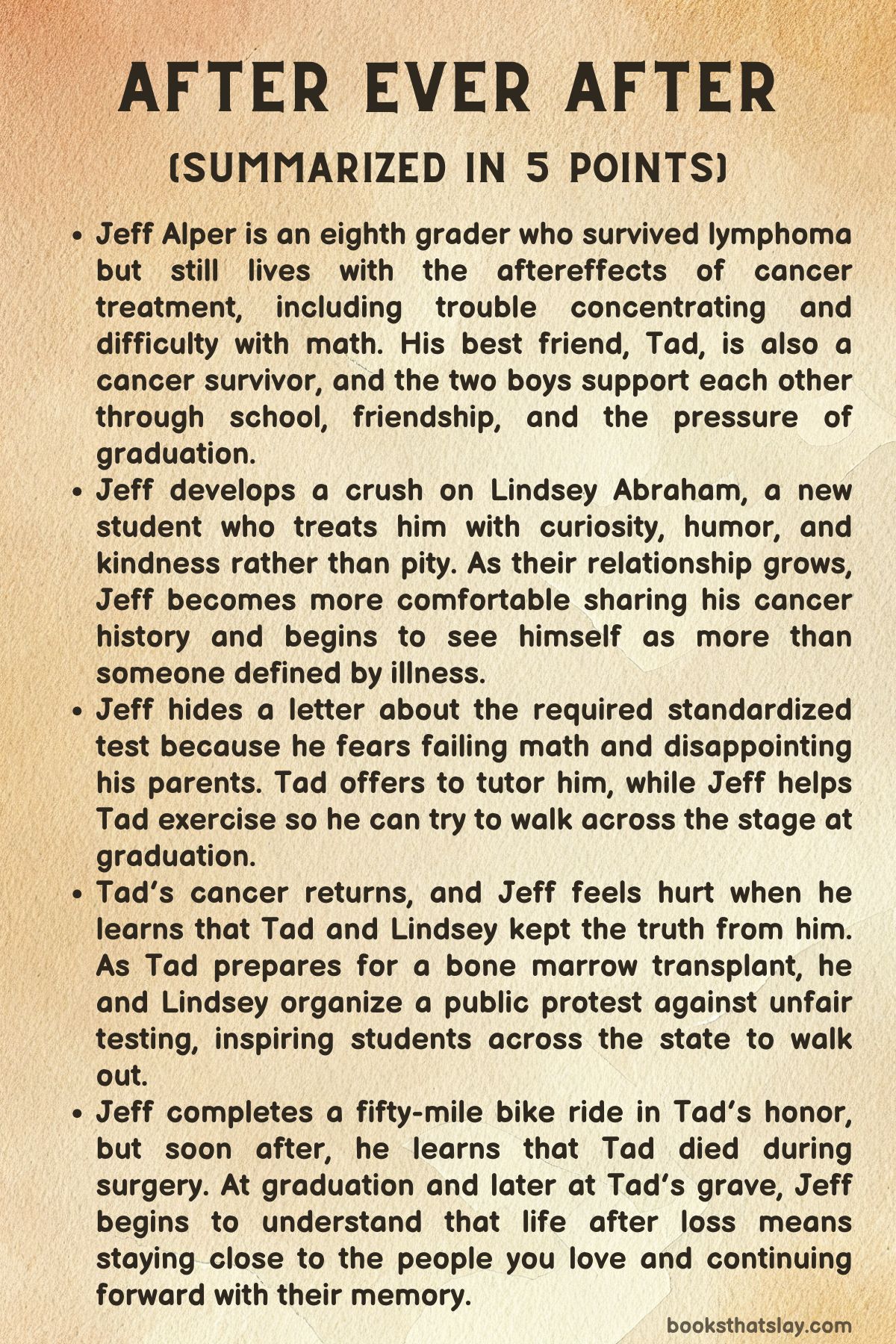
After Ever After by Jordan Sonnenblick is a young adult novel about Jeff Alper, an eighth grader trying to live after cancer while dealing with the lasting effects of treatment, school pressure, family tension, friendship, first love, and grief. The story follows Jeff as he prepares for graduation, struggles with a math test that may hold him back, and supports his best friend Tad, another cancer survivor whose illness returns.
Written with humor and honesty, the book shows how survival is not a clean ending. It is messy, ordinary, painful, and full of small acts of courage. It’s the 2nd book in the Drums, Girls & Dangerous Pie series by the author.
Summary
Jeff Alper is in eighth grade, four years after going into remission from lymphoma. When he looks back on his school years, one of the most important memories is meeting Thaddeus Ibsen, known as Tad.
Tad joined Jeff’s fourth-grade class after also having cancer, and because both boys were survivors, they were seated together. Their friendship became one of the central relationships in Jeff’s life.
By eighth grade, Jeff is preparing for graduation, but his past illness still affects him. His cancer treatment left him with neurological difficulties, including trouble focusing and problems with math.
At the start of the school year, Jeff’s English teacher, Miss Palma, gives the class journal assignments. Jeff writes about overhearing his parents after they learned he was in remission.
His mother worried about whether the cancer would return and what kind of future Jeff would have. His father wanted to believe they could move on and live happily.
That contrast shapes much of Jeff’s life: his father tends to push him forward, while his mother tries to protect him.
Jeff’s eighth-grade year becomes more complicated when he meets Lindsey Abraham, a new student from California. He first notices her picking up papers in a crowded hallway and stops to help.
He is immediately attracted to her, and she soon sits near him in science class. Tad, who uses a wheelchair, joins them, and he and Jeff secretly message each other about Lindsey on their laptops.
Lindsey later reveals that she could read their messages in the window reflection, which embarrasses Jeff but also begins a playful connection between them.
Meanwhile, Jeff receives a school notice about the standardized test all eighth graders must pass. Because he struggles with math, he panics and hides the letter from his parents.
His fear is tied to his father’s expectations and his own belief that failing would prove something is wrong with him. At dinner, his family also discusses his older brother Steven, who once seemed perfect but has dropped out of college and gone to Africa.
Jeff feels abandoned by Steven and confused by the distance between them.
At school, teachers keep stressing the importance of the test. Tad proposes a deal: he will tutor Jeff in math so Jeff can pass, and Jeff will help Tad exercise so he can walk across the stage at graduation.
The pact gives both boys a goal. Jeff wants to overcome his academic challenges, and Tad wants to reclaim a part of himself he has avoided for years.
Jeff’s relationship with Lindsey grows, but he worries about telling her about his cancer. Tad pushes him to make a move, though Tad also admits that he fears no girl will ever like him because of his wheelchair and the visible effects of his illness.
Jeff tries to reassure him, but Tad’s insecurity runs deep. During workouts, Tad is sometimes sharp and angry.
Eventually, he explains that he stopped walking after a classmate, Brianna, made a cruel comment about the way he looked. Jeff encourages him to try again, and Tad slowly begins taking steps.
Lindsey asks Jeff to the Halloween dance and tells him only to “think Disney” for their costumes. Jeff misunderstands and arrives as Donald Duck while Lindsey is Cinderella.
The mix-up is funny rather than disastrous, and they have a wonderful time. Jeff tells Lindsey about his cancer, and she responds with kindness.
This helps Jeff feel more comfortable being honest with her. But when he talks to Tad afterward, Tad becomes irritated.
He compares their experiences as survivors and points out that his own aftereffects are more visible and socially painful.
As fall turns into winter, Jeff and Lindsey become closer, and Jeff continues math tutoring with Tad. On Thanksgiving, Steven calls home, which reminds Jeff of the unresolved pain in their family.
Soon after, the school guidance counselor tells Jeff that his mother now knows he hid the standardized testing letter. At home, Jeff argues with his mother and is grounded until the end of the year.
He overhears his parents arguing about whether he should have to take the test. His father believes Jeff should try, while his mother thinks his disability should exempt him.
Jeff feels hurt because he thinks his mother sees him as incapable.
In English class, the students study Cyrano de Bergerac, and Tad becomes interested in the idea of a beau geste, a grand, meaningful gesture. At the same time, the school gives a surprise pretest, and Jeff worries about failing.
Tad mocks another student’s journal, and Miss Palma calls him out for acting as if no one else’s problems matter because he has suffered more. Jeff suggests Tad try being kinder, and Tad begins making an exaggerated effort to be polite to everyone except Jeff.
Jeff spends Christmas with Lindsey and feels happy when she asks about his limp with simple curiosity rather than pity. But school brings another blow: Jeff fails the pretest.
The guidance counselor explains that his parents may have a case for challenging the lack of accommodations. Tad is absent for medical tests, and Jeff lies to his parents so he can visit Lindsey instead of attending his usual tutoring.
Jeff starts after-school math lessons with Mr. McGrath, the gym teacher, who surprises him by speaking seriously about courage and effort. Jeff begins working harder.
Lindsey, who wants to make a difference in the world, becomes interested in Tad’s situation. When Jeff is out sick, Lindsey and Tad spend time together.
Lindsey decides that Brianna, the girl who once mocked Tad, may actually have liked him, and she tries to help Tad approach her. Tad apologizes to Brianna, but she reacts coldly.
Jeff fails another pretest and becomes convinced he cannot pass. He misses Steven and wishes his brother were there.
Then Jeff overhears his parents again and realizes that his father believes in him while his mother is scared for him. He also senses they are hiding something.
When he talks to Tad and Lindsey, both seem to know the secret but refuse to tell him.
The truth comes out when Jeff visits Tad’s house. Tad admits he has always believed he might die and says he has kept his little sister at a distance so losing him would hurt her less.
Later, Lindsey tells Jeff they should stop seeing each other after school because she does not want to distract him from passing the test. Jeff is hurt.
When he goes back to Tad’s house, Tad’s mother says Tad is asleep because he is undergoing cancer treatment again. Jeff is devastated that Tad’s cancer has returned and that Tad hid it from him.
Jeff receives an email from Steven, who writes cheerfully about Africa. Jeff responds in an unsent email filled with anger, grief, and resentment, but also understanding.
He begins to see that Steven’s life was shaped by Jeff’s illness too. Their mother explains that Steven may be rebelling now because he never had the chance as a teenager.
As Tad grows sicker, Jeff feels angry at both Tad and Lindsey for keeping the truth from him. Tad refuses to keep training for graduation because he expects to be in the hospital for a bone marrow transplant.
Jeff breaks down and talks to the counselor, who helps him understand that his cancer was not his fault and that he did not ruin his family’s lives. She encourages him to support Tad rather than stay trapped in guilt.
Jeff decides to do meaningful things for the people he loves. He asks his father for help with math, which brings them closer.
He also dedicates his annual Moving On Bike-a-Thon to Tad, hoping to show him that people care. Many students support the idea, and Jeff notices hints that Tad and Lindsey are planning something too.
On the day of standardized testing, students gather in the gym. At Tad’s signal, they walk out in protest.
Lindsey has contacted TV reporters, and Tad makes a dramatic statement by rising from his wheelchair and walking out when Mr. McGrath tries to stop him. Tad and Lindsey have made a video protesting unfair testing, and it spreads online, inspiring a statewide student walkout.
Steven hears about the protest from Africa and emails Jeff, promising to come home for graduation. The students still take the math test, but pressure builds against the school system.
Tad spends one final week at school before his transplant. Jeff and Lindsey get back together.
While Tad is in isolation, he and Jeff message each other, and Tad makes Jeff promise to do well in high school if he dies.
Jeff rides fifty miles in the bike-a-thon for Tad. When he finishes, he sees his mother crying and learns that Tad died during surgery.
At graduation, Jeff has passed the math test, though the testing process has been investigated and the results voided. Tad’s mother asks Jeff to accept Tad’s diploma for him.
Jeff feels numb, but with Miss Palma’s encouragement, he walks forward and completes the gesture for his friend.
Before high school begins, Jeff visits Tad’s grave, as he has done all summer. He tells Tad about the test, math class, Steven’s return, his parents, and Lindsey.
Jeff understands that life is not about avoiding pain or getting a perfect happy ending. It is about staying close to the people you love, especially when life hurts.
Lindsey arrives and asks him to go for a bike ride, and Jeff moves forward carrying Tad’s memory with him.
Characters
Jeff Alper
Jeff Alper is the emotional center of After Ever After, and his character is shaped by the complicated experience of surviving cancer without being able to leave cancer fully behind. By eighth grade, he is no longer in active treatment, but his life is still affected by the neurological problems caused by chemotherapy.
His difficulty with concentration and math makes school feel like a constant test of his worth, especially when the standardized exam becomes a requirement for moving on to high school. Jeff is not simply afraid of failing a subject; he is afraid of being seen as broken, incapable, or disappointing.
This fear explains why he hides the testing letter from his parents and why he reacts so strongly when he thinks his mother sees him as less able than other students.
Jeff’s growth comes from learning that survival is not the same as being untouched. At first, he often thinks about himself through other people’s expectations.
He wants his father to be proud of him, wants his mother to stop worrying, wants Lindsey to see him as normal, and wants Tad to keep fighting. Over time, he begins to understand that love does not require perfection.
His bond with Tad teaches him loyalty, frustration, honesty, and grief. His relationship with Lindsey helps him accept vulnerability without shame.
His changing feelings toward Steven allow him to see that his illness affected the whole family, not because he was at fault, but because love makes people suffer alongside one another. By the end, Jeff has matured into someone who can carry pain without letting it make him cold.
His final understanding that people must stay with those they love, especially during suffering, marks his passage from frightened survivor to a more compassionate young adult.
Thaddeus “Tad” Ibsen
Tad is Jeff’s best friend, but he is also one of the most complex characters in the novel because his humor, intelligence, anger, and fear exist side by side. He uses sarcasm as armor.
His sharp comments often make him funny, but they also keep people at a safe distance. Tad has survived cancer once, yet his physical condition makes his illness more visible than Jeff’s.
His wheelchair, his difficulty walking, and the way others react to him make him feel exposed in a way Jeff does not always understand. This difference sometimes creates tension between the two boys, especially when Tad feels that Jeff’s life is moving toward romance, graduation, and possibility while his own future remains uncertain.
Tad’s refusal to walk is not only physical. It is connected to humiliation and emotional injury.
After being mocked for the way he moved, he chose the wheelchair as a way to avoid public judgment. When Jeff encourages him to walk again, Tad’s progress becomes a sign of courage, but the courage is never simple.
He wants to cross the graduation stage, yet part of him has been preparing for death for years. His treatment of his younger sister shows this fear clearly.
He keeps her emotionally distant because he believes it might make his death easier for her, though this actually reveals how deeply he loves her. Tad’s relapse exposes the sadness beneath his jokes.
His final protest against unfair testing is a grand act of resistance, not only for Jeff but for every student being measured without mercy. Tad dies before graduation, but his influence remains powerful because he pushes Jeff to live more boldly.
Lindsey Abraham
Lindsey Abraham brings warmth, confidence, and moral energy into Jeff’s eighth-grade year. As a new student from California, she first appears as someone outside the established patterns of Jeff and Tad’s world.
Her entrance gives Jeff the chance to experience a kind of ordinary teenage excitement that cancer has often complicated for him. Jeff’s crush on Lindsey is important because it allows him to imagine himself as more than a former patient.
Around her, he is awkward, funny, hopeful, and nervous in recognizable adolescent ways. Their Halloween dance, their conversations, and their growing closeness give Jeff moments of happiness that are not defined by illness.
Lindsey is also more than a love interest. She is observant, direct, and socially aware.
She notices things that others miss, including the emotional weight carried by both Jeff and Tad. When Jeff tells her about his cancer, she responds with acceptance rather than pity.
When she asks about his limp, she does so with curiosity and kindness, which matters deeply because Jeff is used to treating his body as something that needs explanation or apology. Lindsey also wants to make a real difference in the world, and this desire leads her into Tad’s protest against unfair testing.
Her decision to step back from Jeff after school, though painful to him, comes from concern rather than rejection. She does not always handle everything perfectly, especially when she keeps Tad’s relapse from Jeff, but her choices usually come from care.
By the end, Lindsey represents both companionship and forward movement. She does not erase Jeff’s grief, but she helps him return to life.
Steven Alper
Steven Alper, Jeff’s older brother, is mostly absent from the immediate action, yet his presence strongly affects Jeff’s emotional life. To Jeff, Steven once seemed like the ideal older brother: talented, successful, and admired by their parents.
His decision to drop out of college and go to Africa feels like abandonment to Jeff, especially because Jeff still needs him. Jeff’s resentment is understandable.
After surviving cancer, Jeff wants stability, and Steven’s departure creates another form of loss. He feels left behind by someone he used to idolize.
Steven’s character becomes more sympathetic as Jeff begins to understand the pressure Steven faced. Being the “perfect” son during Jeff’s illness meant suppressing his own fear, anger, and need for freedom.
Steven’s rebellion is not simply selfishness; it is a delayed reaction to years of emotional strain. He had to grow up in a family organized around illness, worry, and survival.
While Jeff sometimes imagines Steven as someone who escaped responsibility, the truth is more complicated. Steven also suffered, though in a quieter and less visible way.
His emails from Africa show that he still cares about Jeff, and his promise to return for graduation suggests that his separation is not permanent. Steven’s role in After Ever After helps show that illness changes every member of a family.
He also helps Jeff move beyond seeing himself as the only wounded person in the household.
Jeff’s Mother
Jeff’s mother is loving, protective, fearful, and sometimes unintentionally hurtful. Her main instinct is to shield Jeff from pain, failure, and danger.
Because she has already faced the possibility of losing her son, she responds to the standardized test as more than a school requirement. To her, it represents a system that does not understand what Jeff has been through or what his brain now struggles to do.
Her desire to exempt him from the test comes from care, but Jeff hears it as a judgment against his intelligence and ability. This misunderstanding creates one of the central emotional conflicts between them.
Her character shows how parental love can become overprotection when fear is unresolved. She wants Jeff to be safe, but safety can also limit him.
At the same time, she is not portrayed as unreasonable or cold. She has lived through terror, uncertainty, and years of medical worry.
Her protectiveness is rooted in trauma. She knows how fragile life can be, so she has trouble trusting ordinary challenges to be ordinary.
Her conversations with Jeff’s father reveal that she and her husband love Jeff equally but differently. She wants to spare him from harm, while his father wants him to discover his strength.
By the end, Jeff begins to see his mother with more maturity. Her fear may frustrate him, but it is part of her love, not proof that she thinks less of him.
Jeff’s Father
Jeff’s father represents belief, steadiness, and the difficult kind of love that asks a child to keep trying. When Jeff remembers his parents’ conversation after his remission, his father’s wish for a happy future stands out.
He wants to believe that the family can return to life after cancer. This does not mean he is careless or unaware of Jeff’s struggles.
Rather, he refuses to define Jeff only by illness. His insistence that Jeff take the test comes from the belief that Jeff deserves the chance to move forward, even if the process is difficult.
Jeff often fears disappointing his father, especially because math is so hard for him. This fear makes him hide the school letter and avoid honesty.
Yet the more Jeff listens and observes, the more he realizes that his father’s expectations are not based on rejection. His father is proud of him and believes in his ability to work through challenges.
One of their most meaningful developments occurs when Jeff asks him for help with math. This moment matters because Jeff stops seeing his father only as someone who might judge him and begins to see him as someone who wants to stand beside him.
Jeff’s father is not perfect, but he gives Jeff something essential: the belief that effort still matters after suffering. His love helps Jeff separate disability from defeat.
Miss Palma
Miss Palma is one of the most important adult figures in Jeff’s school life because she gives him a language for understanding himself. Her journal assignments are not just classroom exercises.
They become a private space where Jeff can process memory, fear, anger, love, and confusion. Through writing, Jeff confronts moments he cannot easily speak about, including his parents’ worries, Steven’s absence, Tad’s illness, and his own guilt.
Miss Palma’s role as a teacher is therefore emotional as well as academic.
She is also one of the few adults who challenges students without reducing them to their problems. When Tad mocks another student’s writing, Miss Palma refuses to excuse cruelty simply because Tad has suffered.
This is important because she recognizes Tad’s pain while still holding him responsible for his behavior. She believes that hardship should deepen compassion, not become permission to dismiss others.
Her introduction of Cyrano de Bergerac also gives Tad and Jeff the idea of the beau geste, which becomes meaningful later in the story. At graduation, when Jeff freezes, Miss Palma encourages him to complete his gesture for Tad.
In that moment, she understands what the act means and helps him finish it. Miss Palma represents the kind of teacher who sees beyond grades and rules.
She helps students become more honest, thoughtful, and brave.
Mr. McGrath
Mr. McGrath begins as a gym teacher connected to Jeff and Tad’s physical therapy routine, but he becomes more important as the story develops. At first, he may seem like an unlikely source of academic motivation, especially because Jeff’s biggest school struggle is math.
However, his after-school supervision and blunt encouragement help Jeff take his work more seriously. His speech about courage and determination affects Jeff because it treats him as someone capable of effort rather than someone defined by limitation.
Mr. McGrath’s character also reflects the school system’s mixed role in Jeff’s life. On one hand, adults at school enforce testing policies that create stress and unfair pressure.
On the other hand, individual teachers like Mr. McGrath can still show care and respect. His attempt to stop Tad during the walkout places him briefly on the side of school authority, but Tad’s decision to stand and walk past him transforms the moment.
Mr. McGrath is not a villain; he is an adult caught inside a system that values compliance. His earlier support of Jeff shows that he recognizes student courage, even if his official role requires him to maintain order.
Through him, the novel shows that institutions may fail students while individual adults within them can still offer meaningful support.
Brianna
Brianna plays a smaller role than Jeff, Tad, or Lindsey, but her impact on Tad’s life is significant. Her cruel comment about the way Tad walked caused lasting damage.
For Tad, that moment became a source of shame so strong that he stopped walking publicly and relied on his wheelchair instead. Whether Brianna understood the full effect of her words or not, the result was severe.
She represents how casual cruelty during adolescence can shape someone’s self-image for years.
Lindsey’s belief that Brianna may have liked Tad adds complexity, but it does not erase the harm. The possibility that Brianna’s insult came from embarrassment, immaturity, or confused feelings shows how young people sometimes hurt others because they do not know how to express themselves.
Still, Tad’s pain remains real. When he later approaches her to apologize for his own behavior, her irritated response suggests that she is not ready or willing to offer the emotional repair Tad might need.
Brianna’s character reminds the reader that not every wound receives a satisfying apology. Some people leave marks on others without fully understanding or taking responsibility for them.
Her role also makes Tad’s later decision to walk more powerful because he begins to reclaim something that shame had taken from him.
Tad’s Mother
Tad’s mother is seen mostly through her relationship to Tad’s illness and through Jeff’s visits to their home. She carries the exhaustion and fear of a parent whose child is seriously sick again.
When Jeff learns from her that Tad is undergoing treatment, the moment is devastating because it shows how much has been hidden from him. Tad’s mother is not trying to hurt Jeff; she is living inside a crisis where protecting Tad’s privacy and managing medical reality become part of daily life.
Her request that Jeff accept Tad’s diploma after his death is one of the most moving choices in the story. It shows that she understands the depth of Jeff and Tad’s friendship.
She gives Jeff a role in honoring Tad publicly, allowing him to carry his friend’s presence into a ceremony Tad wanted to reach. This request also suggests her generosity in grief.
Even after losing her son, she recognizes Jeff’s need to say goodbye through action. Tad’s mother represents parental love under unbearable pressure.
Her character is quiet but powerful because she shows the human cost of illness beyond the patient. She also helps preserve Tad’s dignity, memory, and place among his classmates.
Yvonne
Yvonne, Tad’s younger sister, appears mainly through Tad’s feelings about her, but she helps reveal a hidden part of his character. Tad is often harsh with her, and at first this may seem like ordinary sibling irritation.
Later, his explanation changes the meaning of his behavior. He keeps her at a distance because he believes he may die and thinks it will hurt her less if she is not too attached to him.
This reasoning is painful because it shows how deeply Tad has internalized the possibility of death.
Yvonne’s importance lies in what she represents: the innocent family member whom illness affects without her choosing it or fully controlling it. Tad’s attempt to protect her by being emotionally distant is misguided, but it comes from love.
He is still a child himself, yet he is trying to manage another person’s future grief. Through Yvonne, the story shows how illness can distort relationships inside a family.
Love becomes mixed with fear, and closeness can feel dangerous because loss seems possible. Yvonne also makes Tad more vulnerable in the reader’s eyes.
His sarcasm and anger are easier to understand when we see that beneath them is a boy trying, in his own flawed way, to spare his sister pain.
Themes
Life After Survival
Survival in After Ever After is not treated as a simple happy ending. Jeff is in remission, but his life still carries the effects of cancer through memory, disability, fear, and family tension.
The title itself suggests that the story begins after the point where many people might expect trouble to be over. Jeff’s cancer is gone, yet the consequences remain in his body and mind.
He struggles to focus, has difficulty with math, and feels embarrassed by the ways treatment has changed him. This creates a painful gap between how others may see survival and how he experiences it.
To outsiders, remission may look like victory. To Jeff, it often feels like entering a new stage of struggle without the same public recognition or support.
Tad’s experience deepens this theme because his survival is even more visibly complicated. His wheelchair, his fear of walking, and his relapse show that living after cancer can include anger, shame, and uncertainty.
The novel refuses to make survival neat or inspirational in a shallow way. Instead, it shows young people trying to build ordinary lives while carrying extraordinary burdens.
School dances, crushes, homework, jokes, and graduation plans continue alongside medical fear. This contrast gives the story its emotional honesty.
Survival means continuing to live, but it also means learning how to live with what has changed.
Friendship, Loyalty, and Anger
Jeff and Tad’s friendship is loving, funny, tense, and sometimes painful. Their bond begins because both have had cancer, but it grows into something deeper than shared illness.
They understand parts of each other that other classmates cannot easily understand. Tad tutors Jeff in math, while Jeff helps Tad work toward walking at graduation.
Their pact gives the friendship structure, but the emotional connection beneath it is more important. Each boy wants the other to succeed because each sees the other’s hidden fear.
At the same time, the friendship is not idealized. Tad can be cruel, defensive, and jealous.
Jeff can be self-absorbed, especially when his relationship with Lindsey makes him less sensitive to Tad’s loneliness. Their arguments show that friendship does not erase pain.
In fact, closeness sometimes makes pain sharper because friends know exactly where the wounds are. Tad’s relapse tests Jeff’s loyalty in a new way.
Jeff feels betrayed when he learns that Tad and Lindsey hid the truth from him, but he eventually understands that anger cannot be the final response. His counselor helps him see that supporting Tad matters more than punishing him emotionally.
After Tad’s death, Jeff’s loyalty continues through memory, visits to the grave, and the acceptance of Tad’s diploma. The story presents friendship as a commitment that includes humor, resentment, forgiveness, and grief.
True loyalty is not the absence of conflict; it is the decision to remain connected even when love becomes painful.
Disability, Testing, and Unfair Standards
The standardized test becomes a symbol of a system that measures students without fully seeing them. Jeff’s math difficulties are not caused by laziness or lack of intelligence.
They are connected to neurological damage from cancer treatment. Yet the school’s testing requirement threatens to hold him back as if every student begins from the same place and faces the same obstacles.
This creates a strong conflict between personal reality and institutional rules. Jeff is forced to prove himself through a process that does not properly account for what he has survived or what accommodations he needs.
The adults around Jeff respond differently to this pressure. His mother wants to protect him from the test, fearing it will punish him unfairly.
His father wants him to try, believing that he deserves the chance to move forward. Both reactions come from love, and the tension between them shows how difficult disability advocacy can be.
Protection can become limiting, but pushing forward without support can also be unjust. Tad and Lindsey’s protest expands the issue beyond Jeff.
Their walkout challenges a system that treats test scores as more important than individual students. Tad’s decision to stand and walk during the protest is especially meaningful because his body, often treated as a sign of limitation, becomes a source of public resistance.
The novel criticizes standards that ignore context. It argues that fairness is not the same as giving everyone the exact same test under the exact same conditions.
Family, Guilt, and Emotional Burden
Jeff’s family life is shaped by love, but also by guilt and unspoken pain. Jeff often believes that his cancer damaged the lives of the people around him.
He worries that his parents suffered because of him and that Steven’s absence may be connected to resentment. This guilt is one of his deepest emotional burdens.
He did not choose to be sick, yet he feels responsible for the consequences of his illness. His counselor’s reminder that his diagnosis was not his fault becomes an important step in his growth because Jeff needs to separate tragedy from blame.
Steven’s storyline shows that family members can be wounded in different ways by the same crisis. While Jeff endured treatment directly, Steven lived under the pressure of being the stable, successful child during a frightening time.
His later rebellion is a response to years of emotional restraint. Jeff’s parents also carry their own scars.
His mother’s protectiveness and his father’s insistence on perseverance are different responses to fear. Neither parent has escaped the past, even though Jeff is in remission.
The family’s love is real, but love does not automatically make communication easy. Much of their pain comes from trying to protect one another through silence.
As Jeff matures, he begins to see his family members as people with their own fears rather than simply as sources of pressure or disappointment. This wider understanding helps him forgive them and himself.