How to Read a Book by Monica Wood Summary, Characters and Themes
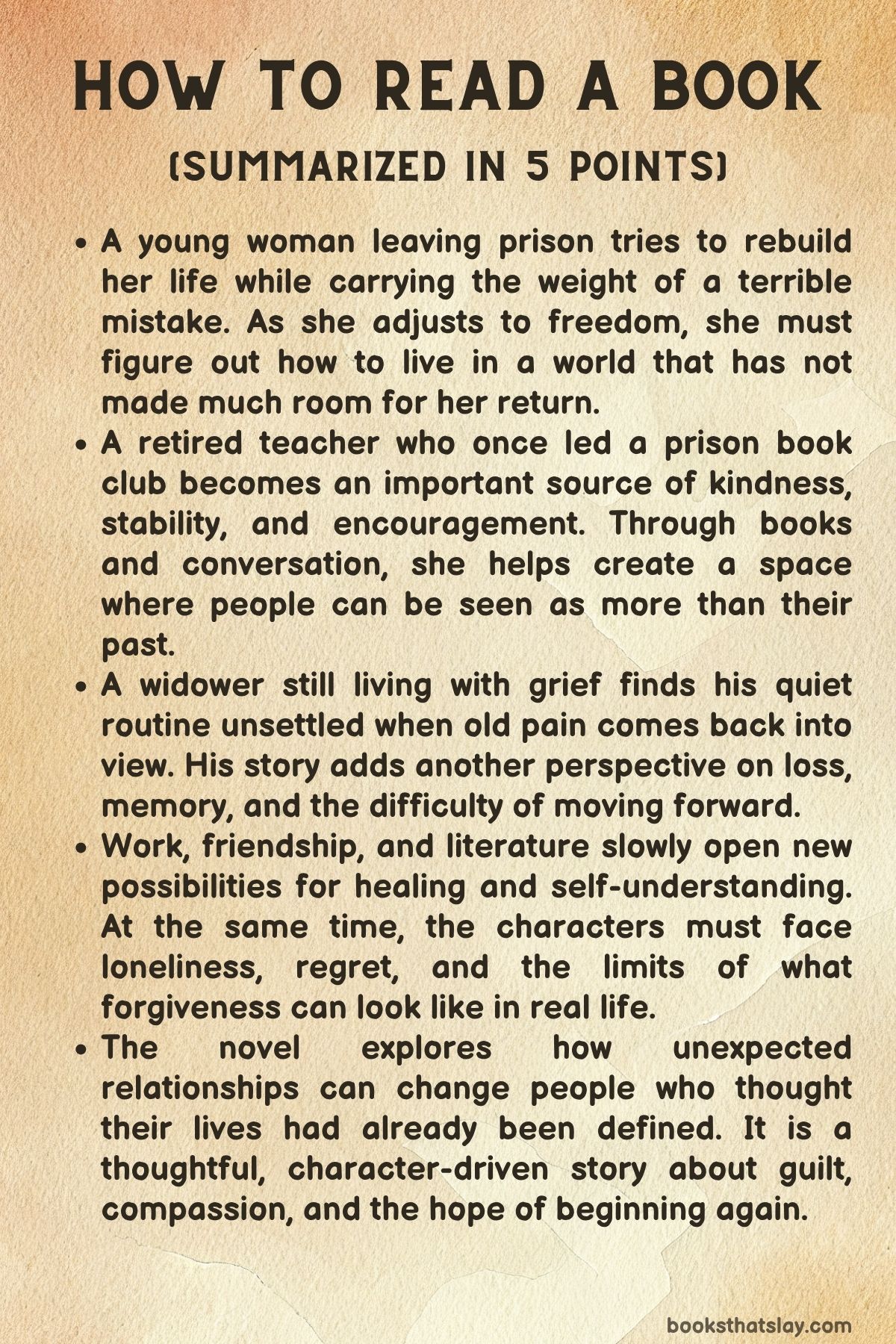
How to Read a Book by Monica Wood is a contemporary novel about guilt, second chances, and the unexpected ways people help one another heal. At its center is Violet, a young woman leaving prison after serving time for a fatal accident, and the two people whose lives become tied to hers: Harriet, a retired teacher who runs a prison book club, and Frank, the widower of the woman who died in the crash.
The novel is thoughtful, humane, and deeply interested in what reading can do for people who feel cut off from the world. It asks whether a person can survive shame, accept forgiveness, and still build a meaningful life.
Summary
Violet is a young woman serving time in a women’s correctional facility for causing the death of Lorraine Daigle in a drunk-driving accident. Prison has narrowed her life, but one thing gives her real purpose: a weekly book club led by Harriet, a retired teacher known to the women as the Book Lady.
In that room, the women are not reduced to their crimes. They talk about novels, argue about characters, laugh, and speak with unusual honesty.
Violet treasures the books Harriet brings, keeping them under her bed as proof that another part of herself still exists. Even in confinement, she feels that reading allows her to remain human.
Harriet cares deeply about the women and takes her role seriously. She chooses books not to instruct them from above, but to invite them into conversation.
Over time, she has learned to see each woman as an individual rather than as part of a faceless system. Outside prison, Harriet is also facing change in her own life.
Her beloved niece Sophie, whom she helped raise after a family loss, is preparing to leave home, and Harriet feels the loneliness of age and uncertainty pressing in. The book club gives her structure, intimacy, and a sense of usefulness.
Frank Daigle, Lorraine’s widower, has built a quiet life after his wife’s death. He spends much of his time at a local bookstore, where he fixes things, talks to the young staff, and finds comfort in routine.
His grief is complicated. Lorraine’s death shattered his life, but their marriage had already been failing, and he carries guilt over the fact that part of him had wanted freedom from that unhappiness.
He also regrets the role he played during Violet’s trial, when pressure from his daughter and the prosecutor pushed him into helping secure a harsh sentence.
Violet is released from prison early for good behavior and arrives in Portland with almost nothing. Her sister drives her to a bare apartment, makes it clear that the family does not want her back home, and leaves her there with money from their late mother.
Violet is overwhelmed by the ordinary tasks of freedom. She is lonely, frightened, and unsure how to move through a world that kept going without her.
Yet she starts taking small steps. She shops for clothes, opens a bank account, and ventures into town.
Seeing a bookstore and a cat outside it stirs something hopeful in her.
At the bookstore, Violet unexpectedly runs into Harriet, who is delighted to see her. But Frank is there too, and when he recognizes Violet as the driver responsible for Lorraine’s death, he is overcome.
The shock knocks him physically and emotionally off balance. Harriet quickly gets Violet away from the store and brings her home, where Violet finally speaks openly about the accident, her guilt, and the trial.
Harriet listens without judgment and offers her friendship in a way Violet has rarely experienced. For Violet, this kindness becomes a lifeline.
Harriet begins drawing Violet into her own world. She feeds her, lends her books, and encourages her to build a life beyond survival.
Sophie is wary at first, suspicious of Violet and protective of Harriet, but Violet sees through Sophie’s certainty and challenges her in a way that exposes her immaturity. Their early tension slowly softens into mutual respect.
Meanwhile, Harriet continues her work in prison, leading the women through poetry and giving them space to write about longing, memory, motherhood, and selfhood. Those sessions become increasingly rich and emotional.
Trying to find work, Violet is repeatedly defeated by job applications that ask about felony convictions. Then she gets an opportunity at a university lab run by Dr. Mikhail Petrov, who studies African grey parrots.
She begins with basic duties but quickly proves herself observant, diligent, and capable. The birds matter to her immediately.
Their intelligence, sensitivity, and dependence awaken a protective tenderness in her. Work in the lab gives Violet a new sense of identity.
She is no longer only a former prisoner or the woman from the accident. She becomes someone needed, skilled, and alive to the future.
As Violet gains confidence, Frank wrestles with his own conscience. The bookstore staff, having looked up the accident, treat Violet as a villain, but Frank resists that simple version of events.
He knows she did something terrible, but he also knows that punishment did not restore what was lost. He begins trying to make amends for his reaction at the bookstore by crafting gifts for Harriet and Violet.
His instinct toward repair grows stronger, and his perspective on Violet shifts from enemy to fellow sufferer.
Harriet, Frank, and Violet gradually form an unusual bond. Harriet remains the emotional center, drawing both of them toward honesty.
Frank apologizes to Violet, and in one of the novel’s most important movements, Violet begins to understand that Lorraine’s husband does not want to spend the rest of his life hating her. Their conversations do not erase the death or the damage left behind, but they create room for mercy.
Frank tells Violet that luck separated his mistakes from hers more than virtue did. That recognition allows him to forgive her, and it gives Violet a way to imagine living with herself.
Violet’s life seems to be opening. She becomes more central at the lab, earns more responsibility, and falls in love with Misha.
Their attraction is intense, and because Violet is hungry for affection and recognition, she gives herself over to the relationship fully. At the same time, Harriet senses danger.
Violet wants the affair to mean love and a future, while Misha remains undefined, secretive, and ultimately selfish. Violet ignores warning signs because being wanted feels too precious to question.
At the prison, Harriet’s work is threatened by officials who dislike the freedom the book club creates. The women are subjected to degrading rules and surveillance, yet they keep reading and writing with fierce commitment.
Harriet feels more attached to them than ever, but the institution reasserts its power. Eventually she is banned from returning after accepting a handmade gift from the women, an excuse used to remove her.
The loss devastates her. The book club had been central not only to the prisoners’ lives but to her own sense of meaning.
Harriet and Frank grow closer as they comfort one another through loneliness, grief, and the disappointments of age. Their companionship turns into love.
Unlike Violet’s affair with Misha, their relationship is marked by tenderness, candor, and mutual care. Frank begins to imagine a future again, and Harriet allows herself happiness she thought had passed her by.
Violet’s own romantic hope collapses when Harriet and Frank visit the lab and Misha’s pregnant wife appears. In an instant, Violet sees the truth: she has been deceived.
Worse, she hears Misha dismiss her as if she meant nothing. Humiliated and heartbroken, Violet leaves the job, bargaining only for severance and a reference.
On impulse, she takes one of the parrots, Ollie, with her, and Frank immediately offers to care for the bird. In that gesture, he once again makes a place for her pain without asking her to justify it.
The story moves toward a final act of moral testing when Dawna-Lynn, one of Harriet’s former book club women, escapes prison and appears at Harriet’s house desperate, dirty, and frightened. Harriet, Frank, and Violet must decide what compassion requires.
They feed her, let her wash, and allow her a brief moment of dignity before doing what must be done. The scene shows how much Violet has changed: once dependent on others’ mercy, she now helps extend it to someone else.
By the end, Frank asks Harriet to marry him, and she says yes. Violet does not get an easy ending or a perfect replacement for what she lost.
Instead, she gets something more believable: a life that continues. In later reflection, she understands that she was never freed from what she did, but neither was she defined only by it.
She goes on to love and be loved, to make family in unexpected places, and to live fully in the years after shame. The novel closes on the idea that a person can carry guilt and still be worthy of connection.
Violet’s life does not deny the death she caused, but it proves that remorse, forgiveness, friendship, and love can exist beside sorrow, and that this, too, is part of a human life.
Characters
Violet
Violet is the moral and emotional center of How to Read a Book, and her character is shaped by the tension between guilt and the desire to keep living. She enters the story as a young woman who has already been defined by the worst thing she has done.
Her prison sentence is not only a legal punishment but also a mental condition that continues after release. She has absorbed shame so deeply that freedom feels unreal to her at first.
Ordinary actions such as shopping, applying for work, or entering a public building become tests of whether she still belongs in the world. What makes Violet compelling is that her remorse is genuine, but it does not make her passive forever.
She does not deny her responsibility for Lorraine’s death, nor does she try to revise the truth to make herself more sympathetic. Instead, she carries the knowledge of what she did while slowly discovering that a ruined life and a responsible life are not the same thing.
Her intelligence is one of the most important aspects of her character. In prison, reading gives her language for feelings she cannot otherwise manage, and on the outside that same inward seriousness allows her to grow.
Violet is observant, emotionally alert, and capable of deep attachment. These traits make her a strong worker in the parrot lab, but they also leave her vulnerable in love.
Her relationship with Misha reveals how badly she wants recognition, tenderness, and a sense of chosen belonging. She mistakes intensity for trust because she has been starved of care.
Yet even in that painful mistake, her character develops. She eventually learns to defend herself, to demand terms, and to walk away instead of accepting humiliation as her natural fate.
Violet is also notable for the way she changes from a person receiving mercy into one capable of offering it. Early in the story, she depends on Harriet’s kindness and Frank’s forgiveness to imagine a future.
Later, she participates in helping Dawna-Lynn at a moment of crisis, and that shift matters. It shows that she has regained enough sense of self to act from compassion rather than from pure survival.
By the end, Violet becomes the clearest example of the novel’s belief that human beings are more than the record of their worst acts. She never escapes what happened, but she does grow into someone who can be truthful about it without being destroyed by it every day.
Harriet
Harriet represents moral imagination, discipline, and emotional generosity. As the leader of the prison book club, she refuses the flattening language that institutions use to reduce people to offenses and categories.
Her teaching is not sentimental, because she does not pretend suffering makes people automatically wise or pure. Instead, she creates a space where reading becomes a way of restoring individuality.
Harriet listens carefully, asks real questions, and treats literature as a shared experience rather than a lecture topic. This makes her more than a kindly volunteer.
She is someone who believes that attention itself is a form of respect, and that belief shapes every important relationship she has.
What gives Harriet depth is that she is not only a helper. She is lonely, aging, and frightened by change.
Sophie’s coming departure exposes how much of Harriet’s emotional life depends on feeling needed. The book club is not a hobby for her; it is one of the places where she feels most alive and most fully herself.
That is why losing it is so devastating. The prison administration may imagine they are removing a volunteer, but the injury is larger than that.
They are taking away a structure of meaning that Harriet had built with patience and love. Her sorrow after being banned from the prison reveals how deeply she had invested herself in that work and how much her own sense of worth had become tied to it.
Harriet’s relationship with Violet reveals her best qualities. She does not approach Violet as a project to fix or as a case study in redemption.
She offers food, books, company, and practical guidance, but most of all she offers steady recognition. She sees Violet’s fear, shame, and intelligence all at once.
At the same time, Harriet is not infallible. She asks Violet whether Troy may have been driving, and that question reveals her own wish that Violet might be less guilty than she is.
Harriet wants innocence where innocence does not exist. This makes her more human, not less admirable, because it shows how hard it is even for a compassionate person to accept complicated truth without trying to soften it.
Her romance with Frank adds another layer to her character. In that relationship, Harriet is not the teacher or rescuer but a woman still capable of desire, vulnerability, and joy.
Their connection allows her to receive comfort instead of always providing it. She becomes one of the clearest examples in How to Read a Book of how later life is not an emotional afterthought.
She remains intellectually alive, physically present, and open to surprise. That openness, more than simple kindness, is what makes her such a memorable figure.
Frank Daigle
Frank is one of the most subtle characters because he stands at the crossing point of grief, guilt, and reluctant renewal. On paper, he could have remained only the widower of the woman Violet killed, a figure of pain and moral authority.
Instead, he is written as a man with divided feelings that trouble him precisely because they are true. Lorraine’s death is a terrible loss, but their marriage had already begun to fail.
He was hurt by her betrayal, exhausted by the strain between them, and unable to confess this publicly because grief is expected to be simple. Frank’s pain is real, but so is his relief, and the conflict between those feelings gives his character unusual weight.
He understands that mourning does not erase what came before death, and this honesty sets him apart from more conventional portraits of bereavement.
His response to Violet also shows great complexity. When he first sees her after her release, his body reacts before his mind can catch up.
The sight of her brings back shock, courtroom memory, and the emotional collapse surrounding Lorraine’s death. Yet he does not remain locked in vengeance.
He comes to see that Violet is not a symbol of his loss but another damaged human being. This shift does not happen because he suddenly forgets Lorraine or excuses the accident.
It happens because Frank knows too much about flawed people, including himself, to remain satisfied with a simple story of innocence on one side and evil on the other. He remembers his own mistakes, his own drunken driving incident, and the many ways luck can separate one person’s life from another’s catastrophe.
Frank’s craftsmanship is also important to his identity. As a retired machinist, he finds meaning in making, fixing, and shaping physical objects.
His wish to build bookends as an apology is not merely quaint. It shows how he thinks through his hands.
He is a man who turns feeling into labor, care into form. That same steadiness makes him a grounding force for Harriet and later for Violet.
He does not dramatize himself, but he becomes essential because he offers calm, shelter, and practical love.
His relationship with Kristy reveals another side of him: the difficulty of being a parent while carrying secrets. He wants to protect his daughter from the messy truth about Lorraine, but that silence creates distance.
Frank is loving, but he is also weary, and the strain of managing Kristy’s anger becomes part of his emotional burden. His eventual love story with Harriet is moving because it arrives after so much suppression.
With Harriet, he is finally able to be known as a whole person rather than only as a bereaved husband or patient father. He becomes a man who can still desire, still care, and still move toward happiness without betraying the dead.
Sophie
Sophie begins as a defensive, skeptical presence, and much of her importance comes from the fact that she is not immediately generous. She loves Harriet and wants to protect her, but that protectiveness is mixed with immaturity, pride, and a need to prove herself morally alert.
She reads the prison women through suspicion rather than through complexity. In her mind, caution is the same as wisdom, and judgment is a sign of seriousness.
This gives her early scenes a sharpness that is necessary to the story, because she embodies the respectable outside world’s discomfort with people who have been incarcerated. She is not cruel in a grand sense, but she is self-righteous, and that self-righteousness narrows her ability to see others clearly.
What makes Sophie interesting is that she is also capable of being shaken out of that certainty. Her conversations with Violet expose the gap between the role she imagines for herself and the actual emotional demands of helping wounded people.
Violet’s blunt criticism of her future as a social worker hits home because Sophie already suspects it is true. She wants to be useful, ethical, and compassionate, but she has not yet learned humility.
Her breakdown after Violet confronts her is one of the moments that allows the novel to show growth without sentimentality. Sophie is not transformed instantly into a saint.
Rather, she becomes less performative, less sure of her own goodness, and more willing to listen.
Her personal disappointments also deepen her. When her relationship with Luis collapses, she becomes less insulated and less confident in her ability to organize life neatly.
That pain does not erase her flaws, but it makes her more reachable. Sophie’s arc is quieter than Violet’s or Frank’s, yet it matters because she represents a younger generation learning that intelligence without empathy is insufficient.
By the end, she is no longer merely the guardian at Harriet’s door. She becomes part of a wider network of care shaped by experience, regret, and affection.
Her development shows that compassion is not a trait people simply possess; it is something they grow into by having their assumptions challenged.
Mikhail Petrov
Mikhail Petrov, or Misha, is one of the most revealing secondary characters because he stands for brilliance without moral steadiness. At first he appears intense, dedicated, and almost romantic in his seriousness.
His work with the parrots has intellectual purpose, and his commitment to research gives Violet a way into meaningful labor. He recognizes her abilities when others might dismiss her, and that recognition matters.
Through him, Violet enters a world of study, observation, and possibility. He is charismatic because he combines authority, mystery, and praise in a way that makes Violet feel newly visible.
Yet Misha’s character is built on imbalance. His admiration for Violet is real enough to feel persuasive, but it never grows into responsibility.
He wants closeness without accountability, desire without honesty, and emotional devotion without public acknowledgment. He benefits from Violet’s hunger to be chosen while withholding the clarity she needs.
This makes him more than a simple villain. He is not a cartoon deceiver; he is a selfish man who has learned to place his own appetite and ambition above the inner lives of others.
His affair with Violet exposes the gap between refinement and decency. He may be cultured, intelligent, and professionally accomplished, but he is willing to use secrecy and emotional ambiguity to preserve his comfort.
His treatment of the birds complicates him further. He genuinely values the research and understands the animals deeply, which prevents him from being reduced to pure hypocrisy.
He is capable of devotion in one part of life and moral failure in another. That division is central to his character.
He can speak movingly about sacrifice and purpose, yet still reduce Violet to “nothing” when his private life is threatened. In that moment, the distance between his public self and private conduct becomes unmistakable.
He serves an important structural role because he teaches Violet, and the reader, that being recognized is not the same as being cherished. His importance lies less in his own inner growth than in the painful education he forces on Violet.
Lorraine Daigle
Lorraine is absent for almost the entire narrative, yet she remains one of its most powerful presences. Because she dies before the main action unfolds, she survives in memory, testimony, resentment, and imagination.
Different characters carry different versions of her. To Kristy and to the courtroom, she becomes an idealized victim: a teacher, wife, and good woman whose death must stand for innocence destroyed.
To Frank, she is harder to contain. He remembers the real Lorraine, which includes her affair, her dissatisfaction, and the unraveling of their marriage.
This difference between public memorial and private truth makes Lorraine an essential figure in the novel’s thinking about the dead. A life does not become simple because it has ended, yet the living often demand that it do so.
Lorraine’s role is not only symbolic. She is the fixed point around which the moral lives of others turn.
Violet measures herself against the life she ended. Frank measures himself against what he did and did not feel as a husband.
Kristy organizes her grief into anger partly because that is easier than facing her mother’s complexity. Lorraine is therefore a figure through whom the novel asks what justice owes the dead and what truth owes the living.
She was wronged by Violet’s actions, but she was not a saint. The insistence on keeping both facts visible is one of the book’s strongest moral achievements.
Kristy
Kristy represents grief hardened into righteousness. As Lorraine’s daughter, she cannot accept ambiguity because ambiguity feels like betrayal.
She wants a clear victim, a clear offender, and a punishment severe enough to honor her mother. In this sense, her anger is understandable.
It emerges from loss, from the need to protect memory, and from the helplessness that follows violent death. Yet the novel also shows how anger can become a structure that traps the grieving person inside it.
Kristy clings to outrage because it gives her certainty and purpose.
Her relationship with Frank is painful because she expects him to perform bereavement in a way that matches her own needs. When he hesitates, softens, or refuses vengeance, she interprets it as disloyalty.
She cannot yet understand that his grief is mixed with knowledge she does not possess. This makes Kristy an emotionally credible character rather than a merely obstructive one.
She is not cruel for the sake of cruelty. She is trying to defend something sacred and lacks the emotional room to imagine that others are carrying different forms of truth.
Her eventual peaceful connection with Violet later in life suggests that time can loosen even deeply held anger, but the novel does not rush that process. Kristy matters because she shows how forgiveness cannot be demanded on a schedule and how grief often protects itself by refusing complexity.
Dawna-Lynn
Dawna-Lynn brings urgency, volatility, and raw feeling into the prison scenes. She is one of the women whose voice helps show that the book club is not simply educational but existential.
Through her and the others, the story shows that prison does not erase wit, frustration, creativity, or longing. Dawna-Lynn’s anger is never far from the surface, yet that anger is tied to disappointment, separation, and repeated humiliation within the system.
She is not polished or controlled in the way Harriet or Frank are, and that contrast matters because it prevents the prison women from being accepted only when they are eloquent or restrained.
Her eventual escape and appearance at Harriet’s house bring the inside world crashing into the fragile outside peace the main characters have built. In that moment, Dawna-Lynn becomes a test of whether compassion is real when it is inconvenient, dangerous, and morally messy.
The others do not romanticize her situation, but they do honor her humanity. She also functions as a mirror for Violet.
Where Violet once needed shelter and understanding, Dawna-Lynn now needs the same. That parallel highlights Violet’s growth and also reinforces the novel’s insistence that people remain human even when institutions classify them as problems to manage.
Dawna-Lynn’s presence is brief but unforgettable because she carries the full force of desperation, humor, tenderness, and damage all at once.
Themes
Guilt, Punishment, and the Uneven Shape of Justice
Justice in How to Read a Book is never treated as a simple exchange in which harm is balanced by punishment. Violet goes to prison for causing Lorraine’s death, and the narrative never minimizes the seriousness of that act.
A woman is dead because Violet drove drunk, and that fact remains morally central from beginning to end. At the same time, the novel keeps asking whether legal punishment can ever fully account for what has happened.
Violet serves time, loses her family, carries public shame, and continues to live under the social afterlife of her conviction even after release. Her sentence ends in the official sense, but judgment follows her into every application, every new relationship, and every moment in which she tries to imagine a future.
Punishment is therefore shown not as one discrete event but as a continuing condition.
The novel also broadens guilt beyond the courtroom. Frank feels guilty not because he caused the crash but because his marriage to Lorraine had already been damaged, because part of him had wanted escape, and because he participated in a trial strategy that gave Violet no room to be seen as anything but monstrous.
Harriet experiences smaller but still meaningful forms of guilt when she wonders whether she has failed the women by not protecting the book club, or whether she has judged Violet too hopefully. Even Sophie carries a moral unease about the difference between wanting to help people and actually knowing how to do it.
The result is a world in which guilt is not confined to the legally guilty. It spreads across relationships, memory, and self-understanding.
What makes this theme powerful is that the novel refuses both extremes. It does not say punishment is useless, and it does not say remorse should be enough.
Instead, it shows how justice often fails to address the full human reality of harm. The court can name responsibility, but it cannot teach Violet how to live afterward.
Public anger can demand consequences, but it cannot heal Frank’s grief or make Kristy’s loss coherent. The story keeps returning to the unsettling truth that justice can be necessary without being sufficient.
A sentence can be deserved and still leave the central moral questions unresolved: how the guilty are meant to go on living, what the injured are owed beyond punishment, and whether a damaged life can ever become more than a warning sign to others.
Reading as Recognition, Survival, and Selfhood
Books matter here not as decoration but as instruments of recognition. The prison book club is one of the few places where the women are invited to respond as thinking, feeling individuals rather than as bodies under surveillance.
Harriet’s genius as a teacher lies in understanding that reading is not respectable escape; it is a way of enlarging life in conditions designed to shrink it. The women disagree with books, mock them, resist them, and sometimes love them, but in every case literature gives them language through which to speak about themselves indirectly and therefore honestly.
A novel, a poem, or a dramatic line opens space for memory, confession, and interpretation. That is why the club matters so much.
It is not merely educational enrichment inside prison walls. It is one of the few institutions in the story that treats interior life as worthy of attention.
For Violet, reading is tied to identity from childhood onward. She is called a born reader, and that early naming becomes important because it offers her a self that exists before crime and beyond punishment.
In prison, the books under her bed are not just possessions. They are evidence that she still has an inward life untouched by the language of case files and convictions.
After release, books continue to function as points of re-entry into the world. The library, the bookstore, the memory of discussion, and even the habit of reading aloud all help her rebuild a self that is thoughtful rather than merely reactive.
Literature gives her not only comfort but continuity.
The same is true for Harriet. Teaching literature allows her to remain engaged, purposeful, and intellectually alive in later life.
The club answers a need in her as deep as the need it answers in the women. It gives shape to her days and lets her participate in a community built through close attention.
Even Frank, who is not initially presented as a reader in the same way, is gradually drawn into this world through the bookstore and through the symbolic weight books carry for Harriet and Violet. Reading becomes one of the central forms of connection among people whose lives otherwise might never touch.
The novel’s larger claim is that stories resist simplification. In prison, in court, and in public judgment, people are reduced to labels.
Literature interrupts that reduction by insisting on voice, motive, contradiction, and emotional context. The attraction of works like Spoon River Anthology lies partly in the idea that the dead can speak for themselves rather than be summarized by what others say about them.
That same desire runs through the whole story. To read carefully is to admit that no life is exhausted by its official version.
Forgiveness as Labor Rather Than Sentiment
Forgiveness in this novel is not presented as immediate moral beauty or as a requirement that good people must fulfill. It is uncertain, uneven, and often resisted.
Frank’s eventual forgiveness of Violet carries weight precisely because it does not come from innocence or abstraction. He has every reason to hate her, and for a time his body itself seems unable to bear her presence.
Yet his later conversations with Violet reveal that forgiveness grows from self-knowledge more than from saintliness. He remembers his own drunken mistake, his own moral compromises, and the complicated truth of his marriage.
This does not erase Lorraine’s death, but it makes simple condemnation impossible for him. He forgives not because the harm was small, but because he understands that a human life cannot be reduced to a single act without violence to the truth.
Violet’s side of forgiveness is equally difficult. Being forgiven does not automatically free her.
In fact, one of the novel’s most affecting insights is that accepting forgiveness can be as hard as offering it. Violet has built her identity around guilt for so long that mercy destabilizes her.
If Frank does not need her to remain the villain forever, then she must face the terrifying possibility of life beyond punishment. She must become responsible for what she does with her freedom, and that can feel more frightening than enduring condemnation.
The story therefore treats forgiveness as a moral turning point that creates new obligations rather than ending the struggle.
The theme also appears in smaller, quieter relations. Harriet must forgive herself for not being able to save everyone, for wanting the prison women to remain in the manageable shape of a book club instead of in the chaotic reality of their lives.
Sophie must let go of the vanity that disguises itself as ethical caution. Kristy, by contrast, shows what happens when forgiveness is still impossible.
Her refusal is not mocked. The novel understands that her grief has made mercy feel like betrayal.
This gives the theme real moral seriousness. Forgiveness is not handed out as proof of virtue.
It comes, if it comes, through time, pain, humility, and the collapse of self-protective certainty.
By the end, forgiveness is shown to be less a grand declaration than a way of allowing reality to become more spacious. It does not cancel memory, restore the dead, or undo betrayal.
What it can do is break the logic that says one terrible act, one terrible wound, or one terrible year must rule everything that follows. That is why it matters so much in the final movement of the story.
It permits continuance without requiring amnesia.
The Human Need for Belonging After Exile
Exile takes many forms in the novel: prison, widowhood, aging, family rejection, failed love, and the quiet estrangement that follows shame. Nearly every major character is living outside some previous version of home.
Violet’s exile is the most visible. She leaves prison only to discover that freedom does not automatically return her to family, community, or ordinary social belonging.
Her sister houses her temporarily but does not welcome her. Her hometown has no place for her.
Even basic systems such as work, housing, and identification treat her as suspect. What she needs is not just survival but a new social world in which she can exist without constant moral erasure.
Harriet and Frank, though older and socially respectable, are also living forms of exile. Harriet faces the emotional emptiness that comes when caregiving roles shift and retirement threatens to become invisibility.
Frank inhabits a house haunted by a dead marriage and a dead wife, uncertain where to place himself now that grief and relief coexist inside him. Both are cut off from earlier identities, and both find unexpected belonging not by returning to the past but by making new attachments.
Their love story matters because it rejects the idea that later life is only decline. They do not recover youth; they create companionship suited to who they have become.
Violet’s gradual inclusion in Harriet and Frank’s orbit gives this theme its emotional force. What begins as hospitality becomes a chosen family structure.
Meals, rides, practical help, shared books, and even the care of animals all become small acts through which belonging is built. This matters because the novel never suggests that emotional acceptance arrives through speeches alone.
It is made through repeated gestures that tell a person: you may be here, you may take up space, your presence is not a threat. That kind of belonging is especially meaningful for someone who has been treated as socially contaminated.
Even the prison book club participates in this theme. It offers a temporary home for women who are physically confined and emotionally displaced from their children, histories, and futures.
The club does not erase prison, but it creates a local form of belonging inside it. The ending extends this vision across time.
Violet’s life remains marked by what happened, yet she is not left outside love. She becomes part of networks of care that do not deny her past but do refuse to let it become her only address.
In that sense, the novel argues that exile may be one of the central human experiences, but so is the making of shelter in unlikely places.