The Great Houses of Pill Hill Summary, Characters and Themes
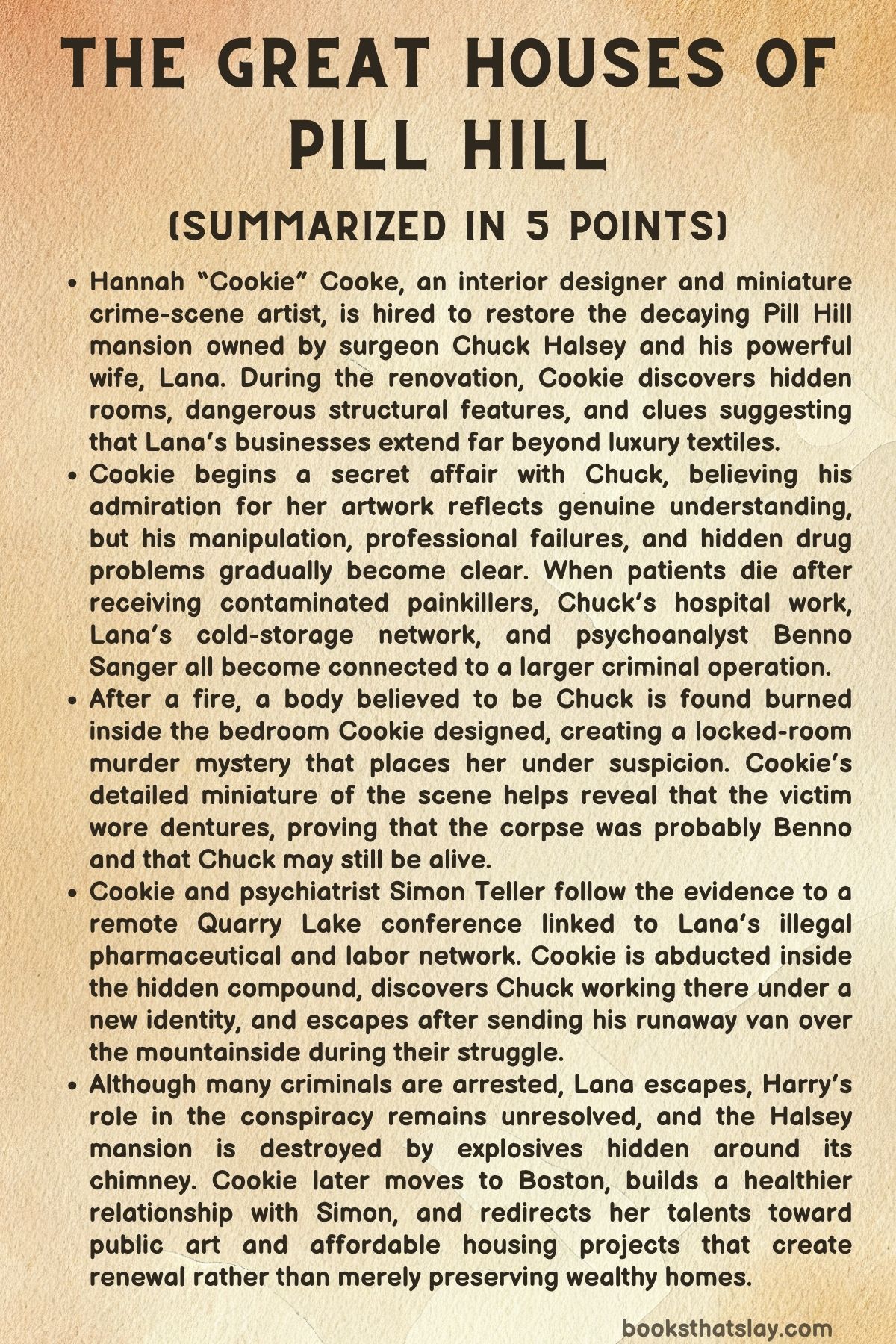
The Great Houses of Pill Hill by Diane Josefowicz is a literary mystery centered on Hannah “Cookie” Cooke, an interior designer whose knowledge of historic architecture becomes crucial to solving a staged murder.
Cookie restores damaged houses while creating miniature models of unexplained deaths, allowing her to study how rooms record secrecy, conflict, and human behavior. When a former lover is apparently murdered inside a mansion she renovated, her professional decisions become evidence in a widening investigation involving medical fraud, contaminated drugs, false identities, insurance schemes, and organized crime. The novel combines architectural history, psychological observation, dark humor, and a woman’s struggle to stop accepting roles designed by others.
Summary
Hannah “Cookie” Cooke is an interior designer, historic-house restorer, and miniature artist living in New Preston. When neurosurgeon Chuck Halsey is apparently murdered inside the bedroom she designed for him, Cookie begins constructing a scale model of the crime scene for Detective Bill Phelps.
The bedroom was created according to Chuck’s request for an “oblivion of light,” resulting in white walls, pale furnishings, a skylight, glossy trim, and a thick flokati rug. Its beauty has been transformed into something disturbing: blood stains the rug, a window has been damaged, smoke marks the fireplace, and the victim’s body was folded into the chimney.
Cookie’s involvement with the Halseys began when Chuck and his wife, Lana, hired her to restore their decaying mansion on Pill Hill, a formerly prosperous neighborhood associated with New Preston’s leading physicians. Lana, the powerful owner of the luxury-textile company Lana Pura, wanted a spectacular home suitable for grand parties, while Chuck seemed more interested in flirting with Cookie.
The renovation soon became complicated when Cookie attempted to expand the cramped kitchen. A wall she planned to remove contained an old chimney and unusual load-bearing beams coated in a dark, foul-smelling substance, creating both structural and fire hazards.
Cookie hired Harry Deluca, a skilled mason with whom she shared a long and troubled personal history. Harry had been her childhood companion, occasional lover, brief husband, professional collaborator, and persistent source of emotional danger.
Demolition exposed a hidden chamber containing Egyptian-style frescoes, an old hearth, and a beehive oven. The discovery fascinated Lana, who insisted that the mysterious room be preserved as part of the mansion rather than removed or donated to the local historical society.
Cookie also noticed a business card suggesting that Lana operated a cold-chain logistics company in addition to her textile business. The card appeared insignificant at first, but it later became connected to the transportation of temperature-sensitive medical materials.
As Lana traveled frequently, Chuck began attending renovation meetings alone. His flirtation with Cookie developed into a secret affair conducted largely inside the unfinished mansion.
Chuck showed genuine interest in Cookie’s miniature crime scenes, including a model inspired by a suspicious death she had heard about during a youthful trip to Nevada with Harry. His attention made Cookie feel understood as an artist, but it also encouraged her to overlook his selfishness, dishonesty, and control over the relationship.
Cookie became increasingly attached to Chuck while he decided when they met, when he withdrew, and when they reconciled. Although she recognized that she was being treated as disposable, she continued hoping he would leave Lana.
Fiona, Cookie’s practical assistant, warned that the renovation was being prolonged because Cookie did not want the affair to end. She also discovered numerous online complaints accusing Chuck of arrogance, incompetence, fraud, and medical negligence.
Chuck dismissed these accusations and continued presenting himself as a brilliant surgeon. Meanwhile, his relationship with Lana grew more hostile, and the couple began seeing Benno Sanger, an elderly psychoanalyst whose professional boundaries with them appeared unusually weak.
The mansion itself revealed further dangers. Harry discovered that the hidden chamber continued upward through a vertical shaft, where dryer lint, damaged bricks, faulty ventilation, and evidence of an earlier fire created a serious risk.
Chuck wanted the shaft sealed and forgotten, while Cookie insisted that the hazards be corrected. Around the same time, someone deliberately slashed the mattress where she and Chuck had been meeting, suggesting that their affair was no longer secret.
A crisis then emerged at the hospital. Patients who had undergone surgery were becoming ill or dying after receiving painkillers that appeared to have been improperly stored.
Cookie overheard Chuck discussing contamination, liability, and professional scrutiny. His behavior became more erratic, and she noticed a puncture mark on his arm that suggested injections or drug use.
Chuck eventually ended the affair and gave Cookie a blue Egyptian protective figure. At the Halseys’ housewarming party, Lana delivered a pointed toast about people who destroy homes, making it clear that she knew about Cookie and Chuck.
Cookie also found refrigerated ampoules labeled as unstable unless kept cold. Benno removed them before she could investigate, and a fire soon spread through the mansion’s kitchen and chimney.
Cookie saw Benno escaping through a hedge during the confusion but had to leave when she received news that her mother, Ginny, had become violent and disoriented at Tomlins Manor. At the facility, Cookie discovered bruises on Ginny and suspected that improper medication or excessive sedation had caused her behavior.
During a lucid moment, Ginny identified Chuck’s blue figure as a Pataikos, a protective deity associated with dangerous creatures. The figure could represent protection, substitution, service, or an absent person acting through another body.
The symbolism became more disturbing after a second fire devastated the Halsey mansion. Investigators found a body believed to be Chuck inside the white bedroom.
The victim had apparently been struck, wrapped in the flokati rug, soaked with an accelerant, pushed into the chimney, and burned. Because the bedroom door was deadbolted from the inside, the crime initially appeared impossible.
Cookie became both a grieving former lover and a potential suspect. She could not publicly admit her relationship with Chuck without damaging her business and exposing her dishonesty, yet her knowledge of the house made her valuable to investigators.
While she withdrew from restoration work, gallery owner Bobby offered her a long-desired solo exhibition. Cookie completed her miniature studies of the Lizzie Borden case, using the Borden house to explore confinement, resentment, domestic control, and the psychological pressure created by architecture.
Detective Phelps questioned Cookie about the renovation, the Halseys’ debts, the bedroom lock, and everyone who understood the chimney system. Cookie concealed the affair and minimized Harry’s suspicious conduct, even though she knew that his strength, access, and knowledge made him an obvious suspect.
Lana disappeared, leaving behind unpaid bills and an increasingly complicated financial situation. Harry later showed Cookie wires and Semtex hidden around the mansion’s central chimney, proving that someone intended to destroy the entire structure.
Harry claimed that the financially overextended Halseys would benefit from an insurance settlement. He also revealed that Lana was facing litigation and that she had been present at the Academy Club on the night of the murder.
Cookie could not determine whether Harry was exposing Lana’s scheme or helping her carry it out. Her uncertainty was shaped by their shared past, including their impulsive marriage near Reno and Harry’s possessive, violent behavior.
Further discoveries damaged Chuck’s reputation. Medical colleague Martha Benton suggested that he had concealed serious professional failures, while Fiona learned that someone had used her name to publish hostile reviews against Martha.
Chuck had apparently been impersonating Fiona online to attack a colleague who knew too much about his mistakes. Cookie began recognizing that he had manipulated not only her and Lana but also patients, coworkers, and professional records.
Phelps asked Cookie to build a precise miniature of the murder scene. The model allowed her to study the window, rug, chimney, deadbolt, blood patterns, and body position without returning to the unstable mansion.
Cookie also accepted a commission involving psychiatrist Simon Teller, whose wife, Wendy, wanted his gloomy office redesigned. Simon resisted the project, arguing that decoration could not solve his declining practice, but Cookie insisted that rooms affect how people feel, behave, and communicate.
Simon knew Benno and had his own painful history with him. As Cookie and Simon discussed the office, their intellectual connection grew, offering Cookie a relationship based more on disagreement and mutual attention than flattery.
Chuck’s funeral created another mystery. Cookie secretly attended and discovered that there was no coffin because the remains had already been cremated.
At the police station, Phelps revealed that identification tags had been mishandled at the morgue. Medical examiner Norman Sawyer and his assistant, Fiona’s brother Owen, had been dismissed after the wrong remains were released for cremation.
Photographs showed that the burned victim had dentures, while Chuck had natural teeth. The corpse also bore puncture marks, and Chuck’s dental records had disappeared.
Cookie realized that the victim might not have been Chuck. Benno, who had vanished after the party, matched the general age and build of the dead man and had been seen near the house shortly before the murder.
The mystery expanded after Wendy Teller died when another vehicle forced her car from a bridge. Witnesses described a large white truck resembling Harry’s, linking him to yet another suspicious death.
Cookie continued renovating Simon’s office while he mourned. Their work together brought them closer, but Cookie violated his trust by stealing a confidential case study Benno had written about Chuck.
The document described Chuck as “Dr. X,” a deceptive surgeon whose identity depended on admiration, borrowed authority, drugs, and manipulation. It also showed that Benno had become personally involved with Lana while pretending that his actions were an unconventional therapeutic experiment.
Lana gave Benno injections, transferred money to him, and offered him work as a doctor at a secret operation near Quarry Lake. Benno gradually realized that her plan to kill Chuck and destroy the mansion was genuine.
Cookie concluded that Benno had probably gone to the house to intervene and had been murdered in Chuck’s place. The false teeth, puncture marks, missing records, and rapid cremation supported the theory.
Her finished miniature helped Phelps and Norman recognize the substitution. Once Cookie confirmed that Chuck did not wear dentures, the investigation shifted from determining who killed him to discovering where he was hiding and whose body had been burned.
Simon produced another copy of Benno’s report and found that a medical conference at Quarry Lake still advertised Benno as a keynote speaker. Since Benno was missing, someone might be planning to appear under his identity.
Simon and Cookie also began questioning Chuck’s professional history. No one seemed to have properly verified his credentials, and Martha had repeatedly protected him when operations went wrong.
Cookie’s investigation became more personal when she learned that Harry had once violently assaulted her artist friend Erica. Simon had evaluated Harry for the court, and Harry blamed Simon’s report for his conviction.
Harry confronted Simon at the renovated office, demanding access to the file. The argument became physical, confirming that Harry’s violence was not an isolated misunderstanding that Cookie could continue excusing.
A fire then broke out in another psychiatrist’s office, but Simon used safety equipment Cookie had installed to rescue his colleague Lou. The incident confirmed Cookie’s belief that practical design decisions can save lives.
Lou disclosed that Martha had loved Chuck and covered for him after serious surgical errors. Her loyalty had allowed an unqualified and dangerous man to keep operating.
Federal investigators connected Lana’s cold-chain network to illicit pharmaceutical materials, contaminated painkillers, exploited labor, and organized criminal activity. Phelps developed a plan for Cookie and Simon to attend the Quarry Lake conference under cover as a married couple.
At the remote luxury resort, Cookie and Simon saw a body fall from a cargo container during their ascent by funicular. The polished conference setting concealed surveillance, hidden workers, medical facilities, and an industrial operation inside the mountain.
Cookie became ill after eating room-service food. While Simon searched for information, supposed hotel staff entered their room, overpowered her, and removed her in a laundry cart.
She awoke bound inside a van and was taken into the fortified compound. Armed guards brought her to the operation’s doctor, who proved to be Chuck.
Chuck was alive and working for Lana, although an ankle monitor suggested that he was not entirely free. He had allowed Benno’s corpse to be identified as his own and planned to use Benno’s identity within the medical operation.
Cookie learned that Harry had participated in staging the murder and had used her ancient silver obol as a message. The coin, which Cookie had lost during her travels with Harry, had been forced beneath the dead man’s dentures.
Using her knowledge of practical systems and physical spaces, Cookie created a signal, escaped through an animal-testing area, and found Simon. Lana fired at them as the compound descended into chaos.
Cookie released the parking brake on a van, sending it rolling downhill. Chuck was hiding inside and attempted to take control, but Cookie fought him, jumped free, and watched the vehicle crash through a barrier and fall from the mountain.
Law-enforcement helicopters arrived, and many members of the operation were arrested. Lana escaped, leaving the criminal network damaged but not entirely destroyed.
During her recovery, Cookie learned that Chuck had no valid transcripts, credentials, or verifiable professional history. Martha and others had suspected him but remained silent, allowing him to continue harming patients.
The conspiracy had also destroyed public trust in medicine. When a teenager overdosed at the resort, Simon used naloxone to revive him, but the boy’s family resisted going to a hospital because contaminated drugs had made the institution itself seem dangerous.
Cookie and Simon finally became intimate after surviving the operation together. Their closeness differed from Cookie’s affair with Chuck because it developed through cooperation rather than secrecy and calculated withdrawal.
The Halsey mansion was eventually destroyed when the Semtex around the chimney exploded. Harry apologized and directed Cookie to an insurance payment that settled the money she was owed, but the payment felt more like another taunt than justice.
Chuck was dead, Benno had been murdered, Harry remained free, and Lana was still missing. Cookie had solved much of the mystery, yet several participants escaped meaningful accountability.
Cookie’s business struggled after the scandal, prompting her to sublet her loft and move to Boston with Simon. Their relationship remained deliberately uncertain, allowing both of them to grow without claiming that survival had repaired every wound.
Ginny escaped Tomlins Manor and sent Cookie a postcard from Egypt, finally pursuing the scholarly and personal life she had once surrendered. Fiona left Cookie’s company to study interior design, beginning an independent professional path of her own.
Cookie helped create blossom, an installation that transformed an abandoned psychiatric hospital with thousands of flowers. The project allowed her to use her contracting abilities for renewal rather than restoration or the reconstruction of death.
When Bobby later proposed converting New Preston’s old powder mill into affordable housing and mixed-use space, Cookie initially resisted. She quickly began imagining possibilities, recognizing that preservation could serve communities rather than merely protecting wealthy properties.
Her final direction is neither a return to her former life nor a complete rejection of it. She carries forward her knowledge of architecture, death, history, and human weakness while choosing work based on transformation, access, and genuine usefulness.
Characters
Hannah “Cookie” Cooke
Cookie is the narrator, investigator, designer, artist, and emotional center of The Great Houses of Pill Hill. Her professional skill lies in understanding buildings not as silent objects but as records of desire, fear, class, concealment, and human compromise.
She notices physical details that others dismiss, including uneven corridors, concealed shafts, dangerous ventilation, damaged chimneys, architectural inconsistencies, and the emotional effects of rooms. This sensitivity makes her an exceptional restorer, but it also reveals how closely her work depends on entering spaces that clients consider private.
Cookie’s miniature crime scenes reflect both her intelligence and her fear of direct confrontation. By reducing violent rooms to manageable scale, she can move bodies, objects, and evidence until hidden relationships become visible.
Her models offer control over events that would otherwise overwhelm her. However, Chuck’s supposed murder forces her to confront a death that cannot remain safely distant because the room, furnishings, and emotional circumstances were partly created by her.
Cookie’s central weakness is her willingness to accommodate powerful or destructive people. She continues working for Lana, accepts Chuck’s secrecy, excuses Harry’s violence, conceals information from Phelps, and steals Benno’s report from Simon.
These actions are not signs of passivity alone. Cookie is resourceful and strong-willed, but she repeatedly directs her strength toward preserving relationships that diminish her rather than protecting herself.
Her affair with Chuck exposes her hunger to be taken seriously as an artist. Because he admires her miniatures, she interprets his attention as recognition and temporarily ignores how thoroughly he controls their connection.
Cookie’s development involves learning that admiration without respect is another form of exploitation. Chuck appreciates her work while using her labor, body, knowledge, and emotional loyalty to support his escape.
Her relationship with Simon offers a different possibility because he challenges her assumptions, admits discomfort, and responds to her expertise without turning it into seduction. Even then, Cookie must overcome her tendency to violate boundaries in the name of obtaining answers.
By the conclusion, she no longer limits herself to restoring private mansions or reconstructing scenes of death. Her work with flowers, abandoned institutions, and affordable housing suggests that she has begun using space to create access, renewal, and social value.
Chuck Halsey
Chuck first appears to be a successful neurosurgeon whose intelligence, confidence, and professional importance make him attractive to Cookie. He performs authority so effectively that people interpret his arrogance as proof of competence.
His charm depends on making each listener feel temporarily chosen. With Cookie, he presents himself as the rare person who recognizes her artistic talent, while with colleagues he uses medical language and prestige to discourage scrutiny.
Chuck’s affair with Cookie reveals his emotional opportunism. He seeks attention, excitement, and reassurance but refuses to accept responsibility for the effects of his behavior.
He controls their meetings, withdraws when she becomes demanding, and returns when he wants comfort. When Lana appears, Cookie is immediately hidden, dismissed, or sent away.
His professional identity is ultimately revealed as a fabrication. Missing credentials, inconsistent performance, patient deaths, online manipulation, drug use, and dependence on Martha’s protection all indicate that he has survived by exploiting the respect automatically granted to doctors.
Chuck does not simply make mistakes. He recruits others into hiding them, allowing Martha’s affection, Benno’s vanity, Cookie’s desire, and Lana’s ambition to become shields against accountability.
His apparent murder represents the ultimate extension of his fraudulent identity. By allowing Benno’s corpse to be burned and misidentified, Chuck abandons one false life and attempts to assume another.
At Quarry Lake, his ankle monitor complicates his position because he is both a participant in Lana’s operation and someone under her control. Even so, his captivity does not erase his responsibility for the deaths, impersonations, and exploitation that made his escape possible.
Chuck’s death in the runaway van removes the illusion that he can always talk, perform, or manipulate his way into another identity. His downfall occurs when Cookie stops reacting to the scene he has prepared and changes its physical arrangement herself.
Lana Halsey
Lana is a commanding entrepreneur whose desire for control shapes her marriage, mansion, businesses, and criminal organization. She treats homes, employees, spouses, and professional relationships as systems to be acquired, redesigned, and made useful.
Her restoration of the Pill Hill mansion initially appears to be an ambitious display of wealth. Her insistence on preserving hidden chambers and unusual architectural features also reveals her attraction to ownership, spectacle, and secret spaces.
Lana’s public business, Lana Pura, associates her with luxury textiles, refinement, and elite consumption. Beneath that surface, her cold-chain network transports medical materials connected to contaminated painkillers and illicit pharmaceutical production.
The contrast between the soft textiles she sells and the violence of her hidden operation is central to her characterization. She uses polished branding and domestic elegance to disguise exploitation, unsafe labor, confinement, and murder.
Lana understands Chuck more clearly than Cookie initially does. She recognizes his weaknesses, increases insurance coverage, draws Benno into their marriage, and prepares a plan in which Chuck can disappear while another person takes his place.
Her marriage is neither a simple victim-abuser relationship nor an ordinary unhappy partnership. Lana and Chuck compete for dominance while using outsiders as instruments in their conflict.
Benno is especially vulnerable to her manipulation because he interprets his attraction and involvement as psychological insight. Lana allows him to believe he is studying her while she studies his vanity, financial needs, and willingness to cross professional boundaries.
Within The Great Houses of Pill Hill, Lana represents power that can survive exposure because it is distributed through businesses, employees, financial systems, and hidden collaborators. Even after the Quarry Lake raid, she escapes, demonstrating that dismantling one location does not necessarily destroy the person who designed the network.
Harry Deluca
Harry is a gifted mason whose understanding of historic structures makes him indispensable to Cookie’s work. He can read chimneys, hidden walls, old fires, unstable loads, and dangerous construction decisions with an instinct that matches Cookie’s own architectural perception.
His usefulness has allowed Cookie to minimize his cruelty for years. She repeatedly treats his threats, jealousy, criminal conduct, and unpredictable behavior as separate from the quality of his work.
Their shared history gives Harry unusual power over her. He remembers the young Cookie who doubted her ambitions, participated in reckless adventures, married him impulsively, and later continued relying on him despite recognizing his possessiveness.
Harry often presents control as protection. He claims to know what Cookie needs, warns her about Chuck, interferes with her projects, monitors her relationships, and frames secret knowledge as something he reveals for her benefit.
His violence against Erica destroys Cookie’s remaining excuses. Learning that Harry assaulted her friend forces Cookie to recognize that his aggression was never merely theatrical, misunderstood, or limited to heated moments.
Harry’s involvement in the staged murder confirms his willingness to convert professional knowledge into criminal opportunity. He understands how the mansion’s chimney can hide a body, spread fire, support explosives, and bring down the entire structure.
The ancient obol found beneath Benno’s dentures operates as Harry’s personal signature and message to Cookie. By using an object from their shared past, he makes the murder scene an act of intimidation as well as deception.
Harry survives the final events and even helps ensure that Cookie receives money through the insurance settlement. His apology and payment do not redeem him; instead, they show how he continues attempting to define their relationship through favors, secrets, and debts.
Simon Teller
Simon is a psychiatrist whose intelligence is accompanied by grief, professional insecurity, and resistance to being managed. His gloomy office reflects his withdrawal after years of humiliation, marital unhappiness, and disappointment.
Unlike Chuck, Simon does not rely on effortless charm. He questions Cookie’s claims about design, resents Wendy’s interference, and openly expresses discomfort when he feels that others are making decisions for him.
His disagreements with Cookie create mutual respect. Their conversations about rooms, authority, comfort, and disclosure show that both understand how environments influence behavior, although they approach the subject through different disciplines.
Simon’s history with Benno explains some of his hesitation. Benno damaged his professional advancement by portraying him as unstable, leaving Simon suspicious of institutions that claim to judge character objectively.
His court evaluation of Harry demonstrates that Simon can act firmly when necessary. He refuses to release confidential files and rejects Harry’s belief that psychological explanation should erase responsibility for violence.
Simon’s response to danger distinguishes him from Chuck. During the office fire, he uses the extinguisher Cookie installed and enters the smoke to save Lou, placing another person’s life above his own comfort.
At Quarry Lake, Simon works beside Cookie rather than attempting to control her investigation. Their partnership is imperfect, particularly because she steals his confidential report, but they address the betrayal through anger, discussion, and continued cooperation.
His use of naloxone to save an overdosing teenager provides a direct contrast with Chuck’s medical fraud. Simon possesses neither Chuck’s glamorous status nor his theatrical confidence, yet he responds to suffering with practical knowledge and responsibility.
Fiona
Fiona is Cookie’s assistant, colleague, and moral counterweight. She understands Cookie’s habits more clearly than Cookie does and repeatedly identifies the emotional motives hidden beneath professional decisions.
Her warning that Cookie is prolonging the Halsey renovation reveals her perceptiveness. She recognizes that the unfinished house allows Cookie to continue seeing Chuck while pretending that their meetings remain necessary for work.
Fiona also investigates Chuck’s online reputation when Cookie refuses to examine it honestly. By locating complaints from patients and colleagues, she challenges the prestige that Cookie has accepted without verification.
Her life is shaped by responsibility for her brother Owen. She supports his unconventional ambition to work with the dead even when his unpaid internship creates financial pressure for her.
Chuck’s decision to use Fiona’s identity for hostile online reviews demonstrates how easily women’s names and reputations can be appropriated. Fiona becomes publicly associated with attacks she never made, leaving her to defend herself against another person’s deception.
She also takes considerable risks to obtain files and preservation records that help expose the conspiracy. Her loyalty to Cookie is active rather than unquestioning because she offers criticism, evidence, and practical help instead of simply confirming what Cookie wants to believe.
Fiona’s decision to leave the Ministry and study interior design marks her emergence from Cookie’s shadow. She has learned from Cookie but refuses to remain permanently defined as someone else’s assistant.
Ginny Cooke
Ginny is Cookie’s mother, a former scholar of ancient art whose academic ambitions were interrupted by pregnancy, marriage, and domestic obligation. Her expertise survives beneath illness, institutionalization, sedation, and periods of confusion.
Her knowledge of Egyptian objects gives several clues their deeper meaning. She identifies the protective figure Chuck gives Cookie and explains the symbolism of the ancient obol associated with passage after death.
Ginny’s situation at Tomlins Manor raises questions about medical authority and the treatment of inconvenient patients. Staff members interpret her confusion as justification for restraint and sedation, while Cookie suspects that the medication itself is worsening her condition.
Her fragmented speech makes her an uncertain witness, but the book repeatedly shows that confusion does not eliminate insight. Ginny may mix names and historical periods, yet her observations about Harry, hidden rooms, occultism, and danger often contain useful truths.
Ginny also represents the future Cookie fears. Both women possess intelligence and ambition, but each has learned to make herself useful to others before claiming a life of her own.
The postcard from Egypt reverses this pattern. By escaping the institution and traveling to the place connected with her abandoned scholarship, Ginny finally acts on a desire she postponed for decades.
Her departure is improbable, comic, defiant, and symbolically important. It suggests that neither age nor a long history of accommodation completely removes the possibility of self-directed action.
Benno Sanger
Benno is a psychoanalyst whose intellectual pride makes him vulnerable to the very manipulations he believes he can interpret. He approaches Chuck and Lana’s marriage as though it were a psychological performance staged for his analysis.
His case study shows a man who repeatedly disguises personal involvement as professional experimentation. He accepts money, injections, secrets, and access from Lana while telling himself that he is penetrating the couple’s defenses.
Benno’s descriptions of his own past, including the story of his wife April’s death, contain possible inventions. These uncertain memories suggest that he has also created a dramatic identity for himself.
His treatment of Simon reveals a harsher side. By interfering with Simon’s professional advancement and representing him as unstable, Benno uses institutional authority to damage a younger colleague.
Despite these failures, Benno eventually recognizes that Lana’s murder plan is real. His attempt to document the conspiracy and send the case report to Simon becomes a belated effort to repair the harm he has helped enable.
Benno’s death is especially cruel because his body becomes material for Chuck’s next identity. His dentures, age, build, and disappearance allow the conspirators to transform him into the officially dead Chuck Halsey.
His report survives as both evidence and warning. It contains valuable observations, but its distortions remind Cookie and Simon that an analyst can correctly identify another person’s deception while remaining blind to his own.
Detective Bill Phelps
Bill Phelps is a pragmatic investigator who initially views Cookie as both a suspect and a useful source of knowledge. He understands that her intimacy with the mansion gives her access to information unavailable to ordinary witnesses.
His decision to commission a miniature of the murder scene demonstrates openness to unconventional methods. Rather than dismissing Cookie’s work as decorative, he recognizes its value in examining space, scale, access, and physical relationships.
Phelps can be insensitive, particularly when he reduces Cookie’s relationship with Chuck to financial or sexual dependence. His comments reflect the suspicion surrounding a woman whose personal and professional boundaries have become entangled.
Even so, he adjusts his conclusions when evidence changes. The dentures, missing dental records, body substitution, case study, and Quarry Lake announcement gradually persuade him to reconsider the supposed murder.
Phelps’s investigation also depends on Cookie revealing information she has concealed. Their relationship therefore develops through tension between official procedure and the private knowledge produced by intimacy.
By involving Cookie in the Quarry Lake sting, he acknowledges her courage and expertise but also places her in serious danger. The operation succeeds only partially, showing both the value and limitations of law enforcement when confronting a criminal system already embedded in respectable businesses.
Wendy Teller
Wendy is energetic, controlling, practical, and deeply dissatisfied with her marriage. She hires Cookie to redesign Simon’s office without obtaining his consent because she believes she understands what his career requires better than he does.
Her approach resembles Lana’s tendency to treat other people’s environments as problems she has the right to solve. Wendy’s friendliness often carries an expectation that others will cooperate with plans she has already made.
She arranges a dinner involving Cookie and Simon, apparently hoping that Cookie’s dogs and personality will influence him. Her intervention blurs professional, domestic, and romantic boundaries.
Wendy’s affair with Norman Sawyer complicates her characterization. The relationship is apparently known to Simon, suggesting a marriage sustained by resignation rather than mutual trust.
Her hospital communications work places her near the contaminated-painkiller scandal, while her connection to Norman links her to the mishandled corpse. Whether or not she fully understands the conspiracy, she possesses information that could endanger those responsible.
Her death after being forced from a bridge shows how quickly peripheral knowledge can become fatal. It also transforms Simon’s relationship to the investigation from professional curiosity into personal loss.
Norman Sawyer
Norman is the medical examiner connected to the identification and cremation of the burned corpse. His role places him at the center of one of the investigation’s most damaging failures.
The mishandled identification tags and premature cremation destroy the possibility of later examining the body. Whether caused by incompetence, manipulation, or both, the mistake allows Benno’s corpse to retain Chuck’s identity.
Norman initially treats the errors as disastrous professional failures rather than evidence of a deliberate substitution. Cookie’s observation about the dentures forces him to reconsider what the medical evidence should have established.
His affair with Wendy creates another possible conflict. Because she works in hospital communications and understands the contaminated-drug crisis, their relationship connects two institutions already struggling to control damaging information.
Norman is neither presented as a master conspirator nor entirely innocent of responsibility. His carelessness demonstrates how criminal plans often depend on ordinary failures, weak systems, and people assuming that someone else has verified the essential facts.
Martha Benton
Martha is one of Chuck’s medical colleagues and one of the people most responsible for protecting his professional identity. Her intelligence allows her to recognize that something is wrong, but her emotional attachment prevents her from acting decisively.
She covers for Chuck after failed operations and conceals evidence that could have stopped him from continuing to practice. Her loyalty, rather than saving him, enables greater harm to patients.
Martha becomes a target of Chuck’s online campaign when he uses Fiona’s name to post hostile reviews. The impersonation isolates her and redirects attention away from his misconduct.
Her guilt grows as the contaminated-painkiller crisis produces further deaths. She knows that her earlier silence gave an impostor time, authority, and access to vulnerable people.
Martha demonstrates that affection can become ethically destructive when it protects someone from consequences. Her actions are motivated by love, fear, shame, and professional self-preservation, but those motives do not lessen their effects.
Lou
Lou is a psychiatrist who works near Simon and has professional connections to Martha, Benno, and the medical community surrounding Chuck. His conversations provide Cookie with information about Martha’s protection of Chuck and Benno’s final case study.
When a fire breaks out in his office, Lou becomes physically vulnerable to the violence spreading through the investigation. Simon’s rescue prevents him from becoming another person silenced before he can speak.
His immediate concern for Martha after the fire reveals emotional loyalty. Unlike Martha’s protection of Chuck, however, Lou’s concern does not depend on denying her actions.
Lou’s presence helps connect Simon’s psychiatric world with the hospital scandal. He represents the ordinary professionals who see fragments of wrongdoing but do not initially understand how those fragments form a larger system.
Erica Subiaco
Erica is Cookie’s former art-school friend, rival, and source of artistic discomfort. She creates bold, confrontational work and refuses the modesty that Cookie has used to make herself acceptable.
Her provocative thesis installation challenges conventional beauty and passive consumption. To Cookie, Erica represents both creative courage and the fear of becoming excessive, difficult, or publicly ambitious.
Their friendship contains admiration, jealousy, competition, and unresolved pain. Cookie measures her own artistic caution against Erica’s willingness to risk ridicule.
The revelation that Harry assaulted Erica forces Cookie to reconsider both relationships. Erica’s suffering becomes evidence of what Cookie’s loyalty to Harry allowed her to ignore.
After Erica’s death, social media reduces her to simplified tributes. Cookie understands that such public narratives cannot contain the contradictory person she knew.
Erica’s influence survives in Cookie’s eventual refusal to undervalue her art. She remains a reminder that women who claim creative space are often treated as unstable or dangerous, while women who remain accommodating risk disappearing inside other people’s lives.
Owen
Owen is Fiona’s younger brother and an aspiring funeral aesthetician. His interest in preparing the dead connects him to the story’s concern with bodies, representation, preservation, and identity.
His unpaid morgue internship places a financial burden on Fiona, but it also reflects genuine vocational commitment. He approaches death as practical work rather than a subject to avoid.
Because he assists Norman at the morgue, Owen becomes implicated in the misidentification and cremation scandal. His dismissal demonstrates how junior workers often absorb the consequences of failures created by larger systems.
His Egyptian wedjat tattoo connects him symbolically to protection and watchfulness. Like Cookie, he works at the boundary between physical remains and the stories the living construct around them.
Bobby
Bobby is the gallery owner who recognizes the artistic value of Cookie’s miniature crime scenes. He gives her opportunities at moments when her professional and emotional lives appear to be collapsing.
His offer of a solo exhibition forces Cookie to take her art seriously. Rather than treating the miniatures as private experiments, he presents them as work worthy of public attention.
Bobby later involves her in blossom, an installation inside an abandoned psychiatric hospital. This project redirects her practical abilities away from death scenes and luxury restoration toward temporary beauty and public benefit.
His proposal involving the powder mill further expands Cookie’s understanding of design. Through Bobby, she begins seeing that artistic and architectural work can serve communities rather than merely collectors or wealthy homeowners.
Doocie
Doocie is the Nevada waitress whose account of a suspicious motel death inspires Cookie’s first major crime-scene miniature. Although she occupies little space in the story, her tale changes the direction of Cookie’s artistic life.
The death she describes contains uncertain positions, motives, objects, and explanations. Instead of deciding on a single answer, Cookie constructs several possible arrangements.
Doocie therefore introduces Cookie to the creative method that later becomes essential to the Halsey investigation. A casual story told in a diner eventually gives Cookie a way to examine violence without pretending that uncertainty can always be eliminated.
Pina
Pina is Cookie and Simon’s troubled neighbor after they move to Boston. Her presence shows Simon’s instinctive response to suffering outside formal professional settings.
Rather than avoiding her distress because she is not an official patient, Simon offers attention and support. This behavior confirms Cookie’s growing belief that he is motivated by care rather than status.
Pina also prevents the ending from becoming a private romantic retreat. Even in a new city, Cookie and Simon remain connected to imperfect communities and people whose problems cannot be solved through a single investigation.
Themes
Houses as Records of Human Behavior
Rooms in The Great Houses of Pill Hill hold evidence that their owners cannot completely control. Walls conceal chambers, corridors reveal missing space, damaged vents record negligence, and decorative choices expose emotional needs that clients may never state openly.
Cookie’s work depends on reading these physical traces. She recognizes that a house is shaped not only by an architect’s plan but also by arguments, compromises, repairs, hidden labor, financial ambition, and fear.
The Halsey mansion becomes the clearest example of architecture functioning as evidence. Its chimney supports the building, hides hazardous systems, receives a corpse, carries fire, conceals explosives, and finally becomes the mechanism through which the entire structure is destroyed.
The white bedroom also changes meaning according to human action. What begins as Chuck’s fantasy of purity becomes a secret meeting place, a staged murder scene, and proof that beauty cannot protect a room from the conduct occurring inside it.
Cookie’s miniatures extend this idea by reducing buildings to a scale at which relationships become visible. She does not treat architecture as a neutral background because the arrangement of doors, furniture, passageways, and locks influences what people can do.
The novel ultimately expands Cookie’s architectural vision. She moves from preserving wealthy homes toward imagining affordable housing, suggesting that buildings should be judged not only by historical authenticity but also by the kinds of lives they permit.
Identity, Imposture, and Manufactured Authority
Chuck survives because people respond to the appearance of authority before verifying its foundations. His title, confidence, medical language, expensive home, and dramatic stories encourage patients and colleagues to assume that competence must exist beneath the performance.
His false identity is supported by many smaller acts of substitution. He posts reviews using Fiona’s name, allows Martha to speak for his ability, lets Benno interpret his motives, and finally permits Benno’s body to be cremated as his own.
The burned corpse becomes the most literal example of one person being forced to carry another’s identity. Missing dental records, incorrect tags, dentures, fire damage, and institutional error make the false story difficult to challenge.
Other characters also construct identities for themselves. Benno imagines that he is a daring analyst rather than a compromised participant, Harry presents control as protection, Lana disguises organized crime as luxury commerce, and Cookie initially defines herself as a practical designer rather than an ambitious artist.
The novel does not suggest that all self-construction is dishonest. Cookie’s eventual reinvention is different because it requires acknowledging her failures rather than erasing them.
Authority becomes dangerous when titles and stories replace verification. The medical scandal grows because too many people accept Chuck’s performance, while those who suspect the truth remain silent to protect their careers, relationships, and reputations.
Loyalty, Complicity, and the Cost of Silence
Loyalty repeatedly appears admirable in intention but destructive in practice. Cookie protects Harry because of their history, conceals her affair because of shame, and initially defends Chuck because she wants his admiration to remain meaningful.
Martha’s protection of Chuck has even more serious consequences. By covering for his surgical failures, she allows an unqualified man to continue treating patients, turning private affection into public danger.
Benno behaves similarly when he treats his involvement with Lana as a sophisticated intervention. His desire to remain important prevents him from admitting that he has become useful to a criminal operation.
Silence allows each form of misconduct to grow. Complaints remain online rather than becoming decisive action, colleagues exchange suspicions without verifying credentials, and institutional workers accept convenient explanations for missing records, medication problems, and identification errors.
Cookie’s development requires understanding that exposing someone can be a form of care. Installing safety equipment, reporting evidence, questioning medical authority, and refusing unreasonable demands protect people more effectively than preserving a destructive relationship.
The story also distinguishes explanation from excuse. Harry’s history, Chuck’s insecurity, Benno’s vanity, Martha’s love, and Cookie’s loneliness may clarify their decisions, but none removes responsibility for the harm those decisions produce.
Death, Miniatures, and the Desire for Control
Cookie’s miniature scenes allow her to approach death through craft, measurement, and arrangement. Blood, furniture, bodies, and damaged rooms become objects she can position, reconsider, and study without being overwhelmed by their full scale.
This process is not simple fascination with violence. Cookie is interested in uncertainty, especially the gap between what a room appears to show and what may actually have happened.
Her Lizzie Borden project refuses to declare guilt or innocence. Instead, it examines how confinement, resentment, economic dependence, domestic labor, and inaccessible rooms can create conditions in which violence becomes imaginable.
The Halsey murder destroys the distance between Cookie’s art and lived experience. The bedroom she designed becomes a real crime scene, and the miniature she constructs contains evidence of her affair, professional choices, shame, and grief.
Objects associated with death also carry unstable meanings. The Pataikos may protect or substitute, the obol may offer passage or threaten Cookie with her past, and Chuck’s funeral urn conceals the fact that the wrong body was cremated.
Cookie eventually moves beyond reconstructing death without rejecting what the practice taught her. The flower installation in the abandoned hospital uses temporary materials, practical coordination, and transformed rooms to honor life rather than preserve violence.
Her final work accepts that control will always remain incomplete. Buildings change, relationships remain provisional, criminals escape, art decays, and endings fail to settle every question, but creation remains possible within that uncertainty.