An Arcane Study of Stars Summary, Characters and Themes
An Arcane Study of Stars by Sydney J. Shields is a dark academic fantasy about Claudia Jolicoeur, a young woman trapped by poverty, grief, and her father’s cruelty. Her search for escape leads her to Cygnus University, a strange occult school where knowledge becomes magic and gods move through classrooms, dreams, and bargains.
Claudia hopes to study the lost art of Astrologia, but her ambition draws her into a dangerous pact with a fallen star god. The book blends romance, mystery, magic, and betrayal as Claudia fights for freedom, love, and control over her own soul.
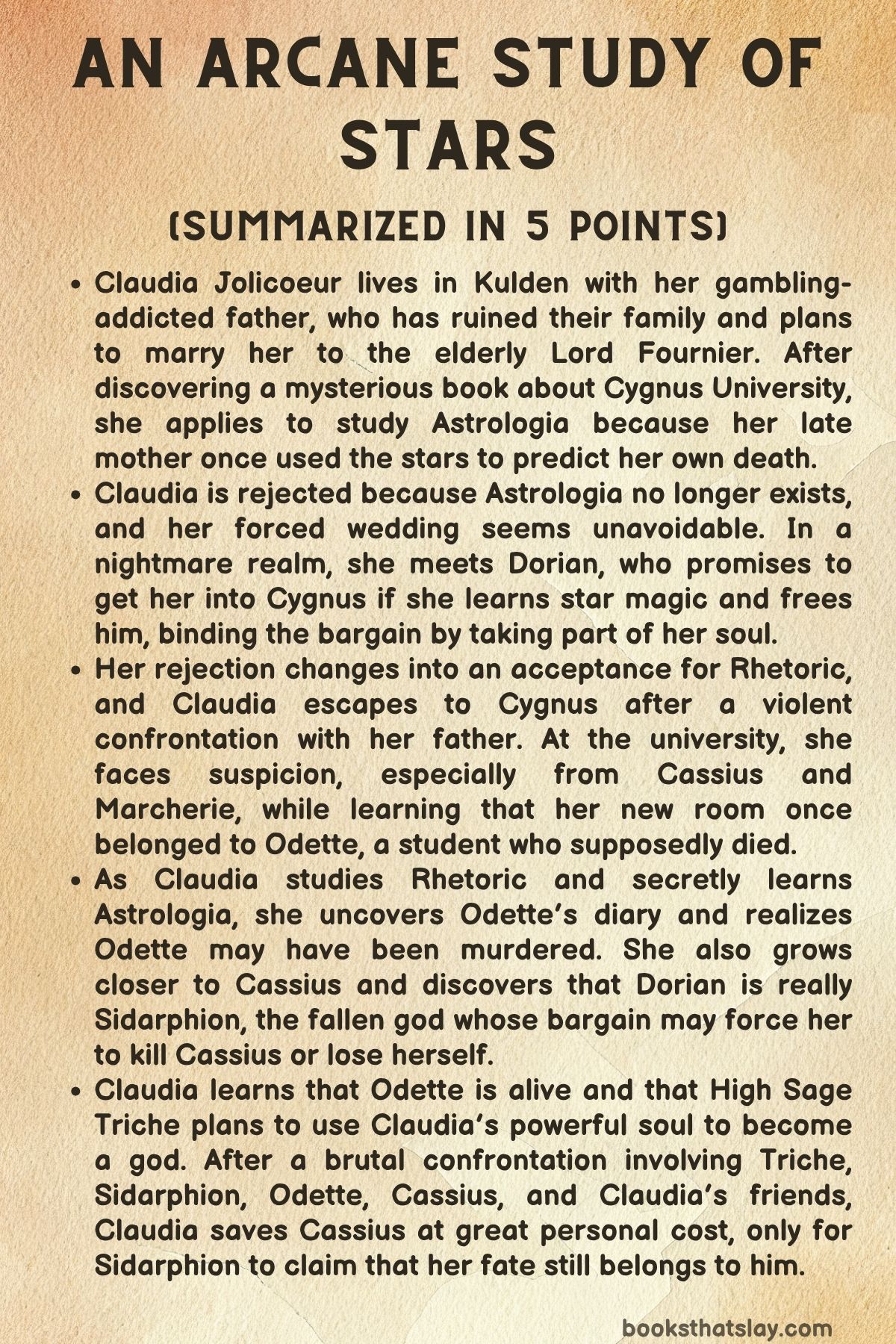
Summary
Claudia Jolicoeur lives in Kulden, a bleak, frozen town that feels as empty as her future. Her family was once comfortable, but her father has destroyed their fortune through gambling, drink, and poor choices.
He is bitter, ruined, and cruel, and Claudia has grown up under the weight of his failures. Her mother, Elise, is dead, and Claudia still mourns her deeply.
Elise had been gifted with knowledge of the stars, and before her death she predicted her own end. That memory stays with Claudia, shaping both her grief and her curiosity.
On the anniversary of Elise’s death, Claudia visits Wanderer’s Wonders, an old bookshop she loves. There she finds a strange black book about Cygnus University, an occult institution where academic subjects become forms of magic.
The book calls to her, especially the discipline of Astrologia, because of her mother’s connection to star-reading. Claudia is desperate for a way out of the life her father has chosen for her, so the idea of Cygnus becomes more than a dream.
It becomes a chance to reclaim her future.
The shopkeeper’s sister, Mrs. Schottstaedt, recognizes Claudia as Elise’s daughter and sells her the book for only a penny. She makes Claudia promise to apply to Cygnus.
The application process is strange and frightening. Claudia must burn the book and mix her blood into the ritual.
Green smoke rises, stars seem to move, and Claudia believes she may have opened a path toward the world she has longed for.
A month later, her hopes collapse. She receives a rejection letter explaining that Astrologia no longer exists at Cygnus because Sidarphion, the God of Stars and Nightmares, abandoned the university.
On the same day, her father announces that she will marry Lord Fournier, a wealthy elderly man. Claudia has no desire to marry him, but her father sees the match as a solution to his financial ruin.
Her life narrows into a trap.
On the night before the wedding, Claudia drinks heavily and climbs onto the roof. She is reckless, grieving, and terrified of the future waiting for her.
After nearly falling and cutting herself, she enters a dreamlike place called the Realm of Nightmares. There she meets Dorian, a beautiful and terrifying figure who claims to be a former Astrologia scholar imprisoned by Sidarphion.
He offers Claudia a bargain: he will help her enter Cygnus if she learns enough star magic to free him. Claudia accepts because she sees no other escape.
Dorian seals the bargain by biting into her soul.
The next morning, Claudia discovers that her rejection letter has changed into an acceptance letter. She has been admitted to Cygnus, though not for Astrologia.
Instead, she is accepted into Rhetoric. When she burns the letter to open a magical Doorway to the university, her father interrupts her and attacks Bishop, her pet snake.
Claudia reacts violently and stabs him with a letter opener. As she flees through the Doorway, her father tries to follow, but the magic rejects him as unworthy and burns him.
Claudia arrives at Cygnus covered in blood.
Her entrance makes her an object of curiosity and mockery. Cassius MacLeod, the apprentice of High Sage Triche, immediately taunts her and reveals that he knows she was first rejected from Astrologia.
High Sage Triche welcomes Claudia and assigns her to the former room of Odette Dufort, a student who recently died. Claudia soon learns that Odette’s death has left behind grief, suspicion, and unanswered questions.
At Cygnus, Claudia begins studying Rhetoric, where language and persuasion carry magical force. She is behind the other students and has to work hard to catch up.
She also encounters Malevimus, the God of Wit and Secrets, and forms a strange bond with him. The gods of Cygnus are not distant myths; they are active, clever, and often dangerous presences within the university.
Claudia struggles to find her place. Cassius continues to challenge her, while Marcherie, Odette’s grieving lover, suspects Claudia may have some connection to Odette’s death.
Claudia also becomes friends with Alistair, a Scientia student, who is kinder and more willing to trust her. At first, Alistair believes Odette died naturally, but Claudia begins finding clues that suggest otherwise.
When Claudia discovers Odette’s diary, the mystery deepens. Odette had feared someone, had studied forbidden celestial magic, and seemed to know she was in danger.
Claudia realizes that Odette may not have died from natural causes at all. Her own connection to Dorian and Astrologia makes the discovery even more alarming.
She has stepped into a story that began before she arrived.
Although Astrologia is officially gone, Claudia convinces Professor Lamour to teach her in secret. In the abandoned observatory, she begins learning the star magic she had wanted from the beginning.
These lessons connect her to her mother’s legacy, but they also move her closer to the bargain she made in the Realm of Nightmares. As Claudia studies, she and Cassius grow closer.
Their rivalry softens into trust and attraction, though danger surrounds them both.
Claudia eventually learns that Dorian lied about who he is. He is not a trapped scholar.
He is Sidarphion himself, the fallen god of stars and nightmares. His charm, suffering, and promises were all part of a larger manipulation.
Worse, Claudia discovers that Odette made the same bargain before her. Odette had been drawn into Sidarphion’s plans and punished when she refused to complete them.
Odette did not die in the ordinary sense. She was trapped because she would not kill Cassius.
Cassius’s bloodline is tied to Sidarphion’s curse, and Sidarphion’s bargain with Claudia is designed to push her toward the same terrible choice. If Claudia kills Cassius, Sidarphion gains what he wants.
If she refuses, she risks losing herself to him. The bargain is not a path to freedom but another prison.
Claudia searches for a way to break free. Her feelings for Cassius become impossible to deny, and she confesses her love for him.
Their relationship becomes one of the few things that feels real and chosen in a world full of bargains and hidden motives. Claudia also discovers that Odette is still alive, trapped but not gone.
Odette becomes an uneasy ally after Claudia herself is poisoned and imprisoned by High Sage Triche.
Triche is revealed as another major threat. He wants to use Claudia’s powerful soul as part of a plan to rise to godhood.
Claudia has been watched, guided, and endangered not only by Sidarphion but also by the head of Cygnus. The university that promised escape has become a place of sacrifice, secrets, and ambition.
Claudia, Cassius, Alistair, Angel, Marcherie, and Odette form a plan to stop both Triche and Sidarphion. Their alliance is tense because trust has been damaged, but they all understand that Triche’s plan could destroy them.
During the confrontation, Triche tries to use Claudia for his own ascension. The fight turns brutal, and Marcherie is badly injured.
Then Odette makes a shocking choice. Believing that Cassius’s death is necessary to end the curse and stop Sidarphion, she stabs him.
Claudia refuses to accept losing him. In desperation, she bargains with Sidarphion again, giving him an even stronger claim over herself so Cassius can live.
Cassius returns, but the cost is terrible. Sidarphion now has a deeper hold on Claudia than before.
After the battle, the survivors are left wounded and shaken. They have stopped Triche, but they have not truly defeated Sidarphion.
Claudia has saved Cassius, yet she has sacrificed more of herself to do it. Her love has kept him alive, but it has also tightened the god’s power over her.
In the end, Claudia faces Sidarphion again in the nightmare realm. He reveals that his plans have always led back to her.
He sees Claudia as the fate he fought for, the person at the center of his long design. Claudia rejects his claim and declares that she belongs to Cassius, not to him.
But Sidarphion insists that he has already won. The ending leaves Claudia alive, loved, and defiant, but still bound to a dangerous god who believes her soul is his.
Characters
An Arcane Study of Stars presents its characters through grief, ambition, betrayal, forbidden knowledge, and the dangerous desire to escape one’s fate. Each character is shaped by what they want most, and many of them become morally complicated because their desires are mixed with fear, love, survival, or power.
Claudia Jolicoeur
Claudia Jolicoeur is the central character of An Arcane Study of Stars, and her journey is built around desperation, curiosity, loneliness, and defiance. At the beginning of the book, she is trapped in a life controlled by poverty, her father’s cruelty, and the threat of marriage to Lord Fournier.
Her interest in Cygnus University is not simply academic; it becomes a way to escape a future that has already been decided for her. Claudia’s connection to Astrologia is also deeply emotional because it ties her to her dead mother, Elise, whose knowledge of the stars left a powerful mark on Claudia’s imagination.
This makes Claudia’s magical ambition personal before it becomes dangerous.
Claudia is intelligent and determined, but she is also reckless when pushed into fear. Her bargain with Dorian, later revealed to be Sidarphion, shows both her bravery and her vulnerability.
She wants freedom so badly that she accepts help from a being she does not fully understand. This does not make her foolish; rather, it shows how limited her choices are.
Claudia is repeatedly placed in situations where survival requires risk, deception, and moral compromise. Her arrival at Cygnus covered in blood immediately marks her as an outsider, and the suspicion she faces forces her to develop resilience quickly.
As the story progresses, Claudia becomes more than a victim escaping an arranged marriage. She becomes an investigator, a hidden student of forbidden magic, and someone willing to challenge gods, scholars, and institutional authority.
Her relationship with Cassius reveals her softer side, but it also increases the danger around her because love becomes tied to sacrifice. Claudia’s greatest conflict is the fight to remain herself while Sidarphion gains more power over her.
By the end of the story, her declaration that she belongs to Cassius is not merely romantic; it is an act of resistance against Sidarphion’s claim over her soul, fate, and identity.
Cassius MacLeod
Cassius MacLeod begins as an arrogant and cutting figure, especially in the way he mocks Claudia when she arrives at Cygnus. His position as the High Sage’s apprentice gives him authority, confidence, and social power, and at first he seems to use those advantages to belittle Claudia.
However, Cassius gradually becomes more complex as the story reveals the pressure surrounding his bloodline and its connection to Sidarphion’s curse. His sharpness is not only pride; it is also a defense formed by expectation, danger, and the burdens placed on him.
Cassius functions as both Claudia’s rival and romantic counterpart. Their relationship develops through suspicion, challenge, and reluctant fascination.
He does not trust Claudia at first, partly because her arrival is tied to Odette’s supposed death and partly because Claudia herself is surrounded by secrets. Yet his connection with her deepens as he sees her courage, intelligence, and emotional strength.
Their bond is important because it gives Claudia something real to protect, but it also places Cassius at the center of Sidarphion’s manipulation.
Cassius is one of the most important moral pressure points in the book. Odette’s refusal to kill him traps her, and Claudia’s bargain is designed to push her toward the same impossible choice.
This makes Cassius more than a love interest; he is the living symbol of the curse’s cruelty. When Odette stabs him, the act reveals how fear and desperation can twist even love and loyalty into violence.
His revival through Claudia’s renewed bargain is both a victory and a loss, because Claudia saves him while giving Sidarphion a stronger hold over herself.
Dorian / Sidarphion
Dorian is first presented as a beautiful and terrifying being trapped in the Realm of Nightmares, but his true identity as Sidarphion transforms him into one of the book’s most deceptive and dangerous figures. As Dorian, he appears alluring, wounded, and useful.
He understands Claudia’s desperation and offers exactly what she needs: entry into Cygnus and access to the forbidden magic of Astrologia. His manipulation is effective because he does not begin by appearing purely evil.
Instead, he presents himself as someone who has also suffered, which makes his bargain feel like an exchange between two trapped people.
Sidarphion’s power lies not only in magic but in emotional exploitation. He studies Claudia’s longing for freedom, her grief for her mother, and her hunger for knowledge.
By binding himself to her soul, he turns her ambition into a trap. His lie about being a former scholar is especially cruel because it allows Claudia to believe she is helping someone like herself.
The later revelation that Odette made the same bargain before her shows that Sidarphion’s methods are practiced, patient, and deeply predatory.
As a fallen god connected to stars and nightmares, Sidarphion represents corrupted wonder. Star magic might seem beautiful, intellectual, and transcendent, but through him it becomes tied to possession, coercion, and sacrifice.
His final insistence that he has won suggests that he sees Claudia not as a person but as the fulfillment of a destiny he has engineered. His conflict with Claudia is therefore not only magical; it is a battle over ownership.
Claudia wants to define herself, while Sidarphion wants to claim her as the fate he fought to secure.
Odette Dufort
Odette Dufort is first introduced through absence, which makes her one of the book’s most haunting figures. Claudia is given Odette’s old room, and Odette’s supposed death creates the vacancy that allows Claudia into Cygnus.
At first, Odette exists as a mystery, a shadow over Claudia’s new life, and a source of suspicion from others. Her diary changes her role by giving her fear, intelligence, and agency.
Through it, Claudia learns that Odette had been studying forbidden celestial magic and believed someone was threatening her.
Odette’s importance grows when it is revealed that she did not die in the ordinary way others believed. Like Claudia, she had made a bargain with Sidarphion, and like Claudia, she was pushed toward killing Cassius.
Odette’s refusal to do so shows that she had moral strength, even though she was trapped by the consequences of that refusal. Her survival complicates the story because she is neither simply a victim nor simply a guide.
She is someone who has already been broken by the same forces now closing around Claudia.
Odette’s decision to stab Cassius is one of her most tragic moments. It does not erase her earlier courage, but it shows how prolonged fear can distort judgment.
She believes his death may be necessary, and that belief leads her to commit an act that harms the people around her. Odette is therefore a deeply tragic character because she understands the danger better than almost anyone, yet that understanding does not save her from making a terrible choice.
Her love for Marcherie and her connection to Claudia reveal her humanity, but her actions show how survival under manipulation can damage even good intentions.
Marcherie
Marcherie is shaped by grief, loyalty, and suspicion. As Odette’s grieving lover, she initially sees Claudia through the pain of loss.
Claudia’s arrival in Odette’s room feels like an intrusion, and because Odette’s death is surrounded by uncertainty, Marcherie’s suspicion is emotionally understandable. She is not simply hostile for the sake of conflict; her distrust comes from love and from the unresolved wound left by Odette’s disappearance.
Marcherie’s character adds emotional weight to the mystery around Odette. Through her, the reader sees that Odette was not only a missing student or a magical clue but a person who was deeply loved.
Marcherie’s grief makes the stakes more intimate. The truth about Odette’s survival does not erase Marcherie’s suffering, because she has already lived through the loss and confusion caused by the deception around Odette.
During the final confrontation, Marcherie’s injury emphasizes the cost of the struggle against Triche and Sidarphion. She is one of the characters most directly hurt by the ambitions and bargains of others.
Her role in the book shows how love can make a person fierce, suspicious, and vulnerable at the same time. Marcherie’s emotional intensity gives the story a strong human center amid the larger conflict of gods, magic, and institutional corruption.
Alistair
Alistair is one of Claudia’s earliest and most important friends at Cygnus. As a Scientia student, he brings a different intellectual energy into the story, contrasting with Claudia’s work in Rhetoric and hidden Astrologia.
His belief that Odette died naturally initially positions him as more trusting or rational than the more suspicious characters around Claudia. However, his friendship with Claudia matters because he offers her kindness in an environment where she is often judged, mocked, or suspected.
Alistair’s role is important because he helps Claudia feel less isolated. Cygnus is a place of wonder, but it is also socially dangerous, and Claudia arrives with no stable support system.
Alistair becomes part of the small group of people who eventually stand with her against Triche and Sidarphion. His presence suggests that loyalty does not always need to be dramatic or romantic to matter.
Sometimes it appears as steady friendship, belief, and willingness to help when the danger becomes clear.
In the larger structure of the story, Alistair represents the possibility of trust within an institution full of secrets. While many characters hide motives or act from suspicion, Alistair gives Claudia a form of companionship that is comparatively sincere.
He may not carry the same tragic burden as Cassius, Odette, or Marcherie, but his importance lies in the way he supports Claudia’s movement from isolated outsider to member of a chosen circle.
High Sage Triche
High Sage Triche appears at first as a welcoming authority figure, but this appearance hides ambition, cruelty, and corruption. When Claudia arrives at Cygnus, Triche gives her Odette’s old room and explains the vacancy in a way that seems official and reasonable.
This early presentation makes Triche seem like part of the institutional order Claudia has longed to enter. However, the later revelation of Triche’s plan exposes that authority as dangerous rather than protective.
Triche’s desire to sacrifice Claudia’s powerful soul in order to ascend to godhood makes the character one of the clearest examples of ambition without moral restraint. Unlike Sidarphion, whose manipulation is divine and intimate, Triche’s danger comes through institutional power.
Triche can poison, imprison, explain, conceal, and command because of a respected position within Cygnus. This makes the betrayal especially serious: the place Claudia hoped would save her contains its own predators.
Triche functions as a mirror to the darker side of scholarship and magical ambition. Cygnus is built around learning, but Triche shows how knowledge can become a path to domination.
The character’s willingness to use Claudia as a sacrifice reveals a worldview in which students and souls are tools. Triche’s villainy is therefore not only personal but systemic, because it exposes how easily academic authority can become monstrous when combined with secrecy and unchecked power.
Malevimus
Malevimus, the God of Wit and Secrets, is connected to Claudia through her Rhetoric studies. This god’s presence gives Claudia’s academic path a magical and symbolic dimension.
Since Claudia originally wants Astrologia, Rhetoric is not her first choice, but Malevimus helps make that discipline meaningful. Wit and secrets are especially fitting for Claudia because her survival at Cygnus depends on language, hidden knowledge, persuasion, and the ability to read what others conceal.
Malevimus represents a different kind of divine influence from Sidarphion. Where Sidarphion binds, deceives, and possesses, Malevimus is associated with cleverness and concealed truth.
This connection suits Claudia’s development as someone who must learn to navigate lies while keeping secrets of her own. The bond with Malevimus also shows that Claudia’s power is not limited to the lost discipline of Astrologia.
She is adaptable, capable of learning from more than one source, and able to turn an unwanted placement into a strength.
Thematically, Malevimus adds richness to the book’s treatment of knowledge. Secrets can protect, but they can also endanger.
Wit can liberate, but it can also manipulate. Claudia’s relationship with this god reflects the double-edged nature of the world she enters.
In a place where nearly everyone hides something, Malevimus’s domain becomes essential to understanding how power operates.
Professor Lamour
Professor Lamour is significant because of the hidden Astrologia lessons given to Claudia in the abandoned observatory. This makes Lamour a bridge between the official world of Cygnus and the forbidden or lost knowledge Claudia truly seeks.
While Astrologia is said to no longer exist because Sidarphion abandoned the university, Lamour’s instruction proves that the discipline has not vanished completely. It survives in secrecy, memory, and risk.
Lamour’s willingness to teach Claudia hidden magic places the professor in a morally complex position. On one hand, the lessons help Claudia understand the forces shaping her life and give her tools she desperately needs.
On the other hand, forbidden knowledge is dangerous in this story, and Claudia’s pursuit of it is tied to Sidarphion’s bargain. Lamour therefore contributes to Claudia’s growth while also drawing her deeper into the web of celestial danger.
As a character, Lamour represents the preservation of knowledge that institutions have tried to bury. The abandoned observatory itself reflects this role: it is a place of neglected power, old learning, and dangerous beauty.
Through Lamour, the book suggests that suppressed knowledge does not disappear. It waits for someone desperate or brave enough to seek it, even when the cost is uncertain.
Elise Jolicoeur
Elise Jolicoeur, Claudia’s mother, is dead before the main events unfold, but her influence is central to Claudia’s identity. Elise’s ability to predict her own death by reading the stars gives Claudia’s interest in Astrologia a deeply personal origin.
Claudia is not drawn to star magic only because it is powerful or mysterious. She is drawn to it because it is one of the few remaining connections she has to her mother.
Elise represents memory, inheritance, and lost protection. Her absence leaves Claudia vulnerable to her father’s ruin and Lord Fournier’s proposed marriage.
Yet Elise’s legacy also gives Claudia the imaginative strength to believe in something beyond Kulden. The idea that the stars can reveal truth becomes part of Claudia’s emotional survival.
Even after Elise’s death, her knowledge shapes Claudia’s choices.
Elise’s role is also important because she links maternal love with dangerous prophecy. Her star-reading is wondrous, but it is connected to death.
This prepares the reader for the way Astrologia works throughout the story: beautiful, meaningful, and perilous. Elise’s memory gives Claudia hope, but it also leads her toward a kind of magic that brings her into Sidarphion’s reach.
Claudia’s Father
Claudia’s father is one of the first sources of oppression in the book. Ruined by gambling and addiction, he has squandered the family fortune and treats Claudia as a means of repairing his own failures.
His attempt to marry her off to Lord Fournier shows how little he values her autonomy. He does not act as a protector; instead, he becomes another threat Claudia must escape.
His cruelty is especially important because it explains Claudia’s desperation. Her bargain with Dorian and her flight to Cygnus are not abstract acts of rebellion.
They come from a home where her future is being sold. When he attacks Bishop and tries to stop Claudia from leaving, his violence forces Claudia into a final break with her old life.
Her stabbing him with a letter opener is a shocking moment, but it grows out of immediate danger and years of powerlessness.
The Doorway burning him as “unworthy” gives his character a symbolic judgment. He is rejected not only by Claudia but by the magic itself.
His failure as a father is complete: he destroys the family’s security, attempts to sacrifice his daughter’s freedom, and cannot pass into the world she is entering. He represents the decayed, patriarchal control Claudia must survive before she can face the larger supernatural dangers of Cygnus.
Lord Fournier
Lord Fournier is not developed as deeply as some of the magical or academic characters, but his role is crucial in defining the threat Claudia faces in Kulden. As an elderly rich man chosen for Claudia by her father, he represents a future built on transaction rather than love or consent.
He is less important as an individual personality than as the embodiment of the social and financial trap closing around Claudia.
His proposed marriage to Claudia shows how wealth and age can become tools of control in her world. Claudia’s father sees Fournier as a solution to debt and ruin, but for Claudia, he is a sentence.
This makes Fournier part of the pressure that drives her toward Cygnus and toward the dangerous bargain with Dorian. Without the threat of that marriage, Claudia might not have been forced into such extreme choices.
Lord Fournier also helps establish the contrast between the ordinary and supernatural dangers in the story. Before Claudia faces gods, curses, and soul-binding bargains, she faces a very human form of imprisonment.
Fournier’s role reminds the reader that Claudia’s magical risks begin as an attempt to escape a realistic social horror.
Mrs. Schottstaedt
Mrs. Schottstaedt is a small but important figure because she helps open the path from Claudia’s ordinary life to Cygnus. By recognizing Claudia as Elise’s daughter and selling her the strange black book for a penny, she acts almost like a gatekeeper.
Her insistence that Claudia apply suggests that she knows more than she fully explains, and her action carries the feeling of fate, memory, and hidden knowledge.
Her connection to Elise gives the moment emotional importance. Claudia’s discovery of the book is not random; it is tied to her mother’s past and to a world Claudia has longed for without fully understanding.
Mrs. Schottstaedt’s role is brief, but she gives Claudia the opportunity to imagine another future. The penny price also makes the exchange feel symbolic rather than commercial, as though Claudia is being given access to destiny rather than simply buying a book.
Mrs. Schottstaedt represents the mysterious helpers often found at the threshold of magical stories. She does not solve Claudia’s problems, but she places the necessary object in Claudia’s hands.
Her role reminds the reader that Claudia’s journey begins not only with desperation but also with recognition: someone sees her as Elise’s daughter and believes she should reach for the world her mother once touched.
The Shopkeeper
The shopkeeper of Wanderer’s Wonders is connected to the atmosphere of old knowledge, hidden doors, and strange possibility. Although the shopkeeper is less central than Mrs. Schottstaedt, the bookshop itself is important because it gives Claudia access to the black book about Cygnus University.
The shopkeeper’s presence helps establish the store as a place where ordinary commerce and magical destiny overlap.
As part of Claudia’s life in Kulden, the shopkeeper belongs to one of the few spaces Claudia finds comforting before she enters Cygnus. Wanderer’s Wonders is her favorite old bookshop, which means it represents imagination and escape even before the magical book appears.
The shopkeeper is therefore associated with the world of books as refuge, a place where Claudia’s mind can move beyond the cold town and her father’s control.
The shopkeeper’s importance is mostly atmospheric and structural. This character helps make Claudia’s discovery of Cygnus feel rooted in a long-standing love of reading and learning.
The journey into magic begins in a bookshop, which reinforces the story’s connection between scholarship, imagination, and transformation.
Bishop
Bishop, Claudia’s pet snake, is not a human character, but he is emotionally important because he represents one of Claudia’s few sources of companionship before Cygnus. In a home defined by fear, debt, and control, Bishop belongs to Claudia rather than to her father’s plans.
His presence helps show her tenderness and need for connection.
The moment when Claudia’s father attacks Bishop is significant because it turns the conflict from control into direct violence against something Claudia loves. This action pushes Claudia into a more desperate and defensive state.
Bishop’s vulnerability exposes the cruelty of Claudia’s father and helps justify the urgency of her escape. Claudia is not only protecting herself; she is reacting to an attack on one of the few living beings she cares for.
Symbolically, Bishop also suits Claudia’s character. A snake can suggest danger, secrecy, transformation, and survival, all of which reflect Claudia’s path.
He is a small but meaningful part of her identity, especially in the early movement from captivity to rebellion.
Angel
Angel is part of the group that joins Claudia, Cassius, Alistair, Marcherie, and Odette in the desperate plan against Triche and Sidarphion. Although less information is given about Angel than about the central characters, the inclusion of this character in the final alliance shows that the struggle is not Claudia’s alone.
Angel belongs to the circle of resistance that forms once the truth becomes too dangerous to ignore.
Angel’s role is important because the final conflict requires collective courage. Claudia may be the central figure and the main target of Sidarphion and Triche, but she survives because others stand with her.
Angel’s presence helps widen the emotional and social world of the book beyond the main romance and the Odette mystery.
As a supporting character, Angel represents solidarity under pressure. In a story filled with suspicion, betrayal, and hidden motives, choosing to join the fight matters.
Angel’s contribution lies in being part of the group that refuses to let Claudia face divine and institutional violence entirely on her own.
Themes
Freedom Against Control
Claudia’s struggle begins in a home where her life is treated as property to be sold for security and status. Her father’s gambling, violence, and decision to marry her to Lord Fournier show how control can hide behind family duty and social respectability.
Her escape to Cygnus is not just a physical departure from Kulden; it is an act of resistance against a future chosen for her by others. Yet freedom does not become simple once she reaches the university.
Every path offered to her comes with conditions, bargains, secrets, and hidden costs. Dorian’s promise seems like liberation at first, but it becomes another form of possession.
Triche also tries to turn Claudia’s power into a tool for personal ambition. In An Arcane Study of Stars, freedom is shown as something Claudia must keep reclaiming, not something she wins once.
Her choices matter because they are made under pressure, fear, and temptation, proving that freedom often requires both courage and self-knowledge.
The Danger of Bargains Made in Desperation
Claudia’s bargain with Dorian grows out of fear, loneliness, and a desperate need for escape. At the moment she accepts his offer, she believes she is choosing survival over a forced marriage and a ruined life.
The danger lies in how desperation narrows her judgment, making a dangerous promise look like the only door available. Dorian understands this weakness and uses beauty, mystery, and sympathy to disguise the truth of what he wants from her.
The bargain does not simply demand magical learning; it reaches into Claudia’s soul and slowly threatens her sense of ownership over herself. Odette’s earlier bargain shows that Claudia’s situation is part of a larger pattern, where vulnerable people are drawn into agreements they cannot fully understand.
The theme warns that power offered during helplessness is rarely neutral. A bargain may appear to solve an immediate crisis, but its hidden terms can create a deeper captivity than the one it replaces.
Love as Protection and Vulnerability
Claudia’s love for Cassius becomes one of the strongest forces guiding her choices, but it also makes her easier to hurt. Their relationship begins with suspicion and rivalry, shaped by Cassius’s sharp judgment and Claudia’s secrecy.
As they grow closer, love becomes a form of trust that helps Claudia resist isolation. Cassius gives her something beyond ambition or survival: a reason to imagine a life not ruled by fear, bargains, or inherited curses.
At the same time, this attachment becomes the exact weakness others exploit. Sidarphion’s curse pushes Claudia toward killing Cassius, while Odette’s attack shows how love can become trapped inside fear and sacrifice.
Claudia’s decision to give more of herself so Cassius can live reveals both the nobility and danger of love. It protects him, but it also strengthens Sidarphion’s claim over her.
The theme presents love as powerful, but not simple; it can save, wound, blind, and sustain all at once.
Knowledge, Secrecy, and Moral Responsibility
Cygnus is a place where learning is not passive; knowledge becomes power, and power demands judgment. Claudia enters the university wanting Astrologia because of her mother’s connection to the stars, but the knowledge she seeks is hidden, forbidden, and tied to danger.
Odette’s diary, Lamour’s secret lessons, Triche’s deception, and Sidarphion’s lies all show that secrecy shapes the lives of the characters as much as magic does. Some secrets protect the vulnerable, while others allow manipulation and violence to continue unchecked.
Claudia’s growth depends on learning to question every story handed to her, whether it comes from a god, a teacher, a rival, or a friend. The more she discovers, the more responsible she becomes for how that knowledge is used.
The theme shows that education is not only about mastering skills or uncovering mysteries. True knowledge requires moral courage: the willingness to act when truth becomes dangerous and silence becomes a form of surrender.