Annie Knows Everything Summary, Characters and Themes
Annie Knows Everything by Rachel Wood is a contemporary workplace romance about Annie Winstead, a sharp, impulsive, people-smart woman whose life is knocked off balance by a sudden layoff, a fake job transfer, family tension, and a growing attraction to the man who becomes her reluctant boss. The book mixes office politics, sisterhood, humor, and romance while following Annie’s messy path toward honesty and emotional maturity.
At its center, the story asks whether loving people means saving them from mistakes or trusting them enough to let them choose their own lives.
Summary
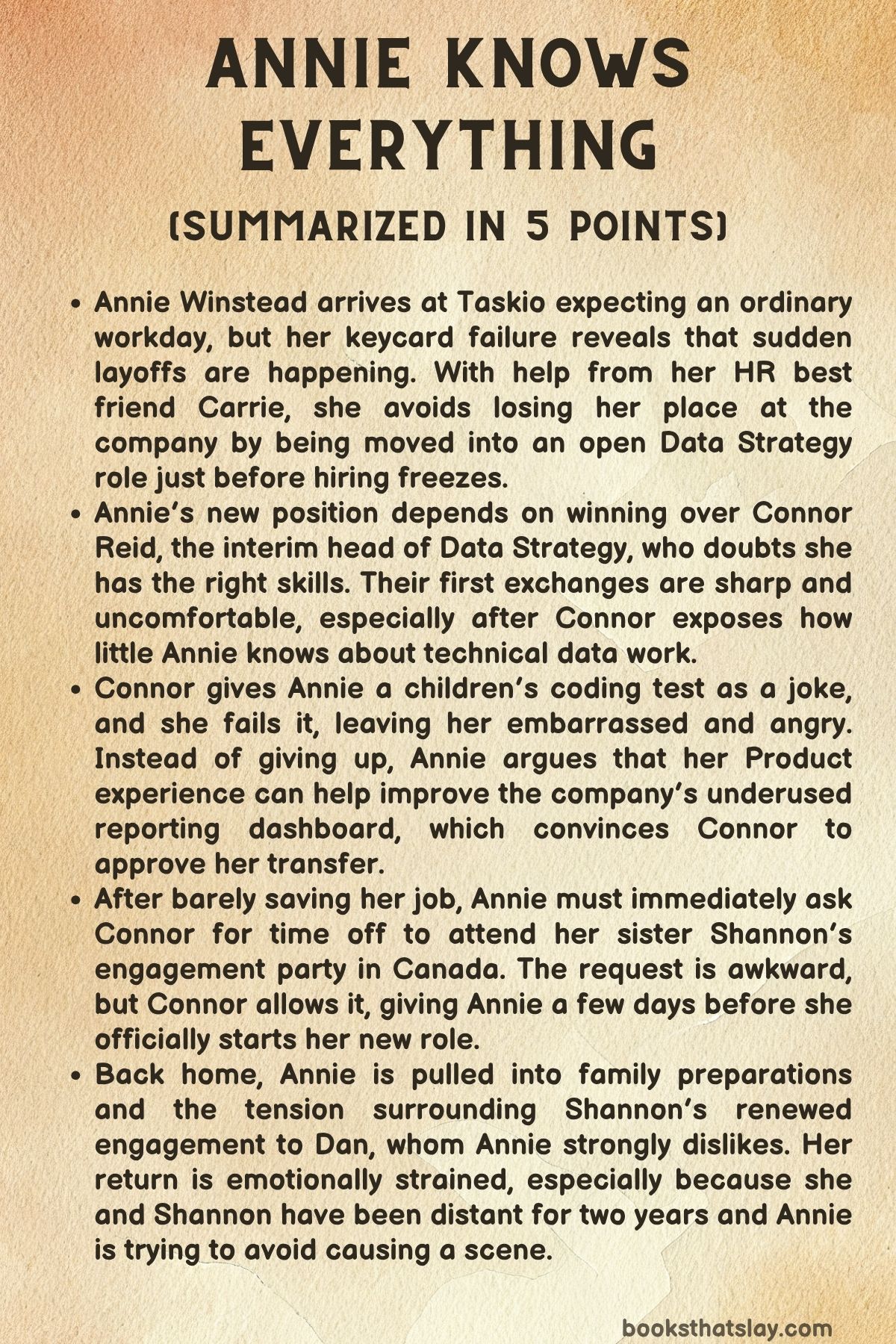
Annie Winstead arrives at Taskio expecting an ordinary workday, only to discover that her keycard no longer works. At first, the problem seems like a technical error, but she soon learns the truth: she has been caught in a sudden round of layoffs.
The news hits hard because her job is not only her income but also proof that her move to New York has meant something. Returning to Canada after losing it would feel like public failure, especially in front of a family that already has its own tensions.
Her best friend Carrie, who works in HR, has to deliver the official termination script, which makes the moment both painful and awkward. Carrie then finds a loophole.
Since external hiring has been frozen, Annie can be reassigned internally to a role that is technically open. The only possible position is in Data Strategy, a department Annie knows almost nothing about.
Carrie transfers her quickly, restores her access, and hides the public listing before anyone can stop them.
Annie goes looking for Data Strategy and finds a nearly empty corner of the company, nothing like the social world she knew in Product. There she meets a casually dressed, irritatingly calm man at a desk.
She assumes he is just someone on the team and asks for Naomi Evans, the department head, only to learn that Naomi is away on maternity leave. The man keeps questioning Annie’s story and clearly does not believe she belongs there.
Later, in the cafeteria, he reveals that he is Connor Reid, the interim head of Data Strategy and the person whose approval she needs to stay employed. Connor is amused by Annie’s confidence, but he is not fooled.
He insists she must interview and pass a skills test. Annie tries to bluff her way through questions about data, Excel, SQL, and experience, but her answers make it obvious that she is unqualified.
Still, she refuses to back down, so Connor agrees to test her.
The test turns out to be a children’s coding game called DinoCode Junior, complete with a cheerful dinosaur guide. Annie struggles through the timed exercises with a mixture of panic, stubbornness, and growing embarrassment.
When she realizes that Connor has tested her with a game meant for children, she is furious. She confronts him, accusing him of making a fool of her.
Connor admits he was teasing, though he did not expect her to take the game so seriously. Their argument changes when Annie points out that his department already has technical experts.
What it lacks is someone who understands people, office politics, training, communication, and resistance to change. She offers to help make Data Strategy’s failed reporting dashboard useful across the company.
Connor sees the sense in this and agrees to keep her, though their relationship remains full of sharp banter and challenge.
Before Annie can settle into the new role, family obligations pull her back to Canada. Her mother expects her to help prepare for the engagement party of Annie’s estranged sister, Shannon, who is once again engaged to Dan.
Annie hates Dan because, years earlier, she exposed his affair during his first engagement to Shannon. Annie believed she was protecting her sister, but the public humiliation destroyed her relationship with Shannon.
At the new engagement party, Annie behaves herself, though Dan needles her and the atmosphere stays tense. For a moment afterward, Annie and Shannon share a fragile connection, and Annie learns that Shannon may have a chance to visit New York.
Annie begins to hope that if she can get Shannon away from Dan for a weekend, she might repair their bond and maybe make Shannon question the wedding.
Back in New York, Annie starts learning her place in Data Strategy. Connor introduces her to Ben, Martin, and John, the team’s technically skilled but socially unusual members.
Annie begins to understand that her real job is not to become a coding expert overnight but to protect the team from chaos and help other departments understand the dashboard. She studies why people are not using it and realizes the problem is political rather than technical.
Through training sessions, food bribes, focus groups, and careful messaging, she starts turning the dashboard into something employees might actually adopt. Connor is impressed despite himself, and their teasing becomes more charged.
Annie grows jealous when she sees him spending time with Carrie, but she later learns Carrie was only helping him think through HR concerns about workplace relationships.
Annie also achieves a small but meaningful technical victory. When the dashboard breaks and the rest of the team is unavailable, she manages to identify and fix a coding issue using lessons she has secretly continued from DinoCode.
The success makes her feel like she is becoming a real member of the team. Connor is amused and impressed, and their bond grows stronger.
A lost work bet sends Annie to Krumes, a famous Upper West Side bakery, where Connor unexpectedly joins her with coffee. What begins as a punishment turns into a warm morning together.
Connor shows her parts of his old neighborhood, and Annie sees more of the person behind the teasing boss: loyal, tired, brilliant, uncertain, and more emotionally open than she expected. The day feels unmistakably romantic, and when Annie kisses him at the subway, he kisses her back before pulling away and saying it is not a good idea.
Annie leaves humiliated, convinced she has misread everything.
At work, Annie avoids Connor until he corners her and explains himself. He did not pull away because he lacked interest; he pulled away because he likes her too much and is technically her boss.
He worries about the risks and about whether Annie fully understands consequences. Then he kisses her, making his feelings clear.
They agree to a proper date, though Shannon’s upcoming visit complicates their plans. When Shannon arrives in New York, she unexpectedly brings Dan.
Annie is furious, but Connor steps in as an ally, giving them a long, exhausting tour of Taskio and later joining dinner as a buffer. Connor handles Dan with patience and charm, while Annie notices that Shannon becomes more alive when talking about her own work instead of Dan.
Still, tensions remain, especially when Shannon makes a cutting comment about Annie’s past interference.
After Shannon and Dan leave dinner, Annie and Connor finally have time alone. Connor invites her to his Brooklyn apartment, where Annie discovers another side of him: a warm, spacious home, signs of his past, and the surprising truth that he and Ben created DinoCode in college before selling it to an education software company.
Their relationship becomes fully intimate that night. The next morning, they talk openly about their feelings, about Shannon, and about the limits of trying to save someone else.
Connor suggests that loyalty sometimes means letting people make choices and staying nearby if they need you later. Annie resists this because she still believes Shannon is making a terrible mistake.
The conflict with Shannon comes to a head during a bridal appointment. Annie tries to support her sister but cannot hide her concern when Shannon chooses a restrictive dress and suddenly commits to a December wedding.
Annie pushes too hard, accusing Shannon of losing herself in Dan. Shannon fires back, accusing Annie of judging and meddling, and finally says she hates her.
Annie leaves devastated.
At work, Annie is shaken by the fight, but another problem soon takes over. During a meeting, she learns that Brad, an executive at Taskio, is pushing a new company direction that may threaten the last remaining Product projects tied to Jotter, Annie’s old department.
Connor warns her that the information is confidential. Annie, feeling loyal to her former colleagues, hints enough to Andy in Product that he understands his project is in danger.
She convinces herself she has not truly leaked anything, but at the Product all-hands meeting, Andy uses the information publicly to challenge Brad. The situation explodes.
Connor, Ben, John, and Martin realize Annie must have warned him. Connor is furious because she has broken trust and created a serious professional crisis.
When Brad confronts them, Annie impulsively takes responsibility, hoping to protect Connor.
Carrie later informs Annie that she has been fired for breaching confidentiality. The humiliation is worse because Connor is present, silent and devastated.
Annie believes he helped fire her and lashes out. In the lobby, Connor catches up to her and argues that she confessed too quickly, making herself an easy target when he might have found a way to handle it.
Annie accuses him of being a Taskio robot and of taking the easy path in life. The comment cuts deeply, and Connor walks away.
Annie returns to Canada in anger and shame. Away from New York, she slowly begins to understand the pattern in her behavior.
She betrayed Connor’s trust in the same way Andy betrayed hers, and she had once treated Shannon’s life as a problem only she could solve. After breaking down during an appointment, she realizes that the job loss is not the deepest hurt.
What she truly cannot bear is losing Connor. She visits Shannon and apologizes honestly, admitting that she acted as if she knew what was best without trying to understand.
Shannon lets her in, and the sisters finally talk. Annie tells her everything about Connor, Taskio, the leak, and the firing.
Shannon admits she did not mean that she hated Annie. Their bond begins to heal, and Annie sees that Shannon and Dan’s relationship contains parts she never allowed herself to notice.
Annie’s family pushes her back toward New York to fix what she can. When Connor does not answer her text, she sneaks into Taskio using Carrie’s keycard, only to learn that he has quit.
She goes to his apartment and finds him there with Ben. Annie apologizes, but Connor clarifies what hurt him most.
He does not want her to stop fighting for people; he loves that about her. What wounded him was that she did not trust him enough to count him among the people she fights for.
Annie tells him she is not sorry for wanting to help Product, but she is sorry for betraying his trust and making him feel unimportant to her. She admits she loves him.
Connor tells her he loves her too, and that being forced to fire her helped him see how unhappy he had become at Taskio. He and Ben have both quit and are pursuing a new venture.
Ben may even have a role for Annie. A year later, Annie and Connor are together, Annie and Shannon are close again, Carrie and Sam are still a couple, and Annie has found a professional life where her people skills are valued.
The story ends with Annie no longer trying to control every outcome, but still fighting for the people she loves in a wiser way.
Characters
Annie Winstead
Annie Winstead is the center of Annie Knows Everything, and her character is defined by quick thinking, emotional impulsiveness, stubborn loyalty, and a deep fear of failure. At the beginning of the book, she is desperate to keep her job not only because she needs money, but because unemployment threatens the identity she has built in New York.
Annie is clever, funny, socially perceptive, and excellent at reading workplace dynamics, yet she often mistakes being right for having the right to interfere. Her greatest strength is that she notices what other people miss: the political reasons behind the dashboard’s failure, the exhaustion of Connor’s team, Shannon’s unease, and the quiet needs of people around her.
Her greatest flaw is that she acts on those observations too quickly. She wants to protect people, but she often does it without asking whether they want that protection.
Her arc is built around learning the difference between loyalty and control. By the end of the novel, Annie has not become less passionate or less brave; instead, she has become more honest about consequences.
She learns to apologize without defending every action, to trust people with their own choices, and to fight for others without treating them like problems to solve.
Connor Reid
Connor Reid begins as Annie’s obstacle, but he becomes one of the book’s most layered figures. At first, he appears dry, teasing, overly controlled, and slightly arrogant.
His decision to test Annie with DinoCode Junior makes him seem like someone who enjoys being the smartest person in the room. As the story unfolds, however, Connor is revealed as a man carrying years of loyalty, pressure, and quiet dissatisfaction.
He was one of Taskio’s earliest employees, helped build its culture, and remains deeply attached to what the company once represented. His intelligence is obvious, but his conflict is not about competence; it is about passivity.
Connor has allowed himself to be pushed into management, meetings, and corporate politics even though they drain him. His romance with Annie works because she disrupts that passivity.
She frustrates him, challenges him, and makes him confront the gap between the life he is living and the one he wants. Connor’s caution around their relationship is not coldness but fear of abusing power, damaging work, or losing control of something that matters.
His final decision to quit Taskio shows that Annie’s influence helps him reclaim agency. In love, he is attentive and emotionally serious, even when his humor hides it.
Shannon Winstead
Shannon Winstead is not simply the sister Annie wants to rescue; she is a woman whose anger, pride, and guardedness come from being publicly humiliated by someone she loved. Her estrangement from Annie is rooted in betrayal as much as embarrassment.
Annie exposed Dan’s affair because she believed Shannon deserved the truth, but Shannon experienced the moment as a loss of dignity and control. Shannon’s coolness during the engagement party, her guarded behavior in New York, and her sharp reaction during the bridal appointment all reveal how tired she is of being treated as someone who cannot make her own decisions.
She may have doubts about Dan, and the book allows readers to see those doubts, but it also makes clear that Shannon’s life cannot be reduced to Annie’s opinion of him. Shannon’s eventual reconciliation with Annie is powerful because it does not require her to admit that Annie was right about everything.
Instead, she allows Annie back into her life after Annie finally apologizes for the way she acted. Shannon’s character gives the story emotional balance by showing that love without respect can still wound deeply.
Dan
Dan functions as one of the most uncomfortable figures in the novel because he is easy for Annie, and often the reader, to dislike. He cheated on Shannon before their first wedding attempt, and he continues to behave with smugness, condescension, and self-importance.
His presence in New York ruins Annie’s carefully planned sister weekend, and his habit of needling Annie keeps old wounds open. Yet the story does not present him as a simple villain with no human dimension.
During Annie’s visit to Shannon’s home, she sees moments of humor and ease between Dan and Shannon that she had refused to acknowledge before. This does not erase his past or make him admirable, but it complicates Annie’s certainty.
Dan’s role is less about proving whether Shannon should marry him and more about testing Annie’s belief that she can understand an entire relationship from the outside. He represents the part of another person’s life that may remain uncomfortable, confusing, and beyond one’s control.
Carrie
Carrie is Annie’s best friend and one of the most important support figures in the book. Her role begins in a painfully comic place: as an HR employee, she has to formally terminate Annie while also trying to save her.
That tension captures Carrie’s personality well. She understands systems, rules, and workplace procedures, but she is also loyal enough to bend them when someone she loves is in trouble.
Carrie often serves as Annie’s emotional sounding board, especially during the confusion around Connor. She is more grounded than Annie in some ways, but she has her own uncertainty, particularly in her unexpected relationship with Sam.
Her romance with Sam gives Carrie a private life beyond being Annie’s helper. It also shows that she, too, is capable of being surprised by desire and change.
Carrie’s friendship with Annie is warm, practical, and honest. She comforts Annie, but she does not exist only to approve of her choices.
Her presence helps connect the workplace plot, romantic plot, and friendship plot into one social world.
Sam
Sam, Annie’s goth roommate, brings bluntness, humor, and emotional clarity to the story. She is not as openly comforting as Carrie, but her directness often cuts through Annie’s spirals.
Sam sees more than Annie realizes, especially in the shifting energy between people. Her relationship with Carrie begins almost in the background, through strange nights out, teasing, and small requests for contact information, before Annie fully understands what is happening.
Sam’s romance with Carrie adds surprise and warmth, but it also gives Sam a softer dimension beneath her dry exterior. She is the person who pushes Annie not to wait passively for Connor’s reply and instead to confront the problem directly.
In that sense, Sam often acts as a force of action without indulging Annie’s self-pity. Her loyalty is not sentimental, but it is real.
She lets Annie fall apart, but she does not let her stay there forever.
Ben
Ben is one of Connor’s closest professional allies and a key member of Data Strategy. He is technically brilliant, socially understated, and deeply tied to Connor through their shared past with DinoCode.
His near-resignation after the layoffs reveals how exhausted the Data Strategy team has become under the pressure of too much work and too little support. Annie’s arrival helps keep him in place, not because she can replace his skills, but because she relieves some of the human and organizational pressure the team has been carrying.
Ben also represents the creative life Connor left partly behind. Their history as co-creators of DinoCode shows that both men once had the courage to build something imaginative together.
By the end of Annie Knows Everything, Ben’s decision to leave Taskio with Connor and pursue a new venture suggests renewed energy and possibility. He is quieter than Annie and Connor, but his presence helps reveal the deeper professional stakes of the story.
Andy
Andy is Annie’s former Product colleague and a complicated figure because he benefits from Annie’s loyalty while also betraying her trust. Early in the book, he belongs to Annie’s old work world: familiar, social, and tied to the version of Taskio she is trying not to lose.
Annie once had a crush on him, but his later role is more professional than romantic. When Annie warns Product about Brad’s plans, Andy understands the danger to his project and uses the information in a public confrontation.
From his perspective, he may be defending his team and fighting corporate secrecy. From Annie’s perspective, he turns her carefully placed hints into a disaster that costs her job.
Andy is not purely malicious, but he is opportunistic. He exposes the danger of loyalty that is not mutual.
Through him, Annie learns that protecting people who are not protecting her can still cause harm to those who truly trust her.
Brad Pincer
Brad Pincer represents the corporate force that has reshaped Taskio from a scrappy, creative company into a more calculating enterprise machine. He is associated with strategy, public flotation, product cuts, and decisions that affect employees without much visible concern for their lives.
Brad’s plans around Taskio Version 3.0 and the possible sidelining of Jotter projects create the conflict that leads to Annie’s firing. He is not explored with the emotional depth of Annie, Connor, or Shannon, but his function is important.
He embodies the pressure that makes Connor feel trapped and that makes Annie feel protective of her old team. Brad’s willingness to push responsibility downward also exposes the limits of corporate loyalty.
People like Connor and Annie may care deeply about teams and products, but executives like Brad are focused on outcomes, risk, and control. His presence clarifies why Connor eventually chooses to leave.
John
John is part of the Data Strategy team and contributes to the sense that Annie has entered a strange but ultimately welcoming professional home. He is technically capable, socially quirky, and more supportive than he may first appear.
His celebration of Annie’s first real technical fix matters because it shows that the team accepts effort and growth, not just expertise. John helps make Data Strategy feel less like a department Annie has tricked her way into and more like a place where she can belong.
Along with Ben and Martin, he also provides a kind of gentle chorus around Annie and Connor’s developing relationship, sensing tension even when Annie tries to hide it. His character helps show the everyday warmth inside a team that outsiders see as odd or mysterious.
Martin
Martin, like John and Ben, helps define the culture of Data Strategy. He is part of the technical backbone of the department, but his role also supports the emotional texture of Annie’s new work life.
Through Martin, the team feels lived-in rather than generic. He participates in the awkward meetings, the group reactions, the teasing, and the concern that surround Annie’s rise and fall at Taskio.
When Annie is fired, the shock and anger of the Data Strategy team show how fully she has been accepted. Martin may not drive the plot on his own, but he helps establish what Annie stands to lose.
He is part of the found workplace community that makes her firing hurt beyond the loss of salary.
Naomi Evans
Naomi Evans is absent for much of the action because she is on maternity leave, yet her influence is felt through Connor’s temporary leadership role. She pushed Connor toward management, believing he could handle it, but that decision contributes to his internal conflict.
Naomi represents the professional structure that existed before Annie arrived and before Taskio’s pressures became unbearable for Connor. Her absence creates the opening through which Annie enters Data Strategy, but it also leaves Connor carrying responsibilities he never truly wanted.
Though she is not a central active presence, her role matters because it helps explain why Connor is in a position of authority over Annie and why the romance between them becomes professionally complicated.
Themes
Loyalty Without Control
Loyalty in the story is active, messy, and often dangerous when it turns into control. Annie loves intensely, and her instinct is always to act when someone she cares about is threatened.
She exposes Dan’s affair because she wants to protect Shannon, warns Product because she wants to protect her old colleagues, and pushes Connor because she senses he is unhappy. In each case, her intentions contain real care, but the damage comes from assuming that care gives her permission to decide for others.
The book gradually teaches Annie that loyalty is not the same as intervention. Shannon does not need Annie to manage her marriage; she needs a sister who will stay connected even when they disagree.
Connor does not need Annie to fight around him; he needs her to trust him enough to fight with him. By the end, Annie’s loyalty has not disappeared.
It has matured into something steadier, based on honesty, apology, and respect for other people’s choices.
Work, Identity, and Corporate Belonging
Annie’s layoff feels devastating because her job has become part of her self-worth. Taskio is not just a workplace; it is her proof that she has built a life away from home.
Losing it threatens to turn her New York dream into failure. Connor has a different but related struggle.
He belongs to Taskio so deeply that leaving seems almost impossible, even after the company has changed into something that no longer fits him. Through both characters, Annie Knows Everything examines how work can give people purpose, community, status, and confidence, while also trapping them in roles they have outgrown.
Annie’s move from Product to Data Strategy reveals that her value does not come from a job title or technical mastery alone. Her strength lies in understanding people, solving adoption problems, and translating between teams.
Connor’s decision to quit shows another side of professional growth: sometimes success means leaving behind the company that once defined you.
Trust, Secrecy, and Consequences
Trust is tested repeatedly through secrets, half-truths, and information shared at the wrong time. Carrie secretly rescues Annie through HR.
Annie hides her lack of qualifications. Connor withholds parts of his past and worries about workplace boundaries.
Annie leaks confidential information through hints, convincing herself she has not truly crossed a line. The story shows that secrecy can feel protective in the moment, but it often shifts risk onto someone else.
Annie’s warning to Andy is a clear example. She believes she is helping Product while avoiding a direct breach, yet Andy uses the information publicly and leaves Annie, Connor, and Data Strategy exposed.
The fallout forces Annie to face the difference between intention and consequence. Wanting to help does not erase the harm caused by broken trust.
Her reconciliation with Connor depends not on denying what happened, but on naming it clearly. Love requires more than passion; it requires being safe with what someone else has trusted you to hold.
Sisterhood, Distance, and Repair
Annie and Shannon’s relationship gives the novel its deepest emotional conflict outside the romance. Their estrangement began with an act Annie framed as protection, but Shannon experienced it as public betrayal.
Years later, their conversations are stiff because both are carrying old pain. Annie wants the closeness they once had, but she tries to regain it by managing Shannon’s future instead of listening to her present.
The bridal boutique fight becomes painful because it exposes the truth both sisters have avoided: Annie still believes she knows best, and Shannon still feels judged. Repair begins only when Annie stops arguing her case and offers a real apology.
Shannon’s forgiveness is not instant erasure of the past; it is a decision to let her sister back in. Their renewed bond rests on a more adult form of sisterhood, one that allows disagreement without abandonment.
Annie learns that being a sister means showing up, staying available, and accepting that love cannot be forced into obedience.