An Accident of Dragons Summary, Characters and Themes
An Accident of Dragons by Cheri Radke is a fantasy novel about power, family, loyalty, and the difficult bond between humans and dragons. The story follows Teddy, Lord Summer, a man tied by ancient contract to the dragoness Summer.
He is a husband, father, ruler, and former lover still marked by grief, but his life is shaken when Summer produces an impossible egg. What begins as a private mystery soon becomes a political and magical crisis involving kidnapping, rebellion, enemy nations, and a dangerous attempt to seize dragon power through Teddy himself. It’s the 1st book of the Tales of Summer series.
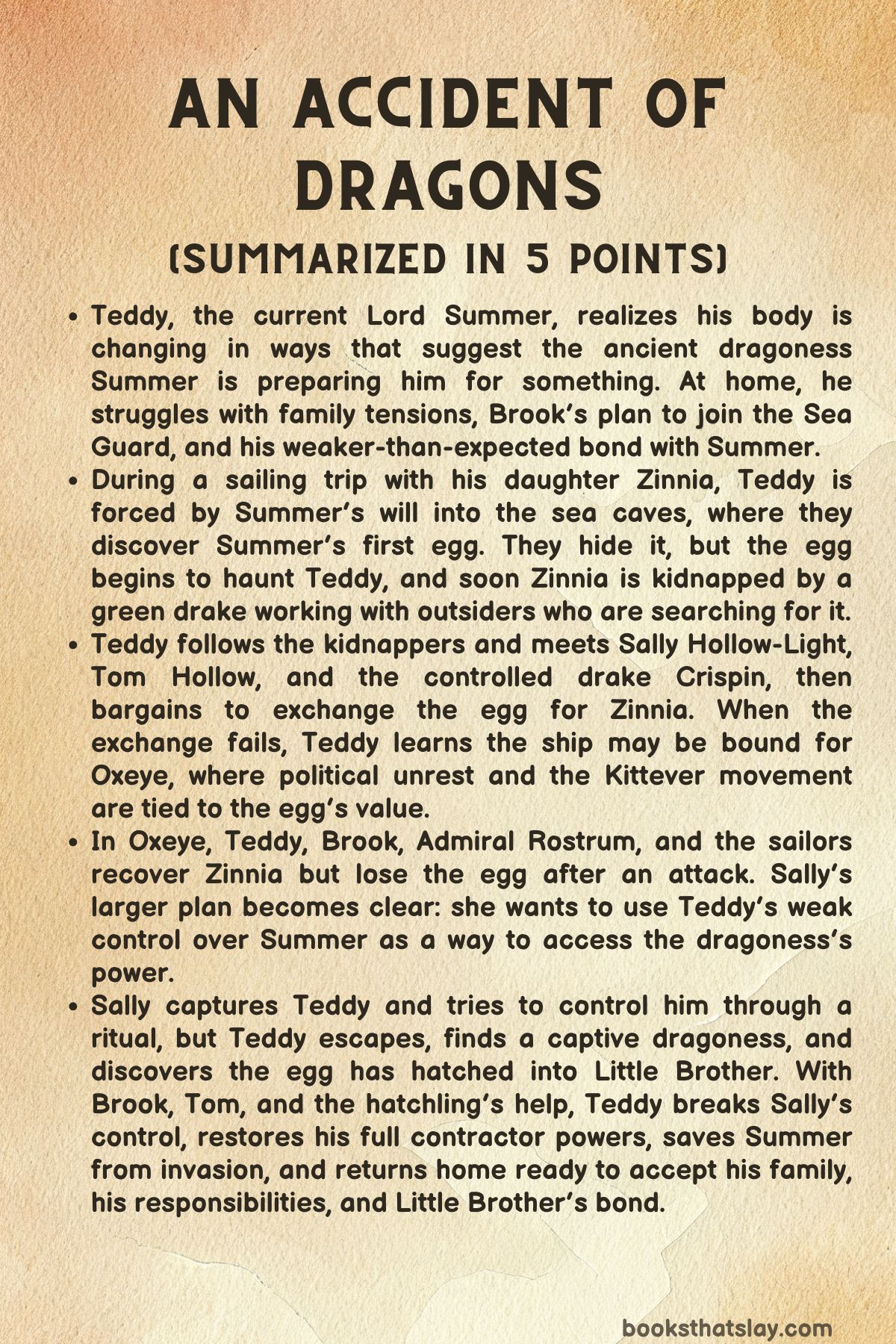
Summary
Teddy is the current Lord Summer, bound by contract to the ancient dragoness Summer. Though he holds one of the most important positions in his land, he is uneasy in the role.
His body has begun to change in ways he cannot ignore. His shoulders and arms have grown stronger, and his clothes no longer fit as they should.
Rather than taking this as simple health or strength, Teddy suspects Summer is preparing him for something. Since his connection to the dragoness is not as natural or powerful as he believes it should be, the change makes him nervous.
At home in the cliffside palace, Teddy moves between the duties of a ruler and the complicated comforts of family life. He visits his wife, Canna, their young daughter Zinnia, and his stepson Brook.
Zinnia has a striking bond with Summer, stronger in some ways than Teddy’s own. This both amazes and unsettles him.
Brook, meanwhile, is growing into his own ambitions. At a tense military dinner, Admiral Rostrum needles Teddy and reveals that Brook intends to join the Sea Guard.
The news hurts Teddy because Brook has not told him directly. It also reminds him how little control he has over the people he loves.
The next day, Teddy takes Zinnia sailing. What should be a peaceful outing becomes strange when Zinnia insists that Summer wants them to enter the sea caves.
Teddy hesitates, but Summer’s will pushes past his resistance. In the dragoness’s cavern, they discover something that should not exist: an egg.
It is the first egg Summer has ever laid. Summer’s feelings toward it are deeply conflicted.
She does not want the egg close to her, but she also does not want it destroyed. Teddy and Zinnia hide it in a smaller sea cave, hoping secrecy will protect it.
The egg begins to weigh on Teddy’s mind. Its existence raises questions about Summer, the ancient contracts, and Teddy’s place in all of it.
It also stirs memories of Jack, the previous Lord Summer and Teddy’s dead lover. Teddy is still shaped by grief and by the history of loving someone who once held the role he now occupies.
The egg becomes more than a mystery; it is a reminder that the old patterns of power may be changing.
At the equinox ball, Teddy performs his ceremonial role with flair, using boldness and public confidence to mask his worries. Then he suddenly feels Summer’s panic.
Zinnia has been taken. A green drake has seized her and is carrying her toward a foreign ship.
Teddy reacts at once, jumping from the balcony into the sea. Summer pulls him through the water toward the vessel, and Teddy finds himself drawn into a larger plot than he understood.
On the ship, Teddy meets Sally Hollow-Light, her brother Tom Hollow, and their controlled green drake, Crispin. They did not know Zinnia was Lord Summer’s daughter when they took her.
Their true goal is the dragon egg. Teddy bargains with them, offering the egg in exchange for Zinnia’s safe return.
But the exchange falls apart when Summer’s ships arrive. The Shadowcat escapes with Zinnia still aboard, while Tom is captured.
Through Tom, Teddy learns that the ship may be headed toward Oxeye, where Sally’s estranged husband, the industrialist Lowell Light, hoped to use the egg in a bargain connected to the growing Kittever movement.
Teddy sails for Oxeye with Admiral Rostrum, Brook, and Summer’s sailors. Oxeye is full of political strain and hidden motives.
There, Teddy meets Lowell Light and Lord Grinhill. He eventually recovers Zinnia from Light’s house, but the danger has not passed.
The egg is stolen from their lodgings after an attack, proving that several players are moving against them. Brook begins investigating in secret, while Teddy tries to understand the politics of Oxeye and the goals of those pursuing the egg.
Events grow more violent. The Godwit burns, strange attackers strike, and Sally’s plans begin to emerge.
She is not simply after the egg. She belongs to the Kittevers, a movement with dangerous ambitions, and she wants Teddy himself.
Because Teddy’s control over Summer is unusually weak, Sally believes he may provide a path into the dragoness’s power. For her, Teddy is not only a ruler or a hostage.
He is a tool that might let her reach one of the greatest forces in the world.
Sally captures Teddy and drugs him. She prepares a ritual using an iron collar like the collars used to control dragons.
Her magic is built around domination, and she intends to use Teddy’s bond with Summer against him. Teddy wakes in a chapel prison and escapes with unexpected help from a cat.
As he searches underground, he finds a captive green dragoness and realizes that the stolen egg has hatched.
The hatchling changes everything. Teddy calls him Little Brother.
Through Summer’s contract, the hatchling is bound to Teddy: just as Teddy’s first child belongs to Summer, Summer’s first child belongs to Teddy. This bond gives Teddy a new responsibility and a new source of strength.
Little Brother is young, dangerous, and connected to Teddy in a way that forces him to reconsider the old rules of the contract.
Sally’s magic allows her to control people, and Brook is among those caught in her influence. Yet Teddy, Brook, and Little Brother resist her.
Little Brother kills Crispin, ending the threat of the controlled drake. Teddy, pushed to the edge, finally breaks through the mental block that has limited his power as Summer’s contractor.
His connection to the dragoness opens fully, and he becomes what he was always meant to be.
Teddy also finds a way to disrupt Sally’s control over her puppets. He threatens suicide, using Sally’s need for him against her, and then kisses Tom, breaking the pattern of command and obedience she has built.
The act shocks the controlled men out of her grip long enough for Teddy to escape with Tom and the freed captives. Sally is left trapped in the flooding cavern, her attempt to control dragons and people collapsing around her.
While Teddy is fighting underground, enemy ships approach Summer. They believe the dragoness has been neutralized and that the land is vulnerable.
But once Teddy’s bond with Summer is restored, that belief proves fatal. Summer rises in her full power and destroys the invading fleet.
The attack that might have conquered Summer instead reveals that the dragoness and her contractor are stronger than their enemies imagined.
Teddy returns home with Zinnia, Brook, and Little Brother. The crisis has changed them all.
Brook decides to leave Summer for a time so he can learn more about the mainland and the Kittevers. His choice is painful but necessary, showing that he is ready to seek his own understanding of the wider world.
Teddy, meanwhile, begins to live more openly with Canna and Zinnia. He accepts Little Brother’s place beside him and takes steps to strengthen Summer’s defenses.
The story closes with Teddy more certain of himself than he was at the beginning. He is still a husband, father, ruler, and man shaped by old grief, but he is no longer hiding from the full force of his bond with Summer.
He helps Zinnia understand the new mental connection she now feels with him, making space for the next generation within the strange inheritance of dragon contracts. In the end, An Accident of Dragons becomes a story about accepting power without surrendering tenderness, protecting family without denying change, and finding courage in bonds that are frightening, flawed, and deeply alive.
Characters
Teddy
Teddy is the emotional center of An Accident of Dragons, and his character is shaped by insecurity, grief, duty, and a gradual awakening into power. As the current Lord Summer, he holds one of the most important positions in the story, but he does not initially feel fully worthy of it.
His changing body becomes an early sign that Summer is preparing him for something larger than he understands, and this physical transformation mirrors the deeper internal transformation he undergoes throughout the book. Teddy is not a naturally confident ruler; he often doubts his connection to Summer, especially when he compares himself to Zinnia, whose bond with the dragoness seems instinctive and powerful.
This weakness makes him vulnerable, but it also makes him interesting because his authority is not built on certainty. He has to grow into it through fear, sacrifice, and emotional honesty.
Teddy’s love for his family reveals his tenderness and his fear of loss. His relationships with Canna, Zinnia, and Brook show different parts of him: as a husband, father, and stepfather, he wants to protect those he loves, but he is not always able to control the forces surrounding them.
Zinnia’s kidnapping forces Teddy into action and proves that his courage is strongest when someone he loves is threatened. His memories of Jack also deepen his character, showing that he carries unresolved grief and a complicated emotional past.
Teddy is not simply a political or magical figure; he is someone whose private wounds affect his public choices.
His captivity under Sally becomes the turning point of his arc. Teddy is targeted because of his weak control over Summer, but that same weakness eventually leads him to understand the true nature of his bond.
His escape, his connection with Little Brother, and his final awakening show that his power was never only about domination or command. It is rooted in love, responsibility, and the willingness to risk himself.
By the end of the story, Teddy becomes more complete as Lord Summer because he accepts both his vulnerability and his strength. He learns to live more openly, to defend Summer more firmly, and to embrace the strange new family bond created by Little Brother.
Summer
Summer is an ancient dragoness whose presence dominates the story even when she is not speaking in a human way. She is powerful, mysterious, possessive, and deeply tied to the political and magical identity of Summer itself.
Her relationship with Teddy is complicated because she is both protector and force of nature. She does not behave like a gentle companion; instead, she acts according to ancient instincts and dragon logic that human characters often struggle to understand.
Her influence over Teddy’s body and choices shows how overwhelming her will can be, especially when she drives him and Zinnia toward the sea caves.
The discovery of Summer’s egg reveals a startling vulnerability in her character. She has produced something impossible and unprecedented, yet she does not respond to the egg with simple maternal affection.
Her refusal to keep it near her, while also refusing to let it be destroyed, suggests that dragon emotion is difficult, alien, and perhaps frightening even to Summer herself. The egg forces everyone around her to reconsider what dragon bonds, inheritance, and family truly mean.
Summer’s actions are not sentimental, but they are not meaningless either; she is guided by a deep instinct that gradually becomes clearer through Teddy’s bond with Little Brother.
Summer also represents enormous political power. When enemies believe she has been neutralized, they move against Summer, proving that the dragoness is not only a magical being but also the foundation of the region’s security.
Once Teddy’s connection to her is restored, her destruction of the invading fleet confirms the terrifying scale of her strength. Summer is not a character who changes in a human emotional sense, but the book reveals new dimensions of her through the egg, Teddy’s awakening, and Zinnia’s bond.
She remains majestic, dangerous, and central to the balance of power.
Canna
Canna is Teddy’s wife and an important grounding presence in his life. Although she is not at the center of the adventure in the same way Teddy, Zinnia, or Brook are, her role matters because she represents home, family, and the ordinary emotional life that Teddy is trying to protect.
The cliffside palace is not merely a seat of power for Teddy; it is also the place where Canna, Zinnia, and Brook live, making his responsibilities personal rather than abstract. Canna’s presence reminds the reader that Teddy’s duties as Lord Summer are tied to real domestic stakes.
Canna also helps reveal Teddy’s divided emotional world. His love for her exists alongside his memories of Jack, showing that Teddy’s heart is layered and complicated rather than simple.
Canna is part of Teddy’s present life, while Jack belongs to his past, and this contrast gives Teddy’s emotional journey more depth. By the end of the book, Teddy begins living more openly with Canna and Zinnia, which suggests that his growth is not only magical or political but also personal.
He becomes more able to inhabit his life honestly rather than hiding behind ceremony, fear, or grief.
Zinnia
Zinnia is one of the most important young characters in the book, and her bond with Summer makes her far more than a child in need of rescue. She is Teddy and Canna’s young daughter, but she possesses a striking spiritual or mental closeness to Summer that even Teddy finds unsettling.
When she insists that Summer wants them to enter the sea caves, she shows an instinctive certainty that Teddy lacks. This makes Zinnia both innocent and powerful, because she does not fully understand the political danger around her, yet she is deeply connected to the dragoness at the heart of that danger.
Her kidnapping becomes the event that pushes the plot into open conflict. To Teddy, Zinnia is not a symbol or bargaining piece; she is his daughter, and his desperate attempt to save her reveals the depth of his love.
To others, however, she becomes connected to the struggle over the egg, Summer’s power, and the larger political unrest beyond the island. This contrast makes Zinnia’s role emotionally intense.
She is vulnerable because of her age, but she is also significant because of what her bond with Summer represents.
By the end of An Accident of Dragons, Zinnia’s character gains a new layer through the mental bond she feels with Teddy. This bond suggests that she is growing into a deeper awareness of the magical inheritance surrounding her family.
Teddy helping her understand it marks an important change in their relationship. He is no longer merely frightened by her connection to Summer; he begins to guide her through it.
Zinnia represents the future of Summer’s bond with humanity, and her presence gives the ending a sense of continuation rather than closure.
Brook
Brook is Teddy’s stepson, and his character is shaped by independence, restlessness, and a desire to understand the wider world. His decision to join the Sea Guard unsettles Teddy because it shows that Brook is making choices beyond Teddy’s control.
Brook is no longer simply a child within the household; he is becoming someone with his own ambitions, loyalties, and questions. This makes his relationship with Teddy emotionally complex.
Teddy cares for him deeply, but he cannot fully possess or protect him.
Brook’s secret investigation in Oxeye shows that he is capable, brave, and curious. He does not passively wait for adults to solve problems; instead, he acts on his own judgment.
This independence makes him useful, but it also places him in danger. Sally’s ability to control him is especially disturbing because it violates the very quality that defines him: his growing autonomy.
When Brook resists her influence alongside Teddy and Little Brother, his strength becomes clear. He is not merely Teddy’s stepson; he is a young person learning how to stand against manipulation and fear.
His decision to leave Summer for a time at the end of the story is one of the most meaningful choices in his arc. Brook wants to learn about the mainland and the Kittevers, which suggests that he is drawn to complexity rather than easy loyalty.
He does not reject his family, but he recognizes that his future requires distance, knowledge, and experience. Brook’s departure gives his character a sense of maturity.
He becomes a bridge between Summer’s protected world and the unsettled political world beyond it.
Admiral Rostrum
Admiral Rostrum is a sharp, tense military presence whose relationship with Teddy is marked by pressure and discomfort. At the military dinner, he needles Teddy and reveals Brook’s intention to join the Sea Guard in a casual but pointed way.
This moment shows that Rostrum understands how to unsettle Teddy, and it also establishes him as someone who operates within the practical, disciplined world of military power rather than emotional delicacy. He is not presented as especially warm, but he is clearly important to Summer’s defense.
Rostrum’s role becomes more active after Zinnia’s kidnapping and the theft of the egg. He sails with Teddy, Brook, and Summer’s sailors to Oxeye, placing him within the story’s political and military response.
His presence reinforces the seriousness of the crisis. While Teddy experiences events through family fear, magical uncertainty, and personal grief, Rostrum represents strategy, command, and institutional authority.
He adds tension because he does not always soothe Teddy’s anxieties, but he also strengthens the sense that Summer’s survival depends on more than dragon magic alone.
Jack
Jack is the former Lord Summer and Teddy’s dead lover, and although he is absent from the present action, he remains emotionally powerful. His memory haunts Teddy, especially after the discovery of Summer’s egg.
Jack represents Teddy’s past: love, loss, and perhaps a version of Lord Summer that Teddy still measures himself against. Because Jack once held Teddy’s current role, his memory carries both romantic and political weight.
Teddy’s grief is not separate from his insecurity; the two are intertwined.
Jack’s importance lies in how he shapes Teddy’s emotional vulnerability. Teddy is not entering the crisis as an untouched hero.
He is someone who has loved deeply and lost deeply, and those memories affect how he understands bonds, duty, and fear. Jack’s absence also sharpens Teddy’s loneliness.
Even with Canna, Zinnia, and Brook around him, Teddy carries a private grief that belongs to another part of his life. This makes his later openness more meaningful, because he is not simply gaining magical power; he is learning to live beyond the shadow of loss.
Sally Hollow-Light
Sally Hollow-Light is one of the most dangerous and complex figures in the story. At first, she appears as part of the group that has taken Zinnia and is seeking the dragon egg, but her motives become much darker and more ambitious as the plot unfolds.
She is tied to the Kittevers and wants not only the egg but Teddy himself, because his weak control over Summer makes him a possible gateway to the dragoness’s power. This makes Sally a villain who understands vulnerability very well.
She does not merely attack strength; she exploits weakness.
Her use of drugs, ritual, iron collars, and controlling magic makes her threat both physical and psychological. Sally’s power lies in domination.
She controls dragons, people, and situations by stripping others of choice. Her treatment of Brook and the controlled drake Crispin reveals the cruelty of her methods.
She is not simply politically radical; she is willing to turn living beings into tools. This makes her especially frightening because her ideology is fused with personal ruthlessness.
At the same time, Sally is not a shallow villain. Her estrangement from Lowell Light, her connection to the Kittevers, and her carefully planned schemes suggest a woman shaped by conflict, resentment, and ideological conviction.
She sees Teddy not as a person but as an opportunity, and this dehumanizing view ultimately becomes one of her greatest moral failures. Teddy defeats her not through brute force alone but by breaking the patterns of control she depends on.
Sally’s end in the flooding cavern is fitting because she is trapped inside the consequences of the power she tried to command.
Tom Hollow
Tom Hollow is Sally’s brother, but he becomes much more than a simple accomplice. When Teddy first meets him aboard the Shadowcat, Tom is connected to Zinnia’s kidnapping and the search for the egg.
However, after he is captured, he provides crucial information about Oxeye, Sally, Lowell Light, and the likely direction of the plot. This makes him a complicated figure: he begins on the opposing side, yet he becomes important to Teddy’s survival and understanding of the larger conspiracy.
Tom’s relationship with Teddy develops through tension, uncertainty, and eventual intimacy. Teddy’s kiss with Tom disrupts Sally’s control over her puppets, making Tom part of one of the story’s most surprising and emotionally charged moments.
The kiss is not merely romantic; it is also an act of resistance against Sally’s manipulation. Through Tom, the story explores how people connected to harmful schemes may still possess humanity, conflict, and the ability to change sides.
Tom’s survival and escape with Teddy give his character a sense of unresolved possibility. He is tied to Sally by blood but not fully defined by her choices.
His presence complicates the moral landscape because he cannot be reduced to innocent victim or simple villain. He exists in the uneasy space between guilt, usefulness, vulnerability, and connection.
Crispin
Crispin is the controlled green drake used by Sally and Tom, and his role highlights the cruelty of dragon control. He is the creature who seizes Zinnia and carries her toward the foreign ship, making him responsible for one of the most frightening events in the book.
Yet Crispin’s actions must be understood through the fact that he is controlled. He is dangerous, but he is also a victim of the same system of domination that Sally later tries to use on Teddy and others.
Crispin’s presence helps show the difference between partnership and enslavement. Teddy’s bond with Summer is difficult, overwhelming, and not always equal, but it is not the same as the iron-collar control imposed on dragons like Crispin.
His death at Little Brother’s hands is violent and significant because it marks a clash between two kinds of dragon power: one bound through coercion and one bound through strange inheritance and contract. Crispin’s tragedy is that he is made into a weapon before he can be seen as a being with his own will.
Lowell Light
Lowell Light is Sally’s estranged husband and an industrialist whose ambitions connect personal conflict with political unrest. His plan to use the egg as a bargaining tool with the Kittever movement shows that he understands the egg’s value not as a living creature but as a piece of leverage.
This makes him morally troubling. Like Sally, he sees dragon power as something to be used, negotiated, or exploited, though his methods seem rooted more in industry, status, and political calculation than ritual control.
Lowell’s presence in Oxeye expands the story beyond Teddy’s family crisis. Through him, the book shows a world of industrial interests, political movements, and mainland power struggles.
He is important because he helps reveal that the conflict over the egg is not isolated. Many people want access to Summer’s power, and Lowell is one of the figures who understands how valuable that access could be.
His estrangement from Sally also suggests a fractured personal history behind the public conflict, making him part of the story’s web of ambition, betrayal, and ideology.
Lord Grinhill
Lord Grinhill is a political figure in Oxeye who helps represent the formal structures of mainland authority. His role is not as emotionally central as Teddy’s or as threatening as Sally’s, but he matters because he places Teddy inside a wider political environment.
When Teddy encounters Grinhill and Lowell Light, the crisis becomes more than a rescue mission. It becomes a confrontation with diplomacy, influence, and competing systems of power.
Grinhill’s presence also helps emphasize Teddy’s discomfort outside Summer. Teddy is used to a world defined by Summer’s dragon power, ritual, and local authority, but Oxeye forces him to deal with people whose priorities and loyalties are different.
Grinhill belongs to that world of negotiation and political pressure. As a result, he functions as a reminder that Teddy’s role as Lord Summer is not only magical or domestic; it is also diplomatic and strategic.
Themes
Power, Control, and Consent
In An Accident of Dragons, power is never shown as simple strength; it is shaped by consent, fear, loyalty, and violation. Teddy’s bond with Summer gives him authority, but it also leaves him uneasy because he does not fully understand what the dragon wants from him.
His changing body becomes a sign that power can alter a person before they are ready to accept it. In contrast, Sally’s use of collars, drugs, and mental control shows power at its most abusive.
She does not persuade people; she turns them into tools. This makes Teddy’s final awakening important because his strength comes not from domination, but from reclaiming his own will and helping others break free.
The theme also questions inherited power. Teddy holds a grand title, commands sailors, and is tied to an ancient dragon, yet he often feels uncertain and emotionally exposed.
His journey suggests that true power is not control over others, but the courage to act responsibly when control has been taken away.
Parenthood, Inheritance, and Responsibility
Parenthood in the story is connected to love, fear, duty, and strange forms of inheritance. Teddy’s relationship with Zinnia is tender but complicated because she seems closer to Summer than he is.
This makes him feel both protective and insecure, especially when her bond with the dragon places her in danger. The discovery of the egg deepens the theme by turning parenthood into something unexpected and unsettling.
Summer rejects the egg emotionally, yet cannot allow its destruction, while Teddy becomes haunted by it before understanding its connection to him. Little Brother’s arrival changes Teddy’s role again: he is not only a father to Zinnia and a stepfather to Brook, but also a caretaker of a dragon child tied to him by contract.
Brook’s decision to leave also belongs to this theme. Teddy must learn that protecting a child does not always mean keeping them close.
Responsibility becomes less about possession and more about allowing growth, choice, and separate futures.
Grief, Memory, and Emotional Avoidance
Teddy carries grief in ways he does not fully admit, especially through his memories of Jack. His past love is not treated as something neatly finished; it continues to shape his fears, his hesitation, and his sense of himself.
The egg brings those feelings closer to the surface because it represents change, uncertainty, and a future he did not ask for. Teddy often performs confidence in public, especially through ceremony and social display, but privately he is full of doubt.
This contrast shows how grief can hide behind charm, duty, and habit. His weak connection to Summer is also emotional, not merely magical.
He has blocked parts of himself because facing them would mean confronting pain, desire, and loss. When he finally breaks through that mental barrier, the moment is not only about gaining magical ability.
It is also about accepting buried feeling. The story presents healing as difficult and messy, but necessary for Teddy to become fully present again.
Family, Belonging, and Chosen Bonds
Family in the story is not limited to blood or marriage; it is built through loyalty, care, conflict, and chosen responsibility. Teddy’s household includes Canna, Zinnia, Brook, Summer, and eventually Little Brother, but each bond works differently.
His marriage gives him stability, his daughter gives him tenderness and fear, his stepson challenges his assumptions, and his dragon bond places him inside an older system of duty. Brook’s desire to join the Sea Guard and later leave Summer shows that belonging does not require stillness.
A person can love a home and still need distance from it. Tom’s role also expands the idea of connection, since he begins as part of the opposing side but becomes important to Teddy’s survival and resistance.
The story treats belonging as something tested by danger rather than guaranteed by titles. By the end, Teddy’s family is larger and stranger than before, but also more honest.
Love becomes strongest when it allows truth, change, and freedom.