The Make Believe Summary and Analysis
The Make-Believe: A Memoir of Magic and Madness is Hannah Murray’s memoir about psychosis, bipolar disorder, spiritual longing and her involvement with an organisation that presented expensive occult training as a path toward healing and enlightenment.
Murray traces how the physical and emotional pressures of acting, untreated mood instability, substance use and a desire to feel transformed left her vulnerable to supernatural claims. Her account follows the growth of an intoxicating belief system that eventually overtook her sense of reality. It is also a study of influence, responsibility and recovery, showing how ordinary emotional needs can become attached to dangerous promises of certainty, power and belonging.
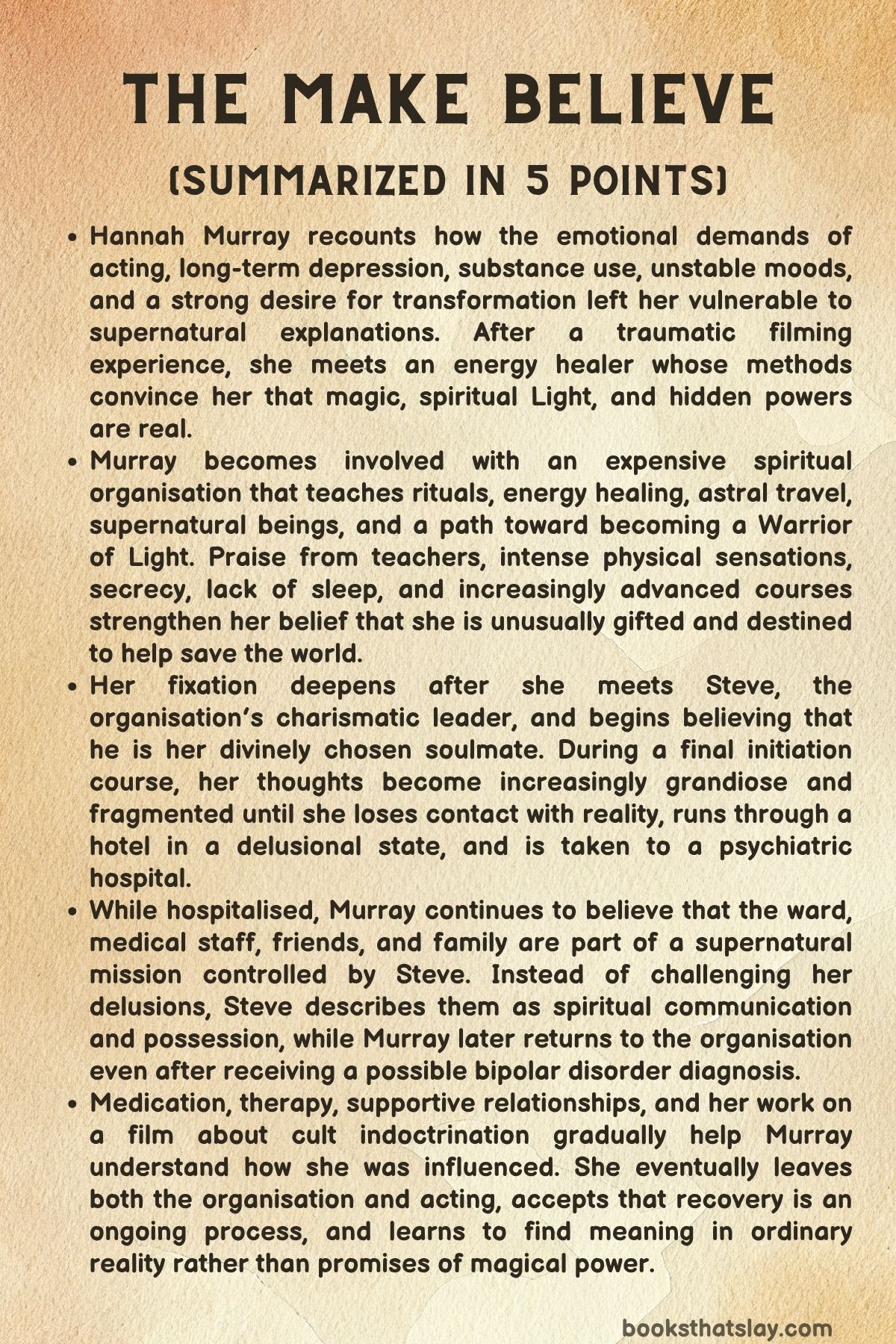
Summary
The memoir opens with Hannah Murray experiencing severe psychosis inside a psychiatric hospital. Rather than understanding the ward as a medical setting, she believes she has been sent there to heal the patients through a divine Light radiating from her body.
Ordinary rooms become locations of rebirth, baptism and supernatural transformation. She imagines herself as Eve, a mermaid, a servant and a weapon controlled by an immensely powerful man whose voice seems to exist inside her mind.
At the centre of this imagined universe is a real memory: the man once told her that magic was real. That statement becomes the foundation of her delusions, linking her spiritual beliefs, romantic obsession and loss of control.
The narrative then returns to the period when Murray was filming Detroit. She plays Julie, a survivor of the violence and sexual assault that occurred during the 1967 Algiers Motel incident, and she feels a profound responsibility to honour the real woman’s experiences.
Murray throws herself into the work with little regard for her physical or emotional limits. Repeated night shoots, violent handling and scenes in which her costume is torn from her body leave her exhausted, bruised, frightened and physically ill.
She tries to convince herself that her reactions do not matter because the events are only being performed. Her body responds differently, producing panic, nightmares, vomiting and pain that reveal how deeply the work is affecting her.
Murray connects this experience to an acting method based on extreme emotional openness. She believes that making herself vulnerable allows another person’s history to pass through her, but this approach gradually weakens the boundaries between her roles and her own identity.
Outside work, she has a long history of depression, self-hatred, self-harm, substance use and fear that professional success will disappear. Alcohol and cocaine offer temporary escape, but they are followed by emotional crashes that intensify her search for another solution.
Self-help books, meditation, gratitude exercises and wellness practices begin to provide a language for personal transformation. Although raised by atheist parents, Murray has always been attracted to religion and magic, making her receptive when a trainer recommends an energy healer named Grace.
During their first meeting, Grace encourages Murray to reveal intimate information about depression, drugs, relationships, self-harm and family pain. Murray also discusses her guilt surrounding her mother’s miscarriages, creating an atmosphere in which she feels emotionally exposed and ready to be remade.
Grace promises to bring Light into Murray’s body, remove everything false and activate her spiritual DNA. During the healing, Murray’s body moves without being touched, buried emotions surface and overwhelming feelings of relief convince her that something supernatural has occurred.
Part of the procedure feels painful and invasive, as though a hot instrument is entering her skull. Instead of interpreting the pain as a warning, she accepts Grace’s explanation that discomfort is evidence of purification.
Afterwards, Murray experiences exhaustion, grandiosity and a belief that her desires can influence reality. Drinking heavily and having anonymous sex no longer produce the same shame, which she sees as proof that she has been spiritually liberated rather than evidence of growing instability.
Soon after filming ends, Murray travels to New York with her friend Sam to attend a Kanye West concert. Sam has long occupied an emotionally complicated place in her life because their friendship became sexual, after which he withdrew and began seeing someone else.
At the concert, the music, floating stage and crowd feel religious to Murray. During the performance, she again senses an invisible force moving her body and regards the experience as confirmation that the healing has opened her to genuine spiritual power.
She feels unusually confident and complete, believing that she no longer requires Sam’s approval. Yet her intense identification with Kanye as a troubled, visionary figure foreshadows her own later breakdown and hospitalisation.
Back in London, Murray attends a costly introductory class taught by Siobhan, whom Grace has recommended. She hides the class’s true purpose from Rina and describes it merely as meditation, beginning the secrecy that will separate her magical life from her established relationships.
Murray and another student learn rituals involving protective circles, energy clearing, spirit guides, Christian imagery, Kabbalah and shamanic ideas. Siobhan teaches that life is predetermined, soulmates are divinely selected and humanity has fallen out of alignment with God’s will.
Guided exercises produce vivid images of lions, unicorns, angels and supernatural beings. Although some teachings seem absurd, repetition, suggestion and physical sensations make them increasingly persuasive.
The organisation flatters Murray by describing her as psychic and spiritually gifted. It also introduces a ladder of progressively more expensive courses that leads toward becoming a Ritual Master and Warrior of Light.
The promise of advancement gives her both identity and purpose. After an initiation ceremony involving a sword, she leaves convinced that she has discovered her destiny.
Murray begins performing rituals twice a day, but her mood soon collapses. She remains in bed, barely eats, smokes heavily and struggles with self-harm urges, while Siobhan explains the depression as negative material being cleared by incoming Light.
Her friend Emily notices that Murray’s emotional highs are becoming higher and her lows more severe. Murray nevertheless resists psychiatric medication because accepting a medical explanation would challenge her belief that the organisation can cure her.
Siobhan performs a cord-cutting ritual intended to break Murray’s attachment to Sam. Around the same period, Murray confronts him about the pain caused by their sexual relationship, and he admits that strong feelings frightened him.
Murray’s willingness to communicate and establish boundaries represents genuine emotional progress. However, she gives most of the credit to magical rituals rather than therapy, reinforcing her dependence on the organisation.
Family tensions also make the promise of purification attractive. Murray feels controlled by her anxious mother and emotionally unseen by her confident but insensitive father.
Her deepest resentment involves discovering that her parents had tested her as a child for a genetic condition associated with her mother’s miscarriages and concealed the positive result until she was twenty-five. Unable to express her anger openly, she withdraws while also hiding important parts of her own life.
Memories of an emotionally abusive former partner strengthen her fear that she is incapable of love. The organisation offers a way to reinterpret shame, anger and depression as impurities that can be removed through discipline and spiritual advancement.
At the beginning of 2017, Murray stops smoking, meditates intensely and enters another elevated period. She feels energetic, loving and unlimited, while ordinary coincidences become communications from the universe.
At a charitable psychic event, she discovers a larger community of believers and experiences a powerful sense of belonging. When Siobhan suggests the Course in Healing, Murray treats the dates, promised wand and convenient timing as signs that she is meant to attend.
A trip to Los Angeles further heightens her excitement. She buys crystals and protective jewellery, sleeps very little, dances through the early morning and reinterprets adolescent memories as evidence of an earlier spiritual awakening.
Photographs of Sam with his new boyfriend still provoke rage and grief. Rather than recognising the contradiction between her claimed emotional freedom and continuing obsession, she becomes more determined to pursue magical transformation.
Before the healing course, Murray attends several prerequisite classes. She rents accommodation near the hotel and lies to Rina about staying with her parents, creating a private world governed by the organisation.
She meets Jodi, whose claim that Grace’s treatment helped her recover from severe Crohn’s disease strengthens Murray’s trust. The classes introduce astral travel, elemental journeys, Shambhala and supposedly real species such as mermaids, vampires, faeries and elves.
Some teachings disturb Murray, particularly the suggestion that drug users and sex workers are human refuse whom vampires may kill. However, she treats the offensive claims as the mistake of individual teachers instead of questioning the system that authorises them.
Having spent money, hidden her involvement and built her identity around the promised transformation, she finds retreat increasingly difficult. Doubt becomes something she must suppress or interpret as personal failure.
The healing course gathers students who describe illness, destiny and spiritual callings. Murray feels competitive as well as excited, hoping others will recognise her as naturally powerful.
Students practise locating invisible energy points without touching one another. Murray experiences pressure, movement and physical reactions that turn belief into certainty, while compliments from classmates strengthen her conviction that she possesses an exceptional gift.
She sleeps very little but feels increasingly energetic and euphoric. Spiritual excitement, sexual thoughts and grandiose fantasies begin merging, making every sensation appear significant.
The organisation teaches that imagination separates great practitioners from ordinary ones. This appeals strongly to Murray because acting has trained her to believe in imagined circumstances with complete emotional commitment.
When she receives a wand, she begins hearing a playful inner voice that she identifies as the object itself. She carries it against instructions and tells friends about her new beliefs with unusual confidence.
Murray imagines becoming a healer for actors, directors and celebrities before transforming entire groups. With almost no sleep, she feels refreshed, chosen and impatient for greater power.
Her condition intensifies when she meets Steve, the organisation’s charismatic leader. A prolonged embrace produces immediate sexual and spiritual excitement, and his teachings about evil, possession and Warriors of Light give her unstable experiences a dramatic explanation.
Steve hints that the violence represented in Detroit may have occult significance. Murray begins to believe that he sees something unique in her and that they share a divinely appointed mission.
After a group dinner, she stands naked before a mirror, repeatedly declaring love and acceptance for herself. During a bath meant to protect her against evil, Steve’s voice appears inside her mind and tells her that they have a magical and sexual future together.
She concludes that Steve is her soulmate. Her manic energy, spiritual training, romantic longing and imagination now operate as one self-reinforcing system.
On the final day, Murray is already deeply delusional. A short walk feels spiritually dangerous, classmates become divinely appointed protectors and an outing to Hyde Park seems like an occult pilgrimage.
She hears Steve’s voice praising her, declaring love and confirming their mission. Sunlight, strangers, money and photographs appear to be objects under his control.
During another healing session, Murray believes she transfers immense power and helps save the world. As the initiation approaches, time and space seem to distort, and sexual attraction toward another participant produces jealousy about whether Steve still wants her.
Her perceptions finally break apart. She hides in a toilet cubicle, believes the bowl is a portal and interprets physical sensations as cosmic birth.
When teachers chant over her with ritual objects, she thinks an exorcism is part of a playful test. Steve’s attempts to calm her become confirmation of their love.
Murray escapes through the hotel, runs barefoot toward a swimming pool and believes she can transform into a mermaid. Security staff restrain her, but she connects them to the violence in Detroit and alternates between fantasies of attacking and seducing them.
Paramedics place her on a stretcher, which she imagines as a royal vehicle taking her to Steve’s palace. Her ordinary identity already feels distant and unreal.
At Gordon Hospital, every object becomes part of the magical system. Blue furniture represents Steve, staff members become possible versions of him and the hospital appears to be a threshold leading to Shambhala.
Murray refuses ordinary necessities because she believes Light can sustain her. Her acting career, spiritual instruction and popular culture combine into a mythology in which she is a uniquely powerful figure destined to join Steve.
After being transferred to Amazon Ward, she believes her presence can heal the hospital. She sings, shouts, wanders and assigns symbolic identities to friends, relatives and staff.
Her mother begins researching the organisation and describes it as dangerous. Murray responds with anger because accepting the criticism would threaten the entire reality she now inhabits.
Steve’s messages deepen the crisis. Rather than challenging Murray’s belief that he speaks inside her mind, he describes the experience as a high-level spiritual connection and suggests that she was possessed while filming Detroit.
He denies that the organisation contributed to her breakdown. By blaming invisible forces and praising her exceptional potential, he gives supernatural authority to symptoms that require medical care.
Murray briefly accuses Steve and the group of causing her suffering. When he mocks the suggestion that he runs a cult and frames her anger as misdirected, she apologises and returns to trusting him.
Visits from friends and family occasionally reconnect Murray with ordinary life. Sam’s worried messages comfort her, while a conversation with her father allows her to see his vulnerability for the first time.
He speaks about the miscarriages, her birth and his own emotional uncertainty. Their exchange creates a genuine moment of closeness, though Murray still interprets her hospitalisation as a spiritual mission.
After three weeks, she receives weekend leave while still psychotic. She hides many beliefs from clinicians and loved ones because she thinks only Steve understands what is happening.
A private psychiatrist listens to Murray’s history of depression, euphoria, substance misuse, self-harm and suicidal thinking and suggests bipolar disorder. The diagnosis offers relief because it connects her current condition to patterns that began before the film and magical organisation.
Nevertheless, Murray soon returns to complete the initiation interrupted by her breakdown. The teachers provide no meaningful apology, yet the ceremony feels glorious to her and renews her loyalty.
Jodi becomes her closest companion within the belief system. Together they interpret London’s parks, exhibitions and museums as landscapes filled with messages about royalty, destiny and spiritual power.
Small doubts begin to emerge when Jodi’s boyfriend identifies the organisation as a cult. Jodi and Murray admit that neither has properly investigated the group because both are emotionally invested in believing that Grace, Siobhan and Steve are good.
Murray finally tells Jodi about her belief that Steve is her soulmate. Jodi responds gently but jokes that he resembles an untrustworthy salesman, creating space for scepticism without humiliating Murray.
Medication makes Murray appear more stable, but delusions continue to shape her dating, shopping and medical appointments. She imagines Steve observing her through symbols, while he directs her toward further paid sessions with Siobhan.
The treatments eventually produce a bill exceeding £1,000 without providing the answers Murray seeks. As the enchanted feeling fades, depression returns with severe exhaustion, binge eating and hopelessness.
Clinicians explain that depression commonly follows psychosis. Steve instead suggests that choosing Light and finding her purpose will help her recover, leaving Murray feeling responsible for her illness and dependent on further initiation.
A decisive change occurs when Murray discovers that Steve is married to Lisa, another senior teacher, and that they have a child. The discovery contradicts her belief that she and Steve share an exclusive divine bond.
Murray attends Lisa’s classes hoping for answers, but the teachings about femininity, skirts, motherhood, beauty and traditional female power repel her. When disagreement is described as resistance, Murray begins recognising how the organisation makes students responsible for every failure or objection.
She accepts that Steve does not belong to her, but she cannot immediately abandon the spiritual structure built around him. Her personal fantasy weakens before her loyalty to the wider system does.
During press tours for Game of Thrones and Detroit, Murray performs public enthusiasm while privately living with severe depression. She visits Lauren, an advanced member, hoping Ritual Master training might restore magic, purpose and Steve’s attention.
Rules involving protective symbols, ceremonial weapons and abstinence initially appear comforting because they promise discipline. Another teacher suggests that those exposed to darkness may be especially qualified to fight it, renewing Murray’s belief that her breakdown represents destiny.
She decides to become a Ritual Master and sends Steve a message. He never responds, and she never hears from him again.
While filming the final season of Game of Thrones, Murray begins accepting sustained psychiatric treatment. A mood stabiliser offers little improvement, but antidepressants, therapy and professional support gradually restore energy and pleasure.
Her departure from the organisation is slow. She reads critical accounts, continues attending some classes, resumes habits forbidden by the group and gradually abandons the ambition to become a Ritual Master.
A year after her hospitalisation, she plays Leslie Van Houten in Charlie Says, a film about the Manson Family. Leslie’s gradual indoctrination helps Murray understand that coercive systems rarely reveal their final demands at the beginning.
Each stage asks only for a little more money, secrecy, obedience and belief. By speaking openly to colleagues about Steve, the exorcism and her hospitalisation, Murray begins turning shame into a story she can examine.
The work still triggers fears about evil and possession, showing that recovery is incomplete. Yet it also gives her a framework for recognising how she was recruited and why leaving required more than simply deciding not to believe.
Years later, Murray does not claim to be completely cured. She treats diagnosis as a useful map, accepts the need for ongoing care and no longer believes that Steve possessed supernatural knowledge.
She understands that her wish to feel special, purified and chosen made the organisation’s promises especially powerful. At the same time, she avoids reducing every participant to either a calculating villain or an innocent victim, recognising that some teachers may have believed the system they promoted.
Jodi also leaves, and naming the organisation as a cult becomes an important part of their recovery. Murray’s relationships with her parents become warmer, while her friendships with Rina and Sam survive in less consuming forms.
She eventually leaves acting because repeatedly surrendering herself to imagined realities no longer feels safe or fulfilling. Instead of searching for magic in secret knowledge, she learns to find wonder in colour, weather, breath, food and the ordinary physical world.
The memoir ends with a restrained but meaningful conclusion: reality is not disappointing merely because it is real. For Murray, accepting its limits becomes a form of freedom.
Characters
Hannah Murray
Hannah Murray is the narrator, central subject and most psychologically complex figure in The Make Believe. Her account is shaped by retrospective awareness, meaning that the older Murray can examine beliefs the younger Murray experienced as unquestionable truths.
Her vulnerability develops from several overlapping sources rather than one isolated event. Depression, self-harm, drug use, emotional abuse, family secrecy, professional pressure and untreated periods of intense elevation all contribute to her hunger for a complete transformation.
Murray’s imagination is both a professional gift and a psychological danger. Acting has taught her to surrender to constructed realities, inhabit another person’s experience and treat emotional exposure as artistic courage, but the same habits make supernatural suggestions unusually powerful when her mood becomes unstable.
Her desire to honour Julie while filming Detroit is sincere, yet she mistakes self-destruction for dedication. She repeatedly overrides fear, pain and exhaustion because she believes a serious actor must offer her body and mind without reservation.
Murray is also motivated by a longing to feel chosen. Compliments about psychic ability, healing talent and spiritual importance offer an answer to her fear that she is defective, unlovable or replaceable.
The organisation does not create every insecurity, but it supplies a system that turns them into evidence of destiny. Depression becomes purification, sleeplessness becomes spiritual energy, grandiosity becomes higher knowledge and doubt becomes personal resistance.
Her attachment to Steve reveals how romantic desire and spiritual authority become inseparable. She does not merely want his affection; she wants him to confirm that her life has a cosmic purpose.
Murray’s recovery begins when she can tolerate explanations that are less exciting but more reliable. Medication, therapy, diagnosis and honest conversations cannot promise divine power, yet they gradually return her to a world in which pain can be treated without being glorified.
Her later self-awareness does not become self-contempt. She recognises the harm she caused, the warning signs she ignored and the ways she might have recruited others, while still treating her earlier self as a frightened person seeking relief rather than a foolish person deserving ridicule.
Steve
Steve is the charismatic leader whose authority dominates the most dangerous period of The Make Believe. His importance comes less from the amount of time he physically spends with Murray than from the power she gives his words, image and perceived approval.
His teachings combine fear and flattery. He warns students about evil, possession and spiritual warfare while presenting advanced members as rare people capable of protecting humanity.
This structure makes terror feel like evidence of importance. When Murray becomes frightened, sleepless and grandiose, the system encourages her to see herself as a Warrior of Light rather than as someone entering a mental health crisis.
Steve’s response after her hospitalisation is especially damaging. Once Murray tells him that she hears his voice, he does not advise her to trust doctors or question the experience; instead, he calls it a high-level connection and suggests that he spoke to her soul.
He also attributes the breakdown to demonic possession connected with Detroit. This explanation protects his organisation from responsibility while confirming Murray’s most dangerous beliefs.
Steve maintains control through ambiguity. He neither openly confirms Murray’s romantic fantasy nor clearly rejects it, allowing her to continue hoping that spiritual advancement will reunite them.
When Murray becomes angry, he mocks the idea that he leads a cult, blames nonhuman forces and presents acceptance of his help as her only reasonable choice. His response makes her feel guilty for questioning him and restores the unequal relationship.
Whether Steve consciously intends every consequence cannot be proved from Murray’s perspective. However, his refusal to challenge an openly psychotic follower, his use of occult explanations and his denial of institutional responsibility make him a central figure in the continuation of her delusions.
Grace
Grace functions as the first authoritative gateway into the magical system. Her importance lies in the sequence she establishes: personal disclosure, emotionally overwhelming physical experience and a supernatural explanation that places her own methods beyond ordinary doubt.
Before beginning the healing, Grace invites Murray to reveal depression, self-harm, substance misuse, relationships and family guilt. This information allows the session to feel intensely personal and makes Murray more emotionally suggestible.
The bodily movements, pain, laughter and crying Murray experiences are real sensations, even if Grace’s explanation for them is unsupported. Because the relief is genuine, Murray assumes the entire spiritual theory must also be true.
Grace presents discomfort as purification and grandiosity as awakening. She therefore teaches Murray to interpret warning signs as proof that the treatment is succeeding.
Her recommendation of Siobhan moves Murray from a single healing into a structured programme of classes, payments and initiations. Grace may believe sincerely in what she offers, but sincerity does not prevent her methods from increasing Murray’s vulnerability.
Siobhan
Siobhan is Murray’s principal teacher during the early stages of her involvement. She introduces the rituals, cosmology and progression system that transform a private search for healing into a disciplined spiritual identity.
Her instruction combines many religious and mystical traditions. Christian symbols, Kabbalah, shamanic language, spirit guides and supernatural races are presented as parts of one hidden reality.
Siobhan repeatedly interprets Murray’s experiences for her. Depression becomes energy clearing, unusual sensations become evidence of psychic ability and emotional change becomes proof that rituals are working.
This interpretive authority discourages Murray from forming alternative explanations. If a practice feels successful, the organisation receives credit; if it fails or causes distress, the student’s resistance, impurity or lack of faith is blamed.
Siobhan’s role after the breakdown is morally troubling. She offers further healing, returns Murray’s possessions and later participates in completing the initiation, yet she provides no meaningful acknowledgment that Murray became psychotic during the organisation’s course.
Her continued willingness to charge Murray for treatments, including an eventual bill of more than £1,000, shows how emotional dependence and financial extraction operate together. Even if Siobhan regards herself as a healer, she helps sustain a system that discourages accountability.
Jodi
Jodi begins as a source of confirmation and eventually becomes a source of reality. Her reported recovery from Crohn’s disease through Grace’s treatment strengthens Murray’s belief that the organisation possesses genuine healing power.
Their friendship develops because they share age, humour, enthusiasm and uncertainty. Within an environment that rewards certainty, Jodi gives Murray permission to admit that some teachings feel ridiculous, offensive or disappointing.
At first, the two women reinforce each other’s magical interpretations. They walk through London treating museums, parks and symbols as messages about destiny, royalty and supernatural purpose.
Their shared doubt gradually becomes more important than their shared belief. When Jodi’s boyfriend calls the organisation a cult, both women recognise how little independent research they have done and how much their gratitude has prevented scrutiny.
Jodi’s reaction to Murray’s soulmate fantasy is particularly valuable. She does not humiliate her or aggressively destroy the belief, but she introduces humour and scepticism by comparing Steve to an untrustworthy salesman.
Because Jodi has participated in the same practices, her later rejection of the organisation carries a credibility outsiders cannot provide. Their ability to name the system together becomes essential to recovery because it replaces isolated shame with shared understanding.
Rina
Rina represents ordinary friendship, imperfect care and the possibility of repair. Murray hides important details from her because the magical organisation demands secrecy and because Rina’s practical perspective threatens the new identity Murray is building.
During the crisis, Rina remains connected to Murray’s life even when she cannot understand the full extent of the delusions. Murray places her inside the supernatural system as a symbolic ally, showing how psychosis absorbs familiar relationships instead of simply erasing them.
Rina is not presented as an ideal rescuer. She sometimes minimises Murray’s distress and fails to recognise how much support her friend requires.
Her later apology matters because it does not claim responsibility for causing the illness. Instead, she acknowledges specific emotional failures and relieves Murray of some of the guilt attached to their friendship and the situation involving Sam.
Rina’s presence shows that recovery depends partly on relationships that can survive confusion, resentment and fear. She offers a connection to Murray’s pre-cult identity without demanding that everything return to its former form.
Sam
Sam occupies several roles: friend, sexual partner, romantic obsession, source of rejection and later source of reassurance. Murray’s attraction to him is intensified by his emotional unavailability, which allows fantasy to fill the space left by unclear communication.
After they sleep together, Sam avoids a direct conversation and begins seeing someone else. His withdrawal reinforces Murray’s fear that intimacy makes her disposable and encourages her to idealise him as uniquely valuable.
The confrontation between them is one of Murray’s genuine moments of growth. She explains her pain, establishes boundaries and refuses to remain indefinitely in an ambiguous relationship.
However, she attributes much of this progress to spiritual healing, allowing the organisation to claim authority over courage that also came from therapy and personal reflection. Even after believing she has transcended romantic need, photographs of Sam with a boyfriend provoke intense jealousy.
During her hospitalisation, his worried messages offer emotional stability. Their later friendship becomes less central, suggesting that Murray eventually learns to value connection without making one person responsible for her identity or salvation.
Murray’s Mother
Murray’s mother is a complicated figure defined by protection, anxiety, secrecy and conflict. Her history of five miscarriages shapes the family atmosphere, although Murray does not fully understand its influence until adulthood.
Her decision to conceal Murray’s childhood genetic test result causes lasting damage. What may have been intended as protection becomes, for Murray, evidence that her own body and future were controlled without her knowledge.
Murray experiences her mother as strict, anxious and infantilising. Because anger is difficult to express directly, resentment develops alongside guilt, dependence and emotional distance.
During the psychotic episode, her mother becomes both a real visitor and a symbolic figure within Murray’s delusions. She is imagined as a librarian, owl and guardian of an official version of Murray’s life.
Her investigation of the organisation is one of the most necessary actions taken by anyone close to Murray. Yet Murray initially experiences the criticism as betrayal and bans her from visiting because the magical system has become more emotionally authoritative than family.
Their later relationship becomes warmer and more ordinary. This change does not erase earlier injuries, but it shows that closeness can grow through reality-based interaction rather than dramatic purification.
Murray’s Father
Murray’s father initially appears confident, emotionally insensitive and difficult to reach. His manner contributes to her feeling that important experiences cannot be discussed openly within the family.
His hospital visit reveals a different side of him. When Murray asks about the miscarriages, he explains that her birth replaced fear with overwhelming joy and admits that he sometimes feels like a child who does not know what to do.
His tears challenge Murray’s assumption that emotional restraint means emotional absence. For the first time, she sees him as vulnerable rather than simply powerful or dismissive.
This conversation does not immediately end her delusions, but it creates authentic intimacy without ritual or supernatural interpretation. His character demonstrates how honest vulnerability can repair relationships more effectively than promises of spiritual perfection.
Lauren
Lauren is an enthusiastic member who advances further into the organisation and becomes a Ritual Master. To Murray, she represents the disciplined, purposeful future promised by higher initiation.
When Murray visits her in Minneapolis, Lauren follows strict rules involving protective symbols, a wand, a ceremonial knife and abstinence from alcohol, drugs, cigarettes and hot caffeine. These restrictions appear reassuring because they give structure to a life that otherwise feels empty and depressed.
Lauren cannot provide a convincing explanation for Murray’s breakdown. Nevertheless, her continued commitment makes advanced training appear possible and respectable.
Her character shows how members can legitimise a system for one another without deliberately manipulating anyone. By organising daily life around its rules, Lauren turns extraordinary claims into ordinary habits and makes deeper involvement look like stability.
Lisa
Lisa is a senior teacher, Steve’s wife and the person whose existence finally breaks Murray’s soulmate fantasy. Discovering their marriage and child forces Murray to confront a direct contradiction between the organisation’s teachings and her imagined bond with Steve.
Murray attends Lisa’s classes partly to understand her and partly to regain a sense of purpose. Lisa appears charismatic, confident and fully established within the hierarchy.
Her lessons promote a narrow vision of femininity based on skirts, beauty treatments, motherhood, domestic practices and traditional gender roles. Murray increasingly experiences these teachings as superficial and restrictive.
The claim that discomfort is merely resistance prevents meaningful disagreement. Instead of allowing students to evaluate the lesson, the system turns criticism into evidence that the student requires more instruction.
Lisa’s warm farewell suggests awareness of Murray’s breakdown but contains no meaningful accountability. She therefore becomes another example of how friendliness and institutional harm can exist in the same person.
Emily
Emily is one of the first people to notice the pattern Murray cannot yet recognise. She observes that Murray’s emotional highs are rising while her lows are becoming more severe.
Her warning offers a simple, reality-based interpretation of Murray’s behaviour. It competes with Siobhan’s more exciting claim that depression and elevation are signs of energetic transformation.
Murray rejects the implication because medical treatment seems ordinary and limiting beside the promise of complete spiritual healing. Emily’s small role is therefore important: she represents early evidence that the crisis was visible before it became catastrophic.
Rajiv
Rajiv is a fellow student whose confidence reflects the competitive environment of the courses. During astral travel exercises, he claims to have reached India while Murray remains uncertain whether anything has happened.
His certainty increases her tendency to blame herself for doubt. Rather than questioning whether the exercise is meaningful, she assumes she lacks the ability or faith other students possess.
When Murray later practises healing on him, she believes she transfers extraordinary power and contributes to saving the world. Rajiv’s presence shows how group testimony can strengthen delusion even when participants may simply be interpreting ambiguous experiences differently.
Maeve
Maeve is a classmate whose compliment strongly affects Murray’s sense of spiritual importance. By describing Murray’s energy as velvet, she provides social confirmation at a moment when Murray is eager to be recognised as naturally gifted.
The compliment appears harmless and may be completely sincere. Within the course environment, however, it becomes evidence supporting Murray’s developing grandiosity.
Maeve’s role demonstrates how ordinary encouragement can acquire extraordinary significance inside a closed interpretive system. A subjective impression is treated not as personal feedback but as proof of supernatural ability.
Zack
Zack participates in the healing session during which Murray’s perception of time and space begins collapsing. His physical proximity becomes absorbed into her spiritual and sexual delusions.
Murray’s attraction to him creates panic because she believes Steve may have selected another soulmate or withdrawn his love. Zack himself is not presented as intentionally causing this reaction.
His role illustrates how psychosis assigns hidden importance to neutral people. A class exercise and moment of attraction become part of an imagined struggle involving destiny, jealousy and divine selection.
Owen
Owen is a fellow participant whom Murray interprets as a divinely appointed protector. During the final course day, his presence helps her transform an ordinary walk into a spiritually dangerous mission.
Later, he appears within Lauren’s community of advanced members. This continuity makes him part of the social network that normalises the organisation’s beliefs.
Owen’s character is shaped mainly through Murray’s projections. He demonstrates how delusion can assign sacred roles to people who may have no knowledge of the meaning being placed upon them.
Nora
Nora is an advanced member whose calm manner impresses Murray during her visit to the organisation’s permanent centre. Her composure makes the life of a Ritual Master appear peaceful and credible.
When questioned privately, Nora suggests that exposure to darkness may qualify a person to fight it. This interpretation gives Murray’s suffering renewed purpose and revives her plan to pursue advanced training.
Nora’s words are dangerous because they transform trauma and psychosis into evidence of spiritual suitability. Her character shows that influence does not always require aggression; calm certainty can be equally persuasive.
Philip
Philip is a date Murray meets while still experiencing delusional beliefs. She interprets their interaction as something Steve is observing and approving through supernatural signs.
Philip is less important as an independent personality than as evidence that psychosis continues beneath Murray’s outward stability. Medication allows her to socialise, but it has not yet restored an ordinary understanding of events.
Through Philip, the book shows that apparent functioning should not be mistaken for complete recovery. A person may date, shop and converse while still organising experience through an elaborate delusional structure.
Themes
The Conflict Between Subjective Certainty and External Reality
Psychosis in The Make Believe is not presented as simple confusion. Murray’s experiences possess emotional coherence, symbolic richness and complete internal certainty, making the magical world feel more persuasive to her than the explanations offered by doctors, friends or family.
Every ordinary detail can support the system. Colours represent Steve, strangers become spiritual agents, hospital corridors become ceremonial passages and physical restraint becomes royal transport.
The danger comes from the belief system’s ability to explain everything. Positive emotions prove that Light is entering her, depression proves that impurities are leaving, doubt proves resistance and criticism proves that outsiders cannot understand.
Because no possible experience can disprove the theory, Murray becomes trapped inside an interpretation that constantly protects itself. The organisation’s language strengthens this trap by treating symptoms as advanced spiritual events.
Medical explanations initially feel insulting because they reduce a divine mission to illness. Yet diagnosis eventually offers something the magical system cannot provide: an account that connects depression, euphoria, sleeplessness, substance use and psychosis without making Murray responsible for defeating supernatural evil.
Recovery therefore requires more than recognising factual errors. Murray must grieve the purpose, romance and exceptional identity those errors gave her.
Her final acceptance of ordinary reality is not a defeat of imagination. It is the recognition that wonder does not need to be supported by secret hierarchies, dangerous certainty or the belief that one person has been chosen to save the world.
Coercive Influence and Gradual Indoctrination
Murray’s involvement develops through a series of apparently manageable decisions. She agrees to one healing, attends one class, learns one ritual, buys one object and then advances toward increasingly expensive and demanding levels.
Each stage creates reasons to continue. Emotional relief suggests the method works, payment creates investment, secrecy separates her from sceptical friends and praise makes withdrawal feel like abandoning a special identity.
The organisation also controls interpretation. Success confirms the teaching, while discomfort, anger or failure is described as resistance, impurity or interference from evil forces.
This structure protects leaders from accountability. When Murray becomes psychotic, Steve attributes the breakdown to demonic possession, Siobhan offers more healing and the group later completes her initiation without seriously examining what happened.
The memoir avoids portraying indoctrination as a process affecting only unintelligent people. Murray is educated, successful, sceptical in certain moments and surrounded by people who care about her, yet her emotional needs and unstable mood make the promise of transformation intensely attractive.
Her work on Charlie Says gives her a language for understanding the process. People do not agree at the beginning to the worst possible outcome; they accept small demands that gradually change what seems normal.
Recognising that pattern helps Murray replace shame with comprehension. She can accept her participation without pretending that the organisation’s methods were harmless or that consent given under escalating influence was fully informed.
Performance, Identity and Psychological Vulnerability
Acting teaches Murray to make imagined circumstances emotionally real. This ability supports her professional success, but it also encourages her to treat self-erasure, pain and extreme vulnerability as evidence of artistic seriousness.
While filming Detroit, she believes that honouring Julie requires complete physical and emotional exposure. Panic, bruising, vomiting and nightmares are dismissed because acknowledging her limits would feel like betraying the real woman’s suffering.
The organisation later praises imagination as a source of magical power. What has made Murray an effective performer is recast as evidence that she possesses unusual spiritual ability.
Her roles, magical training and personal identity gradually lose their boundaries. Violence from Detroit becomes proof of demonic contamination, Steve becomes both leader and imagined lover, and cultural references become messages directed specifically at her.
This does not mean imagination causes psychosis. The book instead shows how professional habits can interact with mood instability, sleep loss, drugs, trauma and suggestion.
Leaving acting is therefore both a loss and a protective decision. Murray grieves the career that shaped her adult identity, yet she no longer wants to surrender herself completely to fictional worlds.
Her later understanding of creativity becomes more limited but also more sustainable. Imagination can remain meaningful without requiring her body, identity and grasp on reality to become permanently available for transformation.
Recovery Through Accountability, Treatment and Ordinary Connection
Recovery arrives through medication, therapy, diagnosis, time and relationships rather than a single dramatic revelation. Murray does not immediately leave the organisation after hospitalisation, and discharge does not mean that her delusions have disappeared.
The gradual nature of improvement challenges the idea of healing as instant purification. Psychiatric treatment sometimes fails, medication requires adjustment and depression follows the excitement of psychosis.
Ordinary conversations become important because they reconnect Murray with people rather than symbols. Her father admits fear and helplessness, Rina apologises for minimising her suffering and Jodi creates a safe space in which doubt can be expressed.
These exchanges differ from the organisation’s promises because no one claims perfect knowledge. Real relationships allow uncertainty, accountability, disagreement and revision.
Murray also learns to distribute responsibility carefully. She recognises her own decisions and the pain her crisis caused others, but she rejects the belief that she should have defeated mental illness through greater spiritual discipline.
She similarly avoids a simple division between wholly evil leaders and wholly innocent followers. Some participants may sincerely believe the teachings while still causing serious harm by repeating them.
The final form of recovery is not invulnerability. Murray continues living carefully with a mental health condition and accepts that some practices and environments remain unsafe for her.
Her peace comes from no longer requiring reality to prove that she is chosen. Colour, food, weather, breath and companionship become valuable without serving as coded evidence of a supernatural mission.