The Lost Book of Lancelot Summary, Characters and Themes
The Lost Book of Lancelot by John Glynn is a reimagining of Arthurian legend told through the life of Lancelot, beginning with his hidden childhood on the Isle of Women and following his transformation into one of Camelot’s greatest knights.
Rather than presenting him only as a heroic warrior, the novel examines his loneliness, sexuality, emotional instability, family inheritance, and resistance to prophecy. His relationships with Galehaut, Gawain, Viviana, Guinevere, Arthur, and Morgan le Fay reshape familiar legends into a story about personal freedom. Magic, political conflict, lost sacred objects, and the struggle between old beliefs and Roman influence surround Lancelot’s search for identity and belonging.
Summary
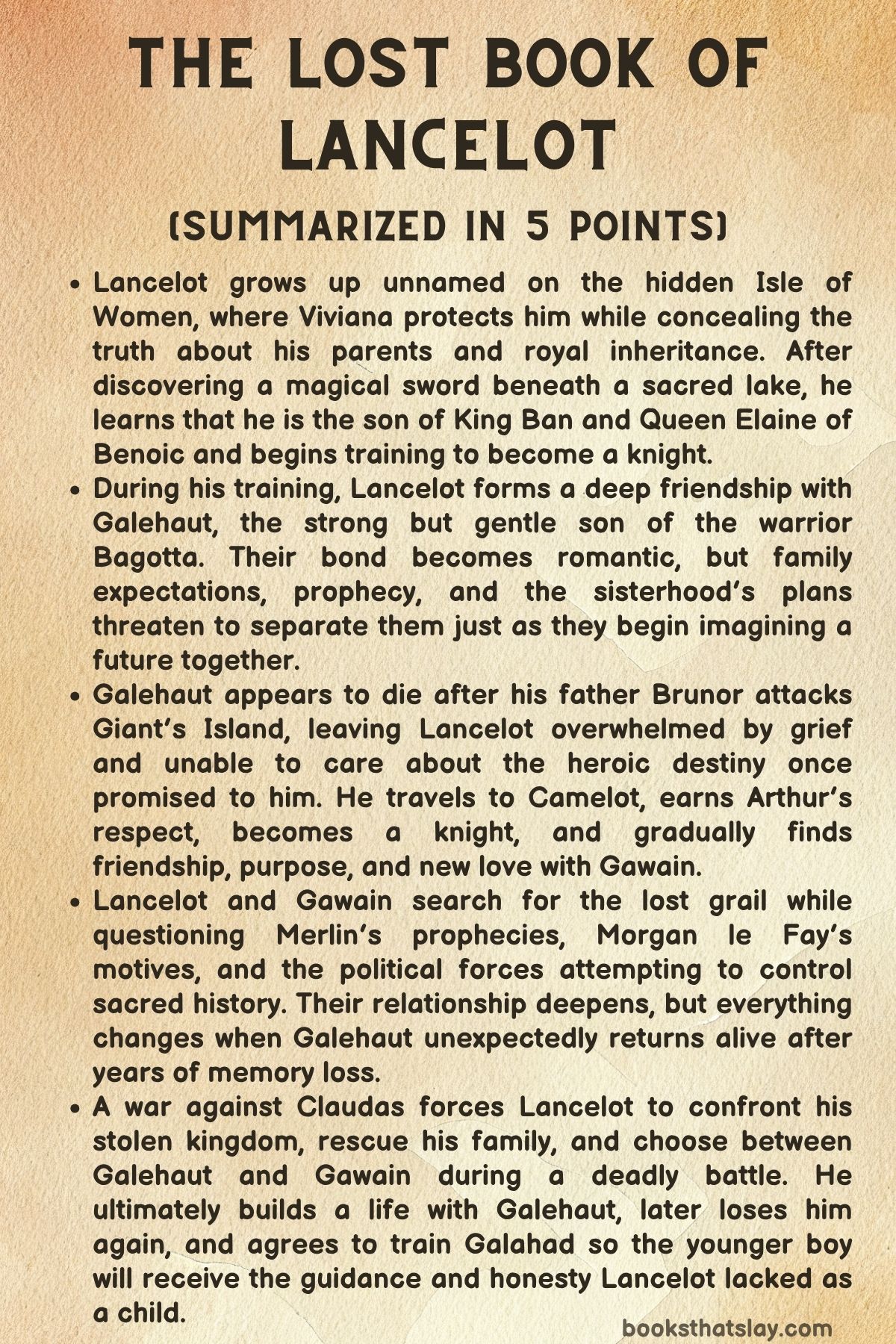
Lancelot grows up as the only boy on the mysterious Isle of Women, raised by Viviana and the island’s sisterhood after the apparent deaths of his parents. He has no personal name and is called only Prince, Boy, or Little One, leaving him uncertain whether he truly belongs among the women who shelter him.
Time behaves strangely on the island, causing him to mature faster than expected while remaining separated from ordinary society. His loneliness becomes so severe that he invents a companion from his reflection in a woodland pool, and when the water disappears, he experiences a devastating emotional collapse.
Most members of the sisterhood remain cautious around him because they fear what a man trained in their magic might become. Elinor, the oldest woman on the island, treats him with unusual tenderness and persuades Viviana to take him to Sorelois so he can see the outside world.
In Sorelois, Lancelot is fascinated by the crowds, merchants, buildings, and tournament grounds. He watches the warrior Bagotta defeat several knights, but his attention is drawn more strongly to her red-haired son Galehaut, who serves as her squire.
The boys briefly connect, and Lancelot gives Galehaut his final piece of plum cake. Before their friendship can develop, a stranger tries to abduct Lancelot, forcing Viviana to use magic to save him and reinforcing her belief that the outside world is too dangerous.
Back on the island, Lancelot becomes increasingly fearful, isolated, and desperate for answers about his origins. After discovering a book of Merlin’s prophecies, he learns that a prediction exists concerning him, although Viviana destroys the volume before he can read it.
His frustration finally erupts when Viviana continues refusing to explain his past or allow him genuine freedom. During an emotional crisis, he destroys the sacred golden harp of Danu, an act that could result in severe punishment from the sisterhood.
Elinor secretly sends him up the island’s mountain, where he discovers a hidden lake inside the crater. Beneath the water lies a golden sword that grants him visions of his parents, King Ban and Queen Elaine of Benoic, during the destruction of their kingdom by Claudas.
Lancelot witnesses Ban dying while attempting to save Elaine and sees his mother entrust her newborn child to Viviana before dying herself. He also hears the name Elaine chose for him, finally gaining the identity that had been withheld throughout his childhood.
When he returns, Viviana confirms that Elaine was her closest friend and that Lancelot was named after his maternal grandfather. Elinor then reveals that she is Elaine’s mother, making her Lancelot’s grandmother and explaining the special affection she has always shown him.
Bagotta and Galehaut arrive to begin Lancelot’s training in riding, combat, survival, scholarship, and service. Galehaut initially appears confident and dismissive, while Lancelot feels inferior because he lacks nearly every practical skill expected of a future knight.
Their relationship begins changing when Lancelot displays extraordinary natural ability with a sword. He repeatedly defeats Galehaut, and Galehaut eventually recognizes him as an equal while teaching him to accept praise without diminishing his own achievement.
As they train together, Galehaut reveals that his father Brunor abandoned Bagotta and their children. He also admits that he does not truly wish to become a knight, because he dislikes violence and would rather travel, learn, and help people.
Lancelot continues secretly visiting the hidden lake, where the sword shows him visions connected to Arthur, Guinevere, the Round Table, and three missing sacred objects. These experiences suggest that Lancelot is being drawn toward Camelot and a coming search for the lost grail.
Elinor suffers a severe illness that leaves her unable to move or speak normally. Lancelot fears that he must marry a woman and father a daughter to continue her bloodline, although Viviana insists that the sisterhood’s future does not depend entirely upon him.
Meanwhile, Lancelot’s friendship with Galehaut becomes emotionally and physically intimate. Galehaut leads him to a hidden forest filled with the blue shadows of water spirits, and their private conversations reveal how deeply they trust and understand one another.
Lancelot eventually shares the secret of the mountain lake and the golden sword with Galehaut. The weapon responds only to Lancelot, but the act of revealing it becomes proof that he has chosen Galehaut above the secrecy imposed by the sisterhood.
Beside the lake, Galehaut kisses Lancelot, and the two confess their growing attraction. They become lovers, giving Lancelot the closeness and acceptance he has sought since childhood and allowing him to experience desire without shame.
Their happiness is threatened during sea training when Lirius, king of the merfolk, attacks Galehaut and holds him beneath the water. Lancelot repeatedly stabs Lirius to save Galehaut, frightening himself with the violence he is capable of committing in defense of someone he loves.
Because Lirius may die, the boys travel to Corbenic to obtain a healing ointment from the Fisher King. There they meet Elaine of Corbenic and Brisen, who recognize their love and welcome them into a community where affection between people of the same sex is accepted.
The Fisher King explains that a grail, sword, and lance were once given to seven priestesses during a famine. Rome later attempted to claim these sacred objects and reshape their history, while the Fisher King and the sisterhood tried unsuccessfully to hide or destroy them.
Lancelot realizes that the missing sword is the weapon beneath the Isle of Women, but he protects the sisterhood by remaining silent. During Corbenic’s Beltane celebration, he and Galehaut briefly experience a life in which their relationship can exist openly.
After returning home, Lancelot learns that his cousins Bors and Lionel survived Claudas’s attack and have been rescued by Viviana. Their arrival releases Lancelot from the belief that he must marry a woman to preserve Elinor’s bloodline.
The sisterhood assigns Bors and Lionel to Joyous Guard so they can begin resisting Claudas, while Lancelot is ordered to travel to Camelot and search for the grail. Galehaut is expected to return to Giant’s Island and marry Cymidei, even though neither he nor Lancelot wants to be separated.
The lovers plan to escape together after Galehaut settles matters with his family. Viviana understands their relationship but warns Lancelot that love cannot excuse abandoning every duty or reshaping the world around personal desire.
Galehaut returns to Giant’s Island and tells his sister Delice that he loves Lancelot. Before he can leave, his estranged father Brunor arrives with Roman forces and demands that Galehaut serve him as a military commander.
Delice poisons Brunor in an attempt to protect the family, but Brunor kills Bagotta and fatally wounds Delice. Galehaut fights his father but is stabbed and thrown from a high window, apparently dying with his final thoughts fixed upon Lancelot.
Merlin reveals that he has been watching Lancelot for years in the form of the white-pawed fox. He reports that Galehaut and his family are dead and takes the grief-stricken Lancelot toward Camelot, where the search for the grail must continue.
Camelot is magnificent, but its public grandeur cannot comfort Lancelot. He meets Arthur, Guinevere, Yvain, Dinadan, Mordred, Gawain, Elaine of Astolat, and the other members of the Round Table while privately mourning the man he believed would share his future.
Arthur treats Lancelot with respect and refuses to knight him until he freely chooses the responsibility. Instead, he asks Lancelot to prove himself against Gawain, one of Camelot’s most dangerous warriors.
During their tournament, Lancelot briefly stops defending himself because death seems preferable to continuing without Galehaut. He then remembers Bagotta’s teaching about the second heart and converts his grief into controlled strength, defeating Gawain before collapsing.
Lancelot and Gawain begin as rivals, but their hostility slowly develops into trust and attraction. Both were separated from their original families, raised under complicated circumstances, and burdened by prophecies that turned their private lives into matters of public expectation.
Guinevere becomes one of Lancelot’s closest friends and openly accepts that Galehaut was his beloved. Her honesty helps him speak about his sexuality and grief without treating either as a source of shame.
Lancelot also encounters Morgan le Fay, who claims that Merlin uses prophecy to manipulate people into producing the futures he predicts. She challenges the official histories of Camelot and the sisterhood, especially those that condemn powerful women while excusing powerful men.
After further quests and shared dangers, Lancelot agrees to become a knight by choice rather than obligation. His relationship with Gawain then becomes romantic, proving that he can love again without erasing what Galehaut meant to him.
Together, Lancelot and Gawain follow clues to Morgan’s Valley of No Return, where they find a golden cup guarded by a dragon. They escape with the object and believe they have recovered the grail, but Elaine of Corbenic later exposes it as a decoy.
The failure humiliates Lancelot, yet Gawain remains beside him. Their relationship continues through the summer, giving Lancelot a period of happiness while military threats, religious conflict, and Mordred’s growing resentment endanger Camelot.
Mordred’s hatred is strengthened by the death of Elaine of Astolat, who kills herself after imagining a romance with Lancelot that never existed. Mordred interprets her death as proof of Lancelot’s selfishness and begins using rumors about Lancelot and Guinevere to undermine Arthur.
During Samhain, an armed force approaches Camelot under the leadership of King Mark’s champion Tristan. Among the opposing warriors is a nameless knight who removes his helmet when he recognizes Lancelot.
The knight is Galehaut, who survived his fall but lost his memories. Isolde found him in Ireland and helped him recover physically, after which he entered Tristan’s service without knowing his identity.
Near Lancelot, Galehaut gradually remembers Brunor’s attack and his love for the man waiting for him. Lancelot concludes that Merlin transported Galehaut away and removed his memories so that Lancelot would go to Camelot rather than escape with him.
Galehaut chooses to remain with Lancelot, and their love returns immediately. However, Lancelot now also loves Gawain, leaving all three men caught in an emotional situation that cannot be solved by denying the sincerity of either relationship.
Before Lancelot can decide how to live, Lionel arrives with news that Claudas has captured Bors and obtained Greek Fire. Arthur launches an attack on Benoic to rescue Bors, defeat Claudas, and prevent a devastating assault on Camelot.
The campaign brings Lancelot, Galehaut, and Gawain together in battle. After Arthur is gravely wounded, the three men continue into Claudas’s tower, where Claudas uses their emotional division against them.
With both Galehaut and Gawain in danger, Lancelot can save only one. He instinctively moves toward Galehaut, and Gawain is struck by a crossbow bolt, revealing that Lancelot’s first response will always be to protect his earliest love.
Lancelot kills Claudas but is pulled from the tower during the struggle. Morgan magically saves him before he strikes the ground, once again proving that the people described as heroes or villains are far more complicated than public legend suggests.
Bors and Lionel restore Benoic, marry, and have children, securing Elinor’s bloodline. Guinevere leaves Camelot to join the Isle of Women, while her half sister Guinevak is enchanted to occupy her place beside Arthur.
Gawain survives but ends his romance with Lancelot after the choice in Claudas’s tower. Lancelot remains with Galehaut, and the two share fifteen years together before Galehaut dies suddenly at the age of thirty-nine.
Years later, Viviana and Gawain bring Galahad to Lancelot. Recognizing another rapidly maturing child burdened by prophecy, Lancelot agrees to help train him, becoming for Galahad the patient guide he himself needed during his isolated childhood.
Characters
Lancelot
Lancelot is the emotional and narrative center of The Lost Book of Lancelot, and his development begins with the absence of a name. Growing up as the only boy on the Isle of Women makes him feel simultaneously protected, feared, loved, and excluded.
His childhood loneliness shapes nearly every later decision. Because he has spent years believing that acceptance can disappear without warning, he often responds to rejection or uncertainty with severe self-criticism, emotional collapse, or the desire to escape.
Discovering his identity as the son of Ban and Elaine gives him a history, but it also places new obligations upon him. He becomes a prince without a kingdom, an heir without parents, and a future knight whose reputation begins forming before he has chosen what kind of life he wants.
His greatest strength is not simply his physical ability. Lancelot is unusually observant, emotionally receptive, intellectually curious, and capable of recognizing the humanity of people whom others reduce to symbols.
His emotional intensity can also become destructive. He breaks Danu’s harp, attempts to remain underwater, nearly welcomes death during his tournament with Gawain, and flees when confronted with the consequences of loving both Galehaut and Gawain.
Bagotta’s teaching about the second heart helps him convert emotion into purposeful action. This technique does not remove his fear or rage, but it teaches him that control comes from understanding powerful feelings rather than pretending they do not exist.
Lancelot’s romantic life challenges the traditional expectation that love must be exclusive, socially approved, or easily explained. His love for Galehaut survives grief and separation, while his love for Gawain emerges honestly during a period when he believes Galehaut is dead.
His final choice of Galehaut does not mean that his bond with Gawain was false. Instead, it shows that love can be genuine even when circumstances make a shared future impossible.
By the ending, Lancelot has moved from being a child controlled by adult secrets to an adult capable of guiding another burdened child. Agreeing to train Galahad completes his transformation because he chooses to provide the patience, knowledge, and emotional honesty that were often denied to him.
Galehaut
Galehaut is Lancelot’s first friend, first lover, and most enduring emotional home in The Lost Book of Lancelot. His confidence initially appears natural, but much of it is a performance created to conceal abandonment, loneliness, and uncertainty.
He claims to have countless friends because he wants to impress Lancelot, although Delice is his only genuinely close companion. This exaggeration makes him seem arrogant at first, but it eventually reveals how badly he wants to be admired and chosen.
Although Galehaut is physically powerful and well trained, he does not enjoy violence. He would rather travel, study, and help others than spend his life pursuing military honor.
His gentleness is most visible in the way he cares for Elinor after her illness. He washes her hands, helps her sit, and treats vulnerability as something deserving tenderness rather than embarrassment.
Galehaut also helps Lancelot understand that talent and self-worth are not things to apologize for. When Lancelot deliberately allows him to win, Galehaut refuses the false kindness and demands an honest contest between equals.
His family loyalty repeatedly places him in danger. He agrees to leave with Brunor because Roman ships threaten Giant’s Island, sacrificing his escape with Lancelot to protect Bagotta, Delice, and their people.
After losing his memory, his skill and moral instincts remain even when his identity disappears. His recognition of Lancelot begins restoring the person he was, suggesting that love has become part of his deepest sense of self.
Galehaut’s eventual return creates emotional difficulty rather than effortless restoration. He comes back expecting to resume the future he planned, only to discover that Lancelot has changed, become a knight, and formed another meaningful relationship.
His later years with Lancelot provide the life both men once believed impossible. His sudden death nevertheless confirms that love cannot prevent loss, even when it gives life purpose before that loss arrives.
Viviana
Viviana is Lancelot’s adoptive mother, magical protector, and one of the most morally complicated figures in the novel. She rescues him at birth, raises him with devotion, and protects him from enemies, but her fear of losing him leads her to restrict his freedom.
Her secrecy originates partly in love and partly in the sisterhood’s political responsibilities. She knows that Lancelot’s identity, the sword, the grail, and his prophecy could attract enemies, yet withholding this information leaves him unprepared to understand himself.
Viviana recognizes that Lancelot is sensitive and emotionally vulnerable. Instead of teaching him how to manage those qualities, she initially attempts to protect him from every situation that might cause pain.
Her approach unintentionally increases his fear. By suggesting that the attempted abduction occurred because he moved away from her, she encourages him to associate independence with danger and guilt.
She eventually admits that the sisterhood failed him. Arranging his training, revealing his family history, and permitting him to leave show that she is capable of changing when she recognizes the consequences of her decisions.
Viviana also understands Lancelot’s sexuality long before he openly discusses it. Her objection to his escape with Galehaut is not based on their relationship but on her belief that private love cannot erase public responsibility.
Her conflict with Merlin reveals another side of her character. She is willing to challenge and eventually imprison him when she believes his manipulation has caused unacceptable harm.
Elinor
Elinor is Lancelot’s maternal grandmother and the member of the sisterhood who offers him the most consistent affection. Her quiet kindness gives him a sense of safety before he knows their biological connection.
Her decision to conceal her identity is shaped by regret. She believes that her damaged relationship with Elaine makes her less entitled than Viviana to occupy the central maternal place in Lancelot’s life.
Elinor is also the person who directs Lancelot toward the hidden lake after he destroys the harp. Rather than treating his violent outburst only as a crime, she recognizes it as the result of unbearable secrecy and sends him toward the truth.
Her illness exposes the pressure created by the sisterhood’s rules of succession. Lancelot initially interprets her vulnerability as another obligation requiring him to deny his own desires, although the survival of Bors and Lionel later removes that burden.
By the ending, her bloodline continues through Lancelot’s cousins rather than through a marriage forced upon him. This outcome honors both her family inheritance and Lancelot’s right to live honestly.
Bagotta
Bagotta is a formidable warrior, devoted mother, and Lancelot’s most important combat teacher. Her physical strength is matched by a practical understanding of fear, attention, discipline, and emotional control.
She refuses to treat Lancelot’s failures as proof that he lacks worth. During the horse training, she teaches him that concentrating on how he appears prevents him from responding to the animal in front of him.
Her concept of the second heart becomes one of the novel’s central teachings. She shows Lancelot that emotion can become a source of precision when it is directed consciously rather than suppressed or released without restraint.
Bagotta’s relationship with Galehaut is built on expectation as well as love. She prepares him to become a warrior even though he privately desires a different life, revealing how caring parents can still impose futures shaped by their own values.
Her death at Brunor’s hands demonstrates the limits of physical strength in the face of coercive political power. Even a legendary fighter can be made vulnerable when an enemy uses family members as leverage.
Her lessons survive her. Lancelot repeatedly remembers her teachings during tournaments, battles, encounters with dragons, and moments of emotional crisis.
Gawain
Gawain begins as Lancelot’s intimidating rival and becomes his companion, lover, and eventual friend after their romance ends. His reputation for strength and accidental brutality hides a man burdened by loneliness, family history, and prophecy.
He is competitive because achievement gives him a stable identity. Recovering the grail represents service to Camelot, but it also promises the recognition he wants for himself.
His rescue of Lancelot from Morgan’s enchanted landscape begins changing their relationship. Shared danger allows both men to see beyond the assumptions created by reputation.
Gawain understands Lancelot’s fostered childhood because his own connection to King Lot and Arthur’s court has also complicated his sense of belonging. Their conversations in the royal crypt reveal how much grief exists beneath his confidence.
His love for Lancelot grows through rivalry, physical equality, humor, and trust. Unlike Galehaut, he knows Lancelot after the loss that changes him and participates in rebuilding the life that grief nearly destroyed.
The choice in Claudas’s tower permanently damages their romantic future. Gawain recognizes that when instinct overrides reflection, Lancelot will save Galehaut first.
Gawain nevertheless survives without becoming vindictive. His later willingness to help train Galahad shows that he has accepted a continuing place in Lancelot’s life, even though it is no longer the place he once desired.
Arthur
Arthur is presented as a thoughtful king who understands that authority does not make him infallible. Lancelot first encounters his younger self through the lake sword and admires his generosity, uncertainty, and lack of self-hatred.
As king, Arthur asks questions rather than demanding obedience. He values Lancelot’s judgment about Rome, the sacred objects, and the sisterhood’s hidden influence.
His refusal to knight Lancelot without consent is one of his most important decisions. Arthur recognizes that even an honored destiny becomes a form of captivity when it is imposed.
He carries guilt over failing to intervene before Claudas destroyed Benoic. His willingness to admit that failure allows Lancelot to forgive him without denying the suffering caused by political hesitation.
Arthur’s mercy is both a virtue and a vulnerability. Gawain admires it, while Mordred interprets it as weakness and uses the king’s tolerance to justify rebellion.
Arthur also knows far more about his companions’ private relationships than he publicly acknowledges. His restraint suggests that good leadership sometimes requires allowing people dignity rather than demanding access to every secret.
Guinevere
Guinevere is Lancelot’s closest emotional confidante at Camelot. She recognizes his grief immediately because she is also living within a role that requires constant performance.
Her friendship with him rejects the traditional romantic triangle associated with their names. She explicitly tells Lancelot that she is not in love with him and encourages him to speak honestly about Galehaut.
Guinevere offers practical compassion rather than shallow reassurance. She does not tell Lancelot that everything will improve, but she gives him space to stop pretending that he is well.
Her own life as queen has denied her freedom. Political expectations, religious tension, and Arthur’s responsibilities have forced her to remain within a marriage and public identity that do not represent her deepest desires.
Her decision to join the sisterhood is an act of self-recovery. By accepting that history may misrepresent her, she chooses a truthful private life over a respected but restrictive public role.
Merlin
Merlin acts as guardian, prophet, manipulator, and unreliable interpreter of destiny. His transformation into the white-pawed fox allows him to observe Lancelot from childhood without revealing his motives.
He sometimes guides Lancelot toward necessary truths, yet he also appears willing to cause terrible pain to keep prophecy on its expected course. Transporting Galehaut and removing his memories becomes the clearest example of this moral failure.
Merlin treats prophecy as a justification for controlling other people’s choices. Even when he believes he is protecting kingdoms, he reduces individuals to pieces within a future only he claims to understand.
His history with Viviana, Morgan, and Ganieda shows that his authority emerged partly from knowledge given to him by women. Morgan’s account suggests that his achievements were celebrated while similar ambitions in women were condemned.
His eventual imprisonment in a tree reverses his control. The man who repeatedly trapped others within prophetic roles is finally deprived of the freedom he denied them.
Morgan le Fay
Morgan is neither a simple enemy nor a misunderstood saint. She is powerful, wounded, intelligent, manipulative, and capable of both cruelty and mercy.
Her history exposes the selective standards applied to male and female magic users. Actions that increased Merlin’s reputation contributed to Morgan’s condemnation and exclusion.
She challenges Lancelot to question every authority shaping his life. Her claim that prophecy creates the events it predicts becomes increasingly credible after Galehaut’s survival and memory loss are revealed.
The false grail humiliates Lancelot and Gawain, showing Morgan’s willingness to manipulate their hopes. However, her decision to save Lancelot from falling to his death proves that she does not desire his destruction.
Morgan ultimately seeks recognition of histories erased by Camelot’s preferred legends. Her later reconciliation with the sisterhood suggests that justice may require restoring excluded voices rather than simply defeating them.
Elaine of Benoic
Elaine of Benoic is Lancelot’s birth mother, whose final actions give him life, protection, and a name. Although she dies shortly after childbirth, her influence remains central to his identity.
Her memories reveal courage amid the destruction of Benoic. She continues protecting her child while grieving Ban, losing blood, and recognizing that she will not survive.
Entrusting Lancelot to Viviana is an act of faith in friendship. Her choice creates the bond between Lancelot and the Isle of Women, even though the sisterhood’s later secrecy complicates that gift.
Her opal ring becomes a physical symbol of inheritance. Lancelot eventually passes it to Galahad, connecting three generations of children shaped by prophecy and disrupted families.
King Ban
King Ban appears primarily through Lancelot’s vision of Benoic’s destruction. Mortally wounded, he continues carrying Elaine and searching for an escape route, showing devotion even when survival is impossible.
His death deprives Lancelot of both a father and a kingdom. The idealized image of Ban becomes part of the heroic standard Lancelot believes he must equal.
Arthur’s later confession that earlier intervention might have saved Ban adds political complexity to his death. Ban is not lost through fate alone but through a combination of invasion, hesitation, and failed alliances.
Claudas
Claudas is the principal political enemy connected to Lancelot’s family history. He destroys Benoic, causes the deaths of Ban and Elaine, controls Bors and Lionel, and later threatens Camelot with Greek Fire.
He does not rely only on military force. He understands emotional weakness and repeatedly uses loved ones, inheritance, and fear to control opponents.
His confrontation with Lancelot transforms personal history into direct violence. By threatening both Galehaut and Gawain, he forces Lancelot to expose a truth he has been unable to express through words.
Claudas’s death brings vengeance but not restoration. Killing him cannot return Lancelot’s parents, repair his childhood, or prevent the emotional consequences of the choice made in the tower.
Bors
Bors is the more serious and restrained of Lancelot’s surviving cousins. His existence immediately changes Lancelot’s belief that he is the final representative of his family.
Having been raised under Claudas’s control, Bors understands that education and apparent care can coexist with captivity. His experience parallels Lancelot’s recognition that protection without freedom can still cause harm.
Bors’s restoration of Benoic gives practical form to the family legacy Lancelot once thought he alone must recover. His marriage and children also ensure that Elinor’s bloodline continues without forcing Lancelot into an unwanted future.
Lionel
Lionel is livelier and more openly energetic than Bors. His playfulness helps create a family atmosphere that Lancelot has never experienced with relatives of his own generation.
He is also courageous and decisive. His arrival at Camelot with news of Bors’s capture pushes Arthur into the campaign against Claudas.
During the siege of Benoic, Lionel helps guide the attacking forces through a concealed route and opens the gates. His actions show that he is not merely a surviving heir but an active participant in reclaiming his family’s homeland.
Elaine of Corbenic
Elaine of Corbenic is bold, perceptive, and comfortable challenging social expectations. She immediately recognizes the nature of Lancelot and Galehaut’s relationship and treats it as ordinary.
Her welcome at Corbenic gives the lovers their first experience of a community where they do not need to hide. Her humor and openness contrast with the secrecy governing the Isle of Women and Camelot.
Elaine is also a guardian of sacred history. She understands the grail tradition and exposes the cup brought from Morgan’s valley as a false object.
Her connection to Galahad places her within the continuing cycle of miraculous births and prophetic children. Unlike the adults who withheld Lancelot’s identity, she brings Galahad into a community where several people can share responsibility for his future.
Elaine of Astolat
Elaine of Astolat is a tragic example of love shaped by fantasy rather than mutual knowledge. She becomes attached to Lancelot through reputation, appearance, and small acts of courtesy that she interprets as romantic encouragement.
Lancelot does not intentionally deceive her, but his social inexperience prevents him from recognizing the intensity of her expectations. Elaine then builds an imagined relationship that cannot survive contact with reality.
Her death exposes the destructive side of courtly romance. A culture that celebrates dramatic suffering for love gives her few emotional models for surviving rejection.
Her letter also becomes politically dangerous after her death. Mordred uses her private despair to justify hatred toward Lancelot and suspicion toward Guinevere.
Mordred
Mordred is driven by exclusion, jealousy, grief, and a growing belief that only he possesses the courage to impose order. Elaine of Astolat’s failure to return his love intensifies his resentment toward Lancelot.
He transforms grief into accusation rather than examining the misunderstandings that contributed to Elaine’s death. This allows him to present personal jealousy as moral outrage.
Mordred views Arthur’s patience and mercy as failures of leadership. When left as regent, he begins imagining how Camelot might be altered to fit his own ambitions.
Trying on Arthur’s crown captures his character clearly. The crown does not fit, but instead of questioning his claim to it, Mordred assumes that the institution must be reshaped around him.
Galahad
Galahad is a child of sacred power who matures with unnatural speed. His development closely resembles Lancelot’s accelerated childhood on the Isle of Women.
Adults immediately discuss Galahad in relation to prophecy and the grail. This threatens to deny him the gradual formation of identity that Lancelot himself was denied.
Lancelot’s decision to give Galahad Elaine’s opal ring initially reflects shame after the false-grail failure. Later, the gift becomes part of a deeper inheritance connecting the child to people capable of understanding his burden.
By agreeing to train Galahad with Gawain, Lancelot interrupts the pattern of secrecy. He can help the boy understand prophecy without allowing it to become the only explanation of who he is.
Lirius
Lirius is the king of the merfolk and an example of grief hardening into prejudice. Saxons murdered his father, and he directs his hatred of humans toward Lancelot and Galehaut.
His training methods move beyond severity into cruelty. The underwater attack on Galehaut becomes an abuse of authority rather than a legitimate lesson.
Lancelot’s violent response nearly causes war, but Lirius’s survival prevents the conflict from expanding. His role demonstrates how inherited pain can create new violence when it is inflicted upon people who did not cause the original wound.
Fisher King
The Fisher King is a guardian of sacred history and a living consequence of the struggle over the grail, sword, and lance. His unhealed wound reflects the damage caused by attempts to control or destroy objects carrying cultural and religious authority.
He freely gives Lancelot the medicine required to save Lirius. This generosity contrasts with the secrecy practiced by many other guardians of magical knowledge.
His account of Rome’s appropriation of the sacred objects reveals that control over stories can be as politically important as control over kingdoms. Whoever defines the grail can claim divine approval for earthly power.
Brisen
Brisen is Elaine of Corbenic’s companion and contributes to the atmosphere of acceptance Lancelot encounters there. Her relationship with Elaine provides a visible example of same-sex love existing without secrecy or tragedy.
She helps create a community in which bodily desire, affection, and old religious traditions are treated as compatible. Her presence shows Lancelot that the shame imposed elsewhere is cultural rather than inevitable.
Delice
Delice is Galehaut’s sister and closest friend before Lancelot enters his life. She understands immediately that he cannot marry Cymidei while loving someone else.
Her attempt to poison Brunor demonstrates courage and strategic intelligence. She is willing to endanger herself to protect Bagotta, Galehaut, and Giant’s Island.
Her death is especially devastating because it follows an act intended to save her family. Brunor destroys the person whose loyalty most clearly contradicts his own selfish understanding of power.
Brunor
Brunor is Galehaut’s estranged father and one of the novel’s clearest representations of domination disguised as duty. He abandons Bagotta and their children, then returns only when Roman power gives him the ability to command them.
He uses the threat of invasion to force Galehaut into service. Family loyalty becomes a weapon because he knows Galehaut will sacrifice himself to protect others.
Brunor responds to Delice’s resistance by murdering Bagotta and attacking his own children. His violence reveals that he values control more than family, legacy, or reconciliation.
Cymidei
Cymidei is Galehaut’s betrothed and represents the future arranged for him by family and social expectation. She senses his emotional distance when he returns to Giant’s Island.
Although she is not developed as an antagonist, her position demonstrates how arranged obligations can harm everyone involved. Galehaut cannot offer her a sincere marriage while his love and imagined future belong elsewhere.
Glitonea
Glitonea is one of the sisterhood’s practical leaders and acts decisively during the crisis involving Lirius. She prevents immediate conflict between the merfolk and the island after Lancelot’s attack.
Her decision to send Lancelot and Galehaut for the Fisher King’s medicine balances judgment with necessity. She condemns the violence while recognizing that Lancelot acted to prevent Galehaut’s death.
Isolde
Isolde is presented as an active political figure rather than only the subject of a famous romance. She leaves Cornwall secretly because she understands the military threat developing around King Mark and Rome.
Her discovery and care of the amnesiac Galehaut save his life. Without knowing his history, she recognizes that he deserves protection and a chance to recover.
Isolde’s journey to warn Arthur connects private love with political responsibility. Her concern for Tristan does not narrow her vision but motivates her to defend a larger community.
Tristan
Tristan is King Mark’s champion and the warrior under whom Galehaut serves during his years without memory. His presence brings another legendary figure into Lancelot’s world while connecting Cornwall’s political crisis to Camelot.
He accepts Galehaut as a capable knight without knowing his origins. His confrontation with Arthur’s forces ultimately creates the circumstances in which Galehaut and Lancelot recognize one another.
Morien
Morien becomes a genuine friend to Lancelot during his early months at Camelot. His honesty and perception help Lancelot understand people beyond their public reputations.
He reveals that his father Aglovale attempted to abduct Lancelot because he feared Lancelot’s prophecy would displace Percival. Morien joins the grail search partly to atone for this inherited wrongdoing, but he refuses to treat friendship as nothing more than repayment.
Aglovale
Aglovale is responsible for the attempted abduction in Sorelois. He believes that removing Lancelot will protect Percival’s prophetic importance.
His action shows how predictions encourage violence when people believe only one person can possess greatness. Rather than allowing the future to develop, Aglovale tries to control it through the elimination of a child.
Percival
Percival is another figure associated with the grail and prophetic expectation. Aglovale’s attempt to protect his destiny places him in competition with Lancelot before either young man has chosen such a rivalry.
He later fights beside Lancelot, Galehaut, and Gawain during the assault on Claudas’s tower. His presence demonstrates that several people may participate in a sacred quest without one person’s importance cancelling another’s.
Yvain
Yvain is among the first knights to welcome Lancelot into Camelot. His friendly guidance helps transform the legendary court into an ordinary community inhabited by approachable individuals.
His loyal lion adds warmth and strangeness to court life. Through Yvain, Lancelot begins discovering that Camelot can offer friendship rather than only duty and public judgment.
Dinadan
Dinadan is connected to Galehaut through family but has been estranged from Brunor’s household. His detached reaction to the deaths on Giant’s Island deeply disappoints Lancelot.
The encounter demonstrates that biological connection does not guarantee shared grief. Lancelot’s need to speak about Galehaut cannot be satisfied by someone who knew the family but did not share the relationship that defined Galehaut’s emotional life.
Hildegard
Hildegard is a baker’s daughter who dreams of becoming a knight. Her discovery of Elaine of Astolat’s body presents Camelot’s romantic culture from the viewpoint of someone outside its privileged circle.
She witnesses how the emotional mistakes of celebrated figures affect ordinary people. Her perspective briefly shifts attention away from knights and royalty, showing that legendary events always have witnesses and consequences beyond the court.
Laudine
Laudine is connected to the sisterhood through Sebile’s bloodline and represents the island’s hidden influence across Britain. Lancelot first encounters her at the fountain he recognizes from the sword’s visions.
She later defeats the dragon with lightning after Lancelot summons the storm. Her dry reminder that women often provide the decisive power challenges the self-important heroic image of male knights completing every quest alone.
Lunete
Lunete is Laudine’s companion and part of the wider network of women connected to the sisterhood. Her presence reinforces the novel’s repeated pattern of female partnerships operating beyond the public structures controlled by kings and knights.
Guinevak
Guinevak is Guinevere’s half sister and becomes the enchanted replacement known as the False Guinevere. Her role allows Guinevere to leave Camelot while preserving the appearance required by Arthur’s kingship.
Her existence raises difficult questions about identity and consent. Even when the plan serves Guinevere’s freedom, another woman must occupy a role shaped by political necessity and magical alteration.
King Mark
King Mark represents the political instability surrounding Cornwall and Tristan. His ambitions contribute to the military confrontation that brings the amnesiac Galehaut into contact with Lancelot.
Although he remains distant from the central emotional conflict, his actions demonstrate how royal rivalries can unknowingly determine the fate of private relationships.
Sagremore
Sagremore is one of the knights who joins Arthur’s campaign against Claudas. His death during the Greek Fire assault shows the human cost of recovering Benoic and defending Camelot.
He is not given a miraculous rescue or a long farewell. His loss prevents the battle from becoming a simple celebration of Lancelot’s revenge.
Ganieda
Ganieda is Merlin’s sister and a member of the Isle of Women. Her relationship to him reveals that his magical knowledge is connected to the same female tradition he later attempts to control.
Her existence further complicates the division between Camelot’s male prophets and the island’s female guardians. The two traditions are not separate but connected through family, teaching, and betrayal.
Themes
Identity, Naming, and the Right to Self-Definition
Lancelot’s early life without a name establishes identity as something controlled by other people. The sisterhood believes it is preserving Elaine’s choice, but the absence of explanation makes the child feel unwanted, incomplete, and separated from human society.
Receiving his name from the lake sword gives him more than a label. It connects him to his mother, father, grandfather, kingdom, and history, allowing him to understand that he existed within a family before becoming Viviana’s protected child.
Yet names and titles repeatedly threaten to become new forms of confinement. Prince of Benoic, prophesied knight, grail seeker, Knight of the Cart, and hero of Camelot are identities created through inheritance, rumor, accident, or public expectation.
The Lost Book of Lancelot distinguishes between discovering identity and having identity assigned. Lancelot needs knowledge of his birth, but he also needs the freedom to decide what that knowledge requires of him.
Guinevere experiences a similar struggle as queen. Her title gives her influence and historical importance, but it also demands that she perform a role that conceals her real desires and connection to the sisterhood.
Galahad represents the danger of repeating the same pattern. Adults already understand him through prophecy before he has developed the language to describe himself.
Lancelot’s decision to train Galahad suggests that identity should be supported rather than dictated. The ending does not free the child from history, but it gives him mentors who understand that a person must become more than the future others predict.
Love, Grief, and the Capacity of the Heart
Love gives Lancelot belonging, but it also exposes him to fear, violence, guilt, and loss. His relationship with Galehaut begins by answering the loneliness that has defined his childhood, making their bond inseparable from his first experience of being fully chosen.
Galehaut’s apparent death destroys the future Lancelot imagined. His grief does not move through a simple sequence toward completion but returns as anger, numbness, exhaustion, self-destructive desire, and physical memory.
His later love for Gawain does not erase Galehaut. Instead, the novel argues that new attachment can exist beside continuing grief without betraying the person who died.
Galehaut’s return makes that principle emotionally difficult. It is easier for Lancelot to accept two loves when one belongs to memory, but the presence of both men forces him to confront how love functions when competing futures become real.
The choice in Claudas’s tower reveals the difference between equal sincerity and equal instinctive priority. Lancelot genuinely loves Gawain, yet his body moves toward Galehaut before thought can intervene.
Bagotta’s idea of two hearts gains symbolic force throughout this conflict. The heart is not divided neatly into separate spaces but can hold memory, desire, loyalty, grief, and renewed hope at the same time.
The ending refuses to make love a defense against mortality. Lancelot and Galehaut receive fifteen years together, but Galehaut still dies, leaving Lancelot to survive loss again.
What changes is Lancelot’s ability to remain connected to life. Gawain, Viviana, Galahad, his cousins, and the island give him reasons to continue, showing that grief can remain permanent without making every future relationship impossible.
Prophecy, Manipulation, and Personal Choice
Prophecy influences nearly every important decision surrounding Lancelot. Viviana hides information to protect him, Aglovale attempts to abduct him, the sisterhood directs him toward Camelot, and Merlin interferes with Galehaut’s life to keep Lancelot on the expected path.
These actions reveal how belief in destiny can become an excuse for denying consent. Adults repeatedly claim that future necessity justifies present cruelty, even when the person most affected receives no opportunity to question their reasoning.
Merlin represents the most dangerous form of prophetic authority. Because he believes he understands what must happen, he treats personal suffering as an acceptable cost of historical order.
Morgan argues that prophecy does not merely describe events but pressures people into producing them. Her claim becomes convincing when Lancelot realizes that Galehaut’s disappearance was likely arranged to prevent their escape.
The sisterhood is also implicated. Although its members oppose Merlin in many ways, they still assign Lancelot to Camelot and dismiss Galehaut’s future as irrelevant to their larger plans.
Lancelot’s healthiest decisions occur when he transforms obligation into conscious choice. Arthur’s refusal to knight him immediately allows him to accept the title only after understanding what service requires.
His discovery of the Valley of No Return also results from his own reasoning rather than direct instruction. Even though Morgan has manipulated the clues, Lancelot begins acting as an interpreter instead of a passive subject.
The conclusion offers no complete escape from prophecy because Galahad remains burdened by it. However, placing him with Lancelot and Gawain creates the possibility that destiny can be discussed, questioned, and resisted rather than silently imposed.
Power, History, and the Control of Stories
Political power in the novel depends heavily upon controlling historical meaning. Rome seeks the grail not only because of its possible magic but because possessing it would allow religious authority and imperial ambition to reinforce one another.
The Fisher King explains that the sacred cup, sword, and lance existed before Rome reshaped their story. Changing the origin of the objects allows political institutions to claim ownership over traditions they did not create.
Camelot also produces simplified legends. Lancelot becomes famous before performing public deeds, Guinevere risks being remembered as false or unfaithful, Morgan is reduced to a villain, and Elaine of Astolat turns courtesy into an imagined romance.
Morgan’s history shows how gender affects which stories gain legitimacy. Merlin receives recognition for magical knowledge connected to the sisterhood, while Morgan is condemned for seeking similar power.
Mordred deliberately uses stories as political weapons. He converts Elaine’s despair into evidence against Lancelot and Guinevere, encouraging rumors that make private misunderstandings appear to be moral crimes against Camelot.
The conflict over Benoic demonstrates the physical consequences of political narratives. Claudas presents conquest as authority, Brunor presents coercion as family duty, and Rome presents expansion as religious order.
Guinevere resists this system by accepting that public history may misrepresent her. Her departure gives her control over her life even if it costs control over her reputation.
Lancelot’s final role as Galahad’s teacher offers another response to distorted history. Instead of handing the child a single heroic story, he can preserve contradiction, acknowledge harm, and teach him that legends are constructed from human choices rather than perfect truths.