The Library of Flowers Summary, Characters and Themes
The Library of Flowers by L.C. Chu is a contemporary fantasy novel about family inheritance, emotional avoidance, cultural identity, and the complicated meanings of love.
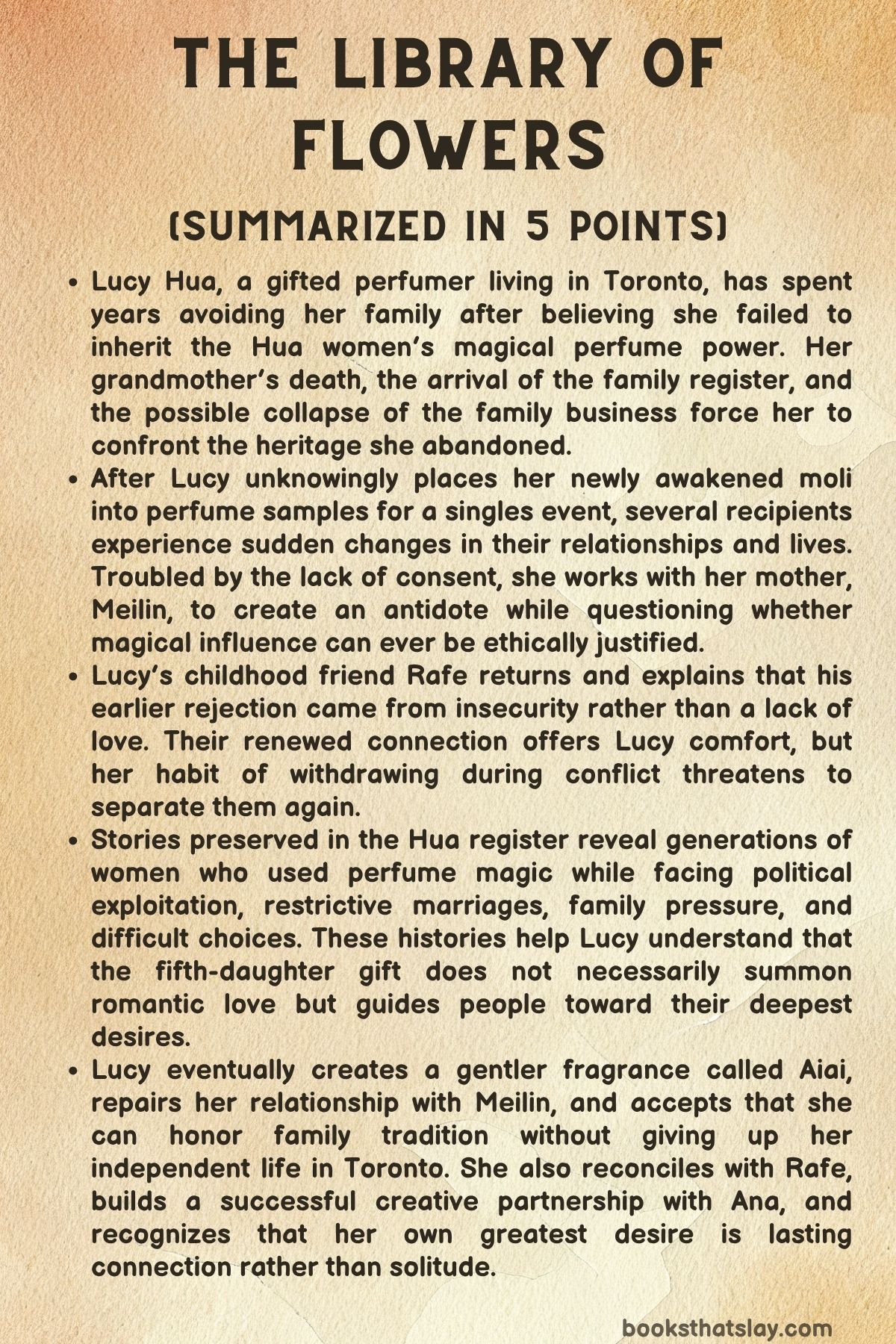
Its central character, Lucy Hua, is a Toronto perfumer who has spent years distancing herself from the magical traditions of the Hua women after believing that she failed to inherit their special power. The death of her grandmother forces her to confront the family history she abandoned, while the return of her childhood friend Rafe challenges the isolation she has mistaken for independence. Through perfume, memory, and generations of women, the novel examines how people discover what they truly desire.
Summary
Lucy Hua, whose Chinese name is Luling, has spent more than a decade moving between Canadian cities and refusing to form lasting attachments. She now lives in Toronto, where she operates Ile de Grasse, a small perfume business located inside Ana’s vintage clothing store.
Lucy presents herself as independent, disciplined, and satisfied with her quiet routines, but her perfectionism hides deep loneliness. Ana’s growing attraction to a nearby bar owner named Jayne makes Lucy remember Rafe Jin, her childhood best friend and first love, whom she has not seen since their painful separation thirteen years earlier.
Lucy’s carefully controlled life changes when a package arrives from Vancouver addressed to Hua Luling. Inside is the Hua family register, an ancient record containing family histories, perfume formulas, magical knowledge, and secrets preserved by generations of eldest daughters.
The register should still be with Lucy’s grandmother, Yulan, so its arrival immediately alarms her. Soon afterward, Lucy’s mother, Meilin, calls to say that Yulan has died, leaving Lucy with an inheritance that represents every obligation she once rejected.
Lucy returns to Vancouver for the funeral and is overwhelmed by guilt. At the reception, she meets Ms. Kang, the first client for whom Lucy created a magical perfume when she was twenty.
The Hua women possess the ability to create moli, fragrances that can influence emotions. Every fifth-generation eldest daughter is expected to possess an especially valuable ability traditionally understood as summoning a person’s true love.
Lucy believed she had inherited that power, but Ms. Kang never found a romantic partner after wearing her perfume. The apparent failure convinced Lucy that she had disappointed her family and destroyed the future they had planned around her gift.
Ms. Kang nevertheless tells Lucy that the perfume accompanied many joyful moments, including the adoption of her daughter and the creation of a successful business. Lucy cannot accept this as proof of success because she still defines true love entirely through romance.
The funeral also reunites her with Rafe. Lucy remembers kissing him when they were twenty, only for him to pull away and say that her family destiny was too large for him.
Rafe had meant that he feared being inadequate and eventually resenting her responsibilities. Lucy understood his words as a rejection of everything she was, and his withdrawal became connected in her mind with the apparent failure of her moli.
Family tensions soon increase Lucy’s guilt. Her brother Eric reveals that their father has lost money through poor investments and that their mother has sold valuable belongings to keep Yixiang, the Hua family perfume shop, operating.
Eric blames Lucy because her true-love fragrances were expected to restore the family fortune. Lucy feels responsible for Yixiang’s possible closure, but the thought of returning permanently to Vancouver terrifies her.
Late at night, Lucy visits Yixiang’s laboratory and remembers training beside Meilin and Yulan. She opens the register and finds a marked passage describing fifth daughters as pillars responsible for the family’s safety and prosperity.
Meilin arrives with a blank register that Yulan prepared for Lucy. She insists that Lucy still possesses her power and accuses her of abandoning her heritage before truly understanding it.
Lucy believes her mother values her usefulness more than her happiness. After a bitter argument, she leaves Vancouver determined to close that part of her life.
The register also contains accounts of earlier Hua women. In 650 CE, Hua Aiai becomes the personal perfumer of Lady Wu, who orders her to create a fragrance that will make Emperor Gaozong love her.
Aiai knows she cannot direct love toward a chosen individual, but admitting uncertainty could place her in danger. Lady Wu declares Aiai dead to her family and takes control of her life, showing how easily powerful people can exploit the Hua gift.
Back in Toronto, Lucy hides both registers in her closet. Ana visits with food and companionship, refusing to let Lucy return from a funeral to an empty apartment.
During their conversation, Ana reveals that she once trained as a talented silversmith but abandoned jewelry making after her romantic and business partner left her. Lucy recognizes that both women have allowed heartbreak to limit their futures.
As a winter storm approaches, Lucy privately attempts to activate her moli again. She feels warmth in her birthmark and becomes exhausted, but fear convinces her that she has imagined the experience.
In frustration, she uses the perfume to fill twenty sample bottles requested by Kelsey for a singles event. She does not consider that the fragrance might actually contain magic.
That night, a blackout brings Rafe to Lucy’s apartment building. He has rented a nearby unit for several months, partly through arrangements made by their mothers, but a failed key and severe weather leave him without shelter.
Lucy reluctantly allows him to stay with her. Over dinner, their old humor and familiarity return, and Rafe finally explains why he rejected her years earlier.
He apologizes and says he never thought Lucy was too much. He feared that he would not be worthy of her future and has regretted allowing insecurity to destroy their friendship.
Lucy admits that pride prevented her from contacting him. They agree to let each other back into their lives slowly, and Rafe’s presence restores a sense of home that Lucy has denied herself.
Lucy begins reading the register and discovers that earlier Hua women also struggled with demanding mothers, restrictive expectations, unhappy marriages, and the conflict between responsibility and personal freedom. Their experiences help her recognize that her pain is part of a much longer family pattern.
At the same time, Kelsey reports unusual romantic success among the people who received Lucy’s samples. Several recipients request wedding and engagement packages, although Lucy does not immediately connect the results with her attempted activation.
A perfume critic named Maryska praises Lucy’s technical ability but says her fragrances lack emotional openness. Meilin disagrees, arguing that Lucy’s work contains intense longing that she tries to conceal beneath control and precision.
Emotionally shaken, Lucy finally tells Rafe the truth about the Hua women. Instead of reacting with fear, he listens carefully and accepts her completely.
Lucy explains that true-love moli is believed to affect both the wearer and the destined person. She also recognizes that this raises serious questions about obsession, consent, and whether magically influenced emotion can still be considered free.
Lucy soon realizes that ten recipients of her twenty samples have reported engagements or weddings. She understands that the supposedly failed fragrance may have contained her moli and returns to Vancouver for Meilin’s help.
Meilin responds with relief rather than criticism. Together they find evidence that some Hua women developed their powers later than expected, confirming that Lucy may never have been defective.
However, the accidental distribution creates a crisis. Lucy has influenced strangers without their knowledge, and neither woman understands how powerful the perfume is or how long its effects might last.
The register’s historical stories reveal similar dangers. Hua Miaoyu once used a sorrow-producing moli in connection with the Taiping Rebellion, contributing to widespread despair and teaching the family that their magic could affect entire communities.
Another ancestor, Hua Pixin, secretly created a ghost scent capable of weakening other moli. Meilin and Lucy reproduce the antidote so the singles-event recipients can be protected.
Lucy insists that Kelsey must be told the truth rather than deceived again. Meilin prefers secrecy, believing it has always protected the family from exploitation, but Lucy argues that correcting one violation through another would be morally unacceptable.
The conflict exposes resentment throughout the Hua household. Kelsey feels humiliated that her husband’s family concealed such an important secret, while Eric admits that he has always felt secondary to the women and excluded from their shared purpose.
Their father, Kevin, dismisses the magic as superstition and refuses to respect Meilin’s work. Lucy begins to understand that the traditions protecting Hua women from outsiders have also damaged trust within their own family.
Meilin follows Lucy to Toronto so they can study her power together. Although living together creates tension, they begin rebuilding their relationship through ordinary perfumery.
Lucy also develops a scented-jewelry collection with Ana called Pulse Points. The partnership allows Ana to return to silversmithing and gives Lucy a way to create meaningful work outside the boundaries of the Hua bloodline.
Meilin’s visit allows Lucy to see her mother differently. She observes Meilin’s creativity, business ability, grief over Yulan, and physical exhaustion after using moli.
Mother and daughter create separate fragrances based on the idea of home, yet both produce interpretations of the Hua family garden at night. Their similar work reveals a shared emotional history beneath years of arguments.
Lucy’s relationship with Rafe also becomes more intimate. He tells her that he trusts her and does not need a magical perfume to identify his true love because he already knows what he wants.
Nevertheless, Lucy continues to interpret concern as pressure. When Meilin assumes that Lucy may return to Vancouver, Lucy believes every kind gesture has been part of a plan to control her future.
Their progress collapses when Lucy discovers that Meilin secretly sold samples of her activated perfumes to three clients. None found romantic partners, and Lucy feels that her mother violated her wishes and used her power for money.
Lucy orders Meilin to leave Toronto. When Rafe refuses to condemn Meilin completely, Lucy accuses him of participating in her mother’s scheme and drives him away as well.
Alone again, Lucy receives an unexpected visit from Ms. Kang and her adopted daughter, Holly. Ms. Kang explains that Lucy’s original perfume did lead her to true love because it brought her the child who became the center of her life.
Lucy finally reads Meilin’s personal section of the register. Instead of criticism, she finds childhood sketches, records of Lucy’s successes, reviews of her work, and evidence that Meilin has quietly followed her life from a distance.
Lucy investigates the recent clients and discovers that the perfumes did work, though not romantically. One client devoted herself to environmental action, another pursued a long-delayed dream in Italy, and another escaped an unhappy marriage.
The singles-event recipients similarly found businesses, education, travel, children, freedom, and companionship. Lucy realizes that fifth-daughter moli does not necessarily summon a romantic partner; it helps people recognize or pursue their deepest desire.
Earlier generations misunderstood the gift because marriage was often the only socially acceptable route to security, status, independence, or family. Lucy’s power had never disappeared, but inherited assumptions prevented anyone from recognizing what it truly did.
Lucy also understands her own deepest desire. Beneath her need for family approval, magical certainty, and professional success lies the simple wish not to remain alone.
After reconciling with Ana and revealing the family secret to her, Lucy creates a new fragrance named Aiai. She dilutes the moli so it helps people recognize their desires without automatically granting them, leaving room for choice and personal action.
Lucy returns to Vancouver and apologizes to Meilin. Meilin explains that she never needed Lucy’s power in order to love her and that the money from the secret tests was intended to help Lucy open her own store.
Meilin also announces that she is divorcing Kevin and reinventing Yixiang. Mother and daughter agree to build separate lives connected through collaboration and affection rather than duty.
Lucy attempts to repair her relationships with Eric and Kelsey, taking responsibility for the accidental perfume without accepting blame for every family grievance. She offers them the diluted Aiai fragrance, but they decline because they already know that preserving their family is what they want.
Lucy then sends Rafe a perfume associated with their shared history as an apology but fails to explain its meaning. He eventually returns to Toronto and meets her in the herb garden outside the store.
Rafe tells Lucy that he has loved her since childhood but cannot build a relationship with someone who disappears whenever conflict becomes painful. Lucy chooses honesty, promises to seek therapy for her avoidance, and accepts that intimacy requires remaining present through discomfort.
She kisses him and agrees to create a future based on trust rather than fear. Surrounded by meaningful work, chosen community, renewed family bonds, and mutual love, Lucy recognizes that she has finally found her own heart’s desire.
Characters
Lucy Hua
Lucy Hua, also known by her Chinese name Luling, is the emotional and narrative center of The Library of Flowers. She is a gifted perfumer whose polished independence conceals fear, shame, loneliness, and an intense desire to belong.
Her belief that she failed to inherit the fifth-daughter moli shapes almost every decision she makes. Instead of risking further disappointment, she abandons Vancouver, limits emotional commitments, and constructs a life in which leaving always remains possible.
Lucy’s perfectionism functions as a form of self-protection. She would rather declare herself incapable than tolerate uncertainty, because an unquestionable failure feels easier to control than hope that might disappoint her again.
Her interpretation of past events is strongly influenced by rejection. Rafe’s withdrawal, Ms. Kang’s apparently unsuccessful perfume, and Meilin’s demanding behavior merge into one painful belief that she is valuable only when she performs perfectly.
Lucy also confuses independence with isolation. She is proud of supporting herself, but her reluctance to celebrate birthdays, form friendships, build a permanent home, or accept help reveals that she has organized her life around emotional escape.
Her growth begins when she allows other people to challenge her version of events. Rafe explains that his youthful rejection came from insecurity, Ms. Kang redefines true love through motherhood, and Meilin’s register entry reveals years of quiet devotion.
Lucy’s understanding of moli reflects her emotional development. At first, she wants the power as proof that she is not defective, but she later treats it as a responsibility that must be governed by consent, restraint, and honesty.
Her final fragrance, Aiai, shows that she has developed a personal philosophy rather than simply accepting tradition. By diluting the power, making it more accessible, and preserving the recipient’s ability to choose, she transforms inheritance into an ethical form suited to her own values.
Lucy’s reconciliation with family does not require surrendering her Toronto life. She learns that belonging can include boundaries, separate homes, professional collaboration, friendship, therapy, and open disagreement.
Her reunion with Rafe becomes meaningful because she no longer treats love as destiny alone. She accepts that a lasting relationship requires communication, accountability, and the courage to remain present after conflict.
Meilin Hua
Meilin is one of the most complicated figures in The Library of Flowers because her love, ambition, fear, grief, and controlling behavior are closely connected. She is both the source of many of Lucy’s wounds and the person whose devotion has been most consistently misunderstood.
As a Hua woman, Meilin has inherited a history in which secrecy protected women from political exploitation, financial dependence, and male control. She therefore treats family knowledge as a collective possession that must be guarded, even when secrecy damages relationships.
Meilin believes strongly in Lucy’s power and refuses to accept her daughter’s conclusion that she is defective. However, her insistence sounds like criticism because she rarely separates encouragement from expectation.
Perfume is Meilin’s primary emotional language. She creates a birthday fragrance for Lucy every year, preserves records of her achievements, remembers her work in the register, and tries to welcome Kelsey through a wedding scent.
Because others do not always recognize this language, Meilin experiences rejection without explaining her hurt. Her resentment toward Kelsey partly develops after Kelsey discards the perfume she created as a sincere gesture of acceptance.
Meilin’s secret testing of Lucy’s moli is a serious ethical violation. Although she believes the experiment is necessary and intends the money to support Lucy, she ignores her daughter’s clearly stated refusal and repeats the pattern of deciding what is best for others.
Her marriage to Kevin reveals the costs of her own compromises. She hoped that love and marriage would lead him to accept her work, but he never respected Yixiang, her moli, or the labor she performed for the household.
Meilin’s visit to Toronto allows her to become more than the severe mother Lucy remembers. She proves to be a talented salesperson, teacher, strategist, artist, and grieving daughter who misses working beside Yulan.
Her decision to divorce Kevin marks an important recovery of self-respect. Rather than continuing to sacrifice her ambitions for a husband who dismisses them, she chooses to rebuild Yixiang according to her own needs.
By the conclusion, Meilin learns that preserving the Hua inheritance does not require controlling Lucy’s location or future. She accepts a relationship based on collaboration, apology, distance, and mutual choice.
Rafe Jin
Rafe is Lucy’s childhood best friend, first love, and eventual romantic partner. His importance lies not only in the romance but also in his ability to remember Lucy as a complete person whose identity existed before shame and isolation transformed her.
His rejection of Lucy’s kiss when they were twenty becomes one of the defining injuries of her life. Rafe believed he was admitting his own inadequacy, but his vague explanation allowed Lucy to believe that her responsibilities made her impossible to love.
As an adult, Rafe takes responsibility for his mistake without demanding immediate forgiveness. He explains that therapy helped him recognize how fear and insecurity caused him to abandon a relationship he deeply valued.
Rafe’s support is compassionate but not passive. He listens when Lucy reveals the Hua secret, accepts the existence of moli, and comforts her without treating her as fragile or attempting to solve every problem.
At the same time, he refuses to confirm all of Lucy’s judgments. He challenges her harsh interpretation of Meilin and identifies her habit of escaping whenever emotional demands become overwhelming.
This honesty creates conflict because Lucy often experiences disagreement as rejection. Rafe’s willingness to risk her anger demonstrates that he seeks a genuine partnership rather than a relationship built on appeasement.
Rafe also treats Lucy’s power as part of her rather than as a threat. His trust contrasts with Eric’s suspicion and Kevin’s dismissal, showing that intimacy with a Hua woman is possible when both people communicate openly.
His final boundary is essential: he loves Lucy, but he cannot accept repeated abandonment. By requiring her to remain engaged during conflict, he helps shift their relationship from nostalgic friendship into mature commitment.
Ana
Ana is Lucy’s business partner, landlord, closest friend, and an important example of chosen family. Her expressive personality, warmth, humor, and openness contrast with Lucy’s controlled and emotionally guarded behavior.
Although Ana appears confident, she has also allowed heartbreak to interrupt her creative life. She abandons silversmithing after being left by a romantic and business partner, much as Lucy abandons moli after her emotional collapse.
Ana’s recovery encourages Lucy to imagine that past pain does not have to determine future work. By creating Pulse Points together, both women return to parts of themselves they once surrendered.
Her care for Lucy is practical and respectful. She brings food after Yulan’s funeral, celebrates Lucy’s birthday, welcomes Meilin, and provides companionship without making Lucy feel weak or pitied.
Ana also demonstrates that trust can exist outside the Hua bloodline. When Lucy tells her about moli, Ana reacts with surprise but neither exploits the secret nor withdraws from the friendship.
Her relationship with Jayne develops through ordinary courage rather than magical assistance. Meilin’s advice encourages Ana to speak honestly, but Ana must still accept the risk of rejection herself.
Ana eventually becomes someone who holds Lucy accountable. She recognizes that Lucy’s unexplained perfume will not substitute for a direct apology to Rafe and pushes her friend toward honest communication.
Yulan
Yulan is Lucy’s grandmother and the character whose death initiates the story’s major events. Although she is absent from the present-day action, her influence remains active through the register, preserved perfumes, family memories, and the blank volume she prepared for Lucy.
Lucy initially remembers Yulan mainly as part of the system of expectation surrounding the fifth daughter. Later discoveries reveal that Yulan preserved Lucy’s childhood perfume exercises and valued her efforts even when Lucy believed she was being judged.
Yulan’s love is expressed through continuity. By sending the register and preparing a new volume, she leaves Lucy both an inheritance and an invitation to enter the family history on her own terms.
Her preference for lemon fragrances connects her to the family’s lost Nanjing home. This detail shows how perfume allows displaced people to preserve sensory connections to places erased by migration and time.
Yulan also acts as a link between Zhengyi, Meilin, and Lucy. Her relationships with older and younger generations demonstrate that the register survives through conversation, teaching, correction, and emotional memory rather than writing alone.
Eric Hua
Eric is Lucy’s brother and one of the clearest examples of the resentment produced by the Hua family’s gendered traditions. Growing up beside women who shared magical knowledge and a defined purpose, he experienced himself as permanently excluded.
His anger toward Lucy is partly financial. He believes her moli was supposed to restore the family fortune, and he uses her apparent failure to redirect attention away from his own involvement in their father’s poor investments.
However, his bitterness cannot be dismissed as simple selfishness. He raises legitimate questions about whether husbands, sons, and brothers can trust family members who conceal the ability to influence emotion.
Eric’s problem is that he expresses these concerns through accusation rather than vulnerability. Instead of admitting that he felt unwanted or unimportant, he attacks the women’s power and portrays himself entirely as their victim.
His strained marriage to Kelsey reflects the effects of inherited secrecy. By withholding the Hua secret, he prevents her from making an informed choice about the family she entered.
Eric’s eventual refusal of Aiai suggests some emotional progress. He and Kelsey recognize that they already know they want to preserve their family, creating an opening for reconciliation through choice rather than magic.
Kelsey
Kelsey is Eric’s wife and a character whose abrasive behavior initially makes her appear superficial and entitled. Her request for free perfume samples at Yulan’s funeral and her interest in profitable gift bags make her seem insensitive to Lucy’s grief and professional labor.
Her anger after learning about moli is nevertheless justified. She discovers that her husband and his family concealed knowledge that could affect trust, marriage, consent, and her professional reputation.
Kelsey’s concern about the accidental samples combines ethics with self-interest. She worries about the recipients but also fears losing business opportunities and damaging her image.
Her argument that advertising and beauty products already influence behavior introduces a useful distinction. Although commercial persuasion can shape choices, moli operates directly on private emotional desire and therefore carries much greater responsibility.
Kelsey’s conflict with Meilin also contains years of mutual misunderstanding. She interprets Meilin’s distance as cultural judgment, while Meilin remembers the discarded wedding perfume as a rejected attempt at welcome.
Kelsey becomes more sympathetic as the novel reveals how thoroughly she has been kept outside the family’s real conversations. Her tentative reconciliation with Eric suggests that honesty may allow them to rebuild what secrecy damaged.
Kevin Hua
Kevin is Lucy and Eric’s father and Meilin’s husband. He represents a form of passive control based less on open aggression than on dismissal, entitlement, avoidance, and the expectation that a wife’s work should remain secondary.
As a young man, Kevin appears attractive because he seems to recognize Meilin as an individual. Yet his early questions about Yixiang’s finances already reveal that he views her calling as a business problem rather than the center of her identity.
Kevin never fully respects moli or attempts to understand the responsibilities Meilin carries. His agreement not to interfere is not genuine support because it leaves her emotionally isolated while allowing him to benefit from her labor.
His financial decisions contribute to the family crisis, but he avoids responsibility and allows tension to fall on Lucy, Eric, and Meilin. At the birthday dinner, he exposes the family secret while dismissing it as superstition, causing damage without accepting accountability.
Kevin expects Meilin to prioritize him, the children, and domestic obligations while treating her dedication to Yixiang as selfish. His demands reveal how unpaid emotional and household labor can be taken for granted within a marriage.
Meilin’s decision to divorce him rejects the belief that endurance is always virtuous. Kevin’s role illustrates how a relationship can become destructive through long-term disrespect even without dramatic acts of cruelty.
Hua Aiai
Hua Aiai is the first magical perfumer in the Hua line and the originator of the family register. Her experiences establish the connection between moli, female creativity, secrecy, political power, and personal danger.
Aiai receives her ability from the Peony Goddess but has little understanding of its rules. Her uncertainty makes her vulnerable when Lady Wu demands a perfume that will secure the emperor’s love.
She survives by withholding information and presenting partial truths. These strategies are morally complicated, but they are necessary in a society where powerful patrons can imprison, exploit, or kill a woman who refuses them.
Aiai’s relationship with Fuqian offers limited freedom rather than complete liberation. She accepts the socially inferior position of concubine because it provides a safer future than remaining under Lady Wu’s control.
Her conditions reveal ambition and courage. She demands the right to continue making perfume, study her gift, and learn to read and write.
By recording her knowledge for her daughter Mingyue, Aiai transforms personal survival into intergenerational protection. She begins a tradition that allows later Hua women to learn from both her discoveries and her mistakes.
Lucy’s decision to name her ethical fragrance Aiai honors this origin while also revising it. The new perfume extends the freedom Aiai sought by helping users recognize desire without surrendering their ability to act voluntarily.
Lady Wu
Lady Wu is an ambitious political figure who seeks to use Aiai’s moli to strengthen her position with Emperor Gaozong. She understands fragrance primarily as an instrument for gaining influence and eliminating rivals.
Her confidence prevents her from questioning whether the emperor is truly her destined love. She assumes that power, desire, and fate must all confirm what she already wants.
Lady Wu’s treatment of Aiai demonstrates why Hua secrecy becomes necessary. By declaring Aiai dead and cutting her off from her family, she attempts to make the perfumer completely dependent on her protection.
She is not merely a personal antagonist but an example of how rulers and elites can appropriate female knowledge. Her presence establishes the historical fear that shapes Meilin’s distrust of outsiders many generations later.
Hua Xiaoting
Hua Xiaoting is a successful Ming-era matriarch whose strengths and flaws reflect the dangers of leadership driven entirely by preservation. She expands the family’s business, serves powerful clients, and accumulates considerable wealth.
When Zheng He warns that accusations of witchcraft and political jealousy threaten the Huas, Xiaoting acts quickly. She evacuates the family, gives their grand residence to the emperor, and moves operations into secrecy.
Her decision saves lives and establishes invisibility as a central Hua principle. However, she does not consult the people whose homes and futures she changes.
Xiaoting’s controlling nature becomes clearer through her relationship with her daughter Yingtai. She believes equal material treatment proves equal love, failing to understand that purpose, attention, and belonging cannot be measured through possessions.
The painting of the separated bird finally helps her recognize Yingtai’s loneliness. This moment reveals that Xiaoting can change, though only after seeing emotional pain represented in a form she cannot dismiss.
Her misinterpretation of Lady Pan’s experience also contributes to the family’s misunderstanding of fifth-daughter moli. She sees the death of an abusive husband as a failed romantic result rather than recognizing that freedom may have been Lady Pan’s deepest desire.
Hua Yingtai
Yingtai is Xiaoting’s younger daughter and a representative of family members who receive material care without receiving an equal sense of significance. She grows up beside Guilan, the moli-bearing elder sister whose role gives her attention, training, and a defined place in family history.
Yingtai’s anger exposes the emotional cost of organizing an entire household around one gifted daughter. She does not claim that Guilan should lose her position; she wants recognition that younger daughters also need purpose and belonging.
Her painting communicates what direct argument cannot. The image of one small bird separated from two larger birds forces Xiaoting to confront the loneliness her practical reasoning has ignored.
Yingtai’s experience parallels Eric’s in the present day. Both characters show that traditions created to empower selected women can unintentionally marginalize relatives who are treated as supporting figures rather than full participants.
Hua Zhengyi
Hua Zhengyi is a reformer who connects personal autonomy with the survival of the family business. In 1899, she challenges her mother’s arranged-marriage plans and demands the right to choose a husband who will respect her work.
She understands that secrecy and aristocratic prestige are no longer sufficient in a rapidly changing society. Her proposal to establish Yixiang as a public perfume house gives the family a legitimate income while concealing the private moli trade.
Zhengyi uses her importance as a fifth daughter to negotiate greater freedom. Her actions demonstrate how women can work within restrictive systems while also changing the rules inherited from earlier generations.
Her later account of Jun and Hao complicates romantic ideals. Jun inspires passion but proves greedy, while Hao offers respect, practical support, and a partnership that gradually becomes loving.
Zhengyi’s choices reflect the limited options available to women who could not independently access basic financial and legal resources. She values safety not because she lacks emotion but because security determines whether future generations can survive.
Her unfinished register entry also shows that family archives are incomplete. Exhaustion, shame, timing, and death can leave important experiences unrecorded, requiring descendants to interpret silences as carefully as written evidence.
Ms. Kang
Ms. Kang is essential to Lucy’s understanding of both her past and her power. Lucy spends years treating her as proof that the first moli failed because Ms. Kang did not find a romantic partner.
Ms. Kang never considers the perfume worthless. She associates it with joyful milestones, business success, and the adoption of her daughter Holly.
Her return allows Lucy to see that true love can take the form of parenthood. Ms. Kang’s experience becomes the key that unlocks the real meaning of the fifth-daughter gift.
She also demonstrates the danger of evaluating other people’s lives according to narrow expectations. Lucy assumed she knew what result the perfume should produce and therefore overlooked the love that was already visible.
Holly
Holly is Ms. Kang’s adopted daughter and the living evidence of Lucy’s first successful moli. Although she has a smaller role, her presence transforms Lucy’s understanding of failure.
Lucy helps Holly choose a fragrance that expresses her identity rather than forcing her into an expected category. This interaction confirms Lucy’s emerging belief that perfume should support self-recognition rather than social conformity.
Holly’s relationship with Ms. Kang also broadens the novel’s definition of family. Their bond shows that love and belonging can be created through choice rather than biology or tradition.
Jayne
Jayne is the owner of a nearby bar and Ana’s eventual partner. Her relationship with Ana develops without moli, emphasizing the value of honesty, risk, and ordinary emotional courage.
Jayne’s uncertainty about fragrance reveals how social pressure can shape self-presentation. She once avoided woody and herbal scents she genuinely liked because she feared they would make her appear too visibly queer.
Lucy helps her choose a fragrance that feels authentic rather than protective. This moment supports the idea that scent can help individuals claim an identity they were previously encouraged to hide.
Jayne also contributes to the commercial future of Ile de Grasse by considering a signature fragrance for her bar. Her presence connects Lucy and Ana’s creative work with the wider Toronto community they are building.
Themes
Inheritance, Duty, and Personal Autonomy
The Hua inheritance provides Lucy with extraordinary artistic knowledge, cultural continuity, and a place within generations of accomplished women. At the same time, it places a predetermined identity upon her before she is old enough to decide what kind of life she wants.
In The Library of Flowers, inheritance is neither an uncomplicated gift nor a burden that must be rejected completely. Its value depends on whether the next generation can question, revise, and voluntarily accept what has been passed down.
Lucy initially believes she has only two choices: return to Vancouver and submit to family expectations, or remain independent by abandoning the Hua tradition. This rigid understanding mirrors the perfectionism that governs the rest of her life.
The register gradually reveals that earlier Hua women also negotiated between obligation and freedom. Aiai accepts an imperfect escape, Zhengyi modernizes the business while bargaining for marriage rights, and Xiaoting protects the family through decisions that also control them.
Meilin represents the consequences of treating survival strategies as permanent rules. Her insistence on secrecy and collective responsibility comes from historical danger, but she fails to recognize when protection becomes intrusion.
Lucy’s final position is based on adaptation rather than obedience or rejection. She writes her own register chapter, develops an ethical version of moli, remains in Toronto, and collaborates with Yixiang without surrendering her business.
The novel therefore presents tradition as a continuing conversation. Genuine inheritance requires enough respect to preserve knowledge and enough independence to correct the beliefs, exclusions, and harmful practices that previous generations accepted.
Love, Desire, and Consent
The misunderstanding surrounding fifth-daughter moli reflects society’s tendency to define true love almost entirely through romance. For generations, Hua women assume that their gift exists to produce marriages, even when the actual results point toward freedom, parenthood, purpose, creativity, or self-respect.
This confusion is historically understandable. In many periods represented by the register, marriage provided women with financial security, social status, protection, children, and a recognized household.
Because several desires could only be pursued through marriage, clients and perfumers mistook the socially available route for the desire itself. Lucy recognizes the difference only after Ms. Kang identifies Holly as the love the perfume brought into her life.
The accidental samples introduce the ethical problem of influencing desire without consent. Even when the outcome benefits the wearer, Lucy understands that secretly altering another person’s emotional life violates personal autonomy.
Meilin’s willingness to test the perfume reflects an older belief that family survival can justify secrecy. Lucy rejects that reasoning because using people as evidence reduces them to instruments rather than respecting them as individuals.
Aiai provides a more responsible model by weakening the perfume. It does not overpower the wearer or guarantee fulfillment; it offers recognition and leaves the person responsible for deciding how to act.
Lucy and Rafe’s relationship reinforces this distinction. Their love succeeds not because magic brings them together but because they choose honesty, apology, therapy, boundaries, and continued effort.
The book ultimately separates love from possession. Real love does not remove uncertainty or control another person’s response; it creates enough trust for both individuals to remain free.
Scent, Memory, and Identity
Perfume functions as an emotional archive throughout the story. A fragrance can preserve a childhood room, a lost garden, a family member, a private longing, or a version of the self that has been hidden for years.
Lucy’s technical skill allows her to reproduce beautiful combinations, but emotional fear initially keeps her work controlled and distant. Maryska’s criticism identifies the gap between polished craftsmanship and honest expression.
Meilin communicates feelings through scent more easily than through conversation. Her annual birthday perfumes record Lucy’s development, while the apparently empty thirty-third bottle reflects the uncertainty surrounding a daughter whose future Meilin can no longer define.
Yulan’s attachment to lemon preserves the memory of the family’s lost Nanjing home. The scent carries geography and history across migration, allowing a vanished place to remain present in the body.
The register creates a written archive, but perfume preserves experiences that language cannot fully capture. When Lucy and Meilin independently interpret home as the Hua garden at night, they discover a shared emotional memory deeper than their disagreements.
Personalized fragrances also help Ana, Jayne, Holly, and other customers express themselves. Lucy’s mature work does not tell them who they should be; it gives form to feelings and identities they already possess.
The creation of Pulse Points extends this principle by joining scent with jewelry worn on the body. Memory, creativity, and identity become portable rather than confined to a family vault.
Perfume therefore acts as both art and communication. It becomes most meaningful when it reveals experience without replacing the honest conversations required to understand it.
Secrecy, Protection, and Trust
Secrecy begins as a necessary defense for Hua women living in societies where powerful people could imprison, exploit, accuse, or destroy them. Aiai’s captivity under Lady Wu and the political danger faced by Xiaoting demonstrate that public knowledge of moli could threaten the entire family.
Over time, however, protective secrecy becomes an unquestioned habit. The Hua women continue hiding information even from husbands, sons, and daughters-in-law who are expected to support the family without understanding its central reality.
Eric and Kelsey’s anger shows the relational cost of exclusion. Their reactions may sometimes be harsh, but their distrust grows from being denied information that directly affects marriage, consent, finances, and family responsibility.
Meilin’s marriage demonstrates that concealment cannot create genuine acceptance. She tells Kevin only after they are married, hoping love will make him supportive, but he never develops respect for her work or inheritance.
The ghost-scent crisis forces Lucy to consider whether secrecy remains ethical when it requires further manipulation. She insists that Kelsey must know the truth because consent cannot be restored through another deception.
Lucy’s disclosure to Rafe and Ana offers a different possibility. Both outsiders receive the secret without attempting to control, expose, or profit from it, proving that trust can be extended beyond blood relations.
The novel does not argue that every secret must become public. Moli still carries real dangers, and complete openness could expose the family to exploitation.
Instead, it distinguishes careful privacy from dishonest exclusion. Protection becomes harmful when it denies trusted people the knowledge needed to participate freely in relationships that directly affect their lives.