Leather and Lark Summary, Characters and Themes
Leather & Lark by Brynne Weaver is a dark romance with crime, revenge, and sharp humor at its core. As the second novel in The Ruinous Love Trilogy, it follows two dangerous people who are forced into close proximity and slowly become each other’s safest place.
Lark is clever, musical, and ruthless toward men who prey on the vulnerable. Lachlan is a weary contract killer who wants out of the life that owns him. Their marriage begins as a strategic move, but the connection between them grows into something real. The book balances violence, family loyalty, trauma, and desire while building a love story between two deeply damaged people.
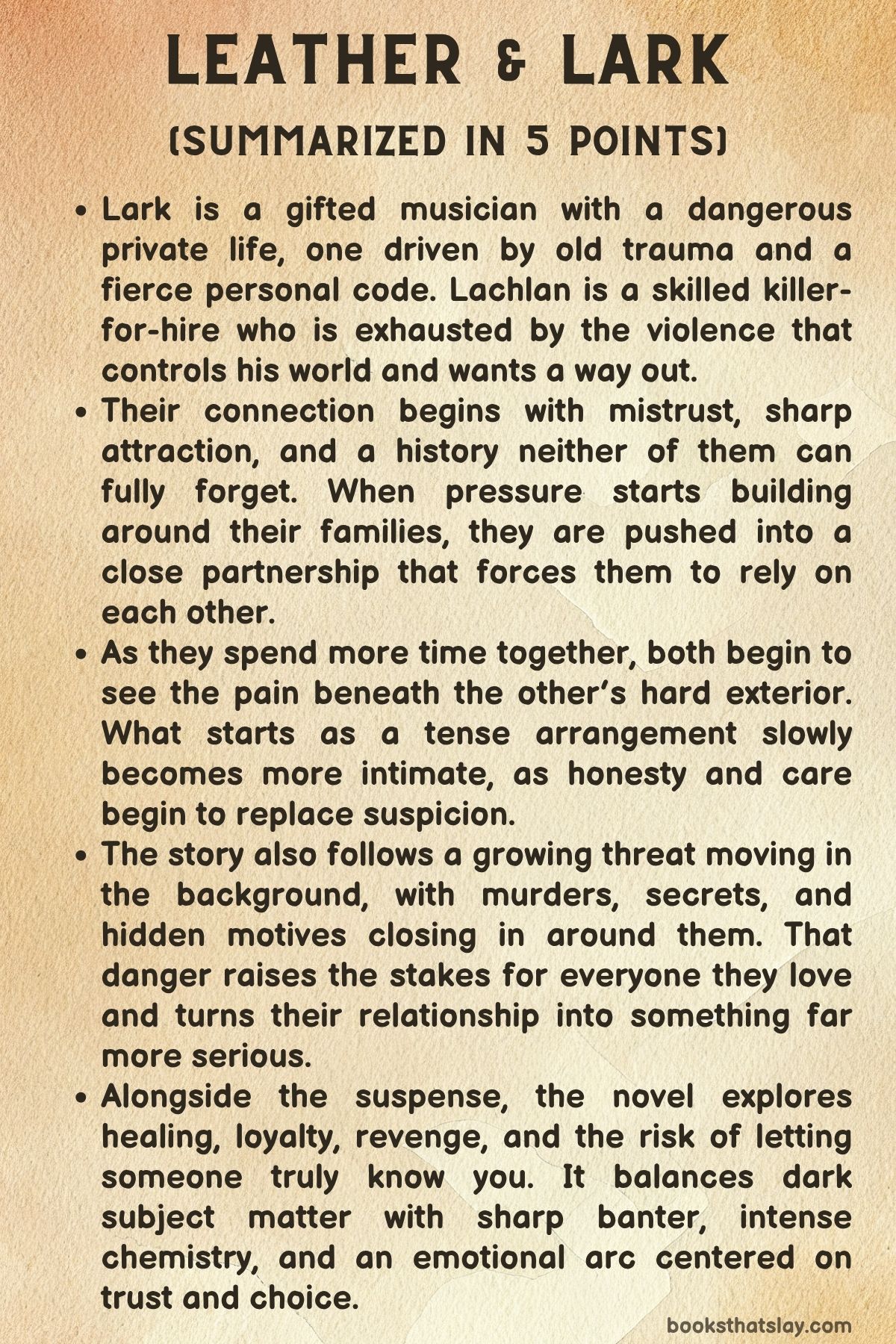
Summary
Lark lives a double life. To the people around her, she is talented, charming, and deeply protective of the ones she loves.
In secret, she tracks down predatory men and kills them. Her victims are not random.
They are men who abuse children or exploit the vulnerable, and Lark sees herself as someone carrying out justice that the world failed to deliver. Her methods are brutal and theatrical, shaped by rage, control, and old wounds she has never fully escaped.
A year earlier, one of her attempts to dispose of a victim went wrong. After forcing a man’s car into a reservoir, she called for help and was sent a cleaner to remove the evidence.
That cleaner was Lachlan Kane. Instead of treating her with care, he handled the situation coldly and forced her into the trunk of his car.
Because Lark carries severe trauma linked to dark, enclosed spaces, the experience left a lasting scar. Their first meeting became a source of resentment for her and guilt for him, though neither forgot the other.
Lachlan’s own life is bleak. He works for Leander, a violent employer who uses him for torture and murder.
Lachlan is exhausted by the work and wants freedom, but he is trapped by old mistakes and by the danger that leaving would bring to his brothers. He keeps going out of duty and survival, even as the job erodes whatever peace he might have had.
When he sees Lark again at a family gathering connected to his brother Rowan and her best friend Sloane, he is stunned by how strongly he is drawn to her. They share an immediate spark, but it quickly turns into a furious confrontation when Lark realizes who he is.
Time passes, and a fresh threat begins to form around both of their families. Several associates connected to Lark’s parents are murdered, and suspicion starts to circle around Lachlan.
Lark learns that her parents are discussing whether Lachlan and even Rowan may need to be eliminated. Her great-aunt Ethel, who understands more than she says, nudges Lark toward a solution.
Lark approaches Lachlan with a bargain: if she can secure powerful contracts for his boss, he may finally be allowed to retire. In exchange, he must help her investigate the killings.
To protect him from her family in the meantime, she proposes something even more extreme. They need to marry.
The marriage is not born from romance, at least not outwardly. It is a shield, a political move, and a desperate attempt to keep everyone alive.
Even so, the ceremony carries real emotional weight. Lark understands that by marrying Lachlan she is giving up more than her freedom.
She is also stepping away from the emotional loyalties that have defined her for years. Lachlan, meanwhile, kisses her with a level of need that reveals how much this arrangement already matters to him.
Their early days as husband and wife are tense, awkward, and charged. They need to convince both families that the marriage is real.
At the same time, they are studying one another, trying to decide what can be trusted. Lachlan begins to see that Lark’s bright, funny exterior hides profound exhaustion and pain.
When they become trapped in an elevator, he witnesses the full force of her panic and finally understands the damage he caused the night he locked her in a trunk. He is horrified by his own past behavior and starts trying, quietly and persistently, to care for her.
Lark does not make it easy. She assumes Lachlan sees her as monstrous, and in some ways she wants him to.
When he discovers the trophies she keeps from her victims, she admits what she is without flinching. Rather than deny it, she tells him the truth: she has killed many men.
Yet the confession is also a test. She expects disgust, rejection, or fear.
Instead, Lachlan stays. He may be shocked, but he is more interested in understanding her than condemning her.
As they continue to investigate the murders around the Montagues and Covacis, their private bond deepens. Lark meets Leander and negotiates for Lachlan’s future, showing both nerve and intelligence.
Ethel remains a strong influence, guiding events in sly, calculated ways even as her health declines. Lark also reveals more of her history.
When she was young, her father was killed during a violent home invasion, and she and her sister were hidden in a closet. That night left permanent damage.
Later, as a schoolgirl, she suffered abuse at the hands of a teacher while authority figures protected him. These experiences explain not only her claustrophobia, but also the fury that drives her to punish predators.
Lachlan does more than listen. He acts.
Once he learns the role played by the school’s headmaster in shielding abuse, he helps Lark confront him. Together, they abduct the man, force him to face what he enabled, and kill him.
For Lark, this is not just another act of revenge. It is a moment of being seen and supported in one of the deepest injuries of her life.
Afterward, when she struggles to sleep, she calls Lachlan and asks him to read to her until she drifts off. He stays on the line even after she falls asleep.
It is a small act, but it marks a turning point. Their relationship is no longer only strategic.
It is becoming intimate in a way neither expected.
Outside their apartment, danger is still moving. A man calling himself Abe Midus enters their orbit.
Lachlan senses that something is wrong with him almost immediately. Abe is too interested, too watchful, and too familiar with details he should not know.
The truth is that he is tied to the violence of the past and is hunting those connected to the death of his brother. He has been stalking them, studying them, and planning a revenge that will wound as many people as possible.
Before that final confrontation arrives, Lark and Lachlan cross another threshold. She forgives him fully for the harm he caused in the past, and she tells him through her music.
He has made her gifts, cared for her body and mind, and shown restraint when she needed safety more than passion. When they finally come together physically, it happens after trust has been rebuilt rather than before.
Their intimacy is intense, playful, and deeply chosen. For both of them, desire is no longer separate from tenderness.
Then everything shatters at once. Ethel is murdered.
Lark is abducted from her apartment by Abe, who also harms her dog and leaves behind evidence of his obsession. Lachlan races to find her, piecing together Abe’s identity and motive with help from Rose and others.
They discover that Abe has been watching from across the street and building toward a final spectacle. He traps Lark inside an industrial oven and forces Lachlan into an impossible choice, claiming that Rowan’s life is also at risk through a bomb planted elsewhere.
Lark, even while facing death, tells Lachlan to save Rowan. Lachlan refuses the logic of that choice.
He fights to get to her, and with Rose’s help he breaks the oven open before it can kill her. Abe is shot dead, and Rowan and Sloane escape the other threat.
In the aftermath, Lachlan is furious not at Lark, but at the idea that she would ever ask him not to choose her. He makes it clear that she is not expendable.
With the enemy dead, loose ends begin to close. Lark signs the contract that secures Lachlan’s retirement from Leander.
They even drug Leander one last time to smooth their exit. Back home, Lachlan gives Lark a birthday surprise.
He returns her hidden trophies, preserves one of her most personal acts of vengeance as a gift, and then offers her a real choice about their future. Alongside honeymoon plans, he also presents divorce papers, making it clear that he will release her if that is what she wants.
Lark rejects the divorce completely. She tears the papers apart and tells him she chooses him.
What began as a marriage of necessity becomes a real declaration of love. Lachlan proposes again, this time not for survival, but for a future they both want.
She accepts, and the story closes with them committed to each other at last, their bond forged through violence, honesty, grief, and hard-won trust.
Characters
Lark
Lark is the emotional and moral center of Leather & Lark, even though she is written to unsettle the reader as much as to invite sympathy. She is introduced as someone who hunts sexual predators and kills them with a level of planning that shows intelligence, patience, and a frightening commitment to control.
On the surface, that makes her seem cold and merciless, but her violence grows from damage that began long before the events of the novel. Her actions are shaped by trauma, grief, and the belief that institutions fail the vulnerable.
She does not see herself as chaotic or evil. She sees herself as corrective force, someone stepping in where justice has collapsed.
What makes Lark especially compelling is the contrast between her brutality and her tenderness. She is deeply nurturing toward the people she loves.
She notices the moods of others, supports them emotionally, and often puts their needs ahead of her own. This duality defines her.
She can murder without hesitation, yet still be the person who comforts a friend, worries about family, and writes music that expresses the emotions she struggles to speak aloud. The novel uses this contradiction to show that she cannot be reduced to one label.
She is not simply a vigilante, a victim, or a love interest. She is all of these things at once.
Her trauma is central to understanding her. Her fear of darkness and enclosed spaces is not a minor quirk but a wound rooted in the violent death of her father and the terror she experienced as a child.
That trauma later deepens through abuse and betrayal at school, where adults who should have protected her instead protected a predator. Because of this history, Lark builds her life around control.
She controls her targets, her surroundings, her secrets, and her image. Even her killings often carry an artistic or symbolic quality, as though she is reclaiming power by deciding exactly how the guilty will be punished.
Her trophies reveal that she does not merely eliminate threats; she archives justice in physical form, turning memory into object.
At the same time, Lark is emotionally lonely. She gives affection freely, but trust comes much harder.
She expects judgment and often assumes that people see the worst in her. This insecurity is especially visible in her relationship with Lachlan.
Even when he begins caring for her with consistency and patience, she continues to anticipate betrayal, rejection, or disgust. Her emotional arc is not about becoming softer.
It is about allowing herself to be known without immediately bracing for punishment. That movement from guarded self-sufficiency to chosen vulnerability becomes one of the strongest parts of her characterization.
Lark is also shaped by family loyalty, though that loyalty is complicated. She loves deeply, but her family structure is full of secrecy, power games, and emotional pressure.
She has affection for her mother, stepfather, sister, and especially Aunt Ethel, yet she is never fully free inside that world. Her decision to marry Lachlan and even change her name becomes more than a tactical act.
It is a painful break with the identity she has guarded for years. In this sense, she is a character who is always negotiating between inheritance and self-definition.
Her love story works because it does not erase her darkness. She does not become good in a conventional sense.
Instead, she finds someone who understands that her violence is tied to pain, conviction, and a fierce instinct to protect. By the end, Lark remains dangerous, but she is no longer isolated.
That is her deepest transformation.
Lachlan Kane
Lachlan begins the novel as a man defined by exhaustion. He is competent, disciplined, and dangerous, but also emotionally hollowed out by the life he leads.
Working for Leander has turned him into an instrument of violence, and he moves through that role with grim efficiency rather than pleasure. Unlike Lark, who uses violence according to her own moral code, Lachlan has spent years carrying out the orders of others.
That difference matters. His character is marked by trapped masculinity, duty, and the slow death of agency.
He wants out, but his loyalty to his brothers and the weight of past mistakes keep him in place.
One of the strongest aspects of his characterization is the contrast between his external hardness and his internal sensitivity. He is capable of torture and murder, yet he notices emotional detail with unusual care.
He sees the way Lark brightens rooms, the way she hides her fatigue, and the ways she masks pain behind humor and composure. His attraction to her is immediate, but what makes him more than a typical dangerous romantic lead is that desire alone does not define his attachment.
He becomes attentive to her fear, her routines, and her hidden fractures. His feelings deepen through observation and remorse as much as through attraction.
Guilt is one of Lachlan’s defining features. His decision to force Lark into a trunk during their first encounter becomes a moral wound that lingers long after the event.
Once he understands the severity of her trauma, he does not defend himself or ask for quick absolution. Instead, he tries to earn forgiveness through action.
That choice reveals a lot about him. He is not emotionally articulate at first, but he is serious.
He takes responsibility in the only way he fully knows how: by showing up, by paying attention, by trying to become safer than he once was.
Lachlan’s craftsmanship also adds important texture to his character. His work with leather reflects a side of him that creates rather than destroys.
This matters symbolically. He is not only a killer; he is a maker, someone who understands material, touch, patience, and form.
His gifts to Lark, especially those that blend sensuality with care, show how deeply love changes the way he uses his skills. What once might have belonged only to labor or survival becomes a language of intimacy.
His relationship to family is equally important. He is deeply bound to his brothers, and much of his endurance comes from wanting to protect them.
This makes him both admirable and tragic, because his loyalty is one of the reasons he remains under Leander’s control for so long. He is willing to absorb degradation and danger if it means keeping his family safe.
That self-sacrificing instinct later extends to Lark, but with her it evolves into something more mutual. She does not simply become another person for him to protect.
She becomes someone who also protects him, strategizes for him, and ultimately chooses him. That reciprocity allows him to imagine a future beyond obligation.
As a romantic figure, Lachlan stands out because restraint is one of his most meaningful qualities. He wants Lark intensely, but he refuses to use intimacy as a shortcut to forgiveness.
He wants their relationship to be real, not merely explosive. That patience gives moral depth to his desire.
He is not trying to possess her before he deserves her trust. By the end, he has moved from being a man trapped in someone else’s system to a man actively building a life of his own.
His arc is about recovering dignity through love, accountability, and choice.
Aunt Ethel
Ethel is one of the most memorable supporting characters because she brings wit, cunning, and emotional force into nearly every scene she occupies. She functions as a strategist, a family elder, and a quiet architect of the romance.
She understands far more than she says directly, and she often guides others by arranging circumstances instead of delivering simple advice. This makes her presence feel commanding without needing physical power.
Even in declining health, she remains one of the strongest personalities in the story.
What makes Ethel remarkable is that she combines warmth with calculation. She clearly loves Lark, but she is not sentimental in a soft or passive way.
Her care takes the form of intervention, manipulation, and bold honesty. She engineers opportunities, protects what she can, and often sees emotional truths before anyone else is ready to name them.
Her role in pushing Lark toward happiness is especially significant because she does not treat love as separate from survival. In her mind, emotional fulfillment and strategic protection can be part of the same plan.
Ethel also represents a kind of unapologetic female authority. She is not intimidated by violent men, by family politics, or even by death.
Her humor sharpens this effect. She remains irreverent in situations where others might collapse into fear, and that irreverence becomes a form of power.
Even during her murder, she refuses to give her killer the repentance or terror he seeks. Instead, she meets him with defiance, mockery, and a refusal to surrender her sense of self.
That scene crystallizes her character: she cannot be spiritually conquered, even when physically vulnerable.
Her bond with Lark is especially important because it provides a model of love that is fierce rather than fragile. She sees Lark clearly, including the darker parts of her nature, and does not recoil.
In a novel filled with secrecy and moral compromise, Ethel’s acceptance carries enormous weight. She is one of the few people who seems to understand that Lark does not need reform nearly as much as she needs recognition, protection, and the freedom to choose her own life.
Her death leaves a deep emotional gap because she is not just a relative. She is a guardian of identity, memory, and possibility.
The Phantom / Abe Mead
Abe Mead, operating under an assumed identity, is the novel’s central external threat and a strong example of how obsession can become theatrical, ideological, and deeply personal. He is not simply a killer pursuing revenge.
He is someone who has built a spiritual framework around violence, convincing himself that he is carrying out judgment. That self-justifying religious language makes him especially disturbing because it allows him to treat cruelty as righteousness.
He does not see himself as monstrous. He sees himself as chosen.
His role in the story works because he is patient and invasive. He watches, studies, and inserts himself into the lives of his targets before striking.
This makes him feel less like a random threat and more like a contaminating presence. He is fascinated not only by killing, but by emotional devastation.
He wants people to suffer in ways that extend beyond death. His plan is designed to force impossible choices, spread blame, and poison relationships.
That impulse reveals a sadistic intelligence focused as much on psychological destruction as on physical harm.
He also serves as a dark mirror to the protagonists. Like Lark, he kills with purpose rather than impulse.
Like Lachlan, he understands planning and intimidation. But where they are shaped by damaged attempts at protection or loyalty, he is shaped by grievance elevated into sacred mission.
He strips empathy away from justice and leaves only punishment. The novel uses him to show what happens when pain curdles into self-righteous annihilation rather than love, accountability, or mutual care.
His fixation on symbols and spectacle also matters. The oven trap, his surveillance, his use of aliases, and the staged moral choices all reveal a man who wants control over narrative, not just outcome.
He wants to direct the emotional meaning of events. That is why he is such an effective antagonist.
He is not merely trying to win. He is trying to author the suffering of others.
His defeat, then, is not only physical. It is the collapse of his claim to mastery.
Sloane
Sloane is not at the center of this particular novel, but she remains one of its emotional anchors. Her friendship with Lark is built on loyalty, understanding, and a kind of hard-earned honesty that allows for very little illusion.
She knows who Lark is, or at least enough to grasp the danger and intensity that define her, and she still loves her fully. That acceptance is crucial because it gives Lark one of the only relationships in which she is not constantly performing a safer version of herself.
Sloane’s strength lies in her clarity. She does not romanticize violence, but she is also not naive about what the people around her are capable of.
She recognizes patterns quickly, especially where Lark’s revenge habits are concerned, and she understands emotional stakes with unusual speed. Her responses often balance affection with bluntness, which makes her feel believable as a close friend rather than a passive supporter.
She can comfort and challenge at the same time.
Her importance also comes from continuity. Because of her relationship with Rowan and her history with Lark, she connects the worlds of the main couple and helps make their marriage feel consequential within a wider emotional network.
She is one of the people whose opinion matters deeply to Lark, which is why her continued love and acceptance carry so much force. Sloane is a reminder that intimacy is not limited to romance.
Friendship, too, can be a site of survival.
Rowan Kane
Rowan functions as both emotional support and narrative bridge. He is important not because he dominates the page, but because his relationship with Sloane and his bond with Lachlan create the larger family framework in which this story unfolds.
He represents the possibility of a different kind of life for Lachlan, one where love, domesticity, and emotional openness are real rather than abstract. When Lachlan sees Rowan’s happiness, he is forced to confront the emptiness of his own existence.
Rowan’s presence also strengthens Lachlan’s characterization. The fear that Rowan might be hurt gives real urgency to the marriage arrangement and later to the antagonist’s threats.
Lachlan’s protectiveness toward him is not theoretical; it shapes major decisions. Rowan thus serves as one of the clearest expressions of why Lachlan has endured so much.
He is not merely clinging to survival. He is trying to preserve the people who give his life meaning.
As a secondary character, Rowan also helps normalize tenderness among dangerous men. His emotional openness, especially in contrast to Lachlan’s reserve, creates a useful balance.
He reminds the reader that vulnerability is possible in this world, even if it does not come easily to everyone.
Fionn Kane
Fionn occupies an interesting position because he is both a source of emotional friction and a sign of family devotion. He appears within the brotherly network as someone whose choices and romantic history have had ripple effects, including misunderstandings between Lark and Lachlan.
Yet he is never reduced to a plot device. He remains part of the emotional web that shows how closely these characters’ lives are tied together.
One of Fionn’s most important functions is in the later crisis, where his practical care and emotional urgency help reveal the depth of his connections. His role in trying to save Bentley and his response to Rose show that beneath any awkwardness or past confusion, he is capable of immediate and real devotion.
The epilogue especially uses him to create emotional suspense and tenderness, suggesting that even characters at the edge of the main love story carry deep feeling.
He also contributes to the texture of the Kane family dynamic. Through him, the novel shows that brothers can be messy, imperfect, and still profoundly loyal.
That atmosphere matters because it makes Lachlan’s attachment to family feel grounded rather than abstract.
Rose
Rose adds emotional delicacy to a novel otherwise dominated by violence, tension, and dark humor. She is associated with movement, performance, and departure, which makes her presence feel transient even before the ending gives that quality tragic force.
Her friendship with Lark carries visible affection, but it is also marked by the pain of separation and unresolved feeling, especially because Lark resents the circumstances that drew Rose away.
Rose becomes especially significant in the final stretch of the story. She does not remain on the sidelines while others act.
She insists on helping search for Lark and proves brave under pressure. This choice gives her moral weight.
She is not just someone to be protected or remembered fondly. She is someone willing to enter danger for people she loves.
Her final scene is quietly devastating because it is written through absence of recognition. While the reunited lovers hold onto each other and the immediate crisis seems to resolve, Rose is the one fading in the background.
That contrast gives her ending a tragic softness. She becomes the emotional aftershock of victory, a reminder that survival in this world often comes with collateral loss.
Leander
Leander is a powerful secondary figure because he represents institutionalized violence. He is not chaos; he is structure.
He runs brutality like a business, treating torture and murder as services governed by hierarchy, reputation, and debt. This makes him more disturbing than a random criminal because he embodies the system that has trapped Lachlan for years.
His control is sustained not simply by force, but by making people believe there is no clean exit.
His relationship with Lachlan is based on possession. He values Lachlan’s usefulness and refuses to release him because usefulness, in his world, creates entitlement.
At the same time, Leander is not written as omnipotent. He can be manipulated, stalled, and drugged.
His arrogance is one of his weaknesses. He underestimates the intelligence and boldness of others, particularly Lark, and this helps make possible the eventual break from his control.
Leander also adds a darkly comic tone at times, especially in scenes where grotesque violence and casual conversation coexist. That tonal quality makes him feel even more unsettling.
He can be absurd and terrifying in the same moment. His presence reinforces the novel’s interest in people who normalize the unnatural.
Nina Covaci
Nina is one of the more emotionally complicated parental figures in the story. She is protective, powerful, and clearly enmeshed in a world where violence is part of ordinary decision-making.
Her reactions to Lark’s marriage show both suspicion and hurt. She is not presented as a simple villainous mother.
Instead, she is someone shaped by a brutal environment, trying to think strategically even when those calculations strain or wound her bond with her daughter.
What stands out about Nina is that love and threat exist very close together in her characterization. She belongs to a family structure capable of discussing elimination as though it were logistics, yet the emotional pain caused by Lark’s choices is real.
This duality keeps her from becoming flat. She is controlling and dangerous, but also visibly vulnerable to rejection.
That tension helps explain why Lark’s acts of independence cut so deeply.
Nina matters less as an individual arc and more as part of the atmosphere Lark is trying to escape and still cannot completely stop loving. Through her, the novel shows how family can be both shelter and pressure system.
Damian Covaci
Damian carries a similar complexity. As Lark’s stepfather, he belongs to the violent machinery surrounding her life, but he is not emotionally detached from her choices.
His disappointment at being excluded from her wedding reveals genuine hurt, which makes him more than just an enforcer or patriarchal threat. He is someone who cares, but whose care is expressed inside a framework of power, control, and transactional thinking.
His significance lies in how he sharpens the stakes of Lark’s marriage. She is not only taking a husband.
She is shifting allegiance in a world where names, loyalties, and symbols carry serious consequences. Damian’s troubled acceptance of the marriage reflects that.
He sees both the personal wound and the strategic meaning of what she has done.
Like Nina, he helps show why Lark’s emotional life is so fraught. Love in her family never arrives without implication.
Approval, disappointment, and danger are never cleanly separated.
Ava
Ava is a smaller but useful character because she reflects a more immediate, personal side of the family response to Lark. Her surprise and emotional openness help contrast with the more controlled reactions of the older generation.
Through Ava, the novel shows that Lark’s decisions ripple through intimate family ties, not just political arrangements.
She helps humanize the household scenes. In a story full of killers, strategists, and secrets, Ava’s reactions keep family moments from becoming too abstract or schematic.
She is part of the emotional reality that reminds the reader these characters do not only operate as players in violent schemes. They are also siblings, daughters, and relatives capable of shocking one another in ordinary ways.
Conor
Conor serves as a practical support figure, but he is more than a faceless helper. He represents competence without theatricality.
He moves bodies, gathers information, drives when needed, and becomes essential in several operations. In a novel where many characters are emotionally volatile or morally flamboyant, Conor’s steadiness is useful.
His value is partly structural. He helps keep the plot moving by making dangerous plans workable.
But he also contributes to characterization, especially for Lachlan. The fact that Lachlan trusts him indicates that even within criminal systems, there are tiers of loyalty and reliability.
Conor helps create the sense that this world runs on relationships as much as force.
Bentley
Bentley, Lark’s dog, might seem minor compared with the human cast, but emotionally he matters a great deal. He represents uncomplicated attachment in a story where nearly every human bond is burdened by secrets, violence, or strategic pressure.
Lark’s care for him reveals a softer and more domestic side of her life, grounding her in everyday routines that contrast with her killings.
His injury during the abduction scene raises the emotional stakes sharply because harm to an animal often cuts through defenses that readers might maintain during human-on-human violence. Bentley is part of what makes Lark’s apartment feel like a real home rather than simply a hiding place for secrets.
His presence underscores what is at risk when that home is violated.
Andrew, Jamie, Patrick O’Neill, Dr. Louis Campbell, and Other Victims
In Leather & Lar, the men Lark kills or helps destroy are not developed as full emotional equals to the main cast, but they are still important to the novel’s moral architecture. They are used to reveal her code, her methods, and the way trauma has shaped her understanding of justice.
These figures are rarely individualized beyond the harm they have done, and that is intentional. The narrative positions them primarily as embodiments of predation, institutional betrayal, and social failure.
Dr. Louis Campbell stands out among them because he is tied directly to Lark’s own history. His death is not only vengeance but also exposure of a system that protected abuse.
The others, including Andrew, Jamie, and Patrick O’Neill, show the repeated pattern behind Lark’s violence. She is not killing for thrill alone.
She is reenacting judgment over and over because the original wound has never been repaired.
Together, these characters deepen the novel’s unsettling moral atmosphere. They make clear that the story is not asking whether Lark is lawful.
It is asking what kind of world creates someone like her, and why so many others failed before she acted.
Themes
Justice Shaped by Trauma
In Leather & Lark, justice is never presented as clean, lawful, or emotionally detached. It is personal, violent, and shaped by pain that has never been properly answered.
Lark’s actions make this theme impossible to ignore. She does not pursue men at random, nor does she hurt people for pleasure alone.
She targets predators, especially those who exploit children and the vulnerable, because her own life has been marked by male violence, institutional failure, and the lasting consequences of being unprotected. Her sense of justice comes from seeing what happens when systems fail.
Adults, schools, and social structures that should have defended victims instead protected abusers, ignored warning signs, or allowed harm to continue. In that kind of world, punishment becomes, in her mind, something that must be carried out privately.
The novel does not frame this as simple heroism. Lark’s methods are horrifying, and the story allows that horror to remain visible.
She stages deaths, keeps trophies, and turns revenge into ritual. That matters because it shows that trauma does not produce a pure moral mission.
It produces obsession, compulsion, and a need for control. Her violence is aimed at guilty men, but it is also a response to helplessness.
Every carefully designed punishment lets her reverse an old powerlessness. She can decide the ending now.
She can make the guilty afraid. She can create consequences where none existed before.
Lachlan offers a revealing contrast. He also kills, but his relationship to violence is different.
He is trapped inside a system in which killing is labor, debt, and survival. Through him, the story shows another face of justice corrupted by power.
He is not choosing victims according to a private ethical code. He is serving a structure that turns violence into transaction.
When he joins Lark in punishing those tied to her suffering, the book brings these two forms of violence together: one born from moral fury, the other from coercion and professional damage. The result is a world where justice has been so thoroughly compromised that private vengeance begins to seem, if not noble, at least understandable.
What makes the theme strong is that the story refuses to separate justice from memory. Lark is not only punishing present evil.
She is answering the past over and over. The harm done to her still shapes what she notices, who she fears, and how she defines responsibility.
Justice here is not an abstract principle but a damaged emotional reality. It is an attempt to impose order on a world that once allowed unbearable disorder.
That gives the novel much of its darkness. It suggests that when institutions fail repeatedly, justice may survive only in altered, unsettling forms.
Love as a Choice to Be Fully Known
The emotional power of the novel grows from the idea that love is not simply attraction or rescue, but the decision to remain after the truth becomes visible. Lark and Lachlan do not fall for polished versions of each other.
Their relationship develops in the presence of secrets, guilt, violence, and shame. That is what gives their connection weight.
Many romances depend on misunderstanding or delayed confession, but this story moves toward intimacy by forcing both characters to confront what the other actually is. Lark is not waiting to be softened into acceptability, and Lachlan is not a man whose darkness can be ignored.
Their bond becomes meaningful because neither person turns away once the reality is exposed.
Lark spends much of the story expecting rejection. She has learned to protect herself by assuming that others will eventually see her as too much, too damaged, or too morally disturbing to love.
Even when she is caring and socially bright, she keeps a private self sealed off. Her killings are part of that secrecy, but so are her fears, her exhaustion, and the depth of her loneliness.
Lachlan’s growing love matters because it is expressed through patient attention rather than instant declarations. He begins to notice what she hides, not in order to control her, but in order to understand how to care for her.
He sees her panic, her sleeplessness, her tendency to hold everyone else together while quietly unraveling herself. His love becomes credible because it responds to those realities.
The same is true in the other direction. Lark does not love an idealized version of Lachlan.
She knows he is capable of terrible acts, that he has hurt her, and that he belongs to a world governed by brutality. What changes is her understanding of the forces shaping him.
She starts to see his guilt, his protectiveness, his capacity for restraint, and his quiet longing for a life not ruled by violence. That shift matters because it turns attraction into recognition.
She is not blinded by desire. She is choosing someone after seeing the damage in him clearly.
The marriage plot sharpens this theme. What begins as strategy slowly becomes a test of whether chosen intimacy can become real even when the beginning is false.
By the end, love is not defined by the ceremony that made them legally bound. It is defined by the fact that both are given a chance to leave and do not.
Lachlan offers Lark freedom in a literal way, and she refuses it because the relationship is no longer obligation. It has become a place where she can be seen without disguise.
The story argues that this is what makes love transformative. It does not erase darkness.
It makes honesty survivable.
Family, Loyalty, and the Cost of Protection
Family in this novel is never simple refuge. It is duty, pressure, inheritance, and sometimes danger.
Almost every major decision is shaped by the need to protect or preserve family bonds, yet those same bonds can become restrictive and painful. Lark’s relationship with her family is full of affection, but it is also entangled with secrecy and power.
Her parents and relatives are not operating inside a stable domestic world. They are part of a network where violence, strategy, and suspicion shape ordinary interactions.
That means love rarely arrives in a gentle form. It comes mixed with expectation, surveillance, and the possibility of punishment.
Lark’s marriage to Lachlan becomes so emotionally charged in part because it is not only a romantic development. It is a shift in allegiance inside a family system that reads choices symbolically.
Her decision to change her name captures this perfectly. It is a practical move meant to protect her husband, but it also wounds her family and costs her a piece of her emotional history.
The act becomes both shield and rupture. It says that protection sometimes demands sacrifice not from enemies, but from the people one loves.
That is why the scene carries such force. It is not just clever strategy.
It is emotional damage performed for survival.
Lachlan’s family life reveals a different version of the same theme. His devotion to his brothers is one of the reasons he remains trapped in violent work.
He does not endure humiliation and danger because he lacks imagination. He endures them because walking away too carelessly could get his family killed.
His loyalty is admirable, but it has also become a chain. The novel is interested in how love can create responsibility so heavy that it begins to resemble captivity.
Lachlan’s life has been narrowed by his urge to protect. He measures risk not only by what happens to him, but by what could happen to Rowan or Fionn.
At the same time, the book does not treat family only as burden. It shows its sustaining power too.
Rowan, Sloane, Ethel, and others create a network of care that gives both protagonists something worth fighting for. Ethel especially embodies the idea that protection can be intelligent, irreverent, and emotionally brave.
She sees the larger picture and acts to preserve not just safety, but the possibility of happiness. Through her, the story suggests that true loyalty is not merely keeping someone alive.
It is helping them build a life that belongs to them.
This theme gains depth because protection is never free. Every act of loyalty costs something: autonomy, innocence, simplicity, peace, or belonging.
The novel returns again and again to the question of what people are willing to lose in order to keep others safe. Its answer is both moving and unsettling.
Love makes sacrifice meaningful, but it does not make it painless.
Survival, Control, and the Need to Reclaim the Self
Control runs through the novel as both coping mechanism and emotional necessity. Characters who have endured fear, abuse, coercion, or loss cling to routines, rituals, plans, and objects because control is one of the few things that makes survival feel possible.
Lark embodies this most visibly. Her killings are controlled, staged, and often transformed into symbolic acts.
Her trophies preserve memory in physical form. Her habits, secrecy, and careful handling of her environment all point to the same truth: she has lived through experiences that stripped her of safety, so she now tries to structure the world before it can wound her again.
Control is not vanity for her. It is the language of self-defense.
Her claustrophobia reveals the limits of that control. No matter how competent, funny, or dangerous she may be, she cannot fully command what her body remembers.
The panic triggered by darkness and confinement shows that survival is uneven. A person can dominate some situations and still be undone by others.
This is one of the novel’s sharpest insights. Trauma does not disappear because someone becomes capable, feared, or violent.
It continues to live in the nervous system. Lark may control death scenes, manipulate dangerous men, and outthink rivals, but she still cannot simply will herself out of fear when old terror returns.
Lachlan’s relationship to control is different but equally important. Much of his life has been controlled by other people, particularly by the criminal hierarchy he serves.
He is competent within that system, yet competence is not freedom. He can perform his role with precision, but he cannot fully choose the shape of his own future.
That is why craftsmanship matters so much in his characterization. His leatherwork is one of the few places where his hands create rather than obey.
It represents a self that exists outside coercion. As his relationship with Lark grows, he begins to reclaim agency not only through plans to retire, but through emotional decisions that belong to him alone.
The antagonist pushes this theme further by turning control into sadism. Abe does not merely want to kill.
He wants to orchestrate fear, force impossible choices, and decide the terms on which others suffer. He turns captivity into spectacle.
In doing so, he represents the most perverse version of control: domination without empathy, power pursued for emotional violation rather than survival. His presence throws the protagonists’ struggles into sharper relief.
They both seek control because they have been hurt; he seeks it because he wants to become the author of hurt.
By the end, reclaiming the self does not mean becoming untouched by the past. It means gaining the right to choose what comes next.
That is why the final gestures matter so much. Freedom from Leander, refusal of the divorce, and the acceptance of a shared future all point toward the same idea.
Survival is not complete when danger ends. It becomes meaningful when a person can finally choose love, identity, and direction without someone else dictating the terms.