Powerful by Lauren Roberts Summary, Characters and Themes
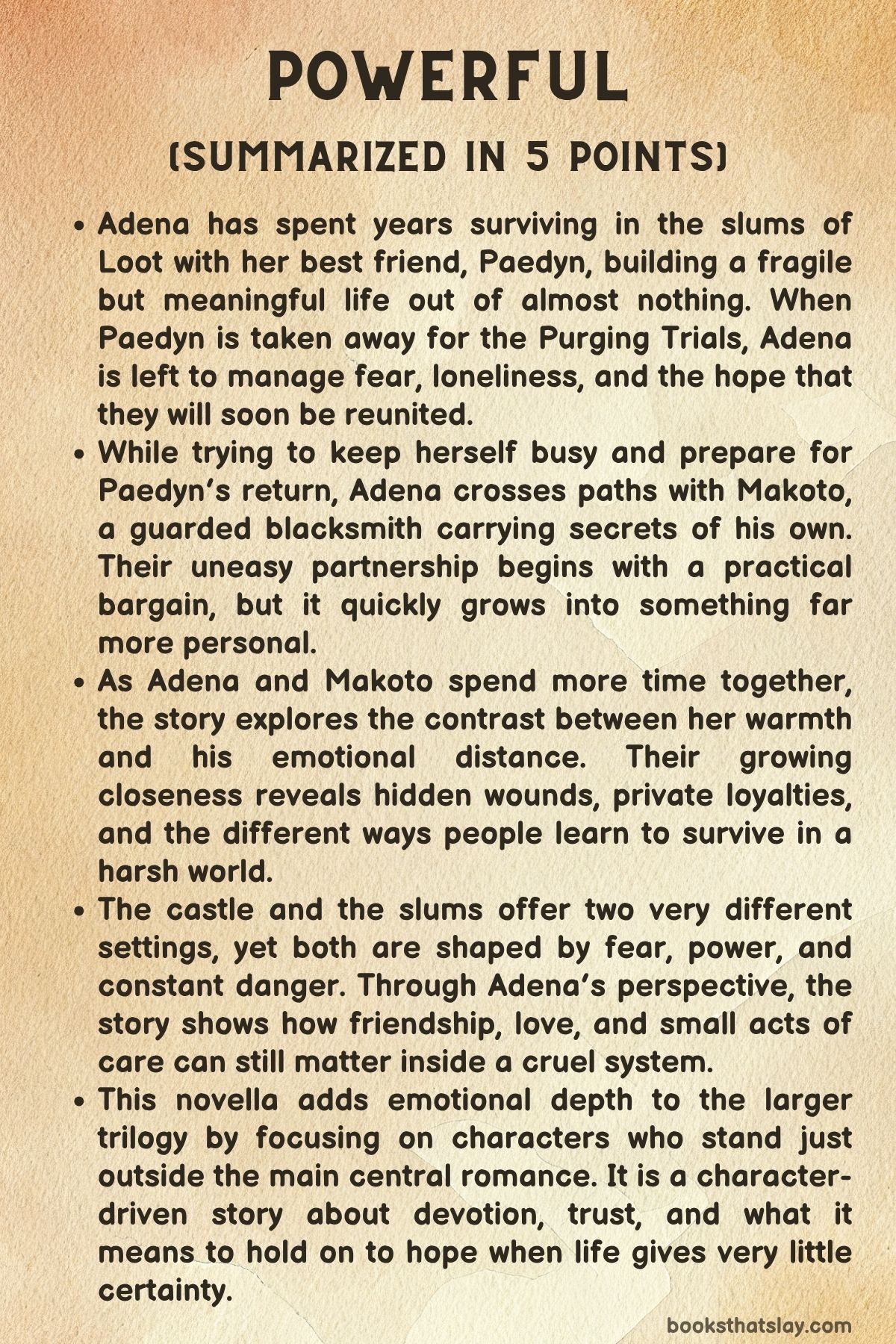
Powerful by Lauren Roberts is a companion novella set in the world of the Powerless trilogy, placed between Powerless and Reckless. Rather than retelling the central romance, it turns its attention to Adena, Paedyn’s loyal best friend, and to Makoto, a guarded blacksmith carrying secrets of his own.
The story is smaller in scale than the main novels, but it adds emotional depth to the larger series by showing life in Loot, the cruelty built into Ilya’s power structure, and the private hopes of people caught beneath it. At its core, Powerful is about friendship, trust, love, and the brief but lasting impact one life can have on another.
Summary
The story begins five years before the main action, in the slums of Loot. Adena is thirteen, starving, alone, and running through a marketplace after trying to steal food.
Her mother is dead, and she has nobody to rely on. Although desperate, she is still ashamed of what she has done and apologizes as she runs from the Imperial chasing her.
During her escape, she passes through a silver-haired girl by using her phasing ability. That girl is Paedyn.
Instead of turning her in, Paedyn helps her hide. In that brief meeting, both girls recognize the loneliness in the other.
Adena is a seamstress; Paedyn is skilled at stealing and surviving. They decide to build a life together in the slums, sharing what each can offer.
From that day on, they become each other’s family.
Five years later, the Purging Trials have begun, and Paedyn has been taken away to compete. Adena is left behind in Loot, trying to hold herself together by believing that Paedyn will survive and return.
She throws herself into plans for their future, fixing up the Fort they built together and imagining the life Paedyn might win if she emerges victorious. Beneath that determination, however, is fear.
Paedyn has always been the stronger one, the person who protects them both, and without her Adena feels exposed.
At the same time, a blacksmith named Makoto is searching for a way into the castle. He is desperate to reach Hera Colt, one of the Trial contestants, because he believes she will die if he cannot help her.
He notices Adena when she is waving goodbye to Paedyn and realizes she may be the key to his plan. Soon after, he rescues Adena from an Imperial when she is once again caught stealing food.
He does so by using a phasing ability that surprises her. Though their meeting is tense, with Makoto cold and sarcastic and Adena bright and talkative, he explains that he needs her sewing skill.
He wants her to make him an Imperial uniform so he can infiltrate the castle. In return, he promises food, supplies, and a chance to see Paedyn.
Their arrangement begins as practical necessity, but the time they spend together changes both of them. Adena works in Makoto’s workshop, measuring him for the uniform and exploring the cramped world he calls home.
Makoto is guarded, sharp-tongued, and clearly burdened by something heavy, while Adena keeps trying to pull him into conversation and into life. She notices his scar, his silver streak of hair, and the sadness behind his bitterness.
He notices her beauty, her resilience, and the calm kindness that does not fit the harshness of Loot. Their banter becomes easier.
Their silences become more charged.
Adena accidentally cuts her hand on one of his hidden blades, and Makoto’s reaction reveals the care he has been trying to hide. He tends to her wound with surprising gentleness.
This becomes one of the first moments when Adena sees the softer person beneath his rough manner. Later, when she arrives at his door frightened after being harassed in the streets, Makoto comforts her, offers her safety, and insists she stay the night.
He also decides she must learn to protect herself. Although she is not naturally suited to violence, the lessons bring them even closer.
During these days, Adena begins to fall for him, and Makoto, despite resisting the feeling, is drawn to her warmth.
Their growing connection is complicated by secrets. Makoto at first claims he simply wants to say goodbye to Hera, but in truth he plans to help her escape the kingdom.
He is a Wielder, someone who can borrow the powers of nearby Elites, and that makes him a threat to the crown. He has survived only by hiding what he is.
When Adena finally learns the truth, she feels betrayed. She realizes he meant to leave with Hera, abandoning Loot and likely dying in the attempt.
For someone who has already lost so much, the deception cuts deeply.
Meanwhile, Adena is called to the castle because Paedyn wants her to sew gowns for the Trial balls. This brings her back into Paedyn’s orbit and places her within the luxury and danger of the royal court.
She works on dresses while worrying constantly about both Paedyn and Makoto. Makoto eventually comes to see her there and finally tells her the whole truth: Hera is not his lover but his younger cousin, the person who protected him when they ran away together as children.
He admits that he has fallen for Adena and that he regrets pushing her away. Adena, terrified that his rescue attempt will only get him killed, begs him not to go through with it.
He gives in, choosing her plea over his plan.
The novella then opens Makoto’s past more fully. He and Hera grew up in crushing poverty.
When his unusual abilities began to show, his parents hid and feared him. His father became abusive, calling him worthless, beating him, and eventually attacking him with a sword, leaving the scar across his mouth.
Hera ran away with him, and for years he survived under the shadow of discovery, convinced he did not deserve joy. This history explains his harshness, his guilt, and his belief that smiles are for other people.
Adena, horrified by what he endured, becomes determined to give him back some piece of the life that was stolen from him.
After Hera dies during the first Trial, Makoto is devastated. He collapses into grief, believing he failed the one person who had always stood beside him.
Adena is the one who catches him in that grief. She refuses to let him disappear into it.
Their relationship deepens during the days that follow. They spend nights in the Fort, repair it together in hopes of Paedyn’s return, and imagine a future that, for the first time, seems possible.
Adena gives him thoughtful gifts, including designs that allow him to carry weapons more easily. He treasures them because nobody has ever given him something made with love before.
In return, he gives her tenderness, honesty, and at last his smile.
Their romance reaches its fullest expression when Adena makes him a black vest lined for hidden knives and stitched with stars and the words “See you in the sky.” Their teasing turns into confession, and then into a kiss. For Adena, who has spent years thinking only of survival and of Paedyn, this is both thrilling and frightening.
For Makoto, it is almost unbelievable that someone as open and loving as Adena could choose him. Still, for a brief time, they allow themselves happiness.
But the wider cruelty of Ilya closes in. At the castle, extra security follows a rebel attack, and Adena notices Prince Kai’s Wielder ability, which reminds her that Makoto is in danger so long as the king rules.
She brings Paedyn her final black dress and leaves excited to spend the night with Makoto. Before she can go, however, she is summoned by the king.
Instead of returning to the Fort, Adena is thrown into the dungeon. She has no idea why she has been imprisoned.
Her fingers are broken, destroying the hands that shaped clothing and beauty, and she is shackled in darkness. The loss is brutal not only because of the pain but because sewing is part of who she is.
She meets another prisoner, Al, who gives her a scrap of kindness in the form of bread, but she is soon dragged away again.
Makoto, waiting for her at the Fort with a gift of his own, grows worried when she does not arrive. The next day he enters the arena for the final Trial as part of the crowd and senses her power nearby.
Slowly he understands the truth: the “criminal” waiting at the center of the maze for the finalists to kill is Adena. He is powerless to reach her.
Inside the maze, drugged, bound, and fading in and out, Adena still believes Paedyn will find her and somehow make things right. When Paedyn does reach her, it is too late.
A branch is driven through Adena’s chest. As she dies in Paedyn’s arms, Adena thinks of the two people she loves most.
She asks Paedyn to keep wearing the vest she made and hopes Makoto will wear his too. Then she counts the stars, clinging to the promise that she will become one of them.
Makoto witnesses her death from the stands, shattered by the sight and by his own helplessness. He cannot hold her, cannot save her, cannot do anything except watch the life go out of the person who gave his own life meaning.
Yet even in the depth of that loss, he remembers their shared language of stars and sky. When he steps back into the sunlight, he feels her not as absence alone but as something still near him.
In the novella’s final note, Adena speaks from that new place in the sky, watching over Paedyn and Makoto with the love she carried at the end.
In the end, Powerful is both a love story and a tragedy. It shows how Adena, who began as a hungry child running alone through Loot, became the center of warmth in the lives of those around her.
Though her life is cut short, her kindness, humor, and loyalty remain with Paedyn and Makoto, shaping what comes after.
Characters
Adena
Adena is the emotional center of Powerful, and her character carries much of the novella’s warmth, innocence, and pain. She begins as a girl shaped by hunger, poverty, and abandonment, yet none of those hardships manage to strip away her gentleness.
Even in desperate moments, she is apologetic, caring, and almost instinctively hopeful. That quality makes her unusual in a brutal world.
She does not survive by becoming cold; she survives by staying soft without becoming weak. Her sewing is an important extension of who she is.
It is not just a skill that keeps her alive but a way of building beauty and dignity in places where neither should easily exist. Through the clothes she makes, the gifts she designs, and the care she takes with every detail, Adena shows love through creation.
She is someone who repairs, comforts, and imagines better futures.
Her bond with Paedyn reveals another key part of her identity. Adena is loyal in a full and unquestioning way.
Paedyn is not simply her friend but her home, her family, and the person around whom she has built her life. Because of that, much of Adena’s early confidence depends on the belief that Paedyn will always return, always fix things, always know what to do.
This dependence does not make Adena shallow; rather, it shows how deeply loss has marked her. After her mother’s death, she clung to the first real human connection that gave her safety and belonging.
At the same time, the story gradually pushes her toward greater independence. She learns to make choices for herself, to stand up for herself, and to imagine a life that is not only an extension of Paedyn’s survival.
Her relationship with Makoto develops this growth even further. Around him, Adena is still bright and playful, but she also becomes more emotionally exposed.
She is not naive about pain, yet she still risks affection. She wants to draw him out, to make him smile, to prove that tenderness can survive even in someone who has been shaped by damage.
What makes her compelling is that she is neither foolish nor passive. When Makoto lies to her, she recognizes the betrayal and names it.
When he is grieving, she does not retreat from his darkness. She meets sorrow with steadiness.
In this way, Adena becomes more than a cheerful contrast to his brooding nature. She is a moral force in the narrative, someone whose kindness is active and resilient rather than decorative.
Her ending defines the tragedy of the story because it attacks everything she is. Adena, a creator, has her fingers broken.
Adena, who values love and safety, is thrown into terror and isolation. Adena, who keeps dreaming of reunion, is made into a tool of cruelty in the final Trial.
Yet even in death, she does not become bitter. Her last thoughts are for Paedyn and Makoto, and her imagination reaches toward the sky rather than collapsing into fear.
That final movement captures her whole character. She is someone who suffers terribly but continues to orient herself toward love, memory, and light.
Makoto
Makoto is written as a man divided against himself. Outwardly, he is severe, sarcastic, guarded, and often difficult to like at first meeting.
Inwardly, he is ruled by fear, guilt, grief, and a desperate hunger for connection that he barely allows himself to acknowledge. His coldness is not natural arrogance so much as emotional armor.
He has spent most of his life learning that what he is makes him dangerous, unwanted, and vulnerable to violence. Because he is a Wielder, his existence threatens the power structure around him, and because of the abuse he suffered in childhood, he has internalized the belief that he is not meant for gentleness or joy.
This history explains why he so often speaks as if happiness belongs to other people.
One of the most effective aspects of his characterization is the contrast between what he says and what he does. Makoto may act irritated by Adena’s chatter, but he feeds her, shelters her, teaches her, protects her, and worries over her exhaustion and injuries.
He pretends distance while constantly moving toward care. That contradiction makes him believable.
He is not secretly soft in a simplistic sense; rather, he is someone whose instinct for love survives beneath years of emotional suppression. His blacksmithing also reflects his personality.
He works with metal, weapons, and force, shaping hard things in fire. Yet even in that harsh craft there is precision, discipline, and hidden artistry.
He is not only destructive. Like Adena, he is also a maker, though his world has taught him to create tools for survival rather than objects of beauty.
His past is central to understanding him. He grows up as an unwanted child in poverty, feared by his own parents and brutalized by his father.
The scar across his mouth becomes a physical symbol of everything stolen from him: safety, childhood, self-worth, even the freedom to smile without shame. Hera’s role in his life deepens this.
She is not just family but the person who helped him escape and live. Because she protected him for so long, Makoto’s desire to save her becomes tied to his sense of obligation and identity.
He measures himself by what he owes. That is why guilt dominates him.
He feels guilty for living, guilty for wanting Adena, guilty for failing Hera, and even guilty for moments of happiness. In his mind, love is something that puts others at risk.
His romance with Adena slowly breaks down these defenses. She does not fix him in an easy or magical way, but she does challenge the lies he has accepted about himself.
She treats him as someone worth knowing, not merely someone dangerous or damaged. Her presence gives him a glimpse of ordinary human warmth, and that affects him more than he expects.
His tenderness emerges hesitantly, then more clearly, until he finally begins to imagine a future that includes peace rather than survival alone. The fact that he learns to smile again matters because it is symbolic, not cosmetic.
He is reclaiming a piece of selfhood his father tried to destroy.
After Adena’s death, Makoto becomes one of the novella’s clearest embodiments of surviving grief. He is forced to witness the loss of the person who reopened his life to hope.
What makes that loss especially painful is his helplessness. He is powerful in one sense, but when it matters most, he cannot save her.
This turns his character into a study of love marked by failure, memory, and endurance. By the end, his connection to the sky and stars becomes a way of carrying her with him.
He remains wounded, but not emptied. She changes him permanently, and his final response to loss suggests that he will go on living with the knowledge of what he was given and what was taken away.
Paedyn
Paedyn functions as both a major presence and an important absence throughout Powerful. Even when she is physically distant for much of the story, she shapes the emotional world of nearly every scene connected to Adena.
She is introduced as resourceful, protective, and instinctively rebellious, someone who sees another lost girl in danger and chooses solidarity instead of self-preservation. That first choice defines much of her character.
Paedyn is a survivor, but she is not selfish. She is capable of cunning, deception, and risk, yet those traits are consistently tied to care for the people she considers hers.
To Adena, Paedyn is more than a friend. She is rescue, loyalty, and certainty.
That matters because it means Paedyn occupies almost mythic space in Adena’s life. She is the person who always manages, always adapts, always fights.
The story subtly shows both the strength and the burden of that role. Paedyn has become someone others rely on to hold chaos back.
Her participation in the Trials intensifies this perception because she is navigating deadly circumstances while also representing hope for Adena’s future. But the novella does not reduce her to a heroic ideal.
It also shows her as someone carrying secrets, stress, and emotional complexity, especially in her interactions with Kai and the royal court.
Paedyn’s importance lies partly in how she reveals different things in different people. In Adena, she brings out devotion and softness.
In Kai and Kitt, she inspires desire, fascination, and conflict. In the king, she sparks suspicion and strategic interest.
This suggests that Paedyn is not just charismatic but destabilizing. She unsettles systems and people because she does not fit easily into the roles others want to assign her.
The fact that she is secretly an Ordinary passing within an Elite world reinforces this tension. Her whole existence is a challenge to the kingdom’s hierarchy, even before her actions begin to openly confront it.
Her final role in Adena’s death is devastating precisely because she arrives too late. The person Adena believes will always know what to do is faced with a situation she cannot repair.
That moment humanizes Paedyn deeply. She may be brave and capable, but she is not omnipotent.
The loss becomes not only a tragedy for Adena but also a wound Paedyn will have to carry. Through that, the story reminds the reader that even the strongest survivors cannot protect everyone they love.
Hera Colt
Hera is not present on the page as often as other characters, yet she has powerful narrative weight because of what she means to Makoto. She is the person tied to his past, his escape, and his deepest sense of debt.
Through him, she comes across as brave, loyal, and sacrificial. She is not treated as a distant symbol but as someone whose practical courage made survival possible.
When Makoto was trapped in abuse and danger, Hera stood beside him and helped him leave. That act gives her a foundational place in his life.
She is family, protector, and moral obligation all at once.
What is especially interesting about Hera is that the story initially allows her to be misunderstood. For a time, both Adena and the reader can suspect she may represent a romantic rival.
Later, when it becomes clear that she is Makoto’s younger cousin, the emotional meaning of his choices shifts. His determination to reach her is not about divided affection but about familial devotion and survivor’s guilt.
That clarification preserves the integrity of his feelings for Adena while also making Hera’s role more poignant. She is the person who carried him through one part of life, just as Adena begins carrying him through another.
Hera’s death becomes one of the story’s key turning points. It destroys Makoto’s original purpose and throws him into intense grief and self-reproach.
Yet even in absence, Hera remains important because she helps define the kind of person Makoto wants to be. He believes she would expect him to keep going, to endure, and not surrender to despair.
In that sense, Hera continues to shape him after death. She stands for loyalty, courage, and the painful cost of trying to survive inside a violent political order.
Kitt
Kitt is an interesting figure because he enters the story from a position of privilege but is shown in a more human, uncertain light than one might expect. As the heir to the throne, he could easily have been written only as a symbol of the elite world Adena and Paedyn are shut out of.
Instead, he is portrayed as awkward, earnest, and emotionally inexperienced, especially in matters involving Paedyn. His conversation with Adena reveals a young man trying to understand how to reach someone he likes and failing to do so through rank or formal authority alone.
That vulnerability makes him more layered than a simple royal stereotype.
At the same time, Kitt’s character also reflects the limitations of sincerity when it exists inside a corrupt system. He may be personally more approachable than the king, but he still belongs to and benefits from the machinery that harms others.
His concern about whether Paedyn’s dress choice will offend people shows that he remains aware of court expectations and appearances. He is trying to navigate feeling within structure, but he has not escaped the structure itself.
This gives him an in-between quality. He is not cruel, yet he is not radical.
He can care, but his position has shaped the frame within which he understands the world.
His function in the story is also relational. Through Adena’s perspective, Kitt appears less suited to Paedyn than Kai because he seems more hesitant and more constrained by convention.
That does not make him false; it makes him limited. He represents a gentler face of authority, but still authority.
The contrast between his uncertainty and Kai’s sharper chemistry with Paedyn helps define the emotional landscape around her while also showing that personal decency does not automatically free someone from the values of their class and upbringing.
Kai
Kai occupies a fascinating position because he is both alluring and dangerous. From Adena’s point of view, he is clearly attractive and charismatic, but he also triggers immediate concern because of what he is capable of.
As a Wielder, he represents the very kind of power that places Makoto in constant danger. This means his presence is always doubled.
He can seem like a better match for Paedyn, more open-minded and less bound by courtly expectations than Kitt, while also embodying a threat that reaches beyond romance into survival itself.
What stands out about Kai in the novella is his ease. Compared with Kitt, he appears less troubled by appearances and more naturally aligned with Paedyn’s unconventional nature.
Adena notices this and quickly decides he is a better fit. That judgment tells the reader something about Kai’s aura.
He carries confidence and instinctive understanding rather than hesitant admiration from afar. Yet the story also keeps him at a certain distance, which preserves his edge.
He is never allowed to become purely safe or uncomplicated because his abilities place him near the logic of control and secrecy that dominates the kingdom.
Kai therefore works as a figure of tension. He belongs to the ruling world, but he also seems capable of moving against some of its expectations.
He is connected to Paedyn through attraction and conflict, and connected to Makoto through the dangerous parallel of their shared kind of power. Even when he is not central to the novella’s emotional core, he adds pressure to it by reminding both Adena and the reader that love and survival are unfolding in a world where power is always being watched.
The King
The king represents institutional cruelty in its purest and most chilling form. Unlike Makoto, whose harshness grows out of trauma, or Kitt, whose privilege is softened by personal uncertainty, the king feels cold in a deliberate and expansive way.
He does not merely participate in violence; he organizes, authorizes, and normalizes it. His treatment of the Trials, of criminals, and of those who threaten his authority reveals someone who sees people primarily in terms of use, threat, and spectacle.
That is why Adena’s imprisonment and death feel especially monstrous. Under his rule, even innocence can be recast as criminality whenever it serves power.
What makes him effective as an antagonist is not emotional excess but emotional absence. He does not seem stirred by the deaths around him, including Hera’s.
He speaks with calm certainty, and that calm makes him more frightening. He is not chaotic evil; he is controlled, strategic, and embedded in the state itself.
His awareness of Wielders is especially important because it places Makoto’s entire life under the shadow of possible execution. In this way, the king is not just an enemy to individual characters.
He is the embodiment of the order that distorts every life beneath him.
His interactions with Adena are particularly telling because they show how little protection there is for ordinary goodness in such a regime. Adena is a seamstress, a friend, a young woman trying to care for others, and none of that matters once he chooses to pull her into his machinery of punishment.
The king turns vulnerability into theater. That ability to convert a human being into an object lesson is what defines his power most clearly.
Ellie
Ellie is a smaller supporting character, but she adds texture to the castle world and helps anchor Adena emotionally while she is separated from both Paedyn and Makoto. As Paedyn’s maid, Ellie belongs to the intimate domestic space around the Trials rather than the public brutality of the arena or the rigid distance of court politics.
Her presence gives the story moments of ordinary companionship amid tension. She helps create a sense that there are still corners of human warmth even inside the castle.
Her role is especially useful in relation to Adena. With Ellie, Adena can share observations, teasing, and worry in a more relaxed way.
This keeps Adena from becoming entirely isolated during the castle sections. Ellie also reinforces the social environment around Paedyn, particularly the way others observe and interpret Paedyn’s connections with Kai and the larger drama of the court.
Though Ellie is not given the kind of layered arc reserved for central figures, she serves as an important tonal counterbalance. She keeps the world from feeling populated only by lovers, rulers, and enemies.
Instead, she reminds the reader that even in dangerous settings, everyday bonds still matter.
Al
Al appears briefly, but his scene in the dungeon is important because he introduces a rare moment of human contact during Adena’s worst suffering. He is mysterious, withholding, and described as dangerous, yet his immediate action is one of assistance.
He helps her get the bread she cannot reach and speaks to her in a way that breaks the total silence of her confinement. This contrast gives him a certain moral ambiguity.
He is not softened into a harmless figure, but neither is he reduced to menace.
In narrative terms, Al’s presence underscores the extremity of Adena’s situation. By the time she meets him, she has been stripped of control, profession, and hope.
The fact that even a near-stranger in an adjacent cell can offer more kindness than the system imprisoning her says a great deal about the world she is trapped in. Al may not be a deeply developed character within this story, but he serves an important purpose.
He reminds the reader that humanity can appear in fragments, even in the darkest places, and that these fragments matter because they reveal how far the kingdom has fallen from justice.
The Imperials
Though not a single character, the Imperials act as a consistent force throughout the novella and deserve attention because they shape the atmosphere of daily fear. They are the visible arm of the regime, present in chases, arrests, surveillance, and punishment.
To Adena, they are a threat woven into ordinary life, turning hunger into a crime and public space into a place of constant risk. To Makoto, they are also a mask to be copied and a system to be avoided, since discovery among them could mean death.
What makes them effective is their impersonality. Individual Imperials may not always be named or explored, but that is partly the point.
They function as the machinery through which power becomes routine. They chase children, escort victims, guard luxury, and carry out torture without needing personal investment in every action.
Because of that, they contribute to the sense that violence in this world is not accidental or exceptional. It is organized and repeated.
Their presence keeps the story grounded in the reality that the personal relationships at its center exist under constant external pressure.
Themes
Love as Shelter in a Violent World
Love in Powerful is not presented as something separate from danger, but as the only thing that makes danger bearable. The story is set in a harsh world shaped by hunger, public punishment, political cruelty, and constant uncertainty, so affection never appears soft in a decorative sense.
Instead, it becomes shelter. Adena’s bond with Paedyn begins in starvation and fear, yet from that first act of rescue they create a life that gives each of them belonging.
Their friendship shows that love does not need comfort to exist. It can begin in the middle of need and still become steady enough to sustain two people for years.
What matters is not luxury or safety, but the willingness to remain beside another person when no one else will.
That same idea deepens through Adena and Makoto. Their relationship grows in a space filled with secrecy, grief, and emotional damage, yet it gives both of them something they have not had for a long time.
For Adena, Makoto becomes a person with whom she can imagine a future beyond waiting for Paedyn’s return. For Makoto, Adena becomes proof that tenderness is still possible for someone who has been taught to expect only fear and rejection.
Their affection changes the emotional texture of their lives. His workshop becomes more than a place of labor.
The Fort becomes more than scraps held together in the slums. These places turn into homes because someone beloved is there.
The novel also makes clear that love is not protection from loss. It cannot stop Hera from dying, cannot stop Adena from being taken, and cannot save her in the end.
Yet this does not weaken the theme. It actually gives it more force.
Love matters not because it guarantees survival, but because it gives meaning even when survival fails. Adena dies thinking of Paedyn and Makoto.
Makoto continues living with the memory of her as something close and luminous rather than erased. In that sense, the story treats love as an act of defiance.
The kingdom can control bodies, separate people, and turn suffering into spectacle, but it cannot fully destroy what one person has become in another person’s life. Love remains the one space the regime cannot completely own.
The Lasting Weight of Trauma
Pain in this story does not stay in the past. It shapes speech, self-image, desire, and the way characters understand what they deserve.
Makoto is the clearest example of this. His childhood abuse is not described as a closed chapter that simply explains why he is sad.
It has become the structure inside which he lives. His father’s cruelty leaves visible marks on his body, but the deeper damage is internal.
He has absorbed the idea that he is dangerous, burdensome, and unworthy of happiness. This is why he guards himself so harshly, why he struggles to accept care, and why he responds to affection with fear as much as longing.
Trauma has trained him to treat closeness as risk.
The story also shows that trauma often produces guilt where guilt does not belong. Makoto feels responsible for surviving, responsible for needing Hera, responsible for failing her, and even responsible for the possibility that he might hurt Adena simply by being near her.
His suffering has convinced him that his existence creates damage. That is a powerful portrayal of how violence can distort the self.
The injured person begins carrying the moral burden that should belong to the abuser or to the system that created the harm. Makoto’s struggle is not only with memory but with the false beliefs those memories have planted inside him.
Adena’s experience broadens this theme in another direction. Her pain is not hidden behind sarcasm or distance in the same way.
She has known hunger, abandonment, and fear, but she still moves through the world with openness. Even so, the novel does not suggest that optimism erases injury.
Her dependence on Paedyn, her longing for stability, and her devastation at betrayal all reveal how much she has needed secure attachment after losing her mother. When she is imprisoned and her fingers are broken, the violence is especially cruel because it attacks the very thing through which she creates identity and comfort.
Trauma here is not abstract. It destroys function, safety, and selfhood at once.
What makes the treatment of trauma especially strong is that healing is shown as partial, fragile, and relational. Makoto does not suddenly become whole because he falls in love.
Adena does not become invulnerable because she remains cheerful. Instead, healing appears in moments: a smile returned, a truth finally spoken, a body trusted, a memory shared without shame.
These small movements matter because they show recovery not as perfection, but as the slow reclaiming of parts of the self that violence tried to erase.
Power, Cruelty, and the Dehumanizing Logic of the State
The political world of Powerful is built on the idea that some lives matter less than others, and the story never allows that truth to fade into the background. The kingdom’s cruelty is not random.
It is structured, public, and normalized through institutions like the Trials, the Imperials, and the king’s authority. This matters because the novel is not simply showing a few bad people making bad choices.
It is showing a social order that depends on humiliation, fear, and spectacle. Hunger is criminalized.
Difference is hunted. Death becomes entertainment.
In such a world, violence is not an interruption of normal life; it is one of the ways normal life is maintained.
Adena’s final fate reveals this theme with particular force. She is not a warrior, rebel leader, or political rival.
She is a seamstress and a friend. Yet the state is able to seize her, torture her, classify her as a criminal, and place her at the center of a public killing.
The horror of this is not only personal. It shows how authoritarian power works by stripping away personhood.
Once the king decides how she will be seen, her history, innocence, and humanity no longer matter within the logic of the regime. She becomes a prop in the machinery of fear.
The fact that the audience watches this as part of the Trial only makes it worse. The state does not hide its cruelty.
It stages it.
Makoto’s life also illustrates the political dimensions of fear. As a Wielder, he must live in secrecy because his very existence threatens royal control.
This reveals a system that cannot tolerate forms of power it does not own. The king’s hostility toward others with rare abilities is not rooted in justice but in preservation of dominance.
What cannot be controlled must be eliminated. That principle extends beyond Makoto to the broader social world, where the slums of Loot are left to desperation and punishment rather than care.
Poverty itself becomes one more way to keep people vulnerable.
The novel is especially effective in showing how political cruelty reaches into intimate life. It separates loved ones, shapes romance through fear, and turns survival into constant calculation.
Even the smallest acts of comfort must happen under threat. In this sense, the story argues that tyranny does not only rule through law or force.
It also attempts to control the emotional possibilities of ordinary people by making trust dangerous and stability rare. That is why every private act of loyalty in the book feels so charged.
Human connection becomes resistance simply because the world around it is designed to crush it.
Memory, Grief, and the Need to Keep the Dead Close
Loss in this story is never treated as disappearance. The dead do not vanish from the emotional lives of the living.
Instead, they remain active through memory, promise, ritual, and imagination. This is especially clear in the way the novel uses stars, sky, and light as symbols of continued presence.
These images are not decorative. They become a language through which grief is made bearable.
Adena and Makoto create a shared vision in which the dead are not lost to emptiness but relocated into something visible and near. That belief does not erase pain, but it gives pain a form that can be carried.
Makoto’s grief after Hera’s death and then after Adena’s death is central to this theme. He does not respond as someone who can neatly process sorrow and move forward.
He is undone by it. He blames himself, feels unworthy of survival, and nearly collapses under helplessness.
Yet the novel does not let grief remain only destructive. Memory becomes a way of preserving relationship.
Hera continues to shape his sense of duty and endurance even after she is gone. Adena continues to shape his sense of beauty, tenderness, and hope.
He carries both women differently, but in each case he remains bound to them through remembrance.
Adena’s final thoughts deepen this theme in a powerful way. At the moment of death, she does not focus on bitterness or revenge.
She thinks of the people she loves and reaches toward the stars she and Makoto had imagined together. This matters because it frames death not as emotional erasure but as transition into a new kind of watching, loving, and remaining.
Her brief closing perspective confirms that idea. She becomes part of the sky in the symbolic world the novel has built, which means memory is not merely a mental act for the living.
It is also the emotional shape through which the dead are kept present.
The theme works because it respects the sharpness of grief while refusing to reduce grief to emptiness alone. Makoto’s pain remains real.
Paedyn’s loss remains devastating. Nothing about remembrance cancels the violence that caused the separation.
Still, the story suggests that to remember is to resist one final act of cruelty. Systems of violence try to turn the dead into numbers, lessons, or collateral damage.
Love answers by insisting on individuality, intimacy, and continuation. A name is remembered.
A gift is kept. A promise is repeated.
A person becomes part of the sky and therefore part of everyday looking. Through that vision, grief becomes not just suffering, but an ongoing relationship with those who can no longer be touched.