The May House Summary, Characters and Themes
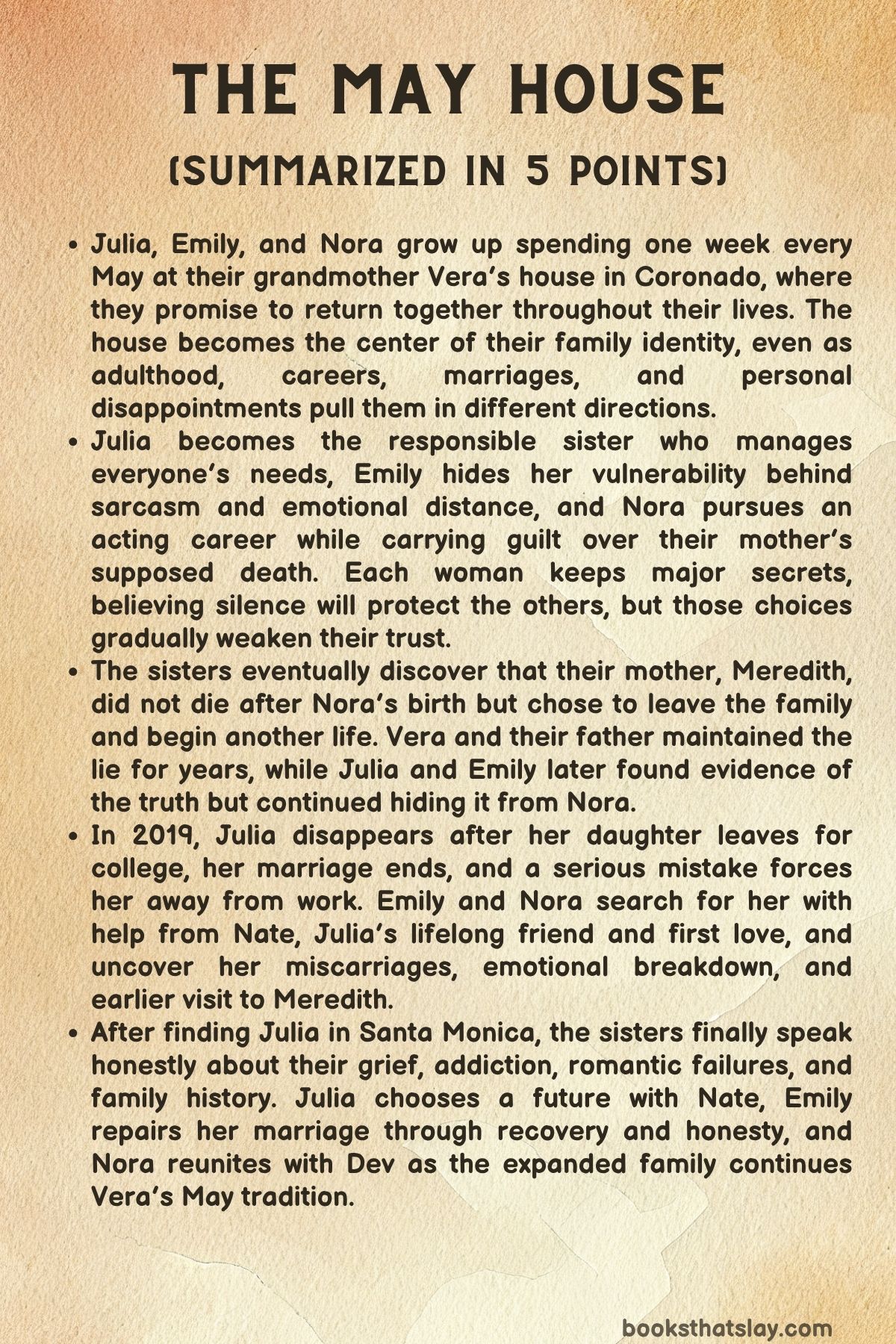
The May House by Jillian Cantor is a family drama about three sisters whose annual visits to their grandmother’s Coronado home become the foundation of their shared identity. Moving between different stages of their lives, the novel examines how childhood promises survive adulthood, marriage, grief, ambition, parenthood, addiction, and betrayal.
At its center is Julia’s unexplained disappearance in 2019, which forces Emily and Nora to examine how little they truly know about their dependable eldest sister. Their search gradually exposes decades of concealed pain and a lie about their mother that shaped all three women differently.
Summary
In 1985, twelve-year-old Julia, nine-year-old Emily, and six-year-old Nora spend their annual week at their grandmother Vera’s house on Coronado Island. Around the backyard firepit, Vera compares them to the ingredients of a s’more: Julia is the marshmallow holding everything together, Emily is the dark chocolate with both bitter and sweet qualities, and Nora is the graham cracker surrounding the others with love.
Vera asks them to promise that they will always return to the Ocean Boulevard house together, regardless of where adulthood takes them. The sisters agree, creating a tradition that will become both a source of comfort and a burden.
In 2019, Emily and Nora arrive for sisters’ week, but Julia is missing. Julia normally reaches the house first, prepares schedules, organizes meals, and manages every practical detail, so her absence immediately feels wrong.
Their relationship is already strained because the previous year ended in anger. Nora gave Julia’s teenage daughter, Veronica, false identification to go drinking and later drunkenly kissed Nate, the sisters’ lifelong friend and neighbor.
Emily and Nora initially assume Julia has been delayed or remains angry. Their concern grows when they discover that she never confirmed the trip, has not responded to messages, and has secretly been separated from her husband, Ted, for months.
The story moves through earlier May visits, revealing how the sisters became the adults they are. As a teenager, Julia begins a romance with Nate, but their relationship ends when Nate becomes overwhelmed by his mother’s terminal illness.
Although they separate, their connection never disappears. Julia eventually marries Ted and builds an outwardly stable life, while Nate remains emotionally important to her.
During one teenage visit, Julia accidentally notices letters in Vera’s armoire bearing a Santa Monica return address. The letters suggest that the sisters’ mother, Meredith, may still be alive, despite the story that she died after giving birth to Nora.
Emily later discovers similar letters but keeps silent. Believing that Julia and Nora have promising futures that should not be disturbed, she decides to carry the suspicion alone.
Nora remains unaware of the evidence. She grows up believing that Meredith died because of complications from her birth, leaving her with a deep sense of guilt and a constant desire to prove that her life was worth the loss.
Vera provides the emotional support their father cannot always give. She encourages Nora’s acting ambitions, recognizes Emily’s kindness beneath her defensive attitude, and guides Julia through the responsibilities and questions of adolescence.
After Vera dies in 1999, Julia goes to Coronado to settle the estate. Vera leaves the house jointly to the sisters, hoping it will continue bringing them together.
Nate suggests turning it into a vacation rental while keeping one week each May reserved for the sisters. Julia accepts, preserving both the house and the promise.
While sorting Vera’s belongings, Julia finally opens the armoire drawer and finds years of letters from Meredith. She mails them to herself without reading them, postponing a truth she does not feel ready to face.
Grief also brings Julia and Nate back together. Although Julia is in a serious relationship with Ted, she and Nate sleep together and place the encounter in an emotional “vault,” agreeing never to discuss it.
During the first May visit after Vera’s death, the sisters arrive carrying important secrets. Emily admits that she is attracted to women and has lost her job, Nora reveals that she plans to leave college for an acting career in New York, and Julia announces that she is pregnant.
They scatter Vera’s ashes at sea with Nate. Each sister privately makes a promise connected to the life she hopes to build.
Julia becomes the mother of Veronica and tries to manage parenthood with the same perfectionism she applies to everything else. She worries constantly, struggles to leave her baby, and gradually finds that motherhood gives her more satisfaction than her legal career.
Nora pursues acting but spends years working as a singing waitress, understudy, ensemble performer, and touring actor. She repeatedly fears that she has failed, but Vera’s encouragement and Nate’s faith in her keep her moving forward.
Emily begins a relationship with Cara, a woman she meets during a flight delay. Cara later leaves without explanation, strengthening Emily’s belief that intimacy leads to abandonment.
The sisters’ yearly tradition frequently comes under pressure. In 2002, Nora leaves early for an audition, Emily follows her, and Julia angrily accuses them of betraying Vera’s promise.
They later reconcile after Nora wins a role in a national tour. However, the sisters usually restore peace through familiar rituals rather than discussing the resentment underneath their conflicts.
Julia’s apparent stability conceals growing pain. She suffers several miscarriages but tells almost no one, convinced that she must continue caring for everyone else without asking for help.
After a particularly dangerous miscarriage in Coronado, Julia calls Nate. He takes her to the hospital, where doctors warn that another pregnancy could threaten her life.
Unable to return immediately to Ted and Veronica, Julia stays in Nate’s guest room for two weeks. She finally tells him about Meredith’s letters and asks him to drive her to Santa Monica.
They find Meredith’s address and see her alive through a window. Julia is unable to knock because the sight confirms that her mother consciously chose a life without her daughters.
Julia and Nate spend the night at a motel, where he holds her while she grieves. She returns home before he wakes and seals the experience inside their vault.
Julia later learns that Nate has a daughter, Mallory, with a woman named Heidi. Seeing him create a family intensifies Julia’s grief, although Heidi eventually abandons Nate and the baby.
Nora develops a long, damaging relationship with Leo Marks, a married Broadway producer who uses his influence over her career. She later meets actor Devlin St. Claire and experiences a more honest form of love.
Nora conceals her history with Leo, however, and the truth becomes public through a scandalous article. Dev feels deceived and ends their relationship, while Leo’s behavior reveals that he has been manipulating both Nora’s career and public image.
Emily falls in love with Cecile, a married woman whose children she helps care for. When Cecile considers leaving her husband, Emily is too frightened to admit her feelings because she does not want to feel responsible for breaking apart a family.
Cecile eventually divorces, and she and Emily begin a relationship. They marry, but Emily hides her dependence on alcohol and falsely claims that therapy is addressing her problems.
The sisters’ father develops cancer. Before his death, he tells Nate that Julia will eventually break down and asks him to care for her when that happens.
He also confirms indirectly that the story of Meredith’s death is false. He defends the lie as a promise made to protect his daughters, showing how secrecy has become the family’s preferred response to pain.
Ted and Julia’s marriage steadily deteriorates. Julia suspects that Ted is involved with someone else, but she avoids confronting him because she fears destroying Veronica’s family.
They eventually agree to remain married until Veronica leaves for college, after which they will divorce. Julia accepts the arrangement, continuing to value the appearance of security over emotional honesty.
Emily discovers Julia’s hidden box of letters and confirms that Meredith survived. Like Vera, her father, and Julia, she chooses not to tell Nora.
In 2018, the sisters gather with seventeen-year-old Veronica. Emily secretly contacts Cara, while Nora gives Veronica false identification and later kisses Nate after confessing that she has loved him since childhood.
Nate does not return the kiss. Julia discovers them and becomes furious, particularly because Nora endangered Veronica.
The following morning, Julia leaves with Emily and Veronica. Nora wakes alone, believing she may have permanently destroyed the family tradition.
By 2019, Julia’s life has collapsed. After she helps Veronica move into college, Ted immediately leaves to live with a younger woman.
Julia then makes a serious error at work and is placed on mandatory leave. With her daughter gone, her marriage finished, and her professional identity damaged, she no longer knows who she is when nobody requires her care.
She begins driving toward Coronado but loses her phone and changes direction. Using Meredith’s letters, she locates her mother in an assisted-living facility after a stroke.
Meredith recognizes Julia but offers little warmth. She explains that she married and had children because those choices were expected of her, then became increasingly trapped and depressed.
Nora’s conception was unplanned, and Meredith believed leaving was necessary for her survival. Vera and the sisters’ father agreed to tell the girls she had died, allowing Meredith to begin another life.
Meredith asks Julia to preserve the lie. Julia leaves devastated because she has spent her entire life trying to become the opposite of her mother through constant presence, responsibility, and sacrifice.
Meanwhile, Emily and Nora question Ted, Veronica, Julia’s office, and finally Nate. Nate reveals Julia’s miscarriage and the earlier Santa Monica trip, forcing Emily to admit that their mother may still be alive.
Nora is furious that nearly everyone knew some part of the truth while she carried guilt for Meredith’s supposed death. The sisters drive to Santa Monica and find Julia’s car outside the Ocean Inn.
They locate Julia alive but emotionally exhausted. Julia says she did not contact anyone because she believed nobody needed her anymore.
Nora insists on visiting Meredith. Meredith initially mistakes her for Emily and defends her choices, but Nora rejects the comparison between them.
Nora chose not to have children because she understood she did not want motherhood. Meredith created a family and then abandoned it, allowing her daughters to believe she had died.
When Meredith asks whether she deserves to remain the villain of Nora’s life, Nora realizes that her absent mother has occupied too much space in her identity. She returns to her sisters ready to stop defining herself through Meredith’s choices.
Julia reveals her miscarriages to Emily, and the sisters acknowledge how their habit of concealing suffering has damaged their lives. They return to Coronado together and abandon Julia’s formal schedule.
Emily admits her drinking and deception to Cecile, deletes Cara’s number, and commits to genuine recovery. Nora accepts that Nate was a childhood fantasy and that Dev is the person she truly loves.
Julia apologizes to Veronica and begins repairing their relationship. She also learns that Nate traveled to Los Angeles because Heidi has returned and is seeking custody of Mallory.
Julia decides to remain in Coronado and represent Nate. With her marriage over and Veronica beginning her independent life, she allows herself to choose a future based on love rather than obligation.
Julia and Nate finally abandon their vault. They confess that they have loved each other throughout decades of separation, marriage, grief, and missed opportunities.
Six years later, Julia lives happily with Nate in Coronado and runs a local law practice. Emily and Cecile have repaired their marriage through honesty and therapy, while Nora has reunited with and married Dev.
The May gathering now includes Cecile’s sons, Mallory, Veronica, Nate, and Dev. Around the firepit, the enlarged family makes s’mores and remembers Vera, proving that her house has remained a place where relationships can be repaired and family can be redefined.
Characters
The characters in The May House are shaped by the roles assigned to them in childhood and by their efforts either to fulfill or escape those roles. Their lives demonstrate how family members can love one another deeply while still misunderstanding, excluding, and hurting each other through silence.
Julia May
Julia is the eldest sister and the emotional center of the book. From childhood, she is described as the person who holds everyone together, and she eventually treats that description as a lifelong responsibility rather than a loving observation.
She organizes the May visits, maintains the rental house, supports her sisters, raises Veronica, protects her father, and attempts to preserve her marriage. Her competence causes others to assume that she does not need support, while her pride prevents her from admitting that she does.
Julia’s perfectionism comes directly from her fear of abandonment. After discovering that Meredith chose to leave, Julia dedicates herself to being endlessly present, dependable, and self-sacrificing.
Her miscarriages intensify her belief that she has failed to create the family she imagined. Instead of sharing her grief with her sisters or husband, she hides it and turns to Nate, the one person with whom she feels safe enough to become vulnerable.
Her relationship with Ted represents the life she believes she should want, while Nate represents emotional truth, history, and acceptance. Julia repeatedly chooses duty over Nate because she fears becoming selfish like Meredith.
Her disappearance in 2019 is not an impulsive rejection of her family. It is the collapse of a woman who has defined herself entirely through being needed and suddenly loses her roles as active mother, wife, and successful lawyer.
Within The May House, Julia’s development depends on learning that love does not require constant sacrifice. By choosing Nate, helping Mallory, reconnecting with Veronica, and remaining in Coronado, she finally creates a life in which she can care for others without erasing herself.
Emily May
Emily is the middle sister, described by Vera as dark chocolate because she combines bitterness with sweetness. Her cynical humor, emotional defensiveness, and bluntness protect a deeply caring person who often notices the suffering others overlook.
As a teenager, Emily learns that Meredith may still be alive. She decides not to tell Julia or Nora because she believes silence will protect their futures, beginning a pattern of withholding difficult truths while considering herself responsible for other people’s emotional safety.
Emily’s romantic history reinforces her fear of abandonment. Cara’s unexplained departure leaves her angry and distrustful, making it difficult for her to believe that stable love is possible.
Her relationship with Cecile offers her the family life she secretly desires, including a meaningful role in the lives of Cecile’s sons. However, Emily’s fear of being responsible for a broken marriage delays her confession of love, and her later dishonesty about alcohol threatens the family they build.
Emily’s drinking reflects her effort to avoid pain rather than confront it. She promises sobriety without seeking genuine treatment, hides renewed contact with Cara, and risks losing Cecile because she continues to separate love from honesty.
Despite her mistakes, Emily possesses strong moral awareness. She eventually recognizes that Meredith’s biological connection does not make her a mother and that Cecile and the twins represent the family she has actively chosen.
Her growth begins when she stops describing secrecy as protection. By admitting her addiction, deleting Cara’s number, and accepting professional help, she replaces defensive self-reliance with accountability.
Nora May
Nora is the youngest sister and the one most visibly shaped by the false story of Meredith’s death. Because she believes her mother died giving birth to her, she grows up carrying guilt for a loss she did not cause.
Vera’s love gives Nora a place where she feels entirely wanted. Her commitment to the annual May visits is therefore stronger than simple nostalgia, since Coronado represents the childhood security she fears losing.
Nora is talented, ambitious, romantic, and emotionally impulsive. She leaves college to pursue acting, survives years of uncertainty, and eventually achieves Broadway success, yet professional recognition does not resolve her need for validation.
Her affair with Leo reveals how ambition and insecurity make her vulnerable to manipulation. Leo offers access, attention, and promises of a future while keeping her dependent and hidden.
Dev provides a healthier form of love, but Nora’s inability to disclose her past destroys their first relationship. Her honesty comes too late because she has learned from her family that painful truths should be delayed until they can no longer remain hidden.
Nora’s love for Nate is partly rooted in childhood longing. He represents Coronado, Vera, safety, and the fantasy that one day she will be chosen by someone who has always known her.
Her kiss with Nate in 2018 is an act of emotional confusion rather than genuine betrayal from him. Once she accepts that Nate does not return her feelings, she can recognize that her love for Dev is based on mutual adult connection rather than nostalgia.
The discovery that Meredith survived transforms Nora’s understanding of herself. She realizes that the guilt at the center of her identity was created by other people’s decision to hide the truth.
Her confrontation with Meredith allows her to reject both guilt and idealization. Nora stops treating her mother’s absence as the defining fact of her life and begins choosing honesty, including her eventual reconciliation with Dev.
Vera
Vera is the sisters’ grandmother and the creator of the annual May tradition. She is theatrical, affectionate, observant, and capable of making each granddaughter feel recognized as an individual.
She gives the sisters the emotional encouragement they do not always receive from their father. Vera supports Nora’s acting dreams, helps Julia navigate adolescence, and reminds Emily that kindness exists beneath her guarded personality.
The house becomes an extension of Vera’s love. Through rituals involving movies, s’mores, the ocean, and shared time, she creates a space in which the sisters experience themselves as a complete family.
Vera is also responsible for the central deception. By agreeing to claim that Meredith died, she protects the girls from the immediate pain of knowing that their mother chose to leave, but she also creates long-term damage.
Her secrecy is motivated by love rather than cruelty. Nevertheless, her decision teaches the family that painful realities should be concealed, a lesson the sisters repeat throughout adulthood.
Vera’s legacy is therefore complicated. She gives the sisters a durable bond and a permanent home, but she also leaves them with an emotional culture in which protection and dishonesty become difficult to distinguish.
Nate
Nate is the sisters’ childhood neighbor, lifelong friend, and the person most closely connected to Julia’s hidden emotional life. His presence across decades makes him both part of the family and an observer of its secrets.
His teenage relationship with Julia ends because he cannot manage romance while facing his mother’s terminal illness. Although the separation is understandable, both continue to carry feelings that influence their later choices.
Nate is consistently patient, practical, and emotionally generous. He helps preserve Vera’s house, manages the rental property, encourages Nora’s acting, takes Julia to the hospital, drives her to Santa Monica, and raises Mallory after Heidi leaves.
His relationship with Julia is built on recognition rather than idealization. He sees her fear, grief, anger, and exhaustion beneath the organized identity she presents to everyone else.
The “vault” allows Nate and Julia to maintain closeness without confronting its meaning. Although intended to protect their friendship and marriages, it becomes another form of avoidance.
Nate also keeps Julia’s secrets from Emily and Nora, believing loyalty requires silence. His eventual confession shows that protecting one person can become harmful when secrecy prevents others from helping.
As a father, Nate demonstrates the form of parenthood Meredith rejected. He remains present for Mallory despite exhaustion and uncertainty, making his devotion particularly meaningful within a story concerned with abandonment.
His final union with Julia is the result of emotional honesty rather than sudden romance. They choose each other only after they stop treating their love as something that must remain hidden.
Meredith May
Meredith is the absent mother whose choices shape the lives of all three sisters. For most of their childhood and adulthood, she exists as an idealized dead woman rather than a living person with complicated motives.
Her decision to leave emerges from depression, resentment, social pressure, and a feeling of entrapment. She explains that she married young and had children because she believed those were the roles expected of her.
Meredith’s suffering is real, and leaving may have felt necessary for her survival. However, the novel does not allow her pain to erase the harm caused by abandoning her children and participating in the lie about her death.
Her request that Julia preserve the deception demonstrates her continued preference for self-protection. Even after decades, she asks her daughter to carry the emotional burden rather than face the consequences of her choices.
Meredith’s limited warmth during her encounters with Julia and Nora prevents the sisters from receiving the apology or explanation they imagined. This disappointment ultimately helps them stop building their identities around her.
Her most important function is not to become reconciled with her daughters. Instead, she forces them to accept that closure may come from abandoning unrealistic hopes rather than repairing every broken relationship.
Bob May
Bob is the sisters’ father, a practical and emotionally restrained man who raises the girls after Meredith leaves. He loves his daughters but often expresses that love through protection, responsibility, and control rather than open communication.
His decision to tell the girls Meredith died is intended to spare them from feeling rejected. However, it burdens Nora with unnecessary guilt and prevents all three sisters from developing an honest understanding of their family.
Bob struggles to support Nora’s acting ambitions because he fears instability and disappointment. His caution contrasts with Vera’s encouragement, although it comes from anxiety rather than a lack of pride.
As his cancer progresses, Bob becomes more aware of Julia’s emotional fragility. His request that Nate care for her reveals that he understands how much she has sacrificed and how little support she allows herself to receive.
Bob’s love is genuine but limited by the same secrecy that defines the family. He protects his daughters from immediate pain while unintentionally leaving them unprepared to face the truth later.
Ted
Ted is Julia’s husband and the father of Veronica. He initially represents stability, kindness, and the respectable adult life Julia believes she should create.
His relationship with Julia gradually becomes emotionally empty. Both remain married partly to preserve Veronica’s sense of family, even though their silence turns the household into a performance rather than a functioning partnership.
Ted recognizes Julia’s attachment to Nate and eventually asks her to end it. Later, he suggests that Nate should become her partner once they agree to see other people, showing that he understands the emotional truth Julia refuses to name.
His affair and eventual relationship with a younger paralegal confirm the collapse of the marriage. However, Ted is not presented as the sole cause of that collapse, since Julia also withholds major experiences, including miscarriages and her continuing love for Nate.
Ted’s departure immediately after Veronica leaves for college contributes to Julia’s breakdown. It removes the domestic structure she has worked for years to preserve and exposes how little emotional connection remains between them.
Veronica
Veronica is Julia and Ted’s daughter and a major source of both joy and fear for Julia. Her existence gives Julia a chance to become the devoted mother she never had, but it also intensifies Julia’s perfectionism.
Julia attempts to control Veronica’s life because she equates constant involvement with protection. As Veronica becomes more independent, Julia interprets ordinary separation as evidence that she may be losing her daughter.
Veronica’s decision to attend college on her own terms reflects her need to establish an identity outside her mother’s plans. Her distance is not an abandonment of Julia, although Julia initially experiences it that way.
The 2018 incident involving false identification exposes tension between them. Julia’s anger is partly justified by the danger Nora creates, but it also reveals her fear that Veronica’s adulthood is moving beyond her control.
Their reconciliation begins when Julia apologizes and becomes more emotionally honest. By 2025, Veronica is an environmental advocate with a secure place in the expanded family, showing that independence and closeness can coexist.
Cecile
Cecile is Emily’s wife and the mother of twin sons, Mikey and Jim. Her relationship with Emily gives Emily the family belonging she has long desired but feared she could not sustain.
Cecile initially remains in an unhappy marriage, leaving Emily uncertain whether admitting her feelings would be loving or destructive. Once Cecile divorces, their relationship develops into a committed partnership.
Her proposal represents trust in Emily’s capacity to become a spouse and stepmother. Emily accepts sincerely but enters the marriage without being honest about her drinking or unresolved connection to Cara.
Cecile’s accusation of betrayal in 2019 is justified because Emily has concealed both addiction and emotional contact with a former partner. Their eventual reconciliation does not erase the damage but requires Emily to accept therapy and recovery rather than offer another unsupported promise.
By the epilogue, Cecile and Emily have built a stable family through continued honesty. Cecile represents the possibility that relationships can survive serious failures when both partners address them directly.
Devlin St. Claire
Dev is a successful actor who becomes Nora’s most meaningful romantic partner. Unlike Leo, he relates to Nora as an equal and values her personality rather than treating her as a career asset.
Their connection begins naturally through conversation, shared work, and continued correspondence. When he travels to Nora’s apartment and openly declares his feelings, he offers the honesty she has rarely experienced.
Dev ends the relationship after learning that Nora concealed her affair with Leo. His reaction reflects damaged trust rather than an unwillingness to accept her past.
Their later encounters demonstrate that their feelings remain unresolved. Nora must first stop pursuing fantasies involving Nate and accept responsibility for her dishonesty before she can rebuild a relationship with Dev.
Their eventual marriage shows that reconciliation becomes possible after both have matured. Dev represents a future based on mutual choice rather than secrecy, professional dependence, or childhood longing.
Cara
Cara is Emily’s former partner and one of the central sources of her fear of intimacy. Their early connection is immediate and important, but Cara ends the relationship without explanation.
Years later, Cara explains that her mother’s illness and her own emotional fear caused her to withdraw. Her apology gives Emily information she once desperately wanted, but it arrives after Emily has built a life with Cecile.
Cara’s later messages become dangerous because they offer Emily an escape into an unresolved past. Emily’s willingness to contact her while drinking reveals a desire for validation and a reluctance to confront problems within her marriage.
Cara is not portrayed as deliberately destructive. Nevertheless, her presence tests whether Emily will continue repeating old patterns or choose accountability to her current family.
Emily’s decision to delete Cara’s number marks a clear boundary. It shows that understanding the past does not require reopening a relationship that threatens the present.
Leo Marks
Leo is a married Broadway producer who maintains a long affair with Nora. He uses professional influence, secrecy, and promises of future commitment to keep her emotionally dependent.
Nora initially accepts the relationship because Leo appears to offer both love and career advancement. Over time, she recognizes that he treats her personal life as something he can control for publicity.
His apparent role in exposing Nora’s affair demonstrates possessiveness and cruelty. He would rather damage her reputation and relationship with Dev than allow her to become independent of him.
Leo represents a distorted connection between ambition and affection. Nora’s involvement with him shows how professional insecurity can make a person tolerate emotional exploitation.
Escaping Leo requires more than ending the affair. Nora must also stop believing that her worth depends on powerful men granting her opportunities or attention.
Mallory
Mallory is Nate and Heidi’s daughter. She grows up with Nate as her dependable parent after Heidi leaves, making her childhood a contrast to that of the May sisters.
Her presence reveals Nate’s capacity for devotion and strengthens Julia’s connection to him. Julia’s willingness to represent Nate during the custody dispute also demonstrates her love for both father and daughter.
Mallory becomes part of the expanded May family rather than remaining only Nate’s child. Her acceptance by Julia, Emily, and Nora reflects the novel’s broader definition of family through care and continued presence.
Heidi
Heidi is Mallory’s mother and Nate’s former partner. She leaves Nate and their baby to live overseas with another man, repeating the pattern of maternal abandonment that has already shaped the May family.
Her departure places Nate under enormous pressure but also demonstrates his commitment to remaining present. Julia’s anger toward Heidi is intensified by her own history with Meredith.
Heidi’s later attempt to obtain full custody threatens the stability Nate has created. The conflict gives Julia a practical reason to remain in Coronado and use her professional abilities in support of the family she is choosing.
Becca
Becca is Nate’s former fiancée. Their relationship reflects Nate’s attempt to create a conventional future even though his emotional connection to Julia remains unresolved.
Before the wedding, Nate admits that he is uncertain whether he is happy. Becca eventually leaves him shortly before the ceremony, confirming that the relationship could not be sustained through determination alone.
Her role parallels Ted’s role in Julia’s life. Both Becca and Ted participate in relationships that appear appropriate from the outside but lack the emotional foundation required for lasting happiness.
Monica
Monica is the young woman Emily meets at Clayton’s diner after discovering evidence that Meredith may be alive. Their interaction contributes to Emily’s recognition of her attraction to women.
Although Monica occupies only a small part of the story, she appears at a critical moment of personal awakening. She represents a possibility outside the roles and assumptions Emily inherited from her family.
Helen
Helen is the woman Emily is involved with during the first sisters’ week after Vera’s death. Emily’s decision to reveal the relationship helps her begin speaking openly about her sexuality.
Helen is less developed than Cara or Cecile, but her presence marks an important stage in Emily’s adult identity. She shows that Emily’s attraction to women is not temporary or uncertain, even if Emily is still learning how to discuss it with her family.
Grey
Grey is Vera’s late husband and the grandfather whose marriage becomes a model of lasting love. His presence is mainly remembered through Vera and Emily’s hope that she might someday find a relationship as enduring as theirs.
The remembered marriage contributes to the sisters’ expectations about love and permanence. It also contrasts with the many unstable, secretive, or incomplete relationships they later experience.
Mikey and Jim
Mikey and Jim are Cecile’s twin sons and become Emily’s stepsons. Emily’s early care for them helps her recognize that she wants a domestic life and is capable of loving children without being their biological mother.
Their acceptance of Emily gives her a meaningful parental role. As they prepare to leave for college, Emily confronts an empty nest similar to Julia’s, but therapy and honesty ensure that she does not face the transition alone.
Themes
Family, Ritual, and the Meaning of Home
The Coronado house functions as more than inherited property in The May House. It preserves the sisters’ memories of being loved, understood, and complete during the one week each year when Vera gathers them together.
The annual visit allows Julia, Emily, and Nora to return to identities formed before adulthood separated them. S’mores, old movies, the firepit, the ocean, shared bedrooms, and Julia’s schedules create continuity during periods of marriage, illness, professional uncertainty, and grief.
Ritual can restore closeness, but it can also create the illusion that unresolved problems have disappeared. After major arguments, the sisters often resume familiar activities without addressing the reasons they hurt each other.
Julia treats the May tradition as an obligation that must be protected through planning and discipline. Nora treats it as proof that she still belongs somewhere, while Emily values it but resists admitting how much she needs it.
The house survives because its meaning changes. It begins as Vera’s home, becomes a rental property, serves as the site of repeated conflicts, and eventually holds an expanded family connected through marriage, friendship, parenthood, and reconciliation.
Its endurance demonstrates that home is not created by preserving every detail unchanged. Home remains alive when people continue returning, speaking honestly, accepting change, and making room for those who choose to stay.
Secrecy Disguised as Protection
Nearly every major conflict grows from a secret originally justified as protection. Vera and Bob conceal Meredith’s survival because they believe the girls will suffer less if they think their mother died rather than chose to leave.
Julia and Emily later repeat the same reasoning. Each finds evidence of Meredith’s existence, but both decide Nora should remain unaware, never asking whether she has the right to understand her own history.
Julia hides her miscarriages, marital collapse, professional leave, and emotional dependence on Nate. Her silence protects her image as the responsible sister but prevents Emily and Nora from recognizing that she is in crisis.
Emily conceals her drinking and renewed contact with Cara because she fears losing Cecile. Nora hides her relationship with Leo from Dev because she fears that honesty will destroy the healthier love she has found.
These secrets do not prevent suffering. They postpone it while adding betrayal, isolation, and unequal knowledge to the original pain.
The family repeatedly confuses control over information with care. People decide what others are strong enough to know, creating relationships in which love exists without full trust.
Healing begins only when the sisters stop defending concealment as kindness. Their reunion requires them to admit that difficult truths may cause immediate pain, but sustained intimacy is impossible when one person controls another’s access to reality.
Motherhood, Abandonment, and Parental Identity
Meredith’s departure shapes the sisters’ beliefs about motherhood long before they learn the truth. Julia fears repeating her mother’s failures, Emily doubts whether she belongs in a parental role, and Nora assumes her own birth caused a death.
Julia responds by trying to become a flawless mother. She monitors Veronica, organizes her life, resists separation, and interprets control as evidence of devotion.
Her miscarriages make motherhood a source of grief as well as love. The loss of imagined children deepens her attachment to Veronica and her fear that one daughter may not need her forever.
Emily’s relationship with Mikey and Jim offers a different model. She becomes a parent through daily care rather than biology, proving that showing up consistently matters more than giving birth.
Nora consciously decides not to have children. Her confrontation with Meredith emphasizes the difference between honestly rejecting motherhood before creating a family and abandoning children after accepting responsibility for them.
Nate also broadens the theme through his devotion to Mallory. When Heidi leaves, he remains, demonstrating that parental identity is built through sustained action under difficult circumstances.
The novel does not present motherhood as an automatic source of fulfillment. It recognizes depression, resentment, infertility, fear, and ambivalence while maintaining that adults remain responsible for how their choices affect dependent children.
Identity Beyond Responsibility, Guilt, and Ambition
Each sister builds an identity around a particular demand. Julia must be needed, Emily must remain emotionally protected, and Nora must prove that her life justifies the loss she believes her birth caused.
Julia’s identity collapses when Veronica leaves for college, Ted ends their marriage, and her career is interrupted. Without people to manage or problems to solve, she interprets independence as evidence that she no longer matters.
Emily defines herself through detachment. Her sarcasm and refusal to depend on others make her appear strong, but her drinking reveals the emotional cost of maintaining that image.
Nora pursues fame partly because achievement promises validation. Even after reaching Broadway, she discovers that success cannot resolve guilt, romantic confusion, or the fear of being unwanted.
Their development requires separating worth from function. Julia must believe she deserves love even when she is not holding everyone together, Emily must accept that vulnerability does not guarantee abandonment, and Nora must stop measuring her value through fame or male attention.
The truth about Meredith becomes freeing because it destroys a false explanation for who they are. Nora did not cause her mother’s death, Julia cannot prevent every departure through perfection, and Emily does not have to absorb pain silently to protect the people she loves.
By the end, the sisters retain parts of their old identities but no longer remain trapped by them. Julia still plans, Emily still possesses sharp humor, and Nora still performs, yet these qualities become expressions of personality rather than conditions for deserving a place in the family.