The One Day You Were My Husband Summary, Characters and Themes
The One Day You Were My Husband by Rosie Walsh is a romantic psychological drama about love, betrayal, memory, and the dangerous consequences of withheld truth. The novel follows surgeon Carrie Cole, whose first husband is seized by armed men on their wedding day in Thailand and later condemned as a drug trafficker.
More than a decade afterward, Carrie has rebuilt her life with another husband, two children, and a career she is trying to reclaim. When she discovers that Johan is alive and living in Stockholm, the past returns with new questions. What begins as a search for closure becomes an unsettling examination of manipulation, family loyalty, and personal freedom.
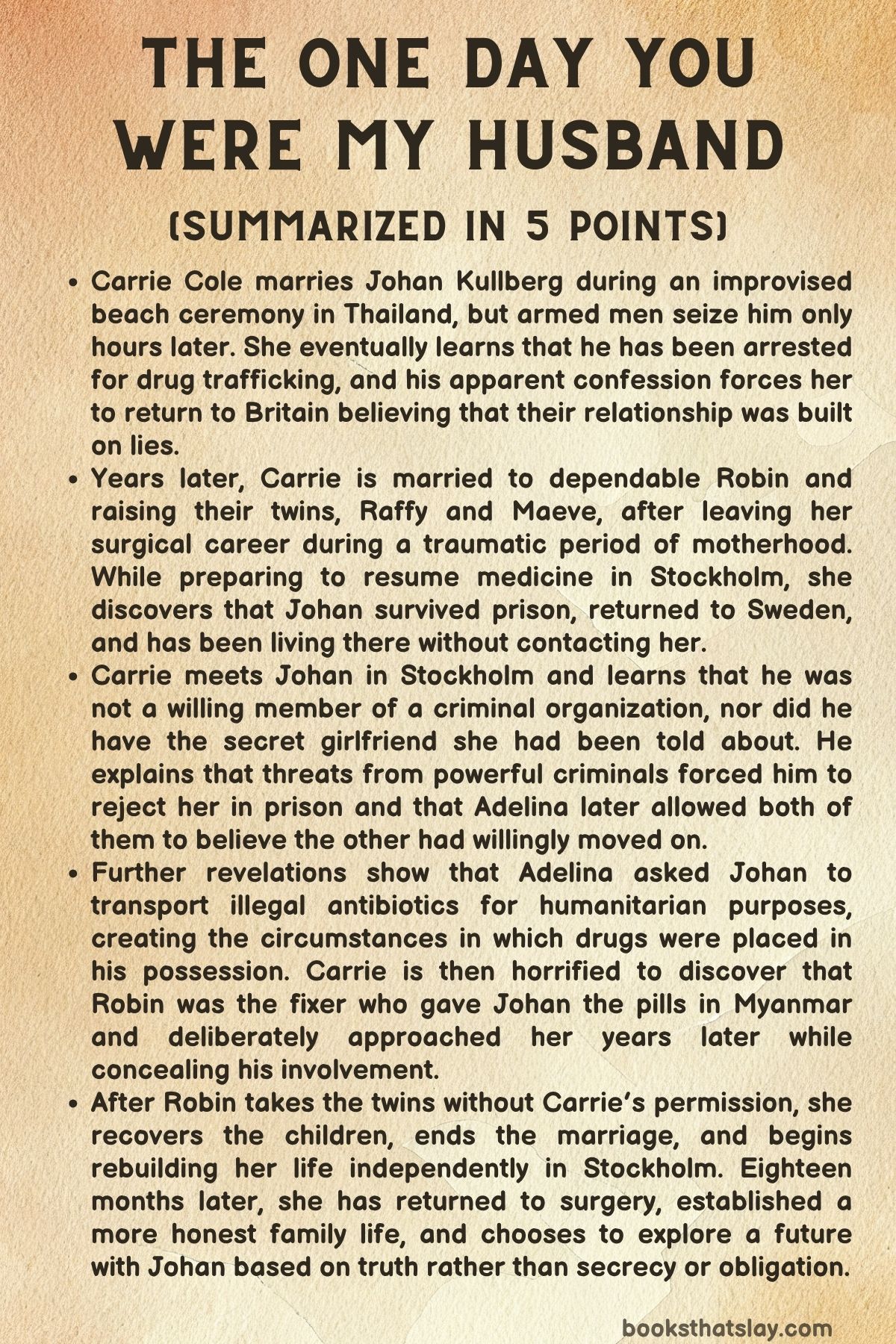
Summary
In September 2010, twenty-seven-year-old surgeon Carrie Cole marries Johan Kullberg on a Thai island after a storm delays their informal beach ceremony. During their first dance, armed men invade the celebration, seize Johan, and drive him away while Carrie chases the convoy, unable to save the husband she has had for only a few hours.
Twelve years later, Carrie lives in rural Devon with Robin and their six-year-old twins, Raffy and Maeve. Raffy’s respiratory problems, the children’s premature birth, and 172 days in neonatal intensive care led Carrie to abandon surgery, while her father’s worsening Alzheimer’s disease adds another exhausting form of caregiving.
Carrie has restored her medical license and plans to return to supervised practice. Her former mentor, Yanika Hatziz, invites her to Stockholm, but while searching for accommodation, Carrie finds a coastal cabin hosted by Johan and realizes that her first husband survived prison, returned to Sweden in 2016, became an architect, and never contacted her.
The discovery creates anger, guilt, and confusion. Carrie learns that Johan appears to have a partner and child, briefly cancels her trip after speaking to Maya, then rebooks it because she refuses to let either Johan’s existence or the demands of motherhood control her professional future.
The story returns to 2010, when Carrie first meets Johan after saving an elderly accident victim during a hospital emergency. Johan, who witnessed the collision, recognizes both her technical ability and the emotional burden of her work, and their attraction grows despite Carrie’s concern about professional boundaries.
After months apart, they meet again by chance and begin an intense relationship. Johan’s adventurous work as an underwater archaeologist contrasts with Carrie’s disciplined life, yet he respects her ambition, teaches her to tolerate uncertainty, and makes her feel understood rather than diminished.
Johan’s assignments abroad trigger Carrie’s fear of abandonment, rooted in a childhood shaped by her activist mother Adelina’s repeated absences. When communication fails during one job, Johan shows Carrie the messages he wrote each night, declares his love, and invites her to Thailand during a break from work in Myanmar.
In Bangkok, Johan delivers a package to a sophisticated woman in Chinatown and later mentions illegal payments connected to work permits. Carrie is uneasy but accepts his explanation, and the couple continue to the islands, where Johan proposes and they arrange a spontaneous wedding.
After Johan’s arrest, Carrie learns that he has been accused of carrying yaba, a form of methamphetamine. She believes he has been framed, but evidence suggests he knowingly transported the drugs, and British officials offer limited help because Johan is Swedish.
Adelina arrives and uses international contacts to pressure officials. When Carrie finally sees Johan, he is bruised, frightened, and physically weakened, yet instead of declaring innocence, he says he committed the crime and warns that dangerous people will punish him if Adelina and her associate Prawat continue interfering.
An anonymous caller then informs Carrie’s hospital of her connection to the case, threatening her medical career. After Prawat’s involvement causes Johan to be beaten, Johan deliberately destroys the marriage by calling it a holiday affair and ordering Carrie never to visit again.
Carrie returns to London, fights a professional investigation, and learns that Johan has received a twenty-five-year sentence. Prawat claims Johan worked for a criminal organization and had another girlfriend, so Carrie accepts the worst version of him because it gives her enough certainty to survive.
In 2014, Carrie meets Robin at a hospital fundraising gala. He is attentive, dependable, and apparently transparent, and after hearing about Johan, he becomes the stable partner Carrie believes she needs; six months later, he proposes and she accepts.
In Stockholm, Yanika tests Carrie’s readiness to return to emergency surgery and offers her a clinical placement. Carrie then nearly visits Johan’s office, retreats, and unexpectedly sees him in her hotel bar, where the living man before her contradicts the criminal image she has carried for years.
Johan is stunned that Carrie believes he was a trafficker who chose silence after gaining freedom. He says he was cleared and pardoned, denies having another girlfriend, explains that the child online is his stepson, and insists that their wedding and relationship were genuine.
Back in Devon, Carrie finds a 2010 telephone bill showing a long call between her father and a Bangkok hotel. Johan later explains that he called her father to request permission to propose, a tender fact that further weakens the story Carrie accepted about his deception.
Carrie returns to Stockholm for Yanika’s placement, and Maya joins her. After Maya accidentally contacts Johan through the rental site, Carrie and Johan begin messaging, and his deleted words, “I miss you tonight,” revive the language of their earlier relationship.
Carrie accepts an invitation to Johan’s family cabin while concealing the visit from Robin. There, Johan’s mother, Kerstin, accuses Adelina of causing the arrest by asking Johan to transport illegal material through Thailand.
Adelina admits that she asked Johan to carry antibiotics for an organization assisting rape survivors in Myanmar. She believed the humanitarian need justified breaking regulations, but the request exposed Johan to dangerous intermediaries and created an opportunity for another illegal package to be added.
Johan finally explains that a fixer in Myanmar asked him to carry pills described as Adderall as repayment for help with work permits. The pills were actually yaba linked to a powerful criminal network, and after his arrest, he was threatened with fabricated charges carrying the death penalty unless he accepted responsibility.
He rejected Carrie in prison to protect her safety and career, served more than five years, and returned to Sweden after a pardon. When he tried to learn about Carrie, Adelina told him she was happily married and promised to explain his innocence, but she never did, leaving each of them convinced the other had chosen separation.
Before Carrie can absorb the truth, Nicola calls to say her father has died. Robin then stops answering Carrie’s calls and disappears with Raffy and Maeve after reading her messages with Johan, turning the emotional crisis into a fear that her children may be taken abroad.
Johan recognizes Robin’s photograph as the fixer who gave him the drugs in Myanmar. Robin had worked for a billionaire linked to the criminal network, helped arrange illegal logistics, carried messages from the people threatening Johan, and secretly paid for better care that helped Johan survive prison.
Carrie and Johan rush back to England, where Adelina uses a police contact to locate Robin and recover the twins safely. Robin admits that his first meeting with Carrie was arranged after he researched her, although he insists he later fell genuinely in love and became devoted to their family.
Carrie learns that Robin also lied about his employment, inheritance, and knowledge of Johan’s release. His care for her and the children may have been real, but it existed beside surveillance, manipulation, and a habit of making major decisions without her consent.
Carrie decides to separate from Robin and refuses to let either man determine her future. She and Johan sleep together, reclaiming part of the wedding night stolen from them, but Carrie understands that passion cannot erase years of damage or substitute for an independent decision.
Eighteen months later, Carrie lives in Stockholm with Raffy, Maeve, and Maya while rebuilding her surgical career. Robin remains involved as a father, Maya has left Colorado and stopped drinking, and Carrie is learning to combine work, motherhood, grief, and selfhood without allowing any single role to consume her.
Carrie visits Johan’s cabin openly and tells him she still loves him. Johan reveals that his relationship with Freja has ended, and they accept that they cannot recover the life stolen in Thailand but can begin a new relationship founded on truth, freedom, and conscious choice.
Characters
Carrie Cole
Carrie is the emotional and moral center of The One Day You Were My Husband, and nearly every major conflict is filtered through her need for certainty. Her surgical training teaches her to manage fear through knowledge, procedure, and decisive action, but personal relationships repeatedly confront her with situations that cannot be controlled in the same way.
Her love for Johan awakens a freer and more trusting side of her personality. She permits spontaneity, physical vulnerability, and emotional dependence, yet his arrest activates the abandonment fears created by her childhood and leaves her desperate for an explanation that will make suffering understandable.
After Thailand, Carrie survives by accepting the harshest possible version of Johan. Believing that he was a criminal and adulterer allows her to close the emotional case, preserve her career, and build a stable life, but this stability depends on information supplied by other people.
Motherhood deepens both her courage and her anxiety. Her devotion to Raffy and Maeve is absolute, yet the twins’ premature birth leaves her unable to trust others, and caregiving gradually erases her professional identity until returning to surgery becomes an act of personal recovery.
Carrie’s final development lies in rejecting lives designed around rescue, guilt, or fear. She stops allowing Johan, Robin, Adelina, motherhood, and even medicine to define her completely, choosing instead to form a life in which love exists beside independence rather than replacing it.
Johan Kullberg
Johan is introduced in The One Day You Were My Husband as adventurous, observant, emotionally open, and unusually responsive to Carrie’s hidden exhaustion. He does not merely admire her intelligence; he understands that her ambition carries loneliness, pressure, and a constant demand for self-control.
His greatest strength is also linked to his central failure. Johan tries to protect Carrie by absorbing danger himself, but he repeatedly decides what she should know and what she can endure, turning love into secrecy and denying her the ability to make informed choices.
His agreement to carry pills shows impulsiveness, misplaced gratitude, and poor judgment rather than deliberate criminal intent. He enters a dangerous arrangement without understanding its scale, then becomes trapped between threats from a criminal network and fear for Carrie’s safety.
In prison, Johan’s cruelty toward Carrie is strategic but emotionally destructive. By dismissing their marriage, he succeeds in driving her away, yet the lie shapes twelve years of her life and contributes to both of them believing that the other made a free decision to move on.
Years later, Johan has become quieter and more cautious. His work as an architect reflects a life rebuilt after trauma ended his diving career, while his willingness to set boundaries at the cabin shows that he has learned to distrust the force of desire when other families may be harmed.
Robin
Robin initially represents safety, consistency, and transparency. His patience with Carrie, support during the twins’ medical crisis, and encouragement of her return to surgery make him appear to be the dependable partner she consciously chose after Johan’s apparent betrayal.
The later revelations do not make every act of care false, but they transform its meaning. Robin researched Carrie before meeting her, concealed his connection to Johan’s arrest, lied about his employment and money, and knew that Johan had been released.
Robin’s love is therefore inseparable from surveillance, guilt, and control. He often presents himself as the calm person protecting Carrie from instability, yet he quietly manages the information available to her and influences her decisions while allowing her to believe she is acting freely.
His decision to take Raffy and Maeve after reading Carrie’s messages exposes the fear beneath his controlled exterior. He may believe he is moving them to safety, but removing the children without Carrie’s knowledge repeats the same pattern of making life-changing choices on her behalf.
Robin remains morally complicated because he is neither a simple villain nor an innocent husband. He participated in dangerous work, helped pressure Johan, and built a marriage on concealment, but he also protected Johan in prison and became a devoted father whose affection for the family appears genuine.
Adelina
Adelina is charismatic, politically connected, forceful, and convinced that moral urgency can justify personal risk. Her activism is directed toward real suffering, yet she repeatedly places causes, influence, and dramatic intervention above the emotional safety of her family.
Carrie’s childhood teaches her that Adelina may disappear whenever a larger mission demands attention. This creates an enduring fear of abandonment, even though Carrie still turns to her mother in Thailand because Adelina understands power, international systems, and crisis better than anyone else.
Adelina’s request that Johan transport antibiotics demonstrates the danger of her moral certainty. The medicine is intended for rape survivors, but she uses Johan’s affection for Carrie, bypasses legal safeguards, and partly acts from a desire to reconnect with Prawat.
Her most damaging act comes after Johan’s release. By telling him Carrie is happily married and promising to explain his innocence, then remaining silent, Adelina controls both lives while persuading herself that she is protecting her daughter.
Even so, Adelina is not emotionally static. She admits failures, supports Carrie financially, contributes to the campaign that helps secure Johan’s pardon, and ultimately uses her influence to locate the twins, showing that the same force that once endangered Carrie can also become a source of protection.
Maya
Maya is Carrie’s sister, confidante, and frequent challenger. She recognizes more quickly than Carrie that seeing Johan could destabilize a life built on suppressed grief, and her warnings come from concern rather than jealousy or moral superiority.
Her own life, however, is far less settled than she initially presents. The move to Colorado, relationship with Eagle, spiritual identity, and struggle with alcohol suggest that Maya has also constructed a life around escape and reinvention.
Maya’s presence in Stockholm allows the sisters to confront their shared childhood from different positions. Carrie responded to instability through discipline and achievement, while Maya pursued distance and alternative forms of belonging.
By the end, Maya leaves Colorado, stops drinking, moves in with Carrie, and helps care for the twins. Her development shows that sisterhood becomes strongest when neither woman pretends to have solved every difficulty and both accept practical dependence without surrendering independence.
Carrie’s Father
Carrie’s father represents steadiness, thoughtfulness, and the secure form of love she rarely received from Adelina. He raises Carrie and Maya with Nicola’s help and becomes the person Carrie trusts to offer calm advice during emotional disorder.
His Alzheimer’s disease creates a painful loss that begins long before his death. Carrie repeatedly wants to ask him about Johan, the telephone call from Bangkok, and the choices shaping her life, but the mind that once held those answers is no longer reliably available.
The revelation that Johan called him for permission to propose gives his relationship with Carrie quiet emotional importance. His returned call confirms that he participated in her happiness without trying to control it.
His death arrives just as Carrie finally learns the truth about Johan, joining an old recovery with a new bereavement. The imagined reassurance Carrie receives during her flight home shows how deeply his calm perspective remains part of her inner life.
Yanika Hatziz
Yanika is Carrie’s mentor and the professional standard against which Carrie measures herself. She recognizes Carrie’s talent early, supports her during the hospital investigation, and later provides a route back into surgery.
Her support is never sentimental or uncritical. Yanika directly questions whether Carrie can place patients first when family emergencies arise, forcing her to confront the practical cost of returning to demanding clinical work.
Yanika also represents a relationship founded on earned trust rather than secrecy. She does not make Carrie’s decisions for her; she tests her readiness, provides opportunity, and allows performance to determine what follows.
Through Yanika, the novel shows that professional identity can be recovered without denying motherhood or vulnerability. Carrie does not return as the untouched young surgeon she once was, but as a more experienced person who understands both the price and value of the work.
Kerstin Kullberg
Kerstin is Johan’s mother and initially appears hostile, defensive, and unwilling to acknowledge Carrie’s suffering. Her anger at the cabin reflects years of watching her son rebuild himself after imprisonment and fearing that renewed contact will reopen injuries.
She also believes Adelina’s family caused Johan’s destruction. From her perspective, Carrie’s arrival threatens Johan’s relationship with Freja and brings back the people connected to the illegal delivery that placed him in prison.
Kerstin’s confrontation is harsh, but it breaks a long pattern of controlled silence. By accusing Adelina directly, she gives Carrie the first information capable of connecting the humanitarian package, the Chinatown woman, and the false trafficking narrative.
Her role shows how families can become guardians of partial truths. Kerstin wants to protect Johan, yet her refusal to contact Carrie after his release contributes to the separation she believes is necessary for his recovery.
Nicola
Nicola is the loving partner who helps Carrie’s father raise Carrie and Maya. Her presence offers a quieter form of care than Adelina’s dramatic activism and gives the sisters a stable adult relationship within an otherwise unsettled childhood.
She remains connected to Carrie during her father’s decline and death. The call informing Carrie of his sudden passing places Nicola in the painful position of carrying news that changes the direction of the story.
Although she occupies less narrative space than several other characters, Nicola represents dependable family created through commitment rather than biology alone. Her care for Carrie’s father also shows that loyalty can be consistent without becoming controlling.
Raffy and Maeve
Raffy and Maeve shape Carrie’s adult identity even when they are not directly involved in the mystery. Their premature birth and long stay in neonatal intensive care explain her departure from medicine, her intense vigilance, and her fear that any separation could lead to disaster.
Raffy’s respiratory problems keep Carrie alert to every change in his breathing, while concerns about Maeve’s behavior remind her that each child has distinct needs. The twins are not merely symbols of domestic responsibility; they are loved individuals whose vulnerability makes Carrie’s choices more difficult.
Robin’s decision to take them without Carrie’s knowledge transforms marital deception into an immediate parental crisis. Their safe recovery becomes more important than either romantic relationship and forces Carrie to act without waiting for complete emotional clarity.
In Stockholm, the children become part of Carrie’s newly chosen life rather than obstacles to it. Their presence confirms that rebuilding her career and exploring a future with Johan must include the realities of motherhood rather than depend on escaping them.
Freja
Freja is Johan’s partner after his return to Sweden and the mother of the boy Carrie initially assumes is Johan’s biological child. Although she remains mostly outside the central action, her existence reminds Carrie that Johan also created a life during the years of separation.
She complicates any romantic reunion because Johan cannot simply treat the past as more important than present commitments. His attempt to maintain boundaries at the cabin partly reflects responsibility toward Freja and her son.
The eventual end of their relationship is presented as connected to Johan’s unresolved love for Carrie. Freja’s recognition of that truth suggests emotional honesty, but the book does not use her merely as an obstacle; she represents the real people affected when unfinished history returns.
Prawat
Prawat is Adelina’s former lover and an influential contact in Thailand. His access to officials initially makes him appear capable of protecting Johan, but his intervention triggers warnings from the criminal network and contributes to Johan being beaten.
His withdrawal shows the limits of personal influence when confronted by organized power. Even a well-connected figure cannot safely challenge the network controlling Johan’s imprisonment.
Prawat also becomes a source of damaging misinformation when he tells Carrie that Johan belonged to a criminal organization and had another girlfriend. Whether he fully believes these claims or repeats a story designed to end interference, his words give Carrie the false certainty she uses to rebuild her life.
Themes
Truth, Secrecy, and the Loss of Choice
Truth in The One Day You Were My Husband is not simply hidden; it is divided among people who each believe they have a right to control what Carrie knows. Johan conceals the threats around his arrest, Adelina hides her role in the antibiotic delivery, Robin suppresses his connection to Myanmar, and both families remain silent after Johan’s release.
These secrets are often defended as protection, yet their combined effect is to remove Carrie’s agency. She marries Robin, leaves Johan in the past, abandons medicine, and understands her own grief through a version of events designed by others.
The novel therefore separates intention from consequence. Johan may lie to save Carrie, Adelina may remain silent to preserve her daughter’s marriage, and Robin may conceal his past because he fears losing the family he loves, but protective motives do not erase the harm caused by manipulation.
Carrie’s demand for the complete story at the cabin marks a decisive change. She no longer accepts reassurance, partial confession, or carefully managed departure because genuine choice requires access to uncomfortable facts.
By the end, truth does not produce a simple or painless answer. It breaks Carrie’s marriage, changes her view of her mother, and exposes Johan’s failures, but it also allows her to choose work, motherhood, independence, and love without living inside another person’s arrangement.
Love and Control
The novel repeatedly asks when care becomes control. Johan, Robin, and Adelina all love Carrie in different ways, yet each assumes authority over decisions that properly belong to her.
Johan rejects Carrie in prison and later stays away because he believes distance will protect her. Robin constructs a stable home and supports her through motherhood, but he also monitors information, hides his past, and takes the twins when fear overwhelms him.
Adelina’s activism follows the same pattern on a larger scale. She acts for people in desperate need, but her certainty that she knows what must be done allows her to use Johan, manipulate Carrie’s understanding, and ignore consequences that others must endure.
Carrie initially associates love with either abandonment or total reliability. Johan appears exciting but unsafe, while Robin seems constant and honest, yet the truth reveals that neither category is complete.
Her final growth depends on rejecting protection that requires obedience or ignorance. She can love Johan without asking him to rescue her, allow Robin to remain a father without restoring the marriage, and accept help from Maya without surrendering control of her future.
Love becomes healthier only when it makes room for knowledge, consent, disagreement, and individual responsibility. The ending offers hope because Carrie approaches Johan openly, not as someone waiting to be chosen or saved, but as a person stating what she wants while acknowledging the uncertainty ahead.
Identity Beyond Marriage and Motherhood
Carrie’s identity is repeatedly organized around demanding roles. As a young surgeon, she defines herself through competence and endurance; as Johan’s wife, she briefly imagines a freer future; as Robin’s partner and the twins’ mother, she becomes the person who keeps the household functioning.
The premature birth of Raffy and Maeve changes care into constant vigilance. Carrie’s fear of leaving them with others gradually removes surgery, travel, solitude, and professional confidence from her life, even though motherhood itself remains deeply meaningful to her.
Returning to medicine is therefore not a rejection of her children. It is an attempt to recover a part of herself that existed before crisis made self-erasure feel responsible.
Stockholm gives Carrie physical and emotional distance from domestic routines. In the hospital, she discovers that skill can survive trauma, and in the city, she encounters the younger self whose desires and losses were never fully resolved.
The final relocation does not provide effortless balance. Carrie is a single mother, surgeon, grieving daughter, sister, and woman considering renewed love, and none of these roles disappears for the convenience of another.
Her independence comes from accepting this complexity rather than searching for one perfect identity. She no longer treats marriage as security, motherhood as total self-sacrifice, or work as a method of avoiding emotion, allowing each part of her life to exist without claiming complete ownership of her.
Trauma, Memory, and Rebuilding
Carrie and Johan both survive trauma by creating stories that make continued life possible. Carrie decides Johan was a criminal who never truly loved her, while Johan believes Carrie learned the truth and freely chose Robin.
These beliefs are painful, but they give each person a closed explanation. When they meet again, the collapse of those explanations is almost as destabilizing as the original separation because grief that seemed finished becomes active again.
Memory also operates through physical and sensory details. The squid-fishing lights, the words “I miss you tonight,” the Bangkok telephone call, the seaside cabin, and Johan’s wedding clothes carry emotional force because they connect past experience to present discovery.
Trauma affects the body as well as memory. Johan loses his diving career after prison, Carrie loses confidence after the twins’ birth, and both become more cautious about dependence and risk.
Rebuilding does not mean restoring the people they were in 2010. Their stolen wedding night, years of separation, other relationships, children, professional changes, and family losses cannot be erased.
The ending instead presents recovery as an honest accommodation with damage. Carrie returns to surgery without pretending fear has vanished, Johan opens himself to love without claiming the past can be repaired, and both approach the future as changed people.
Their renewed relationship is possible because they stop treating memory as either a sacred lost life or a closed wound. It becomes part of a larger history that can be acknowledged without determining every choice that follows.