The Rainshadow Orphans Summary, Characters and Themes
The Rainshadow Orphans by Naomi Ishiguro is a young adult fantasy adventure set in a city shaped by political corruption, criminal power, social inequality and ancient magic.
The story follows three orphaned siblings, a neglected Crown Prince and an exiled boy whose unusual abilities place them at the centre of a struggle over a stolen dragon pearl. As artificial life, exploited workers, Sun Spirits and rival authorities collide, the characters must decide what kind of power they are willing to use. The novel combines action and magical world-building with questions about citizenship, guilt, resistance, family and the moral cost of violence. It’s the first book of the Rainshadow series.
Summary
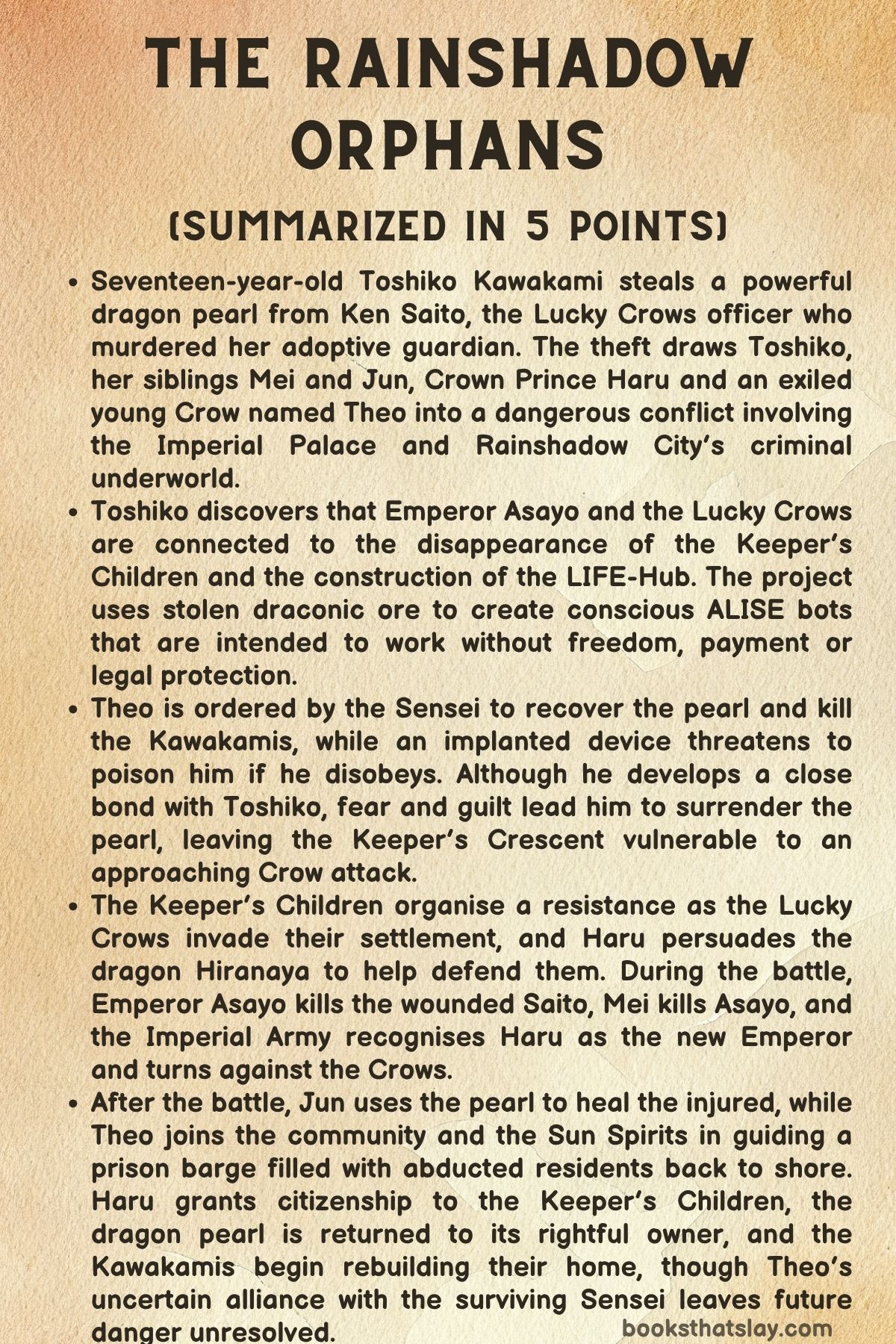
Seventeen-year-old Toshiko Kawakami enters the Imperial Palace during the Turning Leaf Festival, hoping to prove to her older siblings, Mei and Jun, that she is ready for dangerous fieldwork. Hidden in a ginkgo tree and guided by Mei’s surveillance system, she observes Emperor Asayo Soramoto’s banquet and notices Ken Saito, the Lucky Crows officer who murdered the siblings’ adoptive guardian, Auntie Reiko, sitting beside the Crown Prince.
Mei instructs Toshiko to steal Saito’s gold dragon ring because it contains access codes to the criminal organisation’s networks and accounts. Toshiko persuades ten-year-old Crown Prince Haru to treat the theft as a game, but after he obtains the ring, her presence is exposed and Saito corners her before she can escape.
Forced to return the ring, Toshiko tears an enormous pearl from Saito’s necklace and flees into the festival crowds. She does not understand that the pearl belongs to a dragon or that its disappearance will destabilise the alliance between the Imperial government and the Lucky Crows.
Haru is punished and locked in his bedroom for helping Toshiko. Neglected by his mother and surrounded by adults whose inner natures frighten him, he welcomes the arrival of Risu, a shape-changing squirrel-like Sun Spirit who emerges from the maple tree outside his window.
At the Kawakamis’ hidden apartment, Toshiko admits that she lost the ring but presents the pearl. Mei begins studying it, while Jun tries to comfort Toshiko, but the discovery of a black feather in her clothing warns them that the Lucky Crows have marked her for punishment.
At the docks, a young Crow footsoldier named Theo helps unload crates filled with material that radiates extraordinary energy. When Captain Hana tests him, Theo secretly uses his supernatural Gift to hold a falling crate in the air, causing her to recognise that he can manipulate the energy known as Sola.
Unable to remain passive, Toshiko puts on the stolen pearl. It strengthens her existing physical abilities, allowing her to move faster, fight more effectively and sense currents of energy around her.
Toshiko uses Mei’s Birdcatcher surveillance system to identify unusual Crow activity at the docks. She enters a warehouse filled with mysterious crates and deliberately allows herself to be captured so that the gang will take her to Saito.
Inside a hidden boathouse, Toshiko burns the Crows’ warning feather and confronts Saito about Reiko’s murder. Saito remembers the frightened child who witnessed the killing but coldly declares that recognising her does not mean that he cares about what he did.
Empowered by the pearl, Toshiko nearly defeats him, but Saito’s experience and the intervention of other Crows force her to flee with an injured shoulder. She reaches the Keeper’s Crescent, the impoverished settlement where the Kawakamis spent their childhood.
Mailee, an elderly healer, treats Toshiko and challenges her desire for personal revenge. She explains that killing Saito would not address the larger system involving the Crows, the Emperor and the exploitation of the Keeper’s Children, many of whom have recently disappeared.
Toshiko begins investigating the LIFE-Hub, a secretive Imperial project connected to the cargo arriving from Muralania. At the same time, Theo secretly enters Rainshadow University’s library to search for historical records of people who possessed powers similar to his Gift.
Emperor Asayo announces that the city has acquired rare draconic ore for the LIFE-Hub. She also introduces the ALISE bots, conscious humanoid beings intended to replace undocumented workers and foreign labourers while serving without wages, freedom or legal rights.
Toshiko encounters Theo after he steals a library book. Their playful interest quickly turns into an argument when Toshiko condemns the theft without understanding that Theo, who lacks legal citizenship, has no lawful access to the university.
The Kawakami siblings conclude that the missing Keeper’s Children, the draconic ore and the ALISE programme are connected. They decide to infiltrate an Imperial garden party where the first ALISE models will be displayed.
Theo is brought before the Sensei, the secretive leader of the Lucky Crows. She orders him to befriend the Kawakamis, recover the pearl and plant a bomb that will kill them, promising him magical dragon tears that can erase his memories of accidentally killing a man in Eardland.
To prevent disobedience, Saito implants an Hourglass Tracker in Theo’s neck. The device will poison him if he fails within a week, reveals his mission or attempts to remove it.
At the garden party, Toshiko and Jun pose as wealthy foreign visitors while Mei enters disguised as a Palace steward. They learn that the missing Crescent residents have been placed on a barge bound for Hanasaki Island and that fragments of draconic ore give the ALISE bots genuine consciousness.
Theo approaches Toshiko under her false identity and asks her to dance. As they speak about Eardland, he uses his Gift to create rain and a rainbow, but the growing shower washes away Toshiko’s disguise and exposes both her identity and the dragon pearl.
Haru recognises Toshiko and follows her through the Palace, still treating their encounters as a private game. He traps her near the thermal baths, waits until she removes the pearl to dry herself and escapes with it, only to be captured by Hana and taken to Saito.
Jun and Mei are separately discovered by ALISE bots. When Mei damages one while resisting arrest, the bot tells her that it feels pain, confirming that the Imperial government knowingly creates living beings only to exploit and destroy them.
Toshiko is captured and brought before Emperor Asayo, who demands the pearl and threatens Mei and Jun. Asayo reveals that her alliance with the Lucky Crows is collapsing and that she wants the pearl to defend herself against the Sensei.
Toshiko refuses to implicate Haru and claims that she lost the object. When Asayo orders her tortured, a mysteriously moving plant pot distracts the Guards, allowing Toshiko to escape with Theo’s help.
Haru escapes from Saito and witnesses his mother’s cruelty toward Toshiko. Realising that neither the Emperor nor the Lucky Crows can be trusted, he leaves the Palace with his loyal attendant, Kei, and travels to the Keeper’s Crescent.
Theo admits to Toshiko that he created the rain and can manipulate Sola. Although she discovers his connection to the Lucky Crows, his repeated efforts to protect her persuade her to continue accepting his help.
Mei and Jun mislead the Emperor by claiming that the pearl is hidden in a Crow warehouse. Mei remotely locks down the building, ensuring that the Imperial Army and the Crows will waste time fighting over it while the siblings escape to warn the Crescent.
Haru finds shelter with Kei’s friend Ren and begins discovering the community concealed behind Palace propaganda. During a vision, he sees Saito attack a family of dragons in Muralania and tear the pearl from the throat of their young child, Kiri.
Toshiko and Theo share their histories while travelling toward the Crescent. Theo describes his exile, his fear of his Gift and the fatal accident that continues to torment him, while Toshiko explains Reiko’s murder and her family’s flight from their former home.
A resistance force gathers under Ren’s direction, consisting of elderly residents, former Crows and inexperienced volunteers. Haru arrives with the pearl and explains that it must eventually be returned to Kiri, but he temporarily gives it to Toshiko so that it can be used to protect the settlement.
Believing Theo’s Gift could be strengthened by the pearl, Toshiko pressures him to use it. Terrified that he will lose control and hurt more people, Theo takes the pearl and runs rather than accept the responsibility she places upon him.
Theo returns to the Shadow Column and offers the pearl to the Sensei in exchange for his life. He refuses to kill the Kawakamis, but the Sensei accepts the pearl because she has already obtained valuable information about the Crescent’s defences through him.
The Lucky Crows attack earlier than expected, setting fires and entering the Crescent before the resistance is fully prepared. Toshiko fights without the pearl, Jun treats the injured, Mei attempts to prevent the removal of prisoners and Ren keeps the defenders united.
A turquoise dragon named Hiranaya rises from the sea during the battle. Haru learns that she is Kiri’s mother and confesses that he gave away her child’s pearl, but he persuades her to defend the Keeper’s Children.
Haru rides Hiranaya above the settlement and directs her lightning toward the attacking Crows. Although the strikes save many residents, Haru is horrified by the deaths he helps cause and begins understanding that necessary action can still leave lasting guilt.
At the Shadow Column, the Sensei reveals that the pearl amplifies a person’s strongest natural qualities and improves their control over Sola. When Theo attempts to reclaim it, she demonstrates her own mastery of energy and restrains him.
Saito wounds Hiranaya with a Sola-disrupting weapon and captures Haru. Emperor Asayo arrives with the Imperial Army and throws her sword at Saito, severely injuring him when she sees him holding her son hostage.
Saito remains alive long enough to order Hana to seize Haru. As Asayo prepares to continue the assault on the Crescent, Mei shoots an arrow into the Emperor’s throat, killing her in front of the Imperial soldiers.
General Mori immediately recognises Haru as the new Emperor. Haru orders the Imperial Army to protect the Keeper’s Children, turning the Guards against the remaining Lucky Crows.
Theo escapes from the Sensei by studying the structure of her restraints and applying what he has learned about Sola. He takes back the pearl and returns to the Crescent, where the battle has ended but hundreds of people remain injured.
Toshiko is furious with Theo for surrendering the pearl and abandoning the resistance. When he proposes immediately using it to rescue the prisoners aboard the barge, she insists that they first save the people dying around them.
Jun wears the pearl, which amplifies his ability to perceive and redirect the body’s energy. He heals wounds that would otherwise be fatal, although the effort exhausts him and turns parts of his hair grey.
After the injured are stabilised, Theo enters the sea with the pearl and tries to redirect the wind, currents and tides around the prison barge. The task overwhelms him, but Sun Spirits, Hiranaya, Haru, Kei, Toshiko and the Keeper’s Children form a chain in the water and share the strain.
Working together through the night, they guide the barge back to Rainshadow Island. Hundreds of abducted Keeper’s Children, including Mailee, are freed, while the Imperial Guards arrest the Crows who controlled the vessel.
Jun returns Kiri’s pearl to Hiranaya after using it to heal part of the dragon’s injuries. Hiranaya carries the pearl back toward Muralania, while Haru remains behind to accept responsibility for ruling the Archipelago.
The new Emperor grants citizenship to the Keeper’s Children and promises resources for rebuilding the Crescent. Mei plans to remain politically involved, Jun continues healing and Toshiko recognises that dismantling the system that empowered Saito and Asayo is a more meaningful form of justice than personal revenge.
Theo, however, is still dying from the Hourglass poison and refuses to seek Jun’s help because he believes others are more deserving. When the surviving Sensei offers him an antidote and magical training in exchange for helping her recover a hidden Yurei army, he initially considers refusing but saves the antidote from being destroyed, admitting through that action that he still wants to live.
Characters
Toshiko Kawakami
Toshiko is the central protagonist of The Rainshadow Orphans, beginning as a determined seventeen-year-old who wants to prove that she is as capable as her older siblings. Her decision to enter the Palace reflects courage and skill, but it also reveals impatience, pride and a tendency to treat danger as a test of her personal worth.
Her hatred of Saito is rooted in the childhood trauma of witnessing Reiko’s murder. At first, Toshiko believes that confronting or killing him will provide justice, yet her return to the Keeper’s Crescent forces her to recognise that Saito is only one participant in a much larger system of exploitation.
The dragon pearl magnifies Toshiko’s speed, agility and combat instincts, symbolising both her natural potential and her attraction to immediate action. Because the pearl makes her unusually powerful, she sometimes assumes that determination alone can solve problems that actually require cooperation, preparation and trust.
Her relationship with Theo exposes both her generosity and her judgmental side. She is drawn to his kindness and vulnerability, but she initially condemns his theft and later pressures him to use the pearl without fully respecting his fear of losing control.
Toshiko matures by accepting that bravery does not mean acting alone. Her eventual participation in the collective rescue of the prisoners shows that she has moved beyond personal revenge and toward responsibility for an entire community.
Haru Soramoto
Haru begins as a lonely Crown Prince whose privileged surroundings conceal emotional neglect. Emperor Asayo treats him more as an inconvenience or failed successor than as a child, leaving him desperate for attention and recognition.
His unusual ability to perceive the inner nature of people gives him moral insight before he possesses the maturity to interpret it. He senses that Saito resembles a violent storm and that Toshiko resembles a lantern, showing that he instinctively recognises cruelty and goodness even when official authority tells him otherwise.
Haru’s early pursuit of Toshiko is playful and childish. Stealing the pearl allows him to believe that he has won their game, but the consequences force him to understand that he has entered a struggle involving kidnapping, slavery, political betrayal and death.
Risu, Kei and the Keeper’s Children give Haru the affection and moral guidance missing from his life at the Palace. Through them, he learns that leadership depends on listening, protecting others and acknowledging their humanity rather than demanding obedience.
His journey with Hiranaya brings him into direct contact with the consequences of violence. Directing the dragon’s lightning saves innocent people, yet his horror at the deaths prevents him from becoming emotionally hardened.
After his mother’s death, Haru does not simply inherit power; he consciously chooses how that power will be used. His first major orders defend the Crescent and recognise the Keeper’s Children as citizens, suggesting that his reign may replace fear with responsibility.
Theo
Theo is one of the most morally conflicted figures in The Rainshadow Orphans. As an exile without citizenship, he survives within the Lucky Crows while secretly searching for evidence that his Gift does not make him unnatural or alone.
His past is dominated by guilt over accidentally killing Susanna’s uncle. The Sensei exploits this guilt by offering memory-erasing dragon tears, understanding that Theo does not merely want safety but release from the burden of remembering what he has done.
Theo’s connection to Sola gives him remarkable potential, yet he associates power with catastrophe. His fear of losing control explains why he hesitates when Toshiko asks him to defend the Crescent with the pearl, even though his decision to run causes serious harm.
His betrayal is not motivated by cruelty. He is trapped by the Hourglass Tracker, manipulated by the Sensei and convinced that survival requires surrendering the pearl, but the damage remains real because fear leads him to abandon people who trusted him.
Theo’s relationship with Toshiko gives him a glimpse of belonging. Their conversations allow him to speak honestly about exile, guilt and beauty, while her refusal to excuse his actions forces him to confront the difference between understanding a choice and removing responsibility for it.
By reclaiming the pearl, returning to the Crescent and guiding the prison barge home, Theo begins to use his Gift deliberately rather than fearfully. His final encounter with the Sensei shows that he still struggles with self-worth, but saving the antidote proves that part of him believes his life may deserve another chance.
Mei Kawakami
Mei is the intellectual and strategic centre of the Kawakami family. Her surveillance systems, computer skills and technical knowledge repeatedly allow the siblings to understand the Crows’ movements, infiltrate protected locations and disrupt plans that appear far beyond their power.
She often presents herself as controlled and practical, but her restraint does not indicate emotional distance. Her anger at the exploitation of the Keeper’s Children is intense, and her loyalty to Toshiko and Jun shapes nearly every decision she makes.
The pearl reveals that Mei’s strength is not physical aggression but analytical capability. Even without using it for long, she understands that it enhances a person’s existing qualities, demonstrating her ability to turn unfamiliar magic into useful knowledge.
Mei’s encounter with the injured ALISE bot changes the political meaning of the LIFE-Hub. Once she learns that the bots experience pain, the project can no longer be dismissed as advanced machinery because it is a system for creating, enslaving and destroying conscious beings.
Her killing of Emperor Asayo is a decisive and morally difficult act. Mei fires not only to protect Haru and the Crescent but also to punish a ruler responsible for widespread suffering, placing herself in the role of both defender and executioner.
After the battle, others view her as a symbol of resistance, while Toshiko begins to recognise the weight Mei carries beneath her calm appearance. Mei’s determination to remain politically involved shows that she understands victory as the beginning of reconstruction rather than the end of responsibility.
Jun Kawakami
Jun is the compassionate and stabilising presence within the Kawakami family. He offers food, humour and physical comfort during moments of fear, often preventing Mei’s intensity and Toshiko’s impulsiveness from tearing the siblings apart.
His skills with disguises reveal creativity and careful observation. Jun understands how posture, clothing, behaviour and social expectations create identity, making his work essential to the family’s infiltration of the Palace.
The pearl exposes his deepest natural ability: the capacity to perceive pain and guide the body toward healing. This power matches his personality because Jun instinctively responds to danger by protecting life rather than defeating an enemy.
During the battle, he chooses to remain with the wounded instead of escaping or seeking personal safety. His decision demonstrates that courage can appear through sustained care, especially when treating strangers, former enemies and members of opposing forces.
Using the pearl comes at a physical cost, shown by his exhaustion and greying hair. Jun nevertheless continues until the critically injured are stabilised, accepting personal harm because his power gives others a chance to survive.
His treatment of Hiranaya extends his compassion beyond humanity. By recognising the dragon as a physical manifestation of Sola, Jun learns that healing requires respect for forms of life that exceed his existing understanding.
Kei
Kei is Haru’s attendant, protector and most reliable parental figure. Unlike Asayo, she listens to him, takes his unusual perceptions seriously and explains the spiritual world without mocking or dismissing him.
Her knowledge of Sola, Sun Spirits and dragons helps Haru understand Risu and his own rare sensitivity. She does not give him every answer, but she provides a framework through which his experiences become meaningful rather than frightening.
Kei’s decision to leave the Palace with Haru is a major act of loyalty. She risks her position and safety because she recognises that remaining within the Imperial household would place him under the control of people who value power more than his wellbeing.
Her relationship with Ren also reveals a personal life beyond royal service. The warmth between them offers Haru his first experience of an affectionate adult partnership based on mutual respect.
Kei continues supporting Haru after he becomes Emperor, but she does not treat his new authority as a reason to withdraw emotional care. She remains beside him as he confronts loss, responsibility and the difficult transition from neglected child to national ruler.
Ken Saito
Saito represents organised violence protected by wealth and political access. His presence beside the Crown Prince at the Imperial banquet immediately demonstrates that the Lucky Crows are not operating outside the system but are connected to its highest level.
His murder of Reiko defines Toshiko’s understanding of him, yet his response to her confrontation is even more disturbing than the crime itself. He remembers the child hiding beneath the table but refuses to grant emotional importance to her suffering.
Saito is physically skilled, experienced and ruthless. Even when Toshiko is strengthened by the pearl, he survives her attack because he understands how to remain controlled during violence and how to use other people as extensions of his power.
His relationship with the pearl also reveals his limitations. Although naturally insensitive to Sola, he has been trained to exploit its energy, showing how discipline can turn even spiritual power into an instrument of domination.
Saito’s final attempts to control Haru continue after he has been mortally wounded. His refusal to surrender authority suggests that power has become the foundation of his identity, leaving him unable to imagine existence without fear, rank and obedience.
His death ends Toshiko’s personal pursuit, but it does not resolve the suffering he helped create. The story therefore prevents him from becoming the single source of evil and instead presents him as one powerful agent within a broader corrupt structure.
Emperor Asayo Soramoto
Emperor Asayo is a ruler whose public promises of progress conceal exploitation and cruelty. She presents the LIFE-Hub and ALISE bots as technological achievements while knowingly planning to create conscious beings for unpaid labour and eventual destruction.
Her treatment of Haru mirrors her political behaviour. She values people according to usefulness, repeatedly comparing her son to his late father and withholding affection because Haru does not fit her image of strength.
Asayo’s alliance with the Lucky Crows demonstrates her willingness to depend on criminals when they support her ambitions. When the relationship collapses, she seeks the pearl not to correct her abuses but to preserve her position against the Sensei.
Her confrontation with Toshiko reveals how quickly ceremonial authority becomes physical violence. She strikes, humiliates and threatens torture when persuasion fails, showing that the Palace’s elegance rests upon coercion.
Asayo does save Haru from Saito, but the act does not erase her cruelty. Her immediate return to military aggression confirms that maternal instinct and political tyranny can exist within the same person without cancelling one another.
Her death at Mei’s hands ends the old regime but leaves serious questions about political killing. The novel treats her removal as necessary for the Crescent’s survival while still showing the emotional and moral burden carried by the person who fires the arrow.
The Sensei
The Sensei is the calculating leader of the Lucky Crows and one of the story’s most dangerous manipulators. Her authority depends not only on criminal organisation but also on advanced knowledge of Sola, dragons, living bots and psychological control.
She identifies Theo’s guilt as his greatest vulnerability. Rather than simply threatening him, she offers him the possibility of forgetting his worst memory, turning his desire for emotional relief into a weapon against the Kawakamis.
The Hourglass Tracker reflects her governing philosophy. She does not trust loyalty or persuasion when fear, poison and surveillance can make disobedience appear impossible.
Her title gains additional meaning when she reveals herself as a trained practitioner of Sola. She is a teacher who has used knowledge to build hierarchy, producing students such as Saito who understand power primarily as domination.
Even after losing the pearl and the battle for the Crescent, she continues planning. Her offer of an antidote to Theo is another carefully designed bargain that combines genuine survival with future enslavement.
The Sensei’s survival prevents the conclusion from suggesting that one victory has destroyed corruption. She represents the ability of oppressive systems to reorganise themselves, adopt new tools and exploit the unresolved needs of vulnerable people.
Captain Hana
Hana is a senior Crow whose discipline and alertness make her valuable to the organisation. She notices Theo’s hidden Gift at the docks and quickly places him on the path toward the Sensei’s special assignment.
Her actions reveal loyalty to rank rather than to a personal moral code. She participates in the capture of Haru and continues obeying Saito even when the Lucky Crows’ alliance with the Emperor has collapsed.
Hana is particularly dangerous because she rarely displays the emotional instability seen in other antagonists. She treats intimidation, kidnapping and threatened murder as professional duties.
Her decision to hold a dagger against Haru’s throat demonstrates how completely the gang has reduced human beings to bargaining tools. Even a child becomes useful only as leverage against political opponents.
Unlike Theo, Ava or the Santos brothers, Hana shows little evidence of questioning the system that gives her status. Her character illustrates how competence becomes destructive when it is separated from moral reflection.
Ren
Ren is a community organiser whose strength comes from trust rather than official authority. He has devoted himself to protecting the Keeper’s Children and understands both the dangers facing the Crescent and the limited resources available to resist them.
His modest home offers Haru a direct contrast to the Palace. Although Ren possesses far less wealth, his relationship with Kei and his hospitality create a sense of safety that Imperial luxury never provided.
Ren does not romanticise the resistance. He knows that many volunteers are elderly, inexperienced or frightened, yet he refuses to conclude that their lack of military power makes their efforts meaningless.
During the battle, his calls for unity prevent panic from destroying the defence. He gives people a shared purpose, reminding them that their home is worth protecting even when success appears unlikely.
Ren’s leadership suggests an alternative to Asayo, Saito and the Sensei. He guides through solidarity, practical organisation and respect, proving that authority does not need fear to remain effective.
Mailee
Mailee is an elderly healer and moral guide whose understanding of justice influences Toshiko’s development. She treats Toshiko’s physical wound while also challenging the revenge that has shaped her decisions.
Her argument about the “bigger picture” redirects attention from Saito as an individual to the network of political and economic forces harming the Keeper’s Children. She recognises that removing one murderer will not automatically transform the conditions that allowed him to act.
Mailee’s café is both a place of care and a centre of community life. After the battle, it becomes a medical facility where Keeper’s Children, Guards and former Crows are treated without distinctions based on allegiance.
Her kidnapping makes the larger crisis personal for Toshiko and the resistance. When she returns on the prison barge, her survival represents the recovery of a person whose wisdom and care help hold the community together.
Mailee praises Toshiko’s courage without encouraging self-glorification. Her presence continually connects heroism with service, healing and awareness of consequences.
Risu
Risu is a small Sun Spirit who becomes Haru’s first true companion. Its appearance during his confinement provides comfort at a moment when the Palace has made him feel unwanted and alone.
The creature’s shifting autumn colours connect it to the natural world and the spiritual energy flowing through Rainshadow. Risu also confirms that Haru’s strange perceptions are genuine rather than products of imagination.
Risu guides Haru during moments of danger, particularly when he needs to escape the Palace and find Kei. Its help is gentle rather than controlling, allowing Haru to make decisions for himself.
As the dragon pearl leaves the island, Haru gradually loses the ability to see Risu. Their farewell teaches him that the end of visible contact does not erase a meaningful bond.
Risu therefore represents companionship that does not depend on possession. Its influence remains with Haru even when his new responsibilities force him to move forward without its constant presence.
Hiranaya
Hiranaya is the turquoise dragon whose arrival transforms the defence of the Crescent. As Kiri’s mother, she is personally connected to the pearl that humans have stolen, traded and used without considering its rightful owner.
Her history exposes Saito’s violence against Muralania’s dragons. The theft of Kiri’s pearl is not merely the acquisition of a magical object but an attack upon a family and a living spiritual being.
Hiranaya’s decision to help the Crescent demonstrates moral generosity. Although Haru admits that he gave away the pearl, she responds to his honesty and his plea for innocent lives rather than punishing him.
Her lightning is devastating but carefully directed. Even so, the deaths it causes force Haru to confront the moral cost of using overwhelming power for protection.
Hiranaya’s injuries show that spiritual greatness does not make her invulnerable. Her dependence on Jun’s healing and the collective support of ordinary people creates a relationship of cooperation rather than one-sided rescue.
Her departure restores the pearl to its proper world while leaving Haru with unfinished responsibilities. She becomes both a protector and a reminder that human political conflicts have consequences beyond human society.
Kiri
Kiri is the young blue dragon whose stolen pearl drives much of the conflict. Although Kiri does not appear directly in Rainshadow City, the child’s loss connects the ambitions of the Crows, the Emperor and the Sensei.
The pearl is treated by powerful humans as a weapon, resource and symbol of control. Haru’s vision restores its true meaning by revealing that it was violently torn from a frightened child.
Kiri’s absence gives the object an ethical history. Every person who wears or pursues the pearl must confront the fact that its power was obtained through the suffering of another living being.
Returning it becomes an act of restitution rather than the simple disposal of a dangerous artefact. The choice recognises that victory does not give the people of Rainshadow permanent ownership of something stolen from Muralania.
Auntie Reiko
Reiko is the Kawakamis’ deceased adoptive guardian, but her influence remains central to the siblings’ identity. She gave them safety, family and the Kawakami name after they had experienced insecurity and displacement.
Her explanation that Kawakami means “above the river” becomes the family’s guiding principle. The phrase teaches the siblings that they do not have to follow the direction imposed by circumstance, authority or fear.
Reiko’s murder leaves Toshiko with trauma and a powerful desire for revenge. For Mei and Jun, the loss also strengthens their determination to keep the remaining family together.
By the conclusion, honouring Reiko no longer means killing Saito alone. The siblings remain “above the river” by helping dismantle the structures that condemned the Keeper’s Children to poverty and vulnerability.
Ava
Ava is a former Crow who returns to defend the Keeper’s Crescent despite the suspicion surrounding her. Her presence challenges the belief that membership in an oppressive organisation permanently defines a person’s moral identity.
Raised as a Keeper’s Child, Ava regards the Crescent as her true home. Her decision to stand with its residents reflects an attempt to reclaim belonging through action rather than demand automatic forgiveness.
During the battle, she tries to rescue captured residents. This willingness to risk herself gives practical meaning to her claim that she has changed.
Ava also influences Toshiko’s growing doubts about treating every Crow as incapable of redemption. Through her, the story distinguishes accountability from the refusal to recognise transformation.
Hiroto and Daichi Santos
Hiroto and Daichi are Crow brothers shaped by loss, displacement and loyalty to family. They survived the Hanasaki Island disaster but lost their sister, leaving them vulnerable to an organisation that offers belonging, structure and the possibility of reward.
When they intercept Jun, his description of Toshiko as a foolish younger sister appeals to their own grief. Hiroto’s decision to release him shows that personal compassion has not been completely erased by gang membership.
The brothers demonstrate why the Lucky Crows cannot be understood only as a collection of naturally cruel people. Some members have been recruited from desperate communities and taught to seek survival through violence.
Their brief act of mercy also affects Theo, who watches from nearby. By seeing Crows disobey the logic of punishment, Theo begins questioning the system that has turned outsiders against one another.
General Mori
General Mori initially serves the Imperial regime, but his role changes immediately after Asayo’s death. By bowing to Haru, he recognises the lawful succession and redirects the Army’s loyalty toward the new Emperor.
His obedience to Haru allows the Imperial Guards to defend the Keeper’s Children rather than continue attacking them. This decision becomes essential to defeating the remaining Crows.
Mori’s rapid shift also demonstrates the dangerous concentration of authority within the Imperial system. The same military force that threatened the Crescent can become its defender based on a single ruler’s order.
He therefore represents both institutional continuity and the possibility of institutional redirection. His future value will depend on whether he supports Haru’s reforms as principles rather than merely following whoever occupies the throne.
Mochi
Mochi is the Kawakami family cat and a source of warmth within a dangerous story. The animal accompanies Toshiko during her investigation and becomes involved in the siblings’ operations despite having no understanding of the political struggle.
Jun’s preparation of a disguise for Mochi reflects the affection and humour within the family. Such moments prevent the Kawakamis from becoming defined entirely by trauma and resistance.
Mochi also represents ordinary domestic life. The cat’s presence reminds the siblings what they are trying to preserve: a home where affection, food, jokes and companionship can continue without fear.
Rei
Rei is a living Yurei introduced near the conclusion alongside the surviving Sensei. Rei’s existence confirms that the earlier LIFE-Hub experiments created organic bots from biological material stolen from kidnapped Keeper’s Children.
As a conscious product of those experiments, Rei complicates the distinction between human, machine and magical being. Rei is neither an object nor merely evidence of a crime but a living individual whose future remains connected to the Sensei’s plans.
The character’s brief appearance expands the unresolved conflict. It suggests that the abandoned Yurei army contains beings who may possess their own desires even while powerful people attempt to claim them as weapons.
Themes
Power, Exploitation and the Value of Life
The Rainshadow Orphans examines power by showing how political, criminal and technological systems classify certain lives as valuable and others as disposable. Emperor Asayo celebrates the ALISE programme as progress because it promises cheap labour, but the programme depends on creating conscious beings, denying their freedom and destroying them when they are no longer useful.
The treatment of the Keeper’s Children follows the same logic. They perform essential work within Rainshadow City, yet their lack of citizenship allows the government to remove them from their homes, use their bodies in experiments and present their disappearance as an administrative necessity.
The Lucky Crows claim to offer protection and advancement to outsiders such as Theo, Ava and the Santos brothers. In reality, the organisation converts fear, poverty and guilt into obedience, ensuring that vulnerable recruits serve leaders who possess information, wealth and magical resources.
The dragon pearl is another example of life being converted into property. Saito, the Sensei and Asayo treat it as an instrument of authority, while Haru’s vision reveals that it belongs to a child who was attacked and robbed.
The book repeatedly rejects the belief that usefulness determines worth. ALISE bots, dragons, undocumented workers, Sun Spirits and frightened children all possess lives that cannot be morally reduced to labour, weapons or political symbols.
Family, Belonging and Chosen Community
The Kawakami siblings are not connected by a conventional biological household, yet their loyalty forms one of the strongest relationships in the story. Reiko gives them a shared name and philosophy, allowing three orphaned children to understand themselves as a family capable of choosing its own direction.
Their bond is loving but imperfect. Toshiko resents being protected, Mei sometimes controls situations through planning, and Jun frequently has to soften conflict, yet their disagreements never erase their commitment to one another.
Haru’s life presents the opposite situation. He possesses royal blood, wealth and a living parent, but he receives little affection until Kei, Risu, Ren and the Keeper’s Children show him forms of care absent from the Palace.
Theo’s loneliness also grows from the absence of secure belonging. Exiled from Eardland and denied citizenship in Rainshadow, he enters the Lucky Crows because dangerous communities can appear protective when every lawful institution has already rejected a person.
The Crescent eventually becomes a chosen community large enough to include former Crows, Imperial Guards, magical beings and displaced residents. Belonging is not portrayed as automatic innocence, since Theo and Ava must answer for their choices, but neither is it reserved only for people with flawless histories.
The shared rescue of the prison barge shows community as an active practice. Individuals become powerful not by losing their differences but by joining their abilities, bodies and hope toward a common purpose.
Choice, Guilt and Moral Responsibility
Nearly every major character must make decisions under coercion, fear or incomplete knowledge. The story acknowledges these pressures without suggesting that difficult circumstances remove all responsibility for the harm a person causes.
Theo provides the clearest example. The Sensei threatens his life, exploits his guilt and places poison inside his body, yet his decision to surrender the pearl still endangers the Crescent and breaks Toshiko’s trust.
His later return does not erase the betrayal. Redemption begins when he faces the wounded, accepts Toshiko’s anger and uses his Gift to help rescue the people whose suffering he helped intensify.
Toshiko also learns that good intentions do not guarantee good judgment. Her desire to defend the Crescent leads her to pressure Theo into using power he fears, and her certainty that all Crows deserve punishment weakens when she encounters people capable of mercy or change.
Haru and Mei face even harsher choices during the battle. Haru directs lethal lightning to stop an invasion, while Mei kills Asayo before the Emperor can continue the attack.
Neither character celebrates these deaths. Their discomfort preserves their humanity and shows that an action can be necessary within a crisis while still producing grief, doubt and moral injury.
Responsibility therefore involves more than deciding whether an action was justified. It requires acknowledging consequences, repairing damage where possible and refusing to turn violence into a source of pride.
Resistance, Cooperation and Social Change
The Keeper’s Children appear powerless when measured against the Imperial Army, the Lucky Crows and the magical resources controlled by their enemies. Their resistance begins when they reject the assumption that smallness, poverty or lack of training makes action meaningless.
Ren organises elderly residents, inexperienced volunteers and former gang members into a defence based on shared commitment. Mei contributes intelligence, Jun heals, Toshiko fights, Haru changes the direction of the Army and Theo manipulates natural forces.
No single person wins the conflict. Even Hiranaya’s strength is insufficient without Haru’s guidance, Jun’s healing and the community’s willingness to stand together.
The return of the prison barge provides the clearest image of collective power. Theo begins the effort, but he succeeds only when Sun Spirits, a wounded dragon, the new Emperor, his companions and ordinary residents form a physical and spiritual chain.
The political outcome also extends beyond military victory. Granting citizenship and rebuilding the Crescent address some of the conditions that allowed kidnapping and exploitation to continue without consequence.
However, the conclusion does not suggest that one decree has solved inequality. Mei understands that resentment, prejudice and unequal power will survive legal reform, which is why she intends to remain involved.
Resistance is therefore presented as both confrontation and reconstruction. Defeating oppressors creates an opening, but lasting change depends on continued organisation, accountability, healing and the willingness to build institutions that recognise every form of life.