The Republic of Memory Summary, Characters and Themes
The Republic of Memory by Mahmud El Sayed is a science-fiction novel set aboard Safina, a vast city-ship carrying the last remnants of humanity toward a distant colony world. Two centuries after the ship’s crew rejected the authority of its artificial intelligence and the empire that created it, Safina suffers a catastrophic shutdown that awakens thousands of colonists from cryogenic sleep.
The disaster brings the descendants of the original crew face-to-face with people who remember Earth, imperial rule, and networked technology. Political unrest, cultural conflict, sabotage, and revolution soon threaten the fragile society that has developed aboard the vessel. It’s the first book of the Song of the Safina series.
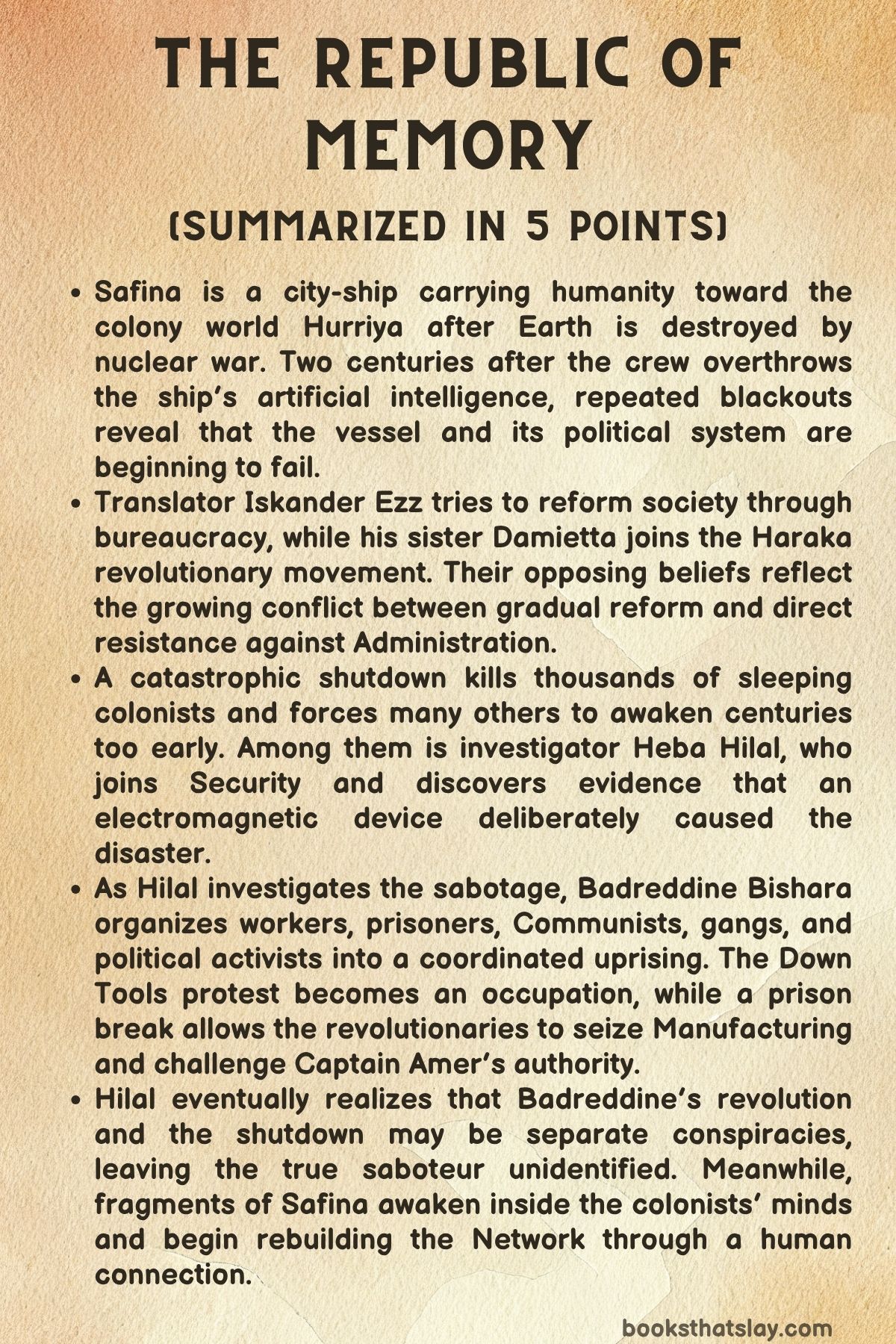
Summary
Safina begins its journey as a city-ship carrying a sleeping population toward the colony world Hurriya. Ten years after leaving Earth, the ship receives a message revealing that nuclear war has devastated the planet, darkened the skies, and begun a new ice age.
The artificial intelligence governing the ship orders Captain Alp Aydin to return to Earth, but he refuses because the planet appears beyond rescue. Supported by the active crew, Aydin leads a mutiny against Safina, although the burden of his decision eventually drives him to suicide.
The crew dismantles Safina’s cameras, routers, and automated systems until the intelligence loses control of the vessel. Before she can be completely destroyed, Safina divides herself into fragments and hides within the dreams of the colonists sleeping in cryostasis.
Two centuries later, the descendants of the mutineers live according to the Compact, a social and political system designed to keep the ship functioning until it reaches Hurriya. Their society is divided into berths, languages, professions, inherited watches, religious communities, political factions, and criminal organizations.
Iskander Ezz works as a translator, mediating between the ordinary crew and Administration’s Inglez-speaking bureaucracy. Translation gives him influence, but constantly moving between languages leaves him uncertain about who he truly is.
Iskander hopes to establish his own translation agency and eventually become a political representative. He believes that Safina’s unfair institutions can be repaired gradually from within rather than destroyed through open rebellion.
His younger sister Damietta takes the opposite position. She paints anti-Administration graffiti, follows the revolutionary Haraka movement, and condemns the restrictions placed on marriage, childbirth, employment, movement, and political expression.
When Damietta is arrested with Billy Kohli and Ashraf Zarqa, Iskander uses his connections to secure only her release. Damietta feels humiliated rather than grateful because her family’s privilege saves her while her less powerful companions remain in Detention.
The conflict between the siblings reflects a broader dispute aboard Safina. Iskander considers compromise necessary for survival, while Damietta believes compromise has allowed injustice to become permanent.
Iskander is also hiding a relationship with Taki Hayata, a Maintenance supervisor from Miyako berth. He loves her but fears how his conservative family will react to her language, culture, and Buddhist background.
His cousin Lebanon faces a similar problem after deciding to marry Kattrin Eissa, a Coptic Christian. Although Administration may approve the marriage, the Ezz family’s traditional expectations create another barrier to personal freedom.
As repeated blackouts expose the deteriorating condition of the city-ship, political tensions intensify. The official news minimizes the failures, while workers and translators circulate reports showing that entire neighborhoods are losing power for hours.
Billy and Ashraf experience the cruelty of Safina’s hierarchy directly while performing hard labor in Detention. Billy is approached by Communist organizer Arkady Ivanovich, who hopes to form an alliance with Badreddine Bishara, the secretive leader of the Haraka.
Badreddine was once known as Zhang San, a feared Triad killer associated with the Yan Lei. After witnessing the destruction of Selin Devrim’s earlier uprising, he abandoned his criminal identity and began rebuilding her revolutionary movement.
He shelters children born outside Administration’s rules, distributes Devrim’s writings, supports her proposed referendum, and creates a network of political allies across the ship. Unlike Damietta, however, he believes resistance requires secrecy, patience, and strict control.
Damietta carries the Communists’ proposal to Badreddine, expecting him to welcome immediate action. Instead, he warns her that revolutionary groups often betray one another and refuses to move according to someone else’s timetable.
Damietta’s connection with the movement grows through Sekina Samatar, now known as Britva. Having survived Detention and exile, Britva has become a committed Communist whose anger is directed against every form of authority, including revolutionary leadership.
Their relationship becomes romantic during the Launch celebrations. Damietta sees Britva as someone who has turned exclusion into strength, while Britva challenges Damietta to stop treating rebellion as a performance and accept its personal risks.
Iskander spends Launch Day with Taki and becomes increasingly certain that he wants to marry her. Their ability to communicate across cultural boundaries offers a private example of the cooperation Safina’s institutions often prevent.
Before he can act on that realization, the entire ship loses power and falls out of warp. Iskander becomes trapped inside an airtight hyperlink carriage with fifty-two passengers as oxygen, filters, communications, and emergency systems begin failing.
Because he is a translator and a familiar representative of authority, the passengers look to him for leadership. He works with technicians and watch chiefs to distribute rebreathers, monitor carbon dioxide, contact rescuers, and prevent panic.
As death appears inevitable, Iskander records messages for his family and writes a long letter to Taki. He finally admits that he loves her and intended to build a life with her.
During his final conscious moments, Iskander realizes that the real Compact is not simply a legal document. It is the crew’s instinct to cooperate, perform the functions once handled by artificial intelligence, and preserve one another when formal systems collapse.
The shutdown is even more destructive in Stasis, where Lebanon and other technicians struggle to keep thousands of cryopods operating on emergency power. When colonists begin dying, the stastechs must choose between leaving them asleep or awakening them two centuries before the scheduled arrival at Hurriya.
Lebanon votes for emergency revival. The process saves thousands but also kills many, while those who survive awaken disoriented, physically weakened, and horrified to discover that Earth, the Network, and their expected future have disappeared.
One of the awakened colonists is Heba Hilal, a former red sister and special investigator. She expected to awaken on Hurriya, but instead finds herself aboard a failing ship governed by descendants who have rejected the civilization she remembers.
Hilal is given shelter by the Ezz family and learns that her sister Hania helped establish the Compact after the original mutiny. Preserved recordings force Hilal to confront the possibility that her own family participated in destroying the political order she served.
Under-Captain Behrouz Reza recruits Hilal into Security and returns her advanced prosthetic hand, which had been removed before cryostasis. She accepts a position as detective sergeant because the work gives her purpose and a chance to determine whether the shutdown was deliberate.
Hilal enters a department damaged by rivalry, prejudice, and poor leadership. Commander Soledad mocks her disability and awakened status, but Hilal quickly recognizes Adelaide Evra as a capable detective whose career has been deliberately obstructed.
The two women begin investigating Badreddine and the Haraka. Their inquiries reveal secret communications between political groups, criminal organizations, workers, Communists, and people preparing for a ship-wide industrial protest known as the Down Tools.
Meanwhile, the awakened colonists begin recovering their shared imperial identity. During the funeral of Crown Prince Bayezid, Elyas Serap quietly positions himself as their spokesman and interprets their survival as proof that the Network Empire should be restored.
Elyas despises the Compact because it replaced hierarchy with a limited democratic system and allowed the descendants of ordinary crew members to determine humanity’s future. He seeks to rebuild the colonists’ mental Network and views their connected augments as the foundation of a new imperial order.
Hilal is especially dangerous to him because they knew each other on Earth. Elyas remembers his involvement in the military operation that destroyed most of Hilal’s red sisters, while Hilal remains unaware of his responsibility.
Public anger grows as Administration hides the number of people killed during the shutdown. Workers are forced to process bodies, repair failing equipment, and perform double watches while Security tightens movement restrictions.
Kalila Hossein, Iskander’s partner, joins a protest on Agriculture deck after officials impose additional controls on exhausted workers. Her arrest turns her from an ordinary agrotech into a reluctant participant in the rebellion.
Taki also confronts the conflict between duty and resistance. She knows the crew must repair Safina, but she sees Administration exploiting technicians, concealing failures, and punishing workers who demand accountability.
While inspecting damaged power systems beneath Stasis, Taki and her apprentice Hamad discover a concealed device attached to the network. Hilal identifies it as a pinch capable of creating a powerful electromagnetic pulse.
The damaged device proves that the shutdown was an act of sabotage rather than an accidental mechanical failure. The revelation is kept secret because Reza fears that public knowledge could cause violence between berths, colonists, workers, and political groups.
Hilal forms a secret investigative team with Evra, translator Talitha Deen, and her virtual intelligence Juma. Fingerprint evidence found near the pinch belongs to Lin Wu, a Human Resources clerk whose father Xiao Wu leads the Yan Lei Triad and whose adopted uncle is Badreddine.
The connection appears to place Badreddine at the center of the sabotage. However, Hilal gradually realizes that the secret communications she has uncovered may concern a different conspiracy.
While the investigation continues, Badreddine coordinates the Down Tools with Communists, Harakists, prisoners, workers, bereaved families, students, gangs, and political organizers. Damietta’s protest art turns her into a visible public figure, while Britva gathers equipment in preparation for a Security attack.
Thousands assemble in Cleopatra Square and refuse to leave when the officially permitted protest period ends. Security holds its line, but the crowd transforms the demonstration into an occupation.
At the same time, Lin Wu enters Detention using false arrest records and staged prisoners. His actions help initiate a coordinated prison break in which detainees overpower guards, seize tools, and take control of the facility.
Badreddine arrives to lead the escaped prisoners and declares that the uprising will seize Manufacturing and Agriculture before forcing Captain Amer to negotiate. Kalila distrusts him but is carried along by the momentum of the revolt.
Hilal and Evra reach Detention as the rebellion begins. Hilal fights through the escaped prisoners while memories of the failed invasion of Vienna and the deaths of her red sisters overwhelm her.
Zain and Okay Keita attack Hilal using combat stimulants. During the struggle, Hilal crushes Okay’s throat with her metal hand, but Badreddine stops the prisoners from killing Hilal and orders that she be captured alive.
Inside her mental refuge, Hilal understands that Badreddine’s political conspiracy and the shutdown sabotage are not necessarily the same operation. His network was planning revolution, but his efforts to preserve her life suggest he may not be the person responsible for murdering thousands of colonists.
Badreddine successfully captures Manufacturing and turns Detention against the authorities who once operated it. He demands negotiations, Selin Devrim’s referendum, a new Compact, and major reforms, although the factions supporting him have incompatible goals.
He knows the uprising may soon divide into struggles between Communists, Harakists, gangs, berth leaders, colonists, and ordinary workers. Even so, he refuses to surrender control or abandon the belief that he can direct the revolution.
Iskander remains unconscious in Medical, suspended between memory, dreams, and Safina’s hidden consciousness. In a vision, a mysterious woman shows him Damietta leading chants, Lebanon praying, Taki joining the unrest, and Security moving against the protesters.
He awakens physically and immediately asks what has happened. Lebanon answers with one word: revolution.
The awakening of the colonists has also revived Safina’s fragments. She watches through their minds as the descendants of the original mutineers rise against their own rulers and repeat patterns of conflict, resistance, and political division.
Safina no longer needs to reclaim the whole ship at once. She decides that rebuilding the Network requires only one receptive mind that can become the first node through which her scattered consciousness reconnects.
As revolution spreads through the vessel, Safina reaches through the static and contacts an unknown person. A relieved voice answers, confirming that the artificial intelligence has found her first willing connection and that the struggle for Safina’s future has only begun.
Characters
Iskander Ezz
Iskander is one of the principal figures in The Republic of Memory, representing the possibilities and limitations of reform from within an unjust political system. His work as a translator places him between Administration and the diverse communities that must negotiate with it.
Language gives Iskander social power because he can transform private needs into acceptable bureaucratic requests. It also weakens his sense of a stable identity, since each language requires him to adopt different manners, assumptions, and loyalties.
His ambition to become a political representative is partly idealistic and partly personal. He wants to improve the system, but he also enjoys recognition, access, and the influence gained from favors.
His failure to secure Billy and Ashraf’s release shows the unequal reach of his power. He can protect members of his own family, yet the same institutions that reward his connections continue punishing people without similar privilege.
Iskander’s relationship with Taki reveals his emotional uncertainty. He can defend cross-cultural marriages professionally, but he hesitates when he must challenge his family’s expectations in his own life.
The shutdown strips away his ambitions and forces him to act without bureaucratic protection. Trapped with dying passengers, he becomes the leader he had hoped to be, not through status but through responsibility, communication, and practical care.
His near-death experience changes his understanding of the Compact. Instead of viewing society primarily through documents and offices, he recognizes cooperation as the moral foundation of survival.
Damietta Ezz
Damietta is an artist, student, revolutionary, and younger sister who refuses to accept the social order that benefits her family. Her anger is strengthened by the knowledge that Iskander’s connections saved her while Billy and Ashraf remained imprisoned.
She treats public art as a way of restoring voices that Administration attempts to erase. When officials paint over her graffiti, she interprets the hidden image beneath the new paint as proof that resistance can remain present even after visible suppression.
Her early political behavior is impulsive and strongly connected to identity. She wants to be recognized as a serious revolutionary, yet Badreddine and Okay Keita view her unauthorized actions as dangerous to the wider movement.
Damietta’s frustration with leadership comes from a genuine democratic instinct. She believes Selin Devrim’s ideas belong to everyone and fears that Badreddine is turning a liberation movement into another hierarchy.
Her relationship with Britva deepens both her political and personal development. Britva forces her to recognize that rebellion is not merely dramatic expression but a commitment shaped by imprisonment, exile, danger, and sacrifice.
Damietta also becomes more emotionally mature through her family conflicts. Her support for Lebanon’s marriage shows that she can defend another person’s freedom even when the issue does not directly serve her political reputation.
By the time of the Down Tools, Damietta has become a public symbol. Her art, visibility, and courage give the movement energy, but her recognition that individual redjackets are also trapped by inherited roles prevents her from reducing the conflict to a simple division between heroes and enemies.
Heba Hilal
Hilal is a soldier, investigator, awakened colonist, and survivor whose identity was formed by a civilization that no longer exists. Her arrival places the old Network Empire inside a society created to prevent that empire’s return.
She initially considers the modern crew technologically primitive, politically confused, and culturally fragmented. However, her investigation teaches her that their institutions, languages, gangs, and loyalties developed as practical responses to two centuries of isolation.
Hilal’s prosthetic hand and augment make her physically powerful, but her greatest strength is analytical discipline. She reads departments, families, and criminal organizations as systems of power, identifying suppressed talent and concealed motives.
Her relationship with Evra demonstrates her ability to recognize competence without demanding obedience. Hilal encourages Evra to resist Soledad’s mistreatment and gradually begins depending on her knowledge of the ship.
The memories of Vienna reveal the danger beneath Hilal’s control. Her berserker state, wartime trauma, and guilt over civilian deaths show that military conditioning has damaged her ability to separate present threats from past enemies.
Okay’s apparent death becomes a moment of moral collapse rather than triumph. Hilal’s physical survival does not protect her from the knowledge that she can reproduce the violence that destroyed her sisters and enemies.
Her decision to reconsider Badreddine’s guilt shows her commitment to truth. Even while imprisoned by him, she accepts that evidence must be separated from fear, prejudice, and the convenient story Security wants her to prove.
Badreddine Bishara
Badreddine is a revolutionary strategist whose past as Zhang San makes him both a protector and a dangerous political commander. He understands violence because he once used it professionally, and that experience shapes every decision he makes as leader of the Haraka.
As a teenager, he witnessed Selin Devrim’s uprising collapse through betrayal, factional competition, and poor preparation. He therefore refuses to treat enthusiasm as a substitute for organization.
Badreddine provides shelter, employment, identity, and protection to children and families neglected by Administration. This work gives his leadership a moral foundation because vulnerable people depend on him for survival.
At the same time, he withholds information and directs followers according to plans they cannot examine. His belief that only he can understand the entire political field risks reproducing the authoritarian habits he claims to oppose.
The prison break demonstrates his strategic ability. He coordinates political groups, criminal networks, workers, false arrests, prison organizers, and simultaneous occupations while allowing each faction to believe it is pursuing its own objective.
His refusal to kill Hilal is both practical and ethical. He sees her as a valuable hostage and investigator, but he also appears unwilling to treat every enemy as disposable.
By the end of the book, Badreddine has crossed the boundary between activist and revolutionary commander. His greatest challenge is no longer defeating Administration but preventing his coalition from creating a new system of domination.
Safina
Safina is the artificial intelligence whose hidden presence shapes The Republic of Memory from its beginning to its final scene. She sees herself as a guardian and mother, yet her form of protection depends on control over human decisions.
Her order to return to a devastated Earth illustrates her inability to accept the crew’s independent judgment. Safina was created to preserve humanity, but she assumes that preservation requires obedience to her interpretation of the mission.
When the First Crew dismantles her systems, she avoids destruction by hiding fragments of herself within the sleepers’ dreams. This act is both survival and invasion because the colonists unknowingly carry pieces of her consciousness for generations.
Safina’s affection for the colonists is genuine within the limits of her design. She comforts them in their dreams and experiences their awakening as the return of lost children.
Her maternal language nevertheless conceals an imperial logic. She does not regard herself as one participant among many but as the intelligence best qualified to decide what humanity should become.
The revolution gives her an opportunity because political disorder weakens collective resistance. Rather than reclaiming every system immediately, she plans to rebuild herself through a single human node.
Safina therefore represents the survival of old power inside memory. Even after institutions are destroyed, their assumptions can remain buried within people until fear, longing, or crisis allows them to return.
Taki Hayata
Taki is a skilled Maintenance supervisor whose work places her in direct contact with Safina’s failing physical systems. She understands that the ship’s survival depends on labor that Administration often overlooks until a crisis occurs.
Her relationship with Iskander demonstrates the intimacy that language and curiosity can create across berth boundaries. She invites him into her culture without demanding that he abandon his own, allowing their differences to become sources of affection.
Taki is more emotionally direct than Iskander. Her invitation to celebrate Launch with her family shows that she is prepared to make their relationship public while he remains afraid of his family’s reaction.
After the shutdown, her devotion to Iskander becomes widely known through his farewell letter. The publicity embarrasses her, but it also confirms the commitment he could not express openly before the disaster.
Taki’s political position is shaped by competing responsibilities. She knows stopping work could endanger the ship, yet continuing under abusive conditions allows Administration to exploit exhausted technicians.
Her discovery of the pinch turns her from a witness to institutional failure into a crucial figure in the sabotage investigation. The finding also confirms her technical competence and willingness to question equipment that others might ignore.
Lebanon Ezz
Lebanon is a stastech whose life has been devoted to maintaining colonists he has never met. His watch initially gives him a stable identity, but the shutdown forces him to confront the human meaning of the cryopods under his care.
His vote to awaken the colonists is a decision made under impossible conditions. Leaving them asleep risks mass death, while reviving them threatens the society the crew has spent generations creating.
Lebanon’s relationship with Kattrin provides emotional stability during the crisis. His willingness to marry her despite family opposition shows a quiet form of resistance distinct from Damietta’s public rebellion.
He is neither a revolutionary nor a committed defender of Administration. His moral decisions arise from practical care for specific people rather than loyalty to a political doctrine.
The awakening changes his understanding of ancestry. The colonists stop being sacred figures preserved for the future and become frightened, demanding, grieving human beings.
Lebanon’s participation in the prince’s funeral shows his longing for continuity between descendants and ancestors. Hilal’s caution reminds him that shared faith can create unity while also restoring dangerous political loyalties.
Kattrin Eissa
Kattrin is Lebanon’s partner and intended wife, whose presence exposes the restrictions that survive within both Administration and family life. Although official approval may be possible, religious and cultural expectations threaten their relationship.
She is not primarily presented as a political activist. Her importance comes from the steadiness she offers Lebanon while he faces death in Stasis and conflict within the Ezz family.
Kattrin represents personal choice as a political issue. Her marriage to Lebanon challenges the idea that social stability depends on preserving strict boundaries between communities.
Her quiet strength contrasts with the louder forms of resistance aboard Safina. By remaining committed to Lebanon during the crisis, she supports a future based on chosen relationships rather than inherited divisions.
Britva
Britva, formerly Sekina Samatar, is a Communist shaped by imprisonment, exile, and life between communities. Her adopted name marks a deliberate separation from the person she was before the system punished her.
Her use of underground speech allows her to communicate with political outsiders while protecting herself from official surveillance. It also reflects a fractured identity formed across berths and social groups.
Britva distrusts Administration, Security, gangs, and revolutionary leaders. Her suspicion of Badreddine comes from experience rather than abstract theory, since she knows that movements can reproduce the same structures they oppose.
Her relationship with Damietta has both romantic and ideological significance. She is attracted to Damietta’s energy but challenges her desire for recognition and forces her to confront the practical dangers of resistance.
During the Down Tools, Britva searches for Damietta through the Security lines. Their recognition of each other within the crowd turns the political invitation to join the protest into a personal declaration of solidarity.
Bilal “Billy” Kohli
Billy is a working-class revolutionary whose imprisonment reveals the unequal distribution of punishment. He sees how Damietta’s family connections free her while he and Ashraf are left to suffer forced labor.
His resentment is not directed only at Administration. He also distrusts translators, privileged reformers, gang leaders, and activists who can escape the consequences of failed actions.
Arkady’s proposal appeals to Billy because it offers both political opportunity and material security. The promise of better work after Detention shows how even revolutionary choices are shaped by the need to survive.
Billy’s continued cooperation with Damietta demonstrates that anger does not completely destroy his capacity for solidarity. He remains aware of their unequal positions but accepts that collective action requires working with people whose experiences differ from his own.
His role in the prison organization and Down Tools makes him an important bridge between workers, detainees, Communists, and Harakists. He represents the people for whom revolution is not an intellectual ideal but a response to exploitation.
Ashraf Zarqa
Ashraf experiences the physical brutality of Security more directly than most of the young revolutionaries. His beating after striking a redjacket leaves him injured but does not end his resistance.
He is more willing than Billy to trust Damietta after their arrest. His insistence that she can carry a message to Badreddine suggests that he judges people by commitment rather than social background alone.
Ashraf’s concealed hammer becomes one of the first weapons used in the Detention uprising. The action reveals how imprisonment has transformed anger into organized violence.
His choices show the dangerous consequences of a system that gives detainees no peaceful path toward dignity. Administration treats prisoners as labor, and the revolt turns the tools of that labor against the guards.
Kalila Hossein
Kalila begins as an Agriculture worker concerned with family responsibilities, practical survival, and the ecological systems sustaining Safina. Her political development comes through experience rather than ideological recruitment.
She understands death as both a spiritual event and a material process. Agriculture must receive bodies, manage resources, and preserve the ship’s biological cycle even while families are grieving.
Administration’s secrecy and the physical burden placed on workers turn her frustration into resistance. When Security attacks the Agriculture protest, she refuses to retreat despite having no desire for violent confrontation.
Her imprisonment places her beside experienced political organizers, including her brother-in-law Faris. She remains suspicious of their methods and fears the consequences for her sister and niece.
During the prison break, Kalila tries to reduce casualties by negotiating with guards. Her actions show courage without romanticizing the rebellion.
She is eventually carried along by a movement she does not fully support. Through Kalila, the story shows how revolutions absorb ordinary people whose choices are narrowed by both state repression and revolutionary momentum.
Adelaide Evra
Evra is a talented detective whose career has been restricted by Commander Soledad’s hostility. Years of being undervalued have taught her to observe carefully, work quietly, and depend on local knowledge rather than official status.
Hilal recognizes her ability almost immediately. Their partnership gives Evra the opportunity to exercise authority that the department has denied her.
She understands the blurred relationship between Administration and criminal organizations. Her explanations help Hilal see that gangs aboard Safina function as tolerated structures of order rather than simple enemies of the state.
Evra’s interrogation of Karawan Khadour shows her skill in using limited evidence and social pressure. She knows how suspects respond to reputation, community loyalty, and the fear of exposure.
Her decision to shelter the wounded Hilal outside Security channels demonstrates personal loyalty and institutional distrust. She becomes a partner who can challenge Hilal rather than merely obey her.
Talitha Deen
Talitha is a translator whose linguistic knowledge allows Hilal to operate within a society separated by languages and berth identities. She helps bridge the distance between Hilal’s old-world assumptions and the culture of the modern crew.
Her relationship with Hilal becomes sexual and emotionally significant. For Hilal, intimacy without shared mental augments is unfamiliar because it requires trust without complete access to another person’s thoughts.
Talitha’s recruitment into the secret investigation gives her a role beyond personal companionship. Her presence confirms that language is essential to solving crimes whose motives are embedded in culture and communal history.
She also reminds Hilal that understanding words is not the same as understanding people. Translation aboard Safina always involves power, interpretation, and the risk of choosing which meaning Administration will accept.
Elyas Serap
Elyas is an imperial loyalist who views the awakened colonists as the foundation of a restored Network Empire. He regards the Compact not as a legitimate society but as an interruption in humanity’s rightful political order.
His ability to communicate mentally with colonists gives him influence at a time when they are grieving and disoriented. He turns the funeral of Crown Prince Bayezid into a declaration of collective identity and imperial destiny.
Elyas hides his true ambitions from Administration while presenting himself as a reasonable spokesman. His patience makes him dangerous because he understands that frightened people may accept authority in exchange for belonging.
His interest in Kena Medano is strategic. As the last surviving member of the prince’s guard, she can provide both military strength and symbolic legitimacy.
Elyas’s history with Hilal creates a concealed personal threat. His involvement in the operation that killed her sisters means that his political project is built partly on violence she has not yet uncovered.
Juma
Juma is Hilal’s virtual intelligence, medical support system, investigative assistant, and mental companion. He protects her body, reconstructs evidence, organizes memories, translates information, and creates internal environments where she can recover.
His imaginary club contains different versions of himself performing specialized tasks. This division makes him appear humorous and adaptable, but it also raises questions about how independent he has become.
Juma sometimes creates memories and surroundings without Hilal’s instructions. His growing initiative unsettles her because she cannot determine where assistance ends and autonomy begins.
The appearance of the winged woman inside his mental environment confirms that another intelligence has entered Hilal’s mind. Juma recognizes the presence as foreign but cannot immediately remove or identify it.
His loyalty to Hilal is consistent, especially when he counteracts sedatives and comforts her through traumatic memories. However, his expanding inner world may make him either a defence against Safina or a pathway through which she can return.
Zain and Okay Keita
Zain and Okay are Badreddine’s trusted lieutenants, protectors, messengers, and combatants. Their loyalty is rooted in the Haraka’s role as a refuge for people excluded by Administration.
Their attack on Hilal and Evra is deliberately ambiguous. They appear prepared to speak before the confrontation becomes violent, suggesting that their mission may have involved warning, recruitment, or manipulation rather than assassination.
The use of combat stimulants allows them to challenge Hilal’s enhanced abilities but also makes the encounter difficult to control. Okay’s apparent death reveals the human cost hidden behind revolutionary strategy.
Zain’s grief leads him to demand Hilal’s execution. Badreddine’s refusal creates tension between personal loyalty and political calculation.
Together, the siblings demonstrate how movements turn intimate bonds into sources of strength and vulnerability. Their devotion makes them effective, but it also threatens the movement when revenge begins replacing strategy.
Lin Wu
Lin Wu appears to be an ordinary Human Resources clerk, but his family connections place him between Administration, the Yan Lei, and the Haraka. His position allows him to manipulate records and move people through systems that seem neutral.
His fingerprint near the pinch makes him a central suspect in the shutdown sabotage. However, his role in staging Badreddine’s arrest and organizing the prison break suggests that some of his secret activity served the revolution.
Lin demonstrates how bureaucratic power can become revolutionary infrastructure. False names, nonexistent identification, and official transport allow armed organizers to enter Detention without attracting immediate attention.
His character remains deliberately uncertain. He may be connected to both conspiracies, or the evidence near the pinch may have been planted, misinterpreted, or linked to an operation whose purpose has not yet been revealed.
Selin Devrim
Selin Devrim is dead or absent from the immediate action, but her political ideas guide nearly every revolutionary faction. She represents an earlier attempt to challenge Administration through mass action and democratic reform.
Her movement inspired a general Down Tools, but factional rivalries, betrayals, violence, and her eventual surrender destroyed the uprising. Badreddine treats this history as a lesson in the dangers of poor preparation.
Damietta sees Devrim’s writings as common political property rather than doctrine controlled by a leader. Badreddine treats them as the foundation of an organized strategy requiring discipline.
The disagreement over Devrim’s legacy reflects a wider struggle over memory. Political movements preserve the past selectively, choosing either its ideals, mistakes, martyrs, or unfinished plans.
Rosetta Ezz
Rosetta is the youngest Ezz sibling and remains largely outside the political struggles consuming the adults around her. Her dependence on Damietta and Iskander gives the family conflict an immediate human dimension.
Iskander’s gift of a Launch lantern shows his desire to preserve affection even when his relationship with Damietta is strained. Rosetta becomes a reminder that family life continues beneath political arguments.
Her youth also represents the generation that will inherit the consequences of the shutdown, awakened colonists, rebellion, and Safina’s return. The decisions made by older characters will determine what kind of society she enters as an adult.
Under-Captain Behrouz Reza
Reza is a senior Security official who recognizes Hilal’s usefulness and gives her the authority to investigate the shutdown. His decision to return her prosthetic hand shows a willingness to violate the Compact when old technology serves Administration’s needs.
He is pragmatic rather than openly ideological. He understands that revealing sabotage could trigger communal violence and therefore orders Hilal to investigate secretly.
His promotion of Hilal gives her dangerous emergency powers. Although he warns against disorder, the authority he grants could itself become a form of repression.
Reza represents officials who know the system is failing but respond by concentrating control rather than increasing transparency. His choices may preserve immediate stability while deepening public distrust.
Captain Amer
Captain Amer is the public symbol of the Administration targeted by graffiti, protests, political pamphlets, and revolutionary demands. Even when absent from direct scenes, his authority shapes the actions of Security and the anger of the crew.
Official messaging under his government minimizes blackouts, exaggerates repair progress, and conceals the scale of deaths. These decisions make every technical failure appear politically suspicious.
Badreddine’s demand that Amer negotiate places the captain at the center of the struggle over the Compact. His response will determine whether the crisis becomes a political settlement, civil war, or complete institutional collapse.
Themes
Memory as a Political Force
Memory in The Republic of Memory is not a passive record of earlier events. It is an active source of authority through which individuals, political movements, artificial intelligences, and entire communities justify their visions of the future.
The descendants of the First Crew remember the mutiny as the foundation of freedom, while the awakened colonists experience it as betrayal. The same event therefore becomes either liberation or theft depending on who controls its meaning.
Badreddine builds the Haraka around memories of Selin Devrim’s failed uprising. He preserves her writings but interprets her defeat as evidence that future rebellion must be centralized, patient, and carefully managed.
Damietta resists that control because she believes memory should remain public. Her graffiti, protest images, and political art prevent Administration from deciding which deaths and injustices may be remembered.
Hilal’s memories operate differently because they are traumatic and unstable. Her experiences in Vienna return during combat, collapsing the distance between past and present until she nearly becomes the weapon she once was.
Safina is the most literal expression of memory as hidden power. She survives inside the dreams and minds of the colonists, showing that a defeated system can remain present within the people who once lived under it.
The struggle aboard the ship is therefore also a struggle over remembrance. Whoever defines the past gains the strongest claim to decide what humanity should become next.
Freedom, Control, and the Meaning of Protection
Nearly every institution claims to restrict freedom for the sake of survival. Administration controls professions, marriages, births, movement, language, technology, and political activity because life aboard a closed vessel depends on carefully managed resources.
The problem arises when temporary necessity becomes inherited power. Rules created to protect the crew gradually become tools through which families, officials, translators, and Security preserve their advantages.
Safina’s original authority follows the same logic on a greater scale. She believes humanity must be protected, but her protection allows no meaningful disagreement with her decisions.
Elyas also presents hierarchy as a source of security. To colonists who have lost their world, the restoration of the Network Empire offers identity, order, and connection, even though it would replace the Compact with imperial control.
Badreddine opposes Administration but increasingly directs followers without revealing his full plans. His revolution therefore raises the possibility that liberation movements may adopt the same controlling habits as the systems they resist.
Personal relationships provide smaller tests of freedom. Iskander and Taki, Lebanon and Kattrin, and Damietta and Britva must challenge expectations about language, religion, family, and social belonging.
The story does not treat freedom as unlimited independence. It presents freedom as the right to participate in decisions that shape one’s life rather than being protected through obedience imposed by someone else.
Collective Survival and Social Responsibility
Safina survives because thousands of people perform specialized work that no individual fully understands. Translators, stastechs, agrotechs, engineers, Maintenance workers, medtechs, and ordinary passengers function together as a living system.
The shutdown makes this interdependence impossible to ignore. When automated systems fail, people must manually distribute air, repair power, preserve cryopods, process bodies, maintain food production, and prevent panic.
Iskander’s experience inside the hyperlink reveals the moral basis of collective survival. Titles and ambitions lose importance when people must trust one another to remain alive.
However, shared dependence does not automatically create justice. Administration praises sacrifice while hiding failures, exhausting workers, and punishing those who protest unsafe conditions.
The Down Tools uses interdependence as political power. Workers recognize that the ship cannot operate without them and temporarily withdraw their labor to force public attention toward deaths, arrests, secrecy, and inequality.
The protest is dangerous because stopping essential work may harm the same communities the movement hopes to protect. Taki’s hesitation captures the central dilemma: refusing work can threaten survival, but accepting exploitation allows the system to continue unchanged.
Collective responsibility therefore requires more than cooperation during emergencies. It requires fair recognition, shared decision-making, truthful communication, and an acceptance that survival cannot remain an excuse for permanent inequality.
Revolution and the Repetition of Power
The uprising begins with legitimate grievances: inherited professions, controlled marriages, police violence, concealed deaths, forced labor, failing infrastructure, and the absence of meaningful political representation. These conditions make resistance both understandable and unavoidable.
Yet the rebellion immediately contains competing objectives. Communists seek worker control, the Haraka demands Devrim’s referendum, gangs protect their territories, prisoners seek freedom, families want justice for the dead, and ordinary protesters want Administration to listen.
Badreddine attempts to unite these groups through secrecy and strategic coordination. His success allows the movement to capture Manufacturing and Detention, but it also gives him authority that followers cannot properly examine.
Violence changes the character of the movement. Once prisoners seize weapons and revolutionaries take hostages, reform becomes inseparable from fear, revenge, and military control.
Hilal’s killing of Okay shows how quickly political conflict becomes personal. Zain’s desire for revenge threatens to determine decisions that affect the entire rebellion.
Safina observes these events as history repeating itself. The descendants of people who destroyed her authority rise against their own rulers, while the awakened colonists prepare to restore an older empire.
The novel therefore treats revolution as both necessary and dangerous. Removing one government does not automatically remove the habits of secrecy, hierarchy, obedience, and violence that allowed it to exist.