Verity Guild Summary, Characters and Themes
Verity Guild by Mai Corland is a political fantasy mystery set in the republic of Pryor, where religious authority, military power, and senatorial privilege maintain an unstable balance.
The story follows High Priestess Kerasea Vestal and Praetorian Torren Morvane, two members of the nation’s highest tribunal who have been shaped by a painful shared past. When a series of ritualistic murders disrupts a secluded political conclave, they are forced to investigate a conspiracy aimed at war, government control, and the destruction of their own institution. Their growing attraction complicates an already dangerous search for truth, especially because Kerasea secretly possesses the blood and magic of Pryor’s murdered royal family.
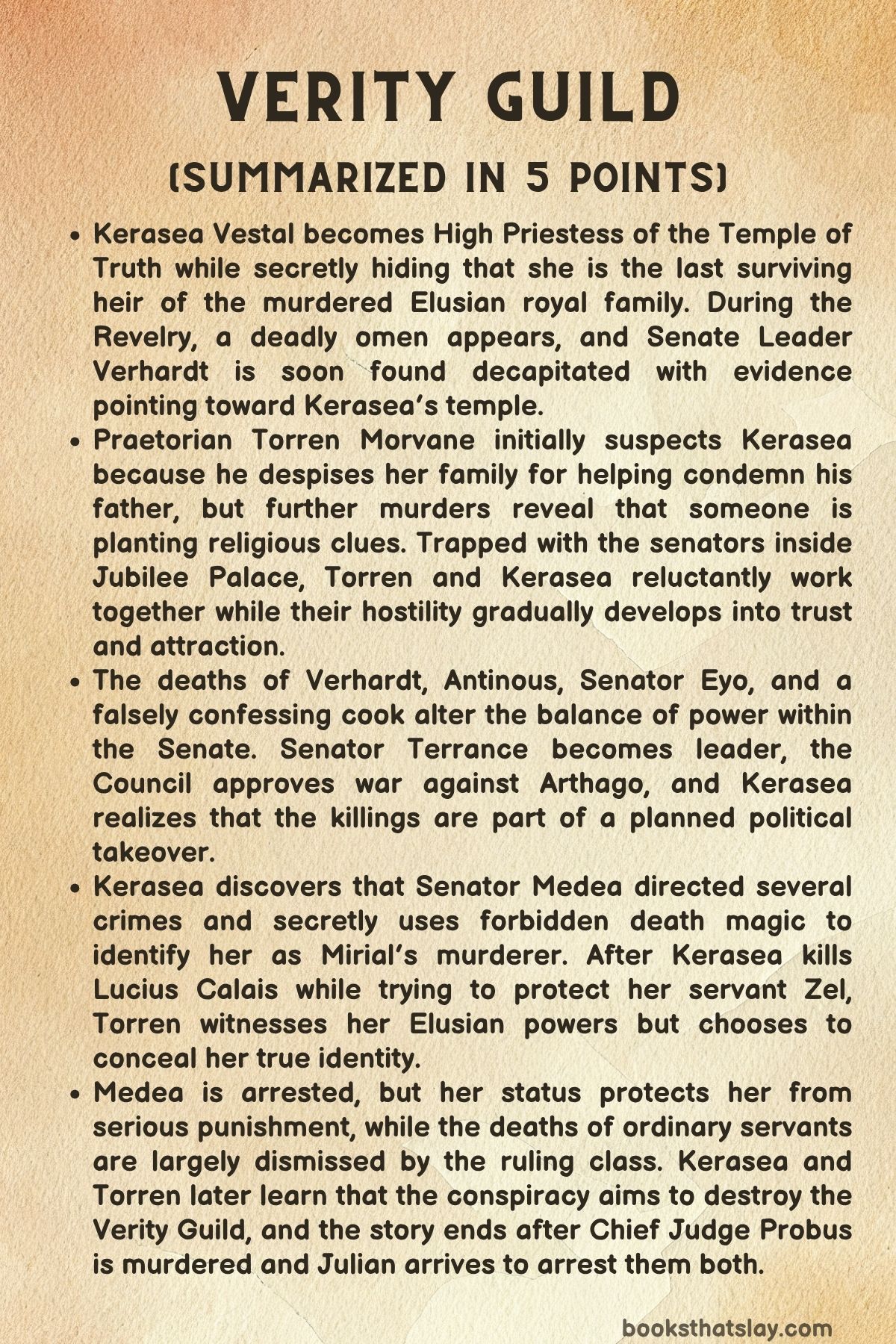
Summary
Kerasea Vestal has recently inherited the position of High Priestess of the Temple of Truth following the death of her adoptive father, Osiris. Although the position gives her enormous religious authority, she feels unprepared to replace him and remains burdened by a secret that could lead to her execution: she is the last surviving descendant of the Elusian royal family, whose members were slaughtered when Pryor became a republic.
During the annual Revelry, Kerasea protects a starving boy who stole a valuable mask to purchase medicine for his sister. Her compassion earns the boy’s loyalty, and when he publicly calls her the heart of the nation, the crowd praises her more enthusiastically than Senate Leader Verhardt.
Kerasea quickly redirects the attention toward Verhardt, knowing that any sign of personal popularity could make the Senate suspicious of her. Senator Verhardt was one of the leaders responsible for destroying the Elusian monarchy, so Kerasea must carefully hide both her fear of him and her true ancestry.
Torren Morvane, Pryor’s Praetorian and chief criminal investigator, attends the celebration with his closest friend, Capital Commander Julian Monroe. Torren distrusts the Temple of Truth and openly resents Kerasea because her childhood testimony helped convict his father of treason, leading to his execution and the ruin of the Morvane family.
Despite their mutual hostility, Torren and Kerasea experience an immediate physical attraction. Torren begins noticing that her confidence hides anxiety and vulnerability, while Kerasea sees moments of generosity beneath his harsh reputation.
The celebration takes place under the shadow of a terrifying omen. An eagle’s liver used for divination has turned black and begun decaying, a sign previously associated with war, mass death, and national chaos.
When Verhardt learns about the omen, he orders Kerasea to conceal it until the upcoming senatorial conclave. Torren finds the order suspicious because Pryor is already losing territory to Arthago, and a warning of approaching disaster should logically be investigated rather than hidden.
By dawn, Verhardt has been murdered. His naked, headless body is discovered at the altar of peace, with his organs removed and later placed in the fountain where Kerasea lit the Revelry flame.
A ceremonial sickle from the Temple of Truth is found among the remains, while Verhardt’s liver is missing. Torren believes the evidence finally gives him an opportunity to investigate Kerasea and destroy the Vestal family, but General Hadrian reminds him that religious leaders and senators are protected by un exorum, a law preventing investigation without overwhelming proof.
The surviving senators refuse to delay the conclave. Because Verhardt’s death creates an even number of senatorial votes, they appoint Kerasea as the deciding vote, drawing the Faith directly into political decisions despite its supposed independence.
At Jubilee Palace, Torren begins testing Kerasea rather than formally questioning her. He plants another temple sickle in an old divining chamber and interprets her emotional reaction as possible guilt, although she explains that the temple owns many identical blades.
The palace is sealed once the conclave begins, trapping the senators, Kerasea, Torren, Julian, their servants, and the sentries together. During the first dinner, the senators reveal little genuine grief for Verhardt and appear satisfied when Julian falsely claims that a convenient criminal has already been arrested for the murder.
Kerasea later encounters Verhardt’s grieving clerk, Antinous, in the palace kitchen. He tells her that Verhardt had damaging information about several senators and suggests that the murder was arranged by members of the Council.
Antinous also warns Kerasea that Torren might be responsible because the person investigating crimes is difficult to investigate. Torren secretly overhears part of the conversation, but instead of strengthening his suspicions against Kerasea, her compassionate questioning makes him wonder whether he has misjudged her.
The following morning, Antinous is found dead in the thermal baths. The senators quickly call the drowning an accident, but Torren discovers a polished piece of lapis associated with temple garments and realizes that religious evidence is appearing too conveniently at every crime scene.
Kerasea supports Torren’s request for a formal investigation, arguing that Antinous deserves justice regardless of his low rank. Her decision surprises Torren and angers senators who expected to control her vote.
Torren discovers that Antinous had been staying in a secret room that was ransacked after his death. Papers hidden there show that Verhardt had been blackmailing Senator Terrance for stealing public money and Senator Eyo over the suspicious death of one of Eyo’s mistresses.
The evidence gives several senators motives for murder. It also weakens the theory that Kerasea is the killer, especially because Antinous was still alive when she left the kitchen.
Torren’s investigation becomes more complicated when Julian admits that he was the last known person to see Verhardt alive. Julian claims he remained at Verhardt’s home drinking until early morning, but no independent witness can confirm his movements.
Although Torren trusts Julian more than anyone, he cannot ignore his friend’s questionable behavior. Julian arranged the false arrest in the capital, removed Antinous’s body from the water before Torren examined it, and repeatedly makes political decisions without consulting him.
During the conclave, Kerasea repeatedly casts deciding votes according to her conscience rather than supporting one faction. She increases the grain allowance for poor citizens and supports the investigation, causing senators from both sides to realize that she cannot be easily controlled.
The political situation becomes more dangerous when Senator Eyo is poisoned at breakfast. Torren identifies the substance as romlock, an Arthagian poison traditionally used against traitors, but he suspects its foreign association was chosen to create support for war.
Kerasea claims that she can examine Eyo’s liver and determine whether he was murdered. In reality, traditional divination cannot reveal completed events, but she invents the claim to prevent the Council from dismissing another suspicious death.
A palace cook soon confesses to poisoning Eyo on behalf of Arthago. Torren quickly recognizes that the confession is false because the man cannot explain the poison, its administration, or his supposed foreign contact.
Torren secretly interrogates the cook and learns that he accepted one hundred gold coins to take responsibility. The cook believed the payment would support his wife and daughters after his execution, but Torren explains that a treason conviction would instead strip them of property, money, reputation, and legal protection.
Before the cook can identify the person who hired him, he is murdered in the room where Torren confined him. The killing proves that the conspirators know the details of Torren’s investigation and can move through the supposedly secure palace.
While the murders continue, the Council votes on war with Arthago. Kerasea abstains because she does not believe she has enough information to decide the fate of thousands, but her neutrality allows the pro-war senators Medea, Suh, and Paolo to win.
Terrance is immediately elected Senate Leader, and the old guard redirects state resources toward the war. Kerasea realizes that Verhardt and Eyo’s deaths created the exact voting conditions needed for Terrance’s faction to seize power.
Torren and Kerasea finally agree to work together. Torren admits that the evidence against her was probably planted and that the attacks may be intended to remove both of them from the Verity Guild, Pryor’s highest judicial tribunal.
Their alliance intensifies the attraction they have been resisting. However, Torren remains haunted by his father’s trial, while Kerasea fears that close investigation will expose her Elusian identity and forbidden powers.
Someone wearing the white robes of the Temple of Truth attacks Torren and Julian after locking them outside in freezing weather. Kerasea later finds an abandoned robe in the palace library, creating another apparent connection to the Faith.
Kerasea’s servant Zel behaves nervously when questioned about the robe. Kerasea eventually discovers that Zel has been hiding an adult woman inside her chamber, but she protects the servant rather than informing Torren.
The hidden woman is Mirial, the priestess who helped raise Kerasea. Mirial secretly remained at Jubilee because she believed Kerasea was in danger, and she may have worn the priestly robe, followed Torren, attacked the investigators, or destroyed evidence in an attempt to protect Kerasea’s secrets.
Before Mirial can explain her actions, she is thrown from an upper terrace and killed. Kerasea is devastated, especially after learning that Mirial had met privately with Verhardt before his murder.
Kerasea secretly uses Elusian death magic to call Mirial’s spirit back into her body. The ritual leaves the word “Medea” written in blood, identifying Senator Medea as Mirial’s killer.
Because Kerasea cannot explain how she obtained the name without revealing her ancestry, she asks Torren to support a false claim that Zel witnessed the murder. Torren struggles with the request because he believes justice must be founded on truth, yet he also knows that the law protects powerful people from legitimate investigation.
Kerasea’s magic then reveals memories from the night she was rescued as an infant. A wet nurse carried her to the temple after the royal massacre, but Osiris ordered the woman killed to protect Kerasea’s identity.
Mirial had initially argued that the infant should be killed because her survival could restart the war. Osiris spared her after she walked unharmed through the temple’s eternal flame, convincing him that she had been chosen by the god of truth.
Kerasea is forced to accept that Osiris and Mirial truly loved her while also building her life upon murder, secrecy, and political calculation. Their protection was sincere, but it was never innocent.
Soon afterward, Kerasea finds Lucius Calais attacking Zel in the divining tower. She uses blood magic to decapitate him, but his falling dagger cuts Zel’s throat and kills her.
Overcome with rage, Kerasea summons the eternal flame and destroys Calais’s body while remaining untouched. Torren arrives in time to witness the magical fire, the impossible decapitation, and Kerasea holding Zel’s body.
Rather than arresting her, Torren helps conceal what she has done. Kerasea then publicly accuses Medea under religious law, and her uncontrolled power forces the senator to her knees before the Council.
The senators interpret the event as divine judgment. Torren arrests Medea and later finds genuine evidence in her room, including a message arranging a meeting with Mirial and one of Verhardt’s missing rings.
Despite the evidence, Medea is kept under comfortable house arrest because of her status. The Council offers Zel’s family only twenty gold coins, exposing how little value the ruling class places on the life of a servant.
Kerasea returns to the temple to oversee the funerals of Mirial and Zel. Torren is publicly praised for solving the murders, although he knows Verhardt and Eyo’s deaths remain unresolved and the larger conspiracy is still active.
United by grief, guilt, and distrust of the official story, Kerasea and Torren finally allow their relationship to become intimate. Their connection is no longer based solely on attraction; each has become the one person who understands the other’s discomfort with power, praise, and compromised justice.
While sleeping beside Torren, Kerasea experiences the memories of the dead Calais. She learns that Medea directed him to poison Eyo and that Medea had secretly ordered an unidentified male lover to murder Verhardt, plant a temple knife, and leave no blood.
The conspirators toasted the end of the Verity Guild, revealing that their objective extends beyond controlling the Senate. Torren independently realizes that the murders were designed to remove or discredit the tribunal’s three members before they could try Trajan Lowe, Medea’s nephew, for raising a private army.
Before Kerasea can clearly describe her vision, Julian arrives in formal armor. He reports that Chief Judge Probus, the third member of the tribunal, has been murdered and announces that he has orders to arrest both Kerasea and Torren.
The deaths have produced war, transferred control of the Senate, protected a private army, and nearly destroyed the institution capable of prosecuting the conspirators. The story ends with Medea’s male accomplice still unidentified and with Kerasea and Torren accused just as they begin to understand the true scale of the plot.
Characters
Kerasea Vestal
Kerasea is the central character of Verity Guild, and her entire public identity is built upon a contradiction. She leads the Temple of Truth while concealing her ancestry, her forbidden magic, the circumstances of her adoption, and the lies used to protect her.
Her compassion distinguishes her from the political and religious leaders around her. She protects the starving boy, supports increased grain allowances, defends the cook’s family, grants Zel sanctuary, and repeatedly argues that justice should not depend on wealth or status.
That compassion is not presented as uncomplicated virtue. Mirial warns that it can become a weakness, and Kerasea’s refusal to expose Zel’s secrets temporarily interferes with the investigation and creates conflict with Torren.
Kerasea’s political growth is shaped by costly mistakes. Her decision to abstain from the war vote appears responsible to her, but she eventually understands that refusing to choose can still determine an outcome and that neutrality often benefits those who already possess power.
Her relationship with truth is especially complex. She recognizes lies in others and serves a god associated with honesty, yet her survival requires constant deception about her bloodline, her powers, Calais’s death, Mirial’s message, and Zel’s supposed testimony.
The death magic connects Kerasea to the victims but also threatens her control. It allows her to recover hidden evidence, yet every use draws her closer to the violent reputation of the Elusian monarchy and raises the possibility that grief or anger could transform her into the danger the republic fears.
Her attraction to Torren forces her to separate inherited conflict from personal judgment. She begins by fearing his authority and resenting his hostility, but she gradually recognizes his integrity, loneliness, generosity, and determination to protect ordinary citizens.
Kerasea’s deepest conflict is not simply whether she will be exposed. She must decide what kind of leader she will become after learning that the people who raised her committed murder, maintained political lies, and taught her to serve institutions that do not value every life equally.
Torren Morvane
Torren is the second central figure in Verity Guild, serving as Pryor’s feared Praetorian and chief investigator. His physical strength, emotional restraint, and uncompromising manner are products of a childhood in which he lost his father, home, social standing, and faith in the fairness of the law.
His hatred of Kerasea initially distorts his investigation. Because her testimony contributed to his father’s conviction, he interprets her reactions as evidence of guilt and allows the killer’s planted religious clues to exploit his prejudice.
However, Torren is capable of revising his conclusions. As he observes Kerasea’s compassion and recognizes that the evidence against her is unnaturally convenient, he begins separating the woman before him from the child he remembers.
His commitment to justice is genuine but frequently conflicts with his methods. He threatens suspects, unlawfully confines the cook, hides the man’s body, and lies to the Senate, yet he also refuses to plant evidence against Medea even when doing so might guarantee her punishment.
The cook’s interrogation reveals Torren’s connection to powerless victims. He understands how a treason conviction destroys an entire family because he personally endured that punishment after his father’s execution.
Torren’s need for control comes from fear rather than simple dominance. He orders Kerasea to remain in her room, pressures Zel, and attempts to manage every danger because he associates failure with losing the people he is responsible for protecting.
His friendship with Julian serves as both emotional support and investigative difficulty. Torren trusts Julian as the person who stood beside him after his family’s fall, but he gradually realizes that friendship cannot exempt anyone from suspicion.
Torren’s relationship with Kerasea changes his understanding of strength. Protecting her secret after witnessing her magic requires him to accept uncertainty, emotional vulnerability, and a form of loyalty that cannot be justified solely through law or duty.
Julian Monroe
Julian is charming, sociable, politically skilled, and outwardly more relaxed than Torren. His privileged Southside upbringing contrasts with Torren’s childhood poverty, yet their friendship began when Torren protected him from attackers without expecting payment or advantage.
He functions as Torren’s closest friend and moral counterweight. Julian understands political performance, social manipulation, and compromise in ways that Torren often resists.
His actions repeatedly blur the line between practical assistance and suspicious interference. He frames a convicted murderer for Verhardt’s death, removes Antinous’s body from the bath, votes to continue the conclave, helps conceal the cook’s corpse, and withholds information from Torren.
Julian argues that keeping the suspects together offers the best chance of exposing the killer. Nevertheless, his decisions also benefit the conspirators, making Kerasea’s growing suspicion of him understandable.
His charm allows him to conceal considerable ambition and strategic intelligence. The senators respond positively to his speeches, and his temporary role as clerk gives him influence beyond his military title.
Julian’s concern about Torren’s relationship with Kerasea may come from loyalty, jealousy, political calculation, or knowledge he has not shared. His arrival to arrest them after Probus’s murder leaves his ultimate position uncertain.
He may be obeying legal orders while attempting to protect them, or he may be connected to forces working against the tribunal. The ending transforms him from a trusted companion into one of the story’s most important unresolved questions.
Priestess Mirial Bauman
Mirial is Kerasea’s mentor, maternal figure, and protector. She teaches Kerasea the responsibilities of the Faith while repeatedly warning that compassion can leave a leader vulnerable to manipulation.
Her love for Kerasea is genuine but morally complicated. She once argued that the Elusian infant should be killed to prevent political chaos, yet she later devoted her life to protecting the child she had considered a threat.
Mirial’s secret presence at Jubilee demonstrates the controlling side of her protection. She hides in Zel’s room, monitors Kerasea, and may be responsible for wearing the priestly robe, attacking the investigators, listening to private conversations, and burning evidence.
These actions probably arise from fear that Torren or the Senate will discover Kerasea’s powers. Even so, they undermine the investigation and unintentionally strengthen the appearance that the Temple of Truth is involved in the murders.
Her private meeting with Verhardt and later contact with Medea suggest that she possessed significant knowledge about the conspiracy. Whether she was cooperating with the senators, attempting to bargain for Kerasea’s safety, or misleading them remains unresolved.
Mirial’s death carries both personal and political importance. It deprives Kerasea of her closest remaining parent while revealing how thoroughly the older generation built the republic upon calculated violence and concealed guilt.
Osiris Vestal
Osiris is dead before the main events, but his influence shapes Kerasea, Torren, the Faith, and the tribunal. As High Priest, he adopted Kerasea, trained her as his successor, and protected the last Elusian heir from the Senate.
His decision to spare the infant shows moral courage because Mirial initially believed the child should be killed. The sight of Kerasea walking through the eternal flame convinced him that her survival had religious meaning.
However, Osiris preserved her life by ordering the murder of the wet nurse who rescued her. That decision exposes the cruelty hidden beneath his image as a loving father and guardian of truth.
His love for Kerasea was real, but it was joined to political calculation. He created an identity that allowed her to survive while preventing her from knowing her origins, understanding her magic, or choosing how she wished to live.
Osiris also played a role in the conviction of Torren’s father. His participation connects Kerasea’s protected childhood to Torren’s destruction, making him one of the unseen sources of their inherited hostility.
Senator Medea
Medea is one of the republic’s founding senators and the clearest identified architect of the conspiracy. Her quiet observation and restrained public behavior initially make her appear less openly ambitious than Eyo or Terrance.
She understands how to influence events without making herself the visible beneficiary. Rather than seeking the Senate leadership directly, she helps create the conditions that elevate Terrance, authorize war, protect her nephew’s army, and weaken the tribunal.
Medea uses people as disposable instruments. She directs Calais to poison Eyo, manipulates Mirial, works with an unidentified lover to arrange Verhardt’s murder, and attempts to sacrifice servants and lower-ranking officials whenever they become inconvenient.
Her family history reveals that such violence is not new. Calais’s father gained power after poisoning Medea’s twin brother, suggesting that betrayal and murder have long been part of her political methods.
Even after she is accused, the legal system protects her. House arrest, senatorial privilege, and the Council’s reluctance to pursue every murder allow her to treat partial exposure as a manageable setback.
Medea represents power that has learned to survive through patience, legal immunity, and indirect violence. Her greatest strength is not physical force but her ability to make other people appear responsible for decisions she designed.
Torren’s Father
Torren’s father appears primarily through memory, yet his conviction determines the course of Torren’s life. Accused of treason by the Verity Guild, he is executed while his family is stripped of wealth, reputation, and social protection.
Kerasea continues to believe that he was guilty, so the novel does not establish his complete innocence. The injustice lies partly in the way the punishment extended to his young son, who had no responsibility for the alleged crime.
His trial becomes Torren’s defining trauma. Torren’s desperate offer to exchange his own life for his father’s and the courtroom’s laughter teach him that powerful institutions can convert suffering into entertainment.
The memory of his father motivates Torren’s pursuit of authority and justice. It also prevents him from trusting Kerasea even after evidence and personal experience show that she differs from the Vestals he remembers.
Senator Verhardt
Verhardt is the powerful Senate Leader whose murder begins the central investigation. He presents the republic as a liberation from royal tyranny, although he personally participated in the massacre of the Elusian family.
His public generosity is calculated. By throwing gold to the crowd and presenting himself as the guardian of the nation, he uses wealth to purchase loyalty and maintain a heroic image.
Verhardt’s treatment of Kerasea and Torren reveals his expectation of obedience. He views the Faith as subordinate to the Senate and treats the Praetorian as a useful servant rather than an independent guardian of justice.
Before his death, Verhardt had gathered evidence against several senators. His blackmail gave him control over Eyo, Terrance, and possibly others, but it also gave them powerful reasons to remove him.
His request that Kerasea hide the omen suggests he already knew that political violence was approaching. Whether he intended to prevent panic, protect himself, or control information remains uncertain.
Senator Terrance
Terrance is a senior senator who emerges as one of the primary political beneficiaries of the murders. Verhardt had evidence that he embezzled public funds, giving him a clear motive for wanting the Senate Leader silenced.
He responds to Eyo’s poisoning with a suspicious reference to his son Emilius’s fatal allergy. The comment may be an attempt to normalize the death, redirect attention, or reveal knowledge of similar symptoms.
Terrance uses the voting changes caused by the murders to become Senate Leader. Once elected, he rapidly redirects resources toward war and works with Suh and Medea to limit opposition.
His accusation that Foreau is an Arthagian traitor allows him to silence an anti-war senator without addressing Foreau’s arguments. He adopts the language of national security while behaving with the authority of an unelected ruler.
Terrance also demonstrates the Council’s disregard for lower-class lives when he offers Zel’s family a small payment. His response reduces her murder to a financial inconvenience rather than a failure of government and justice.
Senator Eyo
Eyo represents the younger faction of senators seeking political change, although his motives are primarily ambitious rather than idealistic. His public confidence and talk of a new guard suggest that he expects war and instability to create opportunities for advancement.
His treatment of women exposes his selfishness and abuse of privilege. He appears with a very young mistress, and Verhardt possessed information connecting him to another mistress’s death.
Eyo assumes that Kerasea will support his faction and becomes angry when she votes independently. He views her less as a religious leader than as a political asset he should be able to control.
His poisoning changes the balance of the Council and helps the old guard secure power. Although Calais wants Eyo’s seat for himself, Medea uses that personal ambition to achieve a larger political objective.
Senator Foreau
Foreau is one of the principal opponents of war and Terrance’s expanding authority. Rumors that he accepts Arthagian money make him either a genuine security threat or an ideal target for fabricated accusations.
He recognizes that Terrance’s conduct resembles monarchy more than republican leadership. His warning that the old guard may have dealings with tyrants suggests that he understands part of the hypocrisy behind the war campaign.
Foreau’s sharp observation of Kerasea and Torren indicates that he notices their developing alliance. He may view their cooperation as a threat, a potential source of support, or useful evidence against them.
The story deliberately leaves his loyalties uncertain. His opposition to war may arise from principle, corruption, foreign influence, or a combination of motives.
Senator Suh
Suh is a member of the old-guard alliance with Terrance and Medea. She supports continuing the conclave despite multiple murders and later votes in favor of war.
Her procedural suggestions help the Council continue functioning under conditions that should have forced reconsideration. By treating empty seats as abstentions, she contributes to the outcome that allows the pro-war faction to prevail.
Suh is less individually developed than Medea or Terrance, but her importance lies in disciplined cooperation. She demonstrates how conspiratorial outcomes can be achieved not only by a central mastermind but also by officials willing to support convenient procedures.
Her continued alliance with Terrance after Medea’s arrest suggests that removing one conspirator will not dismantle the political structure that enabled the murders.
Senator Paolo
Paolo initially appears gentle when he informs Kerasea of Verhardt’s death. His quiet manner makes him seem less threatening than the openly ambitious senators around him.
However, Paolo supports the war resolution and later joins the senators who praise Torren for supposedly solving the murders. His participation shows how politeness can conceal political self-interest.
Kerasea repeatedly questions whether his gentleness is sincere or a method of hiding ambition. The unresolved conspiracy keeps open the possibility that he knows more than he reveals.
His support for war places him among those who benefit from the voting changes. Even without proof of direct involvement, he helps legitimize the result produced by murder.
Chief Judge Probus
Probus is the third member of the nation’s highest tribunal, serving alongside Kerasea and Torren. His early refusal to authorize an investigation against Kerasea demonstrates how un exorum protects powerful religious and political figures.
He appears more concerned with Torren’s aggressive presentation of evidence than with the possibility that a high priestess could be involved in murder. His caution may reflect legal responsibility, institutional bias, or fear of confronting the Faith.
Probus remains largely absent from the Jubilee investigation, but that absence becomes important when Torren identifies the plot against the tribunal. His murder confirms that the conspirators are systematically removing the people capable of prosecuting Trajan Lowe and exposing the private army.
His death completes the attack on the institution. Kerasea is being framed, Torren is being discredited and arrested, and Probus is permanently silenced.
Antinous
Antinous is Verhardt’s clerk and one of the few people who openly grieves for him. Although he acknowledges that Verhardt became corrupted by power, he refuses to accept that corruption makes the murder unimportant.
His knowledge of senatorial secrets makes him a valuable witness and an immediate target. He understands that Verhardt was blackmailing Council members and believes those secrets caused his death.
Antinous’s drunken accusation against Torren reflects the atmosphere of total distrust inside Jubilee. He knows that the person responsible for investigating murder also possesses the power to conceal it.
His final warning that compassionate hearts are consumed by wolves applies directly to Kerasea. His murder proves that the conspirators are willing to kill lower-ranking people who possess information, even when their deaths risk drawing further attention.
Zel
Zel is Kerasea’s chambermaid, loyal companion, and one of the most innocent victims in the story. Her devotion leads her to hide Mirial inside Jubilee despite the danger and the rules of the conclave.
She lies to Torren and Kerasea because she is obeying Mirial and trying to protect the High Priestess. Those lies make her vulnerable when evidence connecting her to poison, Antinous, and the attacks is planted in her room.
Kerasea’s decision to grant her sanctuary reflects their emotional bond. She refuses to let a powerless servant be subjected to methods that the Senate would never permit against a noble suspect.
Zel’s death results from secrets imposed upon her by people with greater authority. She is not killed because of personal ambition but because she knows enough to endanger the conspiracy.
The Council’s small payment to her family confirms the class inequality she represents. Although Kerasea values her as a person and mourns her deeply, the republic treats her as replaceable property.
Lucius Calais
Calais is Eyo’s sentry and an ambitious, cruel man who believes Eyo’s death will allow him to inherit political power. He is motivated by entitlement, wealth, status, and access to women rather than loyalty to any national cause.
Medea exploits those desires and directs him to poison Eyo. Calais therefore operates as both a murderer and a tool used by someone who understands his weaknesses.
His family’s connection to Medea reveals a pattern of rewarded violence. His father gained authority after poisoning Medea’s twin brother, teaching Calais that murder can be a legitimate path to advancement.
Calais becomes especially dangerous when he attacks Zel. His willingness to kill a servant demonstrates that he sees lower-ranking people as obstacles rather than human beings.
His memories provide Kerasea with evidence of Medea’s male accomplice and the plan to destroy the tribunal. Ironically, the man who helps conceal the conspiracy becomes a source of truth only after his death.
General Hadrian
Hadrian is a senior military authority who respects Torren but attempts to control his more reckless instincts. He correctly explains that the temple sickle does not provide sufficient evidence to investigate Kerasea under the law.
His insistence on procedure prevents Torren from acting solely upon prejudice. At the same time, the restrictions he defends demonstrate how legal safeguards can become barriers when applied to powerful suspects.
Hadrian’s willingness to gamble and engage with Torren informally humanizes him. He appears to serve as an experienced mentor who recognizes both Torren’s abilities and his dangerous temper.
The senators later discuss him as a possible warrior ruler, showing that his military reputation carries political weight. However, he remains outside the central conspiracy and does not exploit that reputation during the events described.
Senator Lucius Calais’s Father
Calais’s father is not directly present, but his history helps explain the corruption passed between generations. Medea elevated him after he poisoned her twin brother, proving that political murder had previously been rewarded.
His example shapes Calais’s belief that loyalty to powerful patrons can produce status. The son’s actions repeat the father’s pattern, showing how a corrupt system reproduces itself through opportunity and family expectation.
Senator Medea’s Male Accomplice
The unidentified man who works with Medea is one of the central unresolved figures. Calais overhears the pair planning a bloodless murder, planting temple evidence, and celebrating the future destruction of the tribunal.
His ability to decapitate Verhardt cleanly suggests exceptional strength, skill, or magic. The method resembles Kerasea’s magical killing of Calais, raising questions about his identity and connection to the Elusian bloodline.
Medea addresses him as a lover, indicating that their alliance is both personal and political. His identity may explain how the conspirators obtained private information, moved through secure areas, and manipulated the investigation.
The ending leaves open whether he is a senator, soldier, religious official, or someone personally trusted by Torren and Kerasea. Discovering him becomes essential because Medea’s arrest has not ended the conspiracy.
Trajan Lowe
Trajan Lowe is Medea’s nephew and the accused commander of a private army in the sixth province. Although he does not personally appear, the approaching trial against him provides the strongest explanation for the attack on the tribunal.
If the tribunal remained intact, Kerasea, Torren, and Probus could investigate the army and prosecute him for treason. Destroying their institution would protect both Lowe and the political network supporting the war.
His private forces may be intended for the conflict with Arthago, a domestic seizure of power, or both. The uncertainty surrounding his army ensures that the war resolution cannot be separated from the internal conspiracy.
The Starving Boy
The unnamed boy who steals the Revelry mask introduces Kerasea’s instinctive compassion. His crime is motivated by hunger and his sister’s illness rather than greed.
Kerasea’s decision to protect and assist him reveals her belief that justice must account for circumstances. She values the desperate child more than the wealthy owner’s property.
His public declaration that she is the heart of the nation unexpectedly increases her political danger. Through him, a private act of kindness becomes proof of Kerasea’s influence over ordinary people.
The Palace Cook
The cook is another powerless person exploited by the conspiracy. He accepts gold to confess to Eyo’s murder because he believes his death will provide financial security for his wife and daughters.
His decision is misguided but rooted in sacrifice rather than ideology. He does not understand that a treason conviction will punish his entire family and erase the benefit he hoped to provide.
Torren’s conversation with him reflects the Praetorian’s own experience as the child of a condemned man. The cook’s murder then punishes Torren for showing restraint, reinforcing his fear that mercy creates opportunities for dangerous people.
Avarre
Avarre is Senator Terrance’s sentry and one of the people placed near Eyo’s poisoned wine. His entry into the breakfast room shortly before the meal creates a possible link between Terrance’s faction and the poisoning.
The evidence against him remains circumstantial. Like many clues in the story, his presence could indicate guilt, innocent routine, or an intentional effort to direct suspicion.
His limited role emphasizes the difficulty of distinguishing between servants carrying out ordinary tasks and agents acting on behalf of powerful employers.
Senator Verhardt’s Son
Verhardt’s young son appears briefly during the Revelry. His affectionate interaction with his father reminds Torren of the age at which his own family was destroyed.
The child humanizes Verhardt without excusing his political crimes. Torren sees that even a ruthless leader can be a loving parent, complicating the emotional meaning of his later murder.
He also represents the innocent relatives who suffer when powerful adults create enemies. His future may repeat Torren’s experience of losing a father to political violence.
Themes
Truth, Deception, and the Failure of Legal Justice
Truth is treated as both a sacred principle and a political weapon. In Verity Guild, the people who publicly claim to protect truth repeatedly depend upon secrecy, staged evidence, coerced confessions, false witnesses, and selective enforcement of the law.
Kerasea embodies this contradiction most clearly. She leads the Temple of Truth while concealing her bloodline, powers, adoption, role in Calais’s death, and supernatural method of identifying Medea.
Torren tries to preserve a stricter relationship with evidence, yet he also hides bodies, imprisons the cook without authorization, lies about the investigation, and supports Kerasea’s false-witness claim. His refusal to plant evidence against Medea shows that he still believes procedure matters, even after procedure repeatedly protects the guilty.
The conflict is not simply between truth and lies. The story asks whether an honest legal process can produce justice when the process itself was designed to shield senators and high priests from investigation.
Kerasea’s lie about Zel leads to the arrest of a genuine murderer, while the cook’s false confession protects the real conspirators. The moral value of deception therefore depends partly on who possesses power, who is harmed, and whether the lie challenges or reinforces injustice.
By the end, truth has been discovered but not securely established. The protagonists know enough to identify a conspiracy, yet the law celebrates a false resolution and arrests the very people still searching for the complete answer.
Class, Privilege, and the Unequal Value of Life
Every death is judged according to the victim’s social position. Verhardt’s murder threatens national stability, Eyo’s poisoning alters the Senate, and Mirial’s death receives attention because she is an influential priestess.
Antinous, the cook, and Zel receive far less protection. Their knowledge makes them useful, but their status makes them easy to sacrifice, blame, or dismiss.
The legal doctrine of un exorum captures this inequality. Senators and religious leaders cannot be investigated without extraordinary evidence, while servants and common criminals can be imprisoned, tortured, executed, or condemned through weak accusations.
Torren understands this cruelty because his father’s conviction destroyed the entire Morvane family. The cook’s plan for his daughters forces Torren to explain that punishment in Pryor does not stop with the accused but spreads to innocent relatives.
Kerasea repeatedly resists this hierarchy. She protects the starving boy, supports grain allowances, defends Zel, and insists that Antinous deserves an investigation because citizenship should matter more than rank.
The Council’s payment of twenty gold coins to Zel’s family becomes the clearest expression of institutional contempt. The senators believe money can settle the death of a servant while Medea remains comfortable under house arrest.
The contrast reveals that justice in Pryor is not blind. It measures guilt, grief, protection, and compensation according to wealth, office, and political usefulness.
Inherited Hatred, Trust, and Intimacy
Kerasea and Torren begin their relationship burdened by decisions made when they were children. Torren remembers her apparent laughter during his father’s trial, while Kerasea remembers testifying against a man she still believes was guilty.
Their hostility is therefore rooted in memory rather than complete knowledge. Torren does not know why Kerasea laughed, and Kerasea initially fails to understand how public humiliation, execution, poverty, and abandonment shaped him.
The investigation forces them to observe one another beyond inherited assumptions. Torren sees Kerasea protect poor citizens and challenge senators, while she discovers that his severity coexists with generosity, education, loyalty, and concern for innocent families.
Trust develops through action rather than confession. Kerasea authorizes his investigation, Torren shares secret evidence, she believes his denial of murder, and he protects her after witnessing magic that could justify her execution.
Their attraction increases the danger because intimacy gives each person the power to expose the other. Kerasea can damage Torren’s career and public authority, while Torren possesses enough evidence to reveal her ancestry.
Their relationship becomes meaningful when they choose vulnerability despite that risk. Torren asks what Kerasea wants rather than controlling the moment, and Kerasea allows herself to be seen without the perfection expected of a High Priestess.
The romance does not erase resentment or political conflict. Instead, it suggests that trust is a continuing choice made while fear, uncertainty, and unresolved history remain present.
Identity, Magic, and Political Legitimacy
Kerasea’s identity places her between the fallen monarchy and the republic that replaced it. She is simultaneously High Priestess of the republican Faith and the final heir of the dynasty the Senate defines as tyrannical.
Her existence threatens the political story used to justify the current government. The republic presents the Elusian family as completely destroyed, so proof of her survival could revive royal loyalty, expose the Senate’s massacre, or provide ambitious people with a symbolic ruler.
Magic intensifies that danger because Kerasea’s abilities resemble both divine authority and royal violence. She can walk through sacred fire, communicate with the dead, compel physical submission, and kill with extraordinary force.
The senators interpret her public power as judgment from the god of truth. That explanation temporarily protects her, but it also increases her influence and may cause the government to fear the Faith as much as it once feared the monarchy.
Kerasea herself is uncertain what her magic means. It allows her to recover evidence the legal system cannot reach, yet grief and anger repeatedly threaten to push that power beyond her control.
Her adoption further complicates her identity. Osiris and Mirial loved her, but they protected her by killing the wet nurse, hiding her ancestry, and deciding which truths she was allowed to know.
The story therefore separates legitimacy from blood, office, and official history. Kerasea’s future authority will depend less on whether she is a priestess or royal heir than on whether she can use power without repeating the violence of those who shaped her.