Alan Opts Out Summary, Characters and Themes
Alan Opts Out by Courtney Maum is a social comedy about a wealthy advertising executive who begins questioning the consumer culture that made him successful. Alan Anderson’s abrupt rejection of work, possessions, grooming, and conventional domestic life unsettles his ambitious wife, Vivian, even as it draws their daughters closer to him and inspires other residents of their status-conscious Connecticut community.
Through the family’s escalating rebellion, the novel examines privilege, ambition, marriage, parenting, social performance, environmental responsibility, and the difference between rejecting consumerism and merely turning simplicity into another luxury available to the rich.
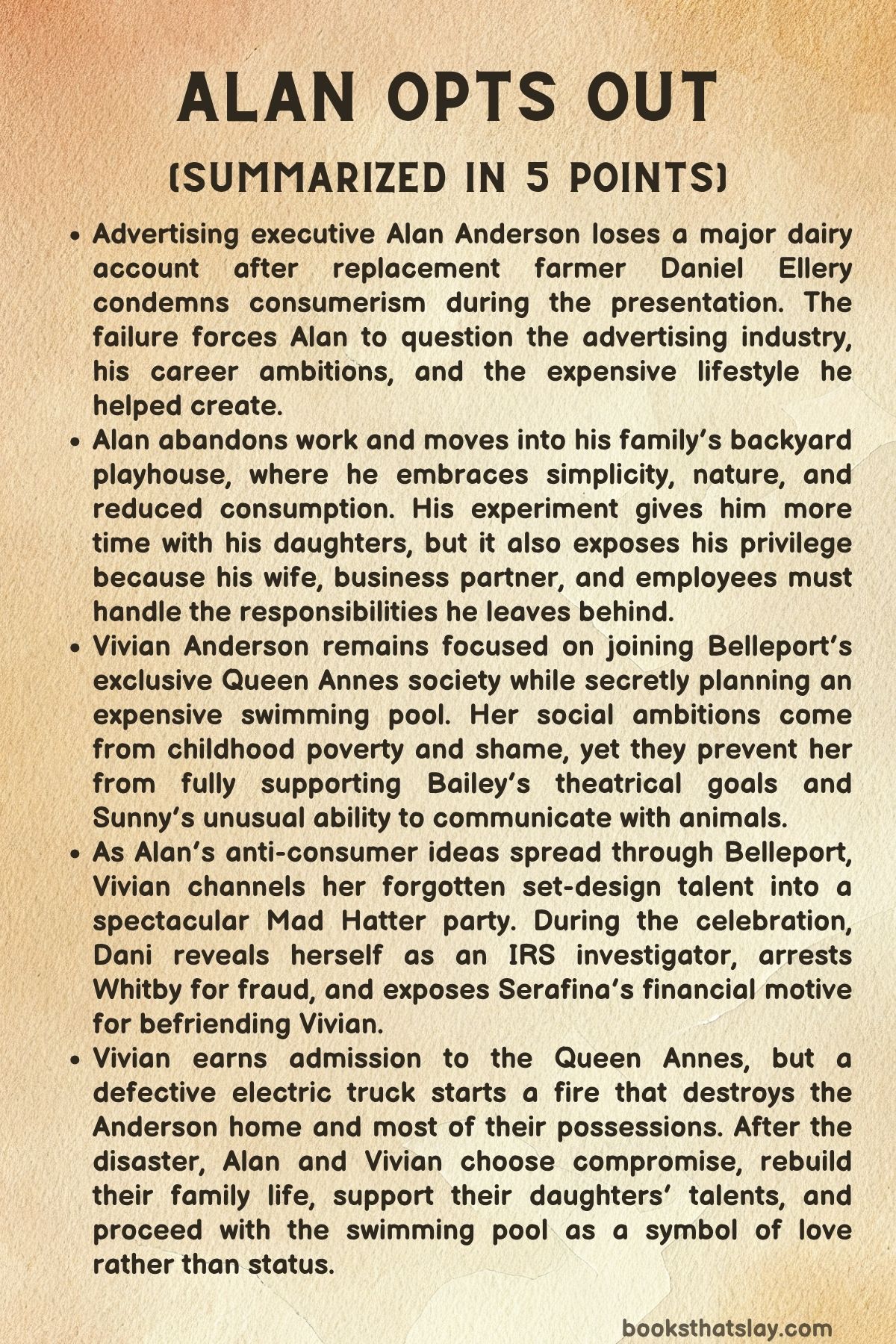
Summary
Advertising executive Alan Anderson visits Greenacres, a Wisconsin dairy farm, while preparing a major campaign for the US Dairy Council. With milk consumption declining, Alan plans to transform farmer Tucker Brannigan into a symbol of honest labor, family nourishment, patriotism, and traditional American values.
Winning the fourteen-million-dollar account would give Alan another major industry victory and relieve the financial pressure created by his family’s expensive life in Belleport, Connecticut. He also hopes the bonus will fund a swimming pool desired by his wife, Vivian, although he regards the project as another costly demand on his limited money and attention.
At Orris + Anderson, Alan presents his strategy with his usual confidence and orders his creative staff to produce dozens of slogans. His ability to convert emotions, traditions, and anxieties into persuasive advertising remains impressive, but his need to control the campaign reveals how thoroughly his identity depends on professional dominance.
Vivian has built her own identity around gaining acceptance in Belleport. Born Valerie Felcher and raised in poverty, she has renamed herself, studied the habits of wealthy women, filled her home with expensive products, and directed the lives of her daughters, Bailey and Sunny, according to what she believes successful families should look like.
Vivian secretly pays a deposit for a swimming pool because she sees it as more than recreation. To her, it represents childhood wishes fulfilled, social legitimacy, and a way to attract friends for Bailey and Sunny, whose personalities have developed in directions she does not understand.
Bailey wants to leave her private school, attend Greenwich High, and stage ambitious theatrical productions. Sunny prefers animals to people and claims she can communicate with birds and horses, an ability Vivian treats as embarrassing fantasy rather than a genuine part of her daughter’s life.
Vivian’s greatest immediate ambition is admission to the Queen Annes, Belleport’s exclusive women’s society. Her friend Serafina Everett secures her invitation, but the return of the controlling Whitby Shepard changes the competition when Whitby appoints herself Vivian’s mentor and subjects her home, family, clothing, lawn, entertaining skills, and personal habits to intense scrutiny.
Meanwhile, Alan’s dairy campaign begins collapsing before the presentation even starts. Tucker refuses to fly, and Greenacres sends Daniel Ellery, a charismatic young farmer whose appearance and confidence initially seem capable of strengthening the pitch.
Daniel performs convincingly at first, describing milk as a basic form of nourishment connected to motherhood and life. He then abandons Alan’s plan and tells the dairy executives that Americans do not need to buy more milk, condemning advertising for manufacturing desires, encouraging waste, exploiting farms, and turning unnecessary growth into a cultural requirement.
Alan is furious that Daniel has destroyed an account worth millions, but the young farmer’s arguments remain in his mind. The crisis deepens when a rival agency wins the business using nearly the same central idea Alan intended to present, proving that his instincts were still effective while denying him the victory that would have confirmed his continued importance.
For the first time, Alan begins questioning the industry he has served throughout his adult life. He sees a marketplace filled with artificial variations, unnecessary replacements, revived products, emotional manipulation, and endless messages telling people that acceptable lives are incomplete.
Daniel’s belief that “just fine” might be enough unsettles Alan because his career and family have been organized around the opposite idea. Even when Daniel criticizes advertising, Alan automatically turns his words into possible slogans, demonstrating how deeply professional thinking has entered his mind.
At home, Vivian’s secret spending intensifies the conflict. Alan discovers boxes of pool furniture and accessories hidden inside the abandoned playhouse, but rather than continuing their usual argument, he empties the structure and begins treating it as a retreat from the large house, costly responsibilities, and consumer habits he now considers meaningless.
Alan stops going to work and begins repairing the playhouse. He remembers the early pandemic, when the family spent more time together, and becomes fascinated by the apparent simplicity of survival programs whose participants must distinguish genuine needs from luxuries.
His experiment quickly exposes his practical limitations. Although he has spent decades presenting himself as decisive and capable, he cannot repair a door, identify plants, grow food, navigate the neighborhood confidently, or survive outdoors without equipment produced by the commercial systems he condemns.
Nevertheless, Alan begins walking barefoot, wearing white linen, refusing many purchases, canceling household services, and questioning the need for cars, deodorant, expensive schools, enormous homes, and constant professional activity. He reads One Hundred Years of Solitude, quotes the command for cows to cease, and interprets his withdrawal as a moral awakening.
The change initially frightens Vivian because Alan has always been the strategist responsible for turning uncertainty into action. When he asks her simply to hold him, she understands that his confident professional identity is collapsing and that the family’s financial and emotional structure can no longer be managed through scheduling, shopping, or optimism.
Alan’s retreat makes him more available to Bailey and Sunny. Bailey secretly sells Vivian’s unused belongings online to finance her theatrical production, while Sunny abandons conventional riding practices because she believes saddles and harsh bits hurt horses.
Sunny’s ability to communicate with animals becomes increasingly difficult to dismiss. She calls a raven, speaks with horses, calmly approaches a moose, summons a buck to block Whitby’s vehicle, rescues a lobster named Lenny, and later helps wild animals participate in family activities.
Vivian initially responds with anger because Sunny’s behavior threatens the polished identity she has constructed for her. During one argument, she calls her daughter strange and reveals the pool project, which upsets Sunny because construction will destroy habitats used by rabbits, foxes, and other animals.
The family’s rebellions begin spreading through Belleport. Alan befriends Eleanor Ashberry, an eccentric Queen Anne candidate who prefers dogs, herbs, potatoes, and outdoor life to social competition, while delivery driver Travis helps Alan with practical projects and becomes a welcome companion rather than an invisible service worker.
Other residents begin walking barefoot, exchanging unwanted possessions, fishing, sleeping outdoors, and questioning neighborhood rules. Fitness influencer Amanda attempts to turn Alan’s behavior into marketable content, showing how quickly even a rejection of consumerism can become a branded lifestyle.
Alan calls his philosophy “opting out,” although he insists that he is stopping something rather than beginning a movement. His privileged circumstances complicate his claims because he can abandon work only while Kenneth, Jacquelyn, Vivian, and the agency’s employees continue carrying the responsibilities that support his household.
Jacquelyn confronts him with this contradiction when she explains that his absence threatens her employment. Unlike Alan, she does not possess savings, property, or the freedom to treat withdrawal from work as a personal experiment.
Kenneth also visits the playhouse and warns that Alan may destroy the agency and endanger numerous jobs. Alan rejects offers of therapy, medical leave, rehabilitation, and professional support because he interprets concern as evidence that others remain trapped within conventional definitions of success.
While Alan withdraws from work, Vivian becomes increasingly trapped by the Queen Annes. Whitby shortens the deadline for her final party and pressures the Andersons to invest millions in Belleport North, a luxury survival development offering wealthy families private resources and underground protection from future disasters.
Vivian cannot afford the investment, particularly after the dairy campaign fails, but she refuses to admit this to Whitby. She lies that she and Alan are considering the property while also hiding the pool, Alan’s outdoor existence, the overgrown lawn, her daughters’ behavior, and the family’s growing financial instability.
The party unexpectedly reconnects Vivian with her earlier creative life. Before devoting herself to Alan’s career and Belleport status, she loved theatrical set design, and she begins planning a Mad Hatter event that will transform the disorder in her yard into an imaginative wonderland.
Bailey helps develop the concept, allowing mother and daughter to rediscover the creative partnership they once enjoyed. Vivian also begins seeing that Bailey’s theatrical ambitions are not failures of discipline but expressions of a talent similar to her own.
Vivian’s rivalry with Dani Fabler gradually weakens. Dani offers practical assistance and emotional understanding, while Serafina, supposedly Vivian’s closest friend, becomes distant whenever supporting her might create social risk.
Alan’s opt out also renews his marriage in an unexpected way. Vivian resents his refusal to earn money and his transfer of responsibility to her, but she is attracted to his physical presence, confidence, beard, and newly available attention, leading them to renew a sexual connection that had faded during his years of professional obsession.
Alan’s commitment to outdoor simplicity becomes less certain as the summer grows hotter. Insect bites, dehydration, dirt, poor sleep, limited hygiene, and the absence of air-conditioning make him long for office bathrooms, prepared food, cold drinks, and other comforts he had condemned.
His discomfort forces him to recognize the difference between voluntarily performing deprivation and living without comfort because no alternative exists. He can abandon the house while knowing it remains nearby, and he can reject work while others continue protecting his financial interests.
The Mad Hatter party becomes a family and community creation. Bailey provides theatrical details, Sunny brings animals, Alan uses his art-direction skills, and Eleanor, Margaret, Dani, Trudy, and others contribute furniture, food, decorations, sewing, and labor.
The event’s floating tables, glowing trees, unusual costumes, projected images, overgrown landscape, and freely moving animals astonish the Queen Anne members. Vivian realizes that the party succeeds not because she has copied Belleport’s standards but because her family’s unusual qualities have been allowed to shape it.
During the celebration, Dani reveals that she is actually Taylor Particelli, an investigator with the Internal Revenue Service’s Criminal Investigation Division. She arrests Whitby for tax evasion and investor fraud connected to Belleport North.
Margaret helped Taylor enter Belleport because Whitby and her husband had cheated Margaret’s girlfriend. Whitby then reveals that Serafina was promised a commission for every person she persuaded to invest, meaning that her original friendship with Vivian was connected to the scheme.
Serafina claims that the friendship eventually became sincere, but Vivian is devastated. Alan points out that Vivian was also using Serafina to gain social status, forcing her to acknowledge that their relationship was compromised by ambition on both sides.
With Eleanor withdrawn and Dani exposed as an investigator rather than a genuine candidate, Vivian is admitted to the Queen Annes. Yet the achievement feels less important than it once did because the social hierarchy she admired has been revealed as manipulative, fraudulent, and far less secure than it appeared.
The party guests walk to the beach, where Vivian finally allows herself to swim without worrying about presentation. Their freedom is interrupted when a fire begins near the Anderson property and rapidly destroys the house, possessions, decorations, pool supplies, and material evidence of the life Vivian worked to perfect.
The family temporarily moves into Margaret’s carriage house. Bailey’s identity as the anonymous neighborhood seller is discovered, but her initiative earns her an internship managing Belleport’s website, while Sunny begins working with an equine-therapy program that respects her unusual connection to animals.
Investigators determine that the fire was caused by the defective battery system in Trudy’s new electric truck. Alan had previously rejected the vehicle’s advertising account because he believed the product had been rushed, connecting the destruction to the corporate negligence and irresponsible consumption he had begun resisting.
Despite the loss of the house, Paradise Plunge arrives to begin constructing the swimming pool. Alan tells the workers to continue because he finally understands that compromise does not require abandoning his principles and that Vivian’s deepest wish deserves consideration.
Lenny unexpectedly crawls alive from the burned garden, giving the family a hopeful symbol of survival. Alan and Vivian decide to find him a companion and create a new home around what remains, recognizing that their marriage, daughters, creativity, friendships, and ability to change matter more than the possessions they have lost.
Characters
Alan Anderson
Alan Opts Out presents Alan as a man whose confidence has been constructed through professional achievement. He believes he can understand any audience, convert any emotion into persuasive language, and dominate every creative challenge through superior instinct and effort.
His advertising career gives him money, authority, and public recognition, but it also separates him from the people whose lives his income supports. He knows the prices of campaigns, properties, and school fees more clearly than he knows his daughters’ interests, fears, or ambitions.
The failed dairy presentation damages Alan because it challenges both his professional control and his belief in endless growth. Daniel does not merely ruin an account; he exposes the moral problem at the center of Alan’s career by arguing that advertising creates dissatisfaction so that companies can sell solutions to needs they helped invent.
Alan’s crisis is intellectually sincere, but his response is deeply privileged. He can leave work, sleep in a playhouse, refuse transportation, and experiment with simplicity because Vivian, Kenneth, Jacquelyn, and the agency’s employees continue managing the consequences.
His rebellion therefore contains the same self-centeredness that shaped his former ambition. In both versions of Alan, he makes a dramatic decision and assumes that everyone around him will adjust.
The playhouse offers him a symbolic escape from the enormous home and demanding identity he helped build. However, his inability to repair basic objects, recognize plants, prepare food, or tolerate extended discomfort shows that his concept of independence remains dependent on the systems he condemns.
Alan’s relationship with Bailey and Sunny changes most positively during his withdrawal. Once he stops treating family time as an interruption, he becomes curious about their abilities and gives them the freedom to pursue projects Vivian considers socially unsuitable.
He accepts Sunny’s communication with animals because his new worldview makes him receptive to realities beyond rational professional life. His support is loving, although it can also be careless when he encourages dangerous behavior without considering practical consequences.
His renewed relationship with Vivian demonstrates that emotional presence matters more to their marriage than material provision alone. Alan’s attention, vulnerability, and physical confidence restore an intimacy that professional success had weakened.
By the conclusion, Alan has not completely rejected comfort, work, or consumption. His decision to build the pool shows that he is learning a more mature form of restraint based on compromise rather than purity.
Vivian Anderson
Within Alan Opts Out, Vivian is both a comic social climber and a deeply understandable woman shaped by childhood shame. Her obsession with wealth, appearance, and acceptance grows from memories of poverty, instability, an absent father, and a home that other children mocked.
Changing her name from Valerie to Vivian represents an attempt to control how the world reads her. She treats identity as something that can be redesigned through clothing, architecture, schools, friendships, and disciplined self-presentation.
Vivian’s devotion to her family is genuine, but she often confuses love with management. She believes that selecting the right schools, camps, sports, products, and social opportunities will protect Bailey and Sunny from the insecurity she experienced.
This approach prevents her from seeing the daughters actually in front of her. Bailey’s theatrical talent and Sunny’s connection with animals appear threatening because neither fits the identity Vivian has designed for them.
Her desire for the swimming pool has powerful emotional roots. The pool represents childhood exclusion reversed, proof that she has escaped deprivation, and a physical space where her daughters might gain the popularity she once lacked.
The Queen Annes appeal to the same wound. Vivian wants admission not simply because the society is prestigious but because membership would certify that her transformation has succeeded and that no one can dismiss her as the poor girl from Indiana.
Her relationship with Serafina reveals how ambition can imitate intimacy. Vivian values Serafina as a friend, but she also treats the friendship as a path to status, making Alan’s observation about their mutual use painful but accurate.
Vivian’s strongest development comes through the Mad Hatter party. Set design awakens a creative identity that existed before she organized her life around Alan’s career and Belleport’s expectations.
Working with Bailey allows her to see that her daughter’s theatrical ambitions are connected to her own neglected abilities. Trusting Sunny’s animals during the party similarly represents a movement from control toward recognition.
Vivian does not abandon her practical concerns when Alan changes. Her anger about finances and responsibility is justified because his freedom places additional labor on her while leaving their mortgage and obligations untouched.
The fire removes the physical evidence of Vivian’s success, but it does not erase her creative skill or her capacity to rebuild. By the end, she remains someone who values beauty and comfort, yet those desires are no longer entirely controlled by social competition.
Bailey Anderson
Bailey is an intelligent, observant teenager whose sarcasm protects her from a family structure that repeatedly dismisses her preferences. She understands the absurdity of Belleport, the severity of Alan’s crisis, and the contradictions in Vivian’s behavior more clearly than many adults around her.
Her desire to attend public school and create theatrical productions is not a rejection of opportunity. It is a demand for opportunities that match her actual abilities rather than the prestige chosen for her.
Bailey’s secret sale of Vivian’s unused possessions is rebellious, invasive, and practical. She takes objects that symbolize her mother’s excessive consumption and converts them into funding for a project Vivian refuses to support.
Using the name “Fred” on the community forum allows Bailey to influence Belleport without being judged as Vivian’s daughter. Her online activity exposes the unused abundance inside wealthy homes and helps unwanted goods circulate rather than remain hidden.
Her most painful conflict with Vivian occurs when she calls her mother Valerie. Bailey understands that the abandoned name contains her mother’s deepest shame, and she uses it deliberately when she feels ignored.
Despite their arguments, Bailey shares Vivian’s imagination and theatrical intelligence. Their collaboration on the Mad Hatter party becomes the basis for a more honest relationship in which Bailey’s talent is recognized rather than treated as an inconvenience.
Bailey also serves as a bridge between rational skepticism and Sunny’s unusual abilities. After witnessing Sunny with the moose, she becomes willing to accept that her sister’s claims may be real.
Her eventual internship managing Belleport’s website rewards the initiative she demonstrated through Fred. Rather than forcing her into a predetermined route, the opportunity recognizes her independence, technical ability, and talent for understanding community behavior.
Sunny Anderson
Sunny is the novel’s most unusual character because her communication with animals appears to be genuine. Ravens, horses, deer, a moose, a buck, fish, rabbits, and a lobster respond to her in ways that cannot be explained as ordinary childhood imagination.
Her abilities challenge the Anderson family’s dependence on appearances and conventional definitions of intelligence. Vivian sees Sunny’s behavior as socially dangerous, while Alan’s transformation allows him to recognize it as a gift.
Sunny’s refusal to use painful riding equipment reveals her strong ethical concern for animals. She is not rejecting horseback riding itself but objecting to a system that treats the animals’ discomfort as irrelevant.
Her rescue of Lenny gives the family’s philosophical conflicts a living focus. Alan’s promise to spare the lobster forces him to apply his beliefs to a creature he would normally regard as food.
Sunny is capable of manipulating her abilities, as shown when the buck blocks Whitby’s car. The scene is humorous, but it also suggests that her connection with animals requires guidance, responsibility, and boundaries.
Vivian’s decision to trust Sunny during the Mad Hatter party marks an important change in their relationship. The peaceful animals become the element that transforms the event from an impressive design into something no conventional hostess could have created.
Sunny’s future in equine therapy offers a setting where her sensitivity can benefit both animals and people. Instead of forcing her back into competitive riding, the family begins creating opportunities that respect who she already is.
Daniel Ellery
Daniel is the catalyst for Alan’s transformation. His sabotage of the dairy presentation is irresponsible toward Tucker, the agency, and the employees whose work depends on the account, yet his criticism of advertising identifies problems Alan has avoided throughout his career.
His belief in “just fine” directly opposes Alan’s conviction that growth proves success. Daniel sees constant expansion as a destructive habit that consumes resources, pressures farmers, and prevents people from appreciating sufficiency.
Daniel’s calmness intensifies Alan’s anger because he refuses to recognize the professional disaster in conventional terms. He interprets the lost account as freedom for cows and farmers rather than lost revenue.
His philosophy influences Alan more powerfully because Daniel appears physically confident, attractive, and self-contained. Alan initially views him as a possible advertising asset before recognizing that Daniel rejects the machinery that would convert his appearance into profit.
Daniel is not presented as entirely wise. He disappears after creating chaos, leaving Alan to carry the emotional consequences and others to face the financial ones.
Alan later idealizes him as a visionary, but that admiration reflects Alan’s need for a guide. Daniel’s ideas matter because they identify a real cultural sickness, even though his own method of resistance is disruptive and incomplete.
Jacquelyn
Jacquelyn is efficient, observant, and capable of managing Alan during both professional pressure and personal collapse. She initially appears as the highly competent assistant who anticipates his needs and protects his ability to perform.
After the dairy disaster, she recognizes that Alan is close to breaking down and gives him cannabis gummies. The action is questionable, but it demonstrates her practical understanding of his condition when he cannot acknowledge his own distress.
Jacquelyn later becomes the agency’s messenger, carrying campaign materials to the playhouse because Kenneth is trying to keep the company functional. Her visits reveal the absurdity of Alan giving anti-consumer advice while still occupying a central professional role.
Her confrontation with him provides one of the clearest criticisms of his opt out. She explains that his absence threatens people who do not have homes, savings, or the freedom to stop working.
Unlike Alan, Jacquelyn cannot transform unemployment into a spiritual experiment. Her presence exposes the class conditions that make his rebellion possible and prevents his philosophy from being treated as universally available.
Kenneth
Kenneth represents Alan’s professional history, shared responsibility, and neglected obligations. As his longtime business partner, he understands both Alan’s talent and the institutional dependence created around it.
His visit to the playhouse is comic because he cannot reconcile the brilliant executive he knows with the dirty, barefoot man living beside a lobster. Beneath the humor, however, his fear is sincere.
Kenneth worries that Alan may be suffering from addiction, neurological illness, or psychological collapse. He offers medical treatment, therapy, formal leave, rehabilitation, and time away, showing that he is prepared to support Alan without immediately punishing him.
His warnings about the agency are also justified. Employees and clients cannot simply suspend their needs because Alan has decided that work is meaningless.
Alan responds to Kenneth with pity rather than accountability, treating conventional responsibility as a form of imprisonment. This reaction shows how his new certainty can be as rigid and dismissive as his old professional arrogance.
Kenneth’s continued management of the agency protects Alan from the full consequences of leaving. He therefore functions as both a loyal friend and an example of the invisible labor supporting Alan’s supposed independence.
Serafina Everett
Serafina initially appears to offer Vivian the friendship and social acceptance she has always wanted. Her relaxed charm contrasts with Whitby’s severity, making her seem like the representative of a kinder and less controlled Belleport.
Vivian’s attachment to Serafina is intensified by adolescent memories of watching wealthier girls enjoy friendships she could not join. Time with Serafina feels like a delayed entrance into the carefree female companionship Vivian once observed from a distance.
Her withdrawal after Whitby takes control of the seeding process reveals the limits of her loyalty. Serafina offers vague support but avoids behavior that might threaten her own standing.
The revelation that she was promised a commission for recruiting Belleport North investors changes the meaning of their relationship. Her original interest in Vivian was connected to profit, even though she later insists that genuine affection developed.
Serafina’s decision to drug Whitby’s drink at the party combines loyalty, resentment, recklessness, and cowardice. She wants to protect Vivian but chooses manipulation rather than openly confronting Whitby.
Her betrayal is painful because the friendship contains both truth and falsehood. Serafina may care for Vivian, but she repeatedly allows fear, money, and status to determine how that care is expressed.
Whitby Shepard
Whitby is the chief enforcer of Belleport’s social order. She treats grass height, floral arrangements, fire safety, clothing, drinks, guest lists, and domestic appearances as evidence of moral worth.
Her power depends less on formal authority than on the fear of exclusion. Women obey her because she can define whose home, family, or behavior deserves respect.
Whitby’s takeover of Vivian’s mentorship is partly an attack on Serafina. By controlling Vivian, she turns the competition into a tool for punishing a former friend and promoting Belleport North.
Her survival development reveals the selfishness beneath her language of preservation. Rather than preparing communities collectively, Belleport North promises wealthy families protection, private resources, and safety from crises that everyone else must endure.
Whitby’s financial fraud reflects the larger deception of her social identity. The woman who presents herself as guardian of standards is secretly exploiting the same people who trust her judgment.
Her intoxicated approval of Vivian’s party weakens the authority Vivian has granted her. Once Whitby’s judgment is altered and her criminal activity exposed, her standards appear arbitrary rather than absolute.
Dani Fabler and Taylor Particelli
Dani initially appears to be Vivian’s most dangerous Queen Anne competitor. She is stylish, independent, socially connected, and apparently less desperate for acceptance, which makes Vivian assume she possesses an unfair advantage.
Her kindness repeatedly conflicts with Vivian’s suspicions. She helps with flower arranging, offers emotional support, warns against Belleport North, contributes to the party, and praises Vivian’s set-design talent.
Dani’s real identity as Taylor Particelli transforms these actions without making them false. She entered Belleport as an investigator, but her admiration for Vivian’s creativity and concern about the fraudulent investment appear sincere.
Her cover identity allows the novel to examine how readily Belleport residents accept a polished performance. Vivian studies Dani for evidence of social strategy without recognizing that nearly everything she knows about her professional life is invented.
Taylor’s arrest of Whitby turns the party into a public collapse of Belleport’s hierarchy. The supposed outsider proves to be the person most capable of holding its powerful residents accountable.
Her character also complicates Vivian’s belief that every woman is either an ally or competitor. Taylor repeatedly offers cooperation, but Vivian’s insecurity prevents her from accepting it until the competition has effectively ended.
Eleanor Ashberry
Eleanor comes from an established Connecticut family but has little interest in performing inherited status. Her unfashionable clothes, devotion to dogs, interest in plants, and comfort with eccentricity make her difficult for Vivian to categorize.
She participates in the Queen Anne competition without sharing Vivian’s hunger to win. Her eventual withdrawal reflects self-knowledge rather than defeat.
Eleanor’s decision to sleep in her gazebo and grow potatoes may resemble Alan’s rebellion, but she explains that outdoor living belongs to her own family history. This distinction matters because she refuses to let either Belleport or Alan define her choices.
Her belief that people need some wildness within ordered life captures one of the novel’s central tensions. Eleanor does not reject community, property, or comfort; she simply refuses to let them eliminate spontaneity.
Her friendship with Alan is based on shared curiosity rather than social usefulness. She teaches him practical knowledge while remaining more balanced than the man who treats every discovery as proof of a total philosophy.
Margaret
Margaret initially appears formal and intimidating because Vivian associates her with the Queen Annes’ rigid standards. Over time, she proves more ethical and compassionate than the women who appear socially warmer.
Her support of Taylor’s investigation grows from Whitby and Brent’s exploitation of her girlfriend. She uses her position within the society to expose wrongdoing rather than protect the club’s image.
Margaret also assists Vivian during and after the party. She contributes materials, intervenes when Serafina pressures Vivian, confirms her admission to the Queen Annes, and provides housing after the fire.
Her actions demonstrate a version of community based on practical support rather than performance. She becomes especially important after the Andersons lose the possessions that once marked their status.
Margaret’s relationship with Tyler also connects the family to equine therapy, giving Sunny an opportunity suited to her abilities. Through Margaret, an institution Vivian once viewed as a prize becomes capable of offering real friendship and assistance.
Travis
Travis begins as the family’s Amazon delivery driver, a person Vivian mainly associates with the visible evidence of her shopping. Alan’s decision to invite him for coffee challenges the social distance created by service transactions.
Travis possesses practical abilities Alan lacks, including knowledge of equipment, outdoor work, and fishing. His assistance shows how Alan’s former lifestyle depended on workers whose individual identities he rarely considered.
Vivian initially feels ashamed that Travis can see the scale of her consumption and Alan’s rejection of it. Her embarrassment reveals how wealth often depends on keeping the labor behind convenience socially invisible.
Travis gradually becomes part of the family’s outdoor projects and party preparation. His inclusion helps transform the Anderson household from an isolated status display into a more open community space.
Tucker Brannigan
Tucker is the hardworking dairy farmer Alan originally intends to use as the campaign’s authentic face. Alan admires him, but he also reduces Tucker’s life, age, family, and labor to advertising material.
Tucker’s fear of flying causes the substitution that leads to the campaign’s destruction. His decision to trust Daniel is naïve, yet it also shows the distance between Alan’s corporate urgency and the farmer’s understanding of the account.
For Alan, the campaign represents millions of dollars and professional immortality. Tucker sees it from a more limited personal perspective and does not initially understand the scale of the consequences.
His role illustrates how advertising claims to honor workers while controlling their public image. Alan wants Tucker’s authenticity only after shaping it into a narrative that serves the client.
Gretchen
Gretchen, Vivian’s mother, appears mainly through memory but strongly influences her daughter’s adult identity. Her cluttered home, foster cats, limited money, and indifference to social standards become everything Vivian attempts to escape.
As a child, Vivian experiences Gretchen’s lack of domestic order as humiliation. She interprets other people’s criticism of their home as proof that safety requires constant management of appearances.
Later, Vivian remembers that Gretchen was comfortable with herself despite lacking polish, wealth, or social ambition. This memory forces her to question whether the life she rejected contained a form of self-acceptance she has never achieved.
Gretchen therefore represents both the insecurity that drives Vivian and a possible alternative to it. Vivian’s development requires recognizing that her mother’s failures and freedoms cannot be reduced to the same judgment.
Themes
Consumerism, Advertising, and Manufactured Desire
Alan Opts Out treats consumer culture as a system that converts emotional insecurity into financial demand. Alan’s career depends on convincing people that ordinary products carry larger meanings, allowing milk to represent family, patriotism, sexuality, tradition, and moral stability rather than simple nourishment.
The novel does not deny the creativity involved in advertising. Alan’s campaigns require imagination, psychological insight, visual intelligence, and an ability to understand cultural symbols, but those talents are repeatedly used to create distinctions between products that may not meaningfully improve anyone’s life.
Vivian demonstrates how this system operates inside a person. She purchases clothing, equipment, decorations, beauty products, school experiences, and a swimming pool because each object promises safety, belonging, popularity, or evidence that she has escaped poverty.
Bailey’s secret sales expose the physical result of manufactured desire. Vivian owns multiple unused products that have already failed to provide the transformation they promised, allowing Bailey to convert accumulated excess into something connected to a genuine creative goal.
Alan’s rebellion cannot fully escape the same machinery. Amanda tries to package his refusal as a lifestyle brand, proving that markets can transform even anti-consumer principles into content, products, sponsorships, and new forms of aspiration.
Privilege and the Unequal Freedom to Opt Out
Alan presents his withdrawal as a universal moral choice, but his ability to stop working rests on wealth, property, professional authority, and other people’s labor. He can live in a backyard playhouse because the main house, pantry, insurance, savings, agency, and domestic infrastructure remain available.
Jacquelyn directly exposes this inequality when she explains that Alan’s disappearance threatens her job. For her, refusing work could mean financial insecurity rather than spiritual renewal.
Kenneth and the agency’s employees also absorb the consequences of Alan’s decision. His freedom from professional responsibility exists because they continue communicating with clients, developing campaigns, and protecting the company he helped build.
The playhouse is therefore both a meaningful retreat and a privileged performance of simplicity. Alan experiences heat, insects, dirt, and discomfort, but he chooses these conditions while remaining close to air-conditioning, bathrooms, food, medicine, transportation, and legal protection.
Belleport North represents the most extreme form of privileged withdrawal. Whitby and Brent sell wealthy families the fantasy of surviving social or environmental collapse through private land, resources, art storage, security, and underground shelter while the wider public suffers.
The novel ultimately suggests that ethical restraint requires responsibility toward others. Simply abandoning a system is insufficient when the costs of departure are transferred to people with fewer choices.
Identity, Status, and Social Performance
Vivian’s transformation from Valerie Felcher into Vivian Anderson demonstrates how identity can become a carefully managed public production. Her name, clothing, home, friendships, daughters’ schools, club membership, and entertaining style are selected to prevent anyone from seeing the poverty and embarrassment she associates with her childhood.
Belleport rewards such performance while pretending its standards are natural. Grass length, floral knowledge, parking choices, guest lists, table arrangements, and domestic order become tests through which residents judge whether someone belongs.
The Queen Annes promise community but operate through competition and fear. Vivian believes admission will prove her worth, yet the process makes her more isolated, suspicious, dishonest, and dependent on Whitby’s approval.
Several characters expose the instability beneath polished identities. Whitby is a fraud, Dani is an investigator using a false profession, Serafina’s friendship begins as a financial strategy, and Alan’s image as a self-sufficient executive hides his practical helplessness.
Vivian’s Mad Hatter party succeeds when she stops copying Belleport’s established style and uses her own neglected creativity. Bailey’s theater, Sunny’s animals, Alan’s art direction, Eleanor’s eccentricity, and the community’s contributions create something memorable because difference is incorporated rather than concealed.
Admission to the Queen Annes matters less once Vivian understands that belonging gained through performance cannot replace self-knowledge.
Marriage, Family, and the Redistribution of Attention
Alan and Vivian’s marriage has been organized around an old agreement: Alan pursues professional success while Vivian manages the domestic and social life that supports it. Both gain something from this arrangement, but both also lose access to parts of themselves.
Alan becomes an absent provider who assumes money compensates for limited emotional presence. Vivian abandons her creative ambitions and concentrates on maintaining the household, raising the daughters, supporting Alan’s career, and presenting the family as successful.
His opt out disrupts this arrangement without first renegotiating it. Alan experiences freedom, while Vivian inherits additional financial anxiety, professional uncertainty, and responsibility for explaining his behavior.
At the same time, his withdrawal redistributes attention toward the family. Bailey and Sunny gain a father who listens, participates, and treats their unusual interests as meaningful.
Vivian’s jealousy reflects more than possessiveness. She has performed the difficult work of parenting for years and now watches Alan receive affection by becoming available only after abandoning the system she helped him maintain.
Their renewed sexual relationship shows that intimacy returns when Alan offers presence rather than provision alone. Yet desire does not erase their conflict over money, labor, and responsibility.
The final decision to build the pool represents compromise. Alan does not return completely to his former values, and Vivian does not abandon her desires, but each begins recognizing that family life requires shared choices rather than unilateral campaigns.