All the Little Ways Summary, Characters and Themes
All the Little Ways by Laura Lekkos is a contemporary women’s fiction novel about two expectant mothers whose unlikely friendship changes their careers, relationships, and understanding of family.
Victoria Miller is an ambitious wealth manager who fears that pregnancy will undermine everything she has earned, while Liz Reynolds is an insecure television editor trapped in an unsatisfying job and an emotionally uncertain relationship. Their lives become connected through shared fears about motherhood, but a shocking family secret threatens the trust they have created. The novel balances humor, emotional conflict, romantic complications, and questions about whether family is determined by biology, choice, or everyday acts of care.
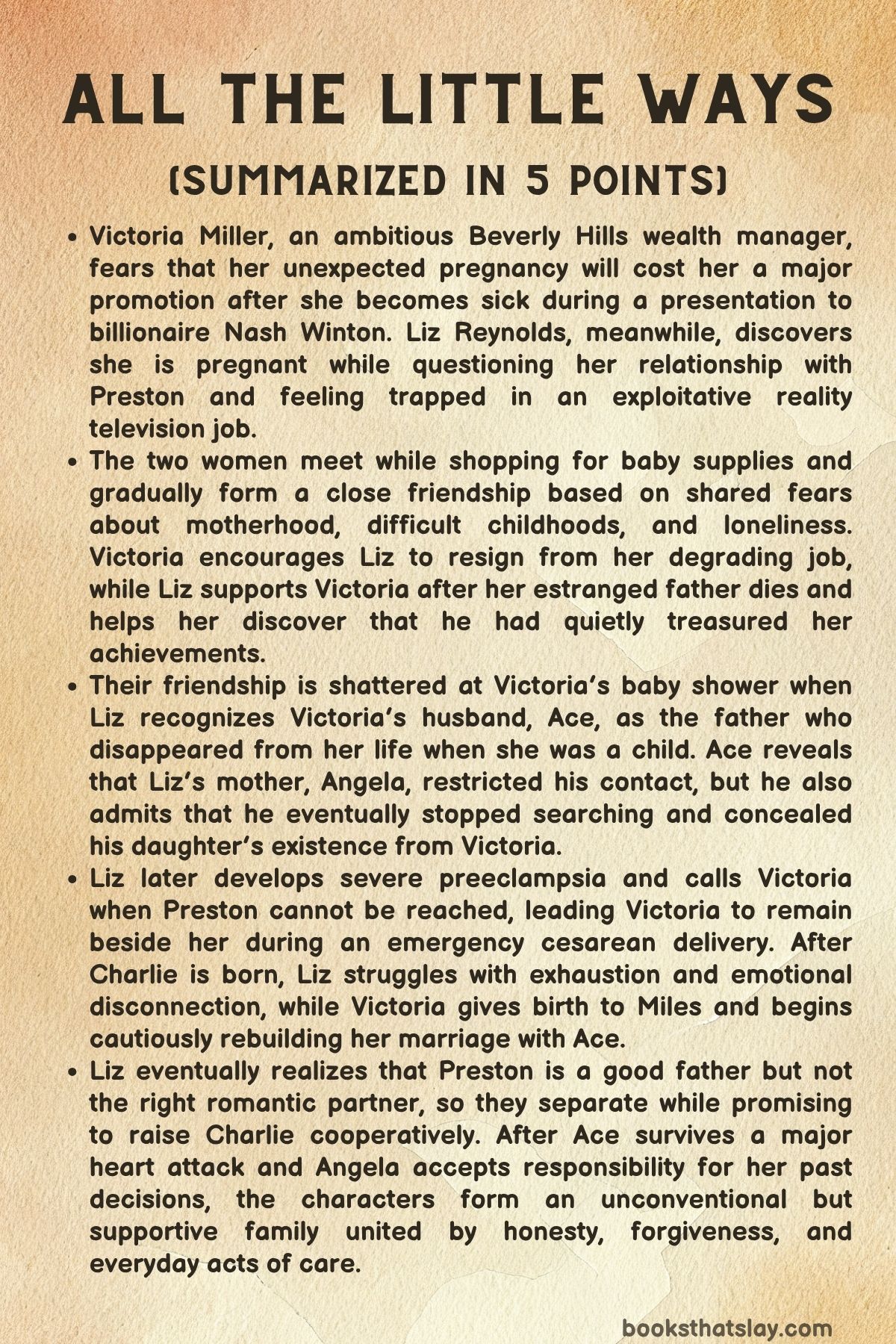
Summary
Forty-three-year-old Victoria Miller has spent years building a successful career as a Beverly Hills wealth manager. Raised in a working-class Fresno family that never understood her intelligence or ambition, she has taught herself how wealthy clients speak, dress, and make decisions, hoping to become the first female managing director at her firm.
Her promotion depends largely on securing billionaire Nash Winton before her privileged rival, Mark Berg, can win his business. Victoria is also hiding an early pregnancy because she fears that her colleagues will regard motherhood as proof that she is no longer fully committed to her career.
During her presentation to Nash, the smell of smoked salmon triggers severe nausea. Victoria vomits on Nash and the conference table, then accidentally announces her pregnancy to everyone before fleeing in humiliation.
At home, she directs her anger toward her husband, Ace, because she believes the pregnancy has destroyed her promotion prospects. Ace understands that her fear is rooted in years of working harder than men who are automatically treated as capable, and he waits patiently until she admits that she is also frightened of becoming a mother.
Victoria’s own mother treated her curiosity and achievements as inconveniences, leaving her afraid that she may repeat those emotional failures. When she later begins bleeding, however, her uncertainty disappears beneath the terror that she may lose the baby.
Doctors determine that the bleeding was caused by a subchorionic hematoma and that the pregnancy remains healthy. Victoria and Ace learn that they are expecting a boy, and the hospital scare helps Victoria recognize that she already loves the child whose existence had previously felt abstract.
Liz Reynolds, meanwhile, is preparing to tell her boyfriend, Preston Lancaster, that she is pregnant. Their eleven-month relationship has been comfortable but emotionally undefined, and Liz fears that Preston was already planning to end it before she announced the pregnancy.
Preston reacts with shock but eventually says that they should move in together. Liz accepts, although she remains unsure whether he genuinely wants a future with her or is simply responding responsibly to an unexpected situation.
Liz works as an editor on The Catch, a reality program that manipulates women, encourages excessive drinking, and treats humiliation as entertainment. She despises the show but depends on its salary and health insurance, making her feel trapped between financial necessity and her desire to edit meaningful independent films.
Although Liz describes the pregnancy as unplanned, she carries private guilt. She had missed several birth-control pills while taking antibiotics and chose not to warn Preston, allowing herself to believe that she had not consciously decided to become pregnant.
Liz’s mother, Angela, responds to the pregnancy with criticism, theories about gender, and stories about her own unconventional parenting. Angela views Liz’s childhood of travel, communal living, and constant change as adventurous, while Liz remembers instability, loneliness, and the absence of dependable adults.
Angela also reveals private information about Liz’s mental health in front of Preston. The violation reminds Liz that her mother repeatedly ignores boundaries while presenting herself as accepting and enlightened.
Victoria soon learns that Mark has received the managing director position. Although she cannot prove discrimination, the timing confirms her belief that the pregnancy announcement and disastrous presentation cost her the promotion.
Several female coworkers invite Victoria to create a baby registry with them. At the store, Victoria is overwhelmed by unfamiliar products and expectations, realizing that professional competence has not prepared her for motherhood.
She meets Liz there, and the two discover that they are at similar stages of pregnancy. Their first interactions are easy and humorous, especially because neither woman feels comfortable with the competitive advice and idealized enthusiasm surrounding pregnancy.
Victoria arranges an expensive brunch with Liz but treats the meeting like a professional consultation. When Liz says that she hates her job, Victoria tells her to resign and pursue independent filmmaking without recognizing that Liz needs income and medical insurance.
Liz feels judged by Victoria’s wealth and certainty, while Victoria believes she is offering encouragement. Their friendship nearly ends before it has properly begun, but they later meet again during a prenatal class and apologize to each other.
Over gelato, they discuss loneliness and the difficulty of maintaining adult friendships. Liz admits that her longtime friends make her feel inadequate, while Victoria confesses that she has devoted so much of herself to work that she has almost no close friends.
As they spend more time together, both women begin speaking honestly about their childhoods. Victoria describes a family that regarded her success as rejection, while Liz explains how she spent years longing for an ordinary home and searching online for the father she had never known.
Both fear that their mothers’ failures may be repeated through them. Their friendship becomes a place where they can discuss these fears without being judged or forced to perform happiness.
Liz eventually tells Preston that she wants to leave The Catch and edit independent films. He offers financial support, but his suggestion that she use his credit card makes her uncomfortable because she does not want professional freedom to require personal dependence.
Conditions at work become intolerable after a contestant suffers alcohol poisoning and the producers continue treating exploitation as valuable footage. Encouraged by Victoria, Liz sends a furious resignation email condemning the program’s sexism and leaves without another job secured.
At the same time, Victoria learns through an old acquaintance that her father has died. Her mother and brother arranged the funeral without contacting her, reinforcing her belief that she never truly belonged in the family.
Liz accompanies Victoria to Fresno. During the trip, their friendship becomes more relaxed and affectionate, giving Victoria the companionship she never realized she needed.
At her childhood home, Victoria discovers a folder containing her report cards, awards, college acceptance letters, newspaper articles, and other records of her accomplishments. Her father had quietly preserved evidence of everything she achieved, proving that he noticed and valued her even though he never expressed it.
The discovery leaves Victoria grieving both his death and the relationship they might have had. Liz remains beside her and holds her while she cries, offering the emotional presence Victoria’s biological family cannot provide.
Victoria later hosts an elegant baby shower attended by coworkers, prenatal classmates, friends, and Liz. Liz gives a moving speech about Victoria’s loyalty and strength, explaining that her friendship has kept Liz from breaking during a frightening period of change.
The celebration collapses when Ace enters the room. Liz recognizes him as the father she once searched for online and calls him “Dad.”
Ace confirms the connection by addressing Liz by her childhood name, Sage. Liz runs away, while Victoria is left confronting the fact that her husband concealed the existence of an adult daughter throughout their marriage.
Ace explains that Angela became pregnant when they were young and originally said she would terminate the pregnancy. She later kept the baby, moved frequently, and gradually prevented him from maintaining contact.
Ace sent money and visited Liz during her early childhood, but Angela eventually told him that another man could provide greater stability. Ace admits that he accepted the separation, stopped searching, and mentally buried his daughter rather than continuing to fight for a relationship.
Victoria is less troubled by his youthful mistakes than by his years of deception. Every statement about becoming a father for the first time now seems dishonest, and she separates from him while trying to process the betrayal.
Liz initially rejects both Ace and Victoria. Although she knows Victoria probably had no knowledge of the secret, she cannot imagine remaining best friends with the woman who is also her stepmother.
Ace later approaches Liz and accepts responsibility for giving up. His explanation contradicts Angela’s claim that he never cared, but he does not pretend that Angela’s interference excuses his own failure to continue searching.
Liz confronts Angela, who argues that she wanted her daughter to have a father who chose her completely rather than one who appeared occasionally out of guilt. Liz recognizes that fear and resentment may have influenced Angela’s decisions, but she cannot forgive her for denying both father and daughter the truth.
Professionally, Liz finally receives an opportunity when independent filmmaker Noora Khan offers her an editing position. Noora admired Liz’s resignation email and believes that her moral courage makes her suitable for work with greater artistic value.
Shortly afterward, Liz develops severe swelling, high blood pressure, sudden weight gain, and protein in her urine. She is diagnosed with preeclampsia and ordered to deliver immediately.
Preston cannot be reached, so Liz calls Victoria. Despite their unresolved conflict, Victoria rushes to the hospital, identifies herself as family, requests additional medical guidance, and helps Liz understand her options.
When the baby shows signs of distress, doctors perform an emergency C-section. Liz begs Victoria to remain with her and protect the child if anything goes wrong.
Liz gives birth to a healthy boy named Charlie. Because she is shaking too badly to hold him, she asks that the newborn be placed in Victoria’s arms, restoring their bond through an act of trust more powerful than any formal reconciliation.
After returning home, Liz struggles with exhaustion, breastfeeding, sleeplessness, and the absence of the immediate maternal devotion she expected. Preston works from home despite taking paternity leave, leaving Liz responsible for much of Charlie’s care.
Victoria recognizes that Liz needs practical support and offers to pay for a night nurse. Liz initially resists because accepting money makes her feel dependent, but Victoria explains that resources are valuable when they can reduce another person’s suffering.
Victoria later encounters Nash at a charity event and learns that he never seriously intended to hire Mark. Nash assumed Victoria had lost interest because she apologized once after the disastrous meeting and then stopped pursuing him.
Victoria renews the negotiation and eventually secures Nash as a client. The achievement restores her professional confidence and demonstrates that pregnancy did not eliminate her ambition or ability.
Ace asks Victoria for another chance, arguing that love is revealed not only through perfect memories but through what people do after their flaws and failures are exposed. Victoria agrees that their former marriage cannot simply be restored, but she remains willing to rebuild trust through counseling, accountability, and time.
Soon afterward, Victoria goes into rapid labor and barely reaches the hospital before giving birth to Miles. Liz visits and meets her newborn half brother, who is also Charlie’s uncle despite being only weeks younger than him.
Liz also tells Ace that she wants to know him rather than continue pretending their connection does not exist. Her willingness does not erase the past, but it creates the possibility of a future relationship.
Victoria gently questions whether Liz is happy with Preston. She suggests that having a child with a good man is not automatically a reason to remain romantically attached to him, especially when emotional intimacy has always been missing.
Liz initially rejects this advice. She insists that Preston is responsible and kind, yet her defensive reaction reveals how strongly Victoria’s observation affects her.
The truth becomes unavoidable when Preston gives Liz a corgi puppy to improve her mood. He intends the gift lovingly, but Liz sees only another living creature she will be expected to feed, clean, supervise, and protect.
Liz finally understands that she spent the relationship worrying about whether Preston would choose her without asking whether she would choose him. Their values, interests, communication habits, and expressions of love are different in countless ordinary ways, and those small differences have become the substance of their life together.
They end their romantic relationship without hostility and make humorous promises to remain friends and cooperative parents. Freed from the pressure to force their partnership into a permanent romance, they begin creating a healthier family structure for Charlie.
At almost the same moment, Ace suffers a massive heart attack while running. He undergoes quadruple-bypass surgery and remains unconscious in intensive care.
Victoria sits beside him, terrified that their second chance may end before they can repair their marriage. Liz joins her, and the two women recognize that both have only recently regained Ace in different ways.
When Ace’s heart stops, doctors perform emergency compressions and use a defibrillator. He survives and gradually begins recovering, giving Victoria, Liz, and their children another opportunity to form a family around honesty rather than secrecy.
Liz later visits Angela and introduces her to Charlie. Angela finally admits that she imposed her preferred lifestyle on Liz, ignored her daughter’s need for stability, and kept Ace away partly because of resentment.
Angela apologizes and promises to listen rather than automatically defending herself. Liz does not erase the damage, but she allows the possibility of a more truthful relationship.
Liz and Charlie temporarily move into Victoria and Ace’s guesthouse while Ace recovers. At a family dinner, Victoria, Liz, Ace, Angela, Miles, and Charlie gather together despite the painful history connecting them.
The two babies, who are simultaneously uncle and nephew, hold hands. Liz recognizes that the unusual family before her has become the secure and loving community she spent her childhood wanting.
Characters
Victoria Miller
Victoria is one of the two central figures in the book, a highly accomplished wealth manager whose confidence has been built through discipline, observation, and relentless self-control. All the Little Ways presents her professional ambition not as vanity but as a response to class insecurity, family rejection, and the unequal expectations placed on successful women.
Her pregnancy threatens the identity she has spent years creating because she believes motherhood will cause colleagues to question her seriousness. Vomiting during the Nash presentation is especially devastating because her body publicly overrides the control on which her reputation depends.
Victoria initially approaches emotional problems as though they were business challenges. Her disastrous first brunch with Liz shows that she often confuses advice with support, assuming that identifying the correct solution is more useful than listening to another person’s fears.
Her growth involves learning that love cannot always be expressed through correction, planning, or control. She becomes a valuable friend because she is willing to arrive at the hospital, remain during Liz’s surgery, provide material help, and tell difficult truths even when they are unwelcome.
Victoria’s relationship with motherhood is shaped by her fear of resembling her own mother. She does not instantly view pregnancy as fulfillment, but her attachment develops through fear, responsibility, and ordinary moments rather than through idealized maternal instinct.
Her reaction to Ace’s secret reveals the importance she places on honesty. She can understand youthful confusion and failure, but she cannot easily accept that Ace allowed her to build a marriage around a false version of his past.
Victoria ultimately expands her idea of success. Securing Nash remains important, yet mentoring Harper, supporting Liz, caring for Miles, and rebuilding her marriage show her that influence and connection can be as meaningful as professional recognition.
Liz Reynolds
Liz is intelligent, funny, observant, and deeply uncertain about her own worth. Within All the Little Ways, her insecurity affects nearly every major decision she makes, from remaining at a degrading job to accepting an emotionally limited relationship because she is more concerned with being chosen than with choosing for herself.
Her pregnancy is complicated by the knowledge that she did not fully inform Preston about the missed birth-control pills. This concealed choice reflects her desire for commitment, but it also reveals her tendency to avoid direct conversations and hope circumstances will force other people to provide the security she wants.
Liz’s childhood with Angela taught her that affection could exist without reliability. Because her mother repeatedly changed homes, partners, communities, and philosophies, Liz learned to adapt rather than clearly state her needs.
Her work on The Catch conflicts with her ethical instincts. She dislikes reducing women to humiliating footage, yet financial fear keeps her in place until Victoria challenges her to treat her ambitions seriously.
Liz’s resignation marks a major act of self-respect. The email is impulsive and risky, but it allows her to stop cooperating with a system she finds degrading and eventually leads Noora to offer her meaningful work.
Her response to motherhood is one of the novel’s most honest emotional conflicts. She expects immediate devotion but instead feels exhausted, trapped, and disconnected, leading her to assume that difficulty bonding with Charlie proves that she is defective.
Liz gradually learns that maternal love can emerge slowly and does not require constant joy. Her eventual peace with Charlie arrives only after she stops measuring herself against other mothers and begins making choices that reflect her actual needs.
Her breakup with Preston is not a rejection of him as a person or father. It is an acknowledgment that kindness and responsibility cannot replace emotional compatibility, shared interests, honest communication, and mutual understanding.
Ace Miller
Ace is warm, persistent, affectionate, and capable of offering Victoria emotional steadiness without trying to diminish her independence. His early courtship shows that he understands her defenses and is willing to use humor and patience rather than pressure.
As Victoria’s husband, Ace is attentive to the inequalities she faces at work. He does not dismiss her fears about pregnancy or insist that everything will automatically improve, which makes him a supportive contrast to people who offer reassurance without understanding her circumstances.
His concealed relationship to Liz creates the central family crisis. Although Angela restricted his access and frequently moved, Ace eventually chose to stop searching, allowing guilt and shame to become excuses for emotional disappearance.
Ace’s greatest wrongdoing in the present is not simply that he abandoned the search for Liz. It is that he concealed her existence from Victoria while repeatedly speaking as though Miles would be his first experience of fatherhood.
He does not defend himself by portraying Angela as the sole villain. When he speaks to Liz, he accepts that he should have fought harder and acknowledges that explanations cannot restore the childhood relationship they lost.
Ace’s request for reconciliation with Victoria is similarly based on accountability rather than entitlement. He accepts that their marriage cannot return to its earlier form and that forgiveness will require counseling, transparency, and sustained effort.
His heart attack forces both Victoria and Liz to confront how quickly their newly rebuilt relationships could disappear. His survival allows him to become a husband, father, grandfather, and recovering parent within a family that now understands both his love and his failures.
Preston Lancaster
Preston is a decent and responsible man who repeatedly attempts to do what he believes is expected of him. When Liz announces her pregnancy, he responds by suggesting that they live together and later embraces fatherhood with genuine affection.
His problem is not cruelty but emotional limitation. He offers practical solutions, money, housing, and reassurance, yet he rarely creates the deeper conversations Liz needs about love, commitment, sex, fear, and their shared future.
Preston’s refusal to have sex during the pregnancy demonstrates how poorly he handles discomfort. Rather than discuss his anxiety in a mature way, he creates distance that intensifies Liz’s insecurity about her body and desirability.
His decision to give Angela the house security code also shows that he does not fully understand Liz’s complicated relationship with her mother. He views Angela as interesting and unconventional, while Liz experiences her behavior as invasive.
Preston’s absence during Charlie’s emergency birth is not intentional, but it becomes part of Liz’s growing recognition that she does not instinctively rely on him during emotional crises. Victoria, rather than Preston, is the person Liz calls when she feels most frightened.
The puppy gift becomes the clearest evidence of their incompatibility. Preston sees a cheerful surprise, while Liz sees another responsibility, proving that his affection often takes forms that do not address what she is actually experiencing.
Their separation is compassionate because neither needs to become a villain. Preston remains a devoted father and supportive coparent, showing that a relationship can fail romantically without destroying the family created through it.
Angela
Angela is imaginative, unconventional, outspoken, and resistant to traditional expectations. She believes that travel, communal living, spiritual exploration, and independence gave Liz an extraordinary childhood.
Her self-image prevents her from recognizing the difference between the childhood she intended to create and the one Liz actually experienced. What Angela remembers as freedom, Liz remembers as loneliness, instability, and the constant loss of familiar people and places.
Angela frequently violates boundaries while presenting her behavior as openness. She enters Preston’s house without permission, rearranges furniture, comments on Liz’s body, and reveals private mental-health information because she assumes that conventional ideas of privacy are unnecessary.
Her decision to remove Ace from Liz’s life contains both protective and selfish motives. She may genuinely have believed that occasional visits would hurt Liz, but she also allowed resentment toward Ace to influence a choice that belonged partly to her daughter.
Angela’s greatest weakness is her habit of converting criticism into a debate about philosophy. Instead of listening when Liz describes pain, she initially explains why her intentions were progressive, loving, or misunderstood.
Her eventual apology is significant because she finally separates intention from consequence. She acknowledges that she imposed her preferred life upon Liz and denied her daughter the stability and paternal relationship she wanted.
Angela does not become an entirely different person. Her development lies in agreeing to listen, accept responsibility, and participate in the family without automatically controlling its meaning.
Harper
Harper begins as Victoria’s enthusiastic but professionally ineffective assistant. She lacks financial knowledge and frequently compensates with energy, optimism, and loyalty.
Her secret replacement of Victoria’s dead orchid provides both humor and insight. Harper wants Victoria to feel competent and cared for, even if her method involves hiding an uncomfortable truth.
Harper’s strengths lie in fashion, popular culture, communication, and understanding people. Victoria eventually recognizes that Harper is failing not because she lacks ability, but because she is using her abilities in the wrong profession.
Victoria’s decision to fire Harper is therefore an unusual act of mentorship. She removes the security of an unsuitable job while clearly identifying talents that Harper herself has never been encouraged to value.
Harper also supports Victoria during the baby-shower crisis. Her observation that most families contain secrets helps Victoria move beyond humiliation and see that another person’s concealed past does not make her foolish.
Her later success in fashion and public relations confirms Victoria’s judgment. Harper becomes evidence that honest intervention, even when uncomfortable, can be an expression of care.
Nash Winton
Nash is an eccentric billionaire whose business represents Victoria’s best opportunity for professional advancement. His wealth allows him to treat negotiations as entertainment, creating uncertainty for both Victoria and Mark.
After Victoria vomits on him, she assumes the relationship is permanently destroyed. Nash’s later behavior reveals that he is less offended by the accident than by her decision to stop pursuing his account.
He enjoys making Mark work for business he never intends to award, which gives him a manipulative and somewhat arrogant quality. At the same time, his willingness to reconsider Victoria shows that her professional judgment and persistence still matter.
Nash functions as a test of Victoria’s resilience. Winning his account proves that pregnancy, embarrassment, and a missed promotion do not erase her professional value.
Mark Berg
Mark represents the privilege Victoria has spent her career resisting. He expects advancement more easily, has access to opportunities without the same degree of scrutiny, and is quick to pursue Nash as soon as Victoria appears vulnerable.
His selection as managing director confirms Victoria’s belief that competence alone does not determine professional success. Timing, gender expectations, social comfort, and institutional favoritism all influence the decision.
Mark is not presented as unusually brilliant or malicious. His importance comes from how comfortably he benefits from a system that requires Victoria to be exceptional while allowing him to be merely acceptable.
Nash’s private amusement at Mark’s efforts weakens Mark’s apparent victory. He may receive the title Victoria wanted, but Victoria ultimately secures the client whose business carries greater personal and professional meaning.
Cam
Cam embodies the moral emptiness of exploitative reality television. He treats intoxication, humiliation, sexual behavior, and emotional collapse as usable material rather than evidence that vulnerable people need protection.
His criticism of Liz focuses entirely on whether she has captured the most degrading footage. He rewards content that attracts attention without considering the human consequences of creating it.
Cam’s behavior forces Liz to recognize that remaining at The Catch makes her an active participant in a system she condemns. Her resignation is therefore not merely a career change but a refusal to keep turning other women’s suffering into entertainment.
Noora Khan
Noora Khan offers Liz the professional opportunity she has been afraid to pursue. As an independent filmmaker, she represents work driven by artistic purpose rather than humiliation and commercial manipulation.
She discovers Liz through the leaked resignation email, interpreting it not as reckless anger but as evidence of principle. Her response shows that refusing an unethical workplace can create opportunities even when the immediate consequences appear frightening.
Noora also recognizes that Liz’s years in reality television have not erased her talent. By hiring her, she validates both Liz’s editing ability and her desire to make work she can respect.
Jen
Jen is an old friend from Victoria’s earlier life who chose to become a stay-at-home mother. Victoria once judged that choice, interpreting domestic commitment as a surrender of intelligence and potential.
Seeing Jen again forces Victoria to recognize that she repeated the same behavior she resented in her own family. Just as they treated Victoria’s ambition as criticism, she treated Jen’s different priorities as evidence of limitation.
Jen’s humorous baby-shower speech recalls Victoria repeatedly breaking eggs during a school parenting exercise. The story makes Victoria’s fear of maternal incompetence visible while also showing that her old friend understands the difference between adolescent carelessness and adult capacity.
Ellen, Deborah, and Annalise
Ellen, Deborah, and Annalise first appear to represent the workplace gossip Victoria expects from other women. Their speculation about her marriage confirms her belief that personal exposure invites judgment.
Their later behavior is more generous than Victoria anticipates. They organize her baby shower, help with the registry, and offer comfort when her relationships with Ace and Liz collapse.
Their development challenges Victoria’s assumption that female relationships are naturally competitive or superficial. Once she allows herself to accept their support, she discovers that community can emerge from people she previously kept at a professional distance.
Cara, Madison, and Freya
Cara, Madison, and Freya are Liz’s longtime friends and experienced mothers. They provide companionship and practical advice, but their conversations often become competitive, intrusive, and dominated by assumptions about the correct way to experience pregnancy.
Their questions about sex, parenting products, and maternal behavior increase Liz’s sense that she is failing an invisible test. Because she fears losing relationships, Liz often tolerates feeling misunderstood rather than clearly explaining what she needs.
Despite their limitations, they are not uncaring. They visit after Charlie’s birth with food and gifts, showing that friendship can contain genuine affection even when emotional understanding is incomplete.
Victoria’s Father
Victoria’s father remains emotionally distant during his life, leaving her convinced that he neither understood nor valued her achievements. His inability to express pride becomes one of the deepest wounds shaping her ambition.
The folder of report cards, awards, articles, and acceptance letters reveals that he quietly followed every stage of her success. His private pride does not erase his failure to communicate, but it complicates Victoria’s belief that he felt nothing.
His death represents the permanent loss of possible reconciliation. Victoria grieves not only the man himself but the words they might have exchanged had either of them known how to cross the emotional distance between them.
Charlie and Miles
Charlie and Miles are infants, yet their births transform nearly every adult relationship in the story. Charlie’s emergency delivery restores the connection between Liz and Victoria, while Miles gives Victoria and Ace a shared reason to attempt rebuilding their marriage.
Their unusual family relationship captures the novel’s blend of comedy and emotional complexity. Miles is Charlie’s uncle despite being almost the same age, and both children connect adults whose histories had previously been defined by secrecy and separation.
When the babies hold hands at the final family gathering, the gesture suggests that the next generation does not have to inherit every division created by the previous one. Their presence turns a fractured group of adults into a family with a shared future.
Themes
Motherhood Without Idealization
Motherhood is presented as an uncertain relationship that develops differently for every woman rather than as an automatic source of fulfillment. In All the Little Ways, both Victoria and Liz feel frightened by the expectation that pregnancy should immediately make them joyful, selfless, and instinctively prepared.
Victoria initially fears that becoming a mother will destroy her professional identity. Her emotional attachment to Miles grows gradually through a medical scare, the discovery that she is carrying a boy, and the recognition that she genuinely wants the life forming inside her.
Liz faces a different struggle after Charlie’s birth. She expects instant love but instead encounters pain, exhaustion, breastfeeding difficulties, resentment, sleeplessness, and the frightening sense that her baby is a stranger whose needs never stop.
Her inability to feel constant happiness becomes more painful because other mothers describe parenthood in absolute and idealized language. The novel challenges those expectations by showing that anxiety, disconnection, frustration, and love can exist together.
Both women also learn that motherhood does not require complete self-sacrifice. Victoria continues pursuing Nash, while Liz accepts a new editing position and ends a relationship that does not meet her emotional needs.
Practical support becomes essential rather than shameful. Night nurses, friends, doctors, partners, and chosen family allow the women to care for their children without pretending that one person should carry every responsibility alone.
The Everyday Foundations of Relationships
Relationships are ultimately determined by repeated habits, ordinary conversations, and daily acts of understanding. Grand declarations matter less than whether two people can communicate honestly, recognize each other’s needs, and share the responsibilities of ordinary life.
Liz spends much of her relationship with Preston waiting for a clear sign that he has chosen her. His willingness to live together and his devotion to Charlie appear to offer security, yet they never resolve the emotional distance between them.
The puppy reveals more than a dramatic betrayal could have done. Preston intends to make Liz happy, but the gift demonstrates that he does not understand her exhaustion, her fear of responsibility, or her desperate need for rest.
Liz realizes that incompatibility is often visible through countless small moments rather than one unforgivable act. Their different interests, communication styles, expectations, and expressions of affection accumulate until she recognizes that pleasant companionship is not enough.
Victoria and Ace face the opposite problem. Their everyday compatibility and genuine love are strong, but Ace’s long concealment of Liz damages the trust supporting their marriage.
Their reconciliation is possible only because they accept that love must continue through counseling, accountability, difficult conversations, and changed behavior. Affection can motivate repair, but it cannot substitute for the daily work required to rebuild trust.
Chosen Family and Biological Connection
Biology creates relationships in the novel, but care determines whether those relationships become emotionally meaningful. Liz is biologically connected to Ace, yet his absence means that Victoria becomes more reliable during the most frightening moment of Liz’s life.
Victoria and Liz choose each other before discovering that they are legally and biologically connected through Ace. Their friendship is built through shared meals, walks, jokes, arguments, apologies, professional encouragement, hospital visits, and the willingness to remain present during moments of vulnerability.
The family secret initially makes their friendship appear impossible. Liz cannot separate Victoria from the father who abandoned her, while Victoria feels unfairly punished for a history she never knew existed.
Charlie’s emergency birth removes those labels temporarily. Liz does not call Victoria because she is her stepmother; she calls because Victoria is the person she trusts to stay calm, explain difficult choices, and protect her child.
The final family gathering does not erase abandonment, deception, resentment, or emotional neglect. Instead, it demonstrates that people can form a stable community by acknowledging those injuries and choosing new patterns.
Angela, Ace, Victoria, Liz, Miles, and Charlie become a family not because their history is simple but because they begin telling the truth. Their connection is strengthened through presence, apology, practical help, and the repeated decision to remain involved.
Inherited Damage and the Possibility of Change
Both Victoria and Liz fear that they will reproduce the failures of their parents. Victoria worries that her mother’s emotional coldness has left her incapable of nurturing a child, while Liz fears that Angela’s instability has prevented her from understanding what dependable motherhood looks like.
Their parents are not presented as entirely uncaring. Victoria’s father secretly preserved records of her achievements, and Angela believed that her unconventional choices gave Liz freedom and experience.
The problem is that love remains incomplete when it is not communicated in a form the child can understand. Victoria’s father may have felt proud, but his silence left her feeling rejected, while Angela’s adventurous intentions could not provide the stability Liz needed.
Ace repeats this pattern by convincing himself that withdrawing from Liz may have been best for her. His private guilt does not help the daughter who grows up believing he never wanted her.
Change begins when the characters stop treating good intentions as sufficient. Ace admits that he gave up, Angela acknowledges that resentment influenced her choices, and Victoria accepts that her habit of forceful advice can hurt people even when she is trying to help.
The novel does not suggest that parents can avoid every mistake. Instead, it presents self-awareness, apology, honesty, and repair as the qualities that prevent damage from becoming permanent across generations.