An Artful Dodge Summary, Characters and Themes
An Artful Dodge by Karen Odden is a Victorian historical mystery centred on Kit Jimeson, a skilled shoplifter whose sharp observation and talent for disguise have kept her younger sister safe.
Set among London’s department stores, criminal networks, newspapers and hidden waterways, the novel examines the uneasy boundary between survival and wrongdoing. Kit’s loyalty to her female thieving ring is tested when a former member returns from transportation and seizes control through threats, manipulation and revenge. As Kit uncovers long-buried betrayals, she must decide whether her abilities will continue serving crime or become the means by which she creates an honest future.
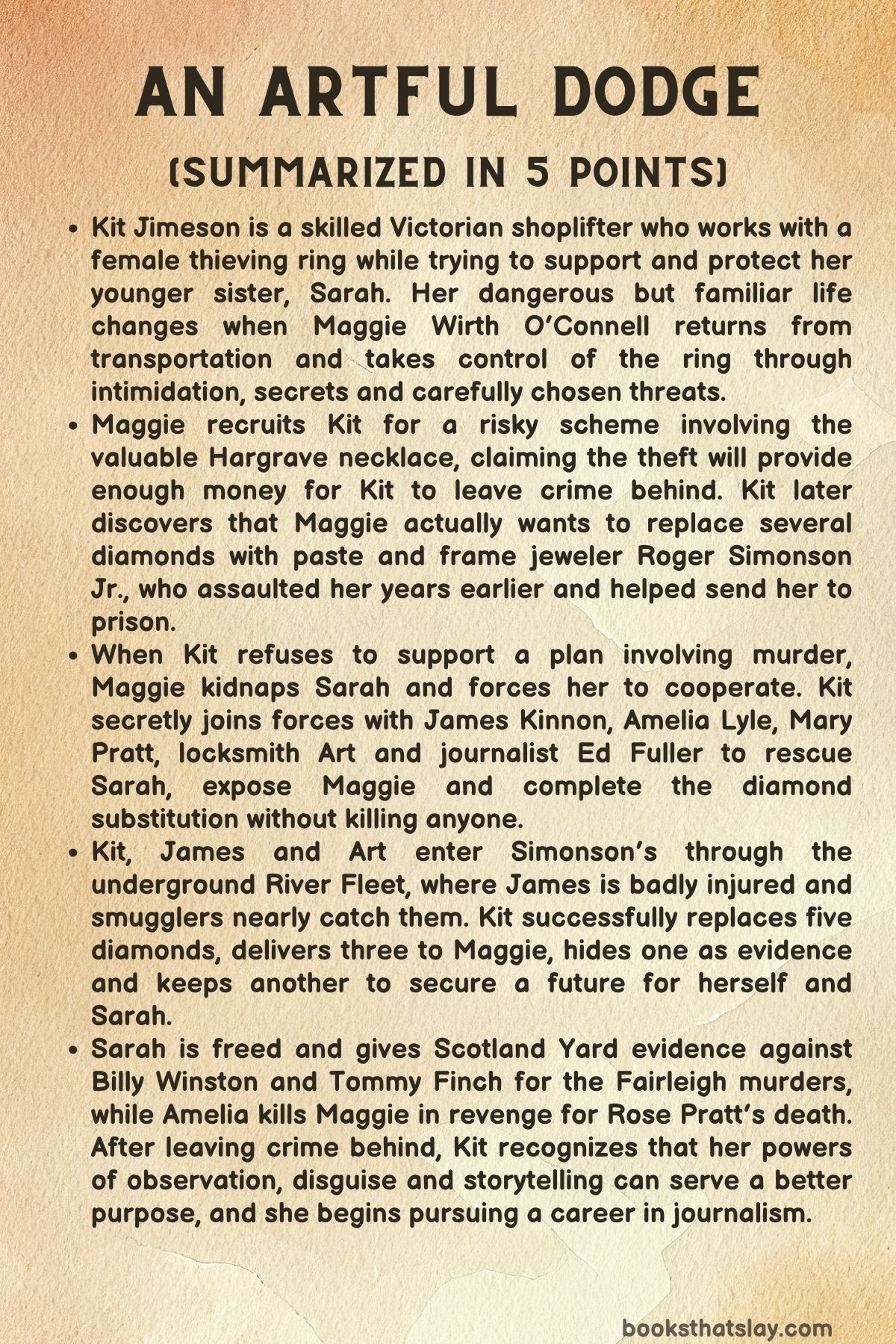
Summary
Kit Jimeson works as one of the most talented members of a female thieving ring based above the Elephant and Castle Inn in Southwark. The group is led by Amelia Lyle, who has turned a collection of struggling women into an organized operation built around disguises, distractions, hidden pockets and carefully chosen targets.
Kit’s closest friend and usual partner is Mary Pratt, who has been absent from active thieving since the murder of her mother, Rose. Although Mary performs well during practice, Amelia worries that grief has weakened her confidence and warns the women that plainclothes detectives have recently increased their presence in West End shops.
Kit and Mary nevertheless attempt a theft at Pickford’s department store with help from Mary’s young nephew, Sid. Their plan requires Sid to steal Mary’s reticule, allowing Mary to faint dramatically while Kit takes merchandise from distracted clerks and customers.
The theft succeeds, but Kit notices a man in a brown suit who ignores Mary’s performance and searches the shop for the real thief. Kit escapes, yet the detective’s watchfulness makes her suspect that the ring may be receiving unusual attention from the police.
Kit conceals the danger from Amelia because she fears Mary will be prevented from working again. Her concern grows when another thief, Josie, ignores a warning signal at Whiteley’s and is arrested with enough stolen property to make a prison sentence almost certain.
At the same time, Kit becomes worried about her younger sister, Sarah, who works as a scullery maid in the wealthy Willits household. Sarah returns late one night, frightened and soaked by the rain, but claims she was delayed by preparations for Clara Willits’s engagement party.
During dinner with James Kinnon, a former smuggler and Kit’s old partner in confidence schemes, Kit reads about the murder of two servants during a burglary at the Fairleigh home. Sarah’s strange behaviour suddenly seems connected to the crime, and James agrees to investigate rumours among Southwark’s criminals.
When Kit confronts Sarah, the girl admits that she saw Billy Winston and Tommy Finch near the Fairleigh house on the night of the murders. The two men were dressed as gentlemen, and Sarah cannot be certain that they failed to notice her hiding nearby.
Kit understands that Sarah may be killed if Billy and Tommy discover that she can identify them. Her protective fear makes her increasingly controlling, while Sarah argues that Kit’s dangerous work creates as much risk as the criminals she wishes to protect her from.
A new threat appears when Maggie Wirth O’Connell returns to London after twenty years in the Swan River penal colony. Maggie is the daughter of the ring’s former leader and claims that leadership was always intended to pass to her.
Amelia announces that she will surrender control, although Kit senses that her decision is not voluntary. Maggie presents herself as charming, experienced and generous, describing the abuse she suffered in Australia and demonstrating her remarkable command of accents, disguises and social behaviour.
Maggie takes a particular interest in Kit and asks questions about Sarah, Kit’s childhood and Kit’s mother, Annie. Kit learns that Annie was Maggie’s partner on the day Maggie was arrested, raising the possibility that Maggie has returned to punish her for an old betrayal.
Although Maggie promises to preserve Amelia’s arrangements, she begins reorganizing the ring according to her own interests. She dismisses Mary on the grounds that grief makes her unreliable and threatens the housing and security upon which many of the women depend.
Kit’s distrust intensifies after learning that Maggie may have manipulated the police into targeting the ring. She also discovers that Mr. Ardle, the pawnbroker for whom she repairs and alters stolen jewelry, once loved Maggie and remains willing to do almost anything for her.
Maggie offers Kit a special assignment involving a valuable necklace left at Simonson’s jewelry shop in Hatton Garden. The Hargrave necklace contains diamonds, sapphires and a large ruby, and Maggie promises Kit enough money to support Sarah and leave thieving behind.
Kit investigates the district in numerous disguises and concludes that an ordinary burglary would be extremely dangerous. Simonson’s is protected by locks, mirrors, safes, nearby patrols and the presence of the jeweler’s family in rooms above the shop.
James helps Kit study old maps of Hatton Garden and recalls that smugglers once used hidden passages in the district. He also proposes a safer alternative: Kit could enter Lord Charleton’s ball as a servant and steal the necklace during the crowded event.
As Kit and James work together, their long-standing friendship changes. James admits that he has loved her for years, while Kit begins to understand that his support for her employment, Sarah’s welfare and her personal safety was never a trick designed to control her.
Maggie rejects the ball proposal because she does not truly want the necklace stolen. She reveals that Roger Simonson Jr. sexually assaulted her after catching her stealing twenty years earlier, then summoned the police and presented himself as the victim.
Maggie intends to replace several diamonds with paste while the necklace is under Simonson’s protection. Once the fraud is discovered, society will assume that Simonson stole the real stones, destroying his reputation and perhaps sending him to prison.
Kit sympathizes with Maggie’s desire to punish the man who abused her, but she refuses to participate in a plan requiring the murder of a constable. Her refusal becomes more dangerous when she recognizes Billy Winston as Maggie’s cousin and realizes that Maggie has placed a violent enforcer inside the ring.
Kit finds Amelia living secretly on Shoe Lane and finally learns the truth about Maggie’s past. Annie did not betray Maggie; the informant was probably Rose Pratt, who loved Tim Lowry, a man involved with Maggie and possibly Mary’s biological father.
Amelia and Kit conclude that Maggie murdered Rose shortly after returning to London. Amelia also explains that Maggie forced her to surrender the ring by threatening her brother Adam, who could be hanged for killing a police officer years earlier.
Kit realizes that Maggie controls people by identifying the person they cannot bear to lose. When she races to the Willits household, she discovers that Sarah has disappeared and that her belongings remain behind.
Maggie admits that she kidnapped Sarah after money failed to persuade Kit. She gives Kit proof that Sarah is alive and explains that Billy will murder a constable, take his uniform and permit Kit and a locksmith to enter Simonson’s after closing.
Kit pretends to cooperate while secretly gathering Amelia, James and Mary. They design a counterplan that will allow Kit to replace the diamonds without killing anyone and provide evidence connecting Maggie to the crime after Sarah is released.
James identifies a route through the underground River Fleet, while Amelia recruits Art, a calm and highly skilled locksmith. Kit practises removing and replacing stones at Mr. Ardle’s shop until she can complete the work quickly and without visible damage.
The group decides that Kit will take more diamonds than Maggie requested. Three will be delivered to Maggie, a fourth will be hidden in the Elephant and Castle as evidence, and a newspaper story will expose the substitution immediately so Maggie cannot delay Sarah’s release.
Kit privately decides to take a fifth diamond for herself. She plans to use it to secure a new life for Sarah, believing that one final theft can provide the independence she has never managed to achieve through ordinary wages.
Kit also contacts journalist Ed Fuller, who agrees to publish the story after learning about Sarah’s kidnapping and the injustice Maggie suffered. In exchange, Kit promises that Sarah will testify about the Fairleigh murders, giving Inspector Gordon Stiles the evidence needed to pursue Billy and Tommy.
Kit, James and Art enter the River Fleet after midnight and travel through filthy underground water toward Simonson’s. A sudden surge crushes James’s leg against their boat, leaving him badly injured and unable to continue.
James insists that Kit and Art proceed without him. They initially emerge beneath the wrong building, but Kit uses the sound of church bells and her memory of the surrounding streets to correct their position.
Art opens the hidden doors and the safe while Kit carefully records the arrangement of every object in the workroom. She opens the sealed box, removes five diamonds from the Hargrave necklace and replaces them with carefully selected paste stones.
The pair restores the room and returns to the tunnel, only to discover that their guide yarn has been washed away. Smugglers enter the passage, forcing James to release their boat into the current so it cannot reveal their presence.
Art helps Kit, who cannot swim, through the deep water while James struggles forward with his damaged leg. The smugglers fire at them, but the three escape into the Thames and reach a doctor who treats James before sending him to hospital.
Kit delivers three diamonds to Maggie and arranges for Fuller’s article to appear in the Mirror. The article states that stones were replaced while the necklace was under Simonson’s protection, making his involvement appear difficult to deny without directly accusing him.
Once the article is published, Kit confronts Maggie with a pistol and demands Sarah’s release. Maggie returns Sarah unharmed, while Mary secretly hides the fourth diamond in the ring’s goods room.
Billy follows Kit and Sarah through Southwark, but they seek protection from a uniformed officer and go voluntarily to Scotland Yard. Sarah identifies Billy and Tommy as the men she saw near the Fairleigh home, and Kit tells Stiles where to find the diamond linking Maggie to the jewelry fraud.
Before the authorities can arrest Maggie, she is found murdered. Kit initially fears that Mary killed her to avenge Rose, but Amelia confesses in a farewell message that she stabbed Maggie twice, repeating the wounds Maggie inflicted upon Rose, and then fled London to join Adam.
Billy and Tommy are arrested and convicted for the Fairleigh murders, while Sarah’s identity is kept out of the newspapers. Amelia leaves money and plans that allow Sarah and Mary to establish a successful stationery shop and tearoom on Dean Street.
Kit chooses not to leave London. James recovers from his injuries, and their relationship becomes loving and stable, teaching Kit that relying upon another person does not require surrendering her freedom.
Inspector Stiles encourages Kit to consider how her unusual abilities might be used outside crime. Kit recognizes that years of thieving have taught her to observe expressions, judge motives, adopt convincing identities, enter guarded places and notice details others overlook.
Instead of returning to sewing or joining Sarah and Mary behind the shop counter, Kit approaches the Mirror. She meets Frances Mitford, a female reporter investigating social abuses, and explains that her criminal past has given her access to people and places ordinary journalists rarely understand.
Frances is impressed by Kit’s experience and her ability to tell a story. Kit enters the editor’s office openly, no longer hiding behind a disguise, ready to transform the skills that once made her a thief into tools for exposing injustice.
Characters
Kit Jimeson
Kit is the central character and moral centre of An Artful Dodge, a highly capable thief whose criminal life began as a practical response to poverty, neglect and responsibility. Her intelligence appears through her ability to study physical spaces, read social behaviour, maintain disguises and respond calmly when carefully prepared plans fail.
Her strongest motivation is her devotion to Sarah, whom she has effectively raised since their mother’s death. Kit believes that money is the only dependable form of protection, so she repeatedly postpones leaving crime until she has accumulated enough savings to guarantee Sarah’s security.
This belief gradually becomes one of Kit’s greatest weaknesses. She treats Sarah as a helpless child, overlooks the emotional cost of her absences and fails to recognize that her sister would rather live modestly with Kit than enjoy financial security after Kit has been imprisoned or killed.
Kit is also deeply guarded in her personal relationships. Her unstable childhood has taught her to suspect generosity, which is why she doubts James’s employment, misreads his loyalty and assumes that accepting help will place her under another person’s control.
Maggie’s arrival forces Kit to examine the rules by which she has justified her crimes. The harm suffered by Emma after the warehouse theft reveals that stolen goods affect seamstresses, shopkeepers and labourers, not merely wealthy owners or impersonal companies.
Her decision to take a fifth diamond shows that her moral transformation is incomplete. Kit still uses theft to solve problems, but the act also reflects her desperation to escape a system in which respectable work cannot easily support two young women.
By the conclusion, Kit does not simply abandon crime because the authorities frighten her. She redirects the abilities developed through crime toward journalism, choosing a profession that rewards observation, courage, adaptability and an instinct for uncovering concealed truths.
Sarah Jimeson
Sarah initially appears to be the dependent younger sister around whom Kit organizes her entire life. In reality, she possesses a clear understanding of danger, a strong moral sense and a more mature view of their emotional needs than Kit gives her credit for.
Her work in the Willits household places her in a vulnerable position, yet she notices Billy and Tommy because she is observant and alert. Although frightened, she remembers enough about their clothing, movements and voices to provide Inspector Stiles with credible evidence.
Sarah’s secrecy after the Fairleigh murders is partly an attempt to protect Kit from further anxiety. This reversal is significant because Kit imagines herself as the sole protector, while Sarah has quietly encouraged James, Mary and others to watch over her sister.
She repeatedly asks Kit to stop thieving, not because she is ashamed of her but because she fears losing her. Sarah understands that Kit’s promise to quit after earning a little more money can continue indefinitely, since insecurity always produces another reason to take one final risk.
Her kidnapping demonstrates both her vulnerability and her resilience. She is frightened by Maggie’s control but survives without surrendering her ability to think, observe and later participate in the effort to bring Billy and Tommy to justice.
Sarah’s decision to testify is morally difficult because informing on people from Southwark violates the code under which she has grown up. She nevertheless chooses accountability over criminal loyalty, showing a willingness to break inherited rules when those rules protect murderers.
The stationery shop and tearoom provide Sarah with the stability Kit always wanted for her. More importantly, Sarah reaches that future as an active participant rather than a passive recipient of her sister’s sacrifices.
James Kinnon
James is introduced as a former smuggler whose charm, secrecy and physical familiarity with criminal work make Kit suspicious. His callused hands and evasive manner appear to confirm her belief that he has returned to crime, although they actually result from honest labour at the Custom House.
His relationship with Kit is built upon years of shared confidence schemes, practical cooperation and unspoken affection. James understands her methods and instincts, which allows him to assist without treating her intelligence as something unusual or threatening.
Unlike Maggie, James never uses Kit’s love for Sarah as leverage. He helps arrange Kit’s employment, protects the sisters from a distance and waits for Kit to recognize his feelings rather than demanding gratitude or emotional repayment.
James’s knowledge of smuggling routes becomes essential to the Hatton Garden operation. He combines memories of London’s criminal geography with a genuine willingness to place himself in danger, proving that he does not merely offer advice while allowing Kit to bear every physical risk.
His injury in the River Fleet exposes the depth of his loyalty. Even after his leg is crushed, he insists that Kit and Art continue because he understands that Sarah’s life depends upon the plan succeeding.
James also represents a healthier form of dependence. Through him, Kit learns that accepting love does not mean losing competence, freedom or control over her future.
By the end, their relationship is based on honesty rather than games and coded signals. James supports Kit’s interest in journalism because he wants her to find work suited to her abilities, not because he wishes to reshape her into a conventional partner.
Maggie Wirth O’Connell
Maggie is the principal antagonist of An Artful Dodge, but she is not presented as cruel without cause. Transportation, forced labour, domestic abuse and Roger Simonson Jr.’s assault have left her with permanent injuries and a powerful belief that official institutions will never provide justice.
Her survival in Australia demonstrates extraordinary endurance. The story of digging herself out after being buried alive captures both her physical determination and her habit of waiting patiently for the moment when resistance becomes possible.
Maggie’s suffering, however, has hardened into a desire to control and punish. Rather than seeking justice only against Simonson, she directs violence toward Rose, threatens Adam, dismisses Mary and kidnaps Sarah because each person can be used within her larger revenge.
She is exceptionally skilled at understanding human weakness. Maggie identifies Amelia’s love for Adam, Kit’s devotion to Sarah, Mr. Ardle’s romantic loyalty and Mary’s emotional vulnerability, then turns those attachments into instruments of obedience.
Her warmth is often genuine enough to make her manipulation difficult to separate from honesty. She can describe her suffering truthfully while deliberately shaping the listener’s sympathy, creating uncertainty about whether any moment of intimacy is free from strategic purpose.
Maggie’s plan against Simonson contains a distorted form of justice. She wants him publicly branded as dishonest and criminal because he once used social respectability to make her appear guilty, but she is prepared to murder an innocent constable and sacrifice Kit to accomplish this reversal.
Her tragedy lies in allowing the people who harmed her to define the person she becomes. She survives cruelty but reproduces its logic, treating innocent lives as acceptable costs and assuming that power is the only protection against betrayal.
Amelia Lyle
Amelia serves as a leader, employer and maternal figure to the women of the ring. She has taken a dangerous occupation and created rules, training systems and shared resources that reduce the risks faced by women who possess few legal opportunities.
Her concern for the thieves is genuine, as shown by her response to Josie’s arrest and her hesitation about Mary’s return. She tries to balance economic necessity against emotional and physical danger, even though no system built around theft can eliminate those dangers completely.
Amelia’s surrender to Maggie initially appears weak or secretive. The discovery that Maggie threatened Adam reveals that Amelia’s decision was an act of sacrifice, since she gave up her authority and home to prevent her brother from being hanged.
Her secrecy reflects both love and a flawed belief that withholding information protects others. By refusing to explain Maggie’s leverage, Amelia leaves Kit exposed to dangers she cannot fully understand.
Amelia remains capable of decisive action after losing the ring. She recruits Art, provides a secure meeting place and contributes practical knowledge to the counterplan without attempting to reclaim formal authority.
Her murder of Maggie is morally troubling because it replaces legal accountability with personal revenge. Amelia prevents Maggie from continuing her threats, but she also repeats the same retaliatory pattern that transformed Maggie into a killer.
Her final provisions for Sarah and Mary show that she continues to care for the women after leaving London. Even while fleeing the consequences of violence, she creates the foundation for their legal and independent future.
Mary Pratt
Mary is Kit’s closest female friend and most trusted professional partner. Her return to thieving after Rose’s murder requires considerable courage, and her successful performance at Pickford’s demonstrates that grief has not erased her skill or intelligence.
Maggie dismisses Mary by claiming that emotional suffering has made her unreliable. The decision exposes how language about protection and competence can be used to remove someone who poses a personal or political inconvenience.
The revelation that Rose probably betrayed Maggie and that Tim Lowry may have been Mary’s father leaves Mary carrying the consequences of choices made before she was born. Her grief becomes more complicated because she must acknowledge her mother’s wrongdoing without accepting Maggie’s murder as justified.
Mary nevertheless refuses to become consumed by revenge. Kit briefly suspects that she may have killed Maggie, but Mary remains committed to the counterplan and helps plant the diamond that provides evidence against the new leader.
Her loyalty to Kit is practical rather than sentimental. She challenges Kit’s refusal to quit, shares uncomfortable truths and participates in dangerous plans without allowing friendship to silence her judgment.
The stationery shop and tearoom give Mary an opportunity to transform domestic and commercial abilities into independence. Her success with the tearoom proves that her value was never limited to the skill of taking goods from shops.
Detective Inspector Gordon Stiles
Inspector Stiles represents a form of law enforcement different from the officers Kit has learned to fear. He is observant and persistent, yet he speaks respectfully and does not assume that poverty or social position automatically proves guilt.
His first conversation with Kit shows that he notices inconsistencies without humiliating or threatening her. Kit gives him a false identity, but his professional restraint leaves her with the sense that truth might be handled fairly under the right circumstances.
Stiles’s response to Sarah’s testimony is equally important. He evaluates the precision of her observations rather than dismissing her because she is a young servant from Southwark.
He understands that solving a crime requires more than selecting a convenient suspect. His conversations with Kit emphasize compassion, evidence and the need to understand why people offend without excusing the harm they cause.
Stiles also respects Kit’s unusual talents. Rather than pressuring her to become an informer or police assistant, he suggests opportunities that might allow her intelligence to serve a constructive purpose.
His association with Fuller demonstrates the importance of cooperation between investigators and journalists. Both men seek the truth, but their different institutions require accountability if they are to avoid exposing vulnerable people or damaging innocent lives.
Ed Fuller
Ed Fuller is a journalist whose professional confidence has been damaged after leaked information allowed a criminal to escape and kill several people. His past mistake makes him cautious about using Kit’s story, especially when public accusations could destroy Simonson’s business.
Fuller believes journalism should expose injustice rather than merely entertain readers. He agrees to help only after understanding the assault Maggie suffered, Sarah’s kidnapping and the wider danger created by Billy and Tommy.
His article is carefully worded so that it reports the substitution without directly making an unsupported accusation. This approach shows both his skill and his awareness that public suspicion can have consequences as severe as a formal charge.
Fuller’s cooperation helps secure Sarah’s release because it removes Maggie’s ability to delay the discovery of the missing diamonds. He also creates a channel through which Sarah’s evidence can reach Inspector Stiles without immediately exposing her identity.
Although he participates in Kit’s counterplan, Fuller is not presented as morally flawless. His work raises questions about how much a reporter should reveal, whose privacy must be protected and whether public exposure can become another weapon.
His presence introduces Kit to journalism as a possible vocation. Through him, she sees that gathering information, understanding hidden motives and telling a persuasive story can be used to defend vulnerable people rather than exploit them.
Mr. Seamus Ardle
Mr. Ardle occupies an uncertain moral position as a pawnbroker who provides Kit with legitimate repair work while also altering stolen goods. His shop allows criminal property to enter ordinary commerce, making him an essential but less visible part of the ring’s operations.
His long-standing love for Maggie makes him vulnerable to manipulation. Her return restores a hope he has preserved for decades, causing him to participate in a plan whose danger and cruelty he partly understands.
Ardle’s willingness to collect paste stones and teach Kit how to replace diamonds is not driven by profit alone. He believes obedience might finally earn Maggie’s affection, even though she mainly values his technical usefulness.
Kit recognizes an uncomfortable similarity between his devotion to Maggie and her own devotion to Sarah. Both are prepared to violate personal principles for someone they love, although Ardle fails to question whether his sacrifice truly protects the person or merely supports destructive behaviour.
His character demonstrates how affection can become harmful when it is separated from judgment. Loyalty has moral value only when it does not require the loyal person to assist cruelty, coercion or murder.
Art
Art is a locksmith and safecracker recruited by Amelia to replace the violent men Maggie intended to use. His calmness and technical confidence provide stability during an operation in which fear, injury and changing circumstances could easily cause panic.
He approaches illegal entry as a skilled craft, opening concealed doors and Simonson’s safe while leaving almost no sign of disturbance. His precision complements Kit’s knowledge of jewelry and her ability to restore the room exactly.
Art’s practical courage becomes clearest during the escape through the River Fleet. He supports the injured James, pulls Kit through water she cannot safely cross alone and continues moving while smugglers fire at them.
His connection to the doctor who treats the group suggests that his criminal abilities exist within a wider network of loyalty and trust. Amelia’s confidence in him is based not simply on technical skill but on the certainty that he will not betray people under pressure.
Art receives less emotional attention than Kit or James, yet the entire rescue depends upon him. He represents the often-unrecognized importance of reliable collaborators whose discipline makes other people’s daring plans possible.
Billy Winston
Billy is Maggie’s cousin, former dependent and principal enforcer. Maggie helped raise him, but their bond has developed into a criminal partnership shaped by violence, secrecy and unquestioning loyalty.
He participates in the Fairleigh burglary and murders, then hides when the police begin investigating. His willingness to kill servants demonstrates that violence is not merely a threatened possibility but an established part of his behaviour.
Maggie intends for Billy to murder a constable and use the dead man’s uniform during the Simonson operation. The plan reveals that she regards his brutality as a useful tool, while Billy accepts murder as an ordinary solution to practical obstacles.
His pursuit of Kit and Sarah after their release shows that he continues acting even when Maggie’s plan begins to fail. The sisters survive because they abandon Southwark’s unwritten prohibition against involving the police and seek protection from official authority.
Billy’s eventual conviction brings legal accountability into a story often dominated by private revenge. Unlike Maggie and Amelia, Sarah chooses testimony over retaliation, ending his violence without repeating it.
Roger Simonson Jr.
Roger Simonson Jr. is the source of Maggie’s central grievance. As a young man, he used his social respectability, gender and control of the shop to assault Maggie and then ensure that the authorities treated her as the offender.
His actions expose the unequal power surrounding Victorian ideas of credibility. Maggie was already a thief, so Simonson could rely on the assumption that a respectable businessman’s account would outweigh the testimony of a poor young woman accused of crime.
When Kit visits the shop, Roger’s rough treatment of a female clerk suggests that age has not corrected his sense of entitlement. His behaviour gives Kit a glimpse of the man Maggie remembers without requiring her to accept Maggie’s methods of revenge.
Simonson’s failure to recognize Maggie after her return deepens the insult. The event that shaped the rest of her life was apparently so insignificant to him that he does not remember the woman he harmed.
The scheme to frame him forces a difficult moral question. Simonson deserves exposure and accountability, but proving his guilt through another false accusation risks reproducing the same injustice he committed against Maggie.
Themes
Survival, Crime and Moral Responsibility
Poverty shapes nearly every decision in An Artful Dodge, but the novel refuses to treat hardship as either a complete excuse for crime or evidence of personal corruption. Kit steals because legal work offers limited wages, little security and no guarantee that Sarah will be protected if illness, unemployment or arrest removes Kit from her life.
The ring provides income, housing, training and companionship to women who possess few respectable alternatives. Under Amelia, theft becomes a structured survival system, yet the arrest of Josie and the suffering caused by stolen fabric reveal that organization does not remove the harm created by crime.
Kit’s moral development begins when she sees consequences beyond the immediate exchange of stolen goods for food and rent. Emma’s business is threatened because warehouse thieves have taken fabric, demonstrating that crime spreads losses through workers, customers and families who may be no wealthier than the thieves themselves.
The novel also distinguishes understanding from absolution. Maggie’s abuse explains her hunger for control, Billy’s environment may explain his loyalty to violent people and Kit’s poverty explains her shoplifting, but explanation does not erase responsibility for kidnapping, murder or exploitation.
Kit’s fifth diamond preserves the complexity of this theme because she does not become morally pure at the moment she rejects Maggie. Her final theft remains wrong, yet it emerges from a social world in which security can be almost impossible to obtain through lawful means.
Her move into journalism suggests that survival skills can be redirected rather than erased. Observation, disguise and persistence are morally neutral abilities whose value depends upon whether they are used to exploit vulnerability or expose injustice.
Protection, Control and the Meaning of Love
Love repeatedly motivates acts of courage, secrecy and coercion. Kit steals for Sarah, Amelia surrenders the ring for Adam, Mr. Ardle assists Maggie because he hopes to regain her affection, and James risks his life because he refuses to leave Kit to face danger alone.
The difference between love and control depends upon whether the loved person is allowed freedom. Kit’s protection of Sarah becomes restrictive because she withholds information, dismisses her judgment and assumes that providing money gives Kit the right to make every important decision.
Sarah challenges this arrangement by explaining that she needs Kit’s presence more than financial security. Her words reveal that sacrifice can become self-centred when the person making it values the role of protector more than the actual wishes of the person being protected.
Maggie offers the darkest version of attachment by turning love into leverage. She studies each person’s deepest loyalty and threatens Sarah, Adam, Mary or the ring whenever direct persuasion fails.
James provides a contrasting model. He creates opportunities for Kit and watches over Sarah, but he does not demand control, public gratitude or immediate affection in return.
Their relationship becomes possible only when Kit recognizes that mutual dependence is not the same as helplessness. James can assist her without diminishing her competence, just as Kit can love Sarah without deciding every aspect of her future.
The novel therefore measures love not by the size of a sacrifice but by the freedom preserved within it. Care becomes destructive when it demands obedience, while loyalty becomes sustaining when it allows another person to remain fully capable of choice.
Revenge, Justice and Repeated Violence
Maggie’s desire to punish Simonson begins with a legitimate grievance. She was assaulted, disbelieved and transported through a system that privileged the reputation of a respectable man over the testimony of a criminalized woman.
Her plan symbolically reverses their positions. By making Simonson appear to have stolen diamonds entrusted to him, she intends to force society to view him as deceptive, dishonourable and criminal.
The revenge becomes morally corrupt because Maggie treats innocent people as acceptable costs. She plans the murder of a constable, kidnaps Sarah, manipulates Mr. Ardle and places Kit in a situation from which she may never return.
Her murder of Rose shows how revenge expands beyond the original wrong. Rose may have informed against Maggie, but Maggie’s retaliation leaves Mary grieving for a crime committed before she understood the relationships involved.
Amelia’s killing of Maggie continues the same pattern. She avenges Rose by copying the wounds Maggie inflicted, yet this symmetry does not repair the losses suffered by Mary, Kit or the ring.
Sarah offers the clearest alternative when she testifies against Billy and Tommy. Instead of killing them or asking Kit to arrange private punishment, she places her observations before an investigator who must evaluate evidence and establish guilt.
The legal system is far from perfect, as Maggie’s history proves, but the story suggests that justice requires truth, proportional accountability and protection for the innocent. Revenge seeks emotional balance through suffering, whereas justice attempts to stop harm without creating another victim.
Identity, Performance and Reinvention
Disguise is both a practical skill and a central symbol throughout the novel. Kit changes clothing, accents, posture and manner so successfully that clerks see the customer they expect rather than the thief standing before them.
Maggie is equally skilled at performance. Her ability to move between social identities helps her survive, gain sympathy and control the ring, but it also makes sincere emotion almost impossible for others to separate from manipulation.
Victorian class assumptions make these performances effective. Respectable clothing can allow Billy and Tommy to enter Mayfair, while Kit’s appearance as a needlewoman prevents strangers from immediately connecting her to Southwark’s criminal world.
The danger of performance appears when society mistakes appearance for character. Simonson’s status allows him to present himself as the injured party, whereas Maggie’s identity as a thief makes the truth of her assault easy for officials to ignore.
Kit’s personal growth requires more than adopting a new disguise. She must determine which parts of the identity she created for survival remain valuable when she is no longer willing to live as a thief.
Journalism offers reinvention without total rejection of her past. Kit can still enter unfamiliar places, notice hidden motives, remember visual details and recognize when another person is acting a role.
Her final meeting at the newspaper marks a decisive change because she presents her criminal history as experience rather than shame. She enters the editor’s office openly, claiming an identity based not on what society expects to see but on the future she has chosen for herself.