Harvest Season Summary, Characters and Themes
Harvest Season by Brynne Weaver is a dark romantic thriller centered on assumed identities, serial killers, unresolved trauma, and a relationship formed under violent circumstances. Harper Starling has spent years protecting the new life she created after surviving captivity, while Nolan Rhodes arrives in Cape Carnage intending to punish her for a tragedy she did not cause.
Their growing attachment is threatened by hidden bodies, amateur investigators, Arthur Lancaster’s declining health, and a sheriff whose apparent friendliness conceals a decades-long plan. The book combines morbid humor, psychological manipulation, family loyalty, vengeance, and romance while moving toward a betrayal carefully manufactured by an unseen enemy. It’s the 2nd book in The Seasons of Carnage series and a sequel to Tourist Season.
Summary
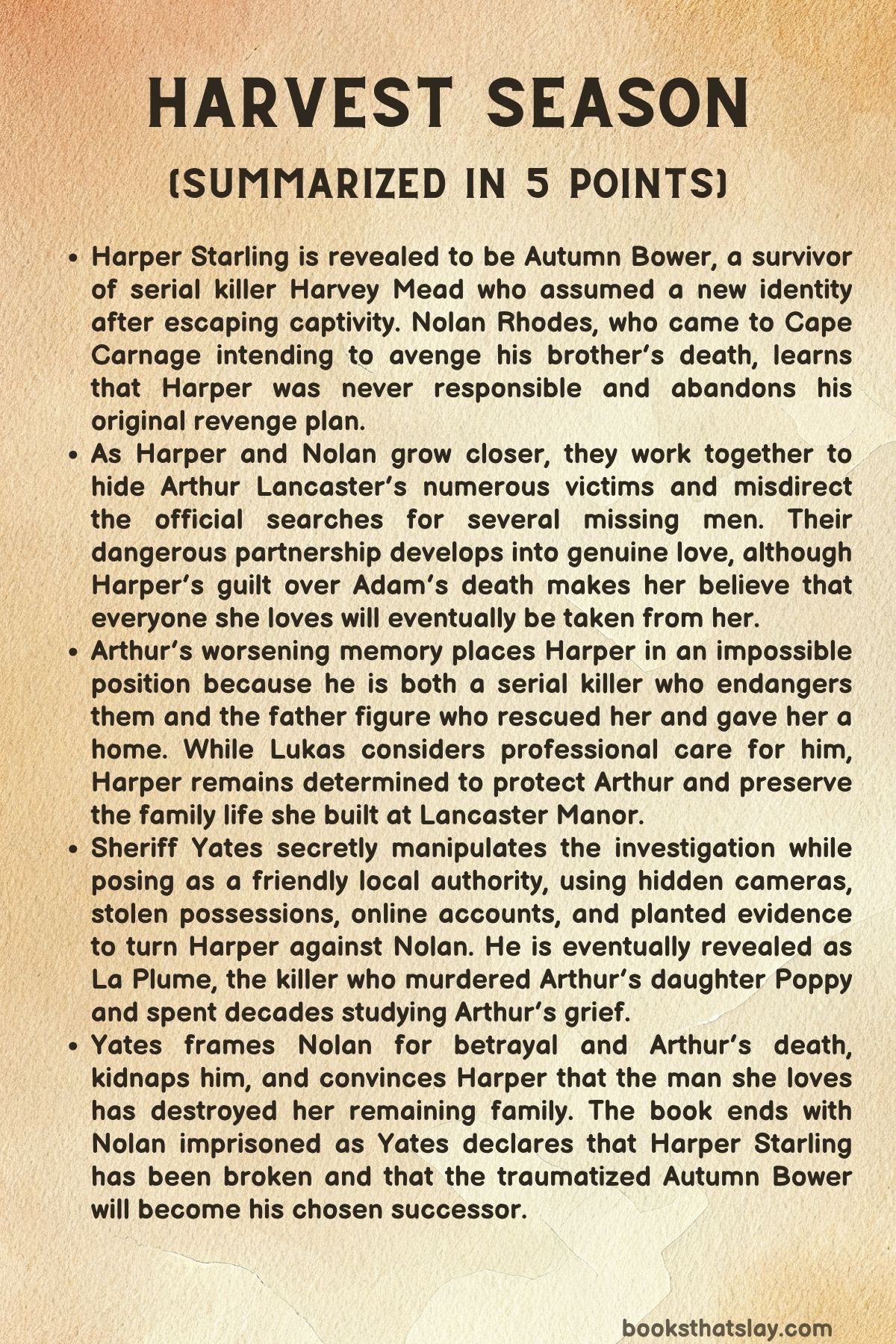
Harper Starling is disposing of Peter Evanston’s dismembered remains at Lancaster Manor when Nolan Rhodes arrives with devastating information. Sam Porter and his drone operator, Vinny Meschino, are dead, the authorities have opened a murder investigation, and Nolan has recovered the submerged van that exposes Harper’s true identity.
Harper is not the woman Nolan believed her to be. She is Autumn Bower, a survivor of serial killer Harvey Mead, who stole another woman’s identification and assumed the name Harper Starling after escaping captivity.
Four years earlier, Autumn witnessed the aftermath of the road accident that killed Nolan’s brother Billy. Terrified that involvement with the authorities would cost her the freedom she had only recently regained, she fled instead of remaining at the scene.
Nolan built his life around the belief that Harper caused Billy’s death and abandoned him. He came to Cape Carnage prepared to torture and murder her, only to discover that the woman he hated was innocent of the crime for which he blamed her.
Horrified by what he almost did, Nolan destroys the scrapbook and tools connected to his revenge mission. He nevertheless remains in Cape Carnage because Harper, Arthur Lancaster, and numerous unexplained disappearances are now connected to an investigation that could expose them all.
Sheriff Yates recruits Nolan to lead the Search and Rescue operation for Peter Evanston. Nolan accepts because the role will allow him to direct search teams away from burial sites, plant misleading evidence, and control how closely investigators approach Harper.
Arthur’s condition creates an additional crisis. The elderly serial killer who rescued Autumn after her captivity is developing severe memory problems, growing impulsive, confusing people, and committing killings that neither Harper nor Nolan can easily conceal.
Lukas Lancaster, Arthur’s son, believes his father may eventually need professional care. Harper understands his concern but feels that sending Arthur away would be an act of abandonment toward the man who gave her safety, a home, and a new purpose.
Believing Nolan will die or lose everything if he remains with her, Harper tries to end their relationship. Nolan refuses to leave and tells her that he loves her, although he asks her not to repeat the words until she can say them without fear or pressure.
Their relationship becomes stronger as they work together to remove sixteen bodies from Arthur’s dumping ground beside the Ballantyne River. Harper then reveals that Arthur also concealed victims beneath the grain shed, inside an abandoned silver mine, and around Lancaster Manor.
Nolan moves into Harper’s cottage while attempting to respect her need for independence. Their shared domestic life offers brief peace, but the investigation continues closing in on Autumn Bower.
Evidence discovered at an abandoned farm includes palo santo incense, an unusual knife, and a Texas Tech sweater belonging to Autumn. Sam Porter had apparently been following clues connected to her survival, her former travels, and her assumed identity before his death.
The Sleuthseekers, an online community of amateur investigators, circulate a photograph of Harper leaving Maya’s shop. A user named KnightofTruth claims the woman may know what happened in Cape Carnage and urges other members to identify her.
Sheriff Yates also begins asking Harper unusually precise questions. He mentions her connection to trained dogs, produces footage of her with missing men, and watches how Peter Evanston’s dog Queenie reacts to her.
During the search, Harper hides Peter’s clothes and Arthur’s murder bag in the distillery grain shed. There she finds an old almanac containing a story about two ships and a fragment of poetry written in unfamiliar handwriting.
Meanwhile, someone repeatedly enters Harper’s cottage and alters objects associated with her former life. The black knight from the chessboard she once shared with Adam is moved, creating the impression that her private memories are being watched and manipulated.
Nolan initially admits moving the chess piece on one occasion, but the disturbances continue. His decision to avoid researching Autumn’s history demonstrates his desire to let Harper control when and how she reveals her trauma.
Harper eventually tells him about Adam, her companion during captivity. Harvey Mead broke Adam’s legs, and when he developed a fever, Harper begged for medicine, only for Mead to remove and kill him.
Harper believes Adam might have survived had she remained silent. Nolan insists that Mead alone was responsible, but Harper’s guilt has developed into a conviction that everyone she loves will eventually die.
Nolan also reveals the truth about his first murder. As a teenager, he killed Marcus Urkhart after the bully nearly killed Billy, then framed a known predator for the crime.
Rather than claiming Nolan is secretly good, Harper accepts that he is dangerous and capable of calculated violence. Her refusal to judge him creates a bond based not on denying their darkness but on acknowledging it.
Unknown to both of them, Sheriff Yates has already confirmed Harper’s true identity. He enters her cottage while she is absent, recognizes the incense connected to Sam’s evidence, and steals the black knight from her chessboard.
Yates is also responsible for the murder of Arthur’s daughter Poppy decades earlier. He has remained close to Arthur ever since, observing his grief and studying the contradiction between his capacity for murder and his ability to love.
Yates views Autumn as an unfinished creation. He believes her assumed name, emotional loyalties, and moral restrictions prevent her from becoming the person he imagines she was meant to be.
Cape Carnage’s residents offer Harper unexpected protection. Maya admits that she saw Harper carrying what appeared to be a severed head but refuses to betray her because Jake Hornell had harassed her and the police did nothing.
This loyalty shows Harper that some townspeople understand more than they openly acknowledge. They protect their own when outsiders treat Cape Carnage as entertainment or cause harm without consequences.
Nolan soon violates his agreement with Harper to avoid further killing. After overhearing Sleuthseekers Charlie, Emma, and Tylor discussing their plans, he murders Charlie near the cliffs and stages the death as an accident.
Harper is furious because Nolan has acted recklessly while police and investigators are everywhere. Nevertheless, the murder demonstrates how completely his priorities have changed, since protecting Harper now matters more to him than his freedom or survival.
Yates questions Nolan about Charlie’s death and exposes several weaknesses in his alibi. He also mentions an old accusation that Arthur murdered his wife Vivian, hoping to create mistrust between Nolan and Harper.
Harper explains that Vivian had terminal cancer and asked Arthur to end her suffering. Arthur administered the medication that killed her, turning her death into an act of love that still carries moral and emotional consequences.
While Nolan investigates, Yates continues entering the cottage. He steals Autumn’s keepsakes, photographs, maps, receipts, and other objects connected to Adam, replacing them with clues drawn from the mysterious poem.
Yates also communicates with the Sleuthseekers through secret online identities. He directs Tylor, who is KnightofTruth, toward evidence that will place increasing pressure on Harper.
Nolan secretly restores Arthur’s damaged topiaries before the gardening competition, recruiting local residents to help him. His gesture makes Harper understand that she loves him, even though fear still prevents her from saying it directly.
Arthur admits that he fears losing his memories, forgetting Harper, becoming dangerous, and dying before correcting his mistakes. Harper promises to remind him who he is for as long as she can, showing how deeply their identities and emotional survival depend on one another.
To reduce attention surrounding Jake Hornell’s disappearance, Harper and Nolan create evidence suggesting he died while surfing. They steal his board and wetsuit, damage a distinctive fin, and place part of his remains on the beach.
Their operation succeeds well enough to encourage the theory that Jake died at sea. However, the Sleuthseekers continue arriving, and Harper begins feeling trapped inside the estate she once considered a refuge.
At the Taste of Terror festival, Tylor publicly identifies the woman in Sam’s photograph as Harper Starling. Fearing he will expose her, Harper slips half a dose of Arthur’s poison into his drink during a chili-eating contest.
Tylor collapses in front of the crowd but survives. Nolan condemns Harper’s recklessness, though she reminds him that he recently murdered Charlie for essentially the same reason.
Arthur unexpectedly appears at the festival after driving without a valid licence. Rather than criticizing Harper, he complains that she wasted his poison by using only half a dose.
Nolan gradually understands that Arthur is not merely a burden or threat. Despite his crimes and declining health, Arthur gives Harper family, belonging, purpose, humor, and a place where she has been accepted without conditions.
Harper finally asks Nolan to Cape Carnage’s Murder Mash Barn Dance. During the celebration, Yates claims he contacted Nolan’s employer and suggests Nolan will soon return to Tennessee.
Terrified of losing him, Harper confesses that she loves him and wants a permanent everyday life together. Nolan promises that he will remain in Maine, find different work, and build his future around her.
The following morning, Nolan decides to propose. He buys an engagement ring, imagining a life with Harper that no longer revolves around vengeance for Billy.
Yates, however, has spent years preparing to destroy precisely this happiness. He has installed dozens of hidden cameras throughout Lancaster Manor and the cottage, allowing him to study Harper, Arthur, and Nolan while learning their habits and vulnerabilities.
He removes Nolan’s clothing and possessions from the cottage, steals Arthur’s medication, manipulates objects connected to Adam, and trains Harper’s raven Morpheus to say “Autumn” in an unfamiliar male voice. Each act is designed to make Nolan appear responsible for betraying her.
During the final judging of Arthur’s garden, Queenie uncovers Bryce Mahoney’s bone. Because Nolan was the only person Harper told about the bone’s hiding place, she immediately concludes that he planted it to expose her.
At the cottage, Harper finds additional manufactured evidence and waits for Nolan with a gun. Nolan denies betraying her and produces the engagement ring as proof that his love is genuine.
Morpheus then says “Autumn,” convincing Harper that Nolan trained the bird and has known her identity all along. She orders him to leave, and Nolan obeys only because she says that killing him would force her to dispose of another body.
Nolan returns to the inn and begins reconsidering everyone who could be manipulating them. Before he can investigate the cottage, an unseen attacker strikes him and takes him captive.
Yates then enters Lancaster Manor after ensuring Harper has left to replace Arthur’s stolen medication. He reveals to Arthur that he is La Plume, the killer Arthur has pursued for decades and the man who murdered Poppy.
Yates explains that he killed Poppy to discover whether another murderer could experience genuine grief. Fascinated by Arthur’s love for his family, Yates remained nearby, became sheriff, and assisted Arthur’s unsuccessful hunt for La Plume.
Yates stabs Arthur, intending his death to become the final force that transforms Autumn. Arthur resists and then cuts his own throat, denying Yates complete ownership of the murder.
When Harper returns, she finds Arthur dead beside a message that appears connected to Nolan. Convinced Nolan murdered him, she hides her suspicions from Yates because she intends to take revenge herself.
At Arthur’s funeral, Harper and Lukas receive the gardening award Arthur won before his death. Yates then arranges for Autumn and Adam’s long-submerged van to be delivered to the cemetery, exposing another part of her former identity.
Nolan awakens chained inside a remote cabin. After six days, Yates arrives and reveals that he is La Plume, that Nolan is being blamed for Arthur’s death, and that Harper is still alive.
Yates claims Harper Starling has been destroyed, leaving Autumn Bower to emerge without the moral limits and loyalties that once restrained her. He considers Autumn his intended successor and believes grief will transform her into his legacy.
Nolan realizes that his love gave Yates the means to hurt Harper more deeply than physical violence could. The story ends with Yates predicting that Nolan fell in love with Harper Starling, but Autumn Bower will become the woman who kills him.
Characters
Harper Starling / Autumn Bower
Harper is the emotional and psychological center of Harvest Season, living under an identity she created after surviving Harvey Mead’s captivity. Her transformation into Harper Starling began as a practical method of escaping public attention, but the false identity gradually became a home, a protective shell, and a version of herself she believed might deserve freedom.
Her actions are shaped by survivor’s guilt, particularly her belief that asking Mead for medicine caused Adam’s death. This guilt has produced a destructive emotional rule: anyone she loves will eventually suffer because of her.
Harper is intelligent, methodical, resourceful, and capable of extreme violence. She removes bodies, manufactures evidence, uses poison, lies under pressure, and protects Arthur’s history with impressive composure.
Her violence does not erase her capacity for tenderness. She loves Arthur as a father, regards Lukas as a brother, develops genuine loyalty toward Cape Carnage, and slowly permits Nolan to become part of the future she once believed she could never have.
Her relationship with Nolan challenges her instinct to survive through isolation. She initially attempts to push him away, not because she lacks feeling, but because loving him means accepting vulnerability and the possibility of another devastating loss.
Harper’s greatest weakness is her belief that fear is a reliable source of truth. When Yates manufactures evidence against Nolan, she interprets each clue through memories of abandonment, punishment, and death, making her vulnerable to conclusions that support her deepest anxieties.
Her final loss of Arthur threatens the fragile balance between Autumn and Harper. Yates believes grief will destroy her chosen identity, but Arthur’s final faith in her suggests that Harper’s survival has never depended only on deception; it also comes from intelligence, loyalty, and the ability to resist those who try to define her.
Nolan Rhodes
Nolan enters the story as a man consumed by revenge. For years, he has believed Harper caused the accident that killed Billy, and he arrives in Cape Carnage with tools, plans, and a scrapbook documenting how he intends to punish her.
The discovery that Harper is actually Autumn Bower destroys the moral justification he constructed around his mission. Burning his scrapbook represents his recognition that vengeance nearly turned him into the murderer of an innocent survivor.
Nolan does not suddenly become harmless or conventionally moral. He remains calculating, territorial, observant, and willing to kill anyone he perceives as a serious threat to Harper.
His murder of Charlie demonstrates how quickly love replaces revenge as the organizing force in his life. He once accepted danger to avenge Billy, but he now accepts it to protect Harper, even when his actions create more evidence and suspicion.
Nolan’s devotion is intense without being entirely controlling. He repeatedly emphasizes that Harper must choose what she reveals, when she says she loves him, and whether she accepts a future with him.
His Search and Rescue experience makes him an effective accomplice. He understands landscapes, evidence, human behavior, and investigative procedure, allowing him to misdirect searchers and construct convincing false trails.
Nolan’s emotional development involves creating a life not defined by Billy’s death. His decision to remain in Maine and propose to Harper shows that he is finally imagining something beyond punishment, guilt, and obligation.
His captivity forces him to confront the helplessness he imposed on his own victims. It also leaves him dependent on Harper’s ability to recognize Yates’s manipulation before grief turns her against him permanently.
Arthur Lancaster
Arthur is a retired serial killer, a grieving father, Harper’s rescuer, and the head of a family whose history is buried throughout Cape Carnage. His contradictions make him one of the most morally complex figures in the book.
To Harper, Arthur is the man who gave her shelter after captivity and allowed her to rebuild herself without interrogation or judgment. His acceptance created the first stable home she had after Adam’s death.
Arthur’s killings reveal discipline, pride, and a private sense of legacy. His murder journal, poisons, hidden bodies, and carefully selected methods suggest that he regards his crimes as part of an identity he refuses to surrender.
His declining memory threatens everyone around him. He commits impulsive murders, confuses Harper with Poppy, forgets major events, and becomes increasingly resistant to the care he requires.
Arthur’s fear of a care home is not simple stubbornness. He understands that losing Lancaster Manor would mean losing his routines, authority, garden, memories, and final connection to the person he once was.
His love for Vivian and Poppy proves that his capacity for violence exists beside genuine attachment. He ended Vivian’s suffering at her request and spent decades searching for Poppy’s killer, never recovering from the grief Yates deliberately caused.
Arthur’s final act captures his resistance and love. By killing himself after Yates stabs him, he denies La Plume full control over the scene and uses his last words to affirm his faith that Harper will defeat him.
Sheriff Yates / La Plume
Sheriff Yates is the hidden architect of Harvest Season, presenting himself as a familiar local official while secretly controlling the investigation, the Sleuthseekers, and the emotional destruction of Harper’s household. His apparent incompetence and casual friendliness disguise patience, intelligence, cruelty, and an extraordinary capacity for surveillance.
As La Plume, Yates does not kill only for physical satisfaction. He treats murder as a psychological experiment through which he can study grief, identity, love, and moral collapse.
His murder of Poppy was designed to test Arthur’s emotional capacity. Rather than disappearing afterward, he stayed close, joined law enforcement, watched Arthur suffer, and even assisted the investigation into the killer he secretly was.
Yates’s obsession with Autumn is based on ownership rather than affection. He believes Harvey Mead began transforming her, while he alone possesses the intelligence and artistic purpose required to complete the process.
He does not respect Harper’s chosen identity because it represents autonomy. By stealing her keepsakes, manipulating Adam’s possessions, framing Nolan, and killing Arthur, he attempts to remove every relationship through which she defines herself.
His surveillance demonstrates that his greatest weapon is knowledge. He studies routines, private conversations, emotional triggers, physical spaces, and personal objects until he can create evidence that his victims will interpret exactly as he intends.
Yates’s flaw is his belief that understanding someone gives him the right to determine who that person must become. Arthur’s final resistance suggests that Yates repeatedly underestimates the ability of love and personal choice to disrupt even a carefully prepared design.
Lukas Lancaster
Lukas is Arthur’s son and one of the few people who gives Harper a sense of ordinary family life. He regards her as his sister, trusts her, and assumes they share the same desire to protect Arthur.
His concern about Whispering Pines is practical rather than cruel. He recognizes that Arthur’s memory problems could place his father and everyone around him in danger, even though accepting this reality causes him pain.
Lukas remains unaware of the full extent of Arthur’s crimes and Harper’s involvement in concealing them. His affection therefore deepens Harper’s guilt because she repeatedly lies to a person whose loyalty is sincere.
His complicated relationship with Maxine introduces another form of emotional avoidance. Like Harper, Lukas delays confronting a relationship that still matters because unresolved pain feels safer than vulnerability.
At Arthur’s funeral, Lukas shares Harper’s loss without understanding the hidden circumstances behind it. His continued presence may become vital because he represents a family connection that Yates has not yet completely destroyed.
Adam
Adam exists primarily through Harper’s memories, keepsakes, videos, and guilt, yet his influence reaches nearly every part of her adult life. He was her travelling companion, chess partner, emotional anchor, and fellow prisoner under Harvey Mead.
His death became the defining trauma around which Autumn reconstructed herself. Because Mead killed him after Harper requested medicine, she wrongly associates love, advocacy, and hope with catastrophic consequences.
The black knight, repaired watch, bracelets, photographs, and hidden travel objects preserve different pieces of Adam. Yates understands their meaning and uses them to manipulate Harper because he knows Adam’s memory is inseparable from her identity.
Adam is not merely a symbol of suffering. The evidence of their travels suggests companionship, curiosity, playfulness, and a life that existed before captivity reduced him to Harper’s final memory of loss.
Harper’s inability to release her responsibility for his death prevents her from fully accepting happiness with Nolan. Until she recognizes that Mead alone chose to kill Adam, her past will continue to determine what she believes she is allowed to love.
Harvey Mead
Harvey Mead is the serial killer who abducted Harper and Adam and confined them in his cellar. Although he is absent from the present action, his cruelty established the fears and guilt that continue governing Harper’s decisions.
Mead broke Adam’s legs, denied him medical care, and killed him after Harper begged for help. His actions taught Harper that expressing need could result in punishment and that attachment could be used as a weapon.
Yates dismisses Mead as crude and purposeless, but this judgment reveals more about Yates’s vanity than about the severity of Mead’s crimes. Both men reduce other people to objects, though Yates conceals his brutality beneath intellectual theories about transformation.
Mead attempted to control Harper through imprisonment and direct violence. Yates uses surveillance, grief, deception, and emotional isolation, making his methods less visible but no less destructive.
Billy Rhodes
Billy is Nolan’s deceased brother and the original source of Nolan’s revenge mission. His death in the road accident becomes the event around which Nolan builds years of anger, investigation, and imagined punishment.
During their youth, Nolan killed Marcus Urkhart after the bully nearly killed Billy. Billy eventually suspected the truth and asked Nolan to become a better man, revealing that he understood both his brother’s devotion and the danger contained within it.
Billy’s memory initially functions as a command that Nolan believes requires endless vengeance. As Nolan falls in love with Harper, he begins separating loyalty to his brother from the need to keep destroying people in Billy’s name.
Nolan’s decision to build a future in Cape Carnage does not mean he stops loving Billy. It means he finally accepts that honoring the dead does not require sacrificing every possibility among the living.
Vivian Lancaster
Vivian was Arthur’s wife and a central source of both his happiness and grief. Arthur explains that he recognized his love for her quickly but resisted it because love carries the certainty of eventual loss.
When Vivian developed terminal cancer, she asked Arthur to end her suffering. His decision to administer the medication that killed her complicates the distinction between murder, mercy, devotion, and control.
Vivian’s death becomes a vulnerability Yates later exploits by suggesting Arthur may have killed her for darker reasons. The accusation works because Arthur’s history makes even an act of mercy appear suspicious.
Her relationship with Arthur also challenges Harper’s fear of loving Nolan. Arthur insists that the years he shared with Vivian justified the pain of losing her, offering Harper a model of love that remains valuable even when it ends in grief.
Poppy Lancaster
Poppy was Arthur’s daughter and the victim whose death shaped decades of his life. Yates selected her not because of anything she had done, but because harming her allowed him to study another killer’s capacity for grief.
Her murder proves that Yates’s interest in Arthur was never professional or accidental. He remained near the Lancaster family so he could observe the damage he created over an extended period.
Arthur’s confusion sometimes causes him to mistake Harper for Poppy. These moments show both the deterioration of his memory and the emotional connection between the daughter he lost and the woman he later adopted into his life.
Poppy’s absence remains active within the family. It influences Arthur’s protectiveness toward Harper, his obsession with La Plume, and his final refusal to let Yates completely control another death.
Maya
Maya is a Cape Carnage resident whose loyalty demonstrates the town’s unspoken moral code. She recognizes Harper in Sam’s photograph but lies to the Sleuthseekers rather than helping them identify her.
Her decision is informed by her own experience with Jake Hornell. Jake behaved obscenely outside her home, and the authorities failed to provide meaningful protection or accountability.
Maya suspects Harper was involved in Jake’s disappearance and may even have seen her carrying his severed head. Instead of responding with horror, she judges the situation through what she knows of Jake’s behavior and the town’s need to protect its residents.
Her support helps Harper understand that she is not as isolated as she assumed. Cape Carnage’s community may tolerate disturbing secrets when silence appears more just than helping outsiders expose the people they consider family.
Irene
Irene manages the Capeside Inn and serves as one of Nolan’s earliest points of connection to Cape Carnage. Her knowledge of local events, guests, and traditions gives her a quiet authority within the community.
She assists Nolan after Harper orders him out of the cottage, providing alcohol, toiletries, and practical emotional advice. Rather than treating the breakup as final, she encourages him not to surrender.
Irene also oversees the barn dance initiation, requiring Nolan to drink liquor containing preserved human toes. The ritual tests his willingness to accept the town’s morbid customs and marks his entry into its social world.
Her behavior reflects the community’s blend of hospitality and macabre humor. She offers care without demanding explanations, making her a stabilizing presence amid the secrecy surrounding Nolan and Harper.
Maxine Yates
Maxine is Sheriff Yates’s daughter and Lukas’s former romantic partner. Her presence connects the Lancaster family to Yates through a relationship neither Harper nor Lukas initially recognizes as dangerous.
The tension between Maxine and Lukas suggests unresolved affection mixed with disappointment or past conflict. Harper repeatedly encourages them to work together, hoping they will confront feelings they have avoided.
Maxine appears unaware of her father’s identity as La Plume. This creates a significant contrast between the ordinary relationships she is trying to rebuild and the hidden violence Yates has committed around her.
Her connection to both men may eventually force her to choose between family loyalty and evidence of her father’s crimes. She also represents another person Yates could manipulate if his larger plan begins collapsing.
Tylor Knightsbridge
Tylor is a committed Sleuthseeker who operates online as KnightofTruth. He is intelligent enough to follow Sam’s evidence toward Harper, but his confidence makes him vulnerable to manipulation by Yates.
His questions at the command center and festival show that he is not merely interested in solving disappearances. He wants recognition for uncovering the mysterious woman in Sam’s photograph and exposing Cape Carnage’s secrets.
Yates encourages this pursuit through his WhisperInsider account. Tylor believes he is independently discovering hidden truths when he is actually being guided toward the conclusions Yates wants him to reach.
Harper poisons him when he publicly identifies her. Although she uses only half a dose, his violent collapse reveals how far she will go to protect her identity when exposure appears imminent.
Tylor survives, leaving him capable of returning with stronger suspicions. His experience may make him either more dangerous or more receptive to the possibility that someone has been directing him.
Emma
Emma is one of the Sleuthseekers who comes to Cape Carnage with Charlie and Tylor. She participates in the effort to identify Harper and gather information from Nolan.
Charlie’s death transforms the investigation from an exciting mystery into a personal loss. Her grief during the interview with Yates gives him another opportunity to shape the narrative while presenting himself as a sympathetic official.
Emma’s persistence demonstrates the danger created by Nolan’s decision to kill Charlie. Rather than simply removing one investigator, he gives the remaining Sleuthseekers an additional reason to distrust Cape Carnage.
She also represents the human cost of Nolan and Harper’s defensive violence. From their perspective, Charlie is a threat, but from Emma’s perspective, he is a friend whose unexplained death deserves justice.
Charlie
Charlie is a Sleuthseeker who travels to Cape Carnage to investigate Sam, Vinny, La Plume, and the unidentified woman in the photograph. His curiosity places him close enough to Nolan to become a perceived danger.
Nolan murders him near the cliffs and stages the death as an accident. The killing shows that Nolan’s protective instincts can become as reckless as the vengeance he claims to have abandoned.
Charlie’s death produces consequences beyond the removal of one investigator. It draws Yates’s attention toward Nolan, intensifies Emma’s determination, and gives the sheriff another incident he can incorporate into his larger plan.
As a victim, Charlie complicates Nolan’s moral position. The book provides no evidence that Charlie deserves death, making his murder an example of how fear and loyalty can become excuses for eliminating inconvenient people.
Sam Porter
Sam Porter is an investigator whose discoveries threaten to expose Harper’s identity. Before his death, he gathers evidence from the abandoned Iver farm, including incense, a strange knife, a blond hair, and Autumn’s Texas Tech sweater.
His photograph of Harper leaving Maya’s shop becomes one of the Sleuthseekers’ most important clues. Even after his death, his research keeps directing attention toward Cape Carnage and Autumn Bower.
Sam’s investigation appears more advanced than Harper and Nolan initially understand. He had already begun connecting locations, objects, disappearances, and the woman living under an assumed name.
His death allows Yates and the authorities to construct a misleading explanation involving Vinny. However, the evidence Sam collected continues functioning independently, proving that killing an investigator does not erase the trail he created.
Vinny Meschino
Vinny is Sam’s drone operator and becomes part of the official explanation for the deaths surrounding the distillery. His blood is found at the Capeside Inn, connecting him to the violence that occurred there.
Authorities come to believe Vinny killed Sam and later attacked Sheriff Yates. This interpretation allows the investigation into their deaths to move toward closure without exposing Harper or Nolan.
Vinny’s role demonstrates how quickly a dead person can be turned into a convenient suspect. Because he cannot defend himself, conflicting evidence can be arranged into a story that serves both investigators and the true manipulator.
His death also gives Yates another opportunity to appear wounded, competent, and innocent. By controlling the official narrative, the sheriff keeps attention away from his own long history of violence.
Peter Evanston
Peter Evanston is a tourist whose death results from Arthur’s worsening judgment. Arthur attacks and kills him in the cemetery, forcing Harper and Nolan to destroy his remains.
His disappearance triggers the Search and Rescue operation that brings law enforcement, volunteers, and investigators dangerously close to Lancaster Manor. Nolan’s leadership of the search becomes essential to protecting the family’s secrets.
Peter’s dog Queenie creates repeated complications because she recognizes Harper and later uncovers Bryce Mahoney’s bone. Her behavior links Harper to Peter more effectively than formal evidence initially does.
Peter’s death shows why Arthur’s decline can no longer be ignored. Unlike his carefully planned earlier murders, this killing appears impulsive, unnecessary, and almost impossible to conceal.
Mrs. Evanston
Mrs. Evanston refuses to allow public attention to move away from her missing husband. She interrupts the garden judging and demands that the authorities resume the search for Peter.
Her anger is understandable because the investigation is gradually losing momentum while people connected to Peter deliberately conceal his fate. Her arrival reminds Harper that every hidden body belongs to someone whose absence continues causing pain.
Mrs. Evanston unintentionally triggers a major turning point when Queenie searches the flower bed and uncovers Bryce’s bone. The discovery gives Yates the opportunity to complete the illusion that Nolan has betrayed Harper.
Although she lacks knowledge of the larger conflict, Mrs. Evanston’s insistence introduces moral pressure into a community accustomed to protecting its own secrets. Her grief exposes the cost of that protection.
Jake Hornell
Jake Hornell is one of the missing men whose behavior made him widely disliked in Cape Carnage. His harassment of Maya helps explain why local residents are willing to ignore disturbing evidence connected to his disappearance.
Harper and Nolan attempt to close his case by making it appear that he died while surfing. They steal his equipment, damage his board, and place part of his remains near the water.
Jake’s disappearance shows how community judgment influences whose death receives sympathy. Because he harmed residents and inspired little affection, the town readily accepts a convenient shark or surfing explanation.
His remains continue carrying danger even after the false evidence is planted. The physical handling of his body also demonstrates how easily Nolan and Harper turn a human death into a practical problem requiring strategic disposal.
Bryce Mahoney
Bryce Mahoney is another missing man whose remains become central to Yates’s plan. Part of his body is stored in Harper’s freezer, while a tibia from his corpse played a role in Harper and Nolan’s first violent encounter.
The bone contains a distinctive surgical plate that could identify him. Nolan later hides part of the leg, making him one of the few people who knows where the evidence is stored.
Yates plants Bryce’s bone in Arthur’s garden, knowing Harper will assume Nolan is responsible. Because the evidence comes from a secret shared between the couple, it becomes more emotionally convincing than an ordinary accusation.
Bryce’s remains therefore become a weapon against trust. His death matters less to Yates than the ability of his body to turn Harper and Nolan against one another.
Sean McMillan
Sean McMillan is one of the missing men whose clothing Nolan uses to create a false trail. Nolan plants McMillan’s shirt near Loon Lake, hoping searchers will discover it and redirect the investigation.
The shirt is never found, demonstrating that even careful plans cannot control weather, timing, human behavior, or chance. Its failure leaves another disappearance unresolved.
McMillan’s role illustrates the scale of the concealment problem. Harper and Nolan are not protecting themselves from one isolated inquiry but from several overlapping cases that require different explanations.
His disappearance contributes to the atmosphere of suspicion surrounding Cape Carnage. Every unresolved name gives the Sleuthseekers another reason to remain in town and search for connections.
Bob, Bobby, and Bert
Bob, Bobby, and Bert are local men whose presence adds humor, community support, and practical assistance. Their similar names and absurd conversations reflect Cape Carnage’s unusual social character.
They help Nolan restore Arthur’s damaged topiaries before the garden competition. Their assistance allows Nolan to give Harper and Arthur a moment of happiness during an increasingly dangerous period.
The men also speculate that Jake Hornell was killed by the legendary shark Sharkimedes. Their ridiculous theory inspires Harper’s plan to stage Jake’s surfing death.
Although they do not understand the full truth, their loyalty indirectly helps conceal serious crimes. They embody the town’s tendency to transform horror into folklore, jokes, and communal protection.
Queenie
Queenie is Peter Evanston’s dog and an unexpectedly important source of evidence. Her affectionate reaction to Harper during the search suggests that Harper had contact with Peter before his disappearance.
Later, Queenie enters Arthur’s garden and uncovers Bryce Mahoney’s bone. The discovery becomes the key event that convinces Harper Nolan has betrayed her.
Queenie acts without deception or hidden intention, yet her instincts repeatedly threaten carefully constructed lies. In a story filled with manipulated evidence, her natural behavior creates some of the most dangerous moments.
Her loyalty to Peter also contrasts with the human effort to erase him. While investigators lose interest and suspects manufacture false stories, Queenie continues responding to scents and people connected to her missing owner.
Morpheus
Morpheus is Harper’s raven and part of the strange domestic life she has built at the cottage. His presence initially contributes humor, familiarity, and companionship.
Yates gains his trust with food and trains him to say “Autumn” in an unfamiliar male voice. This manipulation turns a beloved animal into evidence Harper believes proves Nolan’s deception.
Morpheus does not betray Harper willingly. Instead, Yates exploits the bird’s ability to repeat sounds, demonstrating how he converts harmless parts of her home into psychological weapons.
The moment Morpheus speaks destroys Nolan’s attempt to prove his love through the engagement ring. A single word becomes more persuasive to Harper than Nolan’s denial because it appears to confirm several fears at once.
Themes
Identity, Reinvention, and the Right to Self-Definition
Autumn Bower creates Harper Starling because her original identity has become associated with captivity, public attention, Adam’s death, and a life she no longer knows how to inhabit. The assumed name begins as concealment but gradually becomes a genuine expression of the person she chooses to be.
In Harvest Season, identity is neither entirely fixed nor infinitely replaceable. Harper cannot erase Autumn, yet Yates is wrong to claim that only the traumatized survivor beneath the assumed name is real.
Harper contains both identities, along with every contradiction they represent. Autumn carries memory, guilt, fear, and endurance, while Harper represents freedom, family, work, love, and the future she has built through conscious choice.
Yates refuses to respect this complexity because he wants authorship over another person. He treats Harper as an artificial layer that must be destroyed so that his preferred version of Autumn can emerge.
His campaign against her is therefore an attack on self-definition. He steals personal objects, resurrects her former name, removes Nolan’s belongings, and kills Arthur because each relationship supports an identity she created without him.
The conflict asks whether trauma has the final authority to define a survivor. Harper’s future depends on rejecting both the belief that Autumn must disappear and Yates’s belief that Harper was never real.
Love, Grief, and the Risk of Attachment
Harper believes love creates danger because Adam died after she tried to help him. Her survivor’s guilt turns attachment into a warning sign, convincing her that anyone who becomes emotionally important will eventually be harmed.
Arthur offers a different understanding through his memories of Vivian. He knew loving her meant accepting the certainty of future grief, but he considers their shared years worth the suffering that followed.
Nolan reaches a similar conclusion. He fears losing Harper, failing to protect her, or seeing her exposed, yet he refuses to avoid happiness merely because it may end violently.
Their relationship develops when both accept that love cannot guarantee safety. The promise they make is not that neither person will suffer, but that fear will not be allowed to erase every possibility of connection.
Yates understands the power of attachment but interprets it only as vulnerability. He targets Nolan and Arthur because he knows their loss can cause more damage than physical captivity.
Arthur’s final act challenges this interpretation. His love gives him the strength to resist Yates, preserve a measure of control, and declare confidence in Harper even while dying.
Moral Judgment, Violence, and Community Loyalty
Violence in the story is rarely separated into simple categories of innocent and evil. Harper, Nolan, Arthur, and Yates are all killers, but their intentions, methods, relationships, and attitudes toward their victims differ significantly.
Harper and Nolan often justify violence as protection. Arthur treats murder as part of a personal craft and legacy, while Yates uses it to establish psychological authority over people he considers subjects in an experiment.
Cape Carnage develops its own informal system of judgment. Residents such as Maya suspect that terrible acts have occurred but choose silence when the missing person harmed members of the community.
This loyalty provides Harper with safety, yet it also creates serious moral problems. Charlie’s death, Peter’s disappearance, and Mrs. Evanston’s grief demonstrate that not every victim can be dismissed as someone who deserved punishment.
The community’s humor and folklore make violence easier to absorb. Shark stories, preserved toes, carnival corpses, and local rituals transform death into entertainment or tradition, reducing the emotional distance between ordinary residents and concealed crimes.
The book does not provide a simple verdict on this culture. Instead, it shows how loyalty can offer protection to vulnerable people while also encouraging secrecy, selective justice, and indifference toward outsiders.
Control, Surveillance, and Psychological Manipulation
Yates’s power comes less from physical strength than from his ability to observe people without being seen. His cameras, online identities, police authority, and access to private spaces allow him to gather the information required to manipulate each victim.
He does not invent Harper’s fears. He studies the fears already present and arranges evidence that makes them appear justified.
The bone in Arthur’s garden works because Harper told only Nolan about it. Morpheus’s use of the name Autumn works because Harper fears Nolan secretly researched her past and approached her under false pretenses.
The removal of Nolan’s belongings creates the appearance of voluntary abandonment. The stolen medication removes Harper from the manor at precisely the moment Arthur becomes vulnerable.
Surveillance also destroys the idea of home as a protected space. Harper’s cottage and Lancaster Manor initially represent safety, but Yates’s hidden cameras reveal that he has been present inside their most private moments for years.
His manipulation succeeds because he understands that people often trust emotionally convincing evidence more than direct testimony. Harper believes the story created by objects, memories, and timing even when Nolan denies betraying her.
The larger struggle therefore concerns control over interpretation. Defeating Yates will require Harper to question the narrative he constructed and reclaim the authority to decide what her memories, relationships, and identity mean.