Her Sharp Embrace Summary, Characters and Themes
Her Sharp Embrace by Kate Koenig is a dark fantasy crime novel set in New Soleil, a city ruled by wealthy barons, religious authorities, magical Saints, and violent criminal organizations. At its center is the Nightshades, a gang of women who use alchemy, magical abilities, deception, and force to survive outside the city’s official systems.
The book combines a murder investigation with a study of manipulation, chosen family, class privilege, grief, and romantic obsession. As the Nightshades search for the person responsible for Jolie’s death, hidden loyalties and private crimes expose how fragile their sisterhood has always been.
Summary
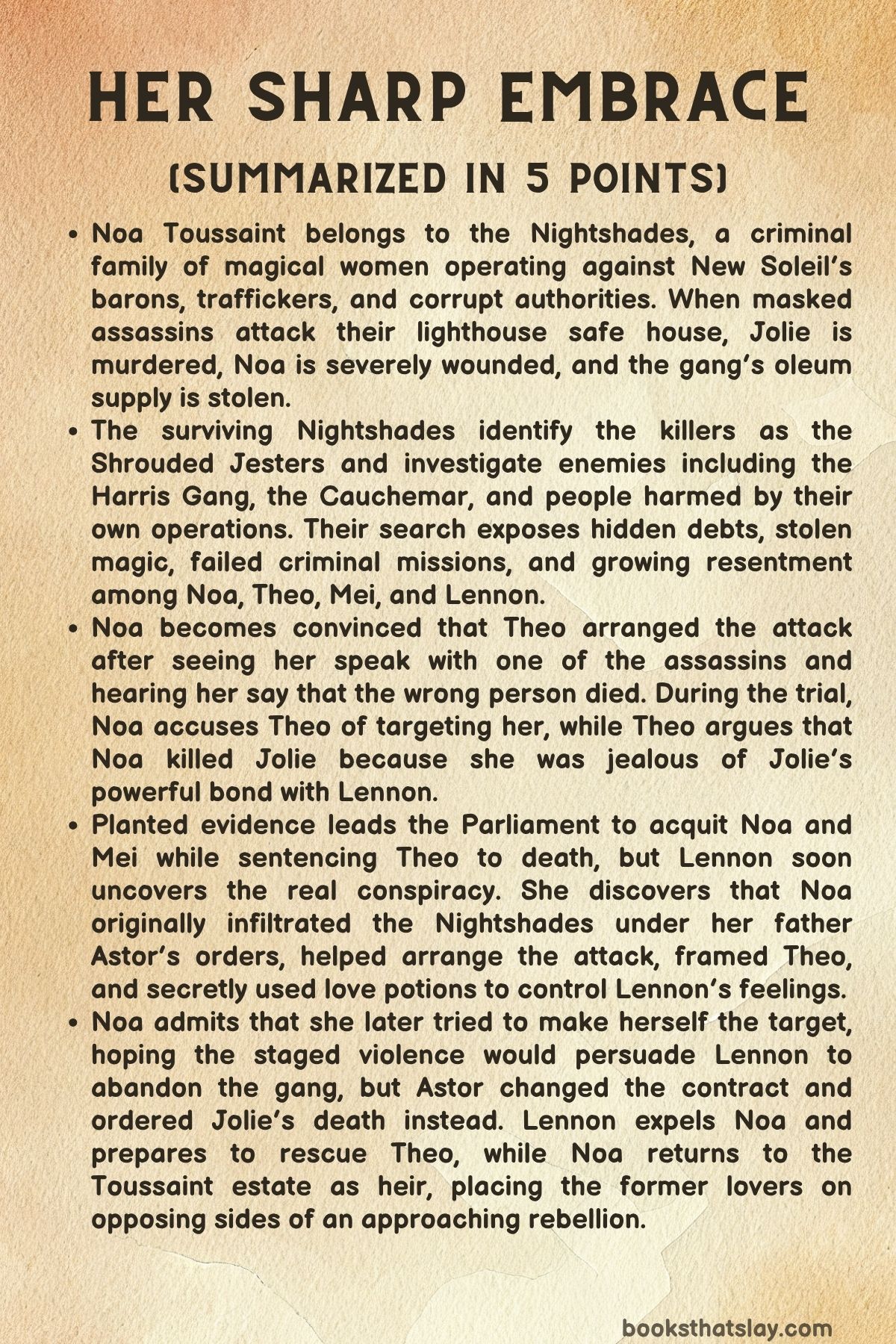
Noa Toussaint is working alone in the Nightshades’ lighthouse safe house when blood from a misplaced vial ruins the good-fortune potion she is preparing. She is already emotionally shaken after a failed mission and Theo’s violent treatment of her, yet she remains determined to prove that she deserves her place in the gang.
Jolie arrives after a courier carrying Noa’s ingredients fails to appear. The women soon realize that someone has followed Jolie, and two masked intruders wearing carnival disguises force their way inside.
The attackers possess a magical charism that allows them to redirect violence against their opponents. Jolie fights fiercely and manages to unmask one man, revealing his scarlet cheeks, but the second intruder attacks her from behind.
Noa is injured and separated from her healing supplies. She watches helplessly as Jolie is stabbed, and the attackers remove Noa’s oleum ring before stabbing her as well.
The intruders steal the Nightshades’ oleum starter and leave both women behind. Jolie dies while holding a small metal object torn from one of the killers, while Noa narrowly survives.
The events leading to the attack reveal growing fractures within the Nightshades. Ten days earlier, Noa, Theo, and Mei had visited a gambling den called Euphoria to confront Monroe, a Harris Gang runner who owed them money.
Theo regarded Noa as a sheltered former baroness who had not earned her position. During Monroe’s interrogation, Theo used her persuasive charism to force Noa into administering a truth serum before she was prepared, causing the potion to overwhelm Monroe.
Lennon, the Nightshades’ leader and Noa’s lover, arrived and warned Theo never to control Noa magically again. Jolie then stabilized the interrogation and learned that the Harris Gang had lost the Nightshades’ money and was also indebted to another apothecary.
The conflict continued when the women were forced to travel through an abandoned oleum well to avoid Grand Inquisitor Isabel de Tavera. At a checkpoint, Theo mocked Noa’s father and privileged childhood, while Noa retaliated by insulting Theo’s pirate father.
Theo forced Noa to her knees and told her she would never replace Zadia, the former Nightshade whose departure had deeply damaged the group. Nevertheless, Noa saved everyone when their disguises failed, using her family identity to pose as a baroness and pass the others off as her servants.
The Nightshades’ apothecary shows another side of their work. Jolie and Noa provide medicine, poison, and protection to people abandoned by the city’s institutions, including an abused woman and Louis Martin, an old friend of Jolie who uses Noa’s potions to feel more comfortable in his body.
Jolie explains that Lennon borrowed an enormous sum from the Cauchemar to rescue them from an abusive orphanage. The debt effectively made them property of Leo Durand, the organization’s cruel leader, and caused Lennon’s relationship with Zadia to collapse.
A baron named Art Torres offers the Nightshades enough money to clear the debt. Art, Jolie’s secret lover and a former Cauchemar member, wants them to steal a recording from Baron Claude Gauthier that supposedly proves Gauthier committed a crime too serious for the other barons to ignore.
Jolie accepts because she believes the mission will finally free her and Lennon. She also hopes to build a life with Art after completing one last job.
Following the lighthouse attack, the surviving Nightshades attend Jolie’s funeral while watching the criminal community for possible suspects. Isabel interrupts the ceremony and detains them, but Noa invokes the Parliament of Saints because Jolie’s killers possessed magical abilities.
A Parliament representative named Elba examines the metal pin found in Jolie’s hand. The carnival-mask emblem identifies the attackers as the Shrouded Jesters, a pair of mercenary Saints known for assassination.
The Nightshades investigate several enemies. Colette LeBlanc, a woman from the Wilds who owes them money, becomes an early suspect because Jolie had recently threatened her over the debt.
Noa captures Colette and successfully administers truth serum during the interrogation. Colette proves that she had nothing to do with Jolie’s murder, but she condemns the Nightshades for raiding poor communities and acting like the powerful people they claim to oppose.
Lennon and Noa then visit Leo Durand. Inside the Nightingale, Noa witnesses the Cauchemar’s trafficking operation and sees how people called Lilies are controlled by potions, magical marks, and threats.
Leo denies killing Jolie, explaining that he considered her truth-wringing ability too valuable to destroy. He also produces an alibi approved by Isabel and warns that betrayal may have come from inside the Nightshades.
The failed Gauthier operation becomes central to the mystery. Before the attack, Mei had infiltrated a Harris Gang hideout and stolen oleum from an ancient well, secretly taking more than Lennon authorized.
Mei planned to sell some of the magic to help her family and use the rest to protect the Nightshades. Her actions were shaped by the murder of her older sister Yulan, whose death left her terrified of losing another person she loved.
During the first attempt to enter Gauthier’s manor, Lennon and Mei discovered the hidden safe but lacked the correct key. Theo and Noa later obtained one from Señor Lee, a Saint capable of discerning hidden intentions.
While they waited for the key, Theo received notice that Noa’s father, Baron Astor Toussaint, had ordered the immediate execution of Theo’s father, Félix Sánchez. Theo’s grief intensified her hatred of Noa and the entire Toussaint family.
When the Nightshades finally entered Gauthier’s estate, they disguised themselves as poor laborers, disabled the guards, drugged the guests, and opened the concealed safe. The safe was empty, making the carefully planned operation appear useless.
Noa refused to leave without evidence. She entered Gauthier’s bedroom alone and forced him to confess that he had murdered Ophelia Lambert after she discovered his connection to the Cauchemar.
Gauthier destroyed the recording and prepared to shoot Noa, but Theo killed him. Furious that Noa had ignored the plan and endangered everyone, Theo attacked her until Jolie intervened.
The women barely escaped after Lennon tore through electrified bars and Noa used explosive powder against enchanted armor. Back at the apartment, the gang blamed one another for the failure.
Jolie went to Lennon that night, and their childhood memories restored the closeness they had partly lost. They kissed and acknowledged that their bond had always contained a love deeper than friendship.
Jolie then realized that living with Art might simply replace one form of dependence with another. She decided to tell Lennon and Art the complete truth about her feelings the following day, but the lighthouse attack prevented her from doing so.
As the investigation continues, Astor secretly summons Noa. He insults her relationship with Lennon and reveals that Isabel has taken control of Juliette, Noa’s younger sister.
Astor offers Noa protection from prosecution and permission to see Juliette if she abandons the Nightshades and returns as the Toussaint heir. Noa refuses, declaring that the gang is now her family, while Lennon overhears the conversation.
Astor then produces a silver contract coin bearing the carnival-mask emblem on one side and a nightshade flower on the other. The Shrouded Jesters use such coins to identify whoever hires them, suggesting that someone within the Nightshades ordered the attack.
The Parliament demands alibis from Noa, Theo, Mei, and Lennon. Lennon proves that she was elsewhere, Noa has no living witness who can verify her full story, and Theo claims she was alone at her father’s grave.
Mei refuses to reveal her whereabouts because doing so would expose her oleum theft. After questioning, Noa overhears Theo speaking with Casamir, the scarlet-cheeked attacker she remembers from the lighthouse.
Theo accuses Casamir and Alejandro of killing the wrong person. Noa concludes that Theo arranged the attack against her and that Jolie died accidentally.
Noa visits Zadia, who confirms that Casamir is a former Cauchemar associate and probable Shrouded Jester. Alejandro, the suspected second Jester, was once Theo’s lover.
Zadia also reveals that someone had previously asked the Cauchemar to remove “Lennon’s foundation.” Noa assumes the phrase referred to her, but Zadia insists that Jolie was Lennon’s true emotional foundation.
Consumed by fear that Lennon never loved her as deeply as she loved Jolie, Noa confronts Lennon. Lennon explains that Jolie was her oldest companion and the person who helped her survive their childhood, but she insists that Noa is now the center of her life.
Noa then approaches Mei and reveals Theo’s connection to Casamir. During the conversation, Noa discovers Mei’s stolen oleum and promises to keep the secret, while subtly reminding Mei that Theo might not show the same loyalty.
At trial, Noa accuses Theo of hiring the Shrouded Jesters to kill her. Because Noa believes her theory, the Parliament’s empath detects no deliberate lie in her testimony.
Theo responds by accusing Noa of arranging Jolie’s death out of jealousy. Mei refuses to support either side, saying only that she did not kill Jolie and cannot imagine anyone deliberately wanting Jolie dead.
While waiting for the verdict, Noa and Lennon reaffirm their relationship and imagine leaving New Soleil together. Noa continues placing love potion in Lennon’s pain medicine, secretly strengthening Lennon’s attachment.
The tribunal later announces that a second Jester contract coin has been discovered inside a hidden compartment in Theo’s weapon. Noa and Mei are acquitted, while Theo is found guilty and sentenced to death.
Lennon is absent when the judgment is announced. Noa returns to the apartment and finds her searching through Jolie’s room.
Lennon has discovered that the coin was planted and that Astor’s supposed replica was the genuine contract token. She has also found Noa’s hidden correspondence and proof that Noa had been drugging her with love potions.
Noa confesses that Astor originally ordered her to infiltrate and destroy the Nightshades as revenge for Benoît’s death. Astor wanted Noa to identify the person Lennon loved most so that he could murder that person and destroy Lennon emotionally.
Noa originally helped arrange an attack against the gang but later altered the contract to make herself the intended victim. She wanted a controlled assault to frighten Lennon into leaving the Nightshades and beginning a safer life with her.
Astor secretly reversed Noa’s alteration and made Jolie the target. Although Noa claims that she acted to protect Juliette from becoming Astor’s next obedient heir, her decisions directly enabled Jolie’s murder and Theo’s conviction.
Noa also reveals that she had already paid Lennon and Jolie’s debt to the Cauchemar. Jolie therefore died believing herself enslaved even though she had unknowingly been free for months.
Lennon is devastated by Noa’s betrayal, the years of magical manipulation, and the knowledge that Jolie never learned the truth. She tells Noa that Jolie was the only person she truly loved, expels her from the Nightshades, and promises to kill her if they meet again.
The story then returns to Noa and Lennon’s first meeting at an illegal fighting tournament. Astor had sent Noa to study Lennon, but Noa became genuinely attracted to her courage and vulnerability.
After Lennon was injured, Noa treated her and added secret ingredients to her medicine. Their romance began with real desire, but Noa altered Lennon’s emotions from the first night.
With nowhere else to go, Noa returns to Saint Aurora Parish during a storm. She uses her family status to bypass ordinary citizens and is welcomed back into the Toussaint manor as a baroness.
Margaret returns the oleum ring stolen during the lighthouse attack, confirming that Astor controlled far more of the crime than Noa had understood. Noa reunites with Juliette and accepts her inherited identity, finding comfort in the sister she sacrificed everything to protect.
Lennon, however, has not surrendered. She writes to Theo in prison, promises to rescue her before the execution, and vows to rebuild their sisterhood.
Noa ends the book inside the system of baronial power, while Lennon prepares to destroy that system. Their love has become open warfare, with Jolie’s death standing between them as the crime neither can undo.
Characters
The characters in Her Sharp Embrace are shaped by a society where magical ability, family status, wealth, and violence determine who is protected and who becomes property. Most of them seek freedom, but their efforts often reproduce the same forms of domination they claim to oppose.
Noa Toussaint
Noa is the central character and the book’s most morally disturbing figure. She presents herself as a woman fleeing baronial privilege, yet she repeatedly uses the skills, authority, and manipulative habits taught by her father.
Her desire to belong to the Nightshades is genuine, but it is inseparable from her secret mission. She enters the gang under Astor’s orders, observes Lennon’s emotional weaknesses, and becomes romantically involved with the woman she was sent to destroy.
Noa’s alchemical talent makes her useful, but it also gives her a private method of controlling others. She uses medicine, truth serum, sleeping potions, and love potions, frequently crossing the boundary between care and coercion.
Her treatment of Lennon is the clearest example of this corruption. Noa believes she loves Lennon, yet she repeatedly alters Lennon’s feelings and denies her the ability to choose the relationship freely.
Noa’s fear of abandonment drives many of her actions. She becomes jealous of Jolie, threatened by Theo, and increasingly willing to remove anyone who might weaken Lennon’s attachment to her.
Her decision to change the assassination contract so that she would be attacked demonstrates both desperation and arrogance. She imagines she can stage violence, control its consequences, and use Lennon’s fear to secure a private future.
When Astor changes the target to Jolie, Noa becomes responsible for consequences she did not specifically intend but made possible. Her guilt is therefore not limited to a single choice; it comes from a long pattern of deception, emotional control, and collaboration.
In Her Sharp Embrace, Noa’s tragedy is that she recognizes the cruelty of her upbringing without truly escaping its logic. By returning to the Toussaint manor, she accepts the power structure she once claimed to reject.
Lennon
Lennon is the leader of the Nightshades and the emotional center of their chosen family. She is commanding, physically powerful, protective, and capable of inspiring intense loyalty.
Her strength was formed through childhood rejection and abuse. After being rejected by her father for being a girl and a Saint, she survived an orphanage with Jolie, who became her first source of affection and security.
Lennon’s decision to borrow money from Leo Durand rescued them from immediate suffering but placed them under another form of control. Her leadership is consequently shaped by debt, fear, and the need to protect others from dangers she believes only she can handle.
She genuinely loves the Nightshades, yet her leadership is not always fair. She often gives Noa special protection, dismisses Theo’s concerns, and conceals crucial information about Art, the Cauchemar, and the Gauthier mission.
Her romantic bond with Noa partly clouds her judgment. Lennon sees Noa as someone who abandoned privilege for love, never realizing that Noa entered her life as an agent of Astor and altered her feelings through potions.
Jolie’s death destroys Lennon because Jolie represents her childhood, survival, conscience, and earliest experience of love. Lennon’s investigation is not simply a search for legal justice; it is an attempt to recover meaning after losing the person who made her life possible.
Once Lennon discovers Noa’s betrayal, her response is severe but understandable. She has lost Jolie, learned that her freedom had already been purchased, and discovered that her romantic life was chemically manipulated.
Her final promise to rescue Theo marks the beginning of a changed form of leadership. Rather than defending Noa or preserving the remains of the old gang, Lennon accepts Theo’s warnings and commits herself to rebuilding the sisterhood she neglected.
Jolie
Jolie is the moral and emotional foundation of the Nightshades. Her truth-wringing charism makes her valuable, but her deeper importance comes from her compassion, loyalty, and ability to understand people without reducing them to their worst actions.
Her childhood was defined by religious cruelty. Born to members of the Children of Sorrow, she was drugged and abandoned after her magical ability appeared, leaving her to grow up in an abusive orphanage.
Jolie’s bond with Lennon begins as a survival partnership and develops into a lifelong love that neither woman fully defines. She supports Lennon’s leadership, carries the burden of their debt, and repeatedly places the gang’s needs above her own future.
Her work in the apothecary shows her desire to protect people ignored by official institutions. She assists abuse victims, supports Louis, and treats vulnerable customers with a dignity that contrasts with the Nightshades’ harsher criminal activities.
Jolie is not morally perfect. She participates in raids, threats, smuggling, and violence, while remaining loyal to an organization that sometimes harms poor communities.
Her relationship with Art represents the possibility of escape, but she gradually recognizes that becoming dependent on a wealthy baron may not produce genuine freedom. Her decision to confront both Art and Lennon suggests that she is finally prepared to choose an honest life rather than a merely safer one.
Her death prevents that choice from being completed. The tragedy becomes even greater when Lennon learns that the Cauchemar debt had already been paid, meaning Jolie died believing herself owned when she was legally free.
Theo
Theo is aggressive, suspicious, loyal, and deeply wounded. Her hostility toward Noa often appears cruel, but the book gradually shows that many of her concerns are justified.
She sees Noa as a representative of the Toussaint family, whose wealth and authority are connected to the oppression of Saints, criminals, and people from the Wilds. Noa’s protected position within the Nightshades convinces Theo that Lennon is placing romantic attachment above the safety of the group.
Theo’s persuasive charism allows her to control other people’s actions. Her use of this power against Noa is abusive and reveals how easily anger can turn her into the kind of oppressor she despises.
Her grief over Zadia’s departure contributes to her resentment. Zadia represented stability, political clarity, and an older version of the Nightshades before Lennon’s relationship with Noa changed the internal balance.
The execution of Theo’s father transforms existing suspicion into personal hatred. She is forced to associate Noa not only with class privilege but also with the man responsible for destroying her last connection to her childhood.
Theo’s relationship with Alejandro creates the appearance of guilt. Her secret contact with the Jesters and her statement about the wrong person dying make Noa’s accusation believable, even though Theo did not commission Jolie’s murder.
Her conviction demonstrates how easily a difficult, angry woman can be turned into a convenient villain. Noa exploits Theo’s reputation, Astor plants evidence, and the Parliament accepts a version of events that fits existing prejudice.
Theo’s final importance lies in her vindication. Lennon’s promise to rescue her confirms that Theo was correct about Noa, even though her methods of expressing that truth often harmed the people around her.
Mei
Mei is an illusionist whose humor, adaptability, and deceptive talent make her essential to the Nightshades. Beneath her confident public image, she is burdened by grief, financial pressure, and a constant fear of failing her family.
The murder of her sister Yulan shapes Mei’s entire emotional life. She can recreate the killer’s appearance through illusion, but she cannot obtain the answers or closure she wants because he died before she could confront him.
Mei’s theft of oleum begins as an attempt to protect her relatives and support the Nightshades. She wants to pay for education, medical care, and security, but the intoxicating power of the magic gradually affects her judgment.
Her secrecy places the gang at risk. She lies to Lennon, returns repeatedly to the Harris Gang’s supply, and refuses to provide an alibi because revealing the truth could lead to imprisonment or death.
Noa manipulates Mei by offering protection after discovering the stolen oleum. Mei understands that Noa wants help against Theo, but fear makes it difficult for her to reject the alliance completely.
At trial, Mei refuses to confirm either woman’s accusations. This decision preserves a measure of moral independence because she will not condemn Theo merely to protect herself.
Mei’s character shows how loyalty can become distorted when people are forced to survive through secrecy. Her intentions are often loving, but her refusal to trust her family contributes to the suspicion that destroys it.
Baron Astor Toussaint
Astor is the principal architect of the tragedy. He represents inherited power, patriarchal authority, and the belief that family members exist to extend his will.
He treats Noa, Benoît, and Juliette as heirs rather than independent people. When one child fails him, he redirects his attention toward another, using affection, access, punishment, and status as tools of control.
Astor blames the Nightshades for Benoît’s death and designs an elaborate revenge campaign against Lennon. Instead of simply killing her, he wants to identify the person she loves most and destroy that person first.
His manipulation of Noa is especially cruel because he exploits her love for Juliette. He convinces Noa that obedience is the only way to prevent the younger girl from being transformed into another weapon of the Toussaint family.
Astor’s control of the contract coins, Jolie’s targeting, the stolen oleum ring, and Theo’s conviction reveals the depth of his influence. He can manipulate criminals, officials, evidence, and family members while maintaining the appearance of lawful authority.
His greatest success is not merely Jolie’s death. It is Noa’s return to the manor, where she accepts the identity he always intended her to inherit.
Juliette Toussaint
Juliette appears less frequently than the older characters, but she determines many of Noa’s choices. She represents innocence, family attachment, and the possibility that the Toussaint cycle of control might continue into another generation.
Noa genuinely loves Juliette and fears that Astor and Isabel will shape her into a replacement for Benoît. This fear gives Astor the leverage he needs to maintain influence over Noa even after she leaves home.
Juliette is also connected to Noa’s alchemy through the oleum-infused magnolia. Thinking about her sister helps Noa stabilize her magic, suggesting that Juliette represents one of the few forms of love Noa does not consciously manipulate.
The reunion at the end gives Noa emotional comfort, but it also creates uncertainty. By returning as heir, Noa may protect Juliette from Astor, yet she may also become another authority figure who confuses possession with care.
Isabel de Tavera
Isabel is the Grand Inquisitor and a powerful representative of institutional control. She presents herself as an investigator, but her methods rely on intimidation, psychological pressure, and political cooperation with the barons.
During Noa’s interrogation, Isabel uses childhood records and family trauma to destabilize her. Her treatment of suspects suggests that legal procedure matters less to her than extracting submission.
Isabel’s relationship with Astor makes her neutrality doubtful. She approves Leo’s alibi, assumes influence over Juliette, and receives custody of Theo after the death sentence.
Her disturbed reaction to Lennon’s absence at the verdict suggests that she knows more about the political operation surrounding the trial than she publicly admits. Isabel therefore functions as a bridge between formal law and private baronial revenge.
Leo Durand
Leo Durand leads the Cauchemar, an organization built on trafficking, debt, magical control, and sexual exploitation. His animated wolf tattoo reflects his predatory personality and his ability to dominate the bodies of others.
Leo rarely needs to raise his voice because the systems surrounding him already produce fear. He controls Lilies through tracking marks, potions, financial obligations, and the knowledge that powerful clients will protect his business.
His relationship with Lennon and Jolie demonstrates how rescue can become ownership. Lennon borrowed money to escape one abusive institution, only to discover that Leo regarded the debt as a claim over their lives.
Leo denies ordering Jolie’s murder because he considered her profitable. This does not make him innocent in a moral sense; it shows that he measures human life according to financial value.
His warning about betrayal within the Nightshades is calculated to create fear, yet it is also accurate. Leo understands that families built under pressure often hide secrets that enemies can exploit.
Art Torres
Art Torres is a baron who attempts to distance himself from the culture of his class. His home, political ambitions, and relationship with Jolie suggest that he wants to build an identity separate from traditional baronial power.
His past with the Cauchemar complicates his claim to moral reform. Although he now intends to expose traffickers and punish their clients, he once participated in the same organization he hopes to destroy.
Art’s proposal to steal Gauthier’s recording combines personal ambition with a genuine desire for justice. He promises enough money to free Lennon and Jolie, but the operation also increases his own political influence.
His love for Jolie appears sincere, yet Jolie recognizes that dependence on him could create another form of confinement. Art wants to rescue her, but he still imagines that safety will come through his money, home, and status.
Zadia Lafayette
Zadia is a former Nightshade whose absence continues to shape the gang. She once challenged Lennon’s decisions, particularly the debt to Leo, and left when Lennon refused to abandon New Soleil.
Theo idealizes Zadia because she represents loyalty without romantic favoritism. Lennon, however, experiences her departure as rejection during a period when she desperately needed support.
Zadia remains informed about the criminal world and correctly identifies Casamir’s history. She helps Noa understand the connection between Theo and the Jesters, but she also deliberately attacks Noa’s insecurity by insisting that Jolie was Lennon’s true foundation.
Her cruelty does not make her information false. Zadia sees the emotional structure of the Nightshades more clearly than Noa and understands that Jolie’s death will destroy Lennon in a way Noa cannot repair.
Casamir and Alejandro
Casamir and Alejandro are the Shrouded Jesters responsible for carrying out the lighthouse attack. Their magical ability to redirect violence makes them unusually effective assassins.
Casamir’s scarlet cheeks allow Noa to recognize him after Jolie unmasks him. His history with the Cauchemar establishes him as someone willing to kill Saints even when their deaths interfere with Leo’s business.
Alejandro’s former relationship with Theo creates the connection later used to accuse her. The bitterness surrounding their separation gives Noa’s interpretation enough plausibility to influence the trial.
The Jesters treat murder as contractual work rather than personal conflict. Their paired coins transform violence into a transaction, allowing the true employer to remain distant from the physical crime.
Colette LeBlanc
Colette is initially treated as a suspect because she owes the Nightshades money and was recently threatened by Jolie. Her capture allows Noa to demonstrate growing competence outside Lennon’s protection.
During interrogation, Colette challenges the Nightshades’ heroic self-image. She explains that their raids removed food, medicine, and oleum from communities that were already poor.
Her criticism reveals that criminal resistance does not automatically produce justice. The Nightshades may oppose barons and traffickers, but they still possess enough power to exploit weaker people.
Colette’s innocence forces the gang to confront the damage it has caused. She is important not because she advances the murder mystery, but because she exposes the moral contradictions within the Nightshades’ business.
Elba
Elba represents the Parliament of Saints and takes control of the magical aspects of Jolie’s murder. Her arrival limits Isabel’s authority and initially gives the Nightshades hope that the investigation may be conducted more fairly.
She identifies the carnival-mask pin as the emblem of the Shrouded Jesters. This discovery provides the first confirmed connection between the attack and a professional assassination contract.
However, the Parliament ultimately accepts planted evidence and condemns Theo. Elba’s role therefore shows that institutions created to protect Saints can still be manipulated by wealth, reputation, and convincing false narratives.
Satya
Satya is an empath who monitors emotional changes during testimony. Her presence makes direct lying dangerous, but her ability does not reveal whether a sincere belief is factually correct.
Noa exploits this limitation by accusing Theo of a crime she genuinely believes Theo committed. Satya detects no deliberate deception because Noa has convinced herself that her interpretation is true.
The trial demonstrates that magical truth-detection cannot replace evidence or judgment. Honest certainty can be as destructive as a calculated lie when it rests on fear, prejudice, and incomplete information.
Claude Gauthier
Claude Gauthier is a wealthy baron whose paranoia protects a record of criminal activity. He represents the connection between elite respectability and organized exploitation.
His confession reveals that he murdered Ophelia Lambert after she discovered his involvement with the Cauchemar. He relies on wealth, guards, enchanted defenses, and political status to prevent accountability.
Noa’s decision to confront him alone nearly destroys the entire operation. Theo kills him to save Noa, making Gauthier’s death another source of conflict rather than the justice Art intended.
Benoît Toussaint
Benoît is dead before the main events, yet his memory motivates Astor’s campaign against the Nightshades. Astor transforms his son’s death into a justification for revenge against anyone connected to Lennon.
Noa remembers Benoît as someone shaped into a violent extension of their father’s will. Her fear that Juliette will suffer the same fate helps explain why she obeys Astor, though it cannot excuse the harm she causes.
Benoît represents the destructive model of inheritance within the Toussaint family. Each child is expected to become an instrument of power rather than an independent person.
Yulan
Yulan is Mei’s murdered older sister and the emotional source of Mei’s protectiveness. Her death leaves Mei obsessed with preventing another loss and supporting the relatives who remain.
Mei’s illusions preserve Yulan’s image but cannot restore her. The ability to recreate appearances without recovering the person reflects the limits of Mei’s magic and the unresolved nature of her grief.
Yulan’s murder also explains Mei’s attraction to oleum. The stolen magic gives her a temporary sense of power against a world where someone she loved could be killed without answers.
Louis Martin
Louis Martin is Jolie’s friend from the orphanage and one of the clearest examples of the apothecary’s positive work. Noa’s potions help him become more comfortable in his body, while Jolie supports his chosen identity without judgment.
His presence reminds readers that the Nightshades are not solely thieves or killers. Their knowledge and resources also provide forms of care unavailable through New Soleil’s official institutions.
Louis’s gratitude strengthens the sense of what is lost when Jolie dies. She created spaces where vulnerable people could be recognized, protected, and treated with dignity.
Themes
Love, Possession, and Consent
Love repeatedly becomes confused with ownership in Her Sharp Embrace. Noa insists that she loves Lennon, but she secretly uses potions to intensify Lennon’s feelings and attempts to arrange events that will isolate them from the Nightshades.
Her actions reveal a belief that emotional security matters more than another person’s freedom. She does not merely want Lennon’s affection; she wants certainty that Lennon will always choose her, even if that certainty must be chemically created.
Astor expresses the same principle through family authority. He claims power over Noa, Juliette, and Benoît because he considers their lives extensions of the Toussaint legacy.
Leo turns care and rescue into financial ownership. Lennon’s loan saves her and Jolie from the orphanage, but the debt allows the Cauchemar to treat them as property.
Jolie’s relationships offer a more honest alternative, though she also struggles to claim her independence. She loves Lennon and Art, yet eventually realizes that neither history nor protection should determine her future without her full choice.
The novel therefore separates intense feeling from ethical love. Genuine love requires truth, consent, and the willingness to let another person make decisions that may cause pain.
Noa fails because she treats abandonment as a danger that justifies control. Lennon’s final rejection restores the choice Noa repeatedly denied her, even though that freedom arrives after irreversible loss.
Chosen Family and Betrayal
The Nightshades define themselves as sisters who have built a family outside abusive homes, institutions, and class systems. Their loyalty provides safety, identity, employment, and emotional support to women who have been rejected elsewhere.
That family, however, depends on secrecy. Lennon conceals the full history of the Cauchemar debt, Noa hides her mission and potions, Mei hides her oleum theft, Theo hides her relationship with the Jesters, and Jolie hides the complexity of her feelings for Lennon and Art.
Each secret is initially justified as a form of protection. The characters believe that disclosure would create danger, disappointment, or rejection, so they choose private action over mutual trust.
The result is a family that remains loving but becomes increasingly easy to divide. Astor does not create every conflict within the Nightshades; he studies the conflicts that already exist and turns them into weapons.
Noa’s accusation against Theo represents the complete breakdown of sisterhood. Instead of confronting the gang with her evidence, she builds a case designed to remove someone she sees as a threat to her relationship.
Lennon’s final promise to rescue Theo suggests that chosen family can be rebuilt, but only after betrayal is acknowledged. The future sisterhood cannot depend on blind loyalty or a leader’s private preferences.
It must be based on accountability, shared knowledge, and the recognition that affection alone cannot protect a family whose members refuse to trust one another with the truth.
Privilege, Power, and Rebellion
New Soleil is divided between barons, Saints, criminals, laborers, and isolated communities whose access to safety depends on wealth and status. Noa claims to reject her baronial identity, yet she repeatedly benefits from it.
At the checkpoint, she saves the Nightshades by posing as Baroness Dobermann and presenting the others as servants. At the end, she uses her family identification to bypass ordinary people waiting in the storm.
These moments show that privilege can be rejected emotionally without being surrendered materially. Noa dislikes baron culture, but she remains able to invoke its authority whenever she needs protection.
The Nightshades also possess power over others. Colette’s criticism reveals that their raids have deprived poor communities of essential resources, making their rebellion harmful to people with even less influence.
Art seeks reform from within the baron class, while Lennon ultimately prepares for open rebellion. Their different approaches raise questions about whether corrupt systems can be repaired through elite influence or must be destroyed through collective resistance.
The Parliament and Inquisition further demonstrate that legal institutions are vulnerable to class power. Theo’s conviction appears official, yet the evidence has been shaped by Astor’s wealth and political reach.
By ending with Noa inside the manor and Lennon planning an uprising, the story places former lovers on opposite sides of the social order. Personal betrayal and political conflict become inseparable.
Grief, Fear, and Moral Corruption
Nearly every major character is governed by an unresolved loss. Lennon fears returning to the helplessness of her childhood, Theo mourns her father and Zadia’s departure, Mei remains haunted by Yulan’s murder, and Noa fears losing both Juliette and Lennon.
Grief does not automatically make these characters compassionate. Instead, it often narrows their judgment and encourages them to justify destructive choices.
Noa’s fear of abandonment leads her to manipulate Lennon, arrange an attack, and frame Theo. Mei’s fear for her family leads her to steal dangerous quantities of oleum and hide information from the people who trust her.
Theo’s grief turns suspicion into hostility and physical violence. Lennon’s fear of losing her family causes her to conceal information, protect Noa unevenly, and ignore divisions until the group can no longer function.
Astor represents grief transformed into calculated vengeance. Rather than mourning Benoît, he turns his son’s death into permission to destroy Jolie, Lennon, Theo, and eventually Noa’s remaining independence.
Jolie offers the strongest contrast because suffering does not entirely destroy her capacity for care. She remains capable of questioning her relationships, helping strangers, and imagining a life built on honesty.
Her death shows why unresolved grief is so dangerous. The survivors do not simply mourn her; they use her absence to confirm existing fears, accuse one another, and pursue emotional security through punishment.
The novel ultimately suggests that pain becomes morally corrupting when people treat it as proof that control, secrecy, or revenge is necessary.