Lost and Stolen Gods Summary, Characters and Themes
Lost and Stolen Gods by Debbie Cassidy is a fantasy romance centred on Leela, a young woman whose ordinary life ends when she discovers that divine blood runs through her veins.
After a devastating personal betrayal and the violent loss of her grandmother, she is taken to Svargana, a realm where gods, demigods, spirits, and corrupted supernatural beings are locked in an ancient war. Leela must train for ascension while navigating an oppressive divine system, lethal rivalries, political secrets, and a forced spiritual bond with Araz, a warrior who views her as the final obstacle to his freedom. This is book 1 of Debbie Cassidy’s Labyrinth of Gods series.
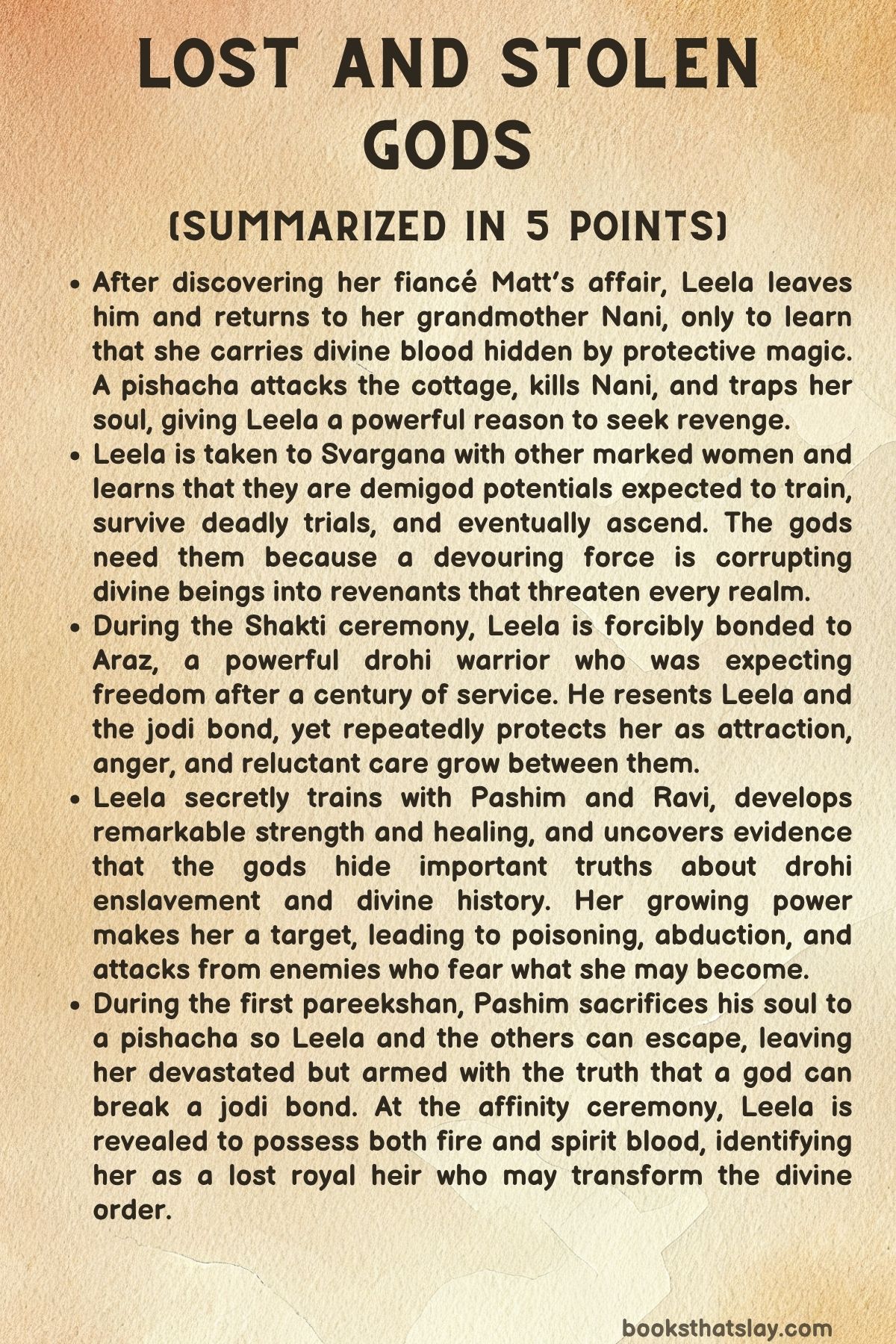
Summary
Leela’s life changes on the evening she expects to celebrate her fifth anniversary with her fiancé, Matt. Instead, she discovers explicit messages proving that he has been having a six-month affair with a law student named Carrie.
Matt first denies the betrayal and then attempts to blame Leela for it. He criticizes her for working two jobs, dismisses her ambitions, and ignores the fact that she sacrificed her education, finances, independence, and time to help repay his student loans.
Recognizing how much of herself she has surrendered, Leela leaves him immediately. With nowhere else to go, she drives back to Mistlethorpe, the village where she was raised by her grandmother, Nani.
During the journey, Leela dreams that Nani is fleeing from a shadowy creature. The nightmare feels more like a warning than an ordinary dream, and its timing on Leela’s twenty-fifth birthday makes it especially unsettling.
When Leela reaches Nani’s cottage, their reunion is loving but brief. Nani becomes alarmed when she learns that Leela has lost the protective amulet she was never supposed to remove.
Nani explains that Leela belongs to a special bloodline and has been hidden from supernatural hunters. Her herbal mixtures and magic have concealed an infinity-shaped mark on Leela’s thigh, identifying her as someone with divine blood.
Nani gives Leela a final potion that reveals the mark. Almost immediately, the creature from the dream enters the cottage.
Nani uses magic to protect Leela and sends her toward the treehouse, but the creature breaks through her defences. Leela watches helplessly as Nani sacrifices herself and is consumed by the monster.
While trying to reach safety, Leela is pursued by strange forest creatures. She is eventually captured by Rathor, a ruby-eyed supernatural being who explains that he has come for her soul rather than her body.
Leela awakens aboard a vessel with three other abducted women: Dharma, Priti, and Remi. They discover that they all possess divine blood and have been collected because their marks identify them as potential demigods.
Priti explains that certain human families descend from gods. Leela realizes that Nani intentionally exposed her mark so Rathor would find her before the creature that killed her could take her as well.
The women attempt to overpower Rathor, but enchanted shackles prevent them from attacking him. He brings them through the ether, a passage between worlds, and delivers them to Svargana.
There, the newcomers are placed under the authority of Umbra, a severe tantrik mage. When Leela challenges Umbra’s cruelty and demands answers, she is punished and confined.
During the journey toward their training centre, the group is attacked by revenants, monstrous beings connected to a mysterious devouring force. Leela risks her own safety to help Dharma and releases a supernatural cry powerful enough to throw one of the creatures backward.
A warrior named Araz saves Leela by decapitating the revenant with a flaming sword. Although she is strongly attracted to him, he treats her with contempt and calls her an aadha rakht, meaning a demigod.
Araz belongs to the drohi, powerful descendants of Danava and djinn who serve the gods as warriors. When Leela challenges the group’s refusal to rest, Araz carries her through the remaining journey while they exchange insults and resist their mutual attraction.
The newcomers arrive at Aakaash Sansaar, an immense sky world formed from floating landmasses connected by bridges. Guru Mihir confirms that they possess divine blood and have been brought there to train for ascension.
Leela describes the monster that killed Nani, and Umbra identifies it as a pishacha. These creatures consume bodies while imprisoning their victims’ souls, which means Nani remains trapped inside the being that killed her.
Leela immediately gains a purpose. She intends to ascend, become powerful enough to destroy the pishacha, and release Nani’s soul.
The potentials learn that the divine realms were once divided by conflicts among the Asura, Danava, and Deva. Those wars weakened the prison of a primordial evil, allowing a devouring force to corrupt gods and transform them into revenants called stolen gods.
Naturally born gods can become infected, but demigods who successfully ascend are immune. The potentials are therefore expected to replace the gods who have been lost and fight the growing supernatural army.
Ascension requires surviving training, dangerous tests called the pareekshan, and a final labyrinth. Failure can result in permanent injury or death.
The newcomers also learn that their mortal lives have been magically erased. Returning home is nearly impossible, leaving them dependent upon the very divine authorities who kidnapped them.
During registration, Leela’s blood causes every enchanted stone in the sanctum to blaze with light. An unknown presence touches her mind, and her wound heals with unusual speed, frightening Umbra.
The potentials are then assigned drohi partners through a ritual governed by the Shakti, three mysterious beings who control fate. Each demigod and drohi will form a jodi, a spiritual connection joining their essence and souls.
Araz expects to be released because his hundred years of service are almost complete. Instead, the Shakti reach beyond the prepared candidates and forcibly bind him to Leela.
Araz reacts with fury and despair. He sees the bond as an extension of his enslavement and blames Leela for destroying the freedom he has awaited for a century.
In their shared quarters, he threatens and humiliates her, insisting that he will never willingly train or support her. Leela understands that his anger comes from captivity, but she refuses to allow him to break her.
While other potentials build supportive relationships with their drohi, Leela is left to train alone. Pashim, another drohi warrior, begins helping her with food, combat, and emotional support.
Leela’s first training session reveals that she possesses extraordinary physical strength and rapid healing. Ravi, a rakshasa observer, warns her that native demigods may view her as competition and attempt to eliminate her before she reaches the labyrinth.
Leela begins hiding her abilities. Pashim trains her privately, while Ravi secretly teaches her how to survive the gauntlet, study traps, conserve energy, and adapt to unexpected dangers.
Araz eventually attends training but does only the minimum required. His occasional acts of concern conflict with his hostility, suggesting that he feels the emotional pull of the jodi even while resisting it.
The attraction between Leela and Araz becomes increasingly difficult to ignore. Their encounters include angry kisses and a sexually charged meeting in the Empire Baths, but Araz repeatedly withdraws because he considers feelings encouraged by the bond to be false.
Pashim offers the patience, reliability, and affection Araz refuses to give. Leela becomes emotionally attached to him, although she fears that the Shakti may eventually assign him to another demigod.
Ravi also develops feelings for Leela. He tells her about Devi, a demigod he once loved and failed to protect after she was murdered before reaching the labyrinth.
Leela investigates the history of the gods at Vidya Tower. Sage Bhoomika reveals that the royal Asura family was supposedly destroyed and that fire affinity disappeared with them.
The official story claims a Danava king killed the royal family with an eternal flame. However, the Asura throne refuses to accept Guru Chandra as its rightful sovereign, suggesting that a royal heir may still exist.
When Leela asks whether a jodi can be broken, Bhoomika insists that separation is impossible without death. Her guarded reaction convinces Leela that the authorities are concealing information.
Leela also discovers that she can perceive the invisible ankh who observe and score the potentials. Because she is not supposed to see them, she hides this ability.
The potentials are ordered to create soul anchors by surrendering a fragment of their souls to the Shakti. These companions can protect their essence and assist in their resurrection.
Dharma receives a hound, Remi receives a crow, and other potentials manifest different creatures. Priti receives nothing, creating another mystery that Umbra refuses to explain.
Leela’s anchor appears as a small blue rat named Blue. Unlike the other anchors, he can speak aloud and immediately becomes sarcastic, affectionate, and fiercely loyal to her.
During combat training, Guru Chandra allows Briella, a hostile native demigod, to attack Leela brutally. Leela tries to hide her strength until rage overcomes her control and she sends Briella crashing into a wall.
Chandra admits that he deliberately provoked Leela to expose her abilities. Her unusual power now becomes public knowledge, placing her at greater risk.
Someone leaves poisonous flowers outside Leela’s room before the official gauntlet. She becomes feverish and loses control of her body while climbing the final wall.
Araz arrives in time to catch her and uses his agni power to burn the poison from her system. He remains with her during her illness, proving that his concern is deeper than he is willing to admit.
Despite failing to complete the course, Leela receives the highest score. The ankh reward her private preparation, initiative, courage, and willingness to sacrifice herself for others.
Soon afterward, Leela is drugged and abducted by members of Ravi’s rakshasa pack. They reveal that Ravi is a prince and that they killed Devi because they believed she threatened his duty to continue the royal bloodline.
Prem, Ravi’s younger brother, arrives and hears their confession. When the attackers prepare to kill both Prem and Leela, Araz follows the warning transmitted through the jodi.
Araz transforms into living fire and kills the attackers. He carries Leela home and comforts her after a prophetic nightmare, finally admitting that he shares her attraction and emotional attachment.
The first pareekshan requires Leela, Dharma, Priti, and Joe to help escort thirty humans from one protected settlement to another. Guru Mihir leads the mission with Araz, Pashim, Jasha, Padmini, and several ascended warriors.
The group must avoid Mrtyu Valley, where spirits trapped outside the underworld invade travellers’ minds. Their primary responsibility is to protect vulnerable civilians rather than display combat ability.
At Nahee Aasha, Leela meets Meena, a pregnant woman, and her young son Viki. Their hope of living above ground gives Leela a personal understanding of the humans endangered by the divine war.
Viki is seized by an unknown creature near a ruined temple. Leela disobeys orders and runs after him, allowing Pooja to shoot the creature and giving Leela the chance to catch the falling child.
The attack causes Meena to go into labour, but she safely delivers her baby. Although Araz and Pooja condemn Leela’s recklessness, Pashim argues that her compassion saved Viki and exposed an unknown enemy nest.
The convoy reaches the new settlement, but a landslide forces the returning warriors through Mrtyu Valley. The spirits assault them with guilt, despair, and false memories, and Araz accidentally shares the memory of his mother’s murder with Leela.
Near the vortex, revenants and a pishacha attack. When the creature seizes Joe, Leela refuses to abandon him.
Pashim realizes that the pishacha can only be delayed by a sacrificed soul. He throws Leela and Joe to safety, declares his love for her, and willingly enters the darkness.
Pashim’s soul satisfies the pishacha long enough for the others to escape. Leela is devastated by his death and blames Araz’s earlier rejection for leaving space in her heart for Pashim.
In Pashim’s room, Leela discovers a sketchbook filled with portraits of her. She also finds a hidden message in one of Bhoomika’s books.
The message reveals that the jodi is a one-way conduit through which ascended gods borrow the power of drohi. It encourages emotional closeness but cannot create love, and an ascended god can choose to break the bond.
The Asura have therefore hidden a method of freeing the drohi. Leela promises that after ascending, she will release Araz from their connection.
Araz seals the promise through an oath involving a kiss and an exchange of essence. He agrees to train Leela fully and help her reach the labyrinth.
Araz then tells her the truth about his childhood. He was raised among free agni djinn but had been promised to the gods before his birth because he was the rare child of a Danava.
Reapers attacked his community, killed his mother and sister, and forced him into service. After gaining freedom, he intends to gather an army and overthrow the gods.
Leela wants to reform the divine system from within because destroying the Asura during the war could leave every realm defenceless. Their alliance therefore contains a serious political conflict that neither can resolve.
At the affinity ceremony, Dharma is assigned to earth and Priti to air. When Leela enters the circle, all five elemental pillars illuminate before only fire and spirit remain blazing.
The Shakti identify Leela as a descendant of Vijayroodra and the first gods. Her fire affinity marks her as part of the lost Asura royal bloodline, while spirit reveals her connection to the absent Deva.
Araz realizes that Leela is not an ordinary potential. She may be the lost royal heir capable of transforming the divine order he plans to destroy, leaving their personal oath, political goals, and growing attachment tied to the fate of every realm.
Characters
Leela
Leela is the central character of Lost and Stolen Gods, and her development begins with the collapse of the identity she constructed around Matt. His betrayal forces her to confront how thoroughly she abandoned her ambitions, money, education, and independence for a relationship that did not value her.
Her return to Nani initially represents an attempt to recover emotional safety, but Nani’s death destroys that possibility. Leela must enter the supernatural world without preparation while carrying grief, anger, guilt, and the urgent need to rescue her grandmother’s imprisoned soul.
Compassion is both Leela’s greatest strength and one of her most dangerous qualities. She repeatedly places herself in danger for Dharma, Joe, Viki, Prem, and the civilians, even when obedience or self-preservation would be safer.
Her unusual power is connected to emotional intensity, especially anger. Rather than presenting anger as purely destructive, the novel shows Leela gradually learning to direct it toward survival, protection, and resistance against injustice.
Leela is also highly suspicious of authority. She notices contradictions in official histories, challenges the treatment of drohi, questions compulsory rituals, and recognizes that the gods control information to protect their power.
Her relationships with Araz, Pashim, Ravi, Blue, and her fellow potentials reveal different parts of her emotional character. She desires love but fears losing herself again, making her struggle between attachment and independence central to her growth.
The final revelation of her fire and spirit affinities transforms her personal struggle into a political one. Leela is no longer simply trying to avenge Nani; she may possess the blood and authority required to reshape the entire divine world.
Araz
Araz is one of the most emotionally conflicted figures in Lost and Stolen Gods. He is powerful, disciplined, intelligent, and capable of extraordinary loyalty, yet years of captivity have taught him to treat vulnerability as a threat.
His hostility toward Leela begins when the Shakti bind them just as his century of service is ending. He does not see her as an individual at first, but as the human face of the system that has stolen his freedom.
Araz’s threats and humiliating behaviour cannot be excused simply because he has suffered. However, understanding his history explains why he interprets emotional closeness, physical attraction, and duty as forms of control.
His actions repeatedly contradict his words. He neglects Leela and denies caring about her, yet catches her during the gauntlet, removes poison from her body, answers the bond when she is abducted, and protects her with his own essence.
Araz’s resistance to love is connected to his fear that the jodi manufactures emotion. Once he learns that the bond cannot create love, his excuses weaken, but his political ambitions continue to separate him from Leela.
His childhood explains the depth of his anger. The gods claimed him before birth, murdered his family while collecting him, and forced him into a military structure that treated his power as property.
Araz’s plan to free the drohi through rebellion makes him both a victim and a potential revolutionary. His challenge is to determine whether liberation requires destruction or whether Leela’s vision of reform can produce genuine freedom without sacrificing the worlds threatened by the devouring force.
Pashim
Pashim represents care that is freely chosen rather than imposed by supernatural obligation. He feeds Leela, trains her, comforts her, protects her secrets, and respects her emotional boundaries without expecting obedience in return.
His affection develops gradually through shared trust. Unlike Araz, he does not punish Leela for wanting closeness or use his pain as a reason to make her feel unwanted.
Pashim also carries deep trauma from his previous bond with Arti. Her death in the labyrinth left him haunted, but instead of withdrawing from future attachments, he chooses to help Leela survive.
His investigation of the forbidden books demonstrates both courage and intelligence. He discovers the truth about the jodi and ensures that the knowledge survives him by hiding a message where Leela can find it.
Pashim’s death completes his role as a self-sacrificing protector. He willingly enters the pishacha to save Leela, Joe, and the others, making the ultimate choice without being commanded by a bond.
His sacrifice also exposes the moral cost of the gods’ secrecy. Had the divine authorities acted honestly about the pishacha, the jodi, and the true nature of the war, he might not have been placed in a situation where death became the only available solution.
Nani
Nani is Leela’s grandmother, guardian, and earliest connection to the supernatural world. Her traditions, herbal remedies, protective magic, and warnings once embarrassed Leela, but they are revealed to have preserved Leela’s life for years.
She concealed Leela’s divine mark and protected her from supernatural hunters. Her apparent eccentricities were practical strategies used to hide a child whose blood carried extraordinary importance.
Nani’s final decision demonstrates both sacrifice and foresight. By revealing Leela’s mark, she makes certain that Rathor’s people can find her before the pishacha claims her.
Her death remains one of the central emotional forces in the story. Because the pishacha traps souls, Leela cannot accept Nani’s death as complete or final.
Nani also represents Leela’s cultural and familial inheritance. Leela’s return to her becomes a return to traditions she once rejected, and her later awakening suggests that identity cannot be permanently erased by distance or embarrassment.
Dharma
Dharma is practical, protective, courageous, and unwilling to accept captivity quietly. She participates in the attempted attack on Rathor and refuses to treat the supernatural authorities as unquestionably legitimate.
Her relationship with her younger sister Priti reveals a strong protective instinct. Dharma often acts as the steadier presence when the dangers of Svargana become overwhelming.
She also refuses to hide her identity despite Eve’s homophobic hostility. Leela’s defence of her strengthens their friendship and establishes the potentials as a community capable of resisting prejudice within their own group.
Dharma performs well in the gauntlet and is selected for the first pareekshan. Her earth affinity reflects her grounded personality, resilience, and ability to remain dependable under pressure.
Her bond with Chaya is warmer and more cooperative than Leela’s bond with Araz. This allows Dharma to illustrate what the jodi can look like when both participants treat one another with respect.
Priti
Priti enters Svargana with more knowledge than most of the abducted humans because her grandmother taught her about divine blood, supernatural races, and the infinity-shaped mark. Her knowledge helps the group understand their situation before the authorities explain it.
She is intelligent, observant, and open to possibilities that others initially dismiss. Her familiarity with myth does not make her fully prepared, but it gives the newcomers a valuable interpretive framework.
Priti’s failure to receive a soul anchor creates an unresolved mystery. The authorities’ refusal to explain the failure suggests that her spiritual nature may be unusual or that the ritual has exposed a truth the gods do not wish to discuss.
She performs strongly during training and earns third place in the gauntlet scoring. Her air affinity suggests movement, thought, adaptability, and a connection to forces that cannot easily be controlled.
Priti’s bond with Keyton appears supportive, allowing her to progress without the emotional conflict that limits Leela. Nevertheless, the mystery surrounding her missing anchor indicates that her path may become much more complicated.
Remi
Remi is one of the four women held together aboard Rathor’s vessel. She initially believed her divine mark was an ordinary birthmark, making her discovery of the supernatural world especially abrupt.
Although she receives less attention than Leela, Dharma, and Priti, Remi contributes to the solidarity among the abducted potentials. She participates in their plans and becomes part of the emotional community they build in the barracks.
Her soul anchor, Percy the crow, fits the atmosphere of mystery surrounding the divine realm. The anchor also marks her successful acceptance by the Shakti, contrasting with Priti’s unexplained rejection.
Remi helps show that the potentials respond differently to captivity, danger, and training. Her presence reinforces the fact that Leela’s story is part of a larger disruption affecting many human descendants of the gods.
Ravi
Ravi is a rakshasa warrior whose calm intelligence challenges the frightening mortal legends attached to his people. He becomes one of Leela’s most effective teachers by focusing on observation, timing, traps, and survival rather than raw force.
His decision to help Leela comes partly from guilt over Devi’s death. He recognizes qualities in Leela that remind him of the woman he failed to protect and refuses to repeat the same mistake.
Ravi’s romantic interest in Leela develops alongside genuine friendship. Although his feelings complicate their connection, he does not use them to pressure her or withdraw his support.
The revelation that he is a hidden prince adds another layer to his character. His family surrendered him to the gods and later wanted him back only when their royal bloodline began to fail.
Ravi rejects the idea that inherited rank defines him. By becoming the new alpha after the guilty pack members are expelled, he accepts responsibility while refusing to return to the family that treated him as expendable.
Blue
Blue is Leela’s soul anchor and one of her most loyal companions. His small size and rat form initially seem unimpressive, but his ability to speak aloud immediately marks him as exceptional.
His humour provides emotional relief during periods of grief, fear, romantic confusion, and political tension. He frequently says what others avoid, especially when criticizing Araz’s treatment of Leela.
Blue’s loyalty is emotional rather than physically protective. He absorbs energy, remains close to Leela during illness, and helps her remain connected to herself when the pressures of ascension threaten to overwhelm her.
Because he holds a fragment of Leela’s soul, his fear during her poisoning reflects more than ordinary concern. Her possible death threatens his identity and existence as well.
Blue also acts as a moral commentator. His blunt reactions strip away excuses and force Leela to examine whether affection, desire, and loyalty are being freely offered or merely accepted because she feels alone.
Umbra
Umbra is a tantrik mage responsible for receiving, transporting, registering, and instructing the potentials. Her severe manner makes her appear cruel, particularly when she punishes fear, tears, or open questioning.
She is a committed representative of the Asura system. Umbra treats compulsory rituals, dangerous training, and the use of drohi as necessary parts of survival rather than subjects for moral debate.
Her fear during Leela’s registration indicates that she knows more about unusual bloodlines than she admits. She repeatedly minimizes signs of Leela’s exceptional nature, suggesting that concealment is part of her official role.
Umbra is not entirely without protective instincts. She fights revenants, maintains security, and provides information that helps the potentials survive, but her loyalty to the institution limits her honesty.
Her character demonstrates how people can preserve unjust systems without being personally sadistic. Umbra believes order is essential, yet her commitment to order makes her complicit in abduction, secrecy, and forced servitude.
Guru Mihir
Guru Mihir is a winged warrior and senior authority whose presence carries supernatural command. He expects obedience but is more willing than Umbra to answer direct questions.
He confirms that the potentials possess divine blood and explains that they are needed to oppose the devouring force. His guidance gives Leela hope that pishacha can be killed and trapped souls can be released.
Mihir leads the first pareekshan and appears genuinely committed to defending mortal settlements. His participation in dangerous missions distinguishes him from leaders who remain protected while others fight.
However, Mihir still represents the hierarchy that abducts potentials and enslaves drohi. His willingness to protect lives does not erase his acceptance of compulsory bonds and restricted knowledge.
His character therefore occupies a morally complicated position. He may be honourable within the rules of his society, but the rules themselves are built upon coercion.
Guru Chandra
Guru Chandra teaches the history of Svargana and explains the origins of the stolen gods. His knowledge makes him an important source of information, although later discoveries cast doubt on the completeness of his account.
He is also the ruler who destroyed the Danava leadership and claimed their territory. The royal throne’s refusal to recognize him suggests that his authority may be based on conquest rather than legitimate succession.
Chandra deliberately allows Briella to brutalize Leela so that her hidden strength will emerge. He considers the violence necessary preparation for war, demonstrating how military logic can override concern for individual suffering.
His method produces useful information but damages Leela’s trust. Chandra views potentials primarily through their value as future fighters, making him one of the clearest examples of institutional pragmatism.
Rathor
Rathor is the supernatural collector who takes Leela from the mortal world and transports her to Svargana. His appearance and methods make him terrifying, especially because he incapacitates her and refuses to explain what is happening.
He is both kidnapper and indirect rescuer. By taking Leela after Nani exposes her mark, he prevents the pishacha from claiming her.
Rathor treats the potentials as an assignment for which he will be paid. His emotional distance reflects a system in which human descendants are collected as valuable resources rather than invited to choose their futures.
His role introduces the moral uncertainty surrounding Svargana. The people who save Leela from one monster are also willing to imprison her and erase her former life.
Jasha
Jasha is a drohi warrior associated with Araz and the elite squad. His initial warning that Leela should stay away from Araz suggests protectiveness, suspicion, or knowledge of Araz’s emotional instability.
He is volatile and quick to react when conflicts involve the drohi. His confrontation with Chaya and Dharma demonstrates how personal loyalties can intensify existing tensions between demigods and their bonded warriors.
Jasha also participates in dangerous missions against the enemy. His aggression is balanced by military courage, making him more than a simple antagonist.
His character reflects the emotional strain placed upon drohi who must fight for a society that denies them freedom. Anger becomes one of the few forms of resistance available to him.
Chaya
Chaya is Dharma’s drohi partner and one of Leela’s most supportive acquaintances. Her bond with Dharma demonstrates mutual warmth, trust, and emotional cooperation.
She helps Leela understand how drohi and demigods normally live together. Her explanations highlight how abnormal and damaging Araz’s early treatment of Leela is.
Chaya also encourages Leela to accept happiness with Pashim rather than waiting indefinitely for Araz. Her advice is compassionate, although it underestimates the strength and complexity of the jodi connection.
She represents the possibility that a bond created through coercive institutions can still develop into a sincere relationship when the individuals involved respect one another.
Keyton
Keyton is Priti’s drohi and part of the supportive community surrounding Leela. His willingness to cook, teach, and share information illustrates the everyday responsibilities placed upon bonded warriors.
His cooperative relationship with Priti contrasts with Araz’s refusal to participate. Through Keyton, Leela sees how much easier training becomes when a drohi accepts the partnership.
Keyton’s character also reinforces the danger of assuming that apparent harmony proves the system is just. Even a kind and functional jodi remains rooted in a structure where drohi are assigned rather than allowed to choose.
Padmini
Padmini is Guru Mihir’s drohi companion and one of the warmest members of the elite group. Her friendliness offers Leela a more welcoming introduction to drohi society.
She serves in dangerous missions and helps protect the potentials during the first pareekshan. Her military competence exists alongside an approachable and compassionate personality.
Padmini demonstrates that strength in the divine realm does not require cruelty or emotional distance. She also shows how some drohi have adapted to service without openly expressing Araz’s level of anger.
Dipika
Dipika provides clothing, supplies, care, and protection within the barracks. Her appearance and warmth remind Leela of Nani, giving Leela a sense of comfort during an otherwise hostile adjustment.
She represents domestic security within a militarized society. While warriors and instructors focus on tests and war, Dipika responds to personal needs that the institution often ignores.
Her presence helps Leela experience Aakaash Sansaar as more than a training facility. Through Dipika and others, the realm gradually becomes a community and eventually a home.
Prem
Prem is Ravi’s younger brother and becomes an accidental witness to the conspiracy surrounding Devi’s murder. His arrival during Leela’s abduction forces the attackers to consider killing him as well.
His danger reveals the ruthlessness of the rakshasa pack members who place royal bloodline expectations above family loyalty. They are willing to eliminate one of their own to protect their secret.
Prem’s survival allows the truth to be exposed and supports Ravi’s eventual rise as alpha. Although he has a limited role, he becomes a crucial witness whose presence prevents the murderers from controlling the narrative.
Briella
Briella is a powerful native demigod who views Leela as a rival. Her attack during training is deliberately excessive and demonstrates how competition for access to the labyrinth encourages hostility among potentials.
She acts as an immediate physical antagonist, but Guru Chandra’s manipulation complicates her responsibility. He creates the conditions for violence because he wants Leela’s power exposed.
Briella represents the corruption produced by scarcity. When ascension is limited and survival depends on defeating others, cruelty can be rewarded as ambition.
Her defeat announces Leela as a serious competitor. It also contributes to suspicions that Leela’s later poisoning may have been motivated by revenge or fear.
Joe
Joe is one of the potentials who qualifies for the first pareekshan. He receives a blue cat as his soul anchor and earns fourth place during the gauntlet evaluation.
During the pishacha attack, Joe becomes the person Leela refuses to abandon. Her decision to hold onto him creates the situation in which Pashim sacrifices himself.
Joe’s gratitude afterward acknowledges that Leela’s compassion saved his life. His survival ensures that Pashim’s death is not reduced to a meaningless loss.
Sage Bhoomika
Bhoomika is the scholar Leela meets in Vidya Tower. She provides information about elemental houses, the lost royal family, the eternal flame, and the throne that refuses to recognize Chandra.
Her guarded response to questions about breaking the jodi reveals that she knows the official claim is false. Although she does not openly defy the authorities, she gives Leela books that contain hidden knowledge.
Bhoomika practices subtle resistance rather than direct rebellion. She understands that the ankh are watching and therefore guides others toward discovery without making explicit accusations.
Her character demonstrates that knowledge can survive censorship through implication, coded writing, and carefully chosen acts of assistance.
The Shakti
The Shakti are three mysterious figures associated with fate, spiritual bonds, soul anchors, and prophecy. They appear to spin, measure, and shape the paths of those who enter their realm.
Their decisions possess enormous authority, yet their motives remain unclear. They bind Leela to Araz against both of their expectations and later reveal fragments of Leela’s ancient inheritance.
The Shakti speak in cryptic language rather than direct explanation. This forces characters to act without understanding how their choices fit into a larger design.
They may be preserving balance, manipulating events, or preparing Leela for a role known only to them. Their refusal to explain themselves makes them powerful but morally difficult to trust.
The Ankh
The ankh are invisible observers who record the behaviour and performance of the potentials. Their scoring determines who advances toward the pareekshan and labyrinth.
Their decision to place Leela first reveals that they value preparation, initiative, and sacrifice rather than simple completion. This suggests a more complex standard than the instructors publicly describe.
However, their constant surveillance also supports the authorities’ control. Characters cannot speak freely because the ankh may be watching and reporting them.
Leela’s ability to perceive them gives her a rare advantage. It also confirms that her senses and bloodline exceed the limits expected of an ordinary demigod.
Eve
Eve is another potential whose homophobic insults target Dharma. Her cruelty shows that mortal prejudice survives even after humans enter a world filled with gods and supernatural beings.
Leela’s decision to punch Eve establishes her refusal to tolerate abuse. The intervention by Pashim also demonstrates that some drohi are willing to protect vulnerable potentials from members of their own group.
Eve functions as a reminder that shared danger does not automatically create solidarity. People bring existing biases into new environments unless those beliefs are directly challenged.
Matt
Matt is Leela’s former fiancé and the first person to expose how thoroughly she has surrendered her identity. His affair is damaging, but his refusal to accept responsibility reveals an even deeper lack of respect.
He uses Leela’s sacrifices against her by criticizing the jobs she took to repay his debt. He also compares her unfavourably with Carrie, reducing achievement and attractiveness to tools for humiliation.
Matt’s betrayal provides the emotional foundation for Leela’s later fear of losing herself in love. Her complicated responses to Araz and Pashim are influenced by the memory of giving too much to someone who treated devotion as weakness.
Carrie
Carrie is the woman involved in Matt’s affair. She appears mainly through messages and Matt’s comparisons, so her personality and understanding of the situation remain largely unknown.
Her narrative function is to expose Matt’s dishonesty and the instability of Leela’s former life. She becomes less important as an individual than as the final sign that Leela’s relationship was built on unequal sacrifice.
Because the book provides little information about her intentions, responsibility for the betrayal rests most clearly with Matt, who had made a commitment to Leela.
Eesha
Eesha is a yaksha guard who escorts the potentials during their journey. He initially appears as part of the system imprisoning them, but his willingness to release Leela for a bathroom break shows basic consideration.
When revenants attack, Eesha is seized and dragged into the forest. His vulnerability demonstrates that even supernatural guards are not safe from the devouring force.
Eesha’s presence also introduces the potentials to the diversity of Svargana. His nature challenges the limited and sometimes inaccurate versions of supernatural beings found in mortal stories.
Cor
Cor is a rakshasa guard travelling with Eesha. Mortal traditions associate his species with frightening legends, but he rejects the idea that human stories accurately represent his people.
When Eesha is taken during the attack, Cor immediately pursues him. His response reveals loyalty stronger than his duty to guard the potentials.
Cor helps establish one of the story’s recurring ideas: races labelled monstrous are capable of devotion, while figures presented as divine may participate in oppression.
Devi
Devi is the demigod Ravi once loved and failed to protect. Her murder remains unresolved until Leela’s abductors confess that they killed her to prevent her from interfering with Ravi’s royal obligations.
Her death exposes corruption inside the rakshasa pack and the authorities’ failure to investigate violence against potentials. Ravi’s grief and guilt become major reasons for his commitment to training Leela.
Although Devi is absent from the main action, her story influences Ravi, Prem, Leela, and the eventual restructuring of the pack.
Arti
Arti was Pashim’s former demigod partner. Rumours claim that she was pregnant when she died, but Pashim later explains that their love was familial and that the pregnancy story was false.
Her death in the labyrinth left Pashim deeply traumatized. He remembers her screams and carries the guilt of being unable to save her.
Arti’s story explains Pashim’s patience and protectiveness toward Leela. Rather than allowing grief to make him distant, he turns his pain into a determination to prepare another potential more effectively.
Meena
Meena is a pregnant human travelling from Nahee Aasha to the new settlement. She and her husband chose surface life so their children could experience sunlight, moonlight, and the natural world.
Her choice gives human form to the consequences of the divine war. The conflict has forced ordinary families underground and deprived children of experiences that should be normal.
When Viki is taken, Meena’s terror and subsequent labour intensify the emotional stakes of the pareekshan. Protecting her family teaches Leela that ascension must serve ordinary people rather than divine ambition.
Viki
Viki is Meena’s young son, whose curiosity leads him near the woods while gathering flowers for his mother. His abduction forces Leela to choose between orders and immediate compassion.
Leela saves him, but the experience leaves him frightened of her because he associates her presence with the attack. His reaction shows that rescue does not instantly erase trauma.
Viki reminds Leela that good intentions do not guarantee gratitude or emotional resolution. Protection is valuable even when the protected person cannot understand or appreciate the sacrifice involved.
Aradha
Aradha is a woman from Araz’s past who reveals that they were once lovers. Her familiarity with him awakens Leela’s jealousy and forces Leela to confront how strongly she feels connected to Araz.
Aradha reacts to Leela’s possessiveness with amusement rather than hostility. She recognizes that the Shakti selected a partner capable of challenging Araz’s pride and emotional isolation.
Her later interest in Pashim produces a second wave of jealousy in Leela. Through Aradha, Leela sees that her feelings for Araz and Pashim cannot be neatly separated.
Pooja
Pooja is a newly ascended elite warrior who previously trained under Araz. Her history confirms that Araz once served as a respected teacher before preparing for freedom.
She follows Leela when Viki is abducted and shoots the creature, making the rescue possible. Her skill prevents Leela’s impulsive decision from ending in disaster.
Pooja criticizes Leela’s insubordination because compassion without discipline can endanger an entire mission. At the same time, the discovery of the creature’s nests proves that Leela’s actions produced valuable intelligence.
Mahira
Mahira is one of the warriors who remains behind during the attack near the vortex. She helps protect Joe while the others attempt to reach safety.
Her presence during the final crisis of the pareekshan reinforces the collective nature of survival. The mission succeeds through many acts of resistance, even though Pashim’s sacrifice becomes its defining loss.
Themes
Identity, Inheritance, and Reclaiming the Self
Leela’s journey in Lost and Stolen Gods begins with the realization that she has allowed another person to define her value. Her relationship with Matt has reduced her to a worker, provider, and supporter whose sacrifices are treated as evidence of failure rather than devotion.
Leaving Matt is the first act of reclaiming herself, but her return to Nani introduces a deeper identity that has been concealed since childhood. The traditions Leela once rejected are revealed as part of a protective cultural and magical inheritance, while the mark hidden on her body connects her to ancient divine blood.
Her entry into Svargana complicates the question of identity because the gods immediately classify her as an aadha rakht, a potential, and a future weapon. Each label contains truth, but each also attempts to limit her to a function chosen by others.
Leela gradually refuses to let romantic partners, divine authorities, supernatural bonds, or inherited titles determine who she must become. Her fire and spirit affinities give her immense historical significance, yet the final challenge will be deciding how to use that inheritance without surrendering the independent self she has only recently recovered.
Freedom, Enslavement, and Institutional Control
The divine world claims to defend existence from the devouring force, but its survival depends upon multiple forms of coercion. Human descendants are kidnapped, their mortal identities are erased, and they are forced into lethal training without meaningful consent.
The drohi experience an even more established form of control. Children such as Araz are taken from their communities, raised for service, assigned to demigods, and taught that obedience is their natural purpose.
The jodi is presented as sacred and unbreakable, but Pashim’s discovery reveals that the gods have concealed the truth. An ascended god can release a drohi, meaning generations of servitude continue because the ruling class benefits from secrecy.
Araz responds by planning revolution, while Leela prefers reform from within. Their disagreement raises a difficult political question: whether an oppressive institution can be repaired by a good ruler or whether its foundations must be destroyed.
The war against the revenants complicates every answer because the Asura also provide real protection. Freedom cannot be separated from survival, yet survival cannot become a permanent excuse for denying choice, concealing information, and treating conscious beings as property.
Love, Choice, and Compulsory Connection
The romantic relationships are shaped by the difference between freely chosen love and emotion encouraged by supernatural systems. Leela’s history with Matt teaches her that devotion can become self-erasure when one person gives continuously and the other treats sacrifice as an entitlement.
The jodi creates an even more complicated situation because Leela and Araz are spiritually bound without consent. Their desire, shared emotions, and instinctive awareness of danger make it difficult to determine which feelings belong to them and which might come from the bond.
Araz initially responds by rejecting everything, believing that resistance is the only way to protect his inner freedom. His cruelty, however, shows that refusing connection can become another method of controlling the person bound to him.
Pashim provides a contrast because his love develops through voluntary acts of care. He supports Leela without magical obligation, and his final sacrifice is powerful because he chooses it.
The discovery that a jodi encourages closeness but cannot create love changes Leela and Araz’s relationship. It confirms that authentic feeling can exist inside an imposed structure, but it does not erase the injustice of the bond or remove the need for genuine consent.
Power, Sacrifice, and Moral Responsibility
Power in the story is measured not only by strength but by the purpose for which strength is used. Leela possesses extraordinary physical ability, rapid healing, rare perception, and an ancient bloodline, yet her most important decisions arise from compassion rather than ambition.
She risks herself for Dharma, Joe, Viki, Prem, and the settlers because she refuses to treat other lives as expendable. These choices are often reckless, but they distinguish her from authorities who justify every loss as necessary for a larger war.
Pashim’s death presents sacrifice in its most painful form. He gives his soul to the pishacha so others can escape, but the circumstances surrounding his death expose the failure of leaders who withheld essential knowledge.
Nani’s sacrifice similarly saves Leela while passing responsibility to her. Both deaths become sources of purpose, but the story refuses to suggest that noble intentions make such losses harmless.
Leela’s royal inheritance will give her the ability to command, reform, or destroy institutions. Her true test will not be whether she can gain power, but whether she can exercise it without repeating the secrecy, entitlement, and coercion practised by the gods before her.