Rocket’s Red Glare Summary, Characters and Themes
Rocket’s Red Glare by James Patterson and Matt Eversmann is a military and political thriller about the creation of a secret American counterterrorism force.
The novel follows former soldier Nathan “Nat” Phillips and Team Rhino, a private security unit whose overseas experience becomes essential when a presidential candidate is kidnapped during a coordinated attack on Nantucket. What begins as a rescue mission grows into an international conspiracy involving political ambition, Russian arms dealers, terrorist operatives, compromised federal agents, and Chinese intelligence. The book combines battlefield action with questions about loyalty, authority, secrecy, and the moral risks faced by people who operate beyond ordinary law-enforcement limits.
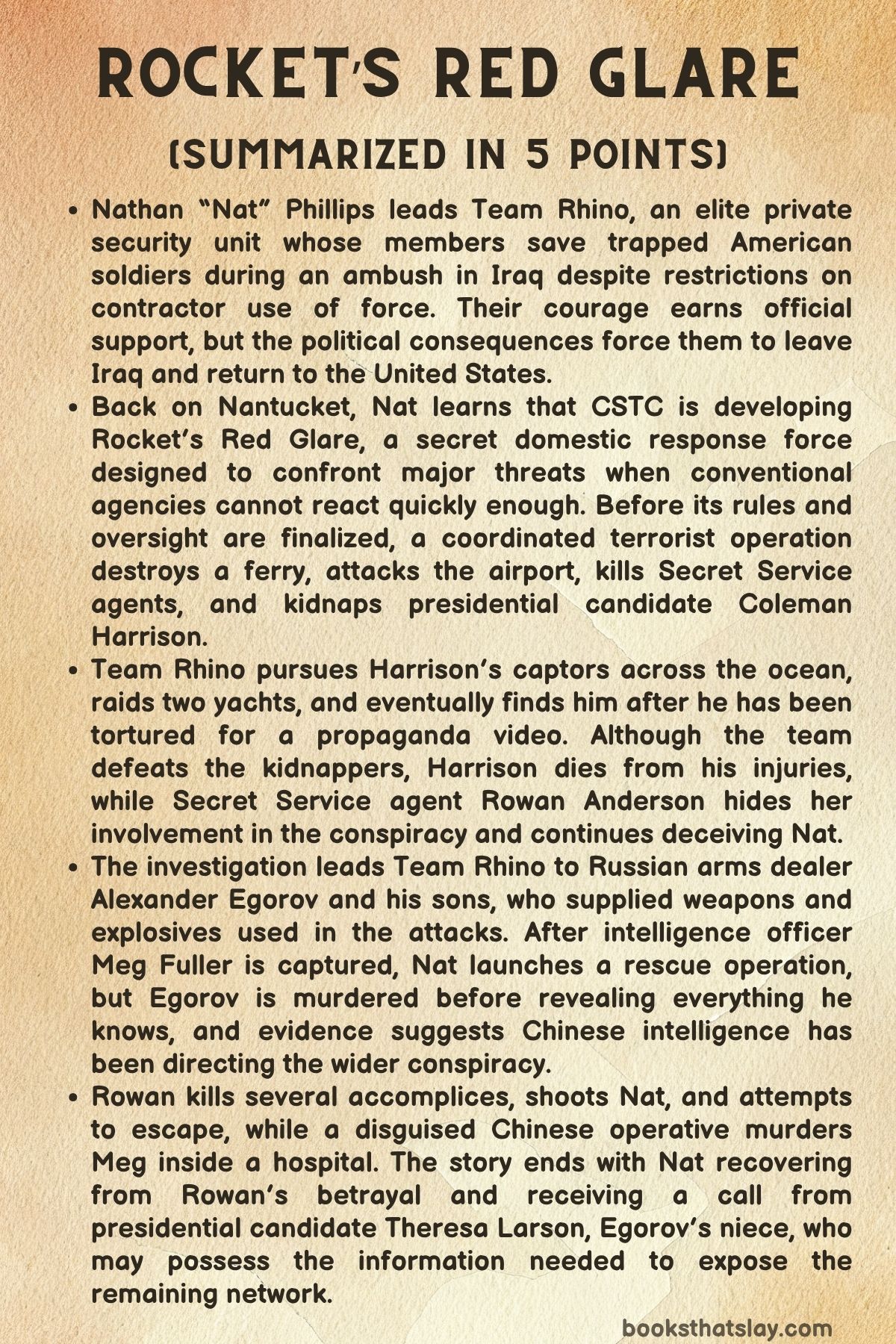
Summary
Nathan “Nat” Phillips leads Team Rhino, an elite unit within the Chesapeake Security and Training Company, or CSTC. During an assignment in Iraq, the team is responsible for protecting congressional aides traveling with an American military convoy to a meeting involving tribal leaders, military commanders, and Congressman Martin Jennings.
On the return journey, insurgents isolate and attack the final Humvee in the convoy. The vehicle is struck by a rocket-propelled grenade, its crew is trapped, and the attackers prepare to finish the wounded soldiers while Team Rhino watches from directly behind them.
Contractor regulations prevent Nat’s operators from firing unless they themselves are attacked. Nat understands that acting without authorization may lead to prosecution, political scandal, or removal from Iraq, but he refuses to allow American soldiers to be executed while his team possesses the ability to save them.
Nat orders Team Rhino to attack. The operators move with speed and discipline, killing most of the gunmen, treating the wounded soldiers, and preventing the destruction of the Humvee crew.
The decision creates an official investigation, but military commanders, Congressman Jennings, and the rescued soldiers defend Team Rhino. Nat is cleared of serious wrongdoing, although the team is removed from Iraq because local authorities require a visible response and enemy forces have placed a bounty on Nat.
Nat returns to his home on Nantucket carrying weapons and equipment from his deployment. Because presidential candidate Senator Coleman Harrison is staying nearby, the island is filled with police officers and Secret Service agents who mistake Nat’s attempt to enter his own house for a possible assassination attempt.
Nat is arrested and placed in jail, where he meets Josiah “Si” Wilson, a wealthy but directionless young man whose father arranged his arrest after Si destroyed an expensive family vehicle. Nat recognizes that Si needs discipline and useful work, so he offers him a temporary job repairing the damage federal agents caused to his house.
Tristan Dent, Nat’s billionaire friend and business partner, uses powerful government contacts to secure Nat’s release. Nat later offers Si a longer position with CSTC, and Si’s parents, Alan and Constance Wilson, approve after meeting Nat and learning about Team Rhino.
At the same time, Senator Harrison’s private life is collapsing. His marriage to Elise Courville is loveless, and his affair with press secretary Aimee Sullivan threatens his political future when Aimee demands a senior national security position in exchange for her silence.
Harrison’s campaign manager, Walter Fitzgerald, pretends to meet Aimee’s demands while secretly arranging her murder. Harrison initially reacts with horror, but his desire to become president proves stronger than his concern for Aimee, and he accepts Fitzgerald’s plan.
Elise is also planning revenge, but her actions are connected to something far larger than her husband’s infidelity. She has formed a secret relationship with Algerian terrorist Haracat al Marrak, who has convinced her that helping him will give her freedom, importance, and a future beside him.
A Secret Service supervisor named Rowan Anderson enters Nat’s life after apologizing for his arrest. Their playful conversations quickly become romantic, and Nat begins trusting her despite knowing little about her private life or the reasons behind her unusual interest in CSTC.
Tristan soon explains a secret government proposal called Rocket’s Red Glare. Senior officials want CSTC to create a deniable domestic response force capable of acting when police agencies lack the necessary training, federal forces are delayed, or legal restrictions prevent the military from operating inside the country.
Team Rhino accepts the mission, although Meg Fuller warns that the unit will need its own intelligence network. The operators understand that they will possess broad authority without the public protection normally given to soldiers or federal agents.
Before the program’s legal structure is complete, al Marrak’s operation begins on Nantucket. A Chechen bombmaker hides a massive explosive device aboard a ferry, while additional terrorist teams prepare to destroy the airport, attack the temporary Secret Service command post, and abduct Harrison.
The ferry is destroyed in a catastrophic explosion that kills passengers and crew members while drawing emergency personnel toward the harbor. Almost simultaneously, attackers fire on the airport, kill federal personnel, damage the runways, and prevent reinforcements from reaching the island.
At Harrison’s residence, hidden gunmen kill members of the protective detail. Rowan reveals her secret allegiance by murdering Aimee and assisting the kidnappers, who drug Harrison, sever his hand when they cannot remove a restraint, and carry him to a waiting boat.
Rowan then arranges to appear injured so that she can later claim she survived the assault. Harrison is transported to a yacht in international waters, where his captors torture him and record the violence for worldwide distribution.
Team Rhino discovers a roadside explosive while returning from a gathering at the Wilson estate. After disabling it, the operators reach Harrison’s residence, find the dead agents and Aimee’s body, and realize that the island’s separate disasters are parts of one coordinated operation.
Tristan formally activates Rocket’s Red Glare. With normal government forces delayed, Nat is ordered to locate the yacht and rescue Harrison, even though he also believes Rowan may have been kidnapped.
CSTC satellites identify two possible vessels. Team Rhino raids the first yacht and finds Russian criminals, cocaine, and weapons but no Harrison, forcing the operators to leave quickly and pursue the second target.
The second yacht responds with gunfire. Team Rhino boards it from helicopters, defeats the guards, and finds Harrison severely tortured and attached to what appears to be an explosive vest.
The vest is fake, but Harrison dies from his injuries despite the team’s efforts. His torture video is transmitted around the world, giving al Marrak international recognition and making the attack appear to be the work of a powerful independent terrorist organization.
Meanwhile, Si watches Elise’s estate under Nat’s instructions and encounters Rowan, who continues presenting herself as an injured survivor. Team Rhino rescues Rowan, Elise, and Si from an assassin sent to eliminate Elise, unaware that both women participated in the conspiracy.
After the Nantucket disaster, Nat’s team begins investigating the weapons and explosives used in the attacks. Evidence leads them to Russian arms dealer Alexander Egorov and his twin sons, Pavel and Taras, who operate from a wealthy Palm Beach estate.
Rowan and Elise secretly travel to Florida aboard a French diplomatic aircraft. They purchase thin explosive sheets from the Egorov twins for a planned attempt on the president, but Alexander unexpectedly arrives and realizes that Team Rhino is already monitoring his family.
Egorov’s men capture Meg. Nat orders an immediate assault on the Palm Beach estate, abandoning the original plan to quietly arrest the twins and making Meg’s survival the team’s only priority.
Team Rhino captures Egorov’s security chief Joseph and discovers Natasha, Egorov’s nurse and companion, hiding in a fortified room. Egorov escapes with Meg and later arranges an exchange involving his associates, millions of dollars, valuable artwork, and his sons.
During the exchange, Egorov releases Meg and tells Nat that al Marrak is merely a public front controlled by Chinese intelligence. He also asks Nat to protect his niece, who has discovered information about the Chinese operation.
Before Egorov can explain further, his driver shoots him. Meg is also wounded, while Pavel and Taras escape in the truck containing their family’s money and artwork.
The driver is revealed as a Chinese intelligence agent. He remotely detonates an explosive hidden in the truck, killing the twins and destroying the property that might have exposed the network.
Nat takes Meg to a Baltimore trauma hospital, where doctors successfully repair her injured shoulder. Chinese intelligence learns that she survived, however, and sends an operative disguised as a physician to inject deadly snake venom into her intravenous line.
Rowan is also eliminating witnesses. After killing Natasha, she tricks Elise into accompanying her to an isolated railway facility and shoots her, then uses Elise’s diplomatic vehicle to create evidence that might connect Nat to the crime.
Rowan learns Nat’s location and arranges to meet him in the hospital parking garage. Nat approaches believing she has come to support him, but Rowan admits that Elise is dead and shoots him in the hip and shoulder.
Nat survives, but Meg dies from the poisoned injection. Rowan later claims that she intentionally spared Nat and denies involvement in Meg’s murder, yet he no longer trusts anything she says.
The story ends when Theresa Larson, Harrison’s former political rival and the probable next presidential nominee, contacts Nat. She reveals that Alexander Egorov was her uncle and that he expected her to help Nat expose the Chinese intelligence conspiracy, leaving Team Rhino with a new source, a powerful enemy, and a mission that is far from complete.
Characters
Nathan “Nat” Phillips
Nat is the central moral and operational figure in Rocket’s Red Glare. He is a highly trained former soldier whose judgment has been shaped by combat, yet he is not presented as someone who follows orders without questioning their consequences.
His decision to rescue the soldiers in Iraq defines his character because he knowingly risks legal punishment to prevent deaths. Nat respects regulations, but he believes rules lose their moral authority when they require a person to stand aside while innocent people are killed.
Nat’s greatest strength is his ability to act under pressure, although the same confidence can become recklessness. He attacks uncertain targets, challenges federal authorities, and moves before complete intelligence is available because he believes hesitation often creates greater danger.
His personal vulnerability appears through Rowan. Nat can read an ambush, identify a bomb, and command an assault, but he fails to recognize manipulation when it is connected to affection, loneliness, and the possibility of a normal relationship.
Meg’s death and Rowan’s betrayal leave Nat emotionally damaged as well as physically wounded. By the conclusion, his mission is no longer driven only by patriotism; it has become connected to grief, anger, guilt, and a desire for personal justice.
Tristan Dent
Tristan is CSTC’s founder, Nat’s closest friend, and the institutional force behind Team Rhino. Although he inherited great wealth, his military background prevents him from becoming a distant businessman who treats danger as an abstract concept.
A parachuting accident ended Tristan’s operational career, but it did not remove his desire to serve. He redirects his resources toward training facilities, security operations, aircraft, intelligence systems, and the creation of a private organization capable of responding faster than conventional agencies.
Tristan trusts Nat’s moral instincts even when those instincts create political complications. His support after the Iraq rescue shows that he values the lives saved more than the company’s comfort or public reputation.
He is also willing to cooperate with powerful government officials in creating a secret domestic force. This ambition makes him necessary to the operation, but it also places him near the danger Alison identifies: wealthy and capable people may begin believing their intentions place them above ordinary restrictions.
Josiah “Si” Wilson
Si begins as an immature young man whose wealth has protected him from lasting consequences. His reckless destruction of his mother’s vehicle leads to jail, but the incident also introduces him to Nat and gives him a chance to discover abilities that have never been tested seriously.
Despite his privileged background, Si is practical, intelligent, physically capable, and willing to work. He repairs Nat’s house, speaks French, understands sailing, follows instructions under pressure, and refuses to abandon assignments after accepting responsibility for them.
His early excitement about Team Rhino reflects youthful fascination with danger. That excitement becomes more mature when he is exposed to gunfire, deception, death, and the fear of failing people who depend on him.
Si’s development represents the constructive side of discipline. Nat does not transform him through punishment or humiliation; he gives him trust, work, and a place where his choices matter.
Rowan Anderson
Rowan is the most deceptive and psychologically divided character in Rocket’s Red Glare. She is introduced as a capable Secret Service supervisor whose confidence, humor, and professional authority attract Nat almost immediately.
Her betrayal is especially effective because many parts of her personality are genuine. She appears to feel real affection for Nat, but that affection exists beside greed, fear, self-preservation, and a willingness to murder colleagues and civilians.
Rowan initially presents herself as someone trapped by blackmail and foreign intelligence pressure. Her later choices show that coercion cannot fully excuse her conduct because she repeatedly rejects opportunities to confess, seek protection, or stop the conspiracy.
She becomes increasingly independent as a traitor, killing Natasha and Elise while preparing to murder Nat. Her claim that she deliberately spared him may be true, but even that act is morally limited because she leaves him bleeding after destroying his trust.
Rowan’s complexity comes from the conflict between emotional attachment and survival. She may care for Nat, yet she consistently chooses herself whenever loyalty requires sacrifice.
Meg Fuller
Meg is Team Rhino’s intelligence specialist, one of its most capable operators, and one of Nat’s closest companions. Her language skills, analytical ability, technical knowledge, and field experience make her essential both during combat and during the investigation that follows Nantucket.
Her humor creates balance within the group. She can challenge Nat, tease him about Rowan, and participate in the team’s rough friendship without losing professional authority.
Meg also serves as a voice of caution. When Rocket’s Red Glare is proposed, she immediately recognizes that a secret operational unit cannot function responsibly without independent intelligence and reliable methods for verifying information.
Her capture exposes the depth of the Egorov network, while her injury forces Nat to place loyalty above the original mission. Her murder after successful surgery is especially devastating because it occurs through quiet infiltration rather than open combat.
Meg’s death demonstrates that skill and courage cannot always protect people from systems built on secrecy. She survives gunfire and hostage-taking but is killed because hidden enemies can reach into a hospital and disguise murder as medical failure.
Oliver Smith
Oliver is one of Team Rhino’s most experienced and dependable operators. He is calm under pressure, attentive to detail, and willing to challenge Nat when a situation requires honest judgment rather than automatic obedience.
His history with JP shows that his loyalty extends beyond combat. Oliver helped JP recover after personal tragedy, demonstrating that his value to the team comes from emotional steadiness as well as tactical skill.
During operations, Oliver accepts danger without seeking attention. He is wounded during the yacht rescue but continues functioning, reflecting the team’s expectation that every member will remain useful until the immediate threat has passed.
Oliver also contributes to the investigation by recognizing connections others might overlook. His suggestions help move the team toward the Russian network, making him an important link between action and analysis.
Wolf Kerr
Wolf is a former Green Beret with additional experience in the FBI and Secret Service. This combination gives him a broad understanding of military action, federal protection, and the institutional limits that Team Rhino regularly confronts.
He is a disciplined driver, fighter, and technical operator who functions reliably without needing to dominate conversations. His ability to examine the device attached to Harrison prevents the team from wasting critical time or risking an unnecessary detonation.
Wolf represents professional competence without personal drama. He supports Nat’s leadership, contributes specialized judgment, and remains focused when emotional pressure threatens to influence decisions.
John Paul “JP” Kennedy
JP’s commitment to counterterrorism is rooted in the death of his brother during the September 11 attacks. That loss drove him into severe depression and nearly destroyed his desire to continue living.
CSTC gives JP a renewed sense of purpose. His service with Team Rhino allows him to convert grief into disciplined action, although the emotional origins of that commitment remain important to his identity.
JP is aggressive when necessary but not careless. His quick response during the Iraq ambush and his ability to identify and eliminate the sniper attacking Elise show both awareness and accuracy.
His story also shows how a team can become a substitute family. Oliver and Tristan do not merely recruit him; they help restore his connection to life and responsibility.
Rudy Martin
Rudy serves as a skilled medical operator within Team Rhino. His presence allows the group to provide immediate treatment during situations in which conventional emergency services are unavailable or too far away.
He treats the soldiers rescued in Iraq, stabilizes Oliver after the yacht assault, and cares for Meg during her emergency flight to Baltimore. These moments make him responsible for preserving life while others focus on eliminating threats.
Rudy is also physically capable in combat, as shown when he fights Joseph during the Palm Beach operation. He is not limited to the role of medic, but his medical knowledge gives the team a moral purpose beyond destruction.
Stu Arden
Stu works mainly in technical and intelligence support. His extraction of information from captured telephones and computers helps Team Rhino move from reacting to attacks toward identifying the networks behind them.
He represents the quieter side of modern conflict. While the field operators receive immediate attention, Stu’s work turns scattered objects into names, routes, financial connections, and possible future targets.
His contribution becomes particularly valuable because Rocket’s Red Glare cannot depend freely on federal databases. Stu helps create the independent analytical capacity that Meg argues the organization needs.
Jimmy Teagan
Jimmy contributes operational experience and valuable family connections. His ability to use contacts in Boston and Irish-American circles gives Team Rhino access to information that official channels may not provide.
He shows restraint when Nat prevents him from shooting Joseph, demonstrating that the team’s members can respond to command even during anger and confusion. This discipline matters because live prisoners often possess more value than dead enemies.
Jimmy also represents the organization’s informal reach. CSTC’s influence comes not only from weapons and aircraft but from relationships spread across business, military, political, and criminal environments.
Coleman Harrison
Harrison is a successful political figure whose public charm conceals weakness, selfishness, and moral emptiness. He wants the presidency, but he lacks the personal discipline and ethical judgment required for the authority he seeks.
His affairs are not simply private mistakes. He uses women, depends on his wife’s wealth and status, and allows Fitzgerald to manage the consequences of behavior he refuses to control.
Harrison’s acceptance of Aimee’s planned murder marks his deepest failure. Even though he does not personally carry out the killing, he chooses political survival over the life of a woman with whom he continues having a relationship.
His torture and death are brutal, but the book does not transform him into a noble figure. He becomes a victim of terrorism while remaining responsible for the corruption that made him vulnerable to manipulation.
Elise Courville
Elise begins as a humiliated wife who appears justified in her anger toward Harrison. Her pain, however, develops into a willingness to assist terrorists, sacrifice civilians, and use her family’s diplomatic position to support revenge.
She is emotionally dependent on al Marrak because he gives her the attention and importance she no longer receives from her husband. Her desire to believe in his affection prevents her from recognizing that he views her as a disposable source of access and intelligence.
Elise is both manipulator and victim. She deceives her father, exploits diplomatic privileges, and helps organize violence, but she is also controlled by al Marrak and later by Rowan.
Her murder completes the pattern of exploitation. After helping destroy Harrison, she is killed by the only person who fully understands her crimes, proving that criminal alliances based on fear cannot produce security or trust.
Walter Fitzgerald
Fitzgerald is Harrison’s campaign manager and political problem-solver. He treats people as obstacles, assets, or risks, reducing every moral question to its effect on Harrison’s path to the White House.
His plan to murder Aimee shows methodical cruelty. He prepares false evidence, constructs a plausible public explanation, and pressures Harrison to accept the killing as a practical necessity.
Fitzgerald believes he controls the crisis, but his confidence is misplaced. The international conspiracy surrounding Elise and al Marrak is far beyond his understanding, and the violence he plans becomes insignificant beside the disaster already forming around him.
He represents political corruption at its most calculating: not emotional rage, but calm reasoning used to justify murder.
Aimee Sullivan
Aimee is Harrison’s press secretary and mistress. She understands that their affair gives her leverage and attempts to exchange silence for a powerful position in a future administration.
Her ambition is ethically questionable, but it does not justify the treatment she receives. Harrison continues using her even after approving Fitzgerald’s plan to have her murdered.
Aimee’s confidence prevents her from recognizing the seriousness of the threat. She believes she has forced powerful men to respect her demands when they are actually constructing a public story that will explain her disappearance.
Her death at Rowan’s hands shows how quickly political manipulation becomes physical violence when people with power consider another person inconvenient.
Theresa Larson
Theresa is introduced as Harrison’s political rival, apparently headed toward defeat. She is intelligent, ambitious, controlled, and far more capable than the people around her recognize.
Her private hatred of her abusive husband reveals a colder and more dangerous side. She imagines killing him, not as a momentary expression of frustration, but as a controlled fantasy born from years of domination and resentment.
Harrison’s death transforms her political future, making her the likely nominee. She publicly mourns him while privately accepting the advantage created by his removal.
The final revelation that Alexander Egorov was her uncle changes her importance completely. Theresa may become an ally against Chinese intelligence, but her family connection, ambition, and secrecy make it impossible to know whether her interests fully match Nat’s.
Mark Larson
Mark treats Theresa’s political success as an extension of his own identity. He threatens to end their marriage if her campaign fails, revealing that his support is conditional and based on control rather than partnership.
He underestimates Theresa because he assumes intimidation gives him authority over her. Her private thoughts suggest that she has already moved beyond fear and is waiting for an opportunity to free herself from him.
Mark’s role is limited compared with the international conspirators, but he helps explain Theresa’s emotional hardness. Living under his control has taught her to hide her intentions, perform expected roles, and prepare retaliation in silence.
Haracat al Marrak
Al Marrak presents himself as a religious warrior and strategic terrorist leader. He uses ideological language to justify murder, but personal vanity, ambition, and a desire for recognition are central to his actions.
He manipulates Elise by turning her marital humiliation into political purpose. He offers affection and historical significance while treating her as a source of access who can be killed after she completes her task.
The Nantucket attack gives al Marrak money, attention, and status among extremists. He mistakes this response for proof that he controls events, even though Chinese intelligence is using him as a public identity behind which it can hide.
His greatest weakness is arrogance. He believes ideology and fear make others obedient, but he fails to recognize that nearly every relationship surrounding him is based on competing deception.
Alexander Egorov
Alexander is an aging Russian arms dealer who has survived through intelligence, caution, corruption, and a strong awareness of danger. Unlike his sons, he recognizes immediately when a transaction carries risks beyond ordinary criminal business.
His wealth and history make him morally responsible for supplying violent groups, yet he is not presented as a simple villain. He understands that Chinese intelligence is eliminating witnesses and attempts to pass vital information to Nat.
His desire to protect his niece suggests that personal loyalty remains important to him despite decades of criminal conduct. His death prevents him from explaining the conspiracy fully, but his final warning redirects Team Rhino toward the real enemy.
Egorov’s fate also shows that powerful criminals often overestimate their independence. He believes he controls his organization while foreign agents have already entered his household, medical care, security team, and transportation.
Pavel Egorov
Pavel is one of Alexander’s twin sons and an active participant in the family’s arms business. He enjoys wealth, drugs, and status but lacks his father’s discipline and suspicion.
His careless dealings with Rowan and Elise expose the family to enormous danger. He treats the sale of advanced explosives as routine business even when the buyers are connected to a major political assassination.
Pavel’s death in the truck explosion reflects his inability to understand the forces around him. He escapes Team Rhino but remains unaware that Chinese intelligence has already decided the entire Egorov family must disappear.
Taras Egorov
Taras shares Pavel’s privilege, criminal confidence, and lack of caution. He participates in supplying the explosives and assumes family wealth will protect him from the consequences.
During the escape, Taras reassures his brother without examining the cargo or questioning why the exchange ended so easily. His exhaustion and drug use further reduce his judgment.
Like Pavel, he inherits a criminal empire without inheriting the instincts that allowed Alexander to build it. His death reveals the weakness beneath the twins’ confidence.
Natasha
Natasha appears to be Egorov’s loyal nurse and companion, but she is secretly a Russian intelligence agent. Her mission involves weakening Egorov through false medical treatment while reporting his contacts and transactions.
Her role demonstrates the depth of state infiltration inside criminal organizations. Egorov trusts her with his body and health, making her betrayal more personal than ordinary surveillance.
Natasha expects her service to earn protection and a return to Russia. Instead, she is murdered by Rowan before she can reveal what she knows, showing that intelligence assets are frequently valued only while their information remains useful.
Joseph
Joseph is Egorov’s security chief and a highly capable counterintelligence figure. He identifies Team Rhino, detects the Palm Beach surveillance, captures Meg, and helps Egorov escape before the assault.
His competence makes him more dangerous than the Egorov twins. He treats security as a professional contest rather than as a display of wealth or aggression.
Once captured, Joseph becomes valuable because he can provide information and serve as part of the hostage exchange. Nat’s decision to keep him alive illustrates the difference between emotional retaliation and strategic necessity.
Ming Yu
Ming Yu is Rowan’s Chinese intelligence controller. He appears briefly, but his authority reveals the larger structure behind the attacks and the extent to which Rowan’s actions are being directed.
He does not rely on loyalty or persuasion. He uses surveillance, threats, and the promise of immediate death to enforce obedience.
Ming views al Marrak, Rowan, Elise, and the Russians as replaceable instruments. His control represents a state system that can use personal weakness, terrorism, criminal trade, and political scandal without publicly connecting itself to any of them.
Dr. Curtis Lee
Curtis Lee is a physician trained to function as an intelligence assassin. His professional appearance allows him to enter a hospital, gain information from staff, and approach a vulnerable patient without attracting suspicion.
His murder of Meg is cold because it uses trust in medicine as a weapon. He does not need a dramatic confrontation; he simply injects venom into her intravenous line and leaves while appearing harmless.
Lee represents the reach of the Chinese operation. Team Rhino can secure aircraft, weapons, and battlefields, but it is less prepared for an enemy who enters through ordinary institutions and professional credentials.
Samuel Starnes
Starnes is a retired federal judge who works on sensitive government projects. His legal authority and political relationships repeatedly protect Nat and CSTC from officials who do not understand their role.
He helps secure Nat’s release, resolves the confrontation after Nantucket, assists with hospital cooperation, and participates in the oversight structure surrounding Rocket’s Red Glare.
Starnes represents the bridge between secret action and legal legitimacy. His presence does not remove the moral risks of the program, but it prevents Team Rhino from operating solely according to private preference.
Alison Dent
Alison provides one of the clearest warnings about the dangers of secret power. While Tristan and Nat focus on operational necessity, she asks what will prevent capable and patriotic people from deciding that ordinary rules no longer apply to them.
Her reference to adventurers corrupted by authority challenges the heroic image Team Rhino might develop about itself. She understands that confidence, good intentions, and military success can become dangerous when an organization lacks accountability.
Alison therefore serves as an ethical counterweight to Tristan’s ambition. She supports the mission only if it includes restrictions, reporting, and internal discipline.
Alan Wilson
Alan is Si’s father and a wealthy businessman who values work, responsibility, and practical competence. Although he arranges Si’s arrest to teach him a lesson, he is willing to recognize a better opportunity when Nat offers one.
His enthusiasm for military culture and CSTC helps Si enter Team Rhino’s world. He does not treat his son as permanently irresponsible but supports the chance for him to earn trust.
Alan’s resources also become useful to CSTC, particularly when the Wilson family properties provide locations for meetings and surveillance. His influence is constructive because it is paired with respect for discipline rather than entitlement.
Constance Wilson
Constance is Si’s mother and the more cautious of his parents. She worries about weapons, overseas missions, and the possibility that her son may enter work he does not fully understand.
Her concern does not become obstruction. After hearing Nat’s account of Iraq and judging his character, she allows Si to accept the opportunity.
Constance’s warmth helps create the sense of temporary normality surrounding Team Rhino before the Nantucket attack. Her hospitality also shows that wealth in the novel is not automatically connected to selfishness or corruption.
Charles Courville
Charles is Elise’s father and the French ambassador. He is protective, influential, and enraged by Harrison’s treatment of his daughter.
His love makes him easy for Elise to manipulate. She presents herself as a helpless victim while secretly using his diplomatic access and emotional reactions to support the conspiracy.
Charles later helps Rowan obtain a prestigious embassy assignment because he believes she protected Elise. His actions show how false appearances can redirect legitimate authority toward the interests of a traitor.
Martin Jennings
Jennings is a congressman and strong supporter of the military. His presence during the Iraq mission gives Team Rhino an influential witness who understands what happened during the ambush.
He protects Nat from political punishment and later participates in the oversight structure for Rocket’s Red Glare. Unlike officials who judge from a distance, Jennings respects operators who make decisions under immediate threat.
His support is important, but it also helps normalize the creation of a force whose authority remains largely hidden. Jennings represents responsible political backing, though the system he supports still requires strong safeguards.
Lieutenant General Chase Montgomery
Montgomery is the senior American commander involved in the Iraq operation. He responds to Team Rhino’s unauthorized action with practical judgment rather than bureaucratic anger.
He recognizes that Nat’s decision saved soldiers and that the political consequences can be managed. His request for Nat’s honest assessment also shows that he values field experience over reassuring official reports.
Montgomery’s leadership contrasts with the insecure convoy major. He possesses enough authority to acknowledge reality without treating independent judgment as a personal challenge.
Command Sergeant Major Chris Miller
Chris is an experienced and respected enlisted leader whose instincts carry great weight with Nat and Meg. He recognizes growing sectarian tension near Yusufiyah and warns that apparent calm may conceal an approaching attack.
His personality combines intimidating authority with rough humor. He can discipline soldiers instantly while greeting Nat through an exchange that initially appears hostile.
Chris represents the practical knowledge developed through long service. His warnings are not based on political optimism but on close observation of people, behavior, and local conditions.
Colonel Dave Knapp
Knapp conducts the initial formal review of Nat’s actions after the Iraq ambush. His severe manner reflects the need to maintain standards when private contractors use force near military units.
He does not ignore the complications Team Rhino created, but he also refuses to value paperwork above soldiers’ lives. His statement that administrative problems are preferable to notifying another dead soldier’s family reveals the humanity beneath his formal role.
Knapp demonstrates that accountability and gratitude can coexist. He can investigate Nat while still respecting the decision that was made.
Sergeant Jeff Carnes
Carnes is one of the soldiers trapped inside the damaged Humvee. His confusion and helplessness during the ambush provide a human view of what Nat’s decision actually prevents.
Afterward, Carnes embraces Nat and thanks the team for saving his crew. His reaction confirms that the incident was not an abstract dispute about contractor regulations but a matter of survival.
Carnes also struggles with the idea that being stunned by an explosion represents personal failure. Nat’s reassurance restores dignity to a soldier who has endured circumstances beyond his control.
Staff Sergeant Ben Hilton
Hilton is another soldier connected to the attacked Humvee. He recognizes that the route through Yusufiyah has always felt dangerous and expresses direct gratitude toward Team Rhino.
His presence helps establish the military’s view of the rescue from below the command level. While officials debate regulations, Hilton understands that Nat’s refusal to wait preserved the lives of his men.
William McKay
McKay is one of the congressional aides traveling with Team Rhino in Iraq. He initially resents being placed with private contractors rather than senior military officers.
His attitude changes after experiencing the dangers of the route and the reality of the ambush. The incident forces him to understand that status matters far less than competence when violence begins.
McKay becomes an important witness because he can describe Team Rhino’s conduct to influential political figures. His change in perspective supports Nat during the investigation.
Travis Hunter
Hunter travels with McKay and also begins the mission with limited respect for Team Rhino. After witnessing the rescue, he recognizes that the contractors acted when the convoy’s official command structure failed.
He promises to give Congressman Jennings a full account and begins making calls that may protect the team. Hunter’s gratitude shows how direct experience can overcome prejudice against private operators.
Jed O’Reilly
Jed is CSTC’s legal adviser. He meets Nat after the Iraq rescue and assures him that the team’s actions can be defended as necessary and legitimate.
His presence highlights the legal complexity surrounding private force. Team Rhino may act like a military unit, but every operation can involve criminal law, international agreements, military regulations, and political consequences.
Jed helps translate battlefield necessity into arguments that officials can accept.
David
David is the Chechen bombmaker who constructs the ferry device. He believes the attack will honor his religion and establish his importance within a larger cause.
His confidence rests on a false understanding of his own value. Once he leaves the ferry, the boatman murders him to eliminate a witness.
David’s fate reveals the dishonesty of the organization he serves. He sees himself as a respected participant, while the planners see him only as a technical resource that must be destroyed after use.
The Boatman
The boatman is a disciplined assassin involved in several stages of the Nantucket operation. He retrieves and kills David, activates the ferry bomb, and later moves to eliminate Elise.
Unlike the more ideological operatives, he appears motivated by professional obedience rather than emotional belief. His efficiency makes him dangerous because he does not hesitate or question why allies must be killed.
His death at Team Rhino’s hands ends one cleanup mission, but the system that sent him continues using other disposable agents.
Senator Tabitha Doyle
Doyle participates in the political oversight of Rocket’s Red Glare. She defends Nat and Oliver when Congressman Dempsey questions operational decisions without acknowledging the pressures faced in the field.
Her response shows respect for practical experience while still supporting government supervision. She represents a form of oversight that is firm but not hostile to the people carrying out the mission.
Congressman Dempsey
Dempsey questions Team Rhino’s decisions during the formal review. His skepticism may appear irritating, but it serves an important purpose because secret organizations should not be protected from difficult questions.
His weakness is that he sometimes evaluates actions from the safety of a conference room without fully recognizing the speed and uncertainty of combat. Even so, his presence prevents the oversight process from becoming simple approval.
Themes
Duty Beyond Rules
The conflict between written authority and moral responsibility shapes Rocket’s Red Glare from the Iraq ambush onward. Nat is ordered to wait because Team Rhino’s contractor status restricts when its members may use force, but obedience would allow trapped soldiers to be killed in front of them.
His choice establishes a demanding ethical principle: rules are necessary, yet rules cannot replace judgment. Nat does not reject regulation because he dislikes control; he breaks a specific restriction because the restriction has become incompatible with the purpose it was meant to serve, which is the protection of life.
The same problem returns when Rocket’s Red Glare begins operating before its charter is complete. Team Rhino repeatedly faces situations in which formal authorization is delayed, intelligence is incomplete, and immediate action may save lives or create disaster.
The novel refuses to offer an easy answer. Nat’s decisions often produce valuable results, but the raid on the wrong yacht proves that courage and good intentions do not guarantee accuracy.
Duty therefore requires more than bravery. It requires accepting responsibility for mistakes, preserving internal discipline, questioning personal motives, and creating limits before emergency authority becomes permanent.
Power, Ambition, and Moral Collapse
Political ambition repeatedly destroys the boundaries that should protect human life. Harrison’s desire to become president is so strong that he accepts Fitzgerald’s plan to murder Aimee, even though he has been using her emotionally and sexually.
Fitzgerald treats murder as campaign management, reducing morality to the question of whether an action protects or damages a candidate. His calm planning shows that corruption does not always appear as uncontrolled cruelty; it can appear as professional efficiency without conscience.
Elise’s ambition is more personal but equally destructive. She wants revenge, freedom, recognition, and the belief that she is participating in an important historical cause, allowing al Marrak to convert humiliation into mass violence.
Al Marrak seeks fame within extremist networks, Rowan seeks survival and money, and the Egorov twins seek profit without considering consequences. Each character believes a desired outcome makes other people expendable.
Theresa Larson’s rise adds further uncertainty because political advantage comes directly from Harrison’s death. Although she did not cause the attack, her private satisfaction shows how quickly tragedy can become opportunity.
Power becomes dangerous when individuals stop seeing other people as independent human beings. Once every relationship is judged according to usefulness, betrayal and murder become ordinary methods rather than moral boundaries.
Loyalty, Betrayal, and Trust
Team Rhino survives because its members trust one another with their lives. Nat, Meg, Oliver, JP, Wolf, Rudy, and the others can act quickly under pressure because each person believes the others will perform their duties and refuse to abandon a teammate.
This loyalty appears most clearly after Meg is captured. The planned mission against the Egorovs immediately becomes secondary, and the entire team accepts the risks of an improvised assault because leaving her behind is unthinkable.
The conspirators operate through the opposite principle. Elise betrays Harrison and her father, Rowan betrays the Secret Service and Nat, Natasha betrays Egorov, and Egorov’s driver betrays the man he has served for years.
These betrayals succeed because they exploit genuine forms of trust. Rowan’s relationship with Nat is effective because his feelings are real, while Natasha’s deception works because Egorov has placed his health and physical safety in her hands.
The novel also distinguishes loyalty from blind obedience. Team Rhino’s bond remains constructive because members can question plans, raise concerns, and demand accountability.
The criminal alliances fail because they are based on fear, payment, blackmail, and temporary convenience. Such relationships may produce cooperation for a time, but every participant eventually expects to be betrayed and begins planning to strike first.
Hidden Warfare and the Price of Secrecy
The central conflict takes place in a world where official appearances rarely reveal who controls an operation. Terrorists, criminals, diplomats, political advisers, federal agents, and foreign intelligence officers operate through layers of false identities and indirect relationships.
The Nantucket attack is deliberately designed to create several possible explanations. Islamic extremists carry out visible violence, Russian criminals provide weapons, American military equipment creates a domestic trail, and compromised officials provide access.
This confusion protects the Chinese intelligence service because investigators are encouraged to treat each clue as proof of a separate enemy. The strategy turns uncertainty into a weapon, forcing Team Rhino to act before it can understand the entire structure.
Secrecy also affects the defenders. Rocket’s Red Glare needs concealment so its members can respond quickly, but that concealment limits outside support, public accountability, and the ability to admit mistakes.
Meg’s murder shows the personal cost of hidden conflict. Her killers can reach her because official systems do not know who she is, why she needs protection, or which foreign service wants her dead.
The story therefore treats secrecy as both protection and danger. It can preserve operations, but it can also isolate good people, shield unlawful power, confuse responsibility, and allow institutions to become vulnerable from within.