Somebody Worth Killing Summary, Characters and Themes
Somebody Worth Killing by Jessica Payne is a darkly comic psychological thriller about Nadia Davis, a professional assassin who hides her violent career behind the carefully maintained image of a suburban wife, mother, and wedding planner.
Her controlled existence collapses when she accepts a prestigious contract and discovers that the target is Brian, her apparently dependable husband. Forced to investigate the man she loves, Nadia uncovers lies, professional rivalries, family secrets, and unexpected similarities between herself and Brian. The novel combines domestic conflict, suspense, moral uncertainty, and sharp humor while examining whether love can survive complete honesty between two dangerous people.
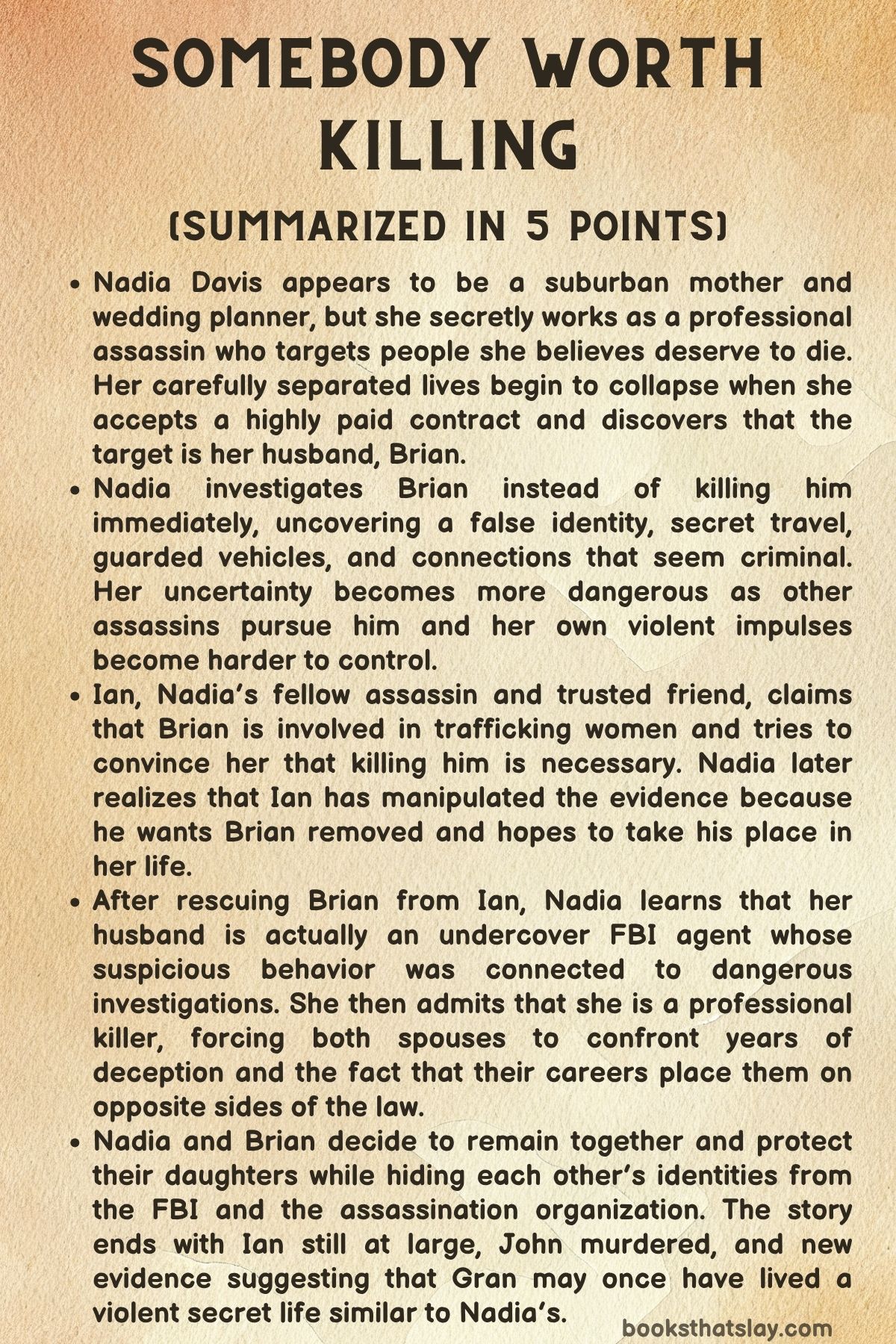
Summary
Nadia Davis appears to be a busy suburban mother raising two young daughters in Texas while working as a wedding planner. In reality, she is a professional assassin who carefully chooses targets she believes deserve to die.
Her two identities exist beside each other with surprising efficiency. She can shoot a wealthy criminal from a tree, stop at a supermarket for medicine, speak politely with another parent, and return home to comfort her sick daughter without allowing either role to expose the other.
Nadia’s hidden office contains weapons, encrypted equipment, and a concealed soundproof room. Her handler, John, assigns her contracts through a secret criminal organization, while her husband, Brian, believes her irregular hours are connected to demanding clients and wedding preparations.
Nadia does not view herself as an ordinary murderer. Since adolescence, she has followed rules taught by her grandmother, Gran, who recognized Nadia’s unusual emotional nature and advised her to direct it toward people who had caused serious harm.
Her first victim was Piper’s abusive boyfriend, whom Nadia killed after realizing that he might eventually murder her sister. The death was disguised as an accident, and Nadia has continued using violence as both a profession and a means of controlling the dangerous pressure she feels inside herself.
Nadia’s confidence is disturbed when Ian, another assassin and one of the few people who understands her nature, reveals that he was offered a valuable international assignment that she was never considered for. Nadia concludes that the organization has restricted her opportunities because she is a woman and a mother.
Furious at being professionally underestimated, she confronts John and demands a prestigious contract. He eventually offers her a sealed assignment with unusually high payment, warning only that the target is extremely dangerous.
Nadia accepts before learning the person’s identity. The instructions arrive through an elaborate riddle that leads her to an independent bookstore and then to a heavily guarded Cadillac traveling toward Austin.
She follows the vehicle, expecting to uncover an influential criminal. Instead, the passenger who steps from the car is Brian, the husband she believed was working in Washington, D.C.
Brian strengthens his false story by sending photographs of cherry blossoms, but Nadia discovers that the images were taken weeks earlier. She realizes that the man she has trusted for ten years is hiding a second life just as carefully as she hides hers.
Rather than completing the contract immediately, Nadia investigates him. Her moral rules require proof that a target deserves death, and Brian’s affection for their daughters makes it difficult for her to accept the organization’s claim that he is monstrous.
Her research reveals that Brian’s identity belongs to a baby who died shortly after birth. The parents he introduced to Nadia before their marriage are also dead, suggesting that his background was intentionally constructed.
The pressure surrounding the contract begins damaging Nadia’s self-control. During a run, she nearly attacks an innocent stranger simply to satisfy her violent urge, an impulse that frightens her because it violates the moral distinction on which she has built her identity.
Ian advises her to kill Brian before the organization sends someone else. He warns that refusing an accepted contract could endanger Nadia, her daughters, and everyone close to her.
Brian returns home and behaves like the loving husband she recognizes. He takes the family to the zoo, plans a thoughtful anniversary celebration, and expresses appreciation for Nadia’s work as a mother, making it increasingly difficult for her to decide whether his domestic affection is genuine or merely part of his cover.
During their anniversary dinner, Nadia notices a sniper positioned to shoot Brian. She pursues the attacker and discovers that the assassin is Ian, who has also accepted the contract.
Ian agrees not to kill Brian that night, but his promise is temporary. Nadia persuades him to help investigate instead, although his interest in the reward and his attraction to her make his loyalty uncertain.
The crisis causes Nadia to lose discipline on another assignment. She brutally kills Jennifer Patrick, a pharmacist who diluted cancer medication and allowed patients to die, but she ignores instructions to make the death appear accidental.
John fires Nadia for her recklessness and her failure to complete the contract on Brian. Nevertheless, Nadia continues investigating, believing she must either establish Brian’s guilt or protect him from the assassins now pursuing him.
When Brian travels secretly to California, Nadia and Ian follow him. Brian appears to approach young women, move them between guarded vehicles, and enter restricted hotel areas.
Ian tells Nadia that Brian is trafficking women and may also be cheating on her. His report seems to explain Brian’s false identity, secret travel, organized-crime connections, and the extraordinary price placed on his life.
Feeling betrayed, Nadia agrees that Brian must die. Ian then suggests that after Brian’s death, he could remain with Nadia, help raise her daughters, and give her a relationship in which she would no longer need to hide her true profession.
They nearly begin an affair, but Nadia stops because she remains emotionally committed to Brian. She decides that she must question her husband directly before killing him, even if the confrontation requires her to admit that she is an assassin.
Nadia prepares a secluded motel room for the interrogation. Before she can take Brian there, Ian disguises himself, kidnaps Brian from the airport, and drives away in a vehicle resembling Nadia’s minivan.
Nadia traces Ian to a hotel, where she meets Victoria, the wife he never told her about. Victoria knows Ian is an assassin and believes his obsession with Nadia has influenced his determination to eliminate Brian.
When Nadia threatens Victoria’s life in an attempt to stop him, Ian responds that she may kill his wife if she chooses. His indifference reveals that he values control, money, and his fixation on Nadia more than the person he married.
Victoria secretly tracks Ian’s phone and gives Nadia his location at a storage facility. Nadia enters alone, knowing that rescuing Brian will almost certainly expose her real identity.
She finds Brian beaten and restrained inside Ian’s weapons unit. Ian tells Brian that Nadia has secrets of her own before gunfire allows him to escape into the building.
Brian assumes Nadia has joined Ian and tries to defend himself. Nadia and Brian pursue and attack each other through the storage corridors until they realize that neither fully understands the situation.
Brian is wounded, forcing them to establish a temporary truce. Nadia takes him to Linda, an unlicensed medical professional who discreetly treats people involved in dangerous work.
Brian finally reveals that he is an undercover FBI agent. He assumed the identity of the dead infant after criminals discovered his original identity and nearly killed him.
His secret trips, guarded transportation, and contact with young women were parts of undercover investigations. The woman in Austin was another agent, while the woman in California was an informant being moved to safety.
Nadia understands that Ian deliberately presented partial observations as proof of trafficking. He wanted her to believe Brian was guilty so that she would accept the assassination and become emotionally available to him.
After returning home, Nadia tells Brian the full truth about her own life. She admits that she is a professional killer, explains her first murder, describes the pressure that drives her toward violence, and reveals that she was hired to kill him.
Brian is shocked, but he does not immediately arrest or reject her. He questions whether she has harmed innocent people and whether their daughters have ever been in danger.
Nadia assures him that her family is safe and that she has always tried to limit her victims to dangerous people. Brian begins to recognize that both of them have spent their marriage committing morally troubling acts while pretending to live ordinary lives.
Their honesty creates a new form of intimacy, but the contract remains active. An assassin enters their home and attempts to shoot Brian, forcing Nadia to kill the attacker while protecting their daughters.
Brian witnesses Nadia’s abilities directly, and the couple works together to clean the scene and dispose of the body. They recognize that neither the FBI nor the assassination organization can be allowed to discover the other’s identity.
To stop further attacks, Nadia and Brian decide to identify the person behind the contract. Their search leads them to Missouri, where they plan to confront John.
They find John murdered in his apartment with a precise gunshot wound. Nadia recognizes the method as Ian’s signature and concludes that he killed John to prevent him from revealing information about the contract.
The evidence suggests that Ian may have arranged, manipulated, or exploited the assignment from the beginning. His motives include eliminating an FBI agent, earning the reward, isolating Nadia, and creating an opportunity to replace Brian.
The immediate conflict ends without Ian being captured. Nadia and Brian remain together, now fully aware that each has spent years deceiving the other while genuinely loving their family.
During Gran’s birthday celebration, Gran mistakes Brian for a man from her past and remarks that they could have become infamous together. The comment gives Nadia another clue that Gran may once have led a dangerous secret life of her own.
Nadia finishes the story with her marriage transformed rather than destroyed. She and Brian must now protect their daughters, conceal each other’s crimes, uncover Ian’s plans, and determine whether two people positioned on opposite sides of the law can build a life based on honesty.
Characters
Nadia Davis
Nadia is the central consciousness of Somebody Worth Killing, and nearly every conflict grows from the distance between her public identity and her private nature. To her neighbors, she is an organized mother, devoted wife, and mildly successful wedding planner, but beneath that socially acceptable image is a disciplined assassin who experiences killing as both work and psychological release.
Her most important characteristic is not simply her capacity for violence but her need to give that violence a moral structure. Gran’s rule that she should kill only those who deserve it allows Nadia to think of herself as a controlled predator rather than an indiscriminate murderer.
That distinction is essential to her self-respect. When she nearly attacks an innocent runner, she is frightened not because violence is unfamiliar to her, but because the impulse threatens the ethical boundary that separates her from killers such as Ian.
Nadia’s motherhood is sincere rather than decorative. She loves Eliza and Evie, worries about their physical and emotional safety, manages their schedules, and carries most of the invisible labor required to keep the household functioning.
At the same time, she resents the assumption that motherhood should reduce her ambition. Her anger at being denied major contracts reflects the same frustration she feels when Brian can leave for work without arranging childcare while every professional decision she makes requires complicated domestic planning.
Her marriage reveals Nadia’s emotional contradictions. She claims to possess a limited emotional range, yet her response to Brian’s possible betrayal includes jealousy, grief, loyalty, fear, and a powerful need to protect him.
Nadia is also an unreliable judge when her emotions are involved. Her jealousy allows Ian’s claims about Brian’s supposed trafficking to seem convincing, although her eventual refusal to kill Brian without confronting him proves that her moral independence survives manipulation.
By the conclusion, Nadia has not become less dangerous. Instead, she becomes more honest about the fact that love, violence, ambition, and domestic responsibility all form genuine parts of her identity.
Brian Davis
Brian initially appears to represent stability in Somebody Worth Killing. He is affectionate, humorous, dependable with the children, and apparently ordinary enough to provide Nadia with the domestic structure that helps her control her violent urges.
The discovery that he is using the identity of a dead infant destroys Nadia’s belief that she is the only skilled deceiver in the marriage. His fabricated history, false travel stories, secret colleagues, and guarded movements make him appear capable of crimes even darker than hers.
Brian’s eventual revelation that he is an undercover FBI agent changes the meaning of his secrecy without making it harmless. He lied to protect his family, but he also denied Nadia the opportunity to understand the danger surrounding their household.
Like Nadia, Brian believes that secrecy can serve love. Both spouses convince themselves that deception is acceptable because the truth might frighten, burden, or endanger the other person.
His response to Nadia’s confession is one of the novel’s greatest surprises. Although his profession requires him to pursue killers, he does not reduce his wife to a criminal category but instead asks whether she has harmed innocents, whether she can control herself, and whether their children are safe.
Brian’s acceptance is partly emotional and partly practical. His undercover work has already forced him to break rules, manipulate people, and maintain false identities, so he understands that legality and morality do not always produce identical judgments.
His desire for another child also exposes insecurity beneath his dependable exterior. He hoped a baby would repair the distance he sensed in the marriage, showing that even an experienced federal agent can respond to emotional uncertainty with an unrealistic domestic solution.
By the end, Brian becomes Nadia’s partner in concealment and survival. His decision to protect her places him in conflict with his professional obligations, but it also marks the first time their marriage is based on informed choice rather than carefully maintained illusions.
Ian
Ian serves as Nadia’s professional equal, emotional mirror, and eventual antagonist. He understands her appetite for danger, recognizes the pressure she experiences when she goes too long without killing, and initially appears to offer the acceptance she cannot receive from her family.
His advice about professional discrimination contains enough truth to gain Nadia’s trust. By informing her that motherhood has limited her opportunities, he encourages her to demand the contract that eventually places Brian in danger.
Ian differs from Nadia in his refusal to restrict his violent nature. He believes complete acceptance of his predatory impulses is healthier than Nadia’s moral rules, but his behavior reveals that this acceptance has become an excuse for selfishness and cruelty.
His manipulation in California is especially revealing. He converts ambiguous observations into a convincing story about human trafficking because he knows Nadia will kill Brian only if she believes her husband has harmed innocent people.
Ian also mistakes understanding for entitlement. Because he shares Nadia’s profession and unusual psychology, he assumes that he is better suited to her than Brian and treats the destruction of her marriage as an opportunity.
His treatment of Victoria exposes the emptiness behind his claims of honesty. He presents himself as someone who never hides his nature, yet he conceals his marriage from Nadia and dismisses his wife’s possible death when it interferes with his plans.
Ian is dangerous because he combines professional skill with emotional obsession. He does not merely want Brian dead for money or strategic reasons; he wants to control the future Nadia chooses after Brian is gone.
Piper
Piper is Nadia’s sister, closest family ally, and one of the main reasons Nadia created her moral code. Her abusive college relationship led Nadia to commit her first killing, establishing the pattern through which violence becomes connected to protection.
Although Piper does not know the full truth, she often senses that Nadia is hiding more than an event-planning career. Her suspicions never become direct accusations because her loyalty is stronger than her curiosity.
Piper’s own career demonstrates a more socially acceptable response to discrimination. After discovering that an incompetent male colleague earned far more than she did, she left corporate employment and built successful fitness clubs.
Her experience helps Nadia recognize that professional inequality exists even within a criminal organization. Piper therefore influences Nadia’s career conflict without realizing that the discussion concerns assassination rather than wedding planning.
Piper also provides humor and emotional support during Nadia’s marriage crisis. Her immediate willingness to finance a divorce, insult Brian, or help dispose of his body reflects exaggerated sisterly devotion while coming unexpectedly close to Nadia’s actual plans.
Her dependence on alcohol and difficulty sustaining relationships suggest that the abusive relationship left lasting damage. Nadia wonders whether secretly killing the abuser protected Piper physically while preventing her from processing the truth of what happened.
Gran
Gran is Nadia’s moral teacher, possible predecessor, and strongest source of unconditional acceptance. When Nadia committed her first murder, Gran did not respond with horror but instead gave her a rule that transformed uncontrolled violence into selective punishment.
Her influence allows Nadia to function as both assassin and mother. Gran does not claim that Nadia’s nature can be erased, but she believes it can be directed toward people whose actions have made them dangerous to others.
Alzheimer’s makes Gran both comforting and unreliable. Her lucid moments provide Nadia with recognition and advice, while her confusion prevents Nadia from receiving clear answers about Brian, morality, or Gran’s own past.
Hints about Paris, secret work, hidden relationships, weapons knowledge, and an abusive husband’s suspicious death suggest that Gran may once have lived a life similar to Nadia’s. Her final reference to becoming infamous strengthens the possibility without resolving it.
Gran’s acceptance is particularly important when Nadia fears that being a killer makes her unfit to raise children. Gran separates Nadia’s capacity for violence from her capacity for love, telling her that one does not automatically destroy the other.
Her character also raises questions about inheritance. Nadia may have learned her rules from Gran, but the story suggests she may also have inherited emotional traits, survival instincts, and a talent for secrecy.
John
John is Nadia’s handler and the administrative link between individual assassins and the larger organization. His pizza-shop job, gaming habits, and ordinary manner contrast with his responsibility for arranging deaths.
At first, John appears more bureaucratic than threatening. He assigns contracts, verifies completion, transfers payment, and treats assassination as a business governed by client expectations and professional reputation.
His response to Nadia’s discrimination complaint reveals that the organization reproduces the same inequalities found in conventional workplaces. He does not openly admit that mothers receive fewer major assignments, but his evasiveness confirms that he has participated in restricting her career.
John’s relationship with Nadia depends on obedience rather than loyalty. He tolerates her moral preferences while they produce clean results, but fires her when her personal crisis causes her to mishandle Jennifer’s death and delay Brian’s contract.
Despite this, he eventually helps Nadia trace Ian after she threatens him. His assistance makes him a liability, and his execution demonstrates how quickly people within the organization can be removed when they possess dangerous information.
John’s death also changes his role from unsympathetic manager to evidence. The precision of the killing points Nadia toward Ian and confirms that the contract involves motives beyond ordinary professional business.
Victoria
Victoria initially appears as an obstacle when Nadia enters Ian’s hotel room, but she quickly becomes one of Nadia’s most useful allies. Her calm response to an armed intruder shows that she has adapted to living with a professional killer.
Unlike Brian, Victoria already knows her spouse’s occupation. This apparent honesty has not created a healthy marriage because Ian still hides his obsession with Nadia and treats Victoria as expendable.
Victoria’s decision to install tracking software on Ian’s phone reveals intelligence, suspicion, and practical foresight. She does not trust his claims enough to remain dependent on the information he chooses to give her.
Ian’s willingness to let Nadia kill Victoria destroys the remaining loyalty she feels toward him. Her anger does not turn her into a reckless fighter, but it makes her willing to provide Nadia with the location needed to rescue Brian.
Victoria and Nadia are temporary allies because each has been deceived by Ian in a different way. Their cooperation also gives Nadia a clearer understanding of how little Ian values family compared with power and personal desire.
Eliza Davis
Eliza, Nadia and Brian’s older daughter, represents the ordinary needs that continue regardless of the dangers surrounding her parents. Her illness at the beginning forces Nadia to move immediately from assassination to caregiving.
Her dependence on Nadia reminds the reader that professional ambition is constantly interrupted by maternal responsibility. Nadia may be tracking criminals, avoiding assassins, or investigating Brian, but she remains the parent the school contacts when something goes wrong.
Eliza also strengthens Nadia’s commitment to moral restraint. Nadia’s fear is not simply that she may be caught but that losing control could make her unsafe around a child who trusts her completely.
Although Eliza does not understand her parents’ professions, her existence shapes nearly every major decision they make. Protecting her future eventually becomes more important than preserving either parent’s career or legal innocence.
Evie Davis
Evie is Nadia and Brian’s younger daughter and a major source of domestic comedy. Her crushed cookies, unpredictable comments, and constant physical needs contrast with the secrecy and violence surrounding the adults.
Because Evie is only three, she experiences the family almost entirely through trust. She assumes that her mother, father, aunt, dog, and extended relatives will keep her safe without recognizing how unstable that protection has become.
Nadia’s memories of pregnancy, nursing, diapers, and exhaustion are strongly connected to Evie’s early years. These experiences explain why Nadia rejects Brian’s request for another baby and resents how much of the work was treated as her responsibility.
Evie’s innocence increases the stakes when assassins enter the house. Nadia and Brian can reconsider their marriage and professional loyalties, but neither can allow their hidden lives to reach the children’s bedroom.
Jennifer Patrick
Jennifer Patrick is a pharmacist who dilutes cancer medication and sells the stolen drugs for profit. Her actions make her an ideal target under Nadia’s moral system because she causes innocent people to die while hiding behind a respectable profession.
Jennifer also reflects Nadia’s concern with concealed identity. Like Nadia and Brian, she presents an ordinary public face while secretly participating in deadly activity, although her motives are financial rather than protective or ideological.
The method of Jennifer’s death reveals more about Nadia than about Jennifer herself. Nadia abandons professional planning and repeatedly stabs her, using the killing to release emotional pressure created by Brian’s contract.
Jennifer therefore becomes the victim through whom Nadia’s discipline visibly collapses. Although Nadia still believes the target deserves death, the uncontrolled manner of the killing proves that moral justification alone cannot guarantee restraint.
Graham
Graham is a dependable relative who steps in when Nadia cannot immediately collect Eliza from school. His limited presence highlights the practical network that allows Nadia to maintain her secret career.
He does not know that his childcare assistance enables surveillance and assassination. This makes him part of the ordinary family structure that unknowingly supports Nadia’s double life.
Graham’s reliability also contrasts with Nadia’s frustration toward Brian. When childcare emergencies arise, she must locate someone who can help, while Brian’s work arrangements often allow him to leave without making similar preparations.
Megan
Megan represents the social world Nadia must perform within as a parent at an expensive private school. Their conversations involve PTA events, family routines, and polite expectations that have nothing to do with Nadia’s actual interests or profession.
Nadia does not dislike Megan so much as recognize that their relationship depends on a carefully constructed version of herself. Megan’s assumptions about Nadia’s loneliness, marriage, and event-planning work show how completely the disguise functions.
Her presence also provides Nadia with camouflage. Participation in school breakfasts and parental small talk makes her appear so conventional that few people would imagine she has weapons hidden behind her office shelves.
Principal Brown
Principal Brown embodies the casual dismissal Nadia experiences as a working mother. He treats her supposed event-planning business as a minor hobby and suggests that she become a teacher’s aide instead.
His attitude is irritating because even Nadia’s fictional career is not taken seriously. The interaction strengthens her anger about being professionally restricted by men who assume motherhood should define the limits of her ambition.
Principal Brown does not know the true scale of Nadia’s abilities, which gives the scene its dark humor. He believes he is advising an underoccupied parent while speaking to a highly trained killer demanding access to more valuable assignments.
Linda
Linda is the discreet former medical professional who treats Brian’s gunshot wound without involving law enforcement. Her familiarity with him confirms that his supposedly ordinary career has exposed him to danger before.
She remains calm around weapons, blood, and suspicious explanations, indicating that she has long served people operating outside normal legal systems. Her apartment functions as neutral ground where Nadia and Brian can stop fighting long enough to exchange the truth.
Linda’s role is practical but essential. Without her intervention, Brian’s injury could have forced the couple into a hospital, exposed both of their identities, and prevented the conversation that saves their marriage.
Penelope
Penelope is a caregiver at Gran’s memory facility who provides Nadia with valuable hints about her grandmother’s past. Her observation that Gran sometimes speaks about secret work supports Nadia’s suspicion that the older woman once lived a dangerous double life.
Penelope also represents the people who witness fragments of Gran’s memories without understanding their meaning. To a caregiver, the stories may sound like confusion, but to Nadia they resemble incomplete evidence.
Her presence reminds Nadia that Gran’s history may disappear before it can be fully recovered. Alzheimer’s is gradually erasing the one person capable of explaining whether Nadia’s nature and profession are part of a larger family pattern.
Bear
Bear, Nadia’s dog, is a quiet but meaningful part of her domestic life. He accompanies her on runs, remains near the children, and reacts instinctively when danger enters the home.
Unlike the human characters, Bear does not require Nadia to perform a socially acceptable identity. His loyalty is based on familiarity and protection rather than judgment.
His presence beside the sleeping girls during the home invasion reinforces Nadia’s belief that every available part of the household must contribute to their safety. He represents uncomplicated loyalty within a family defined by secrets.
Themes
Moral Codes and Selective Violence
Violence in Somebody Worth Killing is rarely presented as a simple conflict between innocence and evil. Nadia kills for money and psychological relief, yet she insists that her victims must have caused serious harm, making personal judgment the foundation of her moral identity.
Her rules allow her to remain a mother and wife without believing that she is a threat to everyone around her. They also give her a sense of purpose because each assassination can be understood as punishment rather than random destruction.
The danger of this system becomes clear when personal emotion affects her judgment. Nadia nearly attacks an innocent runner, brutally mishandles Jennifer’s killing, and almost accepts Ian’s unsupported claim that Brian traffics women.
These failures show that an individual moral code is only as reliable as the person applying it. Nadia may sincerely want to target the guilty, but jealousy, fear, anger, professional ambition, and manipulation can alter what she accepts as proof.
Brian’s position complicates the issue further. As an FBI agent, he represents legal authority, yet his work also requires deception, secrecy, manipulation, and contact with dangerous criminals.
The couple’s reconciliation suggests that legality cannot serve as the only measure of character. The story instead asks whether intentions, consequences, restraint, and personal responsibility can justify actions that remain unlawful.
No final answer makes Nadia’s killings morally acceptable. Her code gives her limits, but the repeated collapse of those limits reveals how easily selective violence can become self-serving.
Marriage, Secrecy, and Radical Honesty
Nadia and Brian build a loving marriage while hiding the most important facts about themselves. Each believes secrecy protects the other, but their mutual deception leaves them unable to understand the fear, distance, and unexplained behavior developing inside their home.
Nadia assumes Brian is emotionally uncomplicated because she sees only his cover identity. Brian assumes Nadia is sheltered and innocent because he interprets her emotional reserve, late nights, and unexplained absences through the ordinary possibilities available to him.
Their secrets create false inequalities. Nadia believes she alone carries a dangerous inner life, while Brian believes his undercover work makes him morally unworthy of a harmless spouse.
The marriage nearly collapses because both judge the other through incomplete evidence. Nadia interprets Brian’s secret travel as infidelity and trafficking, while Brian interprets Nadia’s concealed activities as a possible affair or conspiracy to kill him.
Complete honesty does not instantly solve their problems. Brian must accept that his wife has killed numerous people, while Nadia must accept that her husband is professionally responsible for finding people like her.
Their confession nevertheless gives them something their earlier marriage lacked: the ability to choose each other while understanding the risks. Love becomes more meaningful because it is no longer directed toward invented versions of themselves.
The novel argues that secrecy can temporarily preserve domestic peace, but it also prevents genuine intimacy. Nadia and Brian become stronger only when truth makes their relationship more dangerous, complicated, and real.
Gender, Motherhood, and Professional Ambition
Nadia’s anger begins with the discovery that becoming a mother has quietly reduced her professional opportunities. The assassination organization still gives her work, but it reserves more prestigious and profitable contracts for men considered freer, stronger, or more dependable.
Her situation reflects Piper’s experience in corporate employment, where an incompetent male colleague received far higher pay. The similarity shows that criminal institutions can reproduce the same inequalities as respectable businesses.
Motherhood does not reduce Nadia’s skill, but it changes the conditions under which she works. She must arrange childcare, answer calls from the school nurse, remember PTA commitments, manage illnesses, prepare meals, and maintain the household while planning surveillance and killings.
Brian, meanwhile, can announce sudden travel because Nadia is assumed to be the permanent parent. His wish for another child initially ignores the physical and emotional labor that pregnancy and early childcare demanded from her.
Nadia’s frustration is not a rejection of her daughters. She loves them deeply, but she refuses the belief that maternal devotion requires surrendering ambition, excitement, income, or personal identity.
The story also challenges the idea that motherhood automatically produces gentleness. Nadia can be nurturing and lethal, patient and resentful, protective and professionally competitive without any single trait canceling the others.
Her conflict shows that mothers are often judged not only by what they do but by how completely they allow caregiving to define them. Nadia’s rebellion is dangerous, but the inequality provoking it is recognizable far beyond her profession.
Identity, Performance, and Self-Acceptance
Nearly every important character performs an identity designed for a particular audience. Nadia acts like a wedding planner, Brian lives under the name of a dead infant, Ian presents obsession as professional concern, and Gran hides a past that may have been as dangerous as Nadia’s present.
These performances are not entirely false. Nadia truly loves her children, Brian truly loves his family, and Gran genuinely provides care and guidance even though each person withholds major parts of their history.
The conflict arises from the belief that identities must remain separated. Nadia imagines that the assassin and mother cannot be understood as one person, while Brian assumes that an undercover agent cannot safely be an honest husband.
Ian offers a destructive version of self-acceptance. He claims that Nadia should stop treating her violent nature as a monster, but his own lack of restraint allows desire and professional ambition to justify betrayal.
Nadia’s development requires a more demanding form of acceptance. She must acknowledge her capacity for violence without pretending that every violent impulse is morally valid.
Brian faces a similar challenge when he learns the truth. He must see Nadia neither as the harmless woman he imagined nor as a criminal category defined only by her killings.
Their renewed relationship depends on accepting contradictory qualities within the same person. The story suggests that honesty does not require approving every action, but it does require abandoning comforting simplifications and seeing the complete individual who made them.