Someone Else’s Husband Summary, Characters and Themes
Someone Else’s Husband by Kimberly McCreight is a psychological mystery about desire, resentment, marriage, privilege, and the dangerous stories people create to protect themselves.
The novel follows artist Frankie Callahan, financier Richard Falk, and Richard’s wife, Gretchen, after Frankie appears to have been murdered and Richard becomes the principal suspect. What begins as a case involving an apparent affair gradually exposes stalking, financial desperation, family secrecy, misplaced loyalty, and an earlier death on Mount Kilimanjaro. Through shifting perspectives and police testimony, the book examines how easily assumptions can harden into accusations when nearly every person involved is concealing part of the truth.
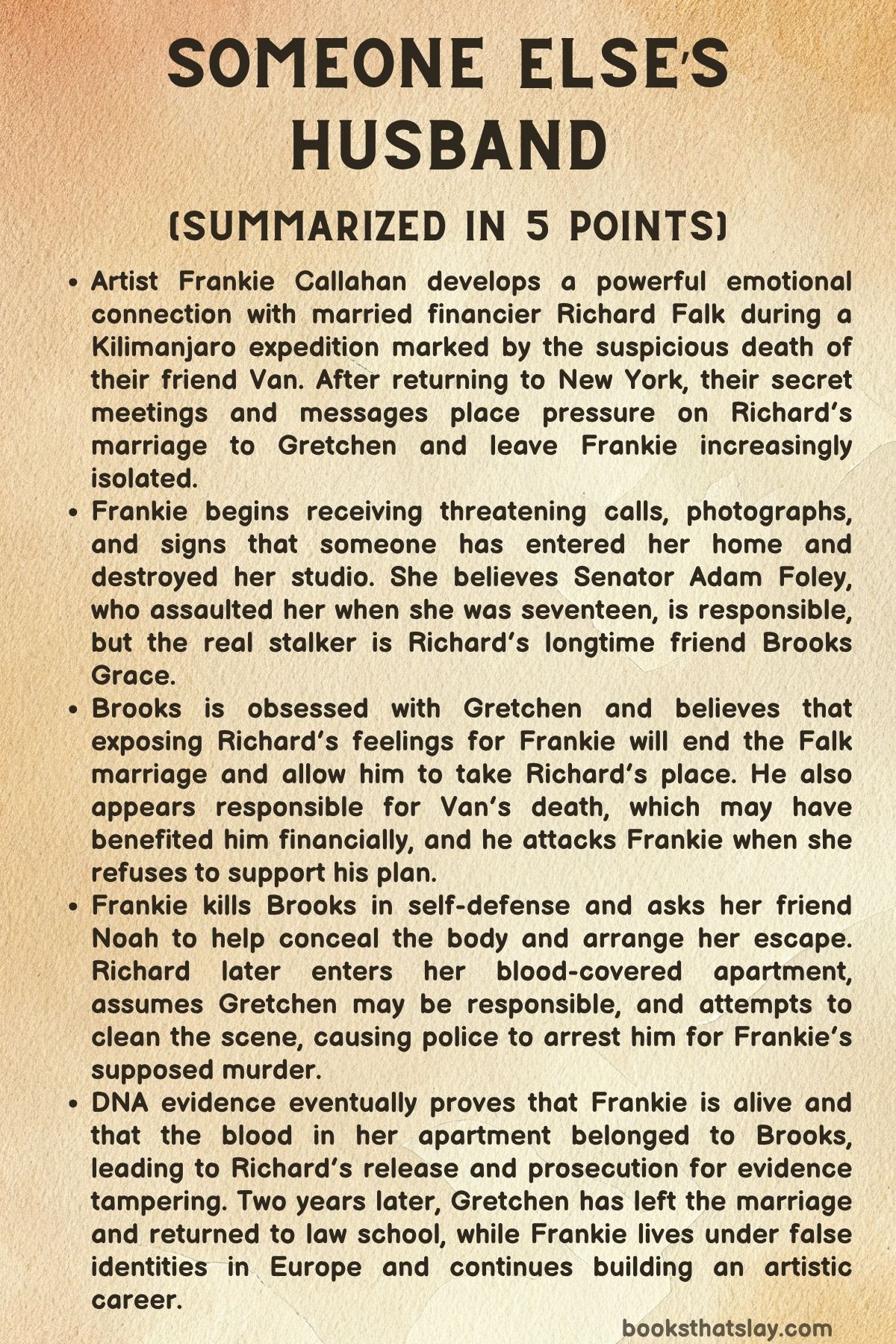
Summary
Police officers arrive at the Manhattan home of Gretchen and Richard Falk in the middle of the night with a warrant connected to the apparent murder of Frankie Callahan. Richard had recently met Frankie during an expedition to climb Mount Kilimanjaro, and although he tells Gretchen that Frankie was merely another participant, his shock and grief immediately suggest a deeper connection.
Richard voluntarily accompanies the police for questioning, believing that cooperation will clear his name. He admits that he and Frankie continued communicating after returning to New York because they were both struggling with the death of their friend Van, who fell during the climb, but detectives become suspicious when Richard reacts to Frankie’s death with the intensity of someone who had been emotionally attached to her.
Frankie, a thirty-nine-year-old painter preparing for an important exhibition, had joined the Kilimanjaro expedition as an attempt to rebuild her life. She was estranged from her father, financially insecure, and still carrying the psychological effects of being sexually assaulted at seventeen by Adam Foley, a powerful man who later became a senator and paid her to sign a nondisclosure agreement.
The other climbers were Richard and three of his longtime college friends: Van, Scotty, and Brooks. Frankie felt an immediate attraction to Richard, whose curiosity about her art and emotional attentiveness made her feel understood, while Richard saw in Frankie the creative, independent life he believed he had surrendered when he chose finance, marriage, and social responsibility.
Their attraction developed during the difficult climb, even as tensions grew within the group. Van was physically unwell and reconsidering the sale of his successful restaurant company, a decision that would affect the money expected by several old friends, while Brooks was facing professional disgrace, financial instability, and growing resentment toward those whose lives appeared more secure than his own.
Van ultimately fell to his death on the mountain. The accident left Richard and Frankie bound by grief and uncertainty, especially because neither had clearly seen the exact moment of the fall and because Brooks, who had financial reasons to want the restaurant transaction completed, had been positioned nearby.
In the emotional aftermath, Richard and Frankie kissed, although they did not begin a sexual affair. Back in New York, they continued exchanging increasingly intimate messages and meeting in secret, with Richard hiding the contact from Gretchen and Frankie repeatedly attempting to establish boundaries because she knew their relationship threatened his marriage.
Frankie’s situation became more dangerous when she began receiving calls and photographs from a Massachusetts number associated in her mind with Senator Foley. Someone followed her, photographed her with Richard, entered her personal spaces, destroyed her paintings, and made her believe that the man who assaulted her years earlier had returned to control her again.
Richard offered protection and practical help, which strengthened Frankie’s dependence on him. Her closest friend, psychiatrist Noah King, warned her that Richard was married and that grief did not excuse their growing emotional involvement, while Scotty also cautioned her that Richard loved Gretchen and might never leave his family.
Gretchen remained unaware of many details, but she knew that Richard had changed after returning from Africa. After reading flirtatious messages between him and Frankie, she hired men to frighten Frankie, believing that intimidation would drive the other woman away without causing lasting harm.
Gretchen’s decision became one of many hidden actions that later made the investigation difficult. Her son Becks had also followed Richard, seen him meeting Frankie, and vandalized Frankie’s studio with his friend Luke in an attempt to protect his parents’ marriage, leaving spray-paint cans in the Falk home without explaining what he had done.
When Frankie later believed that someone had entered her apartment, she called Richard and went to his home while Gretchen was away. There she discovered the spray paint used in the studio attack and concluded that Richard had created the danger himself so that he could appear as her protector, causing her to leave in tears despite his attempts to explain.
Frankie returned to her apartment and finally called the police, but no officers arrived promptly. As she waited, she painted a self-portrait that reflected her determination to survive, only to discover that the person stalking her was already inside.
The intruder was Brooks, not Foley. Brooks revealed that he had used information about Frankie’s past to imitate the senator, sent the photographs, entered her spaces, and encouraged her fear because he wanted her to claim that she and Richard were having an affair.
Brooks had been obsessed with Gretchen for years and had transformed ordinary friendship into proof of an imagined romantic bond. He believed that exposing Richard’s attachment to Frankie would end the Falk marriage, allowing Richard to be with Frankie while Brooks took his place beside Gretchen.
Frankie refused to participate in this plan and confronted Brooks about Van’s death. His evasive response convinced her that he had caused Van’s fatal fall, probably because Van’s survival and possible rejection of the restaurant sale threatened Brooks’s financial interests.
Realizing that Frankie could expose both his stalking and his role in Van’s death, Brooks attacked her. Frankie defended herself with a sharp painting tool, striking him in the neck and causing a fatal wound that left a massive amount of blood across her apartment.
Terrified that Brooks’s prepared evidence, her relationship with Richard, her history with Foley, and her earlier reluctance to contact the police would be used against her, Frankie called Noah. Although the killing occurred during an attack, she did not trust the authorities to understand the circumstances fairly.
Noah helped Frankie remove Brooks’s body and bury it outside the city near Rhinebeck. He then supplied her with money and helped her disappear, leaving investigators with a blood-filled apartment, no body, and every reason to assume that Frankie herself had been killed.
Richard, meanwhile, went to Frankie’s apartment hoping to repair their disagreement. Finding the door open, the rooms covered in blood, and Frankie missing, he concluded that Gretchen might have attacked her because he had discovered evidence of the studio vandalism inside their home.
Determined to protect his wife, Richard attempted to clean the apartment and carried blood away on his trousers. He then returned home without reporting what he had seen, creating evidence that made him appear responsible for both the killing and the removal of Frankie’s body.
Police arrested Richard after an eyewitness placed him near the apartment, his urgent messages to Frankie suggested emotional desperation, and his bloodstained trousers were discovered in the Falk building’s garbage. A badly injured female body recovered from the river was initially believed to be Frankie, strengthening the prosecution’s claim that Richard had killed her during a confrontation and disposed of her remains.
Gretchen publicly defended Richard while privately uncovering the extent of his dishonesty. She learned that he had purchased an expensive watch for Frankie before giving it to her instead, that he had concealed their meetings, and that he had once committed an earlier sexual betrayal that Gretchen had chosen not to confront.
The family’s united appearance concealed separate secrets. Becks hid his role in destroying Frankie’s studio, Gretchen concealed the men she hired to threaten Frankie, Richard refused to explain why he cleaned the crime scene, and several friends had known about his attraction long before Gretchen was forced to face it.
The case changed when laboratory testing showed that the woman recovered from the river was not Frankie and that the blood in the apartment belonged to Brooks. Investigators also discovered records showing that Brooks had followed Gretchen, documented her movements, lost his professional position, separated from his wife, and developed an increasingly dangerous belief that Gretchen belonged with him.
Senator Foley’s travel records proved that he could not have stalked Frankie during the relevant period. His connection to Brooks explained how Brooks had learned about Frankie’s assault and confidential settlement, allowing him to use her deepest fear as a tool of manipulation.
Without evidence that Frankie was dead, the murder charge against Richard collapsed. He later accepted responsibility for tampering with evidence and served time in prison, while Frankie was charged in Brooks’s death and remained a fugitive because the authorities did not possess the full account of his attack.
Two years later, Gretchen has separated from Richard and entered law school, reclaiming the professional life she once abandoned. She still cares for him as the father of her children, but his emotional betrayal and continued secrecy have permanently ended their marriage.
Frankie lives in Europe under changing identities, supported by Noah’s earlier help and sustained by her art. Her paintings gain recognition without her real name attached, and although she remains burdened by Brooks’s death, she begins allowing herself to imagine a life defined by something other than fear, concealment, or survival.
Characters
Frankie Callahan
In Someone Else’s Husband, Frankie Callahan is both a survivor and a woman whose fear of being disbelieved shapes nearly every decision she makes. Her artistic talent gives her a means of expressing experiences she cannot easily explain, yet her independence is weakened by unresolved shame surrounding the assault committed against her when she was seventeen.
Frankie’s attraction to Richard emerges from a desire to be recognized rather than merely rescued. He listens to her thoughts about art and treats her ambitions seriously, allowing her to believe that he sees qualities others have ignored, but this emotional validation makes it harder for her to recognize the dangers created by his secrecy and marital dishonesty.
Her reluctance to involve the police is not simply poor judgment. Past exploitation has taught her that powerful men can control public narratives, and she reasonably fears that her settlement, her relationship with Richard, and her delayed reports will be used to question her credibility rather than establish what happened.
Frankie’s killing of Brooks is an act of self-defense, but her decision to conceal his body places her in a morally complicated position. She is not presented as either wholly innocent or naturally criminal; instead, she becomes someone who survives immediate violence by making choices that create lasting guilt and legal danger.
Her final life in Europe reflects both freedom and punishment. She gains distance, artistic recognition, and the possibility of a new relationship, but she cannot openly claim her identity or erase the knowledge that another person died by her hand.
Gretchen Falk
Within Someone Else’s Husband, Gretchen Falk represents the personal cost of building an identity around marriage, social standing, and the management of other people’s needs. She has spent decades preserving the image of a stable family, often refusing to acknowledge evidence that might require her to reconsider her husband, her children, or herself.
Her denial is not passive ignorance. Gretchen repeatedly recognizes disturbing signs but chooses explanations that allow ordinary life to continue, whether she is overlooking Richard’s earlier infidelity, minimizing her children’s struggles, or convincing herself that his connection with Frankie is harmless.
Her decision to hire men to frighten Frankie reveals how quickly fear of humiliation can become moral recklessness. Gretchen does not intend murder, but she treats another woman’s safety as less important than protecting her marriage and later conceals the arrangement even when it could help explain the crime.
At the same time, Gretchen is capable of loyalty, courage, and self-examination. She supports Richard publicly during his prosecution, protects her children from legal danger, and eventually accepts that love does not require preserving a marriage that has lost honesty and trust.
Her return to law school marks a significant recovery of selfhood. Rather than defining her future through Richard’s reputation or her mother’s expectations, she begins constructing an adult identity based on her own abilities, judgment, and ambitions.
Richard Falk
Richard Falk is charismatic, emotionally intelligent, and deeply skilled at presenting himself as more honest than he actually is. His warmth is genuine, but he uses sincerity to avoid examining the damage caused when his needs conflict with his responsibilities.
His relationship with Frankie is driven by more than physical attraction. She represents the artistic career he abandoned, the spontaneity he misses, and the possibility that his life could still become something different, which allows him to frame emotional betrayal as personal awakening.
Richard insists that he loves Gretchen, and the book gives reason to believe him. His failure lies in assuming that love can exist separately from honesty, allowing him to conceal meetings, messages, kisses, gifts, and earlier infidelity while still viewing himself as a devoted husband.
His attempt to clean the bloody apartment demonstrates both loyalty and disastrous arrogance. Believing Gretchen might be responsible, he decides that he can protect her by manipulating the evidence rather than trusting the legal process or confronting her directly.
Richard’s imprisonment forces him to face consequences that wealth and social influence cannot remove. Even after explaining his actions, he cannot restore his marriage because his confession confirms that he repeatedly valued emotional escape over Gretchen’s right to know the truth.
Brooks Grace
Brooks Grace is the principal source of deliberate harm in the novel. His behavior is governed by entitlement, professional resentment, financial desperation, and an obsession with Gretchen that he disguises as long-standing devotion.
He interprets ordinary friendship as a private promise and treats Gretchen’s choices as temporary obstacles rather than expressions of her will. This belief allows him to imagine that destroying her marriage is an act of rescue, even though she has never chosen him.
Brooks’s treatment of Frankie shows his ability to identify another person’s deepest vulnerability and use it strategically. By impersonating Foley, invading her spaces, and photographing her with Richard, he recreates the fear of her earlier assault while making her doubt her own safety and judgment.
His possible role in Van’s death adds financial self-interest to his emotional instability. Van’s decisions threatened money that Brooks needed, and the dangerous mountain environment offered an opportunity to make violence resemble an accident.
Brooks is not merely confused or lonely. He plans, stalks, threatens, manufactures evidence, and attacks Frankie when she refuses to support his fantasy, making his death the result of a danger he intentionally created.
Noah King
Noah King is Frankie’s closest friend, moral adviser, and eventual accomplice. As a psychiatrist, he understands the psychological effects of trauma and recognizes that Frankie’s attachment to Richard is partly connected to her need for safety, validation, and escape.
He challenges her decisions without abandoning her. Noah warns her about Richard, urges her to report the harassment, and becomes frustrated when she withholds information, but his criticism comes from concern rather than a desire to control her.
After Brooks’s death, Noah chooses loyalty over legality. Helping remove and bury the body places him at serious personal risk, yet he believes that Frankie’s history and the misleading evidence around her will prevent authorities from understanding the killing as self-defense.
His refusal to testify reveals the burden created by that choice. Noah protects Frankie successfully, but he must live with his participation in concealing a death and with the possibility that his help has prevented the complete truth from emerging.
Scotty Kaplan
Scotty Kaplan serves as both Richard’s loyal friend and one of the few people willing to acknowledge the danger of Richard’s attachment to Frankie. His humor and social ease initially make him appear less serious than the others, but he often understands the emotional situation more accurately than Richard does.
When Frankie requests legal advice, Scotty warns her about confronting a powerful figure without understanding the settlement agreement. He also cautions her against assuming that Richard will leave Gretchen, showing concern for everyone involved even while maintaining Richard’s confidence.
His loyalty becomes ethically uncertain when he keeps the relationship secret. Scotty does not create the crisis, but his silence helps Richard avoid accountability and leaves Gretchen among the last people to understand what is happening inside her marriage.
Van
Van is the emotional center of the old college friendship and the figure whose death connects the mountain expedition to the later crime. He is generous, successful, and apparently interested in rewarding the friends who supported his restaurant business, making his financial decisions important to several people.
His declining health creates tension because Richard urges caution while Van resists appearing weak or abandoning the climb. Van’s determination reflects pride, loyalty to the group, and perhaps a desire to prove that success has not separated him from his old friends.
His decision to reconsider the restaurant sale changes his death from an unquestioned accident into a possible murder. Although Van is absent from much of the present action, uncertainty about his fall drives Richard’s guilt, Frankie’s suspicions, and Brooks’s need to silence her.
Becks Falk
Becks is motivated by fear that Frankie will destroy his parents’ marriage. After following Richard and witnessing his emotional involvement with her, he responds with anger rather than seeking an honest conversation with either parent.
His vandalism of Frankie’s studio is intended as intimidation, not physical violence, but it contributes directly to her terror. The hidden spray paint also leads Frankie to believe that Richard has been stalking her and causes Richard to suspect that Gretchen may have committed murder.
Becks illustrates how children can become active participants in family denial. He has absorbed Gretchen’s belief that the family image must be protected, and he converts that belief into conduct that harms a stranger while creating greater danger for everyone he hoped to defend.
Cassandra Falk
Cassandra is the adult child most closely connected to Gretchen’s daily life, partly because Gretchen helps care for Cassandra’s daughter, Ophelia. She initially receives a controlled version of Richard’s arrest, reflecting Gretchen’s instinct to manage information rather than allow her children to respond to reality.
Her presence highlights the way family roles continue across generations. Gretchen remains the organizer and protector, while Cassandra’s dependence allows her mother to avoid considering what she wants outside caregiving and marriage.
Cassandra is less involved in the central deception than Becks, but her history also reveals Gretchen’s pattern of overlooking painful problems. References to Cassandra’s earlier eating disorder suggest that preserving calm has often taken priority over recognizing distress.
Elizabeth Falk
Elizabeth is more direct than the other Falk children in confronting Gretchen’s denial. She understands that her mother’s refusal to acknowledge difficulty has affected the entire family and reminds her that ignoring warning signs does not protect anyone.
Her criticism is shaped by personal experience, including Gretchen’s failure to respond fully to Elizabeth’s struggles with drugs. Elizabeth therefore recognizes that the current crisis is not an isolated mistake but part of a long habit of turning away from facts that threaten the family’s appearance.
Although she wants Richard to be innocent, she does not allow loyalty to erase doubt. Her willingness to challenge Gretchen provides an important contrast to the silence maintained by many of the adults around the Falk marriage.
Hilary Kaplan
Hilary Kaplan is Gretchen’s friend and Scotty’s wife, but her loyalty is complicated by the information she receives about Richard and Frankie. She assumes Gretchen may already understand Richard’s flirtatious behavior, revealing how normalized his conduct has become within their social circle.
After learning more, Hilary confronts Richard and demands that he tell Gretchen the truth. Her decision demonstrates greater honesty than Scotty’s continued silence, although she still delays informing Gretchen directly.
Hilary’s role shows how friends can become guardians of a marriage’s public image even when that protection works against the person being deceived. Her eventual apology acknowledges that withholding painful information can become a form of betrayal.
Senator Adam Foley
Adam Foley represents institutional power and the lasting harm caused when an influential man controls the account of a sexual encounter. He describes his contact with the seventeen-year-old Frankie as consensual and emphasizes his claimed uncertainty about her age, language that reduces his responsibility while ignoring the imbalance between them.
The financial settlement and nondisclosure agreement silence Frankie without resolving the trauma. Money protects Foley’s career and reputation, while Frankie is left fearing that speaking openly will expose her to financial punishment and public attack.
Although Foley is not responsible for the later stalking, his earlier conduct makes Brooks’s deception possible. Brooks needs only to imitate a danger Foley has already created, demonstrating how one act of exploitation can remain useful to other abusers years later.
Thalia Perez
Thalia Perez is fiercely protective of Frankie and refuses to allow legal authorities to reduce her friend to a history of romantic choices. Her resistance during testimony exposes the tendency to examine a victim’s private life more aggressively than the conduct of the men around her.
She knows that Frankie is attracted to Richard but rejects the suggestion that this attraction makes her responsible for violence. Thalia’s loyalty is emotional and principled, even when her anger makes cooperation difficult.
Her perspective preserves Frankie’s humanity at a time when investigators and reporters are turning her into an adulteress, murder victim, or suspect. She insists that moral imperfection does not remove a person’s right to safety or dignity.
Detective Raul Reyes
Detective Raul Reyes represents the strengths and weaknesses of an investigation driven by apparently convincing evidence. The bloody apartment, Richard’s messages, the eyewitness identification, and the presumed body create a coherent case, making his early suspicion understandable.
The problem is that Reyes and the other investigators allow this theory to determine how they interpret later information. Evidence involving Foley, Noah, Brooks, and Frankie’s harassment receives less attention because Richard already appears to fit the expected role of jealous lover and killer.
Reyes eventually explains how DNA testing destroys the original theory. His later testimony acknowledges the errors without fully resolving whether greater attention to competing explanations could have prevented Richard’s wrongful murder charge or uncovered Frankie’s circumstances sooner.
Mikey Pearce
Mikey Pearce is the experienced defense attorney who brings discipline to a family governed by panic and secrecy. He repeatedly explains that Richard’s defense depends on full disclosure, yet nearly every family member withholds information that could change his strategy.
His challenge is not merely disproving the prosecution’s case. He must identify which statements are lies, determine why Richard entered the apartment, and protect his client from evidence created by Richard’s own decision to clean the scene.
Mikey’s professionalism contrasts with Gretchen’s emotional management and Richard’s impulsive self-protection. He understands that concealed facts rarely remain harmless and that a defense built on incomplete information can collapse regardless of a client’s innocence of the central charge.
Lita Hernandez
Lita Hernandez provides an outside view of the Falk household. Her testimony establishes that Frankie visited Richard privately, left in distress, and was deliberately hidden from Gretchen.
Richard’s request that Lita remain silent places her in an unfair position. As an employee, she is expected to preserve the family’s privacy, yet the information later becomes important to a murder investigation.
Lita does not interpret the relationship or accuse Richard of violence. Her value lies in observing actions without the emotional loyalties that distort the accounts given by the Falk family and their friends.
Deborah
Deborah, Richard’s assistant, demonstrates how professional staff often see the private consequences of powerful people’s behavior. She helps Gretchen manage Richard’s cancelled obligations while also possessing information about visitors, calls, and unusual events at his office.
Her identification of Hilary as the woman who confronted Richard corrects one of Gretchen’s mistaken assumptions. This moment shows how jealousy repeatedly encourages Gretchen to imagine sexual betrayal even when another explanation exists.
Deborah remains practical and discreet, but her knowledge reveals how widely Richard’s private crisis had spread beyond his home. His effort to divide personal and professional life fails because secrecy requires the participation or silence of many people.
Guy
Guy is the French gallery owner who helps Frankie’s work reach an international audience. He knows her through an assumed identity and therefore relates to the person she has created rather than the full history she has concealed.
His developing connection with Frankie represents the possibility of affection without the immediate crisis that defined her bond with Richard. At the same time, the relationship remains fragile because Frankie cannot offer complete honesty without risking arrest.
Guy’s role is intentionally limited but symbolically important. He belongs to a future in which Frankie may be valued for her art and present character, even though the unresolved past continues to determine how close she can safely become to another person.
Themes
Marriage, Identity, and Self-Abandonment
Marriage in Someone Else’s Husband is presented not simply as a romantic partnership but as a structure capable of shaping identity, ambition, and moral judgment. Gretchen gives up her interest in law and accepts a domestic role because family expectations teach her that Richard’s career should take priority.
Over time, protecting the marriage becomes inseparable from protecting her understanding of herself. Admitting that Richard has lied would require Gretchen to question the sacrifices she made, the advice she accepted from her mother, and the years she spent organizing her life around a partnership that was never as transparent as she believed.
Richard experiences the same marriage from a different position. He values Gretchen and their family but treats responsibility as something imposed upon his authentic self, allowing Frankie to become a symbol of the creative life he imagines he lost.
Both characters therefore use marriage to avoid personal accountability. Gretchen blames the preservation of family for her silence, while Richard treats emotional dissatisfaction as justification for secrecy.
Their separation does not suggest that marriage itself is destructive. It shows that a relationship cannot remain healthy when one person disappears into service and the other pursues private freedom without accepting the consequences.
The Difference Between Truth and a Convincing Story
Nearly every major conflict develops because a partial set of facts is arranged into an explanation that appears complete. Richard’s messages, bloodstained clothing, emotional attachment, uncertain alibi, and presence near Frankie’s apartment make him look guilty even though he did not commit the presumed murder.
Frankie reaches an equally understandable but incorrect conclusion when she discovers the spray paint in Richard’s home. Because he has already lied about their relationship and positioned himself as her protector, she assumes he created the danger in order to make her dependent on him.
Brooks is especially skilled at manufacturing believable narratives. He uses Frankie’s history with Foley, Gretchen’s marital insecurity, Richard’s attraction, and his own position as an old friend to guide each person toward a false conclusion.
The investigators also become trapped by the story they construct. Once they assume that the blood belongs to Frankie and that the recovered body is hers, competing evidence receives less attention.
The novel demonstrates that facts do not automatically produce truth. Context, prejudice, fear, and emotional need determine how evidence is interpreted, and a persuasive explanation can remain powerful even when its central assumption is wrong.
Trauma, Shame, and the Fear of Disbelief
Frankie’s behavior is shaped by the expectation that institutions will not protect her fairly. Her assault by Foley is followed not by meaningful accountability but by a confidential payment that safeguards his future while teaching her that public disclosure may result in blame, exposure, and financial punishment.
This experience explains why she delays reporting the stalking and withholds important information from police. Her caution creates practical danger, but it develops from a history in which silence was encouraged by people with greater power.
Brooks exploits this wound with precision. He does not invent a random threat; he recreates the presence of the man Frankie already fears, knowing that shame will discourage her from requesting help.
Richard and Gretchen also respond to painful events through concealment. Richard cleans a violent scene because he fears Gretchen may be guilty, while Gretchen hides her hired intimidators because she expects the truth to destroy her family and implicate her.
The story shows how shame isolates people at the moment cooperation is most necessary. Each hidden fact seems individually survivable, but together they create conditions in which violence, wrongful accusation, and manipulation become far more difficult to stop.
Obsession, Entitlement, and Possession
Brooks defines love as certainty about another person’s future rather than respect for that person’s choices. He has known Gretchen for years and converts familiarity into a belief that she secretly belongs with him, treating her marriage as an error that time and manipulation will eventually correct.
His obsession depends on entitlement. He assumes that Gretchen’s ordinary kindness contains romantic meaning and that her dissatisfaction gives him permission to reorganize her life without consulting her.
The same possessive reasoning influences his treatment of Frankie. He imagines that she should accept Richard, cooperate in breaking the Falk marriage, and appreciate the future Brooks has designed for all of them.
When Frankie refuses, he moves from persuasion to blackmail and physical violence. Her independent will becomes intolerable because it threatens the fantasy through which he has explained his failures.
Other characters display less extreme forms of possession. Gretchen treats Frankie as an intruder to be removed, Becks attacks her work to protect his parents, and Richard wants Frankie’s emotional closeness without releasing Gretchen honestly.
The novel separates love from control by showing that genuine care requires recognition of another person’s freedom. Once affection becomes a claim of ownership, protection easily turns into surveillance, punishment, or violence.