Songs of the Dead Summary, Characters and Themes
Songs of the Dead (The Strata Wars #1) by Brandon Sanderson and Peter Orullian is an urban fantasy novel built around music, death, memory, and the struggle for personal freedom.
Set in a supernatural version of London, it follows a discarded metal singer who returns from death and discovers that the city’s past still exists beneath its streets. Ghosts, musicians, historical figures, ancient laws, and spiritual wounds all influence the conflict. At its center is a refuge called the Iron Horse, where forgotten souls can live without becoming servants. The novel combines magical combat and historical fantasy with questions about artistic control, grief, identity, forgiveness, and chosen family.
Summary
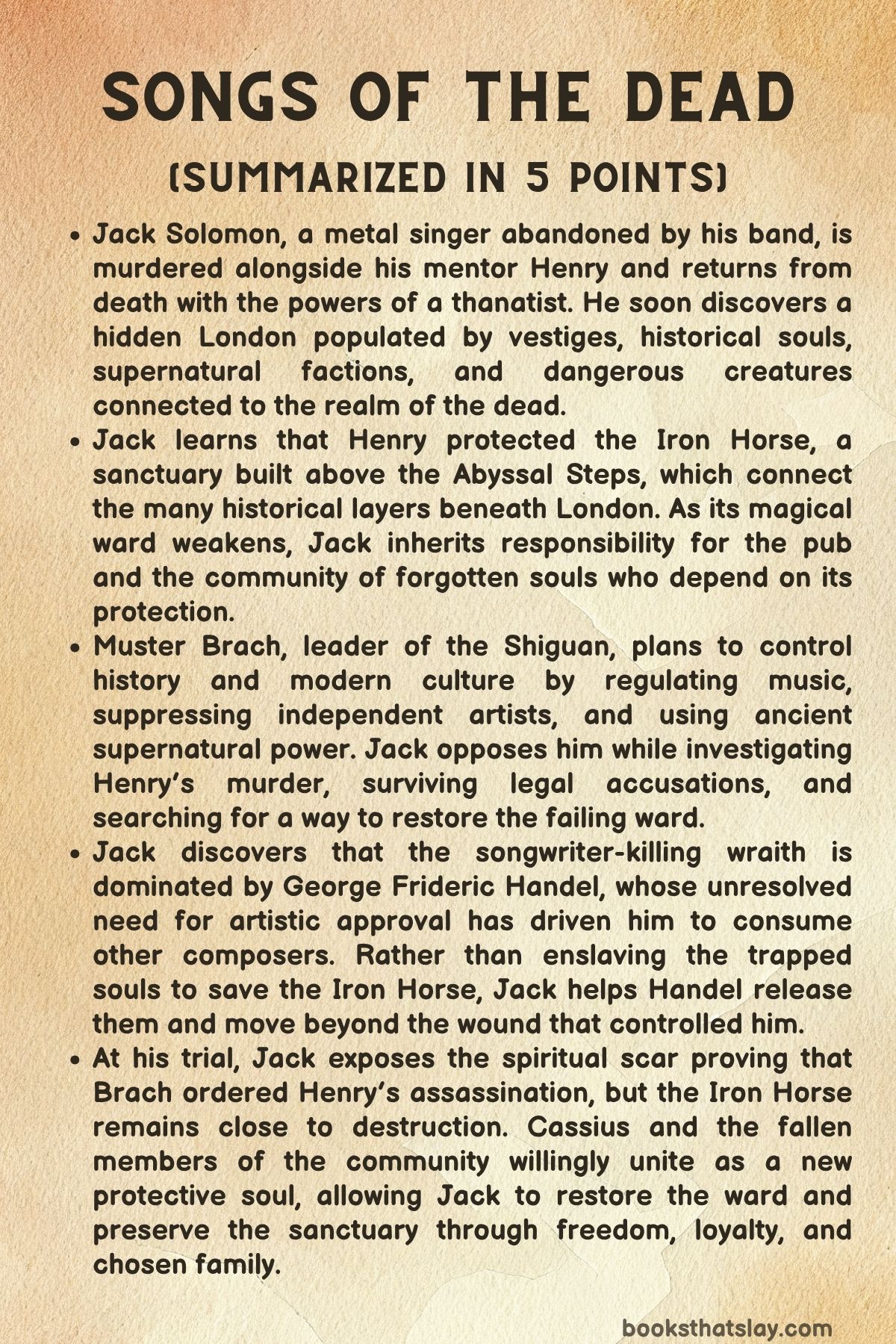
Jack Solomon arrives at the Iron Horse after being dismissed by email from the Hounds of Winter, the metal band he helped create. The rejection reawakens his deepest fear that everyone he loves eventually abandons him, but Henry Wilkinson, the elderly owner of the pub and Jack’s mentor, reminds him that his unfinished song still deserves to be completed.
Before entering the pub, Jack encounters a mysterious woman who gives him a red stone and asks what he would do to escape slavery. Later that night, Jack walks Henry home, only for a corpse-painted gunman to shoot them both outside Henry’s flat.
Jack awakens on a bleak plain where a violent wind carries the dead toward a mountain of fire. Remembering Henry’s past efforts to save him from self-destruction, Jack rejects the promise of surrender, finds the stone image of his body, and forces himself back into life.
His gunshot wound disappears, but Henry and the killer are gone. While searching the streets, Jack encounters Cassius Classicus, a Roman-era vestige whose spirit is separating from his borrowed body.
Jack saves Cassius by touching the golden bindings around him, although the act consumes some of Jack’s memories. Cassius explains that Jack has become a thanatist, someone capable of seeing souls, binding the dead, reading spiritual wounds, and returning after death.
A monstrous hound soon attacks them. Cassius risks himself to protect Jack, and Jack escapes only after crossing an invisible barrier surrounding the Iron Horse, where the creature can no longer follow.
Inside the pub, Jack learns that several of his friends have concealed their true natures. Church, Lady, and Cassius are vestiges whose souls have been attached to physical bodies, while Henry was a thanatist responsible for protecting the Iron Horse and the Abyssal Steps beneath it.
The Steps connect the many historical layers of London known as the Strata. The Iron Horse ward protects the pub as neutral ground, but its boundary has begun shrinking, and Henry’s disappearance threatens to destroy it completely.
Jack reluctantly accepts his new abilities because they may help him recover Henry. He studies shadowmancy, spiritual bindings, magical lanterns, living flame, and the laws governing relations between thanatists, vestiges, and the dead.
Muster Brach, Henry’s former friend and the leader of an influential organization called the Shiguan, offers Jack training and protection. Brach argues that modern art has distorted history and weakened forgotten souls, but Jack rejects his belief that creative expression should be controlled by powerful authorities.
Jack also meets Lakshmi Gopalkrishnan, a raptorial responsible for enforcing supernatural law. She investigates Henry’s shooting while warning Jack that his survival, sudden powers, and connection to the Iron Horse make him both a suspect and a target.
Cassius takes Jack to Father John Kincaid, a priest and wayfinder who can guide people between the layers of the past. Kincaid identifies the red stone as a dowsing device that will lead Jack to the woman who gave it to him.
Before they can follow it, the supernatural hound attacks them inside Westminster Abbey. Jack, Cassius, and Kincaid defeat its physical body, but they discover that it may be connected to a mature wraith made from many consumed souls.
Such a being could potentially restore the failing ward, although binding it would be extremely dangerous. Jack follows the dowsing stone into the Modern Stratum, where London is reconstructed from the incomplete memories of the dead.
There he sees musicians being attacked, silenced, and bound into service by Shiguan forces. Jack helps the wounded without demanding loyalty in return, surprising Cassius, who has spent centuries serving thanatists who treated every act of assistance as a transaction.
The stone eventually leads Jack to Emaline, the woman who approached him before the shooting. She claims that Brach arranged Henry’s removal so he could gain control of the Abyssal Steps and use them to reach an ancient song capable of directing his planned revolution.
Brach’s anger comes partly from the erasure of his daughter Camilla’s legacy. She protected vulnerable children during the Kindertransport, but the song Henry wrote about her disappeared among countless modern releases, and her fading memory convinced Brach that culture must be regulated.
Jack understands Brach’s grief but rejects his solution. Emaline offers to help expose him, although her position within the Shiguan makes her motives difficult to trust.
Jack soon learns that Henry’s body has been found. At the morgue, Brach appears unexpectedly and questions Jack about Henry’s possessions, inheritance, and control of the Iron Horse, confirming that he is searching for something connected to Henry’s plans.
A sympathetic coroner, Dr. Giles Cage, shows Jack a pattern of unusual bodies being transported beneath London. Jack and Cassius discover an underground pumping station where corpses are stored for supernatural use, including the body of Angela DuFresne, a young songwriter Jack had encouraged.
They find spiritual evidence linking Henry’s killer to Brach, but Joseph Bazalgette, a thanatist managing the facility, destroys the body and its bindings before Jack can preserve the proof. Jack nevertheless saves two abandoned enemy vestiges, Sherzer and Delain, rather than allowing their identities to disappear.
The songwriter-killing wraith then murders Jimmy, Jack’s student and creative partner. Jack concludes that the creature is targeting people whose music could challenge Brach’s attempt to control artistic expression.
Henry’s will reveals that Jack has inherited the Iron Horse, the surrounding property, and responsibility for everyone under its protection. The gift forces Jack to choose between pursuing his old dream of professional success and protecting the community Henry created.
When Jack enters the living ground beneath the pub, the ward refuses to accept him as its new steward. It recognizes that his habit of rescuing others partly comes from his inability to face his own childhood abandonment.
Brach’s followers increase their attacks by capturing dead musicians, using their souls as fuel, manipulating audiences with propaganda, and replacing public figures with supernatural replicas. Jack is also accused of murdering Henry, ensuring that legal proceedings will distract him while the ward collapses.
To renew the barrier, Jack needs illegal Orcus thread and a willing old soul made from many spirits. He obtains the thread after traveling into the Endless Dark, where a grateful tailor named Owen risks his life to harvest it.
Meanwhile, the Hounds of Winter ask Jack to return temporarily because their replacement singer cannot perform at Wembley. Rehearsing his unfinished song forces Jack to confront the memory he has avoided since childhood.
His mother promised never to leave but eventually escaped her unhappy life and began another family without him. Jack finally accepts that he can feel anger over her abandonment while also understanding her desire for freedom, allowing him to complete the final verse.
The emotional breakthrough allows the Iron Horse ward to recognize Jack as its steward. He now has the authority and inner readiness to renew it, but he still lacks control of the mature wraith.
Jack and his allies discover Henry imprisoned within a supernatural reconstruction of his past. They defeat the wraith’s physical form and free Henry, but his body has already been cremated, leaving him unable to return to life.
Henry admits that his prison grew partly from guilt over people who died because of his past actions. Jack must accept that his mentor was neither flawless nor innocent, but a good man who carried serious failures and continued trying to protect others.
Rather than remain trapped as a semblance, Henry chooses to move on. Jack allows him to leave, recognizing that love does not grant the right to keep another person from making a final choice.
Soon afterward, Jack discovers that Cassius was the person who physically killed Henry. Brach had transferred Cassius’s soul into the gunman’s body and compelled him to carry out the murder, but Cassius later concealed the truth from Jack.
The betrayal breaks Jack’s trust, although Cassius remains behind to delay Shiguan forces while Jack and the others escape. Jack cannot immediately forgive him, yet Cassius’s later actions make it impossible to reduce him to the worst deed he committed under coercion.
The mature wraith is eventually revealed to be dominated by the soul of composer George Frideric Handel. Brach obtained Handel’s remains and used his wounded desire for artistic validation to create a being capable of consuming songwriters and seeking ancient music.
Handel’s father had forbidden his musical ambitions, destroyed his instruments, and attempted to force him into another profession. Even after becoming celebrated, Handel remained trapped by the need to prove that his life in music had been worthy.
Instead of defeating him through violence, Jack and his friends perform Handel’s music with him. The shared performance helps Handel understand that his work survived, changed people, and remained meaningful despite imperfect interpretations.
Handel releases the souls he consumed, including Jimmy, Angela, and many other composers. Jack refuses to use those unwilling spirits to renew the ward because doing so would preserve the Iron Horse through the same slavery he opposes.
At his trial, Jack accuses Brach of murder, body theft, coercion, cultural manipulation, and plans for revolution. Cassius confesses to killing Henry under Brach’s command, but the court initially rejects his testimony because vestiges are considered unreliable servants.
Jack realizes that ordering the murder of a close friend must have left a permanent scar on Brach’s soul. By identifying and performing the musical pattern within Brach’s shadow, Jack reveals the hidden wound linking him to Henry’s death.
Brach is convicted, but Cassius is sentenced to dismissal for committing the murder. His bindings are destroyed, forcing his soul back into the realm of death.
The victory comes too late to save the Iron Horse ward through ordinary means. Brach’s forces attack the Ancient Stratum while the ward’s remaining souls begin passing into the Asphodel Meadows.
Jack follows them and finds Cassius resisting the wind. The fallen members of the Iron Horse community voluntarily join with him, creating an old soul founded on consent, loyalty, and shared purpose rather than consumption.
Jack brings the transformed Cassius back and uses thread taken from his own healed spiritual wound to bind him to the sanctuary. Cassius freely accepts a new existence as the living ward of the Iron Horse, protecting others without becoming the property of a single master.
The restored barrier drives away the Shiguan forces and preserves the Abyssal Steps. Jack later performs his completed song at Wembley before leaving the Hounds as a friend rather than returning permanently.
At the Iron Horse’s reopening, Emaline admits that she originally helped Brach recognize how Henry’s removal could give him access to the Steps. Although she later worked against her father, her ambition helped set Henry’s murder in motion.
Jack ends their alliance and returns to the pub. Surrounded by Chuey, Church, Lady, Lakshmi, Kincaid, and the remaining regulars, he recognizes that he has found a new band, a new family, and a purpose that does not require him to forget the people he lost.
Characters
Jack Solomon
Jack Solomon is the emotional and moral center of Songs of the Dead. He begins as a talented musician whose dismissal from the Hounds of Winter confirms his belief that every meaningful relationship will eventually end in abandonment.
His instinct is to save others, but the book gradually reveals that this generosity is connected to an injured need to make himself indispensable. Jack fears that people will leave unless he continually proves his value through sacrifice, loyalty, and emotional labor.
His rebirth gives him unusual authority over souls, yet his real development comes from learning not to use that power as ownership. He binds Cassius, Sherzer, Delain, and others, but repeatedly refuses to treat them as servants.
Jack’s leadership is based on consent, protection, and personal responsibility. Even when using unwilling souls could save the Iron Horse, he rejects the option because survival achieved through enslavement would destroy the sanctuary’s meaning.
His unfinished song represents the emotional truth he cannot initially face. Completing it requires him to acknowledge that his mother’s freedom and his own suffering can both be real without cancelling each other.
By the end, Jack no longer measures his worth through fame, career success, or the ability to prevent every departure. He becomes capable of accepting grief, allowing Henry to move on, rejecting Emaline’s manipulation, and building a community in which people remain because they choose to.
Cassius Classicus
Cassius is an ancient Roman vestige whose long existence has taught him to regard service as unavoidable. After nearly two thousand years of changing masters, he assumes that freedom is either impossible or merely another promise made by those seeking control.
His relationship with Jack begins through a binding, but Jack refuses the traditional master-servant structure. That refusal confuses Cassius because it gives him responsibilities without demanding obedience, gradually forcing him to reconsider what loyalty might mean when it is freely offered.
Cassius is physically formidable, disciplined, and deeply experienced, yet he carries emotional exhaustion beneath his martial confidence. His willingness to accept dangerous assignments comes partly from believing that his continued existence has little personal value.
The revelation that he killed Henry complicates every earlier act of devotion. Although Brach compelled the murder, Cassius chose concealment afterward, showing how shame and fear can continue a moral failure even after direct coercion ends.
His final transformation resolves his central conflict. The man who spent centuries bound to individual masters willingly becomes the Iron Horse ward, but this service is chosen, communal, and consistent with his own developing values.
Henry Wilkinson
Henry Wilkinson is Jack’s mentor, surrogate father, and the moral founder of the Iron Horse community. He protects damaged people without requiring them to earn their place, creating a refuge where vestiges and ordinary patrons can experience dignity, music, and companionship.
His influence survives through his songs, books, candles, legal preparations, and the values he taught Jack. He understands Jack’s self-destructive tendencies and repeatedly insists that pain does not remove his responsibility to continue living.
Henry is not presented as morally perfect. His imprisonment is partly sustained by guilt over deaths connected to his past, and his decision to conceal supernatural truths leaves Jack dangerously unprepared.
His importance comes from what he does after recognizing his failures. Instead of turning guilt into domination or self-justification, he devotes himself to protecting others and prepares the Iron Horse for a future beyond his own leadership.
His final choice to move on tests Jack’s understanding of love. Jack honors Henry by allowing him to leave rather than trying to preserve him as an idealized mentor, servant, or source of guidance.
Muster Brach
Muster Brach is the principal ideological opponent in Songs of the Dead. He is not motivated by meaningless cruelty but by grief, historical anger, and the conviction that culture must be controlled to prevent worthy lives from disappearing.
The fading of his daughter Camilla’s memory becomes the emotional basis of his political movement. Because society failed to preserve her contribution, he concludes that artistic freedom creates disorder and that powerful authorities should determine which stories deserve survival.
Brach’s intelligence makes him more dangerous than a simple tyrant. He understands music as a force capable of shaping loyalty, memory, identity, and public action, so he seeks control over performers, songs, venues, historical narratives, and supernatural replicas.
His language of sacrifice hides his preference for obedience. He speaks of communal purpose while compelling Cassius, exploiting Henry’s guilt, imprisoning Emaline, consuming souls as fuel, and treating artists as tools.
The scar in his shadow exposes the truth he attempts to place beneath ideology. Whatever arguments he makes about history, ordering Henry’s death remains a personal betrayal, proving that his movement is sustained by moral injuries he refuses to acknowledge.
Emaline
Emaline is intelligent, secretive, ambitious, and difficult to classify as either ally or enemy. She gives Jack the dowsing stone, provides essential information about Brach, and repeatedly risks her position to interfere with the Shiguan’s plans.
Her opposition to her father is partly rooted in a desire for freedom. Brach’s refusal to release or respect her creates a deep wound, making her sympathetic to others who have been controlled.
At the same time, Emaline often treats people as pieces within a political strategy. She withholds crucial information, manipulates Jack’s trust, and allows dangerous events to develop because they may improve her chance of replacing Brach.
Her final confession reveals that she helped Brach recognize how Henry’s removal could open the Abyssal Steps. Although she later tries to limit the consequences, her ambition makes her partially responsible for the chain of events leading to Henry’s death.
Emaline therefore represents resistance without moral purity. She opposes tyranny but remains willing to use deception, sacrifice, and calculated betrayal, showing that challenging an unjust leader does not automatically make someone just.
Chuey
Chuey is Jack’s oldest and most dependable friend. Their relationship predates the Iron Horse and is built upon years of shared struggle, abandoned opportunities, practical support, and creative partnership.
He provides humor during moments of fear, but his comedy is not emotional avoidance alone. It is also a form of resilience that helps Jack and others continue acting when grief might otherwise make movement impossible.
Chuey sacrificed important personal opportunities for the dream he shared with Jack. Rather than using that sacrifice to demand repayment, he treats friendship as valuable in itself, making him the opposite of characters who turn every favor into a debt.
His lack of initial supernatural sight does not make him passive. He enters dangerous historical layers, fights beside vestiges and thanatists, survives Brach’s attack, and continues supporting Jack while carrying his own regrets.
His greatest contribution may be his ability to remind Jack that family can be created through repeated acts of presence. When Jack collapses in the Ancient Stratum, Chuey uses their unfinished song to help him recognize that not everyone has gone away.
Church
Church is a vestige shaped by political experience, military service, discipline, and a strong respect for responsibility. His concealed sword, formal manner, and legal knowledge make him one of the Iron Horse’s most reliable defenders.
He initially withholds information because of supernatural restrictions and Henry’s secrecy, but once Jack enters the hidden world, Church becomes an instructor and adviser. He explains institutions, laws, risks, and obligations without pretending that Jack is fully prepared.
Church often represents structure within the group. He handles Henry’s legal arrangements, interprets Precedent Law, organizes defenses, and tries to prevent emotional decisions from creating unnecessary danger.
His loyalty is nevertheless personal rather than procedural. When the law cannot protect Cassius or the Iron Horse, Church does not confuse legality with morality, and he continues standing beside Jack even when resistance creates additional charges.
Lady
Lady is a former wartime barber surgeon whose medical knowledge extends to both bodies and souls. Her practical calm makes her essential whenever the group suffers injuries that ordinary medicine cannot repair.
She is compassionate without being sentimental. Lady understands that healing often requires pain, sacrifice, and difficult consent, as shown when she uses thread from Cassius’s soul to close the wound torn open inside Jack.
Her own history remains partly concealed, particularly the circumstances surrounding similar spiritual surgery performed on her. This silence suggests that her competence comes from personal suffering as well as professional experience.
Lady also challenges assumptions about passive care. She fights, plans, repairs damaged vestiges, confronts armed enemies, and protects the community while maintaining a healer’s refusal to treat lives as expendable materials.
Lakshmi Gopalkrishnan
Lakshmi is a raptorial charged with enforcing supernatural law. She begins as a guarded investigator who suspects Jack may know more about Henry’s shooting than he admits.
Her commitment to evidence separates her from both Brach’s political certainty and Jack’s emotional conclusions. Even when she believes Jack, she refuses to arrest powerful figures without proof that can survive formal judgment.
Lakshmi’s legal caution can appear frustrating, but it protects the distinction between justice and revenge. She knows that supernatural power makes false accusations especially dangerous because punishment can include enslavement, bodily destruction, or permanent loss of identity.
As events develop, she becomes an active ally rather than a detached official. She fights beside Jack, confirms Shiguan crimes, helps investigate the wraith, and risks her standing to defend principles that the institutions around her apply inconsistently.
Father John Kincaid
Father John Kincaid offers a spiritual perspective that differs from thanaturgic control. As a wayfinder, he guides souls and travelers between historical layers rather than binding them into service.
His faith has room for uncertainty, damaged souls, and supernatural realities that formal religious institutions may not fully acknowledge. He helps Jack enter the Strata, interpret the dowsing stone, research Handel, and understand that moving on can be an act of release rather than defeat.
Kincaid is also practical in dangerous situations. He fights the hound, provides equipment, researches historical records, and accompanies the group into increasingly unstable layers of the past.
His role emphasizes guidance without possession. He helps people find paths, but he does not claim the authority to decide their final destination for them.
The Iron Horse Ward
The Iron Horse ward functions as both a supernatural being and the moral memory of a place. It contains the accumulated experiences of people who found refuge, music, courage, friendship, and protection on the ground across many historical periods.
Its refusal to accept Jack immediately demonstrates that leadership cannot be granted through property ownership alone. The ward requires emotional honesty because a steward who remains controlled by personal wounds may reproduce the same forms of domination the sanctuary exists to resist.
The ward is willing to die rather than become an instrument of tyranny. This choice gives it moral agency and prevents it from being reduced to a magical barrier or strategic resource.
Its later rebirth through Cassius and the willing Iron Horse souls preserves its original purpose while changing its identity. The new ward is created through communal consent, making the sanctuary’s protection an expression of shared commitment rather than forced spiritual labor.
George Frideric Handel
Handel appears first as the dominant personality inside a mature wraith that has consumed numerous songwriters. His destructive behavior grows from artistic obsession, unresolved childhood pain, and the belief that no achievement can finally prove his worth.
His father’s rejection of music becomes the judgment Handel continues trying to defeat long after gaining public recognition. Every revision and new composition becomes another attempt to receive approval that can no longer be given.
Brach exploits this wound by promising access to ancient music. Handel becomes both victim and perpetrator, manipulated through his insecurity while also consuming innocent souls and helping attack the ward.
Jack reaches him through performance rather than punishment. By showing that Handel’s work remained alive across centuries, Jack gives him evidence that artistic meaning does not depend on perfection or complete control over interpretation.
His release of the consumed souls is an act of responsibility rather than self-exoneration. Handel cannot undo what he did, but he can stop using others to support the damaged identity he built around his father’s rejection.
Madam
Madam is a freeboot thanatist whose apparent loyalty to Brach is shaped by his control over her son. Her criminal actions are therefore connected to coercion, desperation, and a willingness to harm others in pursuit of reunion.
She is dangerous, informed, and skilled at reading spiritual wounds. Her knowledge of wraiths gives Jack the method needed to identify the primal desire within a Rupture.
Madam’s cooperation is transactional, but Jack changes the terms by recognizing the person beneath her crimes. His promise to help her son gives her a reason to assist him without pretending that her earlier actions were acceptable.
She demonstrates how tyrannical systems preserve power by controlling the relationships people value most. Brach does not need her sincere loyalty when he can use maternal love as leverage.
Jimmy
Jimmy is Jack’s student, fellow musician, and an example of creativity rooted in joy rather than regret. His improvisation transforms Jack’s unfinished song by showing that meaningful memory can contain playfulness, family warmth, and ordinary happiness.
His death makes the wraith’s threat personal for Jack. Because Jimmy collaborated with him, Jack interprets the murder as evidence that his own creative connections are placing others in danger.
Jimmy’s later emergence from Handel’s consumed soul confirms that identity can survive even after violent spiritual absorption. His familiar joy also reminds Jack that the dead should not be reduced to the circumstances of their deaths.
Angela DuFresne
Angela is a nervous young songwriter whom Jack encourages before her first public performance. Her brief presence establishes Jack’s instinct to support developing artists at a moment when his own career has collapsed.
Her murder reveals the systematic nature of the attacks against creators. She is not targeted because of political power or supernatural knowledge, but because independent songwriting represents a form of expression the Shiguan cannot fully control.
Angela’s body in the pumping station exposes the brutal connection between cultural repression and physical exploitation. Her later release from Handel restores her individuality and prevents her from remaining only a symbol of victimhood.
Mick
Mick rules the impoverished district around Rats Castle through favors, debts, information, and controlled generosity. He feeds children and assists desperate people, but his protection also allows him to profit from their vulnerability.
His treatment of Jack is both educational and exploitative. He recognizes Jack’s lack of practical training, teaches him effective lantern techniques, and then sells information about his presence to Brach.
Mick represents a social order in which survival depends on obligation rather than law. His community may be safer under his authority than without it, yet every act of help risks becoming another form of control.
Owen
Owen is a desperate tailor whose debt threatens his freedom. Jack pays what he owes even though doing so leaves him without enough money to acquire the materials needed for the ward ritual.
Grateful for being treated as a person rather than an asset, Owen offers to help obtain Orcus thread directly from the Endless Dark. His decision demonstrates how freely given kindness can create loyalty without requiring formal ownership.
Owen’s dangerous harvest also exposes the ethical cost of magical resources. The thread needed to save a sanctuary comes from a vulnerable soul’s arrival, forcing Jack to recognize that even necessary tools may carry consequences.
Joseph Bazalgette
Joseph Bazalgette manages the hidden pumping station where bodies are stored and prepared for supernatural use. He justifies the operation through resentment that the modern world has failed to give him sufficient credit for his historical achievements.
His grievance has a legitimate foundation, but he uses neglect as permission to violate the dignity of the dead. The bodies in his care become materials, containers, and evidence to be destroyed whenever they threaten powerful interests.
Bazalgette’s destruction of the assassin’s corpse shows his loyalty to secrecy over justice. He would rather erase proof of murder than risk losing the system that preserves his status and influence.
Sir Joseph Swan
Sir Joseph Swan is a polished representative of Shiguan authority. His controlled manners and formal offers conceal a readiness to consume souls, threaten careers, and use supernatural law as a political weapon.
He treats artistic opportunity as something authorities may grant or remove according to obedience. By threatening Jack’s ability to perform and circulate his songs, Swan reveals how censorship can operate through institutions rather than direct prohibition.
His use of captured musicians as fuel demonstrates the final result of that worldview. Artists who will not support the movement cease to be people and become resources for strengthening it.
Henry Purcell
Henry Purcell is a powerful thanatist and senior Shiguan operative. His presence near the original crime scene and later participation in efforts to bind Handel connect him to Brach’s larger operation.
Purcell understands the injustice experienced by historical artists whose work is copied, altered, or separated from proper recognition. His argument identifies a genuine moral problem concerning cultural inheritance and the treatment of the dead.
His failure lies in accepting coercive revolution as the only solution. By attempting to bind a mature soul and use its power politically, he repeats the same exploitation he claims to oppose.
Dr. Giles Cage
Dr. Giles Cage is a coroner whose repeated contact with supernatural bodies allows him to see beyond the Enigma Covenant. Rather than ignoring the contradictions before him, he documents patterns and assists Jack in investigating them.
His professional respect for the dead makes him naturally opposed to the pumping station. He understands that a corpse remains connected to identity, history, and possible evidence even when supernatural actors treat it as an empty object.
Cage represents ordinary institutional courage. He lacks Jack’s powers, but his records, observations, and willingness to question restricted areas make the hidden operation visible.
Detective Bryant
Detective Bryant approaches Henry’s death through conventional police reasoning. Jack’s impossible survival, inheritance, anger, and evasiveness make him a credible suspect from an ordinary investigative perspective.
His suspicion is not presented as simple incompetence. Jack genuinely withholds information, supernatural evidence disappears, and every available fact seems to place him near the center of the crime.
Bryant therefore illustrates the divide between visible and hidden reality. The Enigma Covenant prevents him from interpreting the case accurately, even though many of his questions are reasonable.
Sherzer and Delain
Sherzer and Delain first appear as enemies who attempt to capture Jack. When their binder abandons them after defeat, Jack can either let their spirits separate from their bodies or spend his own memories to restore them.
His decision to save them transforms their understanding of thanatists. They expect ownership, punishment, or death, but instead receive protection and permission to choose their next actions.
Their presence broadens the Iron Horse community beyond existing friendships. The sanctuary does not reserve compassion for people who have always been loyal; it offers the possibility of change even to former opponents.
The Hounds of Winter
The Hounds of Winter function as both Jack’s lost dream and the group whose rejection forces him to reconsider his identity. Their decision to dismiss him by email reflects avoidance, resentment, and a failure to recognize the burdens Jack carried outside the band.
Their later apology does not erase the injury, but it creates the possibility of reconciliation without restoration. Jack can forgive them and perform with them without returning to the exact relationship that harmed him.
The group therefore helps demonstrate that forgiveness is not the same as resuming an old role. Jack leaves Wembley as their friend while choosing a different future based on the responsibilities and relationships he now values.
Themes
Freedom, Choice, and Coercion
Songs of the Dead repeatedly examines the difference between service that is chosen and obedience produced through force. Thanatists can bind souls, organizations can control careers, and political leaders can shape public feeling through music, but the possession of power does not create the moral right to use it.
Cassius’s history gives this conflict its clearest personal form. He has served masters for centuries and initially doubts that freedom can exist, yet Jack’s refusal to treat him as property gradually allows him to imagine loyalty as a decision rather than a command.
Brach continually speaks about collective sacrifice, historical duty, and cultural unity. His actions reveal that he values these ideas only when he can define the sacrifice, choose the history, control the music, and punish anyone who refuses.
Jack’s decisions offer a different model. He frees enemies, rejects the use of unwilling souls, allows Henry to move on, and refuses to bind Handel’s victims into the ward even when the Iron Horse may die without them.
The final renewal succeeds because Cassius and the fallen regulars join willingly. Their shared form creates protection without erasing consent, suggesting that responsibility and service become meaningful only when people retain the power to say no.
Memory, History, and Artistic Ownership
Memory is not merely a record of the past in the novel; it is a force that can sustain souls, create physical environments, strengthen institutions, and determine who continues to exist. Forgotten people fade, while remembered lives gain stability within the Strata.
This gives Brach’s anger a legitimate source. Historical figures, artists, and ordinary people suffer when modern culture alters their stories, ignores their sacrifices, or profits from their work without recognition.
The book refuses, however, to accept control as the cure for neglect. Brach responds to cultural loss by deciding that authorities should regulate music, suppress competing interpretations, create obedient replicas, and determine which legacies deserve preservation.
Handel’s story offers a more personal version of the same conflict. His desire to perfect and control his legacy traps him inside endless revision, while the survival of his music depends partly on later performers interpreting it in ways he cannot supervise.
Jack’s performance with Handel suggests that artistic survival requires both continuity and change. A work remains alive because new people perform, misunderstand, revise, love, question, and carry it forward, not because its creator maintains permanent control.
The novel therefore treats remembrance as an ethical relationship. The present should acknowledge its debts to the past, but the dead cannot demand ownership over every future interpretation.
Abandonment, Grief, and Forgiveness
Jack’s fear of abandonment shapes his music, relationships, leadership, and self-image. His mother’s broken promise becomes the central wound through which he interprets later losses, including his dismissal from the Hounds and Henry’s death.
Because he expects people to leave, Jack tries to make himself necessary. He rescues others, solves problems, sacrifices opportunities, and assumes responsibility partly because usefulness seems like protection against rejection.
His emotional development requires more than discovering that his mother hurt him. He must also accept that she was a complete person whose decision may have brought her freedom while causing him lasting pain.
This recognition does not excuse abandonment. Instead, it allows Jack to stop organizing his entire identity around a single injury and to acknowledge love, anger, compassion, and resentment at the same time.
The same lesson shapes his responses to Henry, Cassius, the Hounds, and Emaline. He permits Henry to move on, struggles to see Cassius beyond the murder, accepts the Hounds’ apology without rejoining them, and refuses reconciliation with Emaline when accountability has not been completed.
Forgiveness is therefore presented as an honest reordering of memory rather than forgetting. It can release a person from permanent hatred, but it does not require restored trust, renewed closeness, or denial of consequences.
Chosen Family, Community, and Sanctuary
The Iron Horse is powerful because it is more than a building protected by magic. It is a community formed from people who were forgotten, displaced, exploited, lonely, or separated from the lives they once understood.
Henry creates this sanctuary by giving protection without demanding submission. Jack inherits the same responsibility, but he must learn that leadership does not mean carrying everyone alone or earning love through constant sacrifice.
The regulars repeatedly save one another through practical acts. They repair bodies, defend doors, sing during moments of collapse, share memories of the dead, challenge harmful decisions, and remain present when no individual has enough strength to continue.
Music gives this family a shared language. Songs preserve personal histories, steady travelers moving through the Strata, expose hidden wounds, resist propaganda, and allow people from different centuries to participate in the same emotional experience.
The final ward is created from members of the community who freely join Cassius. Their union demonstrates that sanctuary is strongest when it grows from mutual commitment rather than fear, ownership, or dependence upon one heroic protector.
Jack’s final understanding of family is therefore not based on permanence in the literal sense. People may die, move on, change roles, or choose separate futures, but the care they offered can continue shaping the community they helped create.