The Chateau on Sunset Summary, Characters and Themes
The Chateau on Sunset by Natasha Lester is a historical novel about Hollywood’s glamorous public image and the suffering concealed behind it.
Set mainly between 1957 and 1967, the story follows Aria Jones, an orphan raised inside the Chateau Marmont among actresses, musicians, studio executives, and frightened women seeking protection. As Aria grows from a silent observer into a successful writer and advocate, she confronts exploitation, betrayal, addiction, and the destructive influence of powerful men. The novel is also a story of female friendship, chosen family, creative independence, and the difficult process of learning that safety does not have to mean isolation.
Summary
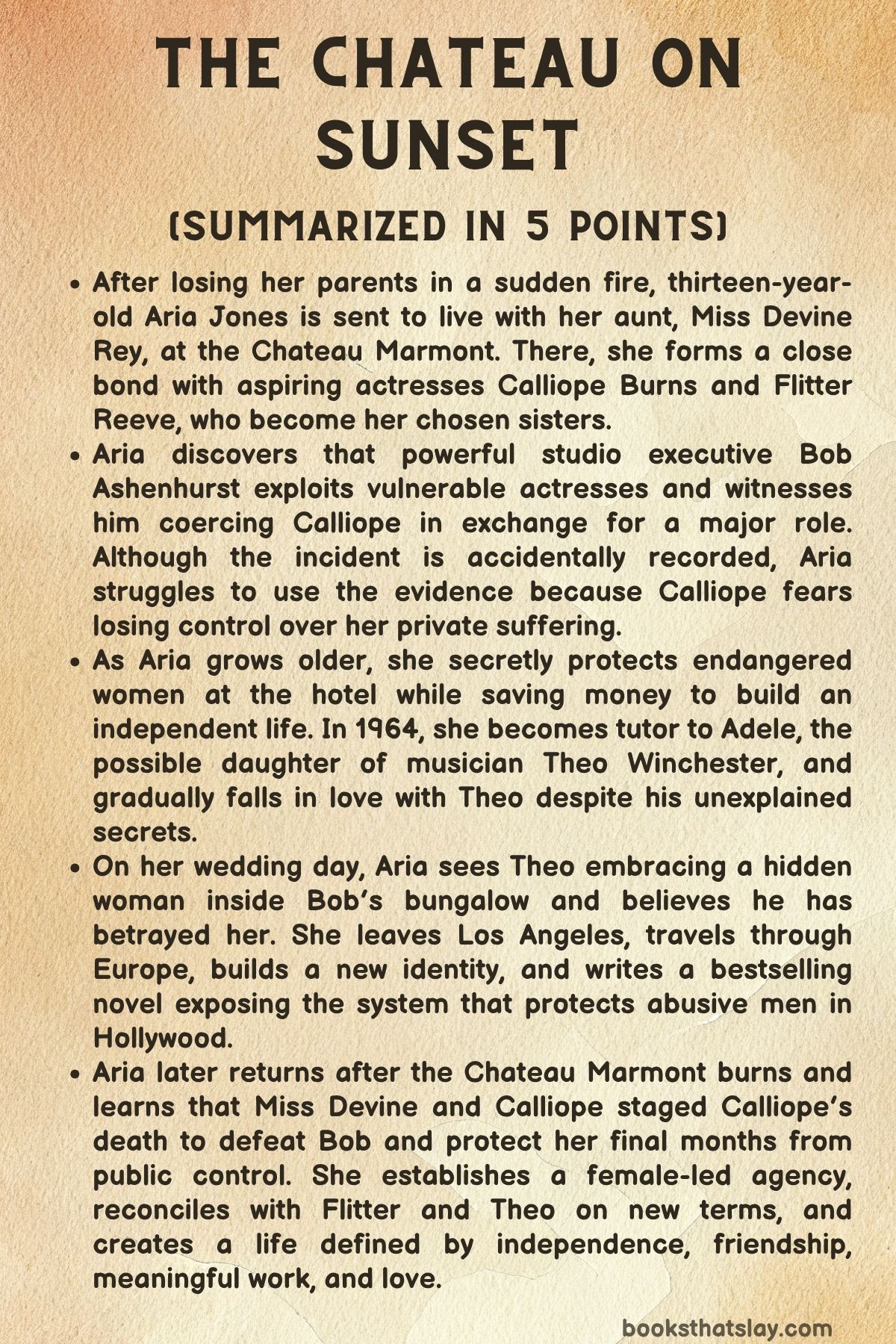
Thirteen-year-old Aria Jones arrives at the Chateau Marmont in 1957 after her parents are killed in a sudden gasoline fire. She has been sent from Manhattan to Los Angeles to live with her aunt, Miss Devine Rey, a former actress who rarely leaves her darkened hotel suite.
While Aria waits alone in the lobby, she meets two aspiring actresses, Calliope Burns and Flitter Reeve. The young women show her the hotel, introduce her to its strange atmosphere, and give her the first sense of belonging she has experienced since losing her parents.
Miss Devine receives Aria without warmth. She criticizes the girl’s appearance, demands secrecy, destroys the cameras that belonged to Aria’s father, and insists that the hotel must become Aria’s school.
A neglected library becomes Aria’s classroom and refuge. She educates herself through books, magazines, observation, and the stories hidden within the hotel, while Miss Devine teaches her to arrange her face so that nobody can see what she feels.
Calliope and Flitter become Aria’s chosen sisters. Calliope longs for fame because she believes being remembered will prove that her life mattered, while Flitter wants professional power that cannot be taken away by a man.
Aria dreams of financial independence and a private house beside the sea. However, Calliope warns her that complete isolation may prevent pain while also preventing love.
As Aria studies old movie magazines, she discovers that Miss Devine was once a celebrated actress engaged to studio executive Bob Ashenhurst. Her career and reputation were destroyed around the time Bob’s sister, Toni, died after supposedly jumping from the hotel’s turret.
Bob appears generous, charming, and attentive in public. Behind closed doors, however, he uses his authority over contracts, publicity, and employment to control vulnerable women.
Calliope receives a major role from Bob’s studio and meets him privately in the library. Aria, hidden nearby, watches Bob make it clear that Calliope’s career depends upon sexual submission, while an RCA sound camera accidentally records the encounter.
Aria is frightened into silence by her age, her dependence upon the hotel, and Bob’s ability to destroy the people she loves. When Bob discovers that she witnessed the assault, he threatens her and assumes that nobody will believe an orphan over a powerful studio head.
Calliope is horrified when she learns that the encounter was recorded. Aria views the film as evidence against Bob, but Calliope sees it as another violation because her most humiliating experience could be shown without her consent.
Flitter learns the truth as well, and the Three Sisters are permanently changed by the secret. Their love remains real, but ambition, guilt, shame, and disagreement over the recording begin creating distances between them.
Aria responds to her guilt by protecting other young women at the hotel. With help from Isaiah, the elevator attendant, and his son Jupiter, she learns to recognize predators, interrupt dangerous meetings, and guide frightened actresses to safety.
She begins babysitting for residents and saving money so that she can leave when she turns twenty-one. At the same time, she becomes increasingly invisible, believing that survival depends upon remaining unnoticed until she can escape.
By 1964, Aria knows every hidden staircase and dangerous habit within the hotel. Rock musician Theo Winchester, usually called Win, purchases the Marmont and arrives with Adele, a rebellious fourteen-year-old whose late mother identified Theo as her father.
Aria accidentally injures Theo’s ankle during their first meeting. When she learns that the hotel’s new ownership may threaten Miss Devine’s housing and her own savings, she persuades Theo to employ her as Adele’s tutor.
Rather than forcing Adele through conventional lessons, Aria teaches her about money, literature, independence, curiosity, and the practical restrictions faced by women. Adele responds to being treated as an intelligent person and gradually begins trusting both Aria and Theo.
Aria also discovers that Theo is sober after years of addiction, failed marriages, and destructive behavior. Although his fame initially makes her suspicious, his concern for Adele, Miss Devine, and vulnerable residents reveals a more thoughtful side.
Their growing attraction develops alongside a series of unexplained dangers. Someone tries to enter Aria’s room, sets fire to Theo’s bed curtains, poisons his dog Pilot, and kills the one-legged woodpecker Aria has cared for in the garden.
Theo repeatedly enters Bob’s supposedly vacant bungalow and refuses to explain what he is doing there. Aria, whose childhood has been shaped by hidden rooms and protected men, finds it increasingly difficult to separate her love for Theo from her fear that he is deceiving her.
Meanwhile, Aria investigates the circumstances of Toni’s death. Miss Devine’s journals and a hidden written statement reveal that she intended to leave Bob and that Toni had discovered disturbing truths about her brother.
The evidence suggests that Toni’s death was not the simple suicide described by the press. It also becomes clear that Miss Devine’s dependence on pills and her retreat from the world resulted from terror, grief, and deliberate damage to her reputation.
Aria gives up her escape savings so that Miss Devine can receive proper treatment. The decision postpones Aria’s freedom, but it also represents her refusal to let her aunt remain trapped in a medicated existence.
As Aria and Theo become closer, he speaks honestly about his abusive childhood, addiction, sexual exploitation, and uncertainty about fatherhood. Aria tells him about her fear of loss and the seaside house she has imagined since childhood.
Their relationship becomes physically and emotionally intimate, and Theo asks her to build a future with him and Adele. Aria agrees to marry him, although she secretly prepares a suitcase in case she needs to escape.
On their wedding day, Flitter leads Aria and an unwilling Calliope to Bob’s bungalow. Through a window, Aria sees Theo embracing a woman named Marley, confirming what appears to be a hidden relationship.
Bob reveals that he helped arrange the discovery as revenge against Aria. Flitter cooperated because he exploited her resentment toward Calliope and promised her the professional recognition she had wanted for years.
Aria refuses to remain for an explanation. Wearing her wedding dress, she retrieves her hidden suitcase, uses the hotel’s secret passages, and leaves the Marmont three days before her twenty-first birthday.
She travels through Europe and eventually settles in Venice with sisters Marzia and Alessia and their brother Arturo. For the first time, Aria lives in a place where nobody knows her history, allowing her to discover preferences, abilities, and ambitions that are entirely her own.
Aria helps the sisters turn their home into a successful guesthouse and takes ordinary employment serving tourists. Her experience in Venice teaches her how to occupy public space instead of hiding within corridors and observing life from a distance.
Arturo offers affection and companionship, but Aria recognizes that she does not need another relationship to define her. When their possible romance ends, she experiences disappointment without seeing it as proof that she has been abandoned.
Aria begins writing a novel inspired by Calliope, Miss Devine, Toni, Flitter, and the many women exploited by Hollywood. She decides against releasing the recording because exposing Bob should not require taking control of Calliope’s experience.
Calliope helps Aria reshape the manuscript so that its heroine represents a larger system rather than one recognizable victim. The resulting novel, Helen Burns, exposes the cooperation among studios, hotels, doctors, journalists, and executives who protect predatory men.
The book becomes a bestseller despite hostile reviews from male critics. Women recognize their own experiences in its pages, while Bob understands that the fictional executive is based upon him.
Aria uses her new financial independence and public influence to establish a female-led agency. She wants actresses to receive honest representation, fair contracts, and protection before exploitation occurs rather than assistance only after they have been harmed.
Theo eventually sends Aria a letter explaining that Marley was a troubled woman from his past who needed a secret place to recover. Although his intentions were protective, he admits that hiding her was a serious betrayal because he understood what concealed women and locked rooms meant to Aria.
Before Aria can fully consider reconciliation, she learns that the Chateau Marmont has burned. Bob’s body has been found, unidentified female remains have been discovered, and Calliope is missing.
Aria returns to Los Angeles and determines that Miss Devine and Calliope created a carefully staged performance. Dressed in silver and using the hotel’s ghost stories, they arranged for witnesses to believe that Calliope died during a dramatic confrontation with Bob.
The older female remains belong to Toni, bringing the long-concealed truth of her fate into public attention. Calliope, who is seriously ill, uses her supposed death to escape reporters, financial controllers, and those who would turn her final months into entertainment.
Miss Devine emerges from treatment alert and purposeful. She assists Aria’s agency and uses her experience to protect younger women from the system that destroyed her own career.
Aria confronts Flitter about the wedding-day betrayal but refuses to let Bob’s manipulation permanently divide the sisters. She casts Flitter in the film adaptation of Helen Burns, giving her the opportunity to prove her talent while honoring Calliope.
Aria and Theo meet again after she has created an independent identity, career, and home. Their reconciliation is based on new conditions: Theo must never use secrecy as a form of protection, and Aria must stop preparing hidden exits while claiming that she trusts him.
By 1967, Aria and Theo have married without requiring her to surrender her name or career. They begin rebuilding the Marmont as a place that acknowledges its past and offers greater safety to the people within it.
Flitter wins an Academy Award for her performance, Miss Devine finds purpose in helping younger actresses, Adele begins learning the business, and Aria’s agency continues to grow. In Venice, the Three Sisters recreate their first pajama party, recognizing that Calliope has become unforgettable, Flitter has earned real influence, and Aria has found a life beside the sea filled with work, friendship, family, and love.
Characters
Aria Jones
In The Chateau on Sunset, Aria Jones develops from a frightened orphan into a writer, businesswoman, and defender of women whose voices have been suppressed. Her childhood trauma creates a deep association between happiness and sudden disaster, causing her to believe that independence, money, and invisibility are the only dependable forms of protection.
Aria’s greatest strength is her ability to observe what other people ignore. She learns the sounds, secret passages, social hierarchies, and concealed dangers of the Marmont, turning knowledge into a means of protecting vulnerable women.
Her silence after Calliope’s assault becomes the source of lasting guilt. However, the book does not reduce her childhood response to cowardice, because she is a dependent thirteen-year-old facing a powerful adult who controls her home, her aunt’s survival, and her friends’ careers.
Aria’s later rescues are partly attempts to answer that guilt through action. Her invisibility initially allows her to intervene unnoticed, but it eventually becomes another prison because she starts believing that being unseen is the same as being safe.
Her relationship with Theo tests whether she can accept intimacy without surrendering autonomy. Leaving him is painful, but the separation is essential because she must discover that she can build a life, career, reputation, and home without depending upon his wealth or love.
Writing Helen Burns completes Aria’s movement from witness to author. She does not simply reveal secrets; she decides how to communicate structural injustice while respecting Calliope’s right to control her own experience.
Miss Devine Rey
Within The Chateau on Sunset, Miss Devine Rey represents both the long-term damage caused by male power and the possibility of reclaiming a life after years of silence. She initially appears vain, cruel, distant, and obsessed with appearances, particularly when she criticizes Aria rather than comforting her.
Her behavior is gradually revealed as the result of terror, grief, addiction, and systematic destruction. Bob damaged her career and reputation, while Toni’s death left her isolated inside the very hotel connected to her trauma.
Miss Devine’s lessons about concealing emotion are harmful to Aria, yet they originate from a survival strategy that once protected Miss Devine in an industry where visible anger could be used to label a woman unstable. She teaches Aria endurance because she no longer believes open resistance is possible.
Her recovery changes her from a passive survivor into an active planner. By helping Calliope stage her public death, supporting Aria’s agency, and advising younger actresses, she applies her knowledge to protection rather than concealment.
Miss Devine’s relationship with Aria is difficult because affection is buried beneath criticism and fear. Her eventual support does not erase the pain she caused, but it reveals that recovery can restore a person’s ability to love, act, and accept responsibility.
Calliope Burns
Calliope Burns is glamorous, generous, ambitious, insecure, and deeply aware of the difference between being admired and being loved. Her dream of fame begins as a desire to offer hope to girls from unhappy homes, but the industry turns that ambition into a means of controlling her.
Bob’s assault becomes the central violation of her life, yet Calliope refuses to let it become the only fact that defines her. She tries to interpret the assault as a price she consciously paid because believing that it served a purpose gives her a limited sense of control.
Her response to the recording is particularly important. Aria views it as evidence against Bob, while Calliope understands that releasing it could expose her body and suffering to another audience without her permission.
Calliope’s reliance on pills and alcohol reflects the strain of maintaining a public identity built upon beauty, availability, and constant performance. Her fame gives her recognition but not authority over her health, finances, privacy, or legacy.
Her decision to stage her death is therefore an act of authorship. By allowing Calliope Burns to become a legend while the private woman lives quietly in Venice, she finally separates her inner life from the image consumed by the public.
Flitter Reeve
Flitter Reeve is driven by a desire for earned authority rather than temporary approval. She understands earlier than Calliope that opportunities granted by powerful men can be withdrawn, but her insight does not protect her from envy, disappointment, or manipulation.
She loves Calliope while resenting the attention Calliope receives. This emotional contradiction makes Flitter one of the story’s most realistic figures because her loyalty and jealousy exist at the same time.
Bob exploits her belief that she has been unfairly overlooked. By offering her the role and recognition she has pursued for years, he persuades her to participate in the wedding-day trap against Aria.
Flitter’s betrayal cannot be excused as simple confusion. She knows Aria will be hurt, yet she accepts Bob’s bargain because ambition has become connected to her sense of worth.
Her later casting in Helen Burns provides an opportunity for accountability rather than effortless forgiveness. Aria asks her to use the talent she always claimed to possess in service of Calliope’s memory, requiring Flitter to honor the friend she both loved and envied.
Theo Winchester
Theo Winchester initially appears to embody the dangers Aria associates with famous men. He is wealthy, admired, sexually experienced, and surrounded by stories of addiction, failed marriages, and reckless behavior.
His private character is more complicated. Theo is attentive to Adele, gentle with Aria, willing to admit fear, and capable of recognizing how his abusive childhood and early exploitation affected his adult behavior.
Theo’s central flaw is his belief that good intentions justify secrecy. By hiding Marley in Bob’s bungalow, he thinks he is protecting a vulnerable woman, but he repeats the exact pattern of concealment that has shaped Aria’s worst memories.
His failure is not presented as equivalent to Bob’s predation. Nevertheless, the novel insists that a caring man can still cause serious harm when he assumes that he alone should decide which truths another person can handle.
Theo’s reconciliation with Aria becomes possible only after he acknowledges the betrayal without demanding immediate forgiveness. He must meet her as an independent equal rather than as an orphan he can rescue through marriage, wealth, or protection.
Adele
Adele arrives as an angry, rebellious teenager who has recently lost her mother and been placed with a famous man who may or may not be her biological father. Her hostility is therefore less a sign of bad character than a defense against grief, uncertainty, and repeated decisions made without her consent.
Aria earns Adele’s trust by treating her intelligence seriously. Instead of forcing her through conventional subjects, Aria teaches her about financial independence, women’s legal limitations, literature, and the practical knowledge required to control her own future.
Adele also forces Theo to confront responsibility. Her desire for his attention is visible beneath her defiance, and their gradually improving relationship shows that parenthood depends more upon presence and effort than biological certainty.
By the conclusion, Adele is no longer merely a child caught between adults. Her interest in Aria’s agency suggests that she may help continue the work of changing the industry for the next generation.
Bob Ashenhurst
Bob Ashenhurst is the story’s clearest representation of institutional power used for personal exploitation. His public charm is not a disguise he occasionally removes but a professional tool that allows him to appear generous while controlling careers, reputations, housing, publicity, and access.
He rarely needs open violence because the system has already limited the choices available to women. Calliope’s dependence upon his approval, Miss Devine’s destroyed reputation, Flitter’s hunger for recognition, and Aria’s fear of homelessness all become instruments he can use.
Bob considers himself injured when women resist him. His statement that he will never forgive Aria reveals a mind that interprets exposure as betrayal while refusing to recognize his own actions as wrongdoing.
He also survives by separating women from one another. Rather than relying only upon male allies, he encourages rivalry and persuades women that his approval is more valuable than their loyalty to each other.
His death ends his personal control but does not automatically destroy the culture that supported him. Aria’s agency and creative work are necessary because removing one powerful man is not enough to change the conditions that produced him.
Toni Ashenhurst
Toni Ashenhurst is absent from most of the action, yet her concealed history influences nearly every major relationship. Her supposed suicide creates the mystery surrounding Miss Devine, Mr. Mason, Bob, and the Marmont’s culture of silence.
Toni’s closeness with Miss Devine shows that female friendship existed before the Three Sisters formed their own bond. Her death also demonstrates what can happen when women discover truths that powerful men cannot permit them to reveal.
The eventual discovery of her remains corrects the public story without fully restoring the life that was taken from her. Toni therefore represents the many women whose experiences survive only through fragments, witnesses, hidden documents, and the determination of others to remember them accurately.
Aria’s Parents
Aria’s parents appear mainly through memory, but their deaths determine the emotional structure of her life. Their ordinary affection becomes associated with a world that vanished without warning, leaving Aria convinced that joy always creates the conditions for loss.
Her father’s cameras and interest in recording influence her development as an observer and storyteller. Miss Devine’s destruction of those cameras cannot erase what Aria learned from him about preserving moments and paying attention.
The seaside home Aria imagines is also connected to her desire to recover the security she felt with her parents. Her growth requires accepting that she cannot reproduce her childhood but can create a new form of family without treating love as a guarantee of disaster.
Isaiah
Isaiah provides Aria with steady kindness in an environment dominated by unreliable adults. His welcome when she first arrives gives her dignity at a time when Miss Devine’s criticism has made her feel unwanted and unattractive.
As an employee, Isaiah understands both the hotel’s secrets and the risks faced by staff members who challenge wealthy guests. His assistance in protecting young women shows moral courage exercised without public praise or institutional protection.
Isaiah also offers a model of dependable care. He does not demand ownership over the people he helps, making his quiet support very different from the controlling protection offered by men such as Bob.
Jupiter
Jupiter is Isaiah’s son and one of Aria’s most trusted allies. He experiences racism from hotel guests, which gives him an understanding of how powerful people treat workers and marginalized individuals as though their dignity does not matter.
He helps Aria remove endangered women from the Marmont through the garage and service areas. Their cooperation shows how people excluded from official power can create informal systems of safety.
Jupiter’s kiss with Aria is based upon trust and consent rather than conquest. He allows her to explore desire without using her inexperience against her or claiming that the moment creates an obligation.
Doctor Foster
Doctor Foster occupies a morally complicated position within the hotel. He saves injured women, treats overdoses, assists Miss Devine, and responds when Nathalie is endangered by an unsafe abortion.
At the same time, his work often allows the institution to manage crises privately rather than confront their causes. By treating women discreetly, he protects their lives but may also help preserve the secrecy upon which abusive men depend.
His gift of paper and a pen encourages Aria to record what she witnesses. That action becomes significant because documentation eventually gives her a way to challenge the narratives created by more powerful people.
Mr. Mason
Mr. Mason, the longtime hotel manager, is linked to both the Marmont’s secrets and Toni’s unexplained death. His engagement to Toni gives him a personal connection to the tragedy that distinguishes him from employees who treat it merely as hotel history.
His disappearance and the missing photograph suggest that he carries knowledge he has never been able or willing to reveal publicly. Like many adults in the story, he survives through secrecy, but the emotional cost of that survival remains visible in what he leaves behind.
Maisie
Maisie is part of the hotel’s informal network of memory. She provides Aria with information about Miss Devine, Toni, Mr. Mason, and the changes that occurred after the women returned from a mysterious night out.
Her importance lies in the way unofficial witnesses preserve truths that public records omit. Maisie may not possess enough authority to challenge Bob directly, but her recollections help Aria assemble a history that powerful people attempted to erase.
Nathalie
Nathalie is a young actress whom Aria finds bleeding after an unsafe abortion. Her condition exposes the physical consequences of an industry in which men can create a crisis and then give a frightened woman money and a telephone number rather than meaningful support.
Her refusal to name the man responsible reflects fear rather than ignorance. Nathalie understands that speaking could damage her career while the man involved would probably remain protected.
Through Nathalie, Aria recognizes that rescuing women after an emergency is necessary but insufficient. Her suffering strengthens Aria’s determination to create structures that can prevent exploitation before women are left injured and alone.
Marley
Marley is initially presented through Aria’s limited perspective as evidence of Theo’s infidelity. Her concealed presence in the bungalow activates Aria’s deepest fears because she appears to be another hidden woman protected by a famous man’s lies.
Theo later explains that Marley was experiencing a crisis and required privacy. This revelation does not make her concealment harmless, but it changes the moral meaning of the situation.
Marley’s role demonstrates the danger of partial truth. She is neither Theo’s secret lover nor a simple explanation that erases his deception, but a vulnerable person whose needs became part of a decision that excluded Aria from knowledge directly affecting her trust.
Arturo
Arturo offers Aria companionship during the period in which she is learning to live outside Hollywood. His interest helps her understand that she can be desired and appreciated without being connected to Theo or the Marmont.
However, Arturo occasionally makes ordinary decisions for her, such as ordering food without asking what she wants. Aria’s reaction shows her growing awareness that autonomy can be weakened through small assumptions as well as dramatic betrayals.
Their relationship does not need to become permanent in order to matter. Arturo helps Aria experience affection without dependence, and their peaceful separation proves that an ending does not always have to become abandonment.
Marzia and Alessia
Marzia and Alessia welcome Aria into their Venetian home when she is exhausted, heartbroken, and uncertain of her future. Their household offers a form of female community that is based upon shared work and mutual respect rather than competition for male approval.
Aria helps them transform their home into Castello Fantasticare, while they give her a place to rebuild her identity. Their success demonstrates what women can create when they control their property, labor, and public presentation.
They later protect Calliope’s privacy during the final stage of her life. Their home becomes the peaceful refuge Aria once imagined, but it is filled with community rather than isolation.
Lois
Lois is a Hollywood columnist whose influence demonstrates the power of publicity to shape public truth. Aria and Miss Devine recognize that confronting Bob requires not only evidence but also control over the story that reaches readers.
Lois is not presented as entirely independent from Hollywood’s manipulations. Nevertheless, she can be guided toward a version of events that protects Calliope while exposing the consequences of Bob’s behavior.
Her role shows that media can serve both oppression and resistance, depending upon whose account is repeated and whose interests determine the final narrative.
James
James is the young officer who helps Aria examine the circumstances surrounding the Marmont fire. His willingness to share information and consider inconsistencies gives her space to investigate rather than dismissing her conclusions as emotional speculation.
He represents a limited but important form of institutional cooperation. Unlike officials who automatically protect powerful men, James pays attention to details and allows Aria’s knowledge of the hotel to guide the inquiry.
Phillip
Phillip presents obsessive attention as romantic devotion. His constant waiting for Calliope might appear flattering within conventional Hollywood stories, but Aria recognizes that his refusal to respect boundaries makes his behavior invasive.
By driving him away, she challenges the belief that persistence proves love. The incident shows her developing ability to identify danger before it becomes a visible crisis.
Karl Douglas
Karl Douglas is a predator who attempts to lead a drugged young woman into a hotel room by suggesting that a professional opportunity awaits her. His conduct closely resembles Bob’s use of career promises to create dependence and confusion.
Aria’s intervention marks a turning point because she refuses to repeat her silence during Calliope’s assault. Karl’s role is brief, but it demonstrates that exploitation is not limited to one uniquely evil man; it is a repeated practice supported by the industry’s customs.
Lacey Magee
Lacey Magee represents the competitive uncertainty surrounding actresses. Her success in receiving a role desired by Calliope and Flitter shows how women are encouraged to view one another as obstacles rather than question the people controlling access to employment.
She is not personally responsible for the system’s unfairness. Her presence instead reveals how limited opportunities generate envy and division among women who might otherwise become allies.
Marian Monti
Marian Monti is discussed after her death as an example of the pressures placed upon celebrated women. Her fate warns Calliope that beauty, fame, pills, and public adoration can combine into a destructive form of confinement.
Although she does not participate directly in the central action, her story establishes a pattern that later appears in Calliope’s declining health. She represents women whose deaths are treated as individual tragedies rather than evidence of an industry-wide problem.
Melissa
Melissa is a young actress whose treatment during the Jane Eyre production reveals how routinely girls’ bodies are inspected, judged, and displayed. Her experience demonstrates that the abusive conditions faced by Miss Devine and Calliope continue into a younger generation.
Aria’s attention to Melissa shows why structural reform is necessary. Without meaningful change, the same expectations will be imposed upon each new actress who enters the industry.
Judith Crown
Judith Crown is one of the adults who relies upon Aria’s babysitting. Her presence helps establish Aria’s reputation as a responsible caretaker while also showing how easily adults transfer their obligations to a capable young girl.
Through Judith and other residents, Aria learns that being useful can earn money and temporary appreciation. It cannot, however, replace the care and recognition she needs for herself.
Pilot
Pilot, Theo’s dog, reflects trust, instinct, and vulnerability. His strong reaction to Bob’s bungalow signals that concealed danger exists there before Aria understands its nature.
His poisoning proves that the threats surrounding Theo and Aria are deliberate. Because Pilot is innocent of the conflicts among the adults, the attack demonstrates how far an unknown enemy is prepared to go.
The One-Legged Woodpecker
The one-legged woodpecker becomes a symbol of survival after injury. Aria feeds it because she recognizes in the bird a creature that continues living despite permanent damage.
Its death feels like a direct warning against Aria’s belief that endurance alone can guarantee safety. The bird’s fate strengthens her awareness that survival must eventually be supported by action, community, and protection rather than private resilience alone.
Themes
Silence, Secrecy, and the Cost of Survival
In The Chateau on Sunset, silence protects people from immediate danger while allowing the conditions that created that danger to continue. Miss Devine hides inside her suite, hotel employees protect guests’ privacy, Calliope conceals Bob’s assault, and Aria survives by making herself difficult to notice.
None of these choices can be understood without recognizing the power held by the people demanding silence. Speaking may cost a woman her career, home, reputation, income, relationships, or physical safety, meaning secrecy often begins as a rational response to unequal conditions.
The cost appears gradually. Miss Devine loses years of her life, Calliope becomes dependent on substances, Flitter’s resentment grows without honest expression, and Aria becomes so invisible that she struggles to believe she deserves attention or love.
The story therefore distinguishes silence from consent. A person may remain quiet because every available alternative seems more dangerous, and that quietness does not make the harm acceptable.
Real change begins when private knowledge is converted into collective action. Aria writes a novel, creates an agency, gathers women around shared experiences, and develops protections that reduce the risks of speaking.
The theme ultimately argues that courage cannot depend solely upon individuals exposing powerful people at enormous personal cost. Institutions and communities must create conditions in which truth does not require a woman to sacrifice her entire future.
Female Ambition and Patriarchal Power
Calliope and Flitter both desire successful acting careers, but their ambitions take different forms. Calliope wants to be remembered and to give neglected girls an image of another possible life, while Flitter wants authority earned through ability rather than male permission.
Hollywood treats both ambitions as resources that powerful men can exploit. Bob knows that employment is scarce, public reputation is fragile, and women are encouraged to compete for a limited number of roles.
Calliope’s assault shows how professional desire can be used to manufacture the appearance of choice. She technically has the ability to refuse Bob, but refusal would risk poverty, exclusion, and the destruction of a career she has spent years building.
Flitter believes she understands this system, yet Bob still manipulates her through resentment. By convincing her that another woman has received the life she deserved, he redirects her anger away from the structure controlling them.
The novel does not suggest that ambition itself corrupts women. The real problem is an industry in which men control access to work and then demand gratitude, loyalty, silence, or sexual availability in return.
Aria’s agency provides an alternative model. Women gain professional power not by rejecting ambition but by controlling contracts, financing, representation, and production, allowing success to exist without dependence upon predatory gatekeepers.
Visibility, Storytelling, and Control of Identity
Aria spends much of her childhood watching other people while avoiding their attention. Invisibility allows her to move through hidden corridors, overhear conversations, rescue endangered women, and preserve information that powerful adults believe has disappeared.
The same invisibility damages her sense of self. She becomes useful to everyone while receiving little recognition as a person with desires, fears, and ambitions of her own.
Calliope experiences the opposite problem. She is constantly visible as an actress, yet the public sees an image manufactured from beauty, publicity, gossip, and male desire rather than the complete person beneath it.
The recording of her assault exposes the conflict between proof and ownership. It could challenge Bob, but releasing it would force Calliope’s private suffering into public view and allow audiences to consume another part of her body.
Aria solves this conflict through fiction. Helen Burns communicates the truth of a system without claiming that one woman’s experience belongs to the author, the press, or the public.
Calliope’s staged death offers another act of narrative control. By deciding how her famous identity will end, she prevents reporters and financial authorities from directing her final months.
Storytelling becomes a form of power when women determine what is revealed, what remains private, and how they will be remembered. Visibility is valuable only when it is joined with consent and the authority to shape one’s own identity.
Chosen Family, Trust, and Freedom
Aria initially imagines freedom as a house beside the sea where nobody can reach her. The dream is understandable because every important attachment in her childhood appears connected to death, betrayal, dependence, or abandonment.
Her bond with Calliope and Flitter challenges that definition. The Three Sisters give her practical guidance, affection, celebration, and a sense of family, but their relationship also contains envy, secrecy, disagreement, and betrayal.
The story refuses to present chosen family as naturally perfect. Love does not prevent Flitter from hurting Aria, Calliope from becoming angry with her, or Aria from judging decisions she does not fully understand.
Trust must therefore involve accountability rather than unquestioning loyalty. Aria can recognize Bob’s manipulation of Flitter without pretending that Flitter had no responsibility for cooperating with him.
Her relationship with Theo follows the same principle. Love becomes possible only after Aria proves that she can survive independently and Theo admits that protective intentions do not excuse deception.
By the conclusion, Aria’s seaside life contains work, friendship, marriage, female community, and continuing responsibility. She has not escaped vulnerability, but she no longer confuses freedom with the absence of attachment.
Her true independence lies in being able to love without disappearing, forgive without denying injury, and belong to others without surrendering her name, ambitions, judgment, or ability to leave.