The Disaster Gay Detective Agency Summary, Characters and Themes
The Disaster Gay Detective Agency by Lev AC Rosen is a queer mystery-comedy about four close friends whose personal problems unexpectedly become useful investigative skills.
Brandon’s reckless romantic encounter with a mysterious hotel guest leads the group to a public assassination, a stolen intelligence drive, private military companies, criminal auctions, and several dangerously attractive suspects. Beneath its comic situations and fast-moving mystery, the novel examines friendship, grief, ambition, romantic fantasy, identity, and the struggle to build an adult life. Its central characters are deeply imperfect, but their loyalty allows them to survive threats that none of them could face alone.
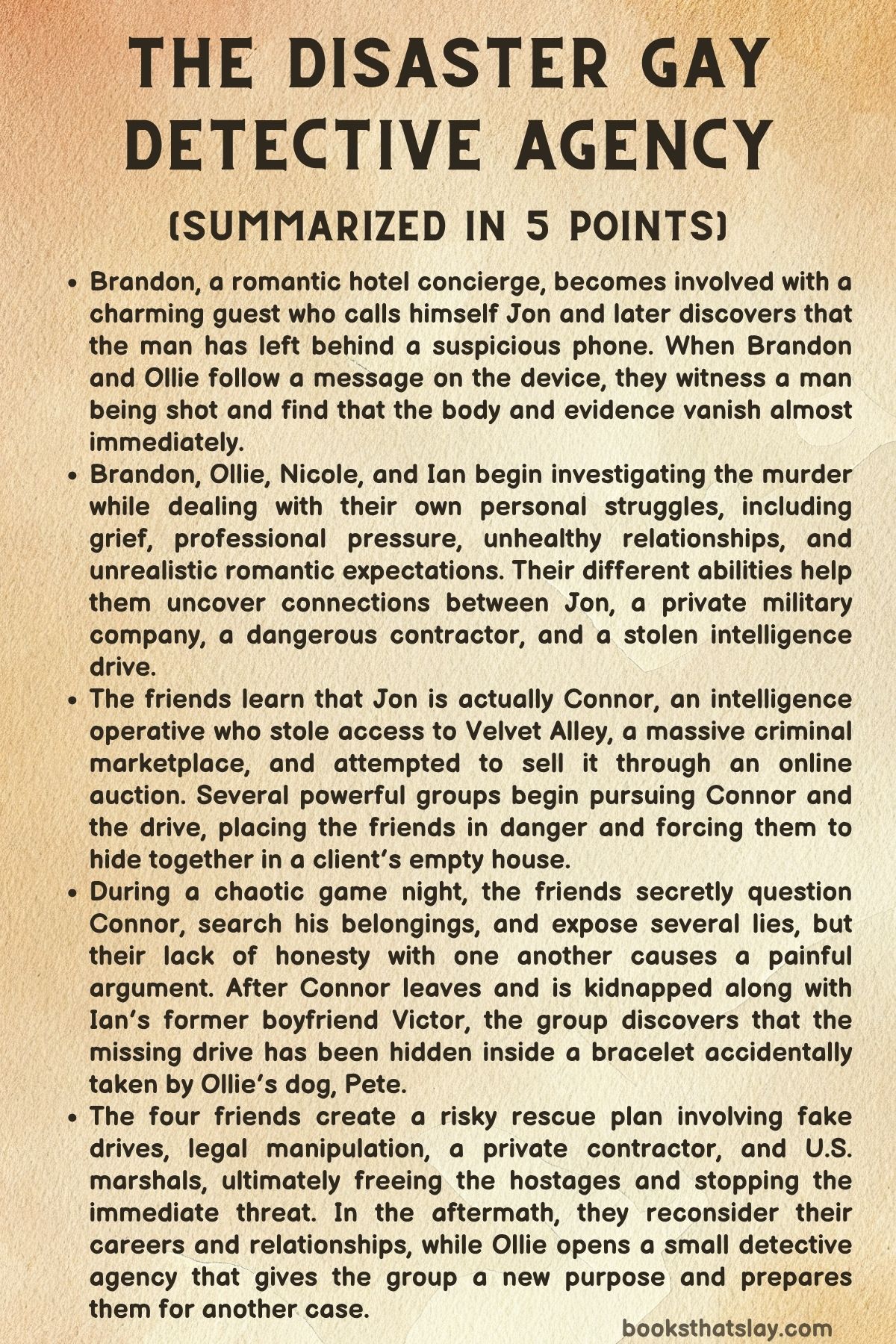
Summary
Brandon works as a night concierge at the Bergamot Hotel in Manhattan, where he meets an attractive guest calling himself Jon Engle. Their conversation begins with drag trivia and quickly becomes flirtatious, leading Brandon to break hotel rules and visit Jon’s room.
Brandon interprets their encounter as more than a casual hookup because Jon recognizes Heimweh, an obscure German spy-romance comic connected to Brandon’s tattoo. The tattoo represents the longing for a person who feels like home, and Brandon begins imagining that Jon may be the romantic partner he has always hoped to find.
Jon gives Brandon his number but does not respond to his messages. Brandon’s closest friends are familiar with his habit of confusing attraction with destiny: Ian is a drag performer still consumed by anger toward an unfaithful former boyfriend, Ollie is a dog walker struggling with grief and uncertainty, and Nicole is an exhausted corporate lawyer who has sacrificed nearly every part of her personal life for professional success.
Several days later, Brandon discovers that Jon checked out early and abandoned his only bag, which contains clothing and a phone. Instead of following hotel procedure, Brandon secretly keeps the phone, especially after a threatening man with a heart-eyes tattoo arrives to collect the luggage and falsely claims to be Jon.
The forgotten phone receives a message containing an address and a meeting time. Brandon and Ollie go to the location, where they see Jon speaking to an older man beneath a skybridge.
As Jon walks away, the older man is killed by a distant gunshot. Brandon and Ollie flee, but when they return with Nicole, the body, blood, emergency response, and nearly all physical evidence have disappeared.
Nicole realizes that whoever cleaned the scene possesses considerable money, influence, or professional resources. Ollie finds a bullet mark and a small piece of human tissue, proving that the murder occurred, while Brandon remains convinced that Jon was the intended target and may need protection.
The danger becomes personal when Ian discovers that someone has searched the apartment they share with Brandon. Ian initially blames Victor, their former boyfriend, because Ian has repeatedly damaged Victor’s car and remains trapped in a cycle of anger, desire, and revenge.
Victor denies entering the apartment, forcing Ian to acknowledge that their rage has kept the failed relationship emotionally active. Once the friends connect the break-in to Jon’s phone, they temporarily move into a wealthy client’s empty house where Ollie is staying while caring for a dog named Pete.
The investigation gives Ollie a renewed sense of purpose. Since his father died in an unsolved hit-and-run, Ollie has stopped planning for the future, but he now creates timelines, collects clues, builds a murder board, and imagines that the four friends could form a detective agency.
Ollie discovers that the heart-eyes man has already purchased surveillance footage from a nearby cannabis shop. The employee who provides this information, Safiya, is a trans woman with whom Ollie develops an immediate romantic connection.
Nicole seeks help from Ellen Kang, a glamorous senior lawyer with powerful clients and extensive criminal contacts. Nicole admires Ellen professionally and becomes attracted to her, believing that Ellen represents the confident and successful future she has been working toward.
Ellen identifies the threatening man as Arthur Nuys, a former special-operations soldier employed as a private contractor. Nicole accepts Ellen’s assistance without realizing that Ellen has a financial interest in locating Jon and the information connected to him.
Ian later encounters Arthur at the queer bookstore where they work. Arthur initially behaves like an ordinary customer and openly flirts with Ian, but he eventually kidnaps them and explains that Jon is actually Connor, a reckless intelligence operative who stole a data drive.
Connor was supposed to deliver the drive to KBA, a powerful private military company. Instead, he attempted to auction its contents, which provide access to Velvet Alley, a vast criminal marketplace involving weapons, trafficking, intelligence, and illegal international commerce.
Arthur admits that he fired the shot at the secret meeting, intending to kill Connor, but the older man stepped into the bullet’s path. A mysterious KBA representative offers Ian ten million dollars to locate the drive while threatening to kill Ian’s friends if they reveal the offer.
Meanwhile, Brandon and Ollie use a photograph on Connor’s phone to find a woman named Avery. She explains that she knows him as Connor rather than Jon and that he often forms intense temporary relationships before disappearing.
Avery directs them to a gay bar called Deep Dive, where they find Connor. He greets Brandon affectionately and provides a polished explanation for his disappearance, claiming that he works in art insurance and travels internationally to inspect valuable collections.
Ollie suspects that Connor is lying, but Brandon immediately accepts his story. Hoping to observe and question him, Ollie invites Connor to a game night at the house without first consulting Nicole or Ian.
Each friend secretly prepares a different plan. Ollie designs trivia questions about espionage, weapons, false identities, and international crime; Nicole intends to question Connor about KBA; Ian plans to search his belongings for the drive; and Brandon hopes the evening will prove that Connor belongs in his life.
Ollie also invites Safiya, while Ian brings Tom as a date and asks Victor to attend because Victor is a U.S. marshal who may provide protection. The gathering therefore combines romantic tension, unresolved resentment, hidden motives, cannabis-infused food, and an interrogation that everyone except Ollie immediately recognizes.
Connor answers suspiciously specific questions about firearms, combat, intelligence agencies, and false identification. Ian searches his room and steals his second phone, while Nicole isolates him and notices his alarm when she mentions KBA.
The evening erupts when Connor catches Ian leaving his room. A misunderstanding makes Victor believe that Connor attacked Ian, and Brandon responds by accusing his friends of humiliating him and refusing to respect his romantic choices.
Brandon retreats with Connor and finally confesses that he kept the forgotten phone, followed its messages, witnessed the assassination, found Avery, and tracked Connor to the bar. Connor’s affectionate behavior disappears when he realizes that Brandon unintentionally allowed KBA to trace him.
Connor leaves the house, and Brandon breaks down. The four friends finally admit everything they have concealed: Ian reveals the kidnapping and financial offer, Nicole admits her relationship with Ellen, and Ollie acknowledges that his investigation has repeatedly placed other people at risk.
Ian’s stolen phone displays the auction for the Velvet Alley data. Nicole recognizes the auction symbol from Ellen’s apartment and understands that Ellen has been using her reports to track Connor for criminal clients.
Before the group can decide what to do, Ian receives a call from Victor’s phone. Victor and Connor have both been kidnapped by operatives connected to the McClintock weapons company, and the kidnappers demand the drive by midnight.
The friends discover that Pete has been chewing one of Connor’s rubber bracelets. The bracelet contains a hidden compartment holding the real drive, which Connor accidentally left behind after Pete exchanged it for a similar-looking dog toy.
Rather than handing the drive directly to the kidnappers, the group creates a rescue plan. They contact Arthur and offer KBA access to the drive in exchange for help, while Nicole tricks Ellen into accompanying them to the abandoned gym where the hostages are being held.
At the gym, Ellen openly admits that her clients promised her a large finder’s fee and a long-term legal contract. She offers Nicole a promotion in exchange for cooperation, but Nicole pretends to accept only long enough to obtain written professional support and secure Victor’s release.
The friends produce several identical flash drives and claim they no longer know which one is genuine. Nicole announces that the correct drive has a blue dot, which is actually the signal for Arthur to begin the rescue.
Arthur makes a dramatic armed entrance, and a gunfight follows. Ian has secretly alerted Victor’s partner Willis, who arrives with U.S. marshals and brings the confrontation under official control.
Arthur escapes, the kidnappers are defeated, and Connor receives medical treatment before being taken for questioning. Nicole conceals Ellen’s involvement because the incriminating email gives her leverage over Ellen and the firm.
Victor attempts to reconcile romantically with Ian, but Ian finally understands that their connection has been sustained by anger rather than trust. Ian refuses to repeat the same destructive pattern and later begins exploring a dangerous but different relationship with Arthur.
Brandon speaks privately with Connor and asks whether any part of their connection was genuine. Connor admits that he enjoyed Brandon and revealed real pieces of himself, but he also explains that seduction is part of his professional skill and that he never imagined the lasting relationship Brandon wanted.
Brandon is hurt but accepts that their ideas of intimacy were fundamentally different. His romantic optimism survives the disappointment, even though he now understands that hope cannot replace evidence.
Safiya ends her relationship with Ollie after learning how much danger he concealed from her. Ollie remains committed to investigation, keeps the real drive hidden from the competing organizations, and plans to find someone capable of dismantling Velvet Alley rather than exploiting it.
Nicole transfers temporarily to the firm’s pro bono department, where she works on cases involving pollution, discrimination, and police violence. She also reconnects with Sam, the politically active barista who reminds her of the values she abandoned while pursuing corporate advancement.
Several months later, Ollie rents a small apartment and establishes the DW Agency, combining dog walking with unlicensed detective work. Brandon serves as the unpaid receptionist, Nicole and Ian remain connected to the group, and a hesitant stranger soon arrives seeking help, suggesting that the friends’ accidental career has only begun.
Characters
Brandon
Within The Disaster Gay Detective Agency, Brandon is the emotional catalyst whose romantic impulsiveness begins the central conflict. He is imaginative, charming, socially skilled, and capable of making strangers feel comfortable, but he often turns limited evidence into an elaborate story about love, fate, and emotional destiny.
His fascination with Connor grows from a genuine desire to find the person represented by his Heimweh tattoo: someone who feels like home. Because that desire is so strong, Brandon interprets shared interests, flirtation, and physical attraction as proof of unusual emotional significance.
Keeping Connor’s phone shows both his recklessness and his instinctive moral concern. Brandon violates hotel policy and ignores obvious risks, yet he also recognizes that Arthur is lying and believes Connor may be in danger.
Brandon’s weakness is not simply that he falls in love too quickly. His deeper problem is that he sometimes values the imagined version of another person more than the person’s actual behavior, allowing him to dismiss lies that would otherwise be unmistakable.
His confrontation with his friends reveals the insecurity beneath his optimism. Brandon knows they view his romantic history as a series of disasters, and their suspicion of Connor makes him feel that they also see him as foolish, unserious, and incapable of making adult choices.
Even when Brandon is wrong about Connor, the book does not present his hope as worthless. Ollie correctly observes that optimism can remain generous when it does not become entitlement, and Brandon ultimately accepts Connor’s rejection without demanding that Connor return his feelings.
By the conclusion, Brandon has gained greater emotional awareness without losing his warmth. He remains vulnerable to attractive strangers, but he is better able to recognize that a meaningful feeling on his side does not automatically create a mutual relationship.
Ollie
The Disaster Gay Detective Agency presents Ollie as a man whose comic enthusiasm for crime-solving develops from unresolved grief. Before his father’s death, Ollie made lists, imagined possible futures, and approached life with energetic curiosity, but the unsolved hit-and-run leaves him unable to trust plans or believe that effort will produce meaningful results.
His dog-walking work reflects this suspended existence. He moves between the expensive homes of clients, benefits from his mother’s wealthy social connections, and avoids deciding whether his work is temporary, permanent, independent, or merely convenient.
The murder investigation restores structure to Ollie’s mind. Timelines, evidence boards, surveillance footage, theories, and task lists allow him to convert frightening uncertainty into problems that appear answerable.
Ollie also understands the friends’ combined strengths before the others do. He sees that Brandon can interview people, Nicole can interpret legal danger, Ian can uncover private information, and he can organize the evidence into a coherent investigation.
His confidence, however, regularly becomes irresponsibility. He invites Connor and Safiya into the same house, designs an obvious interrogation, forgets to warn guests about cannabis-infused food, and treats danger as an exciting story even when other people have not agreed to participate.
Safiya’s rejection forces him to confront the cost of this behavior. Ollie may sincerely care about people, but his excitement can make him overlook their right to understand and choose the risks surrounding them.
His decision to keep the real drive also shows both moral independence and dangerous self-belief. He refuses to trust governments, corporations, mercenaries, or law enforcement with the data, yet his plan assumes that he can personally identify a safer solution.
By opening the DW Agency, Ollie transforms grief into purpose. His new career may be chaotic and legally questionable, but it gives him a future he has actively chosen rather than one he has indefinitely postponed.
Nicole
Nicole is a brilliant Black lesbian lawyer who has built her adult identity around discipline, achievement, and delayed gratification. She believes that exceptional performance will eventually provide security, influence, and freedom, so she treats sleep, relationships, political engagement, and recreation as rewards that must wait until she has succeeded.
Her ambition is shaped by realistic fears about prejudice and professional judgment. Nicole knows she may be judged more harshly than privileged colleagues, which encourages her to arrive earlier, stay later, hide weakness, and avoid any personal choice that might become workplace gossip.
This survival strategy gradually becomes a form of self-erasure. She suppresses her attraction to Sam, distances herself from the activism that once mattered to her, and accepts degrading assignments because she believes resistance could threaten her future.
Ellen attracts Nicole because she appears to embody everything Nicole wants: authority, sophistication, wealth, legal skill, and access to powerful networks. Their sexual relationship allows Nicole to imagine that she has been recognized as an equal by someone at the highest professional level.
Ellen’s apartment destroys that fantasy. Its disorder, isolation, and signs of compulsive consumption reveal that professional advancement has not given Ellen freedom; it has merely allowed work to occupy a larger and more luxurious prison.
Nicole’s treatment of her friends is another important flaw. She loves them and repeatedly protects them, but she often behaves as though intelligence and professional success entitle her to manage their decisions.
During game night, Brandon’s anger and Ollie’s pain force her to see how easily protection can become condescension. Her insult about Ollie’s plan is especially damaging because it carelessly recalls the car crash that killed his father.
Her final confrontation with Ellen demonstrates Nicole’s growth. Rather than choosing between obedience and open rebellion, she uses Ellen’s own methods of negotiation, documentation, and leverage to secure Victor’s release and protect her career.
The move to pro bono work does not solve every problem, since Nicole remains overworked and still struggles to make time for Sam. It nevertheless marks a return to values she had postponed, showing that professional identity can be revised before ambition completely consumes the person pursuing it.
Ian
Ian is a drag performer, bookstore employee, and compulsive completionist who cannot comfortably leave anything unfinished. This tendency applies not only to books and arguments but also to relationships, making the unresolved end of their romance with Victor especially difficult to accept.
Ian experiences anger as both emotional protection and romantic stimulation. Victor’s betrayal causes genuine pain, but repeatedly damaging his car and monitoring his life allows Ian to preserve a relationship through conflict after intimacy has ended.
Their behavior is harmful, yet it comes from more than simple vindictiveness. Ian wants Victor to react intensely because fury would prove that Ian still matters and that the relationship with Raphael has not fully replaced what they shared.
Ian’s anger also has a political and protective side. At the bookstore, they confront perceived homophobia because they cannot quietly tolerate language that appears to diminish queer lives, even when their methods threaten their employment.
Arthur appeals to Ian because he combines danger, flirtation, physical intensity, and moral contradiction. The attraction is clearly risky, but it also allows Ian to pursue something unknown rather than endlessly repeating the same emotional conflict with Victor.
The ten-million-dollar offer tests Ian’s loyalty. They imagine financial freedom, artistic success, security for their friends, and support for queer institutions, which makes betrayal appear temporarily defensible as a path toward collective benefit.
Ian ultimately contributes to the rescue by secretly contacting Willis. This decision shows that beneath their secrecy and impulsiveness, they remain committed to protecting the group rather than claiming the reward.
Rejecting Victor is Ian’s clearest emotional achievement. For the first time, they accept sadness without immediately converting it into renewed rage, allowing the relationship to end without another destructive attempt to restart it.
Connor, Also Known as Jon Engle
Connor is an intelligence operative whose charm depends on mixing truth with deception. He changes names, occupations, locations, and personal histories with ease, but his performances remain convincing because he includes authentic interests, desires, and emotional reactions.
His relationship with Brandon demonstrates this method. Connor genuinely enjoys Brandon’s appearance, intelligence, enthusiasm, and knowledge of Heimweh, but he experiences attraction as a temporary pleasure rather than a promise of emotional commitment.
Connor’s recklessness drives much of the plot. He steals the Velvet Alley drive, abandons the original agreement with KBA, creates an auction visible to multiple criminal organizations, and repeatedly assumes that charm and improvisation will protect him from the consequences.
His decision to reconnect with Brandon is especially revealing. Part of him may enjoy Brandon’s company, but he also recognizes that Brandon can provide a comfortable hiding place in a house unknown to the people pursuing him.
Connor does not fully understand how seriously Brandon interprets their connection until the confession in the shower. His anger comes not only from fear but also from the realization that someone he considered harmless has unintentionally exposed his location.
Despite his selfishness, Connor is not portrayed as emotionally empty. He admits that the parts of himself he showed Brandon were real, although he has trained himself to offer only the amount of authenticity required to create trust.
His tragedy lies in treating emotional distance as freedom. Connor can travel, seduce, deceive, and pursue danger without ordinary attachments, but this lifestyle leaves him unable to recognize or sustain the kind of home Brandon wants to build.
Arthur Nuys
Arthur is a former special-operations soldier whose violence contrasts with his unexpectedly playful social behavior. He is capable of surveillance, kidnapping, assassination, intimidation, and armed rescue, yet he also browses queer art books, discusses sexuality, flirts openly, and expresses strong opinions about online culture.
This combination prevents him from functioning as a simple villain. Arthur kills and threatens people as part of his professional role, but he follows a recognizable code based on contracts, efficiency, and loyalty to his employer rather than uncontrolled cruelty.
His pursuit of Connor and the drive places the friends in danger, while his attraction to Ian creates an unusual personal connection across opposing sides. Arthur appears amused by Ian’s defiance rather than threatened by it, suggesting that he values intensity in others as much as Ian does.
Arthur’s failed assassination also complicates his competence. He is highly trained, yet the accidental death of Fred shows that professional skill cannot remove uncertainty or prevent unintended consequences.
During the rescue, Arthur accepts cooperation because it benefits KBA, but his dramatic entrance reveals that he also enjoys performance. In this sense, he resembles Ian, whose drag identity similarly turns heightened presentation into a source of confidence and control.
Their developing relationship remains morally alarming. Arthur may offer Ian a fresh emotional direction, but his profession ensures that attraction to him cannot be separated from secrecy, violence, and institutional corruption.
Ellen Kang
Ellen initially appears to be Nicole’s ideal future self. She is intelligent, sexually confident, professionally respected, and connected to police officers, defense lawyers, journalists, wealthy clients, and criminal networks.
Her power makes ordinary institutional procedures seem unnecessary. Instead of researching through formal channels, Ellen gathers information through favors and personal relationships, demonstrating how influence often operates beyond visible professional rules.
Nicole mistakes this competence for trustworthiness. Ellen listens without judgment and offers practical help, but her interest in the case is motivated by the money and professional opportunities available through her criminal clients.
Her luxury apartment provides a physical representation of her inner life. Expensive possessions, unfinished meals, scattered documents, and constant work calls reveal that she has gained status without gaining stability, time, or meaningful personal balance.
Ellen’s advice that Nicole should abandon people who cannot rise with her shows the emotional cost of her worldview. She understands relationships primarily through usefulness, access, and professional position.
Even after being exposed, Ellen admires Nicole’s ability to manipulate the situation. Her reaction confirms that she interprets betrayal, leverage, and concealment as signs of professional maturity rather than moral failure.
Nicole’s decision to keep Ellen free is ethically complicated but strategically effective. Ellen becomes both a continuing threat and a source of protection, ensuring that her relationship with Nicole remains based on mutual knowledge and controlled distrust.
Victor
Victor is Ian’s former boyfriend and a U.S. marshal whose presence connects the friends’ emotional conflicts to official law enforcement. His past betrayal deeply wounded Ian, but the novel also makes clear that their relationship was defined by mutual volatility rather than one-sided harm.
Victor’s calmer relationship with Raphael represents the stability he could not create with Ian. Ian interprets this calmness as an insult because it suggests that Victor is capable of being peaceful, just not within their former partnership.
When Ian accuses him of breaking into the apartment, Victor responds with understandable anger but does not exploit Ian’s vulnerability. He accepts the later apology and admits that he still cares, allowing their old warmth to return without pretending the past has disappeared.
At game night, Victor’s protective reaction when Ian falls reveals that the emotional charge remains active. Ian is briefly excited by his anger, while Victor recognizes that this response is exactly why reconciliation would be dangerous.
Victor’s description of their connection as a bomb rather than a spark is central to his characterization. He understands that intensity can feel romantic while still making a relationship unsafe and unsustainable.
His final attempt to kiss Ian shows that insight does not immediately remove desire. Ian’s refusal protects both of them from returning to a cycle they now understand but may not be able to control.
Safiya
Safiya is intelligent, observant, direct, and comfortable discussing identity, philosophy, cannabis, poetry, and uncertain adulthood. Her easy connection with Ollie offers him the possibility of romance during a period when he is rediscovering enthusiasm for life.
She understands the emotional source of Ollie’s fascination with mysteries more quickly than he does. By connecting his interest in true crime to his father’s unsolved death, she recognizes that investigation offers him a sense of order that grief has denied him.
Safiya’s eventual rejection of Ollie establishes an important moral boundary. She is not angry because he enjoys detective work, but because he involved her in a dangerous situation without giving her enough information to make an informed choice.
Her decision prevents the story from treating reckless adventure as harmless simply because it produces comic situations. Safiya insists that attraction does not excuse dishonesty and that care requires respecting another person’s safety.
Although her departure hurts Ollie, it helps expose the selfishness hidden within some of his enthusiasm. She therefore contributes to his growth even though their relationship does not continue.
Sam
Sam is a politically engaged barista whose presence reminds Nicole of the person she was before professional ambition narrowed her life. She belongs to an activist group opposed to war profiteering and provides important information about KBA’s interest in Velvet Alley.
Unlike Ellen, Sam has little institutional power, but her values are clear and openly expressed. Nicole initially worries that dating a barista could damage her reputation, revealing how thoroughly class anxiety and corporate culture have influenced her judgment.
Sam’s interest in Nicole is patient but not passive. She flirts, remembers Nicole’s preferences, notices changes in her emotional state, and leaves space for Nicole to choose whether to respond.
Their possible relationship represents a path back toward political commitment, ordinary pleasure, and emotional honesty. Nicole’s difficulty scheduling dinner shows that change remains incomplete, but asking Sam out is still a meaningful rejection of endless postponement.
Tom
Tom is a kind and emotionally direct man whom Ian previously ignored. When Ian invites him to game night, Tom refuses to accept vague intentions and asks whether the invitation is genuinely romantic.
His insistence on clarity contrasts with Ian’s tendency to use other people as instruments within emotional conflicts. Ian initially brings Tom partly to make Victor jealous, but Tom’s straightforwardness requires Ian to acknowledge the date openly.
Tom’s drug knowledge creates suspicion during game night, although it has an innocent explanation involving a former roommate. This misunderstanding contributes to the evening’s comedy while showing how quickly the group turns fragments of information into accusations.
Tom ultimately functions as evidence that Ian has access to gentler romantic possibilities. Ian’s failure to pursue that stability reveals that intensity still attracts them more strongly than emotional safety.
Kate
Kate, Ian’s employer at the queer bookstore, combines sympathy with practical judgment. She understands that Ian’s anger toward customers often comes from a desire to defend queer people, but she also recognizes that good intentions do not protect a business from the consequences of aggressive behavior.
Her willingness to challenge Ian gives her a stabilizing role. She does not demand silence or obedience, but she encourages Ian to take responsibility for how their actions affect coworkers, customers, and the bookstore’s survival.
Kate’s imagined use of ten million dollars also influences Ian. Her dream of securing a permanent home for the store and supporting queer causes makes the KBA offer appear capable of producing genuine communal good, increasing the moral difficulty of refusing it.
Ollie’s Mother
Ollie’s mother is supportive, socially connected, and enthusiastic about her son’s interests. Her wealthy network provides much of Ollie’s dog-walking work, which helps him survive but also contributes to his uncertainty about whether he has built an independent career.
She participates indirectly in the investigation by offering theories about witnesses, surveillance, and timelines during a conversation Ollie presents as a discussion of true crime. Her suggestions help him identify practical investigative steps.
Unlike Safiya, she responds to Ollie’s dangerous adventure with pride and excitement. Her encouragement strengthens his decision to establish the agency, while her offer to create a podcast shows that she views his unusual career as something worth developing rather than dismissing.
Avery
Avery is a friend of Connor’s who provides Brandon with crucial information about his real identity and behavior. She knows that Connor uses different names, changes locations, forms intense temporary attachments, and disappears without offering reliable explanations.
Her account challenges Brandon’s belief that his encounter with Connor was unique. At the same time, she does not mock Brandon or treat him as foolish, instead giving him the information required to continue searching.
Avery functions as a bridge between Connor’s invented identities and his actual pattern of conduct. Through her, Brandon receives his clearest early opportunity to recognize that attraction and secrecy have replaced genuine commitment.
Pete
Pete is more than a comic animal companion because his ordinary behavior becomes essential to resolving the mystery. By exchanging his toy for Connor’s bracelet and chewing it, Pete accidentally hides the Velvet Alley drive from every professional organization searching for it.
The discovery reinforces the novel’s preference for chance, friendship, and unconventional observation over institutional control. Trained soldiers, lawyers, criminals, and intelligence operatives fail to locate what a dog has unknowingly carried through the house.
Pete also anchors Ollie’s emotional and practical life. Caring for him supports Ollie’s identity as a dog walker, contributes to his connection with Safiya, and ultimately provides the clue that allows the friends to negotiate the rescue.
Themes
Friendship as a Form of Collective Strength
In The Disaster Gay Detective Agency, friendship does not make the central characters wiser, calmer, or less flawed. Instead, it allows their weaknesses to become useful when combined with the abilities of people who understand them well.
Brandon’s romantic openness helps him build connections, Ollie’s obsessive curiosity produces investigative theories, Nicole’s legal reasoning identifies institutional risks, and Ian’s talent for uncovering private information reveals hidden motives. Individually, each skill causes problems because it is connected to an emotional weakness, but together the skills allow the group to challenge organizations with far greater money, training, and power.
Their friendship nearly collapses because they repeatedly hide information from one another. Ian conceals the financial offer, Nicole conceals Ellen’s involvement, Ollie invites people into danger without consent, and Brandon refuses to admit how he found Connor.
Game night becomes disastrous not because the friends lack loyalty, but because each tries to protect or control the others through a separate plan. Their eventual success begins only after they admit their mistakes and share everything they know.
The rescue therefore depends less on individual brilliance than on coordination. Their affection gives them reasons to forgive, while their familiarity allows them to assign roles based on genuine strengths.
The story presents friendship as active work rather than effortless closeness. Trust must be repaired through confession, apology, patience, and the willingness to remain present after embarrassment or failure.
The Difference Between Romantic Hope and Romantic Fantasy
Brandon’s pursuit of Connor examines how easily hope can become a refusal to accept evidence. Brandon does not merely want love; he wants ordinary events to confirm that the love he has imagined is already beginning.
The shared interest in Heimweh, Connor’s attraction, the forgotten phone, and the reunion at Deep Dive become signs of fate in Brandon’s mind. Each new contradiction is absorbed into the romance rather than allowed to challenge it.
Connor’s false name, inconsistent biography, disposable phone, secret meetings, and suspicious behavior should weaken Brandon’s trust. Instead, Brandon treats secrecy as emotional mystery because uncertainty allows him to preserve the version of Connor he prefers.
The novel does not argue that Brandon should become cynical. His openness is part of his generosity, resilience, and ability to connect with people, while his friends’ mockery sometimes turns reasonable concern into cruelty.
Ollie offers the most balanced view by separating optimism from entitlement. Brandon may hope that a relationship is real, but he must still accept Connor’s right to define his own feelings and intentions.
The final conversation between Brandon and Connor makes this distinction unavoidable. Connor experienced attraction and limited authenticity, while Brandon experienced the possible beginning of a shared future.
Both experiences contain truth, but they do not carry equal meaning. Brandon matures when he accepts that emotional intensity cannot create mutual commitment without honest communication and consistent action.
Grief, Anger, and Emotional Avoidance
Several characters organize their lives around feelings they do not know how to face directly. Ollie avoids grief through edibles, temporary housing, dog-walking routines, and true-crime theories, while Ian converts sadness into rage, stalking, vandalism, and romantic conflict.
Nicole avoids uncertainty by working constantly. If every hour is devoted to professional advancement, she never has to ask whether the future she is pursuing actually resembles the life she wants.
Brandon avoids rejection by interpreting ambiguity as possibility. As long as Connor’s motives remain mysterious, Brandon can postpone accepting that the relationship may have been casual, deceptive, or unequal.
These avoidance strategies provide temporary control. Ollie can treat chaos as a mystery, Ian can experience anger instead of loss, Nicole can measure progress through hours and assignments, and Brandon can transform silence into romantic suspense.
The investigation forces each character’s private coping method into public view. Ollie’s excitement endangers Safiya, Ian’s attraction to conflict distorts decisions involving Victor and Arthur, Nicole’s ambition makes her vulnerable to Ellen, and Brandon’s fantasy guides Connor directly into the group’s refuge.
Growth begins when the characters name the feelings beneath their behavior. Ollie acknowledges his need for purpose, Ian accepts sadness without restarting the relationship, Nicole questions the future she has idealized, and Brandon recognizes that hope cannot determine another person’s intentions.
Power, Ambition, and Moral Compromise
The conflict surrounding the Velvet Alley drive shows how institutions often pursue power while presenting their actions as security, business, law, or professional advancement. KBA, McClintock, Ellen’s clients, intelligence operatives, and criminal bidders all want the same information because controlling it would allow them to profit from violence and instability.
Nicole’s career provides the clearest personal version of this struggle. She enters law with political commitments but gradually accepts exhaustion, humiliation, and moral distance because she believes professional authority will eventually allow her to live according to her values.
Ellen reveals the danger of that bargain. She possesses status, money, access, and influence, yet remains isolated, overworked, disorganized, and willing to assist criminals in exchange for additional wealth and opportunity.
The drive itself becomes a test of whether dangerous power can ever be safely transferred. The friends distrust the private military companies, Ellen’s clients, the police, and even official government institutions, since every group may use the data rather than destroy the marketplace.
Ollie’s decision to keep the real drive reflects principled suspicion, but it also creates another concentration of power. His belief that he can find a morally responsible solution may be admirable, reckless, or both.
The story therefore avoids offering a completely pure authority. Ethical action depends on accountability, shared decision-making, and continued skepticism toward anyone who claims that personal control is automatically safer than collective oversight.