The Emilys by Heather Abel Summary, Characters and Themes
The Emilys by Heather Abel is a literary novel about friendship, illness, motherhood, climate change, and the limits of individual responsibility.
Set mainly in Northampton, Massachusetts, the story follows Eve, a struggling writer who reconnects with her childhood friend Demeter while Demeter cares for a daughter suffering from a mysterious sensitivity to daylight. Their relationship becomes part of a wider search for recognition, treatment, and community. Through several connected families, the novel examines how privilege affects whose pain is believed, how environmental change reshapes human health, and how love can inspire generosity while also encouraging jealousy, control, secrecy, and harmful certainty.
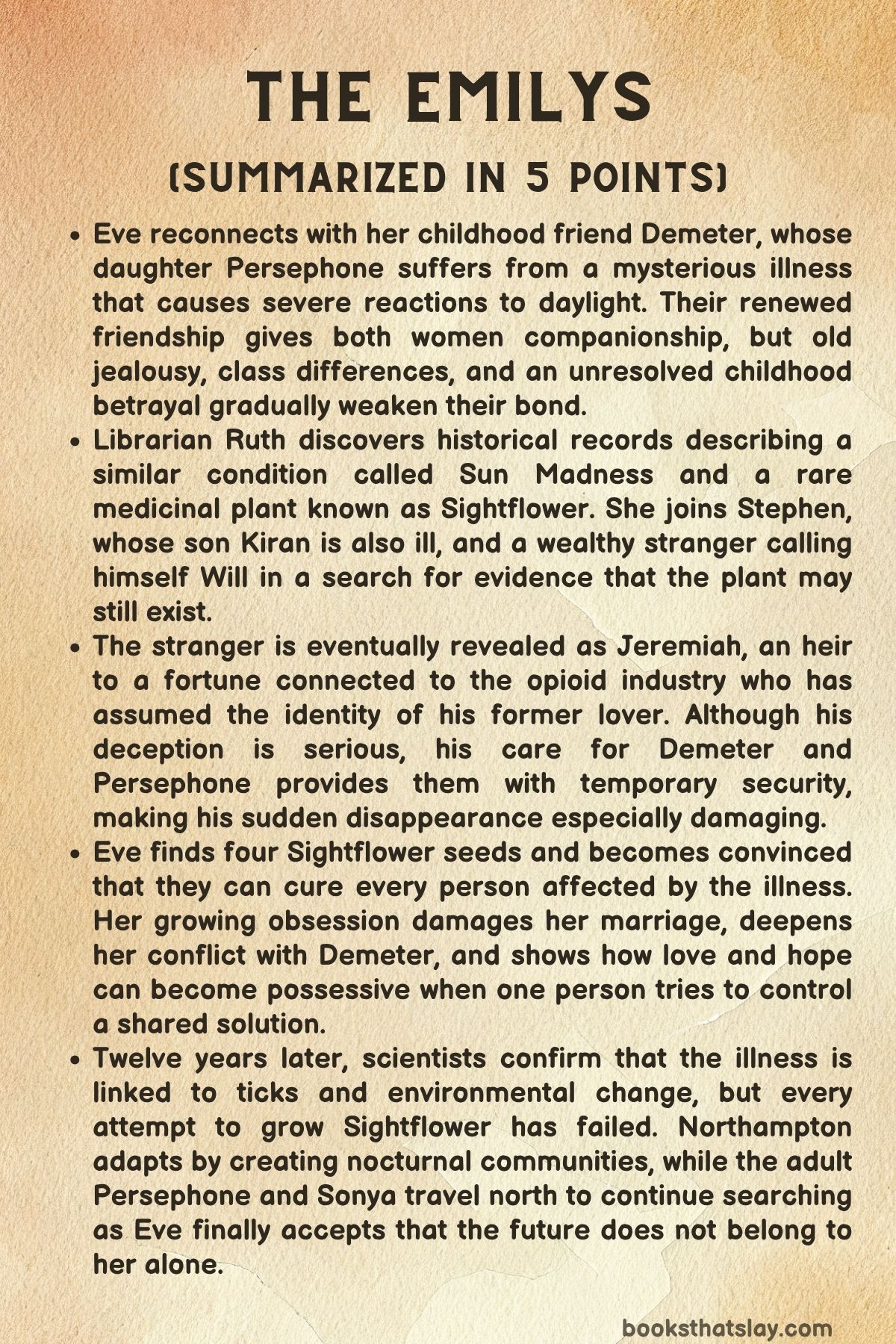
Summary
Thirteen years after the main events, Eve lies awake in Northampton while her adult daughter Sonya isolates herself after returning from college. Hearing two nocturnal women talking in the woods reminds Eve of Demeter, the childhood friend who disappeared from her life twelve years earlier.
Eve still speaks to Demeter in her thoughts and wonders whether she has been forgiven. Her memories return to the spring when unemployment and financial strain forced her to move with Sonya and Lev into her father’s house while her husband, whom she calls Henry James, continued working in New York.
At a playground, Eve unexpectedly meets Demeter and Demeter’s twelve-year-old daughter, Persephone. Persephone wears sunglasses and protective clothing because daylight causes vomiting, shaking, exhaustion, and severe pain, yet doctors have repeatedly treated the condition as imaginary.
Demeter’s life has been marked by poverty, religious extremism, teenage motherhood, unstable employment, and constant improvisation. Eve is fascinated by her energy and by the feeling that Demeter remembers a version of her that existed before marriage, children, and abandoned creative ambitions.
Other Northampton residents are confronting similar losses. Ruth, a widowed librarian, lives with memories of her late wife Ramona and the absence of her estranged son Orion, who now calls himself Ryan and has joined the military.
Stephen, Ramona’s former husband, is caring for his son Kiran, who has developed symptoms resembling Persephone’s. His Medical Mystery Collective fails to produce agreement because families offer competing theories while doctors dismiss the illness as a psychological response to the pandemic.
Eve becomes deeply involved in Demeter and Persephone’s lives. She attends medical appointments, uses her famous mother Joan’s name to pressure a dismissive doctor, and lies to social workers to protect Demeter from losing custody or housing.
Persephone spends her days in a darkened apartment, naming shadows and filling her isolation with music, crafts, audiobooks, and imagined conversations. She trusts Demeter completely, but she also recognizes her mother’s exhaustion and senses that hope is becoming harder for both of them to maintain.
Eve and Demeter soon become inseparable. They share childcare, talk late into the night, invent games, skate after dark, and briefly create a life in which motherhood feels communal rather than confining.
Their private refuge is threatened when other parents react cruelly to Persephone at the library. The mysterious condition becomes publicly known as “Emily Dickinson disease,” or simply Emily, because sufferers avoid daylight and live in darkness.
Ruth discovers an old historical account describing a nineteenth-century illness called Sun Madness. The records mention Sightflower, a rare white trillium believed to have cured people who became sick in sunlight.
Ruth shares the discovery with Stephen, and they begin searching for botanical evidence. A wealthy man named Jeremiah Segal-Weiss joins them while pretending to be Will Roth, his estranged former lover.
Jeremiah’s family fortune is connected to the opioid industry, and he carries guilt over Quinn, the partner of the real Will Roth. Quinn had developed Emily before the pandemic, became dependent on opioids, and died while Will was away on a trip encouraged by Jeremiah.
Jeremiah assumes Will’s identity partly because he hopes that finding a cure will prove he is capable of goodness. His false identity also allows him to create the caring, domestic life he previously refused when the real Will wanted commitment.
Meanwhile, Demeter takes Persephone to a treatment centre called the Healing Hut. The facility offers belief and attention but also demands exhausting labour from Demeter, imposes restrictive treatments on Persephone, and provides little reliable medical evidence.
Eve criticizes the institution but cannot offer a practical alternative. Demeter continues because being listened to feels better than being mocked, and because a poor mother with a sick child cannot afford to reject every imperfect source of hope.
Eve also becomes emotionally attached to Jeremiah, whom she knows as Will. He listens to her frustrations about motherhood, marriage, creativity, climate fear, and her difficult relationship with Joan.
She eventually confesses that, as a child, she stole a rare book belonging to her father Larry and allowed Demeter to be blamed. Larry’s admiration for Demeter had made Eve jealous, and her silence ended their childhood friendship without Demeter ever learning the truth.
Eve’s renewed closeness with Jeremiah becomes complicated when he meets Demeter. Jeremiah admires Demeter’s intelligence and directness, while Eve feels the same jealousy that once emerged when Larry gave Demeter his attention.
Ruth, Stephen, and Jeremiah search historical collections for Sightflower but find nothing. Ruth knows that Antonia, a botanist from her former radical community, may possess unofficial plant records, yet old jealousy surrounding Ramona prevents Ruth from approaching her.
Eventually, Eve agrees to visit Antonia and takes Demeter, Persephone, Sonya, and Lev to Vermont. For a brief period, Eve and Demeter imagine creating a shared home where friendship, childcare, art, and work could coexist.
Antonia’s records identify Sightflower as extinct. Climate change, invasive plants, altered growing seasons, and ecological disruption appear to have destroyed the environment in which it once survived.
Although the promised cure seems lost, another form of support develops in Joan’s darkened apartment. After Joan herself becomes an Emily, Persephone, Kiran, Nina, Marta, and other sufferers begin gathering there to share food, remedies, music, information, and companionship.
Joan becomes Joanie, a respected leader who argues that Emilys should not be forced to imitate daytime life. The group starts imagining communities designed around nocturnal schedules rather than treating darkness as a failure.
Eve continues searching for Sightflower and becomes increasingly obsessed. At the same time, Ruth and Eve notice contradictions in Jeremiah’s stories and begin to suspect that he may be working for a pharmaceutical company.
They confront him at a summer party, but he refuses to explain his identity and disappears. The same gathering is overwhelmed by ticks, making the ecological cause of Emily increasingly visible.
The region’s tick population has expanded because human settlement fragmented forests, removed predators, increased deer and mouse habitats, and created warmer conditions. Emily disappeared and returned because environmental conditions first reduced and later restored the transmission system behind the disease.
Jeremiah’s disappearance devastates Demeter, who had moved into his apartment and depended on his financial and emotional support. When Eve explains her suspicions, Demeter accuses her of interfering out of jealousy and reveals that Jeremiah already told her about the childhood theft.
Eve finally admits what she did, but her attempt to compare her childhood suffering with Demeter’s is rejected. Demeter reminds her that Eve had housing, education, security, and access to influential people even when she felt emotionally neglected.
Stephen also becomes corrupted by the search. After learning that a biotechnology company might pay a fortune for Sightflower, he begins searching privately, imagining that money could give Kiran housing, care, independence, and companionship.
Eve unexpectedly meets Nell, a seed saver whose late sister once grew Sightflower. Nell finds an envelope containing four seeds and gives them to Eve without payment, believing that no person can own a plant’s life.
Eve becomes convinced that the seeds will save Joan, Persephone, Kiran, Nina, and every other Emily. While carrying them through the woods, she gets lost, spends the night injured and dehydrated, and fails to recognize the danger because she experiences herself as the hero of a great rescue.
When she returns home, she pushes Sonya and Lev away from the seeds and finally reveals months of secrets to Henry James. Their confrontation exposes the unequal structure of their marriage and Eve’s belief that the search has become her creative work, intellectual purpose, and path back to herself.
The seeds begin to sprout, but several soon die. Demeter asks Eve to give her the plants so she can treat Persephone immediately, while Eve insists that scientists and botanists must determine how they are used.
Their conflict reveals the difference between Eve’s trust in institutions and Demeter’s experience of exclusion. Scientific caution may be reasonable, but Persephone could lose her entire youth while researchers seek funding, publish findings, and complete trials.
Eve eventually discovers that the man she knew as Will is Jeremiah. Demeter does not excuse the deception, but she values the shelter, food, stability, and attention he gave Persephone more than Eve expects.
Facing eviction and exhausted by conflict, Demeter decides to leave Northampton. Persephone, terrified of losing the Emily community, briefly attempts to move in with Joan but is returned to her mother.
During a painful confrontation, Persephone tells Demeter that she wishes someone else had raised her. Demeter and Persephone leave by bus before Eve can repair the friendship or deliver a large check Jeremiah left for Persephone.
Eve is left with the remaining seedlings while healers, scientists, botanists, activists, parents, and sufferers argue over their future. Every possible choice involves uncertainty, competing needs, and the danger of one person claiming authority over a shared resource.
Twelve years later, the medical connection between ticks and Emily has been established, but no cure has appeared. Every surviving Sightflower seed eventually died despite several attempts to grow it.
Northampton has reorganized around the illness through protected areas and Underworld Houses where Emilys live according to nocturnal rhythms. Joan has become a public advocate for rejecting cultural assumptions that associate light with goodness and darkness with failure.
Ruth has reunited with Ryan and built a life with Jessie, while Stephen supports Kiran’s community. Eve and Henry James are no longer married, although they remain connected through their children.
Persephone returns as an adult botanist and believes Sightflower may have migrated north as the climate changed. She asks Sonya, now consumed by climate grief, to accompany her to Canada.
Eve does not try to control their decision or make herself central to the search. She watches the young women leave together and accepts that she contributed only one small part to a continuing story, and that moving it forward a little may be enough.
Characters
Eve
Eve is the central consciousness of The Emilys, and her memories, justifications, fears, and desires shape much of the book. She is intelligent and observant, yet her insight into other people often exceeds her willingness to examine her own motives.
Motherhood has reduced her time, independence, and sense of artistic identity, while financial instability increases her dependence on Henry James and her father’s home. Her renewed friendship with Demeter offers both companionship and the possibility of recovering the freer person she once imagined herself becoming.
Eve is capable of genuine courage, as shown when she confronts dismissive doctors, deceives social workers to protect Demeter, and commits herself to understanding Emily. However, her generosity repeatedly becomes mixed with jealousy, secrecy, class confidence, and the need to remain important.
Her childhood betrayal of Demeter establishes the pattern that later returns in her suspicions about Jeremiah. Eve convinces herself that she is protecting others, but her actions are also driven by fear that Demeter may choose someone else over her.
Her obsession with the Sightflower seeds reveals how purpose can become possession. By the end, Eve has not solved every conflict, but she has learned to step aside and allow Sonya and Persephone to continue without her direction.
Demeter D’Errico
Demeter is resourceful, imaginative, socially perceptive, and fiercely devoted to her children. Years of poverty and unstable work have taught her how to create pleasure from scarcity, but they have also left her dependent on systems and people who can withdraw support without warning.
Her care for Persephone requires constant labour, vigilance, and sacrifice. She searches for treatment because accepting uncertainty would mean watching her daughter lose ordinary childhood experiences without knowing whether anything can be done.
Demeter’s belief differs from Eve’s optimism because it is formed through repeated encounters with disappointment. She understands that faith is not effortless certainty but a decision that must be remade even when hope has repeatedly failed.
Her friendship with Eve gives her emotional renewal and practical assistance, yet its inequality never disappears. Eve can leave, delay, judge, investigate, or appeal to influential institutions, while Demeter must live with the immediate consequences.
Demeter’s anger after discovering Eve’s betrayal is therefore about more than the stolen book or Jeremiah. She recognizes a recurring pattern in which Eve treats her life as something to interpret, improve, or manage rather than something Demeter has the right to direct herself.
Persephone
Persephone begins the story as a child confined to darkness by an illness that adults either misunderstand or refuse to believe. Her physical suffering is intensified by social isolation, medical suspicion, disrupted education, and the constant fear that her illness may destroy Demeter’s stability.
She is imaginative and attentive, giving names to shadows and using stories, music, crafts, and remembered voices to structure her days. These habits protect her inner life, but they cannot replace friendship, movement, privacy, sunlight, or independence.
Persephone loves Demeter and recognizes everything her mother sacrifices, yet caregiving also makes their relationship restrictive. As she enters adolescence, she wants the freedom to frighten her mother, make mistakes, explore ordinary shops, meet people, and imagine a future beyond being a patient.
Her relationships with Jeremiah and Joan are important because they treat her as a developing person rather than only as a sick child. Jeremiah respects her curiosity, while Joan helps her imagine a community that does not define nighttime existence as inferior.
Persephone’s later work as a botanist shows that illness does not prevent her from becoming intellectually capable and purposeful. Her decision to continue searching for Sightflower represents persistence without the absolute certainty that damaged Eve’s judgment.
Ruth
Ruth is a librarian whose professional devotion to preservation reflects her emotional attachment to what has been lost. She stores Ramona’s belongings, repeats familiar routines, avoids romantic risk, and treats memory as something that must be protected from disappearance.
Her discovery of the historical account of Sun Madness gives her knowledge a practical purpose. What begins as archival curiosity becomes a way to assist living people and re-enter a community after years of loneliness.
Ruth is also possessive and deeply affected by jealousy. Her refusal to approach Antonia delays the search because doing so would force her to confront unresolved questions about Ramona’s relationships.
Her growing friendship with Stephen allows her to reconsider the arrogance with which she once viewed him. By recognizing their shared grief and his continuing tenderness toward Ramona, Ruth develops a more generous understanding of family.
Ruth’s eventual decision to leave Northampton marks a rejection of emotional preservation as a way of life. She chooses the risk of visiting Ryan and pursuing Jessie rather than continuing to organize her existence around absence.
Stephen
Stephen has built his identity around cooperation, communal ownership, family participation, and collective decision-making. He believes problems can be solved through discussion, organization, and shared labour, but Kiran’s illness exposes the limits of these principles.
His desire to care for Kiran is sincere, yet it often becomes a desire to keep his son physically close. Stephen must gradually recognize that Kiran needs independence, friends, nightlife, and a community beyond his father’s darkened house.
The search for Sightflower restores Stephen’s sense of purpose. It also creates a moral crisis when he learns that the plant may be financially valuable.
Stephen’s private search and willingness to approach a biotechnology company contradict everything he has claimed to believe. He understands the contradiction but justifies it through the belief that money could purchase safety and companionship for Kiran.
His actions show how scarcity can transform solidarity into competition. The book does not present him as simply hypocritical; it shows how parental fear can make even a committed idealist consider privatizing knowledge that should belong to everyone.
Jeremiah Segal-Weiss
Within The Emilys, Jeremiah is both a deceiver and a man attempting to become better through deception. He comes from immense wealth connected to opioid marketing, yet money has never given him the emotional honesty or moral direction he needs.
His relationship with the real Will Roth was shaped by desire, privilege, avoidance, and refusal. Jeremiah wanted access to Will without accepting the ordinary obligations of a shared life.
After Quinn’s death and Will’s rejection, Jeremiah adopts Will’s identity while searching for Sightflower. The impersonation begins as a grand attempt at restitution but becomes a way to inhabit the generous, emotionally available personality he wishes were truly his.
As the false Will, Jeremiah listens carefully, supports Demeter and Persephone, and offers Eve recognition. These acts are meaningful, but they remain founded on stolen identity and concealed power.
His disappearance repeats his lifelong habit of fleeing when commitment or accountability becomes unavoidable. Jeremiah’s tragedy lies in his ability to perform care without learning how to remain present after the performance is exposed.
Joan Yalen
Joan is Eve’s celebrated but emotionally destructive mother, a novelist whose periods of artistic intensity alternate with severe depression. Her intellectual force attracts admiration, but her refusal to soften frightening truths repeatedly harms Eve and Sonya.
She believes that comfort can be dishonest and that children should not be protected by spiritual or environmental illusions. Eve experiences this attitude as cruelty because Joan presents mortality and climate collapse without offering emotional security.
Joan’s own experience of Emily transforms her social role. In darkness, she creates a community that values her knowledge, humour, authority, and imagination.
As Joanie, she becomes a leader who questions the cultural association between light and goodness. Rather than treating Emilys as failed daytime people, she proposes homes and schedules designed around their actual needs.
Her bond with Persephone shows Joan’s capacity for tenderness, even though she understands that she cannot replace Demeter. Joan remains difficult and imperfect, but she converts personal suffering into a social vision that improves other people’s lives.
Henry James
Henry James is Eve’s husband, a musician and intellectually serious partner whose nickname reflects his view of Northampton as a place of cultural exile. His early connection with Eve was built through art, conversation, and their shared concept of Greentime.
He initially resisted parenthood because he feared it would destroy their creative life. Although he eventually became a father, the family arrangement allows him to retain more professional freedom than Eve.
Henry James often appears emotionally detached from Demeter’s crisis, yet many of his warnings are reasonable. He correctly recognizes that desperate patients are vulnerable to healers who promise certainty and that secrecy cannot produce genuine creative freedom.
His conflict with Eve reveals both his limitations and hers. He benefits from an unequal marriage, but Eve also conceals major decisions and treats her search as justification for abandoning ordinary responsibility.
Their eventual separation suggests that affection and shared history cannot automatically repair structural inequality. Henry James remains connected to Eve through their children, but their original artistic partnership cannot simply be restored.
Sonya
Sonya is Eve and Henry James’s daughter, and her development reflects the psychological effects of climate instability on children. Her fear that bodies are buried beneath the grass initially appears irrational, but it expresses a wider awareness that the adult world is unsafe and deceptive.
Joan’s direct explanations temporarily remove one fear while creating others. As Sonya learns more about climate collapse, she begins giving away possessions and believing that her life must be devoted entirely to repairing the damage created by previous generations.
Eve wants to preserve Sonya’s capacity for wonder through Greentime, but her attempts to protect her daughter often depend on lies. Sonya therefore receives contradictory lessons from Joan’s harsh truthfulness and Eve’s comforting concealment.
As an adult, Sonya returns from college burdened by severe climate grief and guilt about energy use. Persephone’s invitation to search for Sightflower gives her a purpose based on companionship rather than abstract obligation.
Lev
Lev is Eve and Henry James’s younger child, and he occupies less narrative space than Sonya because he is still very young during the central events. His presence nevertheless intensifies the practical demands placed on Eve and makes every journey, secret meeting, and search more complicated.
He participates in the shared childhood world Eve tries to preserve through games, nature, music, and movement. His dependence also demonstrates why Eve cannot simply return to her pre-parenthood identity.
When Eve becomes obsessed with the Sightflower seeds, Lev and Sonya’s attempt to touch them provokes a frightening reaction. The moment reveals how far Eve’s rescue mission has displaced the children she believes she is protecting.
Kiran
Kiran is Stephen’s son and one of the people affected by Emily. His illness brings him back into Stephen’s home, fulfilling Stephen’s desire for family closeness in a form marked by suffering and dependence.
Kiran resists explanations that reduce his experience to a neat medical theory. At one point he describes himself as cursed, revealing despair that cannot be addressed by another committee or research project.
His anger toward Stephen reflects the conflict between receiving necessary care and needing emotional separation. Kiran wants access to friends and a meaningful night-based life, not permanent isolation under his father’s supervision.
In the later Emily community, Kiran finds people who believe him without requiring constant evidence. By the future ending, he has a partner and a more independent life, suggesting that community support can matter even when medicine cannot provide a cure.
The Real Will Roth
The real Will Roth is Jeremiah’s former college roommate, lover, and emotional counterpart. Unlike Jeremiah, Will eventually sought stability, commitment, and a shared life rather than occasional luxury and secrecy.
Will built a relationship with Quinn, whose illness and opioid dependence ended in death. Jeremiah’s role in drawing Will away before Quinn died makes forgiveness especially difficult.
When Jeremiah later tries to use money and dramatic gestures to repair the past, Will rejects him. His refusal establishes an important limit: guilt does not entitle the guilty person to reconciliation.
Although the real Will appears mainly through recollection, his identity shapes Jeremiah’s entire performance. Jeremiah borrows Will’s history because Will represents the loyal and responsible person Jeremiah failed to become.
Quinn
Quinn is the partner of the real Will Roth and an early sufferer of Emily. His illness before the pandemic proves that the condition cannot be explained solely as a post-pandemic psychological response.
Unable to obtain effective recognition or treatment, Quinn turns to opioids. His addiction connects the medical mystery to the destructive industry that helped create Jeremiah’s family fortune.
Quinn’s death becomes the central source of conflict between Jeremiah and Will. It also shows how untreated illness, disbelief, addiction, wealth, and corporate harm can combine within one personal tragedy.
Ramona
Ramona is Ruth’s late wife, Stephen’s former wife, and the mother figure connecting their separate households. Her earlier affair with Ruth disrupted her marriage to Stephen, but the family they created afterward remained emotionally significant to all of them.
After Ramona’s death, Ruth becomes terrified of forgetting small details about her body and habits. Stephen also preserves a gentler relationship to her memory than Ruth initially understands.
Ramona’s absence shapes Ruth’s conflicts with Orion, Jessie, Antonia, and Stephen. She represents both a lost love and an emotional standard that Ruth uses to avoid fully returning to the living.
Orion, Later Ryan
Ryan, formerly known as Orion, is Ruth and Ramona’s son. His decision to join the military creates a painful break with Ruth, whose political values and grief make it difficult for her to respond without anger.
Ruth interprets his absence as evidence that she failed as a parent. Ellen’s suggestion that Ruth may have been a good father-like caregiver gives her a less conventional way to understand the love she provided.
Ryan’s distance forces Ruth to decide whether respect means waiting indefinitely or risking an uninvited visit. Their later relationship suggests that repair becomes possible when Ruth stops treating rejection as permanent.
Jessie
Jessie is a former member of Ruth’s radical community and a surviving source of romantic possibility. Her brief reunion with Ruth shows that attraction and understanding can remain alive after decades of separation.
She recognizes Ruth’s grief without allowing it to define Ruth as undeserving of love. At the same time, Jessie refuses an ongoing relationship that would require frequent environmentally harmful travel.
Her decision frustrates Ruth but also demonstrates integrity. By the later period, Ruth and Jessie have created a life together, indicating that circumstances and people can change when connection is pursued patiently.
Antonia
Antonia is a botanist whose work once focused on ecological relationships among flowers, moths, and birds. Climate-driven disease destroyed the species connections she studied, leading her to close her institute and become the Keeper of the Gone.
Ruth remembers Antonia through jealousy and imagines her isolation as a kind of punishment. Eve instead discovers a woman surrounded by neighbours, animals, children, knowledge, and ritual.
Antonia’s response to Sightflower is cautious because she understands extinction, scientific uncertainty, and the danger of offering desperate people an unsupported cure. She represents expertise that is valuable precisely because it admits what it does not know.
Ellen
Ellen is another member of Ruth’s former collective and an important source of honest interpretation. She helps Ruth reconsider her identity as a parent without forcing her into conventional expectations of motherhood.
Ellen also provides information about Antonia and eventually becomes involved in connecting the surviving plants with scientists. Her role is practical, but she also challenges Ruth’s habit of understanding relationships only through jealousy and loss.
Larry
Larry is Eve’s father and the owner of the Northampton house where much of the story begins. During Eve’s childhood, he becomes fascinated by Demeter’s intelligence and treats her as an extraordinary unschooled student.
His attention intensifies Eve’s jealousy and contributes to the theft of his rare book. When the book disappears, Larry assumes Demeter is responsible and attacks both her character and her family’s poverty.
Larry’s behaviour exposes the conditional nature of his admiration. He values Demeter while she impresses him, but quickly uses class prejudice against her when he feels betrayed.
Mary Katherine
Mary Katherine is Demeter’s mother, who raises her within poverty, spiritual belief, communal living, and resistance to conventional institutions. Her unconventional choices give Demeter confidence and imagination but do not protect her from material insecurity.
When Larry accuses Demeter of theft, Mary Katherine is also humiliated. Her treatment helps explain why Demeter later distrusts respectable authorities who appear supportive until their property or status feels threatened.
Aengus
Aengus is a wealthy climate pioneer who chooses Northampton as a refuge from future disaster. He understands climate threats in abstract and strategic terms but often fails to recognize suffering within his own household.
His predictions frighten Sonya, and his confidence reflects the privilege of someone who believes catastrophe can be managed through planning and resources. He dismisses Emily as hysteria even while Nina hides her symptoms from him.
Aengus demonstrates how knowledge about global crisis can coexist with denial about personal vulnerability. His response to Nina also shows how disbelief can become a form of domestic control.
Nina
Nina is Aengus’s partner and an Emily who conceals her illness because she fears losing her children. Her secrecy shows how medical disbelief can be reinforced by financial and family dependence.
Within Joan’s nocturnal community, Nina can speak openly and exchange remedies without being judged. Her presence reveals why peer support is not merely comforting but necessary for people whose homes may not be safe places of recognition.
Claude
Claude is Jeremiah’s teenage niece and one of the few family members willing to confront him about inherited wealth. She questions the connection between their privilege and opioid deaths rather than accepting the family’s habits of avoidance.
Claude also struggles with food and body image. Her emotional response to the Albers painting shows that beauty can reach her even when Jeremiah, who claims to value art, feels nothing.
She represents a younger generation that has inherited both wealth and moral damage. Unlike Jeremiah, she may still be capable of confronting that inheritance directly.
Ishmael
Ishmael is associated with alternative healing and becomes one of the people seeking access to the surviving Sightflower seedlings. His position reflects the appeal of immediate treatment for people who cannot wait for formal medical systems.
He is not simply presented as trustworthy or fraudulent. Instead, his claim illustrates the difficult conflict between urgent relief, traditional knowledge, scientific testing, and the risk of unsupported remedies.
DJ
DJ is a young man Persephone meets in Vermont, offering her a brief experience of romantic and social possibility. Their connection matters because it allows her to be seen as an adolescent rather than only as a patient.
He later argues that ticks may be forcing humanity to change its relationship with the environment and urges Eve to destroy the remaining plants. His position treats illness as ecological correction, but it risks sacrificing individual sufferers to an environmental idea.
Doctor Folkenflick
Doctor Folkenflick operates the Healing Hut and represents the mixture of attention, exploitation, charisma, and pseudoscience available to desperate patients. He offers explanations and treatment rituals that conventional medicine has failed to provide.
His institution depends heavily on Demeter’s poorly compensated labour while charging others for uncertain therapies. His offer to pay Eve well for promotional writing further exposes the class hierarchy beneath the centre’s language of healing.
Matty
Matty is connected to the apartment Jeremiah provides for Demeter and Persephone. When Eve casually assumes he can restore the electricity, she fails to understand that Demeter has no legal or financial claim to the home.
Matty’s arrival makes the threat of eviction immediate. His role shows how easily temporary security disappears when it depends on another person’s money, lease, and continued presence.
Marta
Marta is a hairdresser who becomes part of Joan’s Emily community. Her inclusion shows the illness spreading beyond the original families and becoming a shared social identity.
Within the group, Marta contributes to a space built around exchange rather than diagnosis. Her presence helps transform isolated patients into members of a developing nocturnal culture.
Nell
Nell is the seed saver who preserves the last known Sightflower seeds from her late sister’s garden. She values plants as living beings that exceed individual ownership.
Her refusal to accept payment contrasts with Stephen’s interest in selling the plant and Eve’s possessive guardianship. Nell sees preservation as a communal duty rather than an opportunity for profit or personal glory.
Lillian West
Lillian West is a nineteenth-century diarist whose records preserve knowledge of Sun Madness and Sightflower. Her observations become essential because official medicine ignored or dismissed the experiences of the affected families and women healers.
Although she belongs to the historical record, her voice influences the present search. She demonstrates that archives can preserve forms of knowledge that institutions once rejected.
Jane Dekker
Jane Dekker is a historical healer associated with treatment for Sun Madness. She was accused of witchcraft partly because her knowledge existed outside recognized medical authority.
Her fate reflects the long history of punishing women whose practical knowledge challenges official systems. The modern dismissal of Demeter and Persephone repeats this older pattern in a different institutional form.
Abiah Williams
Abiah Williams is connected to the herbarium evidence that identifies Sightflower. Her preserved specimen allows later researchers to establish what the plant looked like and to conclude that it may have disappeared from its original habitat.
Her work represents the importance of preservation even when the person preserving a specimen cannot know its future value. The record she leaves becomes both evidence and a symbol of irreversible ecological loss.
Matilda
Matilda is the audiobook narrator whose voice becomes an important companion in Persephone’s isolation. Although she is not physically present, Persephone experiences her voice as a stable guide to stories and the outside world.
Losing access to Matilda deepens Persephone’s loneliness. The attachment shows how voices, books, and imagined relationships can provide structure when ordinary social life is unavailable.
Monica
Monica is one of Eve’s successful New York friends and offers to connect Persephone with reduced-fee therapy. Her suggestion is well-intentioned but fails to account for Demeter’s fear of mandated reporting and child-protection authorities.
She represents the gap between resources that appear accessible to educated professionals and resources that remain dangerous or unavailable to poor families. Her solution is reasonable within her own social world but impractical within Demeter’s.
Güneş
Güneş belongs to Eve’s successful professional circle in New York. Her life reminds Eve of the career, freedom, and intellectual recognition she feels she has lost.
Her presence is less important as an individual conflict than as a comparison. Through her, Eve sees how far motherhood and financial instability have carried her from the identity she expected to maintain.
Irene
Irene is Joan’s friend and one of the people who recognizes the pattern of Joan’s manic energy and depressive crashes. Her warning helps Eve prepare for the emotional and practical consequences of Joan’s instability.
She functions as a quiet observer who understands Joan without being controlled by Joan’s forceful personality. Her presence also shows that Eve is not the only person aware of Joan’s cycles, even though Eve bears much of the responsibility for managing them.
Ritu
Ritu is Stephen’s wife during the period when his family begins dispersing. Her increasing time in Providence contributes to Stephen’s experience of the empty house and his fear that communal family life is disappearing.
She remains less developed than Stephen or Kiran, but her distance establishes that Stephen’s longing for family closeness cannot be separated from relationships that have already changed. His desire to restore the household does not necessarily account for what its other members want.
Themes
Belief, Medical Authority, and the Right to Be Taken Seriously
Illness in The Emilys becomes a struggle over who has the authority to define reality. Persephone, Kiran, Nina, Joan, and the other sufferers know that daylight causes physical distress, yet doctors and relatives repeatedly interpret their experiences as imitation, anxiety, attention-seeking, or social contagion.
The demand for proof is unevenly applied. Medical professionals can dismiss patients without proving a psychological cause, while sick people must continually demonstrate that their bodies are telling the truth.
Demeter is especially vulnerable because poverty, irregular housing, missing school records, and earlier contact with child-protection authorities make every appointment dangerous. Eve can temporarily force doctors to behave differently by invoking Joan’s status, showing that credibility depends not only on evidence but also on class, education, confidence, and social connections.
Alternative healers respond to this failure by offering attention and certainty. The Healing Hut listens to Demeter, but it also exploits her labour and subjects Persephone to restrictive practices that may have no value.
The book therefore refuses a simple choice between enlightened medicine and foolish belief. Formal systems can be arrogant and inaccessible, while alternative systems can combine genuine care with manipulation.
Joan’s Underworld Houses offer another model based on recognition, accommodation, and shared experience. They do not cure Emily, but they reduce the suffering created when sick people must constantly defend the truth of their own bodies.
Friendship, Jealousy, and Possession
Eve and Demeter’s friendship offers both women freedom from isolation. Shared childcare, conversation, humour, games, and practical support create a form of family life that neither conventional marriage nor individual motherhood has provided.
The intensity of the bond also produces a desire for exclusivity. Eve wants to be Demeter’s best and most necessary friend, not merely one meaningful person among many.
This desire first appears in childhood when Larry admires Demeter’s intelligence. Eve steals his book and permits Demeter to be blamed because she cannot tolerate the possibility that Demeter may replace her in her father’s attention.
The same fear returns when Jeremiah becomes close to Demeter. Eve’s investigation into his identity uncovers a real deception, but her methods and timing are influenced by jealousy and by her need to remain central to Demeter’s life.
Ruth’s relationships reveal a similar pattern. Her love for Ramona becomes connected to possessiveness, suspicion of Antonia, and hostility toward anyone who might complicate the story Ruth wants to preserve.
Both women must learn that love does not create ownership. Another person’s friendship, history, grief, sexuality, or future cannot be controlled without damaging the relationship itself.
The ending offers a different form of attachment when Eve allows Sonya and Persephone to leave together. Care becomes less destructive when it supports movement rather than demanding permanent emotional possession.
Motherhood, Caregiving, and Unequal Freedom
Motherhood is presented as love expressed through repetitive physical and emotional labour. Eve, Demeter, Ruth, Joan, and the other caregivers confront different versions of responsibility, guilt, exhaustion, dependence, and fear.
Eve wanted children despite Henry James’s objections, but that choice does not make the unequal division of labour fair. During financial crisis and pandemic disruption, she becomes responsible for childcare, household management, her mother’s instability, and much of the emotional life of the family.
Demeter’s caregiving is even more consuming because Persephone’s illness affects housing, work, education, medical access, food, mobility, and personal safety. Outsiders judge individual decisions without acknowledging how few acceptable choices are available to her.
The conflict over Sightflower exposes this difference. Eve can trust institutions to conduct research because she assumes they will eventually recognize people like her, while Demeter sees years of testing as years stolen from Persephone’s childhood.
The novel also questions the expectation that a good mother must prevent every form of suffering. Demeter cannot cure Persephone, Eve cannot protect Sonya from climate grief, Ruth cannot control Ryan’s adult choices, and Joan cannot transform artistic intelligence into reliable maternal tenderness.
Care becomes healthier when it acknowledges the other person’s independence. Persephone must be allowed to become more than Demeter’s patient, Kiran must develop a life beyond Stephen’s protection, and Sonya must choose her own response to environmental crisis.
Climate Change, Ecological Disruption, and Human Health
Emily is not an isolated medical accident but the result of changes across an entire environment. Forest fragmentation, deer populations, mouse habitats, reduced predators, warmer winters, altered humidity, invasive plants, and shifting seasons create conditions in which ticks and the microorganisms they carry can spread.
The ecological explanation challenges the characters’ desire for a single villain or simple cure. No individual created the illness, yet human decisions made over generations allowed it to return.
Sightflower’s disappearance adds another layer to the crisis. The plant may once have offered medicinal value, but climate change and habitat destruction appear to have eliminated it before modern society understood what had been lost.
Antonia’s work shows that extinction is not merely the disappearance of isolated species. When flowers, insects, birds, fungi, trees, weather, and seasons change, relationships that sustained entire systems also collapse.
The future Northampton adapts through barriers, controlled outdoor spaces, nocturnal housing, and new forms of public organization. These measures reduce some risks but cannot restore the earlier environment, and the workers maintaining them continue to become sick.
The final search toward Canada reflects ecological movement rather than restoration. Persephone believes Sightflower may have followed colder conditions north, suggesting that survival now requires attention to migration, adaptation, and change.
The story ends without promising that nature will provide a hidden remedy. It instead asks people to combine scientific understanding, communal care, historical memory, humility, and continued action even when complete repair is no longer possible.