Wild Darling Summary, Characters and Themes
Wild Darling by Alexandra Moody is a young adult sports romance about ambition, family pressure, and the fight to be taken seriously in a world that keeps underestimating a talented girl. The story follows Mackenzie Foster, a goalie who wants to earn her place on the ice despite her father’s fear and resistance, and Parker Darling, a confident hockey player trying to step out of his brothers’ shadow.
Their relationship begins with rivalry, banter, and unfinished history, but it grows into something more honest as they train together, challenge each other, and learn what it means to trust someone both on and off the rink. It’s the 3rd book of the Darling Devils series.
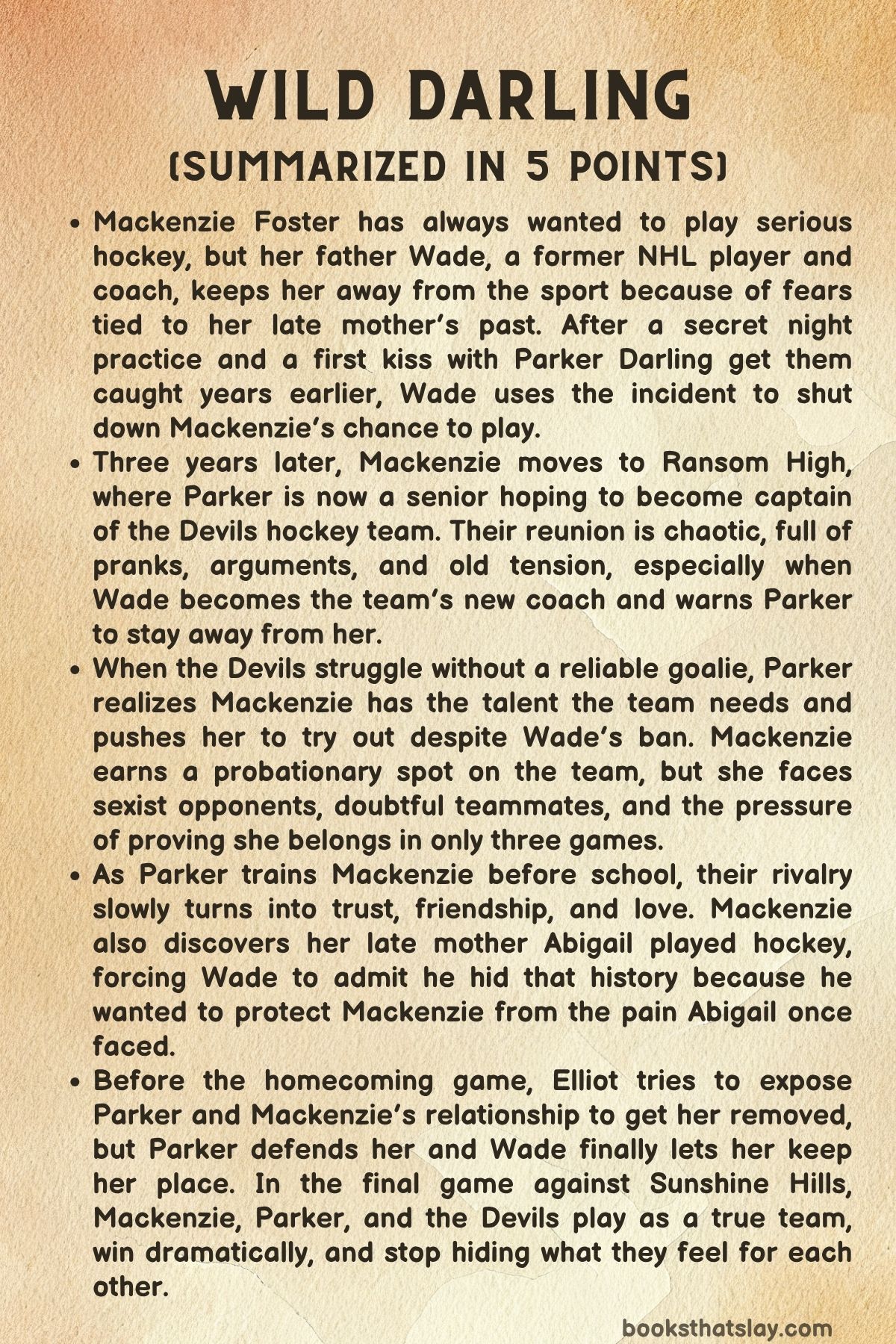
Summary
Mackenzie Foster has spent years loving hockey from the edges of the rink, even though the sport has always felt like the one thing her father refuses to let her truly claim. Her father, Wade Foster, is a former NHL player and a respected coach, but his attitude toward Mackenzie’s hockey dreams is restrictive and frustrating.
She has trained with her older brother Max, learned the position of goalie, and developed real skill, yet Wade continues to keep her away from serious competition. During the summer before freshman year, Mackenzie finally gets a chance to attend Wade’s elite hockey camp, hoping this will be the moment she proves she belongs.
Instead, camp immediately reminds her how hard it is to be a girl in a space dominated by boys who assume she is there as a joke. She hears sexist comments and faces the kind of casual dismissal that makes her more determined to show what she can do.
Later that night, she sneaks into the rink to practice alone, drawn by the freedom of the empty ice. There, she meets Parker Darling, a bold and talented player who has also entered the rink after hours.
Parker wants to impress Wade and prove himself worthy of attention, while Mackenzie wants a real chance to show her father she is serious.
Their first meeting is full of rivalry and spark. They challenge each other in a shootout, argue, tease, and test each other’s confidence.
Parker is cocky, Mackenzie refuses to back down, and the tension between them quickly turns into attraction. In the darkened rink, Mackenzie shares her first kiss with him, a moment that feels exciting and reckless at once.
But Wade catches them, and his reaction is harsh. He kicks Parker out of camp and treats the incident as evidence that Mackenzie cannot be trusted to take hockey seriously.
For Mackenzie, the fallout is devastating because it confirms her father’s worst assumptions and shuts down her hope of playing.
Three years later, Parker is a senior at Ransom High and preparing for a major season with the Ransom Devils. His brothers, Reed and Grayson, have already graduated and moved on to Ryker University, and Parker is eager to step out from behind their reputations.
He expects to be named captain and wants to prove he can lead the team on his own terms. But everything changes when Coach Ray leaves because of a back injury and Wade Foster becomes the Devils’ new coach.
Parker is immediately uneasy because Wade remembers exactly who he is and warns him again to stay away from Mackenzie.
Mackenzie has also moved to Ransom because of Wade’s new job. Her reunion with Parker is anything but smooth.
In the parking lot, Parker tries to return a set of keys, but Mackenzie mistakes the situation for an attempted mugging and punches him in the face. The black eye becomes instant school gossip, and Mackenzie soon realizes Parker is treated almost like royalty because of the Darling family’s hockey legacy.
Her first day at Ransom High becomes worse when Parker accidentally splashes her with dirty puddle water from his truck, forcing her to wear oversized lost-and-found clothes. She meets Jaz, who kindly helps her through the day, and Isaac, Jaz’s quiet friend, who gives her another point of connection in an unfamiliar school.
Parker and Mackenzie continue to clash, especially once they discover they share art class. Their school projects both connect to hockey, reminding them that the rink remains the center of their lives no matter how much they frustrate each other.
Meanwhile, the Devils’ season begins poorly. Their starting goalie, Elliot, is injured, and the backup goalie, Anderson, struggles badly under pressure.
The team loses its first game in embarrassing fashion. Mackenzie watches from the stands and cannot ignore how much she misses playing, even as she notices Parker’s skill and leadership on the ice.
After the game, Mackenzie sneaks into the boys’ locker room looking for her father and accidentally finds Parker wearing only a towel. Their argument becomes another round of revenge when Mackenzie steals his clothes and leaves him stranded.
Parker is forced to walk through the arena wearing only a pink scarf, but instead of letting the humiliation defeat him, he turns it into a joke and teases Mackenzie in front of everyone. Their dynamic remains hostile on the surface, but beneath it, both are clearly paying close attention to each other.
Parker begins to realize Mackenzie might be exactly what the Devils need. After witnessing her quick reflexes during a school trip, he understands she could solve the team’s goalie problem.
He asks her to try out, but Mackenzie refuses at first because Wade has banned her from playing. Parker keeps pushing because he sees her talent and because the team genuinely needs her.
He even climbs up to her bedroom window to convince her to consider it. Eventually, Mackenzie attends goalie tryouts in disguise and performs brilliantly.
Wade chooses her before realizing she is his daughter. When her identity is revealed, he is shocked and angry, but instead of cutting her immediately, he gives her three games to prove she deserves her spot.
Mackenzie’s first game as goalie is difficult. The opposing team taunts her with sexist comments, and her own teammates make things worse by trying too hard to protect her.
Instead of trusting her to do her job, they crowd her space and interfere with her play. The Devils lose again, leaving Mackenzie feeling as if she has failed before she has even had a real chance.
At a party afterward, Parker apologizes and admits he handled things badly. He also tells her the team needs her.
His honesty changes something between them, and he offers to train with her before school.
Their morning practices become a turning point. Parker works with Mackenzie on positioning, rebounds, confidence, and reading plays.
He pushes her hard, but he also supports her in a way that feels different from her father’s constant fear. Mackenzie improves quickly, and her trust in Parker begins to grow.
At the same time, Parker starts to see Mackenzie as more than a challenge or a complication. He notices her determination, her vulnerability, and how much she has had to fight simply to stand where other players are allowed to stand without question.
Their attraction becomes harder to deny. Parker gives her rides, walks her home, stands up for her during games, and becomes more protective without trying to control her.
Mackenzie, meanwhile, sees a more serious side of him beneath his confidence and teasing. She also continues to struggle with Wade, who insists he is protecting her but refuses to recognize that protection can become a cage.
Tessa, Mackenzie’s stepmother, quietly supports her, while Max remains one of her strongest allies. Max understands how much hockey means to her and encourages her to keep fighting for it.
Mackenzie also gets a glimpse of Parker’s family life. After a pond hockey game with Max, Reed, Grayson, Cammie, and Paige, she spends time with the Darlings and experiences the warmth of their home.
Amy Darling’s praise means a great deal to Mackenzie because it offers the kind of recognition she has long wanted from Wade. The Darling family’s support shows her what it feels like to be valued not as a problem to manage but as a player with real talent.
A major shift comes when Mackenzie finds a box of her late mother Abigail Hollis’s hockey belongings while unpacking. The box contains a jersey, goalie gear, medals, and photos.
Mackenzie realizes her mother played hockey too, a truth Wade had hidden from her. The discovery is emotional because it changes the story Mackenzie has been told about herself.
Her love for hockey is not random or rebellious; it connects her to her mother. Parker is with her when she finds the box, and the tenderness of the moment leads to another kiss while they hide from Wade in Mackenzie’s closet.
Afterward, they try to insist it was a mistake and agree to stay friends, but neither of them truly believes their feelings can be shut off that easily.
As Mackenzie continues trying to earn her place, Parker works on becoming the kind of leader the Devils need. He organizes team bonding to repair the lack of trust among the players.
Friendship bracelets and a team party may seem silly at first, but they help the Devils begin to act like a united group rather than a collection of frustrated individuals. Parker’s growth becomes clear as he stops focusing only on proving himself and starts paying attention to what the whole team needs.
Mackenzie eventually confronts Wade about Abigail. Wade explains that Abigail faced harsh treatment and deep disappointment in hockey, and before her death, she wanted Mackenzie protected from the same pain.
Mackenzie understands that her father’s fear comes from grief, but she also refuses to let that grief decide her future. She argues that the sport has changed and that she deserves the right to choose for herself.
Wade still struggles, but Mackenzie’s determination forces him to see her as someone with her own dreams, not just as someone he might lose or fail to protect.
Before the homecoming game against Sunshine Hills, the Devils’ biggest rival, Elliot returns and tries to reclaim the goalie position. He also exposes a photo of Parker and Mackenzie kissing, hoping Wade will punish Parker and remove Mackenzie from the team.
The moment could destroy everything, but Parker steps forward and takes responsibility. He makes it clear that his relationship with Mackenzie has nothing to do with her ability as a goalie.
Wade does not remove her. Instead, he keeps her on the team, names Parker captain, and gives Mackenzie her own jersey with her mother’s number, thirty-three.
This gesture shows that Wade is finally beginning to accept both Mackenzie’s talent and Abigail’s legacy.
Parker then confesses that he loves Mackenzie. Mackenzie returns his friendship bracelet and tells him she loves him too.
Their feelings are no longer hidden behind insults, jokes, or excuses. They have moved from rivalry to partnership, and their relationship now rests on respect as much as attraction.
In the homecoming game, the Devils finally play like a true team. Parker scores, Mackenzie makes important saves, and the players communicate with trust instead of panic.
When the game is tied near the end, Mackenzie redirects a dangerous rebound to Parker. He has the chance to take the glory shot himself, but instead he passes to Owen, trusting his teammate.
Owen scores just as the final siren sounds, giving the Devils a dramatic win over Sunshine Hills.
After the victory, Parker asks Mackenzie for a date based on their old bet, bringing their story back to where it began while showing how much has changed. He kisses her openly in front of the crowd, their teammates, and her father.
This time, there is no hiding and no shame. Mackenzie leaves the ice with Parker beside her, her place on the team earned, her mother’s legacy honored, and her future finally becoming something she gets to choose for herself.
Characters
Mackenzie Foster
Mackenzie Foster is the emotional and competitive center of the book, a girl whose love for hockey is both natural and hard-won. She has spent years training in the background, especially with her brother Max, while being denied the same opportunities that boys around her take for granted.
Her position as a goalie suits her personality because she is watchful, reactive, stubborn, and brave under pressure. She is not written as someone who simply wants attention or rebellion; she wants the chance to prove a skill she has built through effort.
Her anger toward Wade comes from being treated as fragile when she knows she is capable, and that frustration shapes many of her choices. She can be impulsive, as seen in her first parking lot encounter with Parker and in the prank where she steals his clothes, but that impulsiveness also reflects her refusal to be passive.
Across Wild Darling, Mackenzie grows from someone fighting to be allowed onto the ice into someone who understands that belonging is not something she has to beg for. Her discovery of Abigail’s hockey past deepens her identity and gives her a new connection to the mother she lost.
By the end, Mackenzie has earned her jersey, her teammates’ trust, and her father’s reluctant but meaningful acceptance.
Parker Darling
Parker Darling begins the novel as the confident, teasing hockey star who seems to have everything under control, but the story gradually reveals a more thoughtful and insecure side beneath his charm. He carries the weight of the Darling name, especially because Reed and Grayson have already created a legacy at Ransom.
Parker wants to become captain not only because he loves hockey but because he needs to know he can lead without being measured against his brothers. His early behavior is cocky, and he enjoys challenging Mackenzie, but he also recognizes her ability before many others do.
That recognition is important because Parker does not simply see her as Wade’s daughter or as a girl trying to enter a boys’ team; he sees a goalie who can make the Devils better. His growth is tied to leadership.
At first, he wants the captaincy as proof of personal worth, but through Mackenzie and the team’s struggles, he learns that leadership means building trust, accepting responsibility, and making choices that serve others. His pass to Owen in the final game shows this change clearly.
Parker’s romance with Mackenzie works because he respects her strength while also noticing the pain she tries to hide. In the book, he becomes not just her love interest but also her training partner, defender, and one of the first people to fully believe in her talent.
Wade Foster
Wade Foster is one of the most conflicted figures in the story because his actions are often frustrating, but his motives come from fear, grief, and unresolved pain. As a former NHL player and respected coach, he understands hockey deeply, yet his knowledge does not make him fair to Mackenzie.
He keeps her away from serious play because he believes he is protecting her, but his protection becomes controlling. Wade’s treatment of Mackenzie is shaped by Abigail’s past and death, and once that truth is revealed, his resistance becomes more understandable, though not automatically justified.
He has taken Abigail’s disappointment and turned it into a rule for Mackenzie’s life, deciding that his daughter should avoid the pain her mother faced. The problem is that he never gives Mackenzie the dignity of choosing for herself.
As a coach, he values discipline and commitment, but as a father, he struggles to see that Mackenzie has both. His decision to give her three games, keep her on the team after Elliot’s attempt to expose her, and finally give her a jersey with Abigail’s number shows slow but important change.
Wade does not transform overnight, but he begins to separate his fear from Mackenzie’s future. His arc gives the family conflict real weight because he must learn that love cannot be built on restriction alone.
Parker Darling’s Family
The Darling family offers warmth, humor, and a broader sense of belonging within the novel. Reed and Grayson represent the legacy Parker feels pressured by, but they are not only sources of comparison.
Their presence also shows that Parker comes from a family where hockey matters deeply and where achievement is part of everyday life. Cammie, Paige, and Amy Darling help create an atmosphere that feels welcoming rather than judgmental, especially for Mackenzie.
Amy’s praise is especially meaningful because Mackenzie is used to having her talent questioned or hidden. In the Darling home, she experiences something different: recognition without fear attached to it.
The family scenes also soften Parker’s image by showing him as a brother and son rather than just a popular school athlete. Through them, the book contrasts Wade’s guarded household with a family environment where support feels easier and more open.
The Darlings are not perfect, but they provide a sense of ease that Mackenzie needs. Their role is important because they help her understand what it feels like to be welcomed into a hockey-centered world instead of being pushed away from it.
Max Foster
Max Foster is Mackenzie’s older brother and one of the most steady sources of support in her life. Unlike Wade, Max does not treat Mackenzie’s hockey dreams as dangerous or unrealistic.
He has trained with her for years, which means he knows her ability firsthand and respects the work she has put in. His encouragement matters because it gives Mackenzie evidence that she is not imagining her own talent.
Max also serves as a bridge between Mackenzie’s family conflict and her hockey life. He understands the pressure of Wade’s expectations but does not use that pressure to hold her back.
His visits and support remind Mackenzie that someone in her family sees her clearly. He is also important in the scenes involving Parker and the Darling family because his presence helps bring different parts of Mackenzie’s life together.
Max’s role is quieter than Parker’s or Wade’s, but he helps anchor Mackenzie emotionally. In Wild Darling, he represents the kind of family support that strengthens rather than limits, proving that protection and belief do not have to be opposites.
Tessa Foster
Tessa, Mackenzie’s stepmother, plays a gentle but important role in the family dynamic. She is not the loudest advocate in the story, but her quiet support gives Mackenzie comfort in a household where Wade’s fear often dominates.
Tessa understands that Mackenzie needs room to make her own choices, and her presence helps soften the tension between father and daughter. She does not replace Abigail, nor does the story position her as trying to do so.
Instead, she exists as someone who cares for Mackenzie in the present while respecting the emotional weight of the past. Tessa’s support is significant because she sees the strain Wade’s decisions create and recognizes that Mackenzie’s desire to play hockey is not a phase or a rebellion.
Her role also helps show that the Foster household is not defined only by conflict. There is care there, but it is uneven, complicated, and often blocked by Wade’s inability to let go of old fears.
Tessa’s steady presence gives Mackenzie another adult who does not dismiss her feelings.
Abigail Hollis
Abigail Hollis is absent from the present action, but her influence shapes much of the story. For most of Mackenzie’s life, Abigail’s connection to hockey has been hidden, which creates a missing piece in Mackenzie’s identity.
When Mackenzie finds her mother’s hockey items, she discovers not just objects but proof of a legacy. Abigail’s jersey, gear, medals, and photos reveal that Mackenzie’s passion has roots in her family history.
This discovery changes Mackenzie’s understanding of herself and of Wade’s behavior. Abigail’s past also explains why Wade is so afraid.
She faced harsh treatment and disappointment in hockey, and her wish to protect Mackenzie was born from real pain. Still, Abigail’s memory becomes more than a warning.
Through Mackenzie, her love of the sport continues in a new way. The jersey number thirty-three becomes a powerful symbol because it connects mother and daughter across loss, secrecy, and time.
Abigail’s role in the novel shows how the past can be both a burden and a source of strength, depending on whether it is hidden or honored.
Jaz
Jaz becomes Mackenzie’s first real friend at Ransom High and helps her navigate a school where Parker Darling’s reputation seems to shape everyone’s reactions. She enters the story as a guide, but her importance goes beyond simply explaining the school’s social world.
Jaz gives Mackenzie a sense of connection during a difficult transition. Mackenzie’s first day is humiliating and uncomfortable, especially after Parker splashes her with dirty water, and Jaz’s friendliness helps keep her from feeling completely alone.
Through Jaz, the novel gives Mackenzie a life outside the rink and the Foster-Darling conflict. She represents ordinary friendship, the kind that helps a person survive awkward days, rumors, and the stress of being new.
Jaz’s presence also keeps Mackenzie grounded by giving her someone who is not directly tied to the team’s power struggles. She may not drive the central hockey plot, but she contributes to Mackenzie’s emotional adjustment and helps make Ransom feel more like a place Mackenzie can eventually belong.
Isaac
Isaac is a quieter character, but his presence adds balance to Mackenzie’s new school life. As Jaz’s book-loving friend, he brings a calmer energy to the story and helps widen Mackenzie’s circle beyond hockey players and family members.
His personality contrasts with Parker’s boldness and the loud atmosphere surrounding the Devils. Isaac’s role is not built around dramatic action; instead, he helps create a more believable social setting for Mackenzie at Ransom High.
He represents the kind of friendship that does not demand performance. For Mackenzie, who spends so much of the novel trying to prove herself to coaches, teammates, opponents, and her father, having quieter figures around her matters.
Isaac’s presence also reminds the reader that Mackenzie is not only an athlete or Parker’s love interest. She is a teenager trying to adjust to a new school, make friends, and find places where she can feel accepted.
His role is modest, but it helps support the broader world of the story.
Elliot
Elliot functions as both a practical obstacle and a symbol of entitlement within the team. As the injured starting goalie, he represents the position Mackenzie is trying to claim, and his return threatens the place she has worked hard to earn.
Instead of accepting that she has proven herself, Elliot tries to use personal information against her by exposing the photo of her and Parker kissing. His actions reveal insecurity and resentment.
He does not only want his position back; he wants Mackenzie removed by making her relationship with Parker seem like a reason to doubt her skill. This makes him a direct example of the unfair standards Mackenzie faces.
Male players are allowed mistakes, distractions, and ego, but Mackenzie’s private life is treated as potential evidence that she does not belong. Elliot’s attempt fails because Parker takes responsibility and Wade chooses not to punish Mackenzie.
In that sense, Elliot’s role helps mark a turning point. His sabotage forces the people around Mackenzie to decide whether they truly believe in her, and for once, the answer is yes.
Owen
Owen becomes important near the end because his final goal represents the Devils’ growth as a team. He is not the central player in the story, but his role in the homecoming game shows how far the team has come from its early disorganized losses.
When Parker receives Mackenzie’s redirected rebound, he could take the shot himself and claim the glory. Instead, he passes to Owen, trusting him in the game’s biggest moment.
Owen’s successful shot proves that the Devils have learned to rely on each other. His goal is not just a sports victory; it is a sign that Parker has become a real captain and that Mackenzie has become a trusted part of the team’s rhythm.
Owen’s role also matters because it prevents the ending from becoming only about Parker’s hero moment. The win belongs to the team, and Owen’s goal makes that clear.
Through him, the story shows that trust can turn individual talent into shared success.
Themes
Fighting for a Place in a Male-Dominated Space
Mackenzie’s journey is shaped by the constant need to prove that her talent is real in an environment that assumes she does not belong. The boys at camp dismiss her before they have seen what she can do, and later, opposing players use sexist comments to unsettle her during games.
Even her own teammates initially hurt her performance by overprotecting her instead of trusting her. This theme is not limited to open insults; it also appears in the quieter ways Mackenzie is doubted, managed, and treated as an exception.
Her skill as a goalie is never the real problem. The problem is that people keep looking at her gender before they look at her ability.
The three-game probation period becomes a test not only of her athletic performance but of her endurance in the face of unfair pressure. Her success matters because she does not win acceptance by becoming less herself.
She earns her place by playing with courage, improving through training, and forcing others to judge her by her saves, decisions, and commitment. The book treats her fight as both personal and social, showing how hard it can be to enter a space that was never built to welcome you.
Protection, Control, and the Fear of Letting Go
Wade’s love for Mackenzie is real, but his fear turns that love into control. His refusal to let her play serious hockey is rooted in Abigail’s painful experience and in the promise that Mackenzie should be protected from the same disappointment.
Yet the story makes clear that protection becomes harmful when it denies someone the right to choose. Wade believes he is saving Mackenzie from pain, but he also cuts her off from joy, growth, and identity.
His mistake is assuming that avoiding risk is the same as keeping someone safe. Mackenzie’s conflict with him becomes one of the most important emotional threads in Wild Darling because it forces both father and daughter to confront what love should look like after loss.
Mackenzie does not reject Wade’s grief, but she refuses to let it become the boundary around her life. The jersey with Abigail’s number becomes meaningful because it shows Wade beginning to understand that honoring the past does not mean repeating its fear.
Letting Mackenzie play is not a betrayal of Abigail’s memory; it is a way of allowing Mackenzie to live fully.
Trust as the Foundation of Teamwork
The Devils’ early losses come from more than weak goaltending. The team lacks trust, communication, and unity.
Anderson struggles under pressure, Elliot’s absence leaves a gap, and Mackenzie’s arrival exposes how poorly the players understand what teamwork actually requires. When she first plays, her teammates crowd her space because they think they are helping, but their lack of trust makes her job harder.
The team only begins to improve when players learn to respect each other’s roles. Parker’s development as captain is central to this theme.
He starts the season wanting the title as proof that he can stand apart from his brothers, but he earns it by learning how to bring people together. The friendship bracelets and team party may seem light, but they create connection where there had been distance.
The final game shows the result of that change. Mackenzie trusts Parker with the rebound, Parker trusts Owen with the shot, and Owen finishes the play.
The victory belongs to everyone because the team finally understands that success does not come from one star player carrying the game. It comes from shared responsibility.
Love Built on Respect and Recognition
Mackenzie and Parker’s romance begins with rivalry, mischief, and attraction, but it becomes meaningful because they learn to see each other clearly. Their first kiss at camp is exciting, but it is also tied to consequences that separate them for years.
When they meet again, their connection is messy, full of arguments, embarrassment, and competition. What changes the relationship is not simply that they are drawn to each other.
Parker recognizes Mackenzie’s talent before many others do, and Mackenzie sees that Parker’s confidence hides pressure and insecurity. Their morning practices create a bond built on work and trust.
He challenges her without treating her as weak, and she pushes him to become more serious and selfless. Their romance matters because it does not ask Mackenzie to give up her goals.
Instead, Parker becomes one of the people who helps her fight for them. His public defense of her after Elliot exposes the photo is important because he refuses to let their relationship be used to reduce her credibility.
By the end, their love is open because it has grown beyond secrecy and teasing. It rests on belief, respect, and the courage to stand beside each other without hiding.