Wife-Shaped Bodies Summary, Characters and Themes
Wife-Shaped Bodies by Laura Cranehill is a dark speculative horror novel about marriage, bodily control, inherited violence, and the terrifying systems built to preserve male desire. Set inside a decaying walled compound after ecological collapse, the story follows Nicole, a young woman prepared to become a wife by being physically cut down into an acceptable shape.
Her world is ruled by old men, dead wives, fungal biology, and rituals disguised as survival. As Nicole enters marriage, she begins to understand that the compound’s rules are not natural law but manufactured control, and that the women’s altered bodies may contain the power to end it.
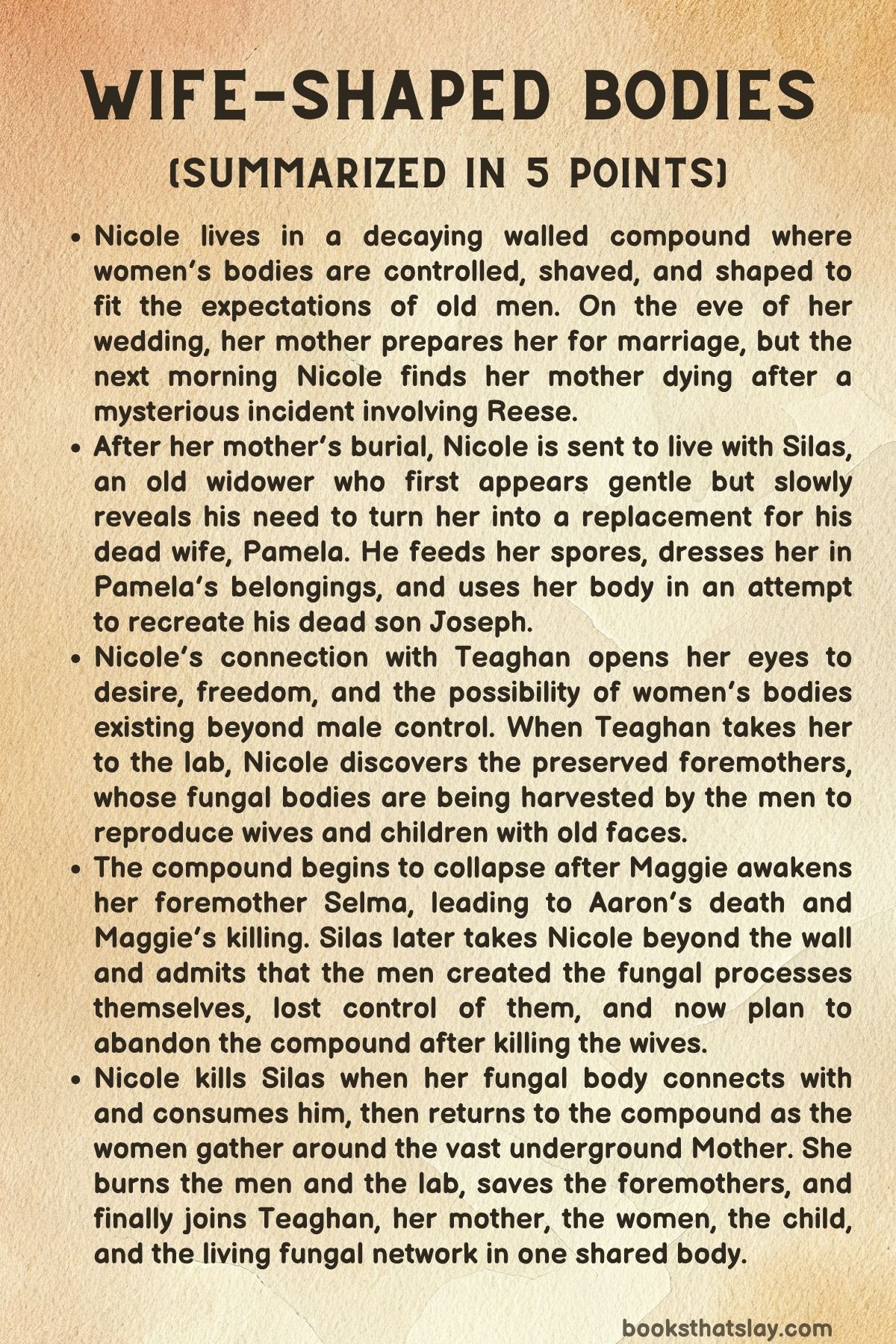
Summary
Nicole lives in a failing walled compound where women are trained to become wives and men hold authority over their bodies, futures, and memories. The compound is full of decay: old homes, poisonous woods, ruined structures, fungal growth, and elderly men trying to maintain a dying social order.
Women grow strange fungal bodies, but before marriage they are shaved down so they can resemble the dead wives who came before them. Nicole has been raised to accept this as normal, even as the process harms her.
On the night before her wedding, her mother removes Nicole’s growths, preparing her to be presented as a proper bride. The shaving leaves Nicole weak, exposed, feverish, and physically wounded.
The next morning, Nicole wakes to crying and confusion. Her mother is dying after contact with glowing fungus from a luciferin lantern.
Nicole’s sister Maggie is present with her young daughter, Eloise, and says their mother was hurt in Reese’s room. Reese, Nicole’s father, acts devastated, but he also tries to defend himself.
Nicole’s mother asks for him, and Reese goes to her bed before she dies. Afterward, Reese cuts off her hair, which will be braided and displayed with the hair of his other dead wives.
The gesture reveals how women in the compound are treated even after death: remembered less as full people than as parts of a husband’s collection.
Because it is Saturday, the women have a short period of freedom while the men gather elsewhere. Maggie and Nicole carry their mother’s body to the graveyard.
For Nicole, this becomes her first real view of the compound beyond her home. She sees ruined houses, the lab, crops, the black wall, and the poisoned woods outside.
Other women join the burial, and the event becomes both a funeral and a wedding ritual. The women bury Nicole’s mother, sing for her, and cover her body with flowers.
Then they turn their attention to Nicole, pushing her through a tunnel of bodies while whispering advice about how to survive marriage. Their words are not romantic or hopeful.
They tell her to hide, stay quiet, avoid her husband’s gaze, avoid being near him, and live long enough to become pregnant.
During this ritual, Nicole meets Teaghan, a girl she has watched from her window for years. Nicole has long admired her from afar, and their first real contact leaves a strong impression.
Maggie then tells Nicole something she does not want to believe: Reese killed their mother intentionally so Nicole would have no reason to come back home. Nicole rejects this idea because accepting it would mean accepting the full cruelty of the men who raised and ruled her.
Instead, she leaves for Silas’s house, stepping into her new role as his wife.
Silas lives in a large mauve house on the outskirts. At first, he seems gentler than Reese and less openly cruel than the world Nicole has known.
He is old, lonely, odd, and eager to make Nicole comfortable in his own way. He gives her clothing and jewelry that belonged to Pamela, his first wife, and shows her the damp, decaying rooms of his home.
He also gives her pieces of history. He explains that the compound was once a retirement community called Mountain Falls Lake before the outside world collapsed.
Through photographs, he tells Nicole about Pamela and their son Joseph. Pamela, he says, was a midwife before everything changed.
Silas also speaks about radiation, poisoned land, mushroom work, and the compound’s attempts to make the environment survivable again.
Yet the kindness in Silas’s behavior is limited and unstable. He soon tells Nicole it is time for her to become pregnant.
He says he has chosen “a face” for their child. Nicole first thinks he means her dead mother, but this misunderstanding hides something even more disturbing.
Silas begins having sex with her and feeding her spores from a Crown Royal pouch. Nicole believes the powder is part of pregnancy, because she has never been given enough knowledge about her own body to question him fully.
The spores change her quickly. She becomes thirsty, restless, sensitive, and emotionally unstable.
Her body begins moving toward a form of pregnancy that is not natural in any ordinary sense.
Teaghan visits Nicole and invites her into the company of the other women. When Teaghan touches her, Nicole feels an intense physical and emotional connection, something unlike anything she has experienced with Silas.
This contact awakens both desire and new awareness. Later, Teaghan brings Nicole to the lab using stolen keys.
Inside, Nicole discovers the secret foundation of the compound. The “foremothers,” ancient original women, are being kept in beds, preserved and altered so that the men can harvest their fungal material.
These bodies are used to create new wives and children with old faces. Nicole sees her own foremother and realizes that women’s lineages are not being honored but controlled.
The men are using women’s bodies as living archives, production sites, and tools for restoring the dead.
Teaghan wants to understand what women could create without male control, but Nicole is terrified. The lab is too much for her, and she runs.
Silas later notices changes in Nicole caused by Teaghan’s touch. He becomes angry and invasive, inspecting her mouth and demanding the name of the woman who affected her.
Nicole survives by pretending to become Pamela. She speaks and behaves like Silas’s dead wife, giving him the illusion he wants most.
Silas accepts this because his grief and selfish longing have made him desperate to believe Pamela can return through another body. Nicole learns that performance can protect her, but it also traps her more tightly inside Silas’s fantasy.
Her pregnancy advances at an unnatural speed. Silas tends to her body, washes her, explains pieces of her fungal condition, and handcuffs her to the bed under the claim that he is protecting her.
He dresses her in Pamela’s clothes and jewelry, turning her into a replacement wife rather than seeing her as herself. Nicole feels the presence of the forming child and comes to love it, believing it is a daughter.
This belief gives her a private hope that something new and hers might exist inside the horror of the marriage. But when the birth-like event arrives, she tears the growth from her body and finds that the child is a dead boy.
She realizes Silas used Joseph’s spores, trying to recreate his dead son through her. The pregnancy was never about Nicole, motherhood, or a shared future.
It was another act of possession.
After this, Nicole is filled with grief and rage. Silas does not punish her in the way she expects, but something in her changes permanently.
She no longer wants to let him or any man claim her body. At the same time, the compound begins to fracture.
Maggie brings her awakened foremother, Selma, out of the lab. Selma is barely conscious, heavily altered, and both frightening and fascinating to the women.
Aaron, Maggie’s husband, has used drugs to awaken Selma, and Silas explains that this means Aaron has given up. Selma kills Aaron, and Maggie is shot and killed as well.
Maggie’s death confirms the cost of defiance, but it also shows that the old order is weakening.
At Aaron’s funeral, Nicole sees how little the men care about women’s grief. Their rituals honor men while women’s suffering is treated as an inconvenience.
The women plan a funeral for Maggie, but Silas takes Nicole away before she can join them. He brings her beyond the wall and gives her mushrooms to eat.
In the woods, the truth expands. Silas admits there is no plague in the simple way Nicole was taught.
The men created fungal processes to filter toxins and radiation from their bodies, but they lost control of what they made. Now the other men intend to abandon the compound, kill the wives, and destroy the evidence of what they have done.
Silas wants Nicole to leave with him and begin again somewhere else. But Nicole understands that his version of escape still centers his needs.
He helped isolate her so she would accept hiding in his house with Joseph’s dead memory. In the woods, Nicole’s fungal body connects to Silas’s body and memories.
She sees Pamela’s reluctance, Joseph’s suffering, and Silas’s guilt. The knowledge confirms that Silas has always known more than he admitted.
Then Nicole’s mycelium enters him fully, feeds on him, and kills him. She returns over the wall alone, no longer his wife in any meaningful sense.
Back inside the compound, Nicole finds the women at the graveyard. They have built a giant figure named Mary from scrap and covered it in blood as a gift for the men.
Instead of running, the women turn toward the ground itself. They find the Mother, a vast underground mycelial presence beneath the compound.
One by one, the women are taken into it, their bodies changing as they join a ring of women. Teaghan, heavily pregnant, also joins the Mother.
The women are no longer isolated wives in separate houses. They become part of something larger, older, and more powerful than the men understood.
Nicole then goes to the lab. She feels the rage of the foremothers and the dead sons whose bodies and spores were used in the men’s experiments.
Carrying fire, she burns the men in their houses. She also carries the foremothers out of the lab before burning it, destroying the place where women’s bodies were preserved for male control.
The compound’s system ends not through rescue from outside, but through the women’s altered bodies turning against the men who made them suffer.
In the end, Teaghan gives birth from within the Mother. Nicole catches the baby and sees Teaghan alive within the child.
She touches Teaghan’s split belly, closing the distance between them at last. Then the underground threads rise and take Nicole too.
She joins Teaghan, her mother, her lost son, the women, the ancestors, the trees, the rain, and the child in one growing body. Nicole’s ending is not a return to ordinary life, but a transformation into collective survival.
The body that men tried to shave, shape, use, and replace becomes part of a living network beyond their control.
Characters
Nicole
Nicole is the central figure of the book, and her journey moves from obedience and confusion toward fury, knowledge, and transformation. At the beginning of Wife-Shaped Bodies, she has been raised to understand herself only through the role she is expected to fill: daughter first, then wife, then mother.
Her body is treated as a problem to be managed, shaved, corrected, and prepared for a husband’s use. This makes her early fear and hesitation believable because she has not been given the language or freedom to understand what is happening to her.
She wants to believe in the people closest to her, especially Reese and Silas, even when their actions reveal cruelty. Her refusal to accept Maggie’s accusation against Reese shows how deeply she depends on old ideas of family and protection.
Nicole’s marriage to Silas forces her into a harsher education. At first, she reads his gentleness as safety because it is less violent than what she expects, but she slowly learns that kindness can still be a form of possession.
Silas does not simply want a wife; he wants Pamela, Joseph, and his lost life restored through Nicole’s body. Nicole’s pregnancy becomes the most painful stage of her awakening because she forms real love for the child she believes she carries, only to discover she has been made into a vessel for Silas’s dead son.
Her grief after the dead boy’s birth is both maternal and personal, because the event proves how completely her body has been used without consent.
Nicole’s connection with Teaghan opens another path for her. Teaghan’s touch awakens desire, bodily awareness, and the possibility of female creation beyond male design.
Nicole is frightened by this at first, especially when she sees the foremothers in the lab, but fear gradually turns into understanding. Her killing of Silas is not only revenge; it is the moment when her altered body stops being a tool of male survival and becomes an agent of judgment.
By the end, Nicole’s movement into the Mother is not simple defeat. It is her final rejection of the wife-shape forced on her, and her entry into a collective female body that holds memory, grief, birth, death, and renewal together.
Silas
Silas is one of the book’s most disturbing figures because his cruelty is wrapped in loneliness, tenderness, and grief. He is not presented as a simple monster who enjoys violence openly.
Instead, he is an old man who understands pieces of the truth, carries guilt over the past, and still chooses to use Nicole for his own needs. His house reflects him: large, damp, faded, and full of the dead.
Pamela’s clothes, jewelry, photographs, and memories surround Nicole from the moment she arrives, making it clear that Silas does not want a new wife as much as he wants to rebuild a lost household.
His relationship with Pamela and Joseph shapes nearly every action he takes. He cannot accept their absence, so he turns Nicole into a substitute.
His decision to use Joseph’s spores reveals the depth of his selfishness. He allows Nicole to believe she is creating a child of her own while he secretly tries to remake his dead son.
Even when he cares for Nicole’s body, washes her, feeds her, or claims to protect her, his care is corrupted by ownership. The handcuffs, the clothing, the jewelry, and his acceptance of Nicole’s Pamela performance all show that he would rather live inside an illusion than face Nicole as a separate person.
Silas also represents the failed conscience of the compound. He knows more than most women do about the outside world, the radiation, the fungal experiments, and the men’s plans to erase the evidence.
Yet knowledge does not make him innocent. He may be less openly brutal than Reese or Aaron, but he still benefits from the system and helps maintain it.
His desire to flee with Nicole comes too late and remains selfish because he wants escape without full accountability. When Nicole’s mycelium enters him, she gains access to the memories he has hidden, including Pamela’s reluctance and Joseph’s suffering.
His death is the collapse of the story he told about himself: that grief excused harm, and that love could exist without consent.
Teaghan
Teaghan is a figure of possibility, rebellion, and bodily freedom. For Nicole, she begins almost as a dream seen from a window, someone admired from a distance before real contact becomes possible.
When Teaghan finally enters Nicole’s life directly, she brings with her a kind of knowledge Nicole has been denied. She moves through the women’s hidden spaces, steals keys, enters the lab, and asks dangerous questions about what women could make without men guiding or harvesting them.
Her courage is not careless; it grows from a clear understanding that the compound’s rules are designed to keep women separated, afraid, and dependent.
Teaghan’s physical connection with Nicole is crucial because it gives Nicole a form of touch that is not rooted in duty or extraction. Silas touches Nicole as a husband claiming a wife, but Teaghan’s touch awakens recognition.
It changes Nicole’s body and exposes how much power exists between women when their bodies are not forced into male purposes. This is why Silas reacts with such alarm.
Teaghan represents a threat to the entire system because she shows that women’s altered bodies are not only reproductive machines for men. They can communicate, transform, desire, and create on their own terms.
Her pregnancy and entrance into the Mother place her at the center of the book’s final transformation. Teaghan does not escape the compound in a conventional sense, but she becomes part of the living female network beneath it.
Her child is not simply a child in the ordinary human way; the baby carries Teaghan’s presence and signals a new form of continuity. Teaghan’s role in Wife-Shaped Bodies is therefore both intimate and revolutionary.
She helps Nicole see beyond wifehood as obedience, and by the end, she becomes part of a birth that belongs to the women and the Mother rather than to the men’s experiments.
Maggie
Maggie is Nicole’s sister and one of the strongest examples of a woman who understands the compound’s violence more clearly than Nicole does. She enters the story at a moment of crisis, present at their mother’s death with her daughter Eloise, and she immediately names what Nicole cannot accept: Reese killed their mother on purpose.
Maggie’s role is often tied to hard truth. She does not soften the danger of marriage for Nicole, nor does she romanticize survival.
Her knowledge has been earned through life as Aaron’s wife and through the constant pressure of raising Eloise in a world where female bodies are watched and used.
Maggie’s actions show both desperation and defiance. She helps carry their mother to the graveyard, participates in the women’s rituals, and later brings Selma out of the lab.
That decision is risky and unsettling, but it also proves Maggie’s refusal to leave the foremothers as hidden resources for men. Selma’s awakening breaks the boundary between the lab’s secret horror and the women’s daily lives.
Maggie’s courage is not clean or safe; it creates danger, but it also exposes truths that the men rely on keeping buried.
Her death after Selma kills Aaron shows the brutal cost of resistance inside the compound. Maggie does not receive the dignity or attention that Aaron receives from the men’s funeral customs, which makes Nicole see the imbalance even more sharply.
Yet Maggie’s influence continues after her death. She gives Nicole the first direct warning about Reese, models suspicion toward male authority, and helps bring the lab’s hidden violence into the open.
Through Maggie, the book shows that survival is not passive endurance. Sometimes survival also means telling the truth, acting before permission is granted, and risking death so that others can finally see.
Reese
Reese is Nicole’s father and one of the clearest examples of patriarchal violence in the story. He appears first as a grieving husband, but Maggie’s accusation reframes him as a man who may have murdered Nicole’s mother to sever Nicole’s last tie to home.
His defensiveness after the lantern incident suggests guilt, and his later act of cutting off his dead wife’s hair shows the possessive ritual at the core of his relationships. The braid of wives’ hair is not a loving memorial.
It is a symbol of collection, replacement, and ownership.
As a father, Reese represents the betrayal of protection. Nicole’s inability to accept Maggie’s claim shows that she still wants to believe in him, but the compound’s family structure makes that belief dangerous.
Fathers and husbands are not separate roles in this world; they are linked positions in the same system of control. Reese prepares Nicole to be transferred into another man’s house, and if Maggie is right, he removes Nicole’s mother so Nicole will have no emotional refuge.
His grief, whether real or performed, does not erase his power over the women around him.
Reese’s importance lies in how he shapes Nicole before Silas ever claims her. He teaches her, directly or indirectly, that women’s pain is ordinary and that men’s desires determine the terms of family life.
His house is the first prison Nicole knows. Silas’s home becomes the second.
By placing Reese near the beginning of the story, the novel makes clear that Nicole’s oppression does not begin with marriage. Marriage only changes the name of the man who controls her.
Nicole’s Mother
Nicole’s mother is present for a short time in the active plot, but her influence is large because her death begins Nicole’s passage into marriage and loss. Before she dies, she shaves Nicole’s growths, participating in the ritual that prepares her daughter to become an acceptable wife.
This action is painful because it shows how women can be forced to carry out the rules that harm other women. Nicole’s mother is not simply cruel; she is a woman shaped by the same system, passing on survival practices because she may see no safe alternative.
Her death after contact with the glowing fungus creates the first major rupture in Nicole’s life. Whether Reese causes it directly, as Maggie believes, or uses the situation to his advantage, the result is the same: Nicole loses the one person who might have anchored her to her childhood home.
The timing makes her death feel like part of the wedding process, as though the old wife and mother must be removed so Nicole can be handed fully to Silas. Reese cutting off her hair reinforces that even death does not free her body from male ritual.
In the graveyard, however, the women reclaim her briefly. They bury her together, sing over her, cover her body with flowers, and fold her death into Nicole’s wedding ceremony.
This mixture of mourning and initiation shows the painful continuity between generations of women. Nicole’s mother becomes part of the ancestry Nicole later joins through the Mother.
Though she cannot save Nicole directly, her death exposes the violence hidden beneath family custom and becomes one of the losses Nicole carries into her final transformation.
Selma
Selma is Maggie’s foremother, an ancient female body taken from the lab and brought into the women’s world. She is barely conscious, altered, and frightening, but her presence is powerful because she is living evidence of what the men have done.
The foremothers are not honored ancestors. They are preserved, drugged, changed, and harvested.
Selma’s body makes the compound’s secret impossible to ignore. She is both a person and a wound left open across generations.
Her awakening unsettles everyone because she does not fit the roles assigned to women in the compound. She is not a wife, daughter, mother, or obedient body.
She is something older and angrier, carrying the damage of long-term captivity. When she kills Aaron, the act is shocking, but it also reads as a violent return of all the harm men tried to bury inside the lab.
Aaron’s death is not random. It comes from the very system he participated in and tried to manipulate.
Selma’s role is important because she breaks the illusion that the past is dead. The foremothers are still present, still suffering, and still connected to the women who came after them.
Selma’s body forces Maggie, Nicole, and the others to confront the fact that their lives are built on the ongoing exploitation of earlier women. Her presence helps move the story toward collective revenge and collective release, especially when Nicole later carries the foremothers out before burning the lab.
Aaron
Aaron is Maggie’s husband and a representative of male failure within the compound. His decision to awaken Selma with drugs suggests desperation, recklessness, or surrender.
Silas says this means Aaron has given up, which implies that the men know the system is collapsing but respond in selfish and dangerous ways. Aaron does not appear as a powerful visionary or even a stable authority.
He is a man inside a dying order, tampering with forces he cannot control.
His death at Selma’s hands is one of the first clear signs that the men’s control over fungal bodies and female ancestry is breaking down. He tries to use or awaken what the lab has contained, and that act turns against him.
The aftermath also reveals the values of the compound. Aaron receives male-centered funeral attention, while Maggie’s death is treated with far less respect.
Through Aaron, the book shows how men are publicly mourned even when their actions contribute to disaster, while women’s suffering is pushed aside.
Aaron’s role is not as emotionally layered as Silas’s, but he is important as a structural character. He helps expose the instability of the men’s world.
His attempt to control Selma results in his own death, proving that the bodies and histories the men have exploited cannot remain passive forever.
Pamela
Pamela is dead before Nicole enters Silas’s house, but she dominates the space Nicole is forced to inhabit. Her clothes, jewelry, photographs, and memories become tools Silas uses to overwrite Nicole’s identity.
Pamela is not only Silas’s lost wife; she is the mold Nicole is expected to fill. Every object Silas gives Nicole carries the message that a wife is replaceable if her shape, clothing, and behavior can be repeated.
Yet Pamela’s memory becomes more complicated when Nicole sees Silas’s hidden past. Pamela was a midwife before the collapse, someone connected to birth and women’s bodies before those bodies became controlled through the compound’s fungal systems.
Nicole’s later access to Silas’s memories reveals Pamela’s reluctance, suggesting that Silas’s version of their marriage may have been shaped by denial. He remembers her through longing, but that longing does not guarantee truth.
Like Nicole, Pamela may have been forced into roles that served him more than her.
Pamela’s importance lies in how the dead are used by the living. Silas claims to love her, but he uses her memory to imprison Nicole.
He turns grief into a demand that another woman disappear into Pamela’s place. In this way, Pamela is both victim and instrument: a woman whose own life was likely constrained, and whose image is later used to constrain someone else.
Nicole’s refusal to remain Pamela’s replacement becomes part of her larger refusal to be shaped by male grief.
Joseph
Joseph is Silas and Pamela’s dead son, and his presence drives one of the book’s most horrifying revelations. At first, Nicole believes Silas wants to choose a face for their child in a way connected to the dead wives or female lineages.
Later, she learns that Silas has used Joseph’s spores in an attempt to recreate him. Joseph’s dead body, memory, or biological trace becomes another preserved material inside the compound’s larger system of reproduction and replacement.
The tragedy of Joseph is that he, too, seems to have suffered under the world the men built. When Nicole connects to Silas’s memories, she sees Joseph’s suffering and Silas’s guilt.
This complicates the story’s treatment of children and sons. The men may value sons more openly than wives, but even sons are not truly free in a society obsessed with control, repetition, and survival at any cost.
Joseph is loved by Silas, but that love becomes destructive when Silas tries to force his return through Nicole.
For Nicole, the dead boy’s birth is devastating because she had loved the forming child as her own. Joseph’s attempted recreation turns her hope into violation.
He represents the way grief can become monstrous when it refuses death and uses another body to reverse loss. His presence also joins the anger Nicole feels in the lab, where the dead sons and foremothers seem to demand recognition.
Joseph is not the villain of that violation; he is another dead figure used by Silas’s refusal to let go.
Eloise
Eloise, Maggie’s daughter, represents the next generation of girls born into the compound’s violence. Her presence beside Maggie during Nicole’s mother’s death reminds readers that the rules harming Nicole are not ending with her.
Without change, Eloise would inherit the same future: bodily alteration, shaving, marriage, pregnancy, fear, and possible erasure inside a husband’s house. She is still young, but that youth makes her role especially painful because the reader can see the life waiting for her if the system survives.
Eloise also helps define Maggie’s urgency. Maggie is not only fighting for herself or warning Nicole out of bitterness.
She is a mother who understands that her daughter’s future depends on whether the women can break the pattern. This gives Maggie’s actions a generational force.
Every risk she takes, including bringing Selma from the lab, carries the shadow of Eloise’s possible fate.
Although Eloise does not drive the plot directly, her presence gives emotional weight to the story’s ending. The destruction of the men’s system matters because girls like Eloise cannot be allowed to become the next bodies shaved into obedience.
She stands for the children who might be spared if the women’s transformation creates a future outside the old order.
The Foremothers and the Mother
The foremothers are among the most important collective figures in the novel. They are the original women whose bodies have been preserved, altered, and harvested in the lab.
Their condition reveals the true foundation of the compound: the men’s survival depends on the continuous use of women’s bodies across generations. The foremothers are treated as resources rather than people, but their anger remains present.
When Nicole sees her own foremother, she understands that her life is connected to a longer history of control.
The Mother expands that history into something vast and living. Unlike the lab, where female bodies are isolated in beds for male use, the Mother is underground, collective, active, and transformative.
It gathers the women into a shared body, not as punishment but as a form of release from the wife-shaped roles imposed on them. The Mother does not restore ordinary life, but ordinary life in the compound was never free.
It offers another kind of existence based on connection rather than ownership.
By the end of Wife-Shaped Bodies, the Mother becomes the answer to the men’s failed experiments. The men tried to use fungal life to filter poison, preserve lineage, and recreate the dead, but they ignored the will and memory of the women whose bodies made that possible.
The Mother turns those same materials into female continuity, revenge, birth, and renewal. It holds Nicole, Teaghan, the dead, the living, the child, and the natural world in one growing presence.
Themes
Bodily Control and the Violence of Wifehood
In Wife-Shaped Bodies, wifehood is not treated as partnership but as a physical shape forced onto women. Nicole’s body is literally shaved before marriage so she can appear acceptable, and this act makes visible the violence behind social expectations that might otherwise be hidden under ritual.
The compound does not simply ask women to behave like wives; it cuts, dresses, confines, impregnates, and reuses them until their identities are reduced to what husbands need. Silas’s treatment of Nicole sharpens this theme because he does not only want obedience.
He wants her to become Pamela, carry Joseph, wear another woman’s clothes, and accept his memories as the center of her body. Even his care becomes a method of control, especially when he washes her, handcuffs her, and explains her body only in ways that serve him.
The horror comes from how marriage turns biological life into property. Nicole’s final transformation rejects the wife-shape entirely.
Her body, once managed by men, becomes part of a living network they cannot command.
Inheritance, Repetition, and the Use of the Dead
The compound survives by repeating the dead through the bodies of the living. Wives are expected to resemble earlier wives, children can be made with chosen faces, and the foremothers are preserved as biological sources for new generations.
This creates a world where inheritance is not loving continuity but forced repetition. Silas’s desire to recreate Joseph shows the cruelty of refusing loss.
Instead of mourning his son, he uses Nicole’s body to attempt a return that can only produce death and suffering. Pamela’s memory works in a similar way.
Silas does not honor her by remembering her honestly; he turns Nicole into her substitute. The braid of dead wives’ hair in Reese’s possession also reflects this theme, reducing women’s lives to trophies that outlast them.
The foremothers reveal the oldest layer of this violence. Their bodies are kept alive so men can continue controlling female lines.
The ending breaks repetition by transforming inheritance into collective memory rather than male possession. The women join their ancestors without being reduced to copies of them.
Female Connection as Knowledge and Resistance
The men’s power depends on keeping women frightened, isolated, and misinformed. Nicole begins the story with very little knowledge of the compound beyond her own home, and that ignorance makes her easier to control.
Her first real education comes from women: Maggie’s warning about Reese, the graveyard whispers about surviving husbands, Teaghan’s invitation, and the discovery of the lab. These moments show that female connection is not only emotional comfort but a way of passing forbidden knowledge.
Teaghan’s touch is especially important because it awakens Nicole’s body outside the terms of marriage. Through Teaghan, Nicole learns that her altered body is not only a problem or a reproductive tool.
It can respond, desire, communicate, and change. The women’s rituals also matter because they create meaning beyond male ceremonies.
The burial of Nicole’s mother, the planned funeral for Maggie, and the final gathering around Mary and the Mother all challenge the men’s version of order. Resistance grows when women stop seeing themselves as separate wives in separate houses and begin recognizing themselves as part of a shared body.
Ecological Collapse and the Revenge of Altered Nature
The poisoned woods, ruined retirement community, fungal bodies, and underground mycelial presence create a world where environmental disaster and social control cannot be separated. The men claim authority because they understand the old world, the radiation, and the experiments that were meant to make survival possible.
Yet their knowledge is incomplete and arrogant. They create fungal processes to cleanse toxins and protect themselves, but they also use those processes to control women and preserve their own desires.
Nature in the novel is not passive scenery. It has been damaged, altered, and forced into service, much like the women’s bodies.
The men believe they can manage it through labs, walls, lanterns, spores, and rules, but the fungal network beneath the compound grows beyond their control. Nicole’s body becomes part of that reversal.
What was designed to make her useful to Silas becomes the means of killing him. The Mother’s rise suggests that the buried natural world has absorbed grief, poison, memory, and rage.
Its revenge is not clean restoration, but it is a powerful answer to the men’s belief that life can be controlled without consequence.