Who Knew the Ridpath Girl? Summary, Characters and Themes
Who Knew the Ridpath Girl? by Stacy Johns is a mystery thriller about guilt, buried family violence, and the long afterlife of a childhood tragedy. The story begins with a terrible dog attack that scars Douggy Ridpath and leaves her brother Gracen convinced that he ruined her life.
Years later, Gracen’s podcast about Douggy’s death reopens old wounds in Meander, Oregon, and draws dangerous attention from people who want to control the truth. As murders begin to follow the podcast’s release, the story shifts between personal regret, police investigation, and the revelation that Douggy’s death was never the accident everyone believed it to be.
Summary
In 2006, Gracen Ridpath is a young boy who is more interested in his own world than in looking after his little sister, Douggy. On the morning of a friend’s birthday sleepover, he is restless, irritated, and eager to get to the bus stop without delay.
Douggy wants him to play with her before school, but Gracen is impatient with her need for attention. Their mother, Marjorie, tells him to hold Douggy’s hand as they walk, especially near the dangerous part of the road where a fierce German shepherd lives behind an old fence.
Gracen resents the responsibility and refuses to slow down.
The danger on their route is well known. The German shepherd is chained behind a rotting fence, and the children fear the spot because the dog barks and lunges whenever anyone passes.
Douggy carries a lucky rock, but near the fence she drops it and freezes in terror. Instead of helping her calmly, Gracen becomes cruel.
He drags a stick along the fence and provokes the dog, enjoying his sister’s fear in a thoughtless moment of childish anger. The fence gives way, the chain snaps, and the dog breaks free.
Gracen falls under the collapsing boards, and Douggy runs toward him to help. The dog attacks her instead.
A neighbor, Vic Dillard, shoots the animal, but Douggy is badly injured and left with lasting scars. From that day on, Gracen carries the belief that his impatience and cruelty destroyed his sister’s life.
Years pass, and Gracen grows into a successful online personality. He hosts Gracen’s Hot Mess and Gracen Stays Home, building a public image around humor, honesty, and self-exposure.
After Marjorie dies in a fire at her assisted living center, Gracen begins releasing a limited podcast called The Ridpath Girl. The podcast focuses on Douggy’s death, which officially had been labeled an accidental poisoning caused by Death Cap mushrooms.
Gracen does not believe that version. He thinks Douggy may have killed herself because of the pain, isolation, and shame that followed the dog attack.
Through the podcast, he places blame not only on himself but also on the town of Meander, the school, and the adults who failed to understand how deeply Douggy suffered.
The podcast causes anger in Meander. Many residents feel accused by Gracen’s version of events, especially those who knew Douggy or had been part of the community when she was alive.
One of the people drawn back into the town’s past is Quinn DeCelles, who was once known as Kathy Fontaine. As a child, Quinn was Douggy’s closest friend.
Quinn returns to Meander after years away, but their purpose is not only connected to Douggy. They also want to confront their estranged mother, Sheila, and convince her to write a letter supporting Quinn’s younger brother, Kade, who is awaiting sentencing after killing their abusive grandmother.
Quinn believes Kade acted in self-defense and needs Sheila’s help.
Quinn also carries unresolved guilt about Douggy. Shortly before Douggy died, she called Quinn and begged them to sneak over because she had something important to say.
Quinn tried to go, but fear overwhelmed them, and they turned back. Douggy died before Quinn ever learned what she wanted to reveal.
That failure has haunted Quinn for years, and Gracen’s podcast gives the old guilt new force.
When Quinn comes back to town, they rent a room from Viveca Crandall, a woman who once babysat the Ridpath children. Viveca resents Gracen’s podcast and believes he is being unfair to the town and to people like her.
Her irritation seems personal, as if the podcast threatens the way she remembers herself and others. Soon after Quinn’s return, Viveca is found murdered in Dunwoody Park.
The murder shocks the town and pulls Detective Kirsten Boon into the case.
Kirsten is already carrying professional and personal strain. In a previous investigation, she wrongly believed a young widower was guilty of murder, and that mistake has shaken her confidence.
At home, her marriage to Travis is weakening because he thinks her work consumes her and damages their relationship. Even so, Kirsten commits herself fully to Viveca’s murder.
She and her partner, Eb, begin examining the crime scene and possible suspects.
At first, suspicion falls on Viveca’s ex-girlfriend, Samantha O’Brien. Dog hair and paw prints are connected to the scene, and Sam owns a husky, making her an obvious person of interest.
Sam lies about going camping, which makes her seem more suspicious, but the lie turns out to have nothing to do with the murder. She was hiding embarrassing behavior involving another ex, not covering up killing Viveca.
Quinn is also questioned because they were living with Viveca, but the investigation gradually begins to suggest that Viveca’s death may be connected to Douggy, Gracen’s podcast, and old secrets rather than to a recent personal dispute.
Quinn continues searching for answers about the past. They try to push Sheila into helping Kade, but Sheila is defensive and hostile.
She also seems worried that Gracen’s podcast could expose something about her own history. Quinn speaks with Alicia Finch, the former school secretary, hoping old records and photographs might reveal more about Douggy’s life at school.
They also track down former classmates, including Drew and Jessica. These conversations confirm what Gracen has been saying in painful fragments: Douggy was pitied, avoided, isolated, and sometimes mocked.
Yet no one identifies one clear event that explains her death. Instead, the picture that forms is one of steady loneliness.
Quinn also meets Gracen and shows him the friendship bracelet Douggy made long ago. Their conversation is emotional because both of them are trapped in guilt.
Gracen believes Douggy’s suffering began with him, while Quinn feels they abandoned Douggy when she needed them most. Gracen insists that Quinn was one of the best parts of Douggy’s life, but that reassurance does not fully erase Quinn’s regret.
Together, they begin to circle the question that has never been answered: what did Douggy need to tell Quinn before she died?
After Viveca’s murder, Quinn moves in with Bella Carton, a coworker from Sunny’s Diner who appears kind, helpful, and safe. Bella’s friendly image hides the truth.
She is actually Celeste Carter, Gracen’s former college girlfriend, living under a false identity. Celeste has killed the Tarbells, whose house she is pretending to house-sit, and she has built a hidden life around obsession.
She is fixated on Gracen and believes his podcast is a sign that fate has brought them together again. She also believes she is acting as an avenger for Douggy.
The murders continue. Alicia Finch is killed after Quinn visits her to ask about old school photographs.
Soon afterward, Gracen receives a package containing those photographs, along with a necklace that his young daughter Aurie innocently wears. Earlier, Gracen had found a glass dolphin from Viveca’s home hidden in his shoe.
These objects are trophies Celeste sends to him after killing people she believes harmed Douggy or contributed to her misery. Celeste imagines these gifts as proof of loyalty and connection, but they become clues that link the killings to the podcast and to Gracen’s past.
Kirsten begins to connect the pattern. Viveca’s death, Alicia’s murder, the strange objects sent to Gracen, and the renewed public attention around Douggy all point toward someone using the podcast as a guide.
The investigation turns back toward Douggy’s death, and Kirsten starts questioning the old accident more seriously.
One of the key people she contacts is Warren Ridpath, Gracen and Douggy’s father. Warren is now living quietly after serving prison time for a later DUI.
When confronted, Warren unexpectedly confesses the truth. Years earlier, he had been having an affair with Sheila and planned to run away with her.
Rather than simply leave Marjorie and the children, Warren decided to kill his family and make the deaths look accidental. He heard Gracen jokingly dare Douggy to drink a Death Cap smoothie and used that idea.
Warren picked the poisonous mushrooms, baked them into brownies, and gave them to Marjorie, Gracen, and Douggy. Gracen survived, but Douggy became fatally ill.
Warren knew that earlier hospital treatment might save her, but he let everyone believe it was stomach flu until it was too late.
Before Gracen learns this truth, Celeste moves against him. She visits his home disguised as a polished professional, drugs him, and abducts him while Aurie sleeps upstairs.
She takes him to a remote pole barn and ties him up. Later, she drugs Quinn and brings them there too, wanting Quinn to witness what she thinks is justice.
Celeste reveals that she killed Marjorie in the assisted living fire, then murdered Viveca and Alicia because she believed they had added to Douggy’s suffering. Her loyalty to Douggy is really a warped obsession with Gracen and a fantasy of shared vengeance.
Gracen, still crushed by guilt, says he killed Douggy. Celeste’s fantasy breaks under this confession.
If Gracen is guilty, then in her mind he must die as well. She prepares a poisonous mushroom mixture and intends to kill him with the same kind of poison that ended Douggy’s life.
Quinn is trapped nearby, forced into the nightmare they once feared when Douggy called for help years before.
Kirsten discovers Bella’s true identity as Celeste Carter. She uncovers Celeste’s criminal past, her connection to Gracen from college, and the bodies of the Tarbells hidden in the trunk of their car.
Kirsten and Eb track Celeste to the remote property and burst into the pole barn as Celeste is attacking Gracen. Kirsten tells Celeste that Warren has confessed and that Gracen did not kill Douggy.
The truth unsettles Celeste. She wavers, drops her knife, and is arrested after Kirsten nearly shoots her.
After the rescue, Quinn and Gracen recover in the hospital. Kirsten tells them Warren will be charged with Douggy’s murder.
This truth changes everything. Gracen is still responsible for his childhood cruelty and for the pain of the dog attack, but he is freed from the central lie that he caused Douggy’s death.
Quinn also begins to move toward healing. Sheila admits her affair with Warren and agrees to support Kade, opening a fragile path toward reconciliation.
Quinn receives a message from Kade, suggesting that their sibling bond may also be repaired.
Gracen returns to his family shaken but alive. Weeks later, he helps Aurie face the monkey bars again, showing a small but meaningful act of patience and care that contrasts with the boy he once was.
Then he drives toward the prison to see Warren. He decides he needs to look at the man who destroyed their family before he can walk away from him.
The story ends with Gracen no longer trapped by the false belief that he killed Douggy, but still facing the damage left behind by fear, secrecy, and betrayal.
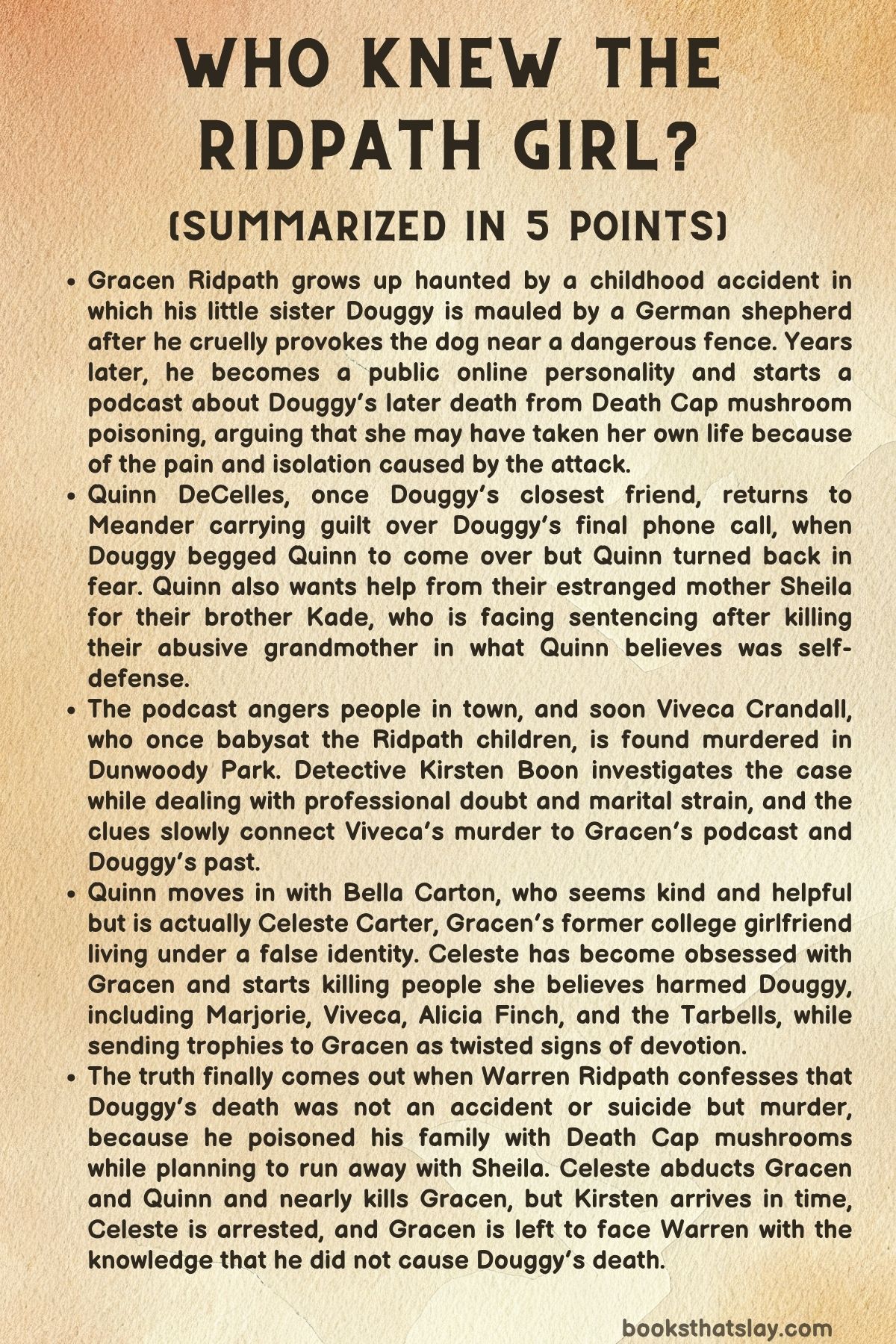
Characters
Gracen Ridpath
Gracen Ridpath stands at the emotional center of Who Knew the Ridpath Girl?, shaped by one childhood mistake that becomes the foundation of his adult guilt. As a boy, he is impatient, cruel for a moment, and careless with Douggy’s fear, and the dog attack that follows becomes the event he uses to explain every later tragedy in his sister’s life.
His adult career as an online personality gives him a platform, but it also shows his need to turn private pain into public confession. The podcast is both an act of love and an act of self-punishment.
He wants people to know Douggy mattered, yet he also wants to prove that he deserves blame. His belief that Douggy died by suicide reveals how thoroughly he has accepted responsibility for her suffering.
When the truth about Warren emerges, Gracen is not suddenly free of all guilt, but he is released from the most destructive lie. His final choice to see Warren suggests a man ready to face the real source of his family’s ruin instead of endlessly punishing himself.
Douggy Ridpath
Douggy Ridpath is the lost figure around whom the entire story turns. As a child, she is vulnerable, loving, anxious, and deeply attached to Gracen, wanting his attention even when he finds her annoying.
The dog attack changes how the world sees her, leaving her injured and scarred, but the book makes clear that the greater damage comes from the reactions around her. She becomes a girl people pity, avoid, mock, or misunderstand.
Her life after the attack is presented through memory, investigation, and the grief of others, which makes her both present and unreachable. Douggy’s final phone call to Quinn gives her death a haunting sense of unfinished business.
She had something important to say, but fear, delay, and silence prevented it from being heard. The revelation that Warren murdered her changes the meaning of her death.
She was not simply a girl destroyed by shame or neglect; she was also the victim of a father who treated his family as an obstacle. Her character remains the moral wound of the story.
Quinn DeCelles
Quinn DeCelles, formerly Kathy Fontaine, returns to Meander with two burdens: the need to help Kade and the need to confront what happened to Douggy. Quinn’s connection to Douggy is intimate and painful because they were not merely classmates or casual friends.
Quinn was one of the few people who made Douggy feel known. Their guilt comes from the night Douggy called and begged them to come over.
Quinn tried, became afraid, and turned back, and that choice becomes a private failure they have carried into adulthood. Their return shows courage because Meander is not a neutral place for them.
It holds family conflict, old shame, and memories they have avoided. Quinn’s search for answers is also a search for self-forgiveness.
They question Sheila, speak to old school figures, meet Gracen, and gradually learn that no single childhood friend could have saved Douggy from the deeper violence surrounding her. Quinn’s survival at the pole barn gives them a second chance to stand beside the truth rather than turn away from it.
Detective Kirsten Boon
Detective Kirsten Boon is a capable investigator whose confidence has been damaged by a previous mistake. Her earlier belief that a young widower was guilty of murder leaves her wary of certainty, and that doubt becomes important in Viveca’s case.
She is not a flawless detective moving cleanly from clue to clue; she is a person under pressure, dealing with professional regret and a strained marriage. Travis sees her work as something that is consuming her, and his frustration adds personal tension to her investigation.
Kirsten’s strength lies in her willingness to keep rethinking the case. She looks beyond obvious suspects, questions the meaning of the trophies sent to Gracen, and eventually sees that the murders are tied to the podcast and to Douggy’s history.
Her confrontation with Celeste is tense because she nearly uses deadly force, but she manages to bring the situation under control. By uncovering Warren’s confession and tracking Celeste, Kirsten restores justice not only for the recent victims but also for Douggy.
Celeste Carter
Celeste Carter is the story’s most dangerous figure because her violence is powered by obsession disguised as devotion. Living as Bella Carton, she appears friendly, ordinary, and helpful, especially to Quinn, but that identity is a mask covering murder and fixation.
Her past connection to Gracen has never loosened its hold on her. She interprets his podcast as a sign meant for her, turning his grief into fuel for her fantasy that they are connected by fate.
Celeste claims to be avenging Douggy, but her actions reveal that Douggy is partly an excuse for her fixation on Gracen. She kills Marjorie, Viveca, Alicia, and the Tarbells, then sends trophies to Gracen as though each murder is a private gift.
Her moral logic is completely broken: she believes she is punishing people for cruelty while committing far greater cruelty herself. When Gracen says he killed Douggy, Celeste’s loyalty turns instantly into a death sentence.
That reversal exposes the emptiness of her supposed justice. She does not love truth or Douggy; she loves the story she has created in her own mind.
Warren Ridpath
Warren Ridpath is the hidden source of the family’s deepest destruction. For much of Who Knew the Ridpath Girl?, Gracen believes the defining guilt belongs to him, but Warren’s confession exposes the far darker truth.
Warren did not merely fail his family; he planned to erase them. His affair with Sheila and his desire to escape his life curdled into a calculated plan to murder Marjorie and the children while making the deaths look accidental.
His use of Death Cap mushrooms is especially chilling because it turns a childish joke from Gracen into a murder method, forcing Gracen to carry false guilt for years. Warren’s cruelty is not impulsive in the way Gracen’s childhood mistake was.
It is deliberate, cowardly, and sustained by silence. Even after Douggy became sick, he delayed treatment and allowed everyone to believe she had stomach flu.
His confession finally gives the surviving characters the truth, but it cannot undo the years of grief and misplaced blame he caused.
Sheila Fontaine
Sheila Fontaine is a difficult and morally compromised character whose past choices damage both the Fontaine and Ridpath families. As Quinn’s estranged mother, she first appears defensive, self-protective, and unwilling to give her child what they need.
Quinn wants her to support Kade, but Sheila resists, partly because helping would force her to face old truths. Her affair with Warren connects her directly to the secret behind Douggy’s death, even if Warren alone carried out the poisoning.
Sheila’s fear of exposure makes her seem cold, but the later admission of the affair and her agreement to support Kade complicate her role. She is not presented as innocent, yet she is also not the central murderer.
Her importance lies in the way secrecy and self-preservation can spread damage across generations. By beginning an uneasy reconciliation with Quinn, Sheila takes a small step toward responsibility.
Whether that step is enough remains uncertain, but it marks a change from denial toward accountability.
Viveca Crandall
Viveca Crandall matters both as a murder victim and as a representative of Meander’s defensive memory. She once babysat the Ridpath children, which places her close to the events Gracen is revisiting through his podcast.
Her resentment toward the podcast suggests that she does not want the town or its adults to be judged by Douggy’s pain. Viveca feels accused, perhaps because Gracen’s public retelling challenges the version of the past she prefers.
Her murder in Dunwoody Park becomes the first clear sign that the podcast has stirred up more than anger. As a character, Viveca shows how people who were near a tragedy may resist responsibility without seeing themselves as cruel.
She may not have been the cause of Douggy’s suffering, but her defensiveness places her among those who would rather protect their own image than sit honestly with the harm a child endured. Celeste’s murder of her is not justice, but it does reveal how old failures can be violently reinterpreted by someone unstable.
Alicia Finch
Alicia Finch, the former school secretary, is one of the people Quinn seeks out while trying to understand Douggy’s school life. Her role is tied to records, photographs, and institutional memory.
She represents the adult world around Douggy, a world that saw pieces of the girl’s isolation but did not prevent it. Alicia’s conversations help confirm that Douggy was pitied and set apart, though they do not provide one neat explanation for her death.
Her murder after Quinn’s visit shows how dangerous the search for memory has become. Celeste treats Alicia as another person who failed Douggy, but the story does not reduce Alicia to a villain.
Instead, she shows the quiet inadequacy of ordinary adults who may witness suffering without recognizing its full weight. Her death also helps Kirsten connect the killings to the old school photos and to Celeste’s pattern of sending trophies to Gracen.
Marjorie Ridpath
Marjorie Ridpath is Gracen and Douggy’s mother, and her presence is felt through both memory and loss. In the childhood scene, she gives Gracen a simple instruction: hold Douggy’s hand on the way to the bus stop.
That instruction becomes painful in hindsight because it represents the care Douggy needed and the responsibility Gracen failed to honor. Marjorie later dies in the assisted living fire, which is first understood as a tragedy but is eventually revealed as one of Celeste’s murders.
Her life is marked by betrayal from Warren, who tried to kill her along with the children. Marjorie survives the poisoning that kills Douggy, but the family she knows is already destroyed.
Her death years later becomes another act of violence committed in the name of Celeste’s false revenge. Marjorie’s role is quieter than Gracen’s or Quinn’s, but she is central to the emotional cost of the story because she loses her daughter, is betrayed by her husband, and is eventually murdered by someone exploiting that same family history.
Kade Fontaine
Kade Fontaine’s storyline widens the book beyond Douggy’s death and shows how family violence repeats in different forms. He is facing sentencing after killing his abusive grandmother, and Quinn believes he acted in self-defense.
Though Kade is not present in the main investigation as much as others, his situation gives Quinn a second urgent reason to return to Meander. Quinn’s determination to secure Sheila’s support reveals their protective love for him and their frustration with a family system that has failed both siblings.
Kade’s case also mirrors the story’s larger concern with blame. Like Gracen, he is attached to an act of violence whose meaning depends on context.
Was it murder, survival, panic, or defense? Quinn’s belief in him shows their need to save at least one person they love after being unable to answer Douggy’s call.
His later message to Quinn suggests that repair is possible, even after long damage.
Samantha O’Brien
Samantha O’Brien initially appears suspicious because of her connection to Viveca and because evidence at the crime scene seems to point toward a dog. As Viveca’s ex-girlfriend and the owner of a husky, she fits the early theory too neatly.
Her lie about camping makes her look guiltier, but the truth behind the lie is embarrassing rather than murderous. Samantha’s role is important because she shows how an investigation can be misled by partial evidence and personal secrecy.
People lie for many reasons, and not every lie hides the crime being investigated. Through Samantha, Kirsten’s caution becomes necessary.
If Kirsten had clung too quickly to the first explanation, the real pattern might have remained hidden longer. Samantha also adds to the book’s portrait of Meander as a place full of private histories, failed relationships, and defensive behavior.
Eb
Eb is Kirsten’s investigative partner and functions as a steady professional presence during a case that becomes increasingly strange and personal. While Kirsten carries the heavier emotional focus, Eb supports the practical movement of the investigation.
His role matters because the case requires patience, coordination, and the willingness to follow connections that are not obvious at first. The murders do not fit a simple domestic pattern, and Eb’s partnership helps Kirsten move from the early suspicion around Samantha to the larger connection between Celeste, Gracen, and Douggy.
He is not as psychologically explored as Kirsten, but he is part of the structure that allows the truth to be found. His presence also keeps the investigation grounded in procedure even as Celeste’s behavior becomes more theatrical and unstable.
Travis Boon
Travis Boon represents the personal cost of Kirsten’s work. His marriage to Kirsten is strained because he believes her job is overtaking their life and damaging her emotionally.
He is not simply an obstacle; his frustration reflects a real concern about what repeated exposure to violence and suspicion can do to a person. At the same time, his inability or unwillingness to fully understand Kirsten’s sense of duty creates distance between them.
Travis’s role adds domestic tension to the police storyline. While Kirsten is trying to solve murders rooted in old family secrets, her own home life is becoming fragile.
His presence reminds readers that justice work does not happen in isolation. It follows the detective home, affects trust, and tests the relationships that are supposed to provide safety.
Aurie Ridpath
Aurie Ridpath, Gracen’s young daughter, gives the story a living future beyond Douggy’s tragedy. Her innocence makes Celeste’s intrusion into Gracen’s home especially frightening, particularly when Celeste abducts him while Aurie sleeps upstairs.
The necklace sent by Celeste becomes more disturbing because Aurie wears it without understanding its meaning, turning a murderer’s trophy into something placed near a child. Aurie also reveals Gracen’s growth.
In the ending, when he helps her face the monkey bars again, the moment quietly answers the opening tragedy. As a child, Gracen failed Douggy when she was afraid.
As a father, he responds to Aurie’s fear with patience and care. Aurie does not erase the past, but she gives Gracen a chance to act differently in the present.
Vic Dillard
Vic Dillard is the neighbor who shoots the German shepherd during the childhood attack. His action saves the situation from becoming even worse, but it cannot prevent Douggy from being badly injured.
Vic’s role is brief but important because he marks the difference between immediate physical rescue and long-term emotional rescue. He stops the dog, but no one can stop the years of shame, pity, guilt, and isolation that follow.
His presence also underlines how quickly a child’s careless cruelty can become a disaster beyond anyone’s control. In the larger story, Vic is part of the original trauma that everyone keeps returning to, not because he caused it, but because his intervention is tied to the moment when the Ridpath family’s life permanently changed.
Themes
Guilt and the Stories People Build Around It
Gracen’s life is shaped by a story he tells himself again and again: he caused Douggy’s suffering, and therefore he caused her death. That belief begins with a real failure.
He frightened her, provoked the dog, and ignored his mother’s instruction to protect her. Yet the book shows how guilt can grow beyond truth when no one corrects it with honesty.
Gracen’s podcast becomes a public version of his private punishment. He does not simply want answers; he wants a structure that makes his self-blame feel deserved.
Quinn carries a similar burden because they did not reach Douggy after her final call. Their guilt is quieter but just as lasting, built around the fear that one choice cost a friend her life.
The truth about Warren changes the moral shape of the past. Gracen and Quinn still made painful choices, but they did not murder Douggy.
The theme rests in that difference between responsibility and false guilt. Healing begins only when the characters stop accepting blame that belongs to someone else.
The Damage Caused by Silence
Silence protects the guilty throughout Who Knew the Ridpath Girl?, but it also traps the innocent. Warren’s silence after poisoning his family allows Douggy’s death to be mistaken for accident and lets Gracen spend years believing he was responsible.
Sheila’s silence about her affair with Warren protects her from shame while leaving Quinn, Gracen, and others without crucial context. The town’s silence around Douggy’s isolation is less criminal but still harmful.
People remember that she was pitied, mocked, or avoided, but those memories remain scattered and softened until Gracen’s podcast forces them into public view. Quinn’s silence is more personal.
They never told Douggy what fear cost them on the night of the phone call, and they never learned what Douggy needed to say. Celeste twists silence into performance by killing people and sending objects instead of speaking truthfully.
The story repeatedly shows that what remains unspoken does not disappear. It waits, changes shape, and eventually returns as accusation, violence, confession, or grief.
Obsession Masquerading as Justice
Celeste believes she is acting for Douggy, but her version of justice is built from fantasy, possession, and rage. She chooses victims based on her belief that they contributed to Douggy’s suffering, then turns each murder into a message for Gracen.
This makes her violence especially disturbing because she frames it as loyalty. She does not see the victims as full people; she sees them as pieces in a private drama where she and Gracen are bound together by fate.
The trophies she sends him reveal how badly she misunderstands love, grief, and accountability. Justice requires truth, proportion, and moral clarity, but Celeste has none of these.
Her actions are not about repairing harm or honoring Douggy. They are about forcing Gracen into the role she has imagined for him.
When he says he killed Douggy, Celeste immediately decides he must die too, proving that her loyalty was conditional on the story in her head. The book uses her to show how dangerous vengeance becomes when someone mistakes obsession for moral purpose.
Family Violence and Its Long Reach
The story’s central crimes grow out of family violence rather than random danger. Warren’s decision to murder Marjorie and the children is the darkest example, but the Fontaine family also carries abuse through Kade’s case and Quinn’s estrangement from Sheila.
These family histories are not sealed in the past. They shape adult choices, legal consequences, emotional distance, and the way characters understand themselves.
Kade’s act against his abusive grandmother raises difficult questions about survival and blame, while Quinn’s fight for him shows the desperation of someone trying to protect a sibling from being misunderstood by the justice system. Gracen’s family history is built on a lie so large that it replaces reality.
He believes his own cruelty killed Douggy because Warren’s violence remained hidden. Sheila’s affair links the two family lines and shows how private betrayal can become public ruin when people choose secrecy over responsibility.
By the end, the characters are not magically healed, but the truth gives them a clearer enemy. The violence began inside families, and recovery must also begin there, through confession, confrontation, and difficult repair.