Witch Queen Rising Summary, Characters and Themes
Witch Queen Rising by Savannah Stephens is an urban fantasy story about a woman forced back into a magical world she tried to escape. Seraphine “Phine” Barreau has built a quiet life away from her powerful family, but the death of her mother and the return of the Primacy drag her back to New Orleans.
The book combines family conflict, political pressure, old romance, supernatural alliances, and magical war. At its center is Phine’s struggle to accept power without becoming like the people who once used power to hurt her.
Summary
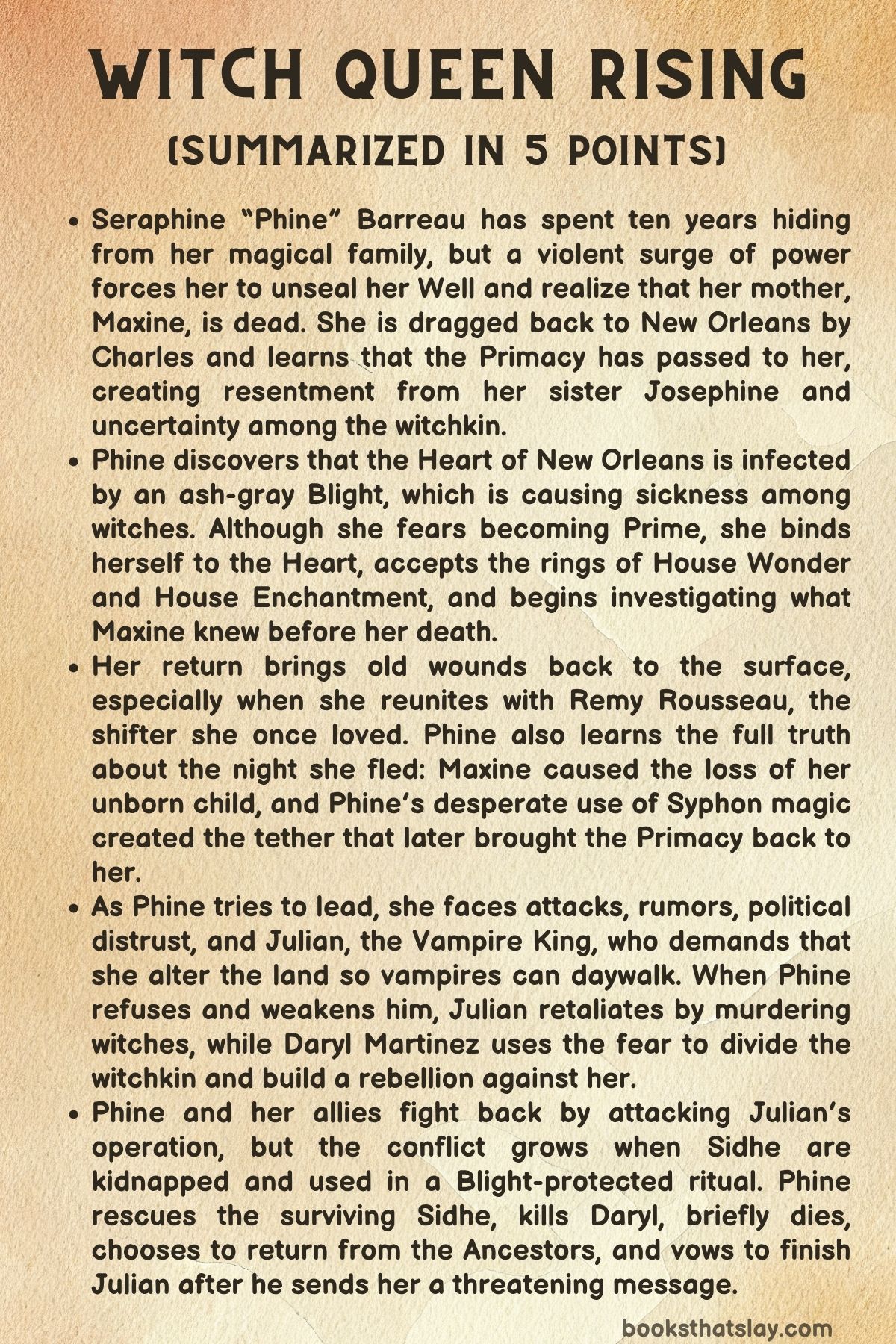
Seraphine “Phine” Barreau has spent ten years hiding from her family and the magical society she was born into. Living in a small Harlem apartment and working as a baker, she has sealed her Well, the source of her magic, so thoroughly that she can pass as ordinary.
That hidden life is shattered when a huge surge of magic tears through her body. She understands almost immediately that the power of the Prime has found her, which can only mean her mother, Maxine Barreau, is dead.
Phine breaks the ward on her Well before the surge kills her, then tries to flee before anyone from her family can track her down.
Her escape fails when Charles, Maxine’s strict steward, appears in her car and teleports her to New Orleans. Phine is returned to the Barreau house, a place full of painful memories.
There she learns from her sister Josephine that Maxine suddenly collapsed and died in the garden. Josephine has become Head of House Wonder, but she is furious that the Heart of the Land has chosen Phine as the new Prime.
The Primacy was expected to pass to House Enchantment, and Josephine resents both the political disruption and Phine’s long absence. Their reunion turns violent when Josephine attacks with vines.
Phine uses her Syphon magic to drain the spell, proving that she can feed on magic itself. The sisters do not fully reconcile, but they agree to work together because the witchkin cannot afford open division.
Phine spends her first night back in a luxury hotel instead of the family home. There the Mandate, the symbol of the Primacy, appears before her in the form of Maxine’s crown.
Phine refuses to touch it, still unwilling to accept the role that has been forced on her. The next day, Charles takes her into the bayou and abandons her, telling her to find the Low House, the Prime’s private residence.
Phine follows the Flows of magic through the land and reaches the Heart of New Orleans. Instead of finding a healthy magical source, she discovers an ash-gray Blight infecting the Heart.
She realizes that the mysterious sickness spreading among witches is coming from this corruption. Phine is terrified of binding herself to the Heart because that would make her the Prime in truth, but she cannot leave the infection untouched.
She chooses to bind herself to the Heart to keep her people from being destroyed.
The Low House then reveals itself as a home made for Phine, shaped around her tastes and needs. For the first time in years, she feels a true sense of shelter and belonging.
Afterward, she begins the difficult work of ruling. Josephine gives her the ring of House Wonder, and Phine is flooded with the memories, powers, and lives of the witches under that House.
Alex Montgomery, Head of House Enchantment, gives her the second ring, connecting Phine to the rest of the witchkin. The rings create a mental song inside her, making her aware of the people she is responsible for.
Phine tells Josephine and Alex about the Blight and begins searching for answers about what Maxine knew before her death.
Her new position also forces her to meet New Orleans’s other supernatural leaders. At Malchance, the shifter stronghold, she finds Remy Rousseau, the boy she once loved, now serving as Troop Leader.
Their reunion is painful because Remy still wants to know what happened to their baby. Phine admits she lost the child but cannot yet tell him the full truth about the night she fled.
She later discovers that Maxine had created Lunar potions to help pregnant shifters avoid forced shifts, despite the fact that Maxine once nearly destroyed Phine for becoming pregnant by Remy. Phine also meets Julian, the Vampire King, whose elegance hides cruelty and ambition, and Moira, the Sidhe Queen of Nightmares, whose power and danger make her a valuable but unpredictable figure.
Phine’s first days as Prime are filled with threats, rumors, and attempts to weaken her authority. She saves Rita Mae Hayward, a badly wounded witch, from a distance after Rita is shot, using her power to keep the woman alive.
Outside Malchance, a jealous shifter named Becky Lynn attacks Phine. Phine defends herself by draining the strength from Becky Lynn’s arms, but rumors spread that she attacked without cause.
With Motega’s help, Phine obtains magical proof that Becky Lynn struck first, allowing her to clear her name before Josephine and Alex. She also chooses to help Ava, a young pregnant shifter, by giving her Lunar potions, even though doing so risks angering Remy and stirring up old pain.
As Phine searches Maxine’s journal, she learns that Maxine knew about the Blight and died trying to tear it from the Heart. At Maxine’s funeral, Phine is pulled before the Ancestors, who must judge whether she deserves to remain Prime.
Maxine votes against her, proving that even death has not softened her judgment. Phine survives the trial, but the Ancestors and her grandmother Rosaline force her to face the truth of the night she fled New Orleans.
Maxine had stopped Phine from leaving with Remy and caused the loss of Phine’s unborn child. In agony, Phine syphoned enough of Maxine’s Prime power to leave a tether behind.
That old connection explains why the Primacy returned to Phine after Maxine’s death. She was not chosen in the usual way; the power followed the link she had created years before.
Trying to earn the trust of the witchkin, Phine hosts a cookout and then prepares to preside over her first Circle. Before it begins, she learns that Derrick Harper murdered his two children after his wife Marie left him.
Phine questions Derrick, but he attacks her. She decides that exile would only release a murderer into the wider world, so she sentences him to death.
At the Circle, she executes him in front of the gathered witchkin, marking herself as a Prime willing to make brutal decisions when she believes justice demands it. Soon after, Phine, Josephine, and Alex are nearly killed in a deliberate car crash.
Vincent, a Sidhe connected to Moira, helps them survive the attack.
Julian then invites Phine to dinner and reveals what he really wants. He demands that she plant a spell into the land that will allow all vampires to walk in daylight.
Phine refuses because the spell would alter the balance of the supernatural world and place her people under his influence. Julian threatens the witchkin truce, but Phine answers by feeding on him deeply and leaving him weakened.
Julian retaliates by dumping thirty-seven freshly killed witches on the High House porch. Phine calls an emergency Circle, explains Julian’s demand, and orders the witchkin to shelter and travel only by Portal.
Daryl Martinez uses the fear and anger to turn many witches against her, and a large group abandons the Circle with him.
As Julian’s war grows worse, more witches are killed and Sidhe begin vanishing. Moira reveals that many of her people have disappeared, including Vincent.
Phine and the Necromancers prepare a counterattack against Julian. They capture a vampire lieutenant named Max, who gives them access codes and confirms that Julian is using tunnels beneath Etienne Enterprises.
Phine, Xiomara, Elijah, and Cam launch a daytime siege, killing many vampires and reaching Julian. However, Julian has protected himself with Blight.
Xiomara is poisoned by it, and Julian escapes through a Portal before Phine can end him.
Moira then brings word that a hundred Sidhe have been taken to an abandoned warehouse near the docks. The building is guarded by witches and vampires and protected by a Blight barrier.
Phine feeds on the Blight to create temporary protection for herself and Moira, allowing them to pass through the corruption. Inside, they kill guards and discover tortured Sidhe.
They learn that Julian and Daryl’s faction are using captive Sidhe as fuel for a massive ritual. Daryl reveals his coup openly, admits that he killed Rita Mae, and orders the Sidhe sacrifices to begin.
Phine frees Moira, resists Daryl’s control, and drains him to death, causing the ritual to collapse.
The warehouse begins falling apart around them. Phine helps the surviving Sidhe escape and gives Vincent enough vitality to free himself from a fallen beam.
She barely makes it outside before the building collapses. For a brief time, she dies and returns to the Ancestors.
Maxine offers her the choice to pass on or become one of them, but Phine chooses to return because Julian is still alive and her people still need her. She wakes surrounded by the Sidhe, Vincent, Josephine, Alex, and Moira.
Back at the High House, Dr. Bryant removes bullets from her body and asks if Phine avenged her daughter. Phine promises that Julian will be next.
Soon after, Julian sends black calla lilies with a card saying he will see her soon. Phine burns the flowers and vows to end him.
Characters
Seraphine “Phine” Barreau
As the center of Witch Queen Rising, Phine is defined by the tension between flight and responsibility. She begins the book as a woman who has deliberately cut herself off from her Well, her family, her city, and her old identity.
Her life in Harlem is not only an escape from duty but also a way of surviving trauma. When the Primacy returns to her, she does not accept it because she wants status or command; she accepts it because the Heart is infected and her people will suffer if she walks away.
That difference shapes her as a leader. She is reluctant, angry, wounded, and often uncertain, but she is not careless with the lives tied to her.
Her Syphon power also makes her frightening because she can drain magic, vitality, and supernatural force in ways others cannot easily defend against. Yet the book does not present that power as simple domination.
Phine’s strength grows alongside her willingness to face grief, guilt, and truth. Her choices, from saving Rita Mae to executing Derrick to risking herself for the Sidhe, show a Prime trying to build authority without surrendering her conscience.
Maxine Barreau
In Witch Queen Rising, Maxine remains one of the strongest presences in the book even though she dies before Phine returns to New Orleans. Her power continues through the Mandate, the Barreau house, the political expectations she left behind, and the emotional damage she caused her daughters.
Maxine was a harsh Prime who believed control was necessary, and that belief shaped the way she treated Phine. Her role in the loss of Phine’s unborn child makes her a deeply damaging mother, one who used authority and family loyalty as weapons.
At the same time, the journal reveals that Maxine was not ignorant of the Blight and did not simply abandon her duty. She died trying to tear the corruption from the Heart, which gives her a more complicated place in the story.
Maxine is not redeemed by that sacrifice, but it prevents her from being only a cruel parent. She represents the danger of leadership without tenderness, discipline without mercy, and legacy without love.
Josephine Barreau
Josephine is shaped by resentment, duty, and the pain of being the daughter who stayed. While Phine ran from New Orleans, Josephine remained within House Wonder and rose into leadership.
Her anger toward Phine is not just jealousy over the Primacy; it comes from years of carrying family expectations while believing Phine had abandoned them. Her first reaction to Phine’s return is hostile, and the vine attack shows how quickly personal hurt can become political violence.
Yet Josephine is not merely an obstacle. As Head of House Wonder, she understands the structure of witchkin society and has the discipline Phine initially lacks.
Her decision to give Phine the House ring proves that she can put duty above pride when the situation demands it. Josephine’s relationship with Phine remains tense because old wounds cannot be repaired instantly, but she becomes one of the people Phine needs most.
Her development lies in learning that loyalty does not require blind obedience to the past, and sisterhood can exist even when trust is still being rebuilt.
Remy Rousseau
Remy brings Phine’s buried past into the present. As Troop Leader, he is no longer only the shifter boy she loved, but a leader with his own responsibilities, anger, and unanswered grief.
His question about their baby reveals that Phine’s disappearance wounded him in ways he never understood. Because he did not know the full truth of Maxine’s interference and the pregnancy loss, he has lived with confusion and pain for years.
Remy’s position also creates tension between personal history and political reality. Phine cannot approach him simply as a former lover, because he represents the shifters and must protect his people.
His connection to Ava and the issue of pregnant shifters shows how the past repeats itself under different conditions. Remy’s importance in the book comes from the emotional cost of secrets.
He is a reminder that Phine’s escape did not freeze time; others suffered, changed, and built lives in the space she left behind.
Charles
Charles is the servant of order, tradition, and the Barreau legacy. His sudden appearance in Phine’s car and his decision to drag her back to New Orleans show how little patience he has for hesitation.
He does not gently guide Phine into power; he forces her into the world she left behind because, to him, the office of Prime matters more than her comfort. Charles can seem cold, especially when he abandons her in the bayou to find the Low House, but his actions come from a strict belief in the systems that govern the witchkin.
He is not presented as emotionally open, yet he is dependable in the way old institutions are dependable: rigid, exacting, and difficult to move. Through Charles, the book shows the pressure placed on Phine before she has had time to grieve or understand what has happened.
He represents the machinery of leadership that keeps working even when the person at its center is broken.
Alex Montgomery
Alex Montgomery, the Head of House Enchantment, serves as an important political counterweight to Josephine and Phine. Since many expected the Primacy to pass to House Enchantment, Alex could have become an immediate rival.
Instead, his decision to give Phine the second ring marks a practical acceptance of her authority. Alex is not passive, however.
His position means he must protect his House and judge whether Phine is capable of leading all witchkin, not only House Wonder. He brings balance to the early political structure of the book because he is neither as personally wounded as Josephine nor as bound to the Barreau household as Charles.
His support matters because it gives Phine access to the wider witchkin song, but it also comes with scrutiny. Alex represents the kind of alliance Phine must earn through truth and action.
He helps show that ruling is not just about claiming power; it is about convincing others that the power will be used in their defense.
Julian
Julian is a polished and dangerous antagonist whose cruelty is matched by political patience. As Vampire King, he understands how to hide violence behind elegance, hospitality, and negotiation.
His dinner with Phine reveals his true ambition: he wants access to the land itself so vampires can daywalk. That demand is not simply a request for survival or equality; it is an attempt to make Phine use her bond with the Heart to change the balance of power in his favor.
When she refuses, Julian immediately answers with mass murder, proving that diplomacy was only a mask. His use of the Blight shows his willingness to corrupt anything if it protects him and advances his goal.
Julian’s black calla lilies at the end are a final reminder of his theatrical cruelty. He wants Phine frightened, aware, and waiting.
As a villain, he is effective because he attacks both bodies and morale, using death as a message and fear as a weapon.
Moira
Moira, the Sidhe Queen of Nightmares, enters the book as a figure of danger and authority, but she becomes more than a distant supernatural ruler. Her power makes her intimidating, and her connection to Vincent gives her a personal stake in the growing conflict.
When Sidhe begin disappearing, Moira’s concern reveals the vulnerability beneath her title. She is not only a queen guarding territory; she is responsible for a people being hunted, captured, and used as fuel.
Her alliance with Phine is uneasy but important because both women understand what it means to carry power that others fear. In the warehouse rescue, Moira proves willing to risk herself alongside Phine, and their partnership becomes one of necessity built under extreme pressure.
Moira’s role expands the conflict beyond witchkin politics, showing that Julian and Daryl’s plans threaten the wider supernatural world. She also helps Phine become a broader kind of leader, one whose choices affect more than her own people.
Daryl Martinez
Daryl Martinez is the danger inside the community. Unlike Julian, who attacks from outside the witchkin structure, Daryl uses fear, grief, and distrust to build a faction against Phine from within.
He takes advantage of the deaths Julian causes and turns public panic into political opportunity. His betrayal is especially damaging because Phine is already struggling to earn trust, and his rebellion makes her seem weak or unworthy in the eyes of frightened witches.
The later revelation that he killed Rita Mae and helped organize the Sidhe ritual exposes the depth of his corruption. Daryl is not simply a critic of Phine’s rule; he is a murderer willing to sacrifice innocents for power.
His death at Phine’s hands is both a personal victory and a political necessity. Through him, the book shows that communities can be endangered not only by open enemies but also by leaders who dress ambition in the language of protection.
Vincent
Vincent begins as a Sidhe connected to Moira, but his actions give him a meaningful role in Phine’s survival and in the larger conflict. He helps Phine, Josephine, and Alex after the car crash, proving that the Sidhe are not distant observers but active participants in the crisis.
His later capture gives Moira’s fear a specific emotional focus and shows the brutality of Julian and Daryl’s operation. Vincent’s presence in the warehouse, trapped and injured, makes the rescue more personal.
Phine’s decision to give him enough vitality to free himself from a fallen beam reflects her growing willingness to use her power not only to drain but also to preserve life. Vincent is not the loudest character in the book, but he matters because he connects alliances, consequences, and sacrifice.
Through him, the Sidhe losses become more than numbers, and Phine’s protection extends beyond witchkin boundaries.
Xiomara
Xiomara stands out as one of the allies willing to move from planning to direct action. Her role in the daytime siege against Julian places her among the characters who trust Phine enough to risk themselves in battle.
As part of the counterattack, Xiomara helps shift the witchkin response from defense to offense. Her poisoning by the Blight is significant because it shows how dangerous Julian has become and how far the corruption has spread beyond the Heart.
Even skilled and prepared fighters can be harmed by it, which raises the stakes of Phine’s mission. Xiomara’s presence also strengthens the sense that Phine’s leadership is not solitary.
The Prime may carry the central bond to the land, but she needs witches, Necromancers, and other allies who can act with courage when the enemy is hidden underground or protected by corrupted magic.
Rosaline
Rosaline, Phine’s grandmother, serves as a link between family memory, ancestral judgment, and buried truth. Her role in forcing Phine to remember the night she fled is painful but necessary.
Phine’s trauma has shaped her entire adult life, yet parts of it have remained hidden or unbearable. Rosaline helps bring those memories into the open, not to punish Phine, but to reveal why the Primacy returned to her.
She shows that the past cannot be avoided when it is still active inside the present. Rosaline’s involvement also gives the Ancestors’ judgment a more personal dimension.
The trial is not only about whether Phine is politically fit to rule; it is about whether she can face the wound at the center of her power. Rosaline represents hard truth, the kind that hurts before it frees.
Her presence helps Phine understand that her connection to the Primacy was born from survival, not ambition.
Ava
Ava’s role is smaller than Phine’s or Josephine’s, but she is important because she shows what Phine’s choices mean for vulnerable people. As a young pregnant shifter, Ava reflects the same danger that once surrounded Phine’s pregnancy with Remy’s child.
Forced shifts threaten pregnant shifters, and the Lunar potions offer protection, but helping Ava also forces Phine to confront the hypocrisy of Maxine’s past actions. Maxine nearly destroyed Phine for her relationship with Remy, yet she later created potions to protect others in similar situations.
By giving Ava the potions, Phine chooses compassion over bitterness. She does not withhold help because her own pregnancy ended in tragedy.
Ava helps reveal the kind of Prime Phine wants to become: one who uses painful experience to protect others rather than punish them for needing what she was denied.
Themes
Power, Consent, and the Burden of Rule
Power in Witch Queen Rising is never treated as a simple reward. Phine receives the Primacy after years of trying to live without magic, and her first instinct is not pride but fear.
The title of Prime gives her access to the Heart, the rings, the Mandate, and the lives of the witchkin, but none of that comes with emotional readiness. The book repeatedly connects power to consent, asking whether a person can truly choose a role when an entire people may suffer if she refuses.
Phine’s bond with the Heart is a clear example: she does not want to bind herself permanently, but the Blight leaves her with a moral choice she cannot ignore. Her leadership also forces her to make public decisions that carry terrible weight, including Derrick’s execution and the war response against Julian.
The theme becomes richer because Phine’s Syphon ability can violate others if used carelessly. She can drain, weaken, and consume magic, so her growth depends on learning restraint as much as strength.
True rule, the book suggests, is not claiming authority; it is accepting accountability for every life touched by that authority.
Family Legacy and the Damage of Control
The Barreau family is built on power, reputation, and old wounds. Phine’s return to New Orleans is not only a political event but a forced return to the family system that harmed her.
Maxine’s control over Phine’s life, especially the night she prevented her from leaving with Remy and caused the loss of her child, shows how family authority can become violence when love is replaced by possession. Josephine’s resentment comes from another side of the same legacy.
She stayed, served, endured expectations, and watched Phine return with the highest power in their world. The sisters’ conflict is therefore not a simple rivalry; it is the result of a household where duty was used to shape daughters into weapons and heirs.
Maxine’s death does not end her influence because the structures she built remain alive in Charles, the house, the Mandate, and the Ancestors’ judgment. The book treats legacy as something both inherited and challenged.
Phine cannot erase what Maxine did, but she can decide not to rule through fear, secrecy, and emotional cruelty.
Trust, Public Judgment, and the Making of a Leader
Phine’s greatest challenge is not only defeating Julian or surviving the Blight; it is convincing a frightened people that she deserves to lead them. Her long absence makes her suspicious in the eyes of many witchkin, and the unusual way the Primacy returned to her creates even more doubt.
Every early event becomes a test of public trust. When Becky Lynn attacks her, rumors spread faster than truth, and Phine must produce proof just to defend her own actions.
When she executes Derrick, she establishes authority, but she also shows the gathered witchkin that her rule will not avoid violence when she believes justice requires it. Daryl exploits this unstable public mood by turning fear into rebellion.
His success shows how quickly communities can fracture when grief and uncertainty are given a target. Phine’s leadership develops through pressure rather than ceremony.
The rings connect her to her people, but that mystical bond does not guarantee loyalty. Trust must be earned through transparency, protection, and visible sacrifice.
By the end, Phine has not won everyone completely, but she has shown that she will bleed for the people bound to her.
Corruption, Survival, and Enemies Within
The Blight gives the book a physical image for corruption, but the idea extends far beyond the infected Heart. It appears in Julian’s magic, in the sickness among witches, in the warehouse ritual, and in the political betrayal carried out by Daryl.
This makes the external danger and internal danger mirror each other. Julian is an open enemy who wants to remake the supernatural balance for vampires, but Daryl is more dangerous in a different way because he speaks from inside the witchkin community.
He uses fear, murders his own, and sacrifices Sidhe while pretending to offer a better path. The Blight itself is also something Phine must consume in order to fight, which creates a sharp survival question: how much darkness can a person take into herself without being changed by it?
Phine survives because she refuses to treat corruption as only someone else’s problem. She enters the infected places, feeds on what can kill her, and risks death to pull others out.
The theme ends with unfinished conflict because Julian remains alive, reminding the reader that corruption is not defeated by one victory. It must be faced again, named clearly, and burned out at the root.