The Neighbors Are Watching Summary, Characters and Themes
The Neighbors Are Watching by Aggie Blum Thompson is a suburban mystery about secrets, privilege, parenthood, and the dangerous lengths people will go to protect their families.
Set in the affluent Eastbrook neighborhood near Washington, D.C., the story begins with a woman waking near the site of an unsolved murder with no memory of how she got there. Her search for answers gradually connects her family to old burglaries, hidden relationships, manipulated college admissions, and the murder itself. Through Caren Costa and Finn, two very different investigators, the novel examines how ordinary people can become participants in deception when fear, reputation, and parental loyalty overpower conscience.
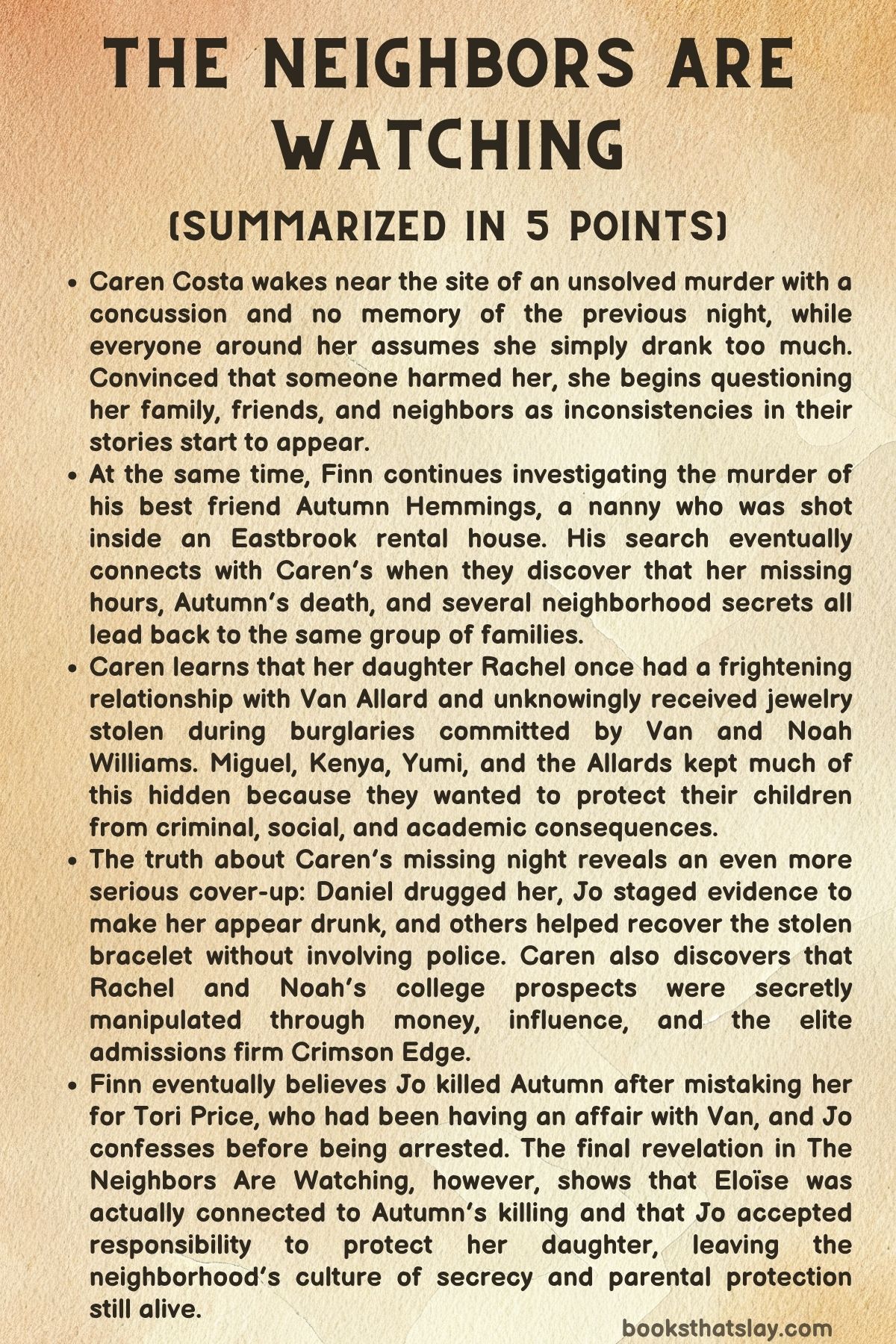
Summary
Caren Costa attends the graduation party of Eloïse Allard, whose friendship with Caren’s daughter Rachel ended badly. With Rachel preparing to leave for Georgetown and her older son Zach already in college, Caren is becoming increasingly aware that the period of her life defined by raising children is ending.
Her uncertainty is worsened by the fact that she has recently been pushed into early retirement. Organizing the annual Eastbrook yard sale with her friend Kenya Williams gives her some structure, but beneath the neighborhood’s pleasant surface Caren feels restless and uneasy.
The party takes place close to a rental property owned by the Allards where a young nanny named Autumn Hemmings was murdered the previous summer. Flyers asking who killed Autumn still appear around Eastbrook, although many residents have become uncomfortable with being reminded of the unsolved crime.
After leaving the party, Caren walks home and later takes her dog outside. She speaks with her close friend Yumi by phone, hears someone approaching her, recognizes the person, and then loses consciousness.
The following morning, Caren wakes near the Allards’ vacant rental with no memory of the previous several hours. Finn, a young library assistant who also walks neighborhood dogs, finds her disoriented and bleeding from an injury to the back of her head.
Finn has his own reason for being near the rental. Autumn was his closest friend, and for the past year he has been putting up the murder flyers and quietly investigating the people living around the house.
On the night Autumn was killed, Finn had been speaking with her through FaceTime. Autumn told him that one of the neighbors had arrived at the door, after which Finn heard two gunshots before someone closed Autumn’s laptop.
At the hospital, Caren learns that she has suffered a serious concussion and post-traumatic amnesia. Her doctors cannot determine exactly how she was injured and advise her to contact police because assault or drugging cannot be ruled out.
The police, however, quickly become skeptical. Evidence inside Caren’s house appears to suggest that she ordered her favorite takeout meal, opened a bottle of wine, and continued drinking after returning home, even though she remembers doing none of those things.
Miguel, Caren’s husband, also begins treating the incident as a possible alcohol-related blackout. His uncertainty makes Caren increasingly isolated because she is convinced that someone deliberately caused her memory loss.
A second mystery emerges when Holly Stone contacts Caren about a gold heart bracelet listed for the yard sale. Holly claims that the bracelet was stolen during a neighborhood burglary the previous year, yet Caren knows it came from Rachel’s belongings.
Soon afterward, the bracelet disappears from Caren’s carefully organized yard-sale collection. Caren becomes convinced that someone entered her home and removed it, but Miguel repeatedly encourages her to consider whether her concussion is affecting her judgment.
Meanwhile, Finn continues investigating Autumn’s death. Detective Aziz tells him that investigators recovered unidentified blood from the crime scene and developed a DNA profile, giving Finn renewed hope that Autumn’s killer can eventually be identified.
Finn begins taking dog-walking jobs in Eastbrook partly because they allow him to observe the households that might know something about the crime. In the Allard home, he notices an envelope from an elite educational-consulting company called Crimson Edge.
His investigation becomes connected to Caren’s when he sees suspicious messages on an iPad in Kenya and Shawn Williams’s home. Miguel appears to be participating in a secret exchange concerning something that has been obtained and returned without “C” becoming suspicious.
Caren begins investigating the old burglaries herself. Yumi initially claims that she once saw Van Allard entering a neighbor’s property with a girl who looked like Rachel, but Caren eventually proves that Rachel was out of town when the burglary occurred.
This means Yumi has lied to her. Caren’s growing distrust is especially painful because Yumi had been the one person who immediately believed that something criminal might have happened during Caren’s missing night.
Caren and Finn eventually enter the vacant rental together. In its basement, Caren discovers a large dried bloodstain and suddenly remembers waking there during the lost period of her memory.
The discovery proves that she had been inside the murder house while injured. Police are forced to take her story more seriously, and Finn becomes convinced that Caren’s assault and Autumn’s murder may be connected through the same group of neighbors.
Caren then confronts Rachel about the stolen bracelet. Rachel admits that she received jewelry from Van during a brief secret relationship but insists she did not know that the items were stolen.
Rachel reveals that Van became sexually coercive and frightening during their relationship. After she escaped from his bedroom one night, Miguel came to get her without telling Caren.
Eloïse subsequently turned Rachel’s social circle against her, accusing her of lying and participating in vicious bullying that contributed to Rachel’s emotional collapse and eventual school transfer. Miguel knew the truth but kept it from Caren because he believed he was protecting their daughter.
Rachel also reveals that Van’s actual burglary partner was Kenya’s son, Noah. The stolen bracelet remained accidentally among Rachel’s possessions after most of the other items were quietly returned.
At the same time, Finn uncovers another secret involving Van. Tori Price, the divorced psychotherapist who had rented the Allards’ property when Autumn was alive, had begun an affair with nineteen-year-old Van after becoming resentful of Jo and Daniel Allard.
Tori’s relationship with Van began partly as retaliation against his parents, especially after Daniel rejected her romantic advance and Jo publicly humiliated her. Van eventually became possessive, controlling, and physically threatening when Tori tried to end the affair.
Because Autumn was wearing Tori’s distinctive pink silk kimono on the night she was killed, Finn develops a theory that someone intended to murder Tori and mistakenly shot Autumn. Tori strongly implies that Van might have been responsible.
The theory appears convincing until evidence proves that Van was in Delaware at the time of Autumn’s murder. This leaves Caren and Finn looking again at the adults who spent the past year hiding what happened around the rental.
Caren finally confronts Kenya and Yumi and learns the truth about her missing night. Yumi had lied about Rachel being involved in the burglaries because she hoped Caren would become protective and stop asking questions, thereby shielding Noah.
When Holly threatened to involve police over the bracelet, Kenya, Yumi, Miguel, and the Allards became involved in efforts to return it quietly. Daniel secretly put lorazepam into Caren’s drink at the graduation party.
When Caren later collapsed and injured her head, Daniel carried her into the vacant rental and left her there. Jo entered Caren’s home and staged the takeout food and wine so that Caren would appear to have become drunk after returning home.
Kenya later removed the bracelet during what appeared to be a friendly visit. Their attempt to protect Noah and Rachel from consequences had therefore developed into drugging, trespassing, evidence manipulation, and a coordinated campaign to make Caren doubt herself.
Caren also learns that Miguel accepted another secret arrangement from the Allards. Through Crimson Edge, Rachel was presented to Georgetown as a possible tennis recruit while a substantial donation was made on her behalf.
A similar arrangement helped Noah. Miguel believed he was protecting Rachel after her difficult junior year, but Caren is devastated that he concealed the truth and participated in manipulating their daughter’s future.
Rachel overhears Miguel admitting that he did not fully trust her ability to succeed without intervention. Hurt by both the deception and his lack of confidence in her, she eventually rejects the Georgetown plan and chooses a different path.
The investigation into Autumn’s murder then turns toward Jo Allard. Finn discovers that Jo possesses Autumn’s missing laptop, and she offers him an enormous amount of money to stop investigating.
Jo later tries to leave the area but is followed by Finn and his elderly friend Paula. When confronted, Jo admits that she went to the rental on the night of the murder after learning about Tori’s relationship with Van.
Jo claims she was intoxicated and furious when she saw a woman wearing Tori’s kimono. Believing the woman was Tori, she entered with a gun and says the weapon fired during a confrontation, killing Autumn instead.
Jo is arrested, while Daniel is also held accountable for his actions against Caren. Yumi admits that she saw Jo moving through the yards after the murder but accepted financial assistance and a position with Crimson Edge in return for remaining silent.
Three months later, the apparent mysteries have largely been resolved. Finn begins building a life beyond his investigation, Caren and Miguel attempt to repair their damaged marriage, Rachel takes a gap year, and Yumi faces consequences for helping conceal evidence.
Yet The Neighbors Are Watching reserves its most disturbing revelation for the end. A letter from Yumi shows that she secretly possesses a photograph proving that Eloïse, not Jo, left the rental on the night of Autumn’s murder carrying the gun and the missing laptop.
Jo’s confession was therefore another act of parental protection. Rather than exposing Eloïse, Yumi uses the photograph to demand continued payments, proving that even after arrests and confessions, Eastbrook’s habits of secrecy, money, surveillance, and protection remain firmly alive.
Characters
Caren Costa
Caren Costa serves as one of the book’s central perspectives and becomes the person through whom the carefully maintained order of Eastbrook begins to collapse. At the beginning of The Neighbors Are Watching, she is already experiencing a crisis of identity because retirement and her children’s growing independence have removed the roles that once gave her daily life a clear structure.
Her concussion intensifies this uncertainty by attacking the one thing she needs in order to defend herself: confidence in her own perception. Because Caren cannot remember what happened, other people gain the power to define her experience for her.
The police reduce her story to drunkenness, Miguel repeatedly questions her interpretation of events, and several friends participate in creating evidence meant to support a false version of the night. Caren therefore has to investigate not only an external crime but also whether her own judgment can still be trusted.
Her emotional complexity becomes particularly visible when Rachel is suspected of burglary. Caren wants truth, but the moment her daughter might face consequences, she feels the same protective instinct that motivates Kenya, Miguel, Jo, and Daniel.
The crucial difference is that Caren eventually refuses to allow parental love to become a permanent excuse for deception. She recognizes that protecting a child cannot justify harming innocent people or deciding that other families should absorb the consequences.
Caren’s relationship with Finn also changes her. He believes her without treating her age, injury, or emotional distress as reasons to dismiss her, giving her the confidence to keep asking questions.
By the end of the novel, Caren has lost much of her previous certainty about marriage, friendship, motherhood, and social respectability. What she gains instead is a stronger willingness to live with uncomfortable truths rather than preserve a reassuring lie.
Finn
Finn combines grief, patience, curiosity, and stubbornness in a character whose private investigation gives the murder of Autumn a human center. To most Eastbrook residents, Autumn has gradually become the subject of an old neighborhood crime, but to Finn she remains his closest friend and chosen family.
His decision to put up flyers and take dog-walking jobs around Eastbrook reflects both devotion and an inability to accept how easily the neighborhood has moved on. He is not investigating because mysteries fascinate him; he is investigating because forgetting Autumn feels morally unacceptable.
Finn’s transgender identity is an important part of his personal history without becoming the sole definition of his character. Autumn supported him through his transition, surgery, and legal name change, which helps explain the depth of his loyalty to her memory.
His friendship with Paula also reveals his ability to form meaningful relationships outside conventional family structures. Paula respects him, helps with his investigation, and refuses to treat him as fragile or incapable.
Finn frequently crosses boundaries in pursuit of answers, from observing private messages to entering spaces where he has not been invited to investigate. Detective Aziz repeatedly warns him that determination does not automatically give him legal or ethical authority.
That tension prevents Finn from becoming an idealized amateur detective. His grief sometimes causes him to treat every clue as something he personally must solve, even when his actions could complicate the official investigation.
His friendship with Caren changes both characters because each supplies what the other lacks. Caren brings experience and fearlessness in confronting the neighborhood’s adults, while Finn brings belief, persistence, and intimate knowledge of Autumn.
By the end, Finn has not stopped grieving, but grief no longer controls every part of his identity. His new apartment, career plans, romantic relationship, and adoption of Muffinhead show that seeking justice for Autumn has finally become one part of his life rather than its entire purpose.
Autumn Hemmings
Although Autumn is already dead when the central investigation begins, she remains one of the most important presences in The Neighbors Are Watching. Her murder is the event around which many of Eastbrook’s secrets eventually gather.
Through Finn’s memories, Autumn emerges as creative, loyal, spiritual, and deeply supportive. Her friendship with Finn gives her an identity beyond the label of “the murdered nanny,” which is how much of the neighborhood has come to remember her.
Her death is particularly cruel because she appears to have been killed because someone mistook her for another woman. Wearing Tori’s pink kimono placed her inside a conflict she did not create and may not even have understood.
Autumn also exposes the unequal value Eastbrook places on different lives. Wealthy parents mobilize extraordinary resources to protect their children, while the murder of a young employee can slowly become an inconvenience that residents would rather stop discussing.
Finn’s insistence on displaying her photograph resists that process. Every flyer forces neighbors to see a face where they would prefer to see an old incident.
The final revelation makes Autumn’s fate even more disturbing. Multiple adults know enough to uncover the truth, yet again and again they decide that protecting their own families matters more than justice for her.
Autumn therefore becomes the moral measure against which the behavior of nearly everyone else can be judged. She cannot advocate for herself, which makes the willingness or refusal of others to speak for her especially significant.
Tori Price
Tori Price is one of the book’s most psychologically complicated characters because she possesses professional knowledge that should help her identify destructive behavior, yet she repeatedly uses that knowledge to justify her own impulses. As a divorced psychotherapist raising a young son, she enters Eastbrook already feeling financially insecure and socially inferior to the wealthy families around her.
Her fascination with the Allards grows from a painful mixture of admiration, resentment, loneliness, and class insecurity. She wants access to the confidence and status they represent, and Daniel initially becomes the person through whom she imagines gaining that access.
When Daniel rejects her romantic advance and Jo humiliates her, Tori’s embarrassment becomes resentment. Rather than distancing herself from the family, she becomes increasingly willing to harm them in ways that also damage herself.
Her affair with Van is especially revealing because Tori understands from the beginning that the relationship is ethically troubling. Van may be legally an adult, but Tori recognizes the age difference, her own position as a mental-health professional, and her desire to use him as a weapon against his parents.
Her use of the AI chatbot Cyrus shows her tendency to seek validation rather than judgment. When the program challenges her choices, she modifies it until it tells her what she wants to hear.
Eventually Tori becomes trapped inside the very relationship she helped create. Van’s attention, which first made her feel powerful and desirable, develops into surveillance, possessiveness, threats, and physical intimidation.
Her later silence about Van and the Allards is understandable as fear but still morally compromised. Accepting money and withholding information allows a false account of Autumn’s death to survive.
Tori is therefore neither a simple victim nor a simple wrongdoer. Her actions cause serious harm, yet the novel also shows how humiliation, isolation, resentment, and self-deception can gradually weaken the boundaries a person once believed they would never cross.
Jo Allard
Jo Allard represents the disciplined, polished surface of Eastbrook privilege and the ruthless protection that exists underneath it. She presents herself as socially confident, generous, and completely in control of her family’s future.
Her identity is closely tied to managing outcomes. She attempts to control friendships, college admissions, scandals, public appearances, and eventually criminal consequences.
Jo’s treatment of Rachel after Van’s misconduct shows how quickly parental loyalty becomes aggression toward someone else’s child. Instead of confronting the harm caused by Van and Eloïse, she helps preserve the family’s reputation and allows Rachel to bear much of the social damage.
Her relationship with Tori reveals another aspect of her character. Jo’s anger is understandable when she learns that Tori attempted to become involved with Daniel and later entered a relationship with Van, but her response is shaped by humiliation, class judgment, and a determination to dominate the situation.
Jo also understands the practical power of money better than almost anyone else in the story. She uses financial arrangements, professional connections, educational consultants, and direct offers of cash as tools for controlling people.
Her attempt to buy Finn’s silence is perhaps the clearest expression of this worldview. She assumes that every person has a price because so many people around her have already accepted compromises in exchange for security or opportunity.
Her confession to Autumn’s murder initially appears to mark a final acceptance of responsibility. The epilogue changes that interpretation completely.
Jo is willing to sacrifice her own freedom to protect Eloïse, repeating on a far greater scale the same parental logic that has shaped nearly every cover-up in Eastbrook. Her final act is therefore both an extraordinary expression of maternal loyalty and another refusal to allow the person responsible for harm to face the consequences.
Daniel Allard
Daniel initially appears warmer and more approachable than Jo, particularly through Tori’s perspective. His friendliness allows Tori to imagine that he might see her as an equal rather than merely as his tenant.
That impression disappears when he rejects her advance in a way that leaves her feeling socially inferior and humiliated. His reaction reveals the class consciousness beneath his relaxed manner.
Daniel’s treatment of Caren later exposes a much darker willingness to harm others for the sake of family protection. Drugging her with lorazepam transforms him from someone participating in concealment into someone directly responsible for a potentially life-threatening assault.
His decision to carry an unconscious, injured Caren into the vacant rental is especially disturbing because he prioritizes avoiding discovery over obtaining medical care for her. Leaving her there overnight shows how easily his concern for his own family overwhelms concern for another person’s safety.
Daniel repeatedly minimizes the seriousness of what he has done by insisting that he did not intend for Caren to be injured. This distinction matters to him because it allows him to imagine himself as a good person who made a mistake rather than someone who consciously endangered another human being.
His later confrontation with Caren shows that his instinct remains control rather than accountability. Even while apologizing, he continues pressuring her to stop investigating.
Daniel shares Jo’s belief that Van and the family must be protected from public consequences. Yet unlike Jo, whose behavior is generally calculated, Daniel often appears emotionally reactive and less capable of maintaining control when pressure increases.
Van Allard
Van is initially known through gossip and other people’s impressions as wealthy, attractive, socially powerful, and accustomed to receiving what he wants. As more information emerges, the charm surrounding him gives way to a pattern of entitlement, coercion, and resentment toward parental control.
His burglaries with Noah are partly acts of rebellion. Stealing from wealthy neighbors allows Van to violate the ordered world his parents have created, even though he himself benefits enormously from that same world.
His relationship with Rachel reveals his willingness to use emotional and sexual pressure. What begins as attention that makes Rachel feel chosen becomes demands for intimate images and an attempt to prevent her from leaving when she refuses him.
Van’s relationship with Tori is more complicated because she is significantly older and initially holds greater emotional and professional maturity. She knowingly enters the affair for selfish reasons, but Van gradually becomes controlling and physically aggressive when she tries to withdraw.
His dissatisfaction with the Stanford future designed by his parents gives him a degree of sympathy. He wants a life that is not entirely scripted by Jo and Daniel, even imagining work far removed from elite education and Eastbrook status.
However, his desire for independence does not produce respect for the independence of others. He resents being controlled while repeatedly trying to control Rachel and Tori.
For much of the investigation, Van appears capable of having killed Autumn. The evidence eventually clears him of that particular crime, but innocence in the murder does not make him morally innocent within the story.
Eloïse Allard
Eloïse initially appears mainly through her destroyed friendship with Rachel and her position within the Allards’ socially powerful family. Her cruelty after Rachel’s frightening experience with Van reveals how strongly she identifies loyalty with defending her brother.
Rather than consider the possibility that Van harmed Rachel, Eloïse attacks Rachel’s credibility and encourages their social circle to isolate her. The mental-health and suicide-related harassment is especially vicious because Rachel is already emotionally vulnerable.
Eloïse’s actions demonstrate how social influence can become a weapon. She does not need physical violence to cause serious damage because she controls friendships, narratives, and group loyalties.
For most of the novel, Eloïse remains less visible than Van, Jo, or Daniel. That apparent distance is essential to the final revelation.
Yumi’s photograph shows that Eloïse was actually leaving the murder house with the gun and Autumn’s laptop. Jo’s confession has protected her, meaning the family’s entire machinery of concealment ultimately reaches its most extreme form around Eloïse.
The revelation also changes how her loyalty to Van should be understood. Her earlier treatment of Rachel already showed that she was willing to punish anyone she believed threatened her brother.
If her motive for confronting Tori was similarly connected to Van, Autumn’s death becomes the most catastrophic result of Eloïse’s belief that defending family justifies attacking outsiders. She becomes the final proof that the danger within Eastbrook was never limited to one troubled young man.
Rachel Costa
Rachel spends much of the story being discussed before she is allowed to explain herself. This is important because almost every adult around her has already constructed a version of her life based on what they believe is best for her.
Caren remembers her difficult junior year primarily as a period of declining grades and emotional instability. Miguel knows more but chooses silence, while the Allards help create a public story that keeps Van’s behavior hidden.
When Rachel finally speaks, the apparent mystery surrounding her becomes understandable. She had entered a relationship with Van, received stolen jewelry without knowing where it came from, experienced sexual pressure, escaped from a frightening encounter, and then endured sustained bullying from Eloïse and former friends.
Her school transfer is therefore not evidence that she is unstable or incapable. It is part of her attempt to recover from experiences that adults around her failed to confront openly.
Rachel is also hurt by the way her parents manage her future. Miguel believes that manipulating her Georgetown admission compensates for the academic damage caused during her junior year.
From Rachel’s perspective, however, the arrangement takes away the meaning of her achievement. Learning that her father doubted she could succeed without secret assistance damages her trust even further.
Her eventual decision to reject Georgetown and take a gap year is therefore a declaration of independence. For perhaps the first time, Rachel chooses a future that has not been engineered by Van, Eloïse, Miguel, Jo, or an admissions consultant.
Miguel Costa
Miguel is a loving father whose desire to protect Rachel gradually becomes a source of serious betrayal within his marriage. He is able to reach Rachel emotionally in ways Caren often cannot, which initially makes his closeness with their daughter seem like one of the family’s strengths.
When Rachel calls him after escaping Van’s bedroom, Miguel responds immediately and protects her. His first instinct is admirable because he makes Rachel’s safety his priority.
The problem arises afterward, when protection becomes secrecy. Miguel decides that Caren does not need to know the full truth, establishing a pattern in which he treats himself as the person entitled to decide what information his wife can handle.
The same reasoning later shapes his involvement with the stolen property and Crimson Edge. He accepts questionable solutions because he believes practical outcomes matter more than transparency.
Miguel repeatedly tells himself that he is doing what parents must do in an unfair world. Yet each protective decision also removes agency from someone else, particularly Caren and Rachel.
His response to Caren’s concussion is especially painful because his knowledge of the surrounding secrets makes his skepticism difficult to separate from self-protection. Even if he did not know Daniel intended to drug her, he knows enough to understand that unusual events are occurring.
By the end, Miguel must face the fact that good intentions do not cancel deception. Repairing his marriage requires more than explaining why he acted; it requires recognizing that he repeatedly denied Caren the right to make informed choices about her own family.
Yumi
Yumi is one of the story’s most contradictory characters. She is Caren’s closest friend, one of the first people to believe that Caren may have been assaulted, and eventually one of the people revealed to have deliberately manipulated her.
Her decision to lie about seeing Rachel with Van shows how well she understands Caren. She predicts that suspicion involving Rachel will activate Caren’s protective instincts and distract her from investigating Noah.
Yumi’s participation in the attempt to retrieve the bracelet is motivated partly by loyalty to Kenya and concern for Noah. Yet she continues the deception even after Caren is drugged, seriously injured, and made to doubt her own memory.
Her own vulnerability complicates judgment of her behavior. Serious autoimmune illness, failing treatment, kidney problems, and fear about Ryan’s future make financial and medical security urgent rather than abstract.
The Allards exploit this vulnerability by arranging a well-paid Crimson Edge job with valuable health insurance in exchange for silence about what Yumi saw after Autumn’s murder. Her acceptance demonstrates how economic pressure can turn knowledge into something that can be bought.
Yumi nevertheless retains a genuine attachment to Caren. She eventually uses a Taser against Daniel and helps prevent him from harming her further.
The final letter proves that remorse has not completely changed her. Instead of exposing Eloïse, Yumi converts the truth into financial leverage.
Her character therefore embodies one of the novel’s darkest ideas: a person can love someone, regret betraying them, understand that silence caused harm, and still continue exploiting the same system when survival and family security are at stake.
Kenya Williams
Kenya initially appears as Caren’s highly organized friend and partner in running the Eastbrook yard sale. Her efficiency makes her later claim that she simply overlooked Holly’s repeated messages immediately suspicious.
Her central motivation is protecting Noah. Once she learns that her son participated in the burglaries, Kenya begins making decisions according to what exposure could mean for his future.
Her fear is shaped not only by ordinary parental concern but also by her awareness of the potentially harsher consequences a Black teenager may face within the legal system. This gives her choices a social context that differs from the Allards’ attempts to protect Van and Eloïse.
However, understandable fear does not remove the consequences of what Kenya helps conceal. She allows Caren to be misled and continues participating after the situation moves far beyond hiding a teenage burglary.
Kenya’s affection for Caren appears genuine, which makes her behavior more complicated rather than less harmful. She brings comfort items after Caren’s injury while simultaneously knowing information that would help Caren understand what happened.
Her character demonstrates how people can divide their moral lives into separate compartments. Kenya can sincerely care about Caren while also deciding that Noah’s protection must come first.
Shawn Williams
Shawn is less prominent than Kenya, but his involvement shows that the conspiracy surrounding the stolen bracelet extends across several households rather than being driven by one frightened parent. Finn’s discovery of messages connected to Shawn helps reveal coordinated efforts to return evidence without Caren learning the truth.
His participation is largely connected to protecting Noah. Like Kenya, he appears willing to treat secrecy as a practical family responsibility rather than an ethical problem.
Because Shawn remains less emotionally central to Caren than Kenya or Yumi, his betrayal does not receive the same attention. Still, he represents the quieter form of complicity that allows larger schemes to function.
He does not need to design the entire cover-up to become responsible for sustaining it. By cooperating, communicating secretly, and helping evidence move between households, Shawn becomes part of the structure that keeps Caren uninformed.
Noah Williams
Noah is significant less because of his direct presence than because of the actions adults take on his behalf. His participation with Van in the neighborhood burglaries creates the problem that eventually connects the stolen bracelet to a much larger series of deceptions.
Kenya’s fear for Noah’s future becomes one of the strongest motivations behind the cover-up. His actions are therefore repeatedly interpreted through the possible consequences awaiting him rather than simply through the burglary itself.
Noah also functions as a parallel to Rachel. Both teenagers make mistakes or become connected to harmful situations, and both have parents willing to interfere with normal consequences.
The difference is that Rachel was also victimized by Van and Eloïse, while Noah actively participated in the break-ins. Yet adults repeatedly manipulate information in ways that blur these distinctions.
Through Noah, the story asks whether protecting a child’s future should ever mean denying another person the truth about crimes committed around them.
Paula Dunker
Paula is one of the novel’s most appealing sources of practical intelligence and independence. She provides Finn with affordable housing, friendship, emotional support, and a relationship in which his transgender identity is accepted without unnecessary drama.
Her age causes other people to underestimate her, something she understands and deliberately uses. Paula recognizes Finn’s investigation long before he openly explains it and even helps place him inside the Allard household.
The mah-jongg gathering demonstrates her understanding of human behavior. Rather than interrogating anyone directly, she creates a social environment where people talk because they assume the conversation is harmless.
Her support for Finn is not unconditional approval. She worries when his investigation becomes dangerous and creates practical safeguards rather than merely encouraging risk.
Tracking Jo’s vehicle and recording Finn’s conversation eventually become crucial to preventing Jo from disappearing. Paula therefore proves that experience, patience, and observation can be as useful as physical authority.
Her presence also reinforces the novel’s interest in chosen family. For Finn, Paula becomes someone whose loyalty is not based on biology but is nevertheless reliable in ways many blood relationships in Eastbrook are not.
Detective Aziz
Detective Aziz occupies the difficult position between legitimate investigation and Finn’s increasingly risky personal search for answers. He respects Finn enough to share some developments but repeatedly warns him against interfering with witnesses or collecting evidence unlawfully.
His frustration with Finn is not simple indifference. He understands that amateur actions can damage a case, contaminate evidence, or alert suspects before police are ready to act.
At the same time, Aziz represents one of the few official figures who continues treating Autumn’s murder as an active investigation. The unidentified DNA and genetic genealogy work show that the case has not been abandoned even when Finn fears nothing is happening.
His relationship with Finn highlights the difference between emotional urgency and legal procedure. Finn needs answers immediately because every delay feels like another failure toward Autumn, while Aziz must work within rules that make progress slower.
Officer Jankowski
Officer Jankowski represents the institutional skepticism Caren encounters after her injury. He quickly becomes attracted to the simplest explanation: alcohol, prescription medication, and an accidental fall.
The evidence staged inside Caren’s house strengthens that interpretation, but his early assumptions make him less willing to imagine that the evidence itself might have been manipulated. Caren therefore experiences his questioning as another form of disbelief.
His attitude is particularly damaging because official skepticism reinforces the private doubts expressed by Miguel and others. Once the police treat Caren as an unreliable witness, the people deceiving her gain additional protection.
Jankowski eventually has to acknowledge evidence that contradicts his original theory when Caren’s blood is discovered in the rental. His role shows how an initially reasonable assumption can become dangerous when investigators become too attached to it.
Officer Lee
Officer Lee participates in the first police interview with Caren and contributes to the official response that leaves her feeling dismissed. Although less forceful than Jankowski, Lee is still part of a process that interprets the situation mainly through Caren’s drinking and medication.
The character’s smaller role is useful because disbelief does not come from a single hostile officer. It emerges from a broader institutional tendency to prefer an ordinary explanation over Caren’s more alarming account.
Lee therefore contributes to the isolation that pushes Caren toward investigating on her own.
Dr. Malik
Dr. Malik provides an important contrast to the dismissive reactions Caren receives elsewhere. He takes her concussion, memory loss, and physical symptoms seriously even when the circumstances could easily be blamed on alcohol.
His explanation of post-traumatic amnesia gives Caren a medical framework for understanding why her memory cannot simply be recovered through concentration. He also clearly explains that some missing memories may never return.
Most importantly, he raises the possibility of assault and recommends involving police and performing toxicology testing. He does not claim to know what happened, but he refuses to treat uncertainty as proof that nothing criminal occurred.
His role is relatively brief, yet his willingness to believe that Caren’s symptoms require investigation provides one of the first forms of professional validation she receives.
Ellis
Ellis provides Finn with a glimpse of a life that extends beyond Autumn’s death. Their developing attraction shows that he is still capable of curiosity, companionship, and romantic possibility even while grief dominates much of his attention.
She also contributes practically to the investigation by helping him understand Crimson Edge and suggesting ways Tori might be located. Her knowledge of the local culture surrounding elite admissions gives Finn a context he lacks.
Ellis does not replace Autumn emotionally, which is important. Instead, her presence suggests that forming a new relationship does not require Finn to abandon the person he lost.
She represents movement toward a future in which memory and new attachment can coexist.
Leo
Leo is Tori’s young son and an important reminder of the responsibilities that exist outside her obsession with the Allards. Tori repeatedly tries to construct a stable life for him, yet her choices with Van bring danger increasingly close to their home.
His presence makes Tori’s relationship with Van more troubling because she understands that the conflict is no longer limited to her private romantic life. Van knows Leo’s schedule and appears at the house while he is present.
Leo therefore represents the ordinary family life Tori risks while pursuing validation, revenge, and emotional excitement. He is largely innocent of the conflicts surrounding him but remains vulnerable to their consequences.
Zach Costa
Zach, Caren and Miguel’s older son, has a limited direct role but contributes to Caren’s emotional transition. His departure for college has already begun the process that Rachel’s graduation is about to complete.
Caren understands her relationship with Zach as comparatively straightforward. This contrasts with her more complicated relationship with Rachel and partly explains why Rachel’s hidden experiences are so difficult for her to recognize.
The family’s trip to visit Zach also becomes important evidence when Caren proves that Rachel could not have participated in Holly Stone’s burglary. Even a relatively minor character therefore becomes part of dismantling Yumi’s false story.
Ryan
Ryan is Yumi’s son and one of the strongest explanations for her fear about the future. As Yumi’s health deteriorates, concern about what will happen to him increases the emotional pressure behind her decisions.
When she asks Caren to look after Ryan if she dies, the request demonstrates that their friendship remains real despite the betrayal between them. Caren’s decision to promise reflects her ability to separate anger at Yumi from concern for an innocent child.
Ryan also becomes part of Yumi’s final threat to Eloïse. She ensures that evidence will reach police if anything happens to either herself or Ryan, turning maternal protection into a source of leverage.
Holly Stone
Holly initiates one of the central chains of discovery when she recognizes the gold bracelet listed for the yard sale as property stolen from her house. Her insistence on recovering it threatens the secrecy surrounding Van and Noah’s burglaries.
She functions as an outsider to the main conspiracy because she simply wants stolen property returned and is prepared to involve police. That ordinary demand becomes dangerous to several parents because it could expose the teenagers.
Holly therefore shows how distorted Eastbrook’s moral logic has become. A victim asking for her own property creates panic not because her request is unreasonable, but because too many people have already invested in hiding the truth.
Bonnie
Bonnie appears primarily as a source of neighborhood observation and gossip, but the information she provides repeatedly proves useful. She notices Caren walking on the night of her injury and later reveals that Tori has been seen locally despite assumptions that she moved away.
Her comments at Paula’s mah-jongg gathering also help Finn reconsider the idea that Autumn had been involved with a married man. What initially sounds like gossip eventually points toward a nighttime visitor to Tori.
Bonnie represents the surveillance culture of Eastbrook in a relatively ordinary form. She watches, remembers, speculates, and circulates information without necessarily understanding its significance.
Her role demonstrates that a neighborhood can contain many witnesses while still failing to produce the truth, because observation and understanding are not the same thing.
Themes
Parental Protection and Moral Compromise
Parental love repeatedly becomes a justification for decisions that would otherwise be recognized as dishonest, cruel, or criminal. In The Neighbors Are Watching, nearly every major deception begins with an adult telling themselves that protecting a child is more important than following ordinary moral rules.
Miguel hides what happened between Rachel and Van because he wants to spare his daughter further pain. His initial secrecy comes from compassion, yet that decision gradually makes it easier for him to accept additional concealment, including the quiet return of stolen property and the manipulation of Rachel’s college admission.
Kenya follows a similar path with Noah. Fear that a burglary charge could damage his future, combined with her concern about how the justice system might treat a Black teenager, leads her to accept increasingly serious forms of deception.
Jo and Daniel take parental protection to its most extreme level. They conceal Van’s conduct, use money and professional connections to control consequences, and eventually participate in acts that physically endanger other people.
Jo’s willingness to confess to a murder committed by Eloïse reveals the final stage of this logic. Parenthood becomes not only the desire to help a child but the belief that the parent has the right to redirect consequences toward someone else.
Caren provides the important counterpoint. She also feels the instinct to protect Rachel immediately, but she eventually understands that love cannot depend on maintaining falsehoods forever.
The story therefore treats parental devotion as both powerful and dangerous. Protecting a child can be compassionate, but once protection requires sacrificing another person’s safety, justice, or autonomy, love becomes difficult to distinguish from moral corruption.
Wealth, Status, and the Ability to Control Consequences
Eastbrook’s wealth does more than provide attractive houses and educational opportunities. It gives certain families the ability to transform consequences into problems that can be managed financially.
The Allards possess the strongest version of this power. When scandal threatens Van or Eloïse, Jo and Daniel do not simply hope matters will disappear; they activate networks, money, travel options, consultants, employment opportunities, and private arrangements.
Crimson Edge becomes a clear symbol of this system. College admission, which is publicly treated as a reward for merit, can be influenced through athletic positioning, donations, and connections available only to families with enormous resources.
Rachel and Noah become beneficiaries without even knowing it. Their futures are modified by adults who can purchase access while maintaining the appearance that ordinary rules still apply.
Money also affects the murder investigation. Tori accepts a financial arrangement connected to her silence, while Yumi receives employment and health insurance after witnessing suspicious activity.
These decisions are morally compromised, but the novel refuses to treat every transaction as identical. For Yumi, health insurance is connected to serious illness and survival, while for the Allards money functions primarily as a tool of control.
That difference exposes a hierarchy within the neighborhood. Wealthy people can create circumstances in which less secure people must choose between truth and necessities.
The larger problem is therefore not simply that rich people have advantages. It is that money allows the powerful to shift risk, shame, and punishment onto people with fewer resources while preserving their own public respectability.
Memory, Perception, and the Control of Truth
Caren’s concussion turns memory into one of the story’s central sources of conflict. Because she cannot recall what happened during several crucial hours, she becomes dependent on other people to explain her own experience.
That dependence creates an opportunity for manipulation. Jo stages food and alcohol inside Caren’s house, Daniel hides the circumstances of her injury, and several friends give incomplete or deliberately false accounts.
The most damaging effect is not simply that Caren lacks information. She begins questioning whether her own mind can be trusted.
Miguel’s calm skepticism, police assumptions, and the physical evidence arranged against her gradually make Caren wonder whether she actually behaved in ways she cannot remember. Her concussion therefore becomes a psychological weakness that other people can use.
The novel repeatedly contrasts personal memory with external evidence. Caren remembers fragments, Finn remembers Autumn’s final FaceTime call, Yumi remembers what she saw from her porch, and photographs, DNA, messages, bloodstains, and digital records either confirm or challenge those memories.
Yet evidence itself is not automatically truthful because it can be staged, hidden, deleted, purchased, or selectively revealed. The takeout bag and wine bottle are real objects that support a false story.
The final photograph of Eloïse provides the strongest example. For months, confessions and official conclusions seem to have established the truth, yet one withheld image changes the meaning of the entire case.
Truth in the novel therefore depends not only on what people see or remember but on who controls the evidence, who is believed, and who benefits when uncertainty remains.
Community Surveillance, Secrecy, and Complicity
Eastbrook is a neighborhood where people constantly observe one another. Residents notice who walks through backyards, who drinks too much, who visits which house, whose children are dating, who receives college assistance, and who appears where they supposedly should not be.
This constant watching might seem as though it would make secrets impossible. Instead, the story shows that surveillance can exist alongside extraordinary levels of concealment.
Yumi sees activity from her elevated porch, Bonnie remembers people moving around the neighborhood, Finn gains information by entering houses, and residents exchange gossip about families they believe they understand. Yet crucial facts remain hidden because people interpret what they see according to existing loyalties and assumptions.
Observation therefore does not automatically produce accountability. A person can witness suspicious behavior and still decide that friendship, fear, money, illness, reputation, or family loyalty gives them a reason to remain silent.
The neighborhood’s apparent closeness also makes concealment easier. Shared door codes, familiar routines, social gatherings, backyard shortcuts, community events, and long friendships give residents access to one another’s homes and private lives.
Those connections become tools for both investigation and deception. Finn uses dog walking to learn about families, while Yumi uses trusted access to enter Caren’s house.
The murder of Autumn shows the ultimate consequence of communal complicity. Many residents possess fragments of information, but no one person initially has the complete truth, and several people actively prevent those fragments from being assembled.
Eastbrook is therefore dangerous not because nobody is watching. It is dangerous because everyone is watching, while too many people are also deciding which truths should remain unseen.