The Open Era Summary, Characters and Themes
The Open Era by Edward Schmit is a contemporary sports romance centered on professional tennis, public identity, anxiety, grief, ambition, and the complicated relationship between two athletes competing at the highest level.
At its center is Austin Hardy, a twenty-year-old player whose breakthrough at the US Open places him under intense attention as the first openly gay male player to compete in a Grand Slam during the Open Era. His growing connection with elite player Diego Cruz gives him companionship he has rarely experienced, but their attraction develops alongside professional rivalry, personal insecurity, and public pressure. The book treats athletic success as inseparable from emotional vulnerability, self-acceptance, and the difficult process of learning how to live openly.
Summary
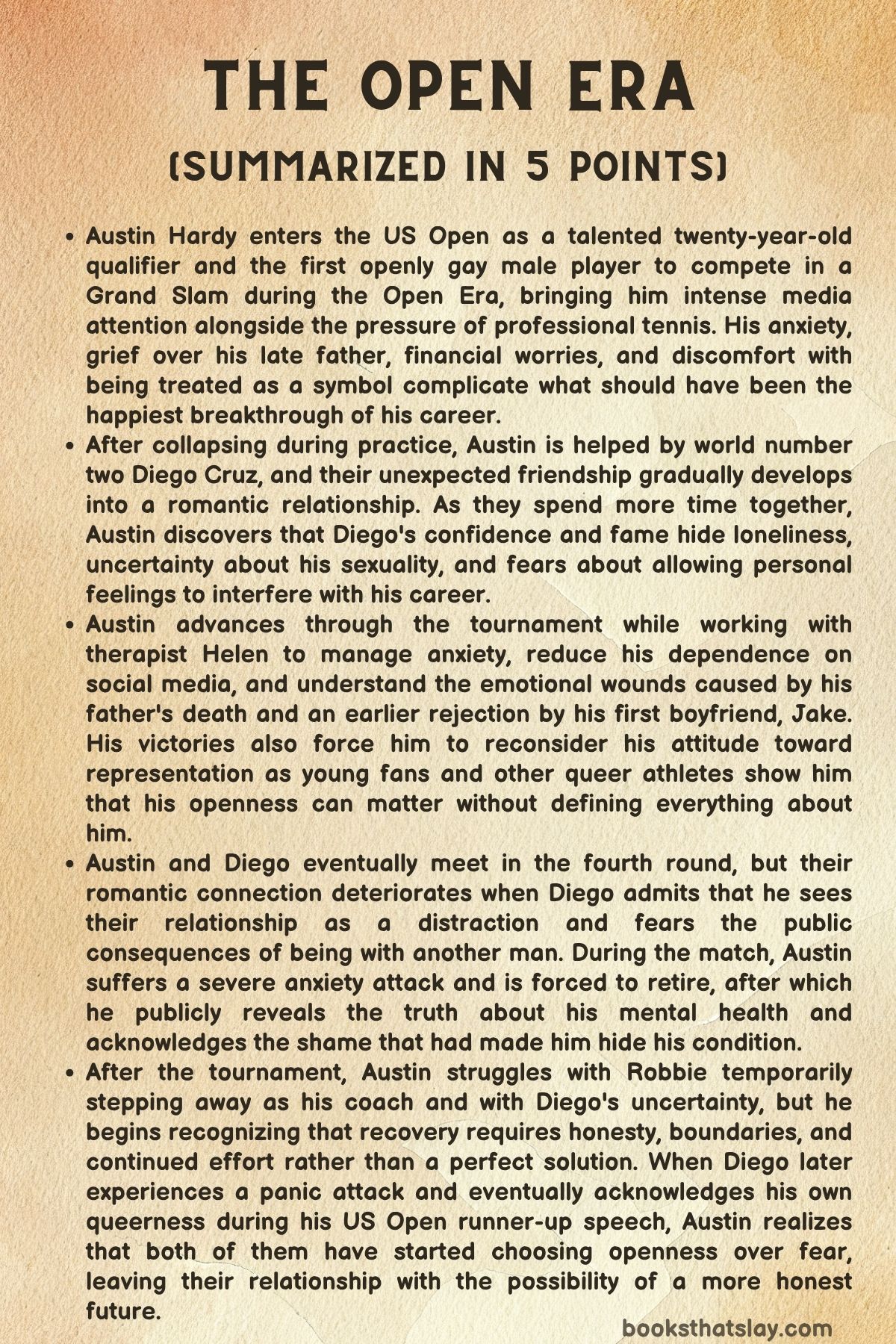
Twenty-year-old Austin Hardy reaches the US Open after surviving qualifying, achieving a goal that has shaped much of his young life. The accomplishment immediately becomes larger than tennis because Austin is recognized as the first openly gay male player to compete in a Grand Slam during the Open Era, a distinction that attracts enormous media interest even though Austin would rather be discussed for his performance.
Austin’s uneasiness grows when an interview about his achievement spreads widely online. Supportive reactions appear beside homophobic abuse, and his habit of repeatedly reading comments intensifies anxiety symptoms that have troubled him for years.
During practice, Austin becomes dizzy, struggles to breathe, and collapses on court. Diego Cruz, the world’s second-ranked player and one of tennis’s biggest stars, rushes from a neighboring court to help him, creating a highly visible moment that quickly circulates online.
Although medical examinations reveal no physical emergency, Austin knows the incident is connected to his anxiety. Robbie, his coach and his late father’s closest friend, becomes deeply concerned and insists that Austin speak with a therapist named Helen if he wants to continue competing.
Austin reluctantly agrees. Meanwhile, Diego unexpectedly contacts him and visits his hotel room, where the two spend an ordinary evening playing video games rather than discussing rankings, fame, or public expectations.
Their friendship develops rapidly because both men are lonelier than their public lives suggest. Diego appears socially confident and glamorous, yet Austin learns that many of Diego’s interactions are connected to sponsorship obligations, while Austin himself has few close relationships outside his family and Robbie.
Helen begins helping Austin recognize how several pressures contribute to his anxiety, including social media, professional expectations, loneliness, grief, and his tendency to judge himself harshly. She encourages him to make brave choices and eventually persuades him to separate himself from his phone during the tournament.
Austin’s first-round opponent is Leon Volt, a decorated veteran whom Austin initially views as almost impossible to defeat. After a disastrous beginning, however, Austin becomes more aggressive, trusts his serve, and recovers mentally after remembering his late father.
He defeats Volt in four sets and earns his first Grand Slam main-draw victory. A young spectator named Peter, wearing rainbow shoelaces in Austin’s honor, helps Austin understand that his visibility genuinely matters to some people, even though he still resents being treated primarily as a symbol.
Austin’s relationship with Diego continues to deepen. After Diego temporarily stops responding, Austin discovers that Diego’s beloved elderly dog has died, and their conversation about loss leads Austin to discuss his father’s death from ALS.
Austin later learns that Diego has noticed far more about his anxiety than he realized. After Austin admits that his strange physical reactions are anxiety attacks, Diego responds with patience and affection rather than embarrassment, creating enough trust for their friendship to become openly romantic in private.
At the same time, Austin continues advancing through the tournament. He survives another anxiety episode during his match against Dimitris and later faces Byron Davies, whose deliberate attempts to disturb his concentration nearly cause Austin to lose control.
During that match, Austin takes a private break, acknowledges the many thoughts overwhelming him, and remembers that tennis once gave him genuine joy. He returns with greater control, defeats Davies, and reaches the fourth round, where the draw places him against Diego.
Their approaching match turns an already uncertain relationship into something much more difficult. Austin learns from Diego’s coach, Emiliano Perez, that Diego has previously experimented with another male player, contradicting Diego’s earlier suggestion that his feelings for Austin were entirely new.
Austin feels deceived, although Diego later explains that the earlier experience was brief and emotionally insignificant. Their attraction remains strong, and before their match they become physically intimate, with Diego openly admitting uncertainty about his sexuality and Austin reassuring him that he does not need to force himself into a label.
The emotional closeness lasts only briefly. Diego becomes distant during the night and later stops responding to Austin, awakening Austin’s memories of Jake, his childhood best friend and first boyfriend, who withdrew from him after Austin publicly acknowledged their relationship.
Austin’s sense of abandonment becomes even stronger when he discovers that Robbie and Charlotte declined an interview request from the New York Times without consulting him. Austin feels they have taken control of his story in the name of protecting him, and his anger pushes him back toward social media at the worst possible moment.
Robbie attempts to restore Austin’s focus by arranging a training day with former champion Lucas Eriksson and elite player Killian Warner. Killian challenges Austin’s frustration with questions about sexuality, reminding him that earlier queer athletes helped create opportunities that now make Austin’s career possible.
The experience helps Austin remember that he belongs at this level, but Diego’s silence continues to hurt him. By the time Austin and Diego enter Arthur Ashe Stadium for their fourth-round match, their personal conflict has become almost inseparable from their professional competition.
The match takes place on Pride Day, surrounding Austin with exactly the symbolism he has struggled to manage throughout the tournament. He begins strongly, while Robbie notices that Diego may be protecting an ankle injury.
A rain delay eventually forces Austin and Diego into a private confrontation. Diego admits that his feelings for Austin have become a distraction because he cannot stop thinking about him, but he is frightened by both the effect on his tennis and the public attention that could come from being involved with another man.
Austin recognizes that Diego is afraid of experiencing the kind of scrutiny Austin has already been forced to endure. He is even more hurt by the realization that Diego may originally have pursued him without expecting a low-ranked qualifier to remain in the tournament long enough to become a serious competitive threat.
Austin ends their relationship and returns to the court determined to defeat him. He plays brilliantly for a period and even uses knowledge gained from their personal time together to anticipate Diego’s serves.
Then Austin’s anxiety becomes physically overwhelming. His chest tightens, dizziness returns, his thoughts become increasingly hostile, and he eventually becomes unable to continue.
Austin retires from the match because of the anxiety attack. The defeat devastates him, particularly because he sees Peter crying and knows that he has repeatedly hidden the truth about his mental health.
Instead of maintaining the earlier explanation that his physical problems were caused by heat or food, Austin decides to speak publicly. He admits that both his practice collapse and his retirement were caused by anxiety, discusses therapy and shame, and acknowledges that openness can matter even when he dislikes being reduced to one aspect of himself.
The end of Austin’s tournament creates further personal loss. Robbie decides that coaching Austin has become emotionally unbearable because Austin reminds him so strongly of Austin’s father, David, and because Robbie feels responsible for protecting the son of the friend he lost.
Austin interprets Robbie’s departure as another abandonment. His relationship with Diego appears finished, his coach is gone, and his competitive schedule has been interrupted just as his ranking rises dramatically into the world’s top hundred.
Helen gradually challenges Austin’s belief that everyone inevitably leaves him. She explains that therapy cannot be won like a tennis match and that progress comes through repeated actions such as honesty, emotional awareness, sleep, meditation, and allowing himself to continue despite setbacks.
Austin soon receives an unexpected call from Diego, who is experiencing his own panic attack before the US Open final. Recognizing the symptoms immediately, Austin goes to him and remains beside him until his breathing and fear begin to settle.
Seeing Diego in that state changes Austin’s understanding of how frightening his own attacks must be for the people who love him. Diego admits that Austin was the person he specifically wanted when he became afraid.
The following morning, Diego asks Austin to remain in New York and sit in his players’ box for the final. He also admits that he wants Austin in his life, but he can only promise that they might eventually have a public relationship.
Austin refuses to become someone’s secret again. His experience with Jake has taught him that affection without openness carries a cost he is unwilling to accept, and he tells Diego that uncertainty about timing cannot require Austin to hide himself.
Austin initially considers leaving New York, but an anonymous message from Emiliano telling him not to attend the final changes his mind. Rather than allowing another person to decide where he belongs, Austin chooses to stay.
Before the final, Austin learns that Helen and Robbie have a history together and that Robbie has personally paid for Austin’s therapy. The discovery helps Austin understand that Robbie’s withdrawal came from grief and fear rather than indifference, leading him finally to call his coach.
Austin then returns to Arthur Ashe with Charlotte and sits in Diego’s players’ box despite Emiliano’s disapproval. Diego immediately notices him and visibly responds to his presence.
Diego plays brilliantly against world number one Viktor Zolotarev and comes close to winning the championship, but his injured ankle worsens and he eventually loses in five sets. During his runner-up speech, however, Diego makes a choice that carries significance beyond the result.
He publicly thanks Austin for his courage and acknowledges queer athletes who made it possible for people like Austin and people like himself to live openly. By placing himself within that statement before an enormous audience, Diego rejects the secrecy that had separated them.
Austin realizes that their connection has not reached a final conclusion. The US Open has transformed his ranking, his understanding of representation, his relationship with anxiety, his bond with Robbie, and his expectations of love, while Diego’s public acknowledgment suggests that both men may finally be ready to approach whatever comes next with greater honesty.
Characters
Austin Hardy
Austin Hardy is the emotional center of The Open Era, and nearly every major conflict in the book develops through the tension between the person he believes he must be and the vulnerable young man he actually is. He is ambitious, talented, sarcastic, competitive, self-conscious, and frequently funny, but his greatest opponent is often his own tendency to interpret mistakes, silence, rejection, and uncertainty as evidence that something is fundamentally about to go wrong.
His anxiety is not presented as a temporary obstacle that disappears once he becomes successful. Austin can be winning a match comfortably and still experience chest pressure, dizziness, breathing difficulties, intrusive thoughts, and panic, which makes his condition especially frustrating because athletic success cannot guarantee emotional stability.
His relationship with public identity is equally complicated. Austin is proud of being gay and refuses to hide it, yet he resents the assumption that every achievement must become a statement about his sexuality.
That resistance slowly becomes more nuanced through Peter, Killian, Diego, and his own experiences with the press. Austin begins to understand that representation can matter to other people without requiring him to surrender the right to be recognized as a complete individual.
Grief shapes many of his reactions even when he does not consciously recognize it. The death of his father and Jake’s earlier rejection have created a deep expectation that attachment eventually leads to abandonment, causing Diego’s silence and Robbie’s departure to affect him with far greater force than those events might otherwise carry.
Austin’s development therefore depends less on eliminating anxiety than on changing his relationship with uncertainty. By speaking publicly about his mental health, setting boundaries with Diego, returning to Arthur Ashe after his retirement, and reconnecting with Robbie, he begins choosing honesty even when honesty cannot guarantee a comfortable outcome.
Diego Cruz
Diego Cruz enters The Open Era as Austin’s apparent opposite. He is highly ranked, famous, wealthy, socially confident, commercially valuable, and seemingly capable of separating emotion from competition with an ease Austin desperately wants.
That image gradually proves incomplete. Diego is lonely, heavily managed by professional expectations, frightened by vulnerability, and uncertain about what his attraction to Austin means for both his identity and his career.
His affection for Austin is often expressed through actions rather than direct declarations. He rushes to help Austin after the collapse, spends private time playing games with him, shares his drawings, gives Austin his Rolex, comforts him during an emotional confession, invites him into his professional world, and ultimately wants him present at the most important match of his career.
Yet Diego’s weaknesses are equally significant. He withdraws when intimacy begins interfering with the strict mental structure he has built around tennis, and his decision to stop communicating becomes particularly harmful because he knows Austin already struggles with anxiety and abandonment.
Diego’s fear of public judgment also exposes an important imbalance between the two men. Austin has already experienced open scrutiny as a gay athlete, while Diego initially wants emotional closeness without accepting the public consequences that may accompany it.
His panic attack becomes an important reversal because the athlete who appeared mentally untouchable suddenly experiences the terror Austin has repeatedly endured. That experience does not automatically resolve his uncertainty, but it forces Diego to understand vulnerability from inside rather than observing it from a distance.
His public speech after losing the final represents his clearest act of growth. By identifying himself with queer athletes before a worldwide audience, Diego chooses openness at a moment when silence would have been easier and professionally safer.
Robbie
Robbie functions as coach, guardian, mentor, financial supporter, and surviving connection to Austin’s father. His relationship with Austin is therefore far more emotionally complicated than a conventional professional partnership.
He understands Austin’s talent and pushes him toward excellence, but he also feels responsible for protecting him. That responsibility becomes painful after Austin’s anxiety episodes because Robbie believes continuing to coach him may mean encouraging a career that is harming the son of the man he loved as a friend.
Robbie’s instinct to protect Austin sometimes becomes controlling. Declining the New York Times interview without consulting him demonstrates how easily care can become interference when one person assumes that knowing what is safest gives them the right to decide for someone else.
At the same time, Robbie’s commitment is extraordinary. He coaches without taking payment, privately covers Helen’s fees, studies opponents obsessively, arranges elite training opportunities, manages Austin’s phone when necessary, and repeatedly reminds him that his talent belongs to him rather than to his father or coach.
His temporary departure is not a simple rejection. It reveals unresolved grief over David and the impossible emotional position of trying to protect a young man who increasingly resembles the friend he lost.
Charlotte
Charlotte combines the roles of older sister, public-relations manager, protector, critic, and comic counterweight to Austin’s intensity. She understands his personality well enough to recognize when he is spiraling, yet she rarely responds to him with excessive delicacy.
Her practical intelligence becomes especially important as Austin’s public profile rises. Charlotte manages statements, handles media complications, photographs sponsorship content, and frequently recognizes the consequences of Austin’s impulsive reactions before he does.
She is also one of the first people to recognize the romantic nature of Austin’s relationship with Diego. Where Austin repeatedly questions whether Diego is interested in him, Charlotte views the attraction as obvious.
Her loyalty becomes especially clear after Austin’s tournament ends. She gives him a place to stay, encourages him to reenter ordinary life, accompanies him back to Arthur Ashe, and remains present without demanding that he recover according to anyone else’s schedule.
Austin’s Mother
Austin’s mother represents emotional safety and family continuity. She appears most powerfully during moments when Austin’s professional identity collapses and he becomes simply a frightened young man who wants comfort.
Her presence after his anxiety attack in Arthur Ashe demonstrates this role clearly. Once the immediate medical danger has passed, Austin breaks down in her lap, allowing himself a level of emotional dependence that he often tries to suppress elsewhere.
She also understands the sacrifices behind his career. Her encouragement during qualifying and willingness to return to New York for his match against Diego reveal that Austin’s tennis ambitions have always existed within a family project shaped by both pride and loss.
David Hardy
David Hardy, Austin’s deceased father, remains one of the story’s most influential figures despite never participating directly in the present-day action. His death from ALS shapes Austin’s grief, finances, career motivation, relationship with Robbie, and fear that everyone he loves eventually disappears.
Austin repeatedly turns toward memories of his father during moments of extreme stress. Beach memories, childhood tennis memories, old texts, and imagined conversations provide both comfort and pain because David represents a period when Austin felt protected from the unpredictability that now dominates his life.
David’s influence is also preserved through Robbie. The similarities Robbie sees between father and son make coaching Austin emotionally difficult, while Austin eventually understands that David’s friendship with Robbie effectively gave him a second adult protector after his father’s death.
Helen
Helen is important because she refuses to treat Austin’s mind like another tennis problem with a score, strategy, and decisive victory. Her approach repeatedly frustrates Austin because he wants a solution that will permanently stop anxiety rather than a process that teaches him how to live with it.
She encourages practical changes such as limiting social media, meditating, adjusting breathing, improving sleep, allowing emotional release, and considering psychiatric treatment. None of these techniques becomes a magical cure, which reinforces the book’s realistic treatment of mental health.
Helen also identifies the emotional structure beneath Austin’s anxiety. She connects his fear of abandonment to David’s death, Jake’s rejection, Diego’s uncertainty, and Robbie’s departure, eventually challenging Austin’s belief that loss proves attachment itself is unsafe.
Her most important lesson is that improvement consists of repeated choices rather than one dramatic breakthrough. By framing recovery as something practiced over time, she helps Austin begin replacing perfection with persistence.
Emiliano Perez
Emiliano Perez represents the professional culture surrounding Diego at its most controlling and results-driven. He values focus, victory, and protection of Diego’s career, and he views Austin primarily as a possible distraction rather than as a person important to his player.
His confrontation with Austin is especially significant because he exposes information about Diego’s previous experience with another man while simultaneously trying to restrict their contact. The conversation damages Austin’s trust and intensifies the conflict between private affection and professional control.
Emiliano’s later attempt to prevent Austin from attending the final reveals how strongly he believes Diego’s emotional life should be managed for competitive reasons. Ironically, the interference contributes to Austin’s decision to attend because Austin refuses to allow Emiliano to determine his place in Diego’s life.
Jake
Jake appears mainly through Austin’s memories, but his influence on Austin’s romantic psychology is enormous. As Austin’s childhood best friend and first boyfriend, Jake once represented both emotional safety and first love.
When Austin publicly suggested that they were together, Jake panicked and withdrew. Austin therefore experienced rejection at precisely the moment when he was trying to live openly, and David’s death soon afterward reinforced the association between love and sudden disappearance.
Jake becomes the template through which Austin interprets Diego’s uncertainty. When Diego becomes distant after intimacy, Austin immediately expects history to repeat itself.
Austin’s eventual decision to delete his old messages with Jake shows a small but meaningful shift. He cannot erase the past, but he can stop preserving the relationship as an active emotional wound.
Peter
Peter begins as the young spectator Austin accidentally frightens during his difficult first-round match. He quickly becomes one of the clearest examples of why Austin’s public presence matters beyond rankings and victories.
His rainbow shoelaces and conversation with his father show Austin that representation can affect individual lives in ways that media slogans cannot fully express. Peter does not treat Austin as an abstract historical figure; he simply sees someone whose existence makes questions about identity easier to ask.
Peter also becomes an emotional reference point during later matches. His encouragement helps Austin regain composure, while his tears after Austin retires from the Diego match deepen Austin’s realization that hiding his anxiety has consequences.
Nicole
Nicole, the Nike representative, introduces another dimension of Austin’s conflict with representation. She sees clear commercial value in his combination of athletic talent, rising visibility, and significance as an openly gay player.
Austin reacts defensively because he fears becoming valuable to a sponsor mainly as a diversity symbol. Nicole’s interest therefore forces him to confront the difficult reality that professional sports constantly turns identity, achievement, personality, and public attention into marketable qualities.
Her presence near Peter during Austin’s match against Diego suggests that the sponsorship relationship remains possible despite Austin’s confrontational response. She represents a professional opportunity Austin may eventually need to evaluate without assuming that commercial interest automatically erases genuine respect for his tennis.
Killian Warner
Killian Warner offers Austin a perspective he cannot easily dismiss because she is both an elite player and part of the wider queer tennis community. Her conversation with him challenges the assumption that constant questions about sexuality are uniquely his burden.
She acknowledges his frustration while reminding him that openly queer women competed before him and helped create the environment that makes his own visibility possible. Her role therefore complicates Austin’s resistance to symbolic responsibility without suggesting that he must enjoy every question or media narrative attached to his identity.
Lucas Eriksson
Lucas Eriksson represents the version of professional success Austin once idealized from a distance. As a former sixteen-time Grand Slam champion, he possesses the authority of someone who understands the psychological cost of elite competition rather than merely admiring it.
His advice helps Austin remember that professional tennis can consume a person if achievement becomes tied entirely to other people’s expectations. By telling Austin that he must ultimately compete for himself, Lucas raises a question Austin has not fully resolved because his father’s memory and family’s sacrifices remain closely connected to his ambition.
The private training session also gives Austin a rare experience of belonging among elite players. Practicing successfully with Lucas and Killian temporarily restores his confidence at a moment when his personal relationships feel unstable.
Leon Volt
Leon Volt serves as Austin’s first major test after entering the US Open main draw. His experience, former championship success, and condescending attitude initially reinforce Austin’s fear that he does not belong at the highest level.
Defeating Volt becomes important because Austin proves that reputation does not determine the result of a match. The victory marks the first time during the tournament that Austin converts anxiety into aggressive belief rather than allowing fear to define the limits of his performance.
Dimitris
Dimitris is less developed personally, but his match with Austin becomes a significant test of Austin’s ability to function while anxiety returns unexpectedly. Austin begins brilliantly, making the later physical symptoms especially disturbing because they demonstrate that panic does not require a losing position or obvious external crisis.
Dimitris’s irritation at Austin’s repeated burping adds embarrassment to the episode. Through this match, Austin learns that symptoms can appear absurd from the outside while feeling frightening and uncontrollable to the person experiencing them.
Byron Davies
Byron Davies is deliberately disruptive and understands how small acts can damage an opponent’s concentration. His racket tapping becomes effective because Austin is already carrying unresolved anger about Diego, Emiliano, public pressure, grief, and anxiety.
The match forces Austin to recognize that he cannot control every external irritation. His decision to meditate, delay his return, and use an underarm serve marks a moment when he responds creatively rather than allowing Davies to dictate the emotional direction of the match.
Viktor Zolotarev
Viktor Zolotarev appears primarily as Diego’s opponent in the US Open final. As the world number one, he represents the final competitive barrier between Diego and the Grand Slam title he desperately wants.
His comeback after Diego wins the first two sets demonstrates the unforgiving nature of elite competition. Viktor’s presence also ensures that Diego’s final personal transformation occurs during defeat rather than victory, making the public speech more significant because Diego chooses honesty when he has just lost what he wanted most professionally.
Other Austin
The teenage hitting partner who shares Austin’s name provides a lighter parallel to the protagonist. His casual ability to block abusive online commenters contrasts sharply with Austin’s compulsive habit of reading every hostile reaction.
His eventual victory in the boys’ singles tournament offers a small moment of continuity near the end of the book. While Austin’s own run has ended painfully, another young player’s success reminds him that the tournament contains beginnings as well as endings.
Ryan
Ryan, the reporter who interviews Austin after qualifying, helps establish the central conflict between athletic achievement and public identity. His questions immediately frame Austin’s success through the historical significance of being openly gay.
Austin corrects him when he overlooks openly gay women who competed before him, demonstrating both Austin’s awareness of tennis history and his resistance to simplistic media narratives. Ryan’s interview also triggers the viral attention that increases the pressure surrounding Austin before the tournament has properly begun.
Themes
Identity Beyond Public Labels
Austin’s conflict with visibility develops from a difficult contradiction: he refuses to hide who he is, yet he does not want openness to become the only reason people notice him. In The Open Era, every major achievement risks being reframed as a historical moment connected to sexuality, leaving Austin wondering whether audiences, reporters, and sponsors see the athlete or simply the symbol.
His frustration is understandable because reducing someone to representation can become another form of limitation. Austin wants his serve, forehand, competitiveness, humor, ranking, grief, anxiety, ambition, and personality to matter alongside his sexuality rather than disappear behind it.
At the same time, the book refuses to let Austin dismiss representation entirely. Peter’s rainbow shoelaces, Killian’s reminder about earlier queer athletes, and Diego’s final public declaration show that visibility can create possibilities for people watching from the outside.
Austin therefore moves toward a more balanced understanding. He does not need to accept every question, commercial campaign, or symbolic burden placed upon him, but he can recognize that his openness possesses social meaning without allowing that meaning to define the limits of his identity.
Diego’s development extends the same idea from another direction. Austin begins the story already visible, while Diego must decide whether private truth is enough when secrecy requires another person to hide beside him.
Anxiety, Control, and the Limits of Performance
Professional tennis rewards control. Players train their bodies, routines, strategies, diets, sleep, emotions, equipment, schedules, and attention in the hope that preparation can reduce uncertainty when they enter the court.
Austin’s anxiety exposes the limits of that belief. Symptoms can arrive while he is winning, after positive experiences, or at moments when no obvious external danger exists, making the condition especially difficult for someone trained to believe that every problem should have a correct technical response.
His repeated attempts to conceal symptoms also reveal how strongly elite sports can associate vulnerability with failure. Austin invents explanations involving heat, food, physical injuries, and exhaustion because admitting that anxiety has affected his body feels more dangerous than allowing people to misunderstand him.
The turning point comes when he recognizes that control cannot mean pretending anxiety does not exist. Therapy, meditation, reduced social media exposure, breathing exercises, honest conversations, and possible medication are not presented as ways to guarantee that another attack will never happen.
Instead, they represent forms of management and self-knowledge. Diego’s later panic attack reinforces this idea by showing that ranking, confidence, wealth, and professional success cannot make a person immune to fear.
Grief, Abandonment, and the Fear of Attachment
Austin’s belief that everyone leaves is built from experiences that happened close enough together to become emotionally connected. Jake withdrew after Austin made their relationship visible, and Austin’s father died only months later, transforming two very different losses into evidence that closeness eventually produces pain.
That expectation affects almost every important relationship Austin forms afterward. Diego’s delayed messages feel catastrophic, Robbie’s temporary departure feels permanent, and even moments of affection become frightening because Austin instinctively searches for signs that they will end.
The book distinguishes actual abandonment from the fear created by grief. David did not choose to leave Austin, Robbie withdraws because he is overwhelmed by responsibility and unresolved loss, and Diego’s hesitation comes from fear rather than absence of feeling.
Those distinctions matter because Austin initially experiences all departures through the same emotional conclusion. Helen’s work with him gradually challenges that pattern without pretending that relationships are guaranteed to last.
Growth therefore does not require Austin to believe that nobody will ever leave. It requires him to accept that the possibility of loss cannot become a reason to avoid attachment, hide his needs, or accept relationships that make him feel invisible.
His decision to tell Diego that he will not be a secret shows this development clearly. Austin can love someone and still refuse conditions that reproduce an older wound.
Love, Competition, and Emotional Honesty
Austin and Diego’s relationship becomes difficult because neither romance nor competition can be separated from the lives they have chosen. They are attracted to each other while progressing through the same tournament, and their closeness eventually leads directly to a match in which one person’s success requires the other’s elimination.
That conflict tests the difference between affection and possession. Austin wants Diego emotionally, yet he also genuinely wants to defeat him, while Diego desires Austin’s presence but fears that emotional attachment will damage the ruthless concentration his career requires.
Their private knowledge even becomes competitive information. Austin recognizes patterns in Diego’s serve because of time spent playing Ping-Pong with him, while Diego’s ankle injury becomes something Austin and Robbie can consider tactically.
The relationship can survive only when both men stop pretending that feelings can be neatly isolated from professional life. Diego’s attempt to treat Austin as a distraction fails because avoiding him creates as much emotional disruption as being close to him.
Austin reaches a similar realization from the opposite side. Love cannot require him to accept secrecy simply because Diego needs more time.
Their final movement toward honesty therefore matters more than whether they immediately become a conventional couple. Diego publicly acknowledges a part of himself he had feared exposing, while Austin returns to support him without surrendering the boundary that he deserves to be recognized openly.