American Dirt Summary, Themes And Review
American Dirt by Jeanine Cummins follows Lydia Quixano Pérez, a bookstore owner in Acapulco, and her young son Luca after a cartel massacre destroys their family and forces them to flee north. The novel is a story of survival, fear, and motherhood under extreme pressure.
It follows ordinary people pushed into the migrant journey, showing how violence, corruption, poverty, and hope shape each step toward the United States. At its center is Lydia’s desperate effort to protect Luca while facing grief, guilt, danger, and the loss of the life she once knew.
Summary
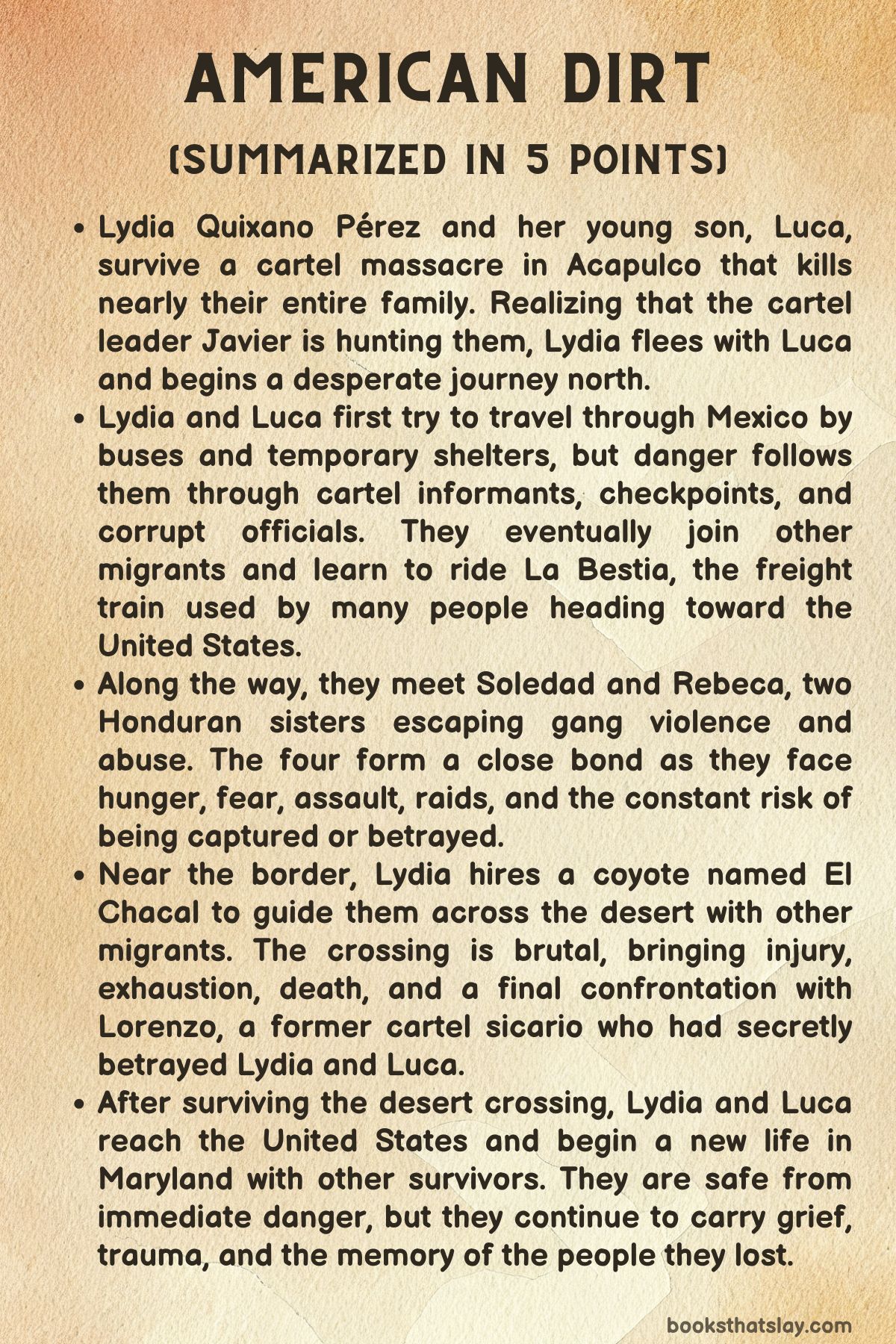
American Dirt begins in Acapulco, where Lydia Quixano Pérez and her eight-year-old son, Luca, survive a horrifying cartel attack during a family celebration. The gunmen kill nearly everyone in Lydia’s family, including her husband Sebastián, a journalist, and many relatives gathered at her mother’s home.
Lydia and Luca survive only because they hide in the bathroom while the killers search the house. Lydia realizes that the attack was not random.
Sebastián had written an article exposing Javier Crespo Fuentes, the leader of the Los Jardineros cartel, who was also Lydia’s friend and a regular customer at her bookstore.
Before the massacre, Lydia knew Javier as a thoughtful reader who shared her love of books and poetry. Their friendship grew through conversations at her shop, and Lydia saw him as intelligent, wounded, and lonely.
She later discovered that he was the cartel boss known as The Owl. Even then, she struggled to connect the gentle man she knew with the brutal violence Sebastián described in his reporting.
When Sebastián published an article revealing Javier’s identity and crimes, Lydia believed Javier might be flattered by the literary attention, especially because the piece included one of his poems. Instead, the article leads to disaster.
Javier’s daughter Marta kills herself after being humiliated and shaken by the public exposure of her father’s life. Javier blames Sebastián and Lydia, and his grief turns into revenge.
After the attack, Lydia understands that she and Luca are still in danger. Cartel informants are everywhere, including among police and hotel workers.
She takes money, supplies, and Sebastián’s red Yankees cap for Luca, then begins moving carefully through Acapulco. Javier sends Lydia a copy of Love in the Time of Cholera with a threatening message that confirms he knows she is alive.
Lydia decides she and Luca must leave Mexico and reach Denver, where her uncle lives.
Their escape begins by bus, but Lydia fears roadblocks controlled by Los Jardineros. She turns to Carlos, an old friend of Sebastián’s, who helps them reach Mexico City with a group of American missionaries.
Even this route is dangerous. At a checkpoint, armed boys connected to the cartel inspect the vehicles, and Lydia narrowly avoids being recognized.
In Mexico City, Lydia tries to obtain identification for Luca so they can fly north, but the bureaucracy blocks them. She realizes that they cannot travel like ordinary citizens.
They must join the path of migrants.
Lydia learns about La Bestia, the freight trains used by migrants heading north. The journey is dangerous, but she has no safe alternative.
At a migrant shelter, she meets people whose stories reveal the violence faced by those fleeing Central America and Mexico. She hears about sexual assault, cartel threats, poverty, and the hard choices people make when staying home becomes impossible.
Luca, who has been quiet and traumatized since the massacre, slowly begins to observe the world around him again. His gift for geography helps him understand where they are and where they need to go.
Lydia and Luca meet two sisters from Honduras, Soledad and Rebeca. The sisters are fleeing gang violence and abuse.
Soledad had been claimed by a violent gang member, while Rebeca was also threatened. Their beauty makes them vulnerable during the journey, but they are resourceful and brave.
They teach Lydia and Luca how to board La Bestia from overpasses and moving points along the tracks. Together, the four form a temporary family as they ride north, sleep in plazas, share food, and watch out for one another.
The journey exposes them to constant danger. Migrants fall from trains, face hunger, and are hunted by authorities and criminals.
Lydia remains alert for anyone connected to Javier. Her fear becomes reality when Lorenzo, a former Los Jardineros sicario, appears on the train.
Luca recognizes him from a migrant shelter, where Lorenzo had assaulted a young girl. Lorenzo tells Lydia that he has left the cartel and will not betray her, but she cannot trust him.
He knows who she is and carries the danger of Javier’s reach with him.
As the group continues north, they are captured during an immigration raid. Officials abuse and rob the migrants, and Soledad and Rebeca are separated from the others and sexually assaulted.
Lydia and Luca are nearly released because they are Mexican citizens, but Luca refuses to leave the sisters behind. Lydia uses the last of her money to pay for their release.
This moment shows Luca’s moral courage and Lydia’s growing attachment to the girls. They are no longer strangers traveling in the same direction; they have become responsible for one another.
A doctor named Ricardo helps them with food, shelter, and transport. Soledad miscarries during this part of the journey, another loss she must carry silently.
Later, the group reaches Nogales, where the United States is visible behind fences, cameras, and razor wire. They meet Beto, a boy who was born in Tijuana but raised in the United States before being deported.
He becomes Luca’s friend and joins their attempt to cross the border. The group hires a coyote named El Chacal, who agrees to guide them across the desert.
Before crossing, Lydia withdraws money from her dead mother’s account with help from a sympathetic bank manager whose own family has suffered cartel violence. The migrants gather in an apartment while waiting for the crossing.
They include deportees, families, and people who have lived in the United States for years before being removed. Their stories show that the border is not a simple line between safety and danger.
For many, it is a place of separation, loss, and repeated attempts to return to loved ones.
Lorenzo appears again and joins the crossing group. Lydia remains deeply uneasy.
The migrants begin the desert trek at night, carrying water and following El Chacal’s strict instructions. The crossing is physically brutal.
They hide from drones, Border Patrol, vigilantes, and the sun. They climb hills, endure thirst, cold, rain, and exhaustion.
A flash flood injures Ricardín, forcing his father Choncho to stay behind with him and try to reach help. The group must continue, aware that survival sometimes requires choices that feel cruel.
During a rest stop in a cave, Lorenzo follows Rebeca and tries to assault her. El Chacal stops him, and Soledad shoots Lorenzo dead.
Lydia later checks Lorenzo’s phone and discovers that he had betrayed her and Luca to Javier in exchange for his freedom from the cartel. In anger, Lydia video-calls Javier.
She tells him Lorenzo is dead and makes clear that he destroyed her life but did not destroy her will to survive. Her love for Javier is gone, replaced by hatred and a fierce commitment to Luca.
The final part of the crossing brings more loss. Beto suffers a severe asthma attack and dies despite Marisol and Nicolás trying to save him.
The group is devastated, but El Chacal forces them onward. Eventually, they hide inside compartments in RVs and are driven past a closed checkpoint into Tucson.
Lydia and Luca make it through, though the cost of the journey has been immense.
The story ends 53 days after the massacre. Lydia and Luca now live in Maryland with Soledad, Rebeca, César, and others.
Lydia cleans houses, and Luca attends school. Bookstores and libraries become small places of comfort for Lydia, connecting her to the life she lost.
Luca still struggles with trauma and dreams of his father, but he also begins to build a new life. The survivors bury painted stones in the garden to honor those they lost.
Lydia’s grief remains, but so does her love for Luca and her determination to keep going.
Characters
Lydia Quixano Pérez
Lydia is the emotional and moral center of American Dirt, a woman whose life changes from ordinary stability to extreme danger in a single afternoon. At the beginning, she is a bookstore owner, wife, mother, daughter, and friend, rooted in Acapulco and shaped by books, family, and routine.
Her survival after the massacre forces her into a role she never imagined: a migrant mother making one dangerous decision after another to keep her child alive. Lydia’s strength does not appear as fearlessness.
She is terrified almost constantly, but she acts despite that fear. Her intelligence shows in the way she checks cars, avoids buses that might be watched, uses fake names, hides money, studies train routes, and judges whom to trust.
Her deepest conflict comes from her past relationship with Javier. She is haunted not only because he kills her family, but because she once cared for him and failed to see the full danger he carried.
This guilt becomes part of her grief, yet it does not defeat her. By the end, Lydia has lost her home, husband, mother, relatives, money, and former identity, but she has gained a harsher knowledge of the world.
Her love for Luca becomes the force that keeps her moving, and her final survival is not a clean victory but a continuation of life after enormous damage.
Luca
Luca is a child marked by trauma, intelligence, and moral clarity. His gift for geography gives him a way to understand the world when everything familiar has collapsed.
He knows distances, routes, cities, borders, and directions, and this knowledge often gives him a small sense of control during a journey ruled by uncertainty. After the massacre, Luca becomes silent and withdrawn, carrying shock in ways that his mother cannot fully reach.
Yet he is not passive. He observes carefully, remembers details, recognizes danger, and often understands more than adults expect him to.
His red Yankees cap, taken from Sebastián, becomes a symbol of memory and connection to his father, though even that must be hidden when survival requires it. Luca’s compassion is one of his strongest traits.
He refuses to let Lydia abandon Soledad and Rebeca when they are held by corrupt officials, even though saving them costs nearly all their money. He befriends Beto, worries about the injured and the dead, and carries questions that no child should have to ask.
By the end, Luca has reached safety, but he is not healed. His dreams, his need for light, and his conversations with his father’s memorial stone show that survival and recovery are different things.
Javier Crespo Fuentes
Javier is one of the most complex figures in the story because he is presented through two opposing realities. To Lydia, he first appears as a charming, intelligent, literary man who loves books, writes poetry, speaks with vulnerability, and seems capable of tenderness.
To the public and to Sebastián, he is The Owl, the head of Los Jardineros, a cartel leader responsible for calculated violence. The force of his character lies in the fact that both versions are true, but they do not cancel each other out.
His taste for literature does not soften the consequences of his brutality. His grief over Marta’s death does not excuse the slaughter of Lydia’s family.
Javier’s relationship with Lydia is built on emotional intimacy, but also on blindness and power. He wants to be seen as a man with a soul, yet he uses terror when his ego and pain are wounded.
His revenge after Marta’s suicide reveals the selfishness beneath his sorrow. He mourns his daughter by destroying another family, then frames Lydia’s suffering as something that binds them.
Javier is dangerous not only because he commands violence, but because he turns love, grief, and art into excuses for possession and cruelty.
Sebastián
Sebastián is Lydia’s husband, Luca’s father, and the journalist whose work sets the central conflict in motion. Though he dies early in the story, his presence remains powerful throughout the journey.
He represents truth-telling in a society where truth can be fatal. His reporting on cartel violence is driven by professional duty, courage, and a belief that people should know who controls their city.
At the same time, his commitment to journalism creates tension within his family. Lydia worries that his articles will place them in danger, and her fear proves justified.
Sebastián is not portrayed as reckless in a simple sense; he understands danger and takes precautions, but he also underestimates the personal reach of Javier’s revenge. As a father, he is remembered through tender details, especially by Luca, who recalls ordinary moments that become precious after loss.
Sebastián’s death turns him into both a wound and a guide. Luca carries his cap, Lydia carries guilt over advising him not to hide, and their journey north is shaped by the absence he leaves behind.
Rebeca
Rebeca is one of the Honduran sisters Lydia and Luca meet on the migrant route, and she brings warmth, courage, and practical knowledge to the group. She is young, beautiful, and vulnerable to predatory men, yet she is also skilled at survival.
She knows how to board La Bestia, when to move, when to rest, and how to read danger along the tracks. Her memories of her village and her Ch’orti identity give her character a strong connection to home, nature, and cultural belonging.
That background contrasts sharply with the violence that forces her to flee. Rebeca’s bond with Soledad is central to her life; the sisters protect each other even when fear, grief, and exhaustion make protection difficult.
Her near assault by Lorenzo in the desert becomes one of the clearest examples of how migrant women remain unsafe even after escaping earlier threats. Rebeca’s survival is shaped by both endurance and the care of others.
In Maryland, she is alive but changed, separated from ordinary teenage life by memories her classmates cannot understand.
Soledad
Soledad carries a heavy burden of trauma, responsibility, and suppressed grief. Before fleeing Honduras, she is targeted by Iván, a violent gang member who claims her as his girlfriend, abuses her, and threatens her family.
Her escape with Rebeca is an act of desperation and courage. During the journey, Soledad often appears guarded, sharp, and suspicious, and these traits are forms of self-protection.
She understands how easily girls can be used, sold, assaulted, or made to disappear. Her pregnancy and later miscarriage add another layer to her suffering, though she has little space to mourn properly.
When she learns that her father has died, she chooses not to tell Rebeca immediately, carrying the pain alone because she wants to protect her sister. Her killing of Lorenzo is not presented as simple revenge; it is the result of accumulated fear, rage, and the urgent need to stop another assault.
Soledad’s character shows how survival can demand emotional hardness, but her hardness is rooted in love. She protects Rebeca, remembers her father, and continues forward even when grief threatens to break her.
Lorenzo
Lorenzo is a young former sicario whose presence creates suspicion and danger wherever he appears. He claims to have left Los Jardineros, but his actions reveal that he remains shaped by violence, self-interest, and predation.
Luca first recognizes him as the man connected to an assault at the migrant shelter, which immediately marks him as a threat. Lorenzo’s youth complicates him slightly; he is only seventeen and presents himself as a runaway trying to escape the cartel’s control.
However, the story does not allow his youth to erase the harm he causes. He manipulates Lydia by claiming he will not betray her, while secretly communicating with Javier and trading information for his own freedom.
His attempted assault on Rebeca confirms that he has not rejected the cruelty of the world he comes from. Lorenzo’s death in the desert becomes both an act of protection and a grim turning point.
Through him, the novel shows how violence follows migrants through official spaces, criminal networks, shelters, trains, and even the final crossing.
Beto
Beto is a boy close to Luca’s age who joins the group near the border. His character adds another view of migration because he was born in Mexico, grew up in the United States, and was deported south.
He has already experienced the instability of belonging to two places and being fully protected by neither. Beto is streetwise, generous, and eager for connection.
His friendship with Luca matters because Luca has spent much of the journey surrounded by adults, danger, and grief. With Beto, he briefly has a companion who feels closer to his own age and experience.
Beto’s asthma makes him physically vulnerable during the desert crossing, and his death is one of the most painful losses near the end of the journey. He survives so much only to die when safety is almost within reach.
His death reminds the group, and the reader, that the border crossing does not become less dangerous simply because people are close to their goal.
El Chacal
El Chacal is the coyote who guides the migrants across the desert. He is a morally mixed character, neither purely heroic nor purely cruel.
He charges high fees and works within a dangerous system tied to bribery, secrecy, and cartel-controlled routes. Yet he also takes his work seriously and shows concern for the people under his charge.
He warns them, pushes them, hides them, and understands the desert with practical authority. His decisions can seem harsh, especially when injured or dying people cannot be saved without risking the entire group.
At the same time, he stops Lorenzo from assaulting Rebeca and tries to maintain order when violence threatens to destroy the group from within. Luca’s final embrace of him suggests that even in a corrupt system, individuals can still make choices that preserve life.
El Chacal represents the uncomfortable reality that survival often depends on people who operate in morally compromised spaces.
Marisol
Marisol’s story shows another side of displacement: deportation after years of living in the United States. She has built a life in California, raised children there, and belongs emotionally to the place from which she has been removed.
Her legal situation changes after her husband’s death, and she is separated from her American-born daughter. Marisol is caring, practical, and deeply wounded by the cruelty of a system that treats long-established family life as disposable.
She helps others during the journey, especially Beto when his asthma worsens. Her presence broadens the story beyond people fleeing immediate cartel or gang violence.
She represents those who are forced to cross not because they are entering a foreign dream for the first time, but because they are trying to return to the life and family they already had.
Nicolás
Nicolás is a deportee and former PhD student whose life has been disrupted by immigration enforcement. His background challenges narrow ideas about migrants as uneducated or disconnected from American society.
He has lived, studied, and built ambitions in the United States, yet he is still pushed out and forced into the dangerous process of return. Nicolás also provides companionship and support within the crossing group.
He helps Marisol care for Beto and becomes part of the shared effort to survive the desert. His character shows how quickly personal achievement can be made fragile when legal status becomes the measure of belonging.
Carlos
Carlos is Sebastián’s college friend and one of the first people Lydia turns to after escaping Acapulco. His willingness to help carries real risk, especially because Lydia and Luca are being hunted by a cartel with broad influence.
Carlos acts from loyalty to Sebastián and from basic human decency. He also exposes the limits of comfortable distance from violence.
In his argument with Meredith, he criticizes the shallow nature of some outsider charity, especially when people prefer symbolic acts over meaningful risk. Carlos understands that helping Lydia and Luca requires more than sympathy.
It requires action, secrecy, and courage. His role is brief but important because he gives Lydia and Luca the first real chance to move beyond the cartel’s immediate reach.
Meredith
Meredith is Carlos’s American wife, and her reaction to Lydia’s situation reveals fear, privilege, and moral hesitation. She is not cruel, but she is cautious in a way that exposes the gap between abstract compassion and direct involvement.
Her missionary background suggests a desire to help, yet when help becomes dangerous, she worries about the safety of the American volunteers. Meredith’s discomfort is important because it reflects a limited form of charity that prefers controlled, visible, low-risk service.
Through her, the narrative questions what it means to help people in danger and whether good intentions are enough when real sacrifice is required.
Padre Rey and Hermana Cecilia
Padre Rey and Hermana Cecilia represent the shelter workers who offer migrants temporary safety, order, and dignity. Their work is quiet but essential.
They cannot remove the dangers of the journey, but they provide food, registration, rest, and moments of human recognition. Hermana Cecilia’s warning to Lydia to be careful shows that even shelters are not completely safe.
Criminals, informants, and predators can enter spaces meant for protection. Padre Rey’s presence also highlights the role of religious institutions along the migrant route, where faith becomes both comfort and practical aid.
These characters show that survival is often supported by small acts from people who may never know the full outcome of their help.
Ricardo Montañero-Alcán
Ricardo is a doctor who helps Lydia, Luca, Soledad, and Rebeca after they are released from captivity. His kindness arrives at a moment when trust feels almost impossible.
Lydia and Soledad are understandably suspicious of him because many offers of help along the route are traps. Ricardo’s character shows how trauma changes the ability to accept kindness.
He provides food, shelter, medical attention, and transport, and he asks for nothing in return. His religious motivation does not feel performative; it becomes a practical expression of care.
In a story filled with betrayal and exploitation, Ricardo reminds the characters that goodness still exists, though it must be tested before it can be trusted.
Paola
Paola, the bank manager in Nogales, plays a small but meaningful role in Lydia’s final attempt to gather money for the border crossing. She listens to Lydia’s story and responds not with suspicion, but with recognition.
Her own family has suffered cartel violence, which creates a brief but powerful bond between the two women. Paola risks her job to help Lydia close her mother’s account and access the money she needs.
Her decision shows how shared suffering can create solidarity between strangers. She cannot protect Lydia from the desert or from Javier, but she gives her the means to keep moving.
In American Dirt, such moments of help often become the difference between being trapped and surviving.
Themes
Survival and the Cost of Escape
Survival in American Dirt is never presented as simple rescue or clean triumph. It is a repeated series of painful choices made under pressure.
Lydia survives the massacre, but that survival immediately becomes a new danger because the cartel knows she and Luca are alive. Every step north demands another compromise: trusting strangers, hiding identity, spending money meant for the future, boarding trains, sleeping in unsafe places, and accepting help from people whose motives are uncertain.
The physical cost is severe, but the emotional cost is just as significant. Lydia must suppress grief because mourning fully could slow her down.
Luca must grow alert to adult dangers long before he should. Soledad and Rebeca must keep moving despite assault, pregnancy, miscarriage, and family loss.
The desert crossing makes this theme even sharper. When Ricardín is injured and Beto dies, survival becomes tied to unbearable separation.
The group can grieve only briefly because stopping may kill more of them. The novel treats escape not as freedom gained in one moment, but as a process that strips people down to endurance, instinct, memory, and love.
Motherhood Under Extreme Pressure
Lydia’s motherhood is defined by protection, but the story tests what protection means when no place is safe. Before the massacre, she protects Luca through ordinary care: family, routine, books, food, school, and emotional closeness.
After the massacre, protection becomes tactical. She hides his blood, shields him from bodies, changes routes, lies when necessary, watches strangers, and studies danger in every room, vehicle, and roadblock.
Yet she cannot protect him from everything. Luca sees death, hears threats, loses his father, rides trains, runs from officials, and crosses the desert.
This failure is not a failure of love; it is the reality of a violent world where even the fiercest parent cannot control every risk. Lydia’s motherhood also expands beyond Luca.
Her decision to save Soledad and Rebeca, influenced by Luca’s insistence, shows that care can grow under pressure rather than shrink. Marisol’s story adds another angle, showing a mother separated from her child by deportation.
Across these women, motherhood becomes both strength and vulnerability. Their children give them reasons to continue, but also expose them to fear that never fully ends.
Violence, Power, and Corruption
The violence in the story does not come only from cartel gunmen. It spreads through police, immigration raids, paid informants, criminal recruiters, predatory men, and systems that allow cruelty to hide behind authority.
Javier’s cartel power is terrifying because it reaches into ordinary life. Hotel clerks, officials, and local watchers can become extensions of his will.
Lydia cannot simply report danger or ask the state for protection because the state itself may be compromised. This creates a world where trust becomes dangerous.
Official uniforms do not guarantee safety; they may signal theft, assault, detention, or disappearance. The immigration raid shows this clearly, as agents abuse migrants, steal from them, and hand them into the control of violent men.
Gendered violence is also central to this theme. Soledad, Rebeca, and other girls face threats not only because they are migrants, but because their bodies are treated as opportunities for control and profit.
The story presents violence as a network rather than an isolated event. It moves through institutions, private grief, money, masculinity, and fear, making escape difficult even after leaving home.
Identity, Displacement, and Belonging
The journey changes how characters understand who they are. Lydia begins as a middle-class bookstore owner who sees migrants as people outside her own life.
In Mexico City, she realizes that she and Luca are not pretending to be migrants; they have become migrants. That recognition is central to her transformation.
Her identity is stripped of its familiar markers: home, work, family, legal safety, and social position. Luca also changes, moving from gifted child in a stable family to displaced survivor trying to carry memory into a new country.
The other migrants complicate the idea of belonging even further. Beto grew up in the United States but is sent away from it.
Marisol lived in California for sixteen years and still is removed from her daughter. Nicolás studied in the United States but is forced into the desert to return.
These characters show that belonging is not only legal; it is emotional, familial, cultural, and practical. The ending in Maryland offers shelter, but not full belonging.
Lydia works, Luca studies, and the survivors share a home, yet trauma separates them from ordinary life. Their new identity is built from survival, memory, and the fragile hope of staying.