The Girl in the Lake Summary, Characters and Themes
The Girl in the Lake by Lauren Oliver is a psychological mystery centered on memory, guilt, friendship, and the uneasy boundary between rational explanation and the unexplained.
Psychologist Kate Willis returns to the Massachusetts Berkshires more than two decades after a childhood tragedy she has spent years trying to suppress. Her investigation of a six-year-old girl who claims to remember a previous life unexpectedly connects to Kate’s dead childhood friend, Becca McGuire. What begins as a professional attempt to explain unusual memories gradually becomes a personal investigation into a concealed death, false identities, buried crimes, and the question of whether some mysteries can ever be fully explained.
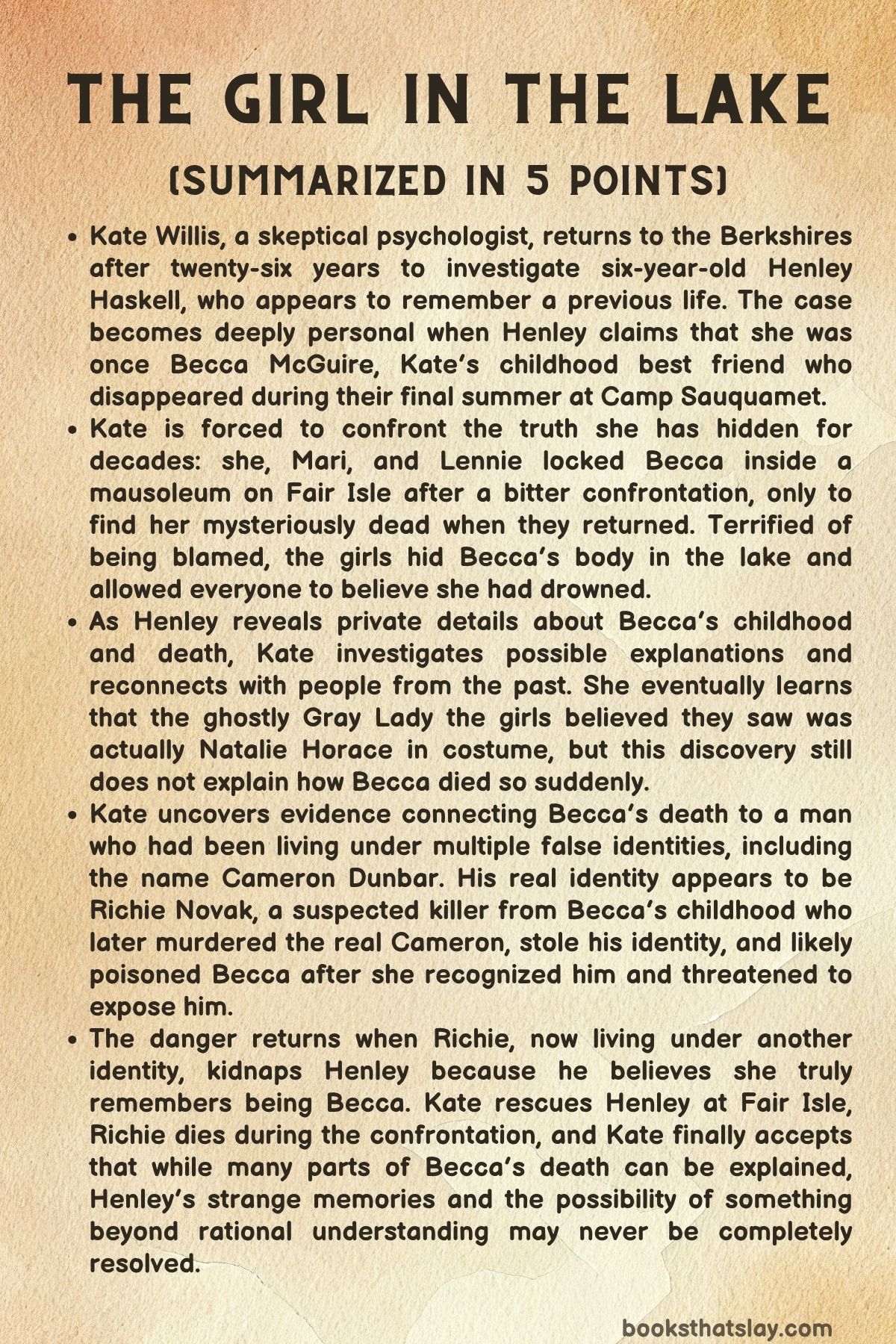
Summary
Psychologist Kate Willis returns to the Berkshires in Massachusetts after avoiding the area for twenty-six years. Now forty, she is a successful university professor who occasionally consults with a research division studying unusual psychological experiences, although she usually approaches claims of the supernatural with considerable skepticism.
Her new case concerns six-year-old Henley Haskell, whose mother, Emily, believes that the child remembers a previous life. Henley speaks about having another family before she was born, suffers nightmares about being unable to breathe, and repeatedly draws a yellow house, a church with a cannon, and a cemetery located on an island.
The case immediately becomes personal for Kate because one drawing resembles Fair Isle, an island in Lake Sauquamet that contains an abandoned cemetery and is associated with the legend of the Gray Lady. Kate spent her childhood summers nearby at Camp Sauquamet with her closest friends Becca McGuire, Mariana Edwards, and Lennie Anderson.
Twenty-six years earlier, fourteen-year-old Becca disappeared during their final summer at camp. The official account claimed that she had probably taken a canoe toward Fair Isle while drinking, fallen into the lake, and drowned, although her body was never recovered.
Kate knows that this explanation is false.
As she begins investigating Henley, the child reacts to her with unexpected hostility, calling Kate mean, bad, and a liar. Henley later makes an even more disturbing claim: she says that her name in her previous life was Becca and that she remembers Kate.
Kate tries to find ordinary explanations. She considers dissociation, source amnesia, parental influence, and accidental exposure to information, but Henley seems healthy and Emily does not appear to be manipulating her.
Meanwhile, Kate reconnects with Mariana, now known as Mari. She learns that Lennie recently died from cancer and discovers something stranger: Mari remembers Becca’s disappearance only through the false version created after the tragedy.
Kate remembers far more.
Their friendship with Becca had become increasingly difficult during their final summer. Becca was charismatic, fearless, funny, controlling, and frequently cruel, capable of making her friends feel uniquely loved before humiliating them moments later.
She also became fascinated by Fair Isle and the Gray Lady legend. Her fascination eventually convinced the four girls to make a secret nighttime trip across the lake.
Their relationships were already deteriorating before that night. Kate was angry at Becca for mocking her crush on eighteen-year-old counselor Cameron Dunbar, while Mari had become a frequent target of Becca’s ridicule and Lennie was increasingly willing to challenge her behavior.
On the night of the expedition, Becca brought cinnamon whisky and became intoxicated. The four girls crossed the lake in two canoes, with tension between Kate and Becca worsening before they even reached Fair Isle.
On the island, Becca led them to the cemetery and its old mausoleum. She claimed Cameron had told her about a challenge involving spending time inside the tomb and tried to force the terrified Mari to enter it.
Mari pushed Becca instead.
Kate and Lennie joined her, and together the girls forced Becca into the mausoleum and locked her inside. They intended the imprisonment as punishment for the fear and humiliation she had caused them.
The three girls ran into the woods while Becca screamed after them. There they encountered what appeared to be a decaying woman dressed in white, convincing them that the Gray Lady was real and that they had entered dangerous territory.
When they returned to the mausoleum roughly twenty or thirty minutes later, Becca was dead. Her skin had turned blue and her face showed signs of terror, although she had been alive and shouting when they left.
The girls panicked.
Believing they would be blamed for killing her, they carried Becca’s body to a canoe, placed stones in her pockets, and sank her in Lake Sauquamet. Lennie then ordered Kate and Mari to swear that they had never left their cabin and knew nothing about Becca’s disappearance.
Mari eventually repressed much of what happened. Kate remembered but spent decades burying the truth beneath professional achievement, skepticism, and alcohol addiction.
Henley’s memories now force those secrets back into Kate’s life. The child recognizes Becca and Kate in an old camp yearbook, knows details about the night on Fair Isle, and insists that Becca did not drown.
Henley says Kate helped lock her in a dark place and that she could not breathe. She believes the Gray Lady eventually took her away.
Kate begins testing Henley’s statements against Becca’s real childhood. Henley remembers Becca’s grandparents’ yellow home in Hillsdale, a nearby church and cannon, a stuffed dog named Sammie, and other private details that seem difficult to obtain from public sources.
Kate contacts Becca’s mother, Tammy, and learns more about Becca’s troubled childhood. She also discovers that Becca had asthma and serious allergies, information Becca concealed from most people.
As Kate investigates the circumstances of the death, another possibility emerges. Jenny Lin, a former camp counselor who later worked at Henley’s preschool, remembers that three canoes were missing on the night Becca disappeared, even though Kate remembers the four friends using only two.
Kate suspects that someone else followed them to Fair Isle.
Henley identifies Natalie Horace, Becca’s former rival, in an old photograph. Kate tracks down Natalie, now an adult living in Connecticut, and learns that Natalie really did follow them to the island in the third canoe.
Natalie had planned to frighten the girls while dressed as the Gray Lady. More surprisingly, Becca knew about the prank and had encouraged Natalie to scare Kate, Lennie, and Mari.
The ghost the girls believed they saw was therefore Natalie in costume.
Natalie, however, never entered the mausoleum or harmed Becca. She did not even hear Becca screaming when she passed through the cemetery, suggesting Becca may already have been dying before Natalie arrived.
Kate turns toward the physical circumstances of Becca’s death. She remembers the unnatural blue color of Becca’s body and finds a similar detail in the unsolved death of an unidentified teenage boy discovered near Lake Sauquamet fifteen months earlier.
That boy also appeared blue when found.
Records show that a bottle of Fireball whisky was discovered near his body, matching the type of alcohol Becca drank before she died. A toxicologist later explains to Kate that severe oxygen deprivation caused by certain poisons could create the blue coloration, and sodium nitrate becomes a plausible explanation.
At the same time, Kate discovers troubling information about Cameron Dunbar, the counselor she adored as a teenager. Becca had spent private time with him, possessed a silver lighter engraved with his initials, and once warned Kate that Cameron was a creep.
The investigation then reveals that the real Cameron Dunbar was the unidentified teenage boy whose body had been found near the lake.
The counselor at Camp Sauquamet had stolen his identity.
Kate and detective Matt Bishop uncover the impostor’s previous identity as Gregory Owens, a supposedly orphaned teenager who had once fooled people into believing he was much younger than he actually was. Further investigation shows that Gregory Owens was another stolen identity.
Kate eventually learns the man’s probable true identity: Richie Novak.
Richie had known Becca when she was a neglected young child living in Portland, Maine. He was an older young man who played guitar and sometimes watched her while her mother was absent or drinking.
Richie later became suspected of deliberately setting a house fire that killed members of his family. He disappeared before authorities could arrest him and repeatedly created younger identities afterward, allowing him to enter homes, schools, and communities where people treated him as a vulnerable adolescent.
Years later Becca recognized Richie at Camp Sauquamet even though he was calling himself Cameron Dunbar.
Kate realizes that Becca probably used this knowledge against him. Becca had a habit of collecting other people’s secrets and using them as leverage, and Richie had far more to lose than the other people she manipulated.
Evidence begins pointing toward Richie poisoning Becca’s whisky with sodium nitrate. Locking her inside the mausoleum was therefore not the original cause of her death, although fear, intoxication, and physical stress may have accelerated the effects of the poison.
Kate finally confesses the truth about Fair Isle to Matt Bishop. She admits that she and her friends imprisoned Becca, found her dead, hid the body, and maintained the lie for twenty-six years.
The confession makes Kate a potential suspect, but it also allows the investigation to move toward Richie.
Henley’s memories, meanwhile, become more difficult to interpret. Kate discovers that Mari’s son Alex once heard part of the Fair Isle story from Lennie and turned it into an unfinished graphic novel.
Alex had babysat Henley, meaning she may have seen images of the mausoleum, the Gray Lady, and the trapped Becca before her supposed past-life memories developed. This offers a rational explanation for some of Henley’s knowledge, but it cannot account for every private detail she knew.
The situation becomes dangerous when someone leaves Henley a threatening message addressed to Becca. Kate realizes that whether Henley is truly remembering Becca’s life is no longer the only important question.
Someone believes that she is.
Richie has created yet another younger identity and is now calling himself Ethan. He has placed himself near Henley by living with someone connected to her swimming lessons.
When Henley disappears from school, Kate understands what has happened.
She races to the abandoned camp during a storm and sees Richie in a canoe with Henley near Fair Isle. Before Kate can reach them, Richie drops the unconscious child into the lake.
Kate immediately dives after her.
She finds Henley underwater, brings her to Fair Isle, and performs CPR until the child begins breathing again. Henley explains that Ethan gave her a drink and offered to show her where Becca died.
Richie soon confronts them with a gun.
During the confrontation, Kate accuses him of killing Becca because she recognized him and threatened to expose his real identity. Richie remains disturbed by Henley because she knows information that appears impossible for her to know.
Then Henley calmly looks beyond him and asks whether he can see the lady standing nearby.
Richie turns in terror.
He loses his footing at the same moment his gun fires, and the shot kills him. Kate cannot determine whether his fall was an accident or whether something unseen affected what happened.
Kate and Henley survive and are hospitalized for hypothermia. Tests confirm that Richie drugged Henley, while the larger mystery of her memories remains unresolved.
Henley later draws a blond woman holding hands with a little girl. She identifies the woman as the nice lady who protected them on Fair Isle and identifies the child as Becca, the girl in the lake.
Kate asks Henley about previously claiming she had invented her memories, but Henley cannot remember saying it.
For the first time, Kate accepts uncertainty rather than trying to force every experience into a single explanation. Henley may have absorbed information from Alex, responded to Kate’s questions, genuinely remembered something from Becca’s life, or experienced a combination of things science cannot yet explain.
Before they separate, Kate and Henley promise to remain friends and link pinkies.
Henley unexpectedly repeats the same warning Becca gave Kate decades earlier: forever should not be treated lightly because forever is a very long time.
Back in Virginia, Kate returns to ordinary life with a changed understanding of herself. She remains committed to rational inquiry, but she no longer believes that accepting uncertainty is the same as surrendering intelligence.
She also begins considering Alcoholics Anonymous and recognizes how much of her drinking, professional skepticism, and need for control grew from the secret she had carried since childhood.
Just as she begins finding peace, another unusual case reaches her. A defense attorney asks for her help with a twelve-year-old boy accused of killing a teenage girl who claims he has no memory of the crime because he believes he committed it while dreaming.
Kate’s life with unexplained human experiences is far from over.
Characters
Kate Willis
In The Girl in the Lake, Kate Willis functions as both investigator and participant, making her perspective especially important because she is searching for truth while hiding part of it herself. As an adult psychologist, she has built her identity around skepticism, evidence, explanation, and the belief that seemingly supernatural experiences usually have ordinary psychological causes.
That intellectual certainty is partly defensive. Kate has spent twenty-six years carrying the knowledge that she and her friends imprisoned Becca, discovered her dead, disposed of her body, and allowed the world to believe in an accidental drowning.
Her relationship with control therefore extends well beyond her profession. If every strange event can be explained, categorized, and reduced to understandable causes, then perhaps the terrifying uncertainty surrounding Becca’s death can also be contained.
Kate’s alcoholism reinforces this aspect of her character. Her cravings intensify when memories return, suggesting that alcohol has often functioned as another method of controlling or silencing experiences she cannot comfortably face.
Her childhood relationship with Becca is equally complicated. Kate loved Becca deeply, admired her confidence, and was drawn to her intensity, yet she also resented Becca’s cruelty and sometimes wished to escape her influence.
That contradiction creates much of Kate’s guilt. She knows she did not deliberately murder Becca, but she cannot ignore that she was angry enough to participate in locking her inside the mausoleum.
Kate’s development depends on learning the difference between responsibility and total control. She must accept responsibility for concealing Becca’s death without pretending that every later event can be explained solely through her actions.
Her decision to rescue Henley completes this transformation. At fourteen, fear caused Kate to run away from Becca; as an adult, she moves toward danger and returns for Henley even when doing so places her own life at risk.
By the end, Kate has not abandoned reason. Instead, she has acquired greater intellectual humility and recognizes that uncertainty does not invalidate evidence, human experience, or emotional truth.
Becca McGuire
Within The Girl in the Lake, Becca McGuire is a remarkably complex presence because she dominates the story despite being physically absent from its present-day events. Nearly every major mystery, relationship, and emotional wound leads back to her.
Becca is charismatic, adventurous, funny, fearless, possessive, manipulative, and often cruel. She can make her friends feel specially chosen, but she also uses embarrassment, secrets, fear, and loyalty to maintain power over them.
Her bond with Kate illustrates this combination particularly well. Becca demands permanent loyalty and treats friendship almost as a binding contract, even marking that loyalty physically through rituals that reveal how intensely she fears abandonment.
Her cruelty does not reduce her to a simple antagonist. Information about her childhood suggests a neglected girl who learned early that affection could be unstable and that controlling information might provide security when adults could not.
This helps explain her habit of collecting secrets. Becca learns weaknesses, obtains private objects, and discovers information that gives her leverage because knowledge offers her a form of control.
The same behavior eventually places her in danger. When she recognizes Richie Novak beneath his stolen identity, she attempts to turn his secret into another source of power without understanding how dangerous he is.
Becca also occupies an unusual position between victim and aggressor. She torments Mari, humiliates Kate, manipulates Natalie, and deliberately encourages the Gray Lady prank, yet she is ultimately a fourteen-year-old murdered by an adult criminal trying to protect himself.
Her fascination with the Gray Lady further complicates her personality. What initially appears to be reckless interest in ghost stories may partly represent her search for protection, explanation, or power at a time when she senses genuine danger around Richie.
Henley’s possible memories prevent Becca from becoming merely a figure from Kate’s past. Whether the connection is supernatural or psychological, Becca continues demanding recognition long after her death.
Henley Haskell
Henley is the character who forces the hidden past into the present. At six years old, she appears energetic and psychologically healthy in ordinary situations, yet she experiences frightening memories, nightmares, compulsions, drawings, and fears that appear connected to Becca’s death.
Her innocence makes the mystery more difficult because Henley does not appear to have a clear motive for deception. She speaks about her previous life with the directness of a child describing something she considers ordinary.
Henley nevertheless becomes increasingly affected by the adults investigating her. Kate’s questions, Emily’s concern, Alex’s drawings, media attention, and the growing association between Henley and Becca all make it difficult to determine where memory ends and suggestion begins.
This uncertainty is central to her characterization. Henley may genuinely possess memories that cannot be explained, but she may also be a vulnerable child trying to organize frightening images and information she encountered indirectly.
Her reenactment of confinement when she locks another child in a closet shows how trauma can be repeated from different positions. Henley does not simply experience herself as Becca the victim; she also reproduces the aggression surrounding Becca’s death.
Her role becomes especially tragic when Richie begins treating her as though she literally is Becca. Henley becomes endangered not because the mystery has been solved, but because another person believes strongly enough in one explanation to act violently.
Henley’s final comments preserve ambiguity. Her reference to the protective woman on Fair Isle and her repetition of Becca’s childhood promise to Kate suggest knowledge that remains difficult to account for completely.
Emily Haskell
Emily is defined by her determination to protect Henley while taking her experiences seriously. She does not immediately dismiss her daughter’s unusual statements, but neither does she appear eager to turn Henley into a supernatural spectacle.
Her careful documentation of Henley’s drawings, dreams, and statements demonstrates responsibility. Rather than constructing a dramatic story herself, Emily records what the child says and looks for professional guidance.
Her relationship with Kate gradually becomes more difficult because Kate’s investigation starts affecting Henley emotionally. Emily correctly recognizes that even a search for truth can become harmful when a child is repeatedly encouraged to return to frightening experiences.
This creates an important moral tension. Kate needs Henley’s memories to investigate Becca, while Emily must consider whether solving a decades-old mystery is worth increasing her daughter’s fear and confusion.
Emily ultimately represents grounded parental protection. When Henley disappears, her earlier concerns are validated in the most frightening possible way because adult obsession with Becca has placed her child directly in danger.
Mariana “Mari” Edwards
Mari represents the psychological power of repression and reconstructed memory. As a teenager she is the most openly frightened member of the friendship group and is particularly vulnerable to Becca’s mockery and supernatural stories.
Her decision to push Becca into the mausoleum comes after repeated humiliation and fear. The action is impulsive rather than murderous, but it becomes the event around which Mari’s later guilt is organized.
After Becca dies, Mari embraces the idea that the Gray Lady caused the death. This belief gives her frightened adolescent mind an explanation that is easier to tolerate than confronting the consequences of the girls’ own actions.
Over time, she suppresses so much of the event that the official drowning story becomes her genuine memory. Her reaction when Kate reveals the truth shows that this is not calculated dishonesty but a psychological defense maintained for decades.
Mari’s later shrine to Becca reveals that repression has not eliminated guilt. Once the memories return, she becomes consumed by the need for forgiveness and begins treating Henley as a possible opportunity to repair the past.
Her decision to discuss Henley’s supposed reincarnation with others demonstrates how guilt can distort judgment. Mari wants proof that Becca has returned because such proof might allow her to seek forgiveness from the person she believes she wronged.
Lennie Anderson
Lennie is the most pragmatic and forceful of the four childhood friends. She is more willing than Kate or Mari to challenge Becca directly and eventually responds openly when Becca’s behavior becomes intolerable.
After Becca’s death, however, Lennie becomes the architect of the group’s silence. She recognizes immediately how suspicious their situation will appear and instructs the others to deny that they ever left their cabin.
Her actions demonstrate a practical intelligence distorted by fear. She is not trying to commit murder or profit from Becca’s death; she is a terrified child attempting to control an impossible situation through secrecy.
Lennie’s insistence that the night become a dream has lasting psychological consequences. Kate preserves the truth privately while Mari eventually absorbs the false account, showing how Lennie’s survival strategy shapes all three lives differently.
Her later drunken confession to Alex also reveals that she never completely escaped the event. Even though she maintained the secret publicly, some part of her still needed to speak about what happened.
Her death before the adult investigation gives her character additional significance. Kate and Mari must confront the consequences without the one person who originally imposed order on their panic.
Richie Novak
Richie Novak is frightening because his central characteristic is not physical violence alone but the systematic destruction and reconstruction of identity. He repeatedly abandons one name and history for another, presenting himself as younger and more vulnerable so that people will admit him into spaces where he can hide.
His aliases as Gregory Owens, Cameron Dunbar, and later Ethan reveal a deeply unstable relationship with selfhood. Richie does not simply use false names for practical concealment; he repeatedly constructs complete younger versions of himself.
His talent for earning trust makes him particularly dangerous. Adults respond to the apparently abandoned or troubled young person he pretends to be, while adolescents such as Kate see him as attractive and approachable.
Becca threatens his survival because she recognizes him from childhood. Unlike everyone at camp, she possesses information capable of destroying the identity he has carefully constructed.
His suspected poisoning of Becca shows the extreme lengths he will take to protect himself. A fourteen-year-old becomes expendable once she possesses knowledge that can expose him.
Decades later, Henley creates the same threat in his mind. Whether her memories are real is irrelevant to Richie because he believes they might reveal what he did.
His death on Fair Isle also exposes the weakness beneath his many identities. Richie has spent his life controlling how other people see him, yet the suggestion that the Gray Lady is standing behind him instantly reduces him to panic.
Steve
Steve, Kate’s former husband, serves as a philosophical counterbalance to her rigid skepticism. He is more willing to consider paranormal possibilities and does not automatically assume that an unexplained experience must eventually fit an ordinary psychological model.
His openness initially frustrates Kate because it challenges the worldview she uses to maintain emotional control. Yet Steve never requires her to abandon scientific thinking; he simply encourages her to admit when the existing evidence does not support an easy explanation.
Their continued closeness after divorce suggests a relationship transformed rather than destroyed. Steve remains one of the people Kate trusts when her investigation becomes emotionally overwhelming.
His importance becomes clearest near the end, when Kate begins recognizing that his willingness to experience wonder is not intellectual weakness. Through him, she learns that uncertainty can coexist with seriousness, intelligence, and rational inquiry.
Matt Bishop
Matt Bishop initially appears to Kate as someone casually connected with the abandoned camp, but he is eventually revealed as the detective responsible for reopening Becca’s case. His early friendliness therefore contains an investigative purpose that Kate does not initially recognize.
Matt represents the legal and evidentiary perspective on Becca’s death. Where Kate sees terrified children reacting irrationally to an unexplained death, Matt sees motive, imprisonment, concealment of a body, and decades of lying.
His skepticism toward Kate is reasonable. Her account asks him to believe that three angry girls locked Becca in a mausoleum, found her mysteriously dead shortly afterward, disposed of the body, and somehow had no direct role in killing her.
Matt therefore prevents Kate from treating confession as automatic absolution. Telling the truth is morally necessary, but it does not erase the seriousness of what she did.
Once physical evidence appears, however, he responds appropriately and investigates Richie. His character demonstrates the difference between emotionally compelling explanations and evidence strong enough to support criminal investigation.
Natalie Horace Gersch
Natalie initially appears to be a promising suspect because of her hostile relationship with Becca and her secret presence on Fair Isle. As a teenager, she participates in an escalating cycle of rumors, pranks, humiliation, and retaliation that becomes increasingly vicious.
Her decision to dress as the Gray Lady and follow the girls demonstrates how adolescent cruelty can have consequences far beyond what the participants intend. Natalie wants revenge and fear, not death.
The revelation that Becca encouraged the prank changes the meaning of Natalie’s actions. She believed she was cooperating with Becca in frightening the others rather than pursuing an independent plan to hurt her.
Natalie’s adult guilt shows how incomplete information can shape a life. For twenty-six years she believes her prank may have caused Becca’s disappearance even though she never touched her.
Her testimony becomes essential because it explains both the third canoe and the apparent supernatural figure. At the same time, it creates a tighter timeline for Becca’s death and helps direct Kate away from the ghost story toward murder.
Tammy McGuire
Tammy provides essential insight into the childhood experiences that shaped Becca. Her history of drinking and instability suggests that Becca grew up without the consistent adult protection and attention children normally rely upon.
Tammy does not excuse the difficulties in Becca’s personality, but the information she provides makes them more understandable. Becca’s obsession with loyalty and control can be viewed partly as the response of a child who learned that adults and relationships could disappear unexpectedly.
Tammy is also crucial to identifying Richie. Her memories of Portland establish that young Becca knew him long before Camp Sauquamet and therefore could recognize him beneath a false identity.
Her character quietly exposes the consequences of parental absence. Becca’s dangerous familiarity with Richie began because an unreliable home environment allowed an unrelated older man to become part of her childhood world.
The Real Cameron Dunbar
The real Cameron Dunbar never participates directly in the main events because he dies before Kate’s final summer at camp. Nevertheless, his stolen identity becomes one of the central pieces of evidence in the murder investigation.
His death demonstrates the scale of Richie’s crimes. Richie does not merely invent the name Cameron Dunbar; he possesses Cameron’s belongings and later assumes his identity, strongly suggesting direct involvement in the young man’s unexplained death.
The engraved lighter becomes particularly important because it survives the theft of identity and eventually connects the real Cameron, Richie, and Becca. In a story where memory is often uncertain, this physical object provides unusually concrete evidence.
Cameron therefore represents the victims whose stories have been erased by Richie’s constant reinvention. Even his name is temporarily taken from him until Kate’s investigation restores the distinction between the dead young man and the impostor.
Dr. Marc Rushkin
Dr. Marc Rushkin provides an important professional challenge to Kate. He is interested in Henley precisely because her apparent memories may support research into experiences that conventional explanations do not adequately address.
Yet he is also more cautious about Kate’s personal involvement than Kate herself. Once she reveals her connection to Becca, he recognizes that she is no longer functioning as a detached investigator.
His question about whether Henley needs the mystery solved or whether Kate is the one unable to let go exposes the emotional motive driving the investigation. Kate claims she is pursuing evidence, but Rushkin recognizes that grief and guilt are influencing her professional decisions.
He therefore represents necessary ethical restraint. Curiosity does not automatically justify continued investigation when the subject is a frightened six-year-old child.
Jenny Lin
Jenny Lin is a relatively brief but decisive figure because her memory changes the structure of the Fair Isle mystery. As a former head counselor, she possesses independent knowledge of Camp Sauquamet and remembers details that the frightened girls themselves never knew.
Her recollection that three canoes were missing proves that another person traveled to the island. This creates the possibility of an unknown witness or participant and eventually leads Kate toward Natalie.
Jenny also remembers concerns about Becca’s contact with the counselor calling himself Cameron. Her earlier warnings show that the relationship looked inappropriate even before anyone knew his true identity.
She therefore functions as an external observer whose memories help confirm that certain suspicions are not simply products of Kate’s guilt.
Martin Sheehy
Martin Sheehy helps separate historical fact from accumulated legend. His research shows Kate that the Gray Lady story developed through separate tragedies, local history, rumor, and repeated retelling rather than from one clear supernatural event.
His role has thematic importance because this process resembles the creation of the false story surrounding Becca. Confusing events are simplified until people inherit a version that feels coherent even when it does not accurately represent what occurred.
Martin also provides Kate with information about the unidentified boy later revealed to be the real Cameron Dunbar. His records help connect the strange blue appearance of the boy’s body with Kate’s memory of Becca.
He therefore helps Kate move from folklore toward physical evidence without dismissing the psychological power of folklore itself.
Stephanie Morrow
Stephanie Morrow enters the story as a toxicologist but becomes important to Kate for personal reasons as well. Her knowledge of poisoning provides a plausible explanation for the severe oxygen deprivation that caused Becca’s unusual blue coloration.
The sodium nitrate theory allows Kate to reconsider the death as a deliberate poisoning rather than a supernatural event, accidental asthma attack, or direct consequence of confinement.
Stephanie’s experience with Alcoholics Anonymous also challenges Kate’s understanding of control. She introduces the idea that acknowledging limits is not equivalent to surrendering responsibility.
This distinction matters deeply to Kate, whose alcoholism and professional identity have both been associated with her desire to impose order on experiences she finds frightening.
Alex
Alex, Mari’s son, becomes unexpectedly significant because he offers a possible rational source for some of Henley’s apparent memories. Lennie once told him about the forbidden Fair Isle expedition, and he transformed the story into an unfinished graphic novel.
Because Alex later babysat Henley and drew with her, she may have encountered images involving the mausoleum, the Gray Lady, canoes, and Becca without consciously remembering their source.
His role introduces source amnesia as a serious possibility and forces Kate to acknowledge how complicated memory formation can be.
Alex does not explain everything Henley knows, however. His presence therefore narrows the mystery without completely resolving it.
Harriet
Harriet, the camp director, is important mainly because she passes the Gray Lady legend to another generation of campers. Her campfire story transforms local history into a dramatic narrative involving betrayal, death, and a ghostly woman who continues to haunt Fair Isle.
The story influences Becca, Mari, Kate, and other campers differently. For Mari, it produces genuine fear, while Becca treats the uncertainty surrounding it as an invitation to investigate.
Harriet does not cause the later tragedy, but her storytelling demonstrates how narratives can affect behavior when listeners begin treating symbolic stories as literal explanations.
George
George, Kate’s graduate student, appears primarily through her efforts to find psychological explanations for Henley. His discussions with Kate about dissociation and related phenomena represent the academic framework she initially trusts.
His presence emphasizes Kate’s professional identity and the distance between her normal intellectual environment and the emotional reality awaiting her in Massachusetts.
As the mystery develops, the theories Kate discusses with George become increasingly insufficient. This does not make psychological science useless, but it demonstrates that models must respond to evidence rather than forcing evidence to fit predetermined expectations.
Courtney
Courtney is Kate’s longtime friend and an oncologist whom Kate contacts when she begins reconsidering Becca’s asthma and possible respiratory causes of death. Her involvement marks an important stage in Kate’s investigation because Kate begins searching for a physical medical explanation rather than assuming the mausoleum itself caused Becca’s death.
Although Courtney has only a limited role, she helps move the investigation toward respiratory medicine and eventually toxicology. Her practical assistance reflects the network of professional relationships Kate has built in adulthood.
Susan
Susan, Kate’s Airbnb host, plays a small but useful role by helping Kate contact Martin Sheehy. Through that connection, Kate gains access to historical information about the Gray Lady legend and the unidentified boy found near the lake.
Susan represents the ordinary local connections through which an old mystery gradually becomes accessible. Her role is minor, but she helps bring Kate into contact with information that significantly changes the direction of the investigation.
Themes
Memory, Truth, and the Stories People Create
Memory in The Girl in the Lake is never presented as a perfect recording of the past. Kate remembers the central events surrounding Becca’s death but has spent decades avoiding them, while Mari suppresses the experience so completely that the invented drowning story eventually feels true to her.
The contrast shows that remembering and knowing are not necessarily the same. A person may sincerely believe an inaccurate account because fear, repetition, trauma, and the need for psychological survival can reshape how an event is stored and understood.
Henley makes the issue even more complicated. Some of her memories correspond to private facts about Becca, while others may have been influenced by Alex’s drawings, Kate’s questions, stories she overheard, or information whose original source she has forgotten.
The Gray Lady legend operates in much the same way on a larger scale. Separate historical events are repeatedly retold until they become one apparently coherent supernatural story.
Becca’s disappearance undergoes a similar transformation. A chaotic series of decisions made by frightened children becomes the simpler public story of a girl who drank, took a canoe, and drowned.
The novel therefore treats truth as something that must often be recovered from competing narratives rather than simply remembered. Physical evidence, testimony, emotion, memory, and belief all contain pieces of information, but none automatically provides the complete picture.
Even at the end, Kate must accept that Henley’s experience may never fit one definitive explanation. The truth can remain meaningful even when part of it remains uncertain.
Guilt, Responsibility, and the Need for Forgiveness
Kate’s adult life is shaped by the difference between causing a tragedy and carrying responsibility for what happens afterward. She did not knowingly poison Becca, but she participated in imprisoning her, abandoned her while she screamed, helped conceal her body, and maintained the lie for more than two decades.
Her guilt therefore contains both legitimate moral responsibility and exaggerated self-condemnation. Because she never discovered what actually killed Becca, she allows uncertainty to become a private punishment that follows her into adulthood.
Mari responds differently. She psychologically removes the experience from conscious memory, yet the return of the truth produces an intense need for forgiveness that eventually becomes almost devotional.
Lennie responds through control. She organizes the cover-up, establishes the false story, and instructs the others to treat the night as though it never occurred.
Each response shows how unresolved guilt can alter a person’s relationship with truth. Kate drinks and intellectualizes, Mari represses and later seeks spiritual forgiveness, while Lennie turns secrecy into a survival strategy.
Kate’s confession to Matt is therefore essential even though it exposes her to legal danger. She finally accepts that telling the truth is necessary regardless of whether doing so makes her appear innocent.
Her rescue of Henley provides another form of moral repair. Kate cannot return to the night Becca died and make a different choice, but she can refuse to repeat that choice when another frightened child is in danger.
Forgiveness in the story is consequently not presented as erasing wrongdoing. It emerges through responsibility, truth, and the willingness to act differently when the past presents itself again.
Rational Explanation and the Possibility of the Unexplained
Kate begins from the belief that unusual experiences should eventually yield to psychological or environmental explanation. This approach has served her professionally and protects her personally because it allows frightening uncertainty to be converted into manageable questions.
Much of the mystery ultimately does receive rational explanations. Natalie is responsible for the supposed Gray Lady sighting, Alex’s artwork may explain some of Henley’s knowledge, poisoning offers a medical explanation for Becca’s blue appearance, and Richie’s stolen identities explain several apparently unrelated mysteries.
Yet every explanation creates a remaining question.
Alex can account for some of Henley’s imagery but not all of her private knowledge. Natalie explains the ghost encountered by the girls but cannot explain what Henley later sees. Richie explains Becca’s death but cannot explain why Henley repeats details that appear to belong specifically to Becca.
The story therefore refuses to construct a simple conflict between science and superstition. Kate’s scientific reasoning is often what brings her closer to the truth, and her willingness to test claims prevents fear from becoming evidence.
Her mistake lies instead in assuming that intellectual integrity requires certainty.
By the conclusion, Kate remains a rational investigator but becomes more comfortable admitting that evidence may be incomplete. She recognizes that saying “I do not know” can be more rigorous than forcing an experience into an explanation unsupported by the available facts.
This change allows her to retain curiosity without using it as a defense against fear.
Identity, Control, and the Fear of Being Known
Identity repeatedly becomes a source of power and danger. Richie Novak survives by replacing himself with invented younger identities, moving from one constructed life to another whenever his real history threatens to catch up with him.
His impersonations depend on controlling what other people know. As long as everyone accepts the version of himself he presents, he can enter schools, families, workplaces, and communities without confronting his past.
Becca represents the direct threat to this system because she recognizes the person beneath the disguise. Her knowledge turns identity into a weapon, fitting her broader tendency to collect secrets and use them as leverage.
Kate also constructs a socially acceptable identity around concealment. She becomes a respected psychologist and professor while hiding the terrified fourteen-year-old who helped dispose of her best friend’s body.
Mari’s identity is built around an even more complete revision of the past. By genuinely forgetting what happened, she is able to become someone who believes Becca simply drowned.
Henley complicates the idea further by appearing to possess elements of someone else’s identity. If she remembers Becca, the boundaries separating one individual from another become uncertain; if she does not, then the case demonstrates how easily identity can be influenced by memory, suggestion, images, and stories.
The characters repeatedly suffer when identity becomes something that must be defended at all costs. Richie kills to preserve his disguise, Kate damages herself through secrecy, and Mari loses access to part of her own history.
The movement toward resolution begins when identity no longer depends on total control. Kate can finally acknowledge who she was, what she did, and what she still cannot explain without allowing any single fact to define the whole of her life.