These Ancient Bones Summary, Characters and Themes
These Ancient Bones by Heather Graham is a paranormal crime thriller that combines an international murder conspiracy with modern cybercrime, ancient curse traditions, and supernatural investigative abilities.
The story follows FBI agents Shelly Mahoney and Grant Markham as a violent case in St. Augustine expands into a network reaching Rome and beyond, where killers use curse tablets and vulnerable recruits to disguise organized murder as supernatural judgment. Alongside the central mystery, the novel develops the partnership between Shelly and Grant, whose unusual gifts allow them to obtain truths unavailable through ordinary investigative methods. It’s the 2nd book of the Crows series.
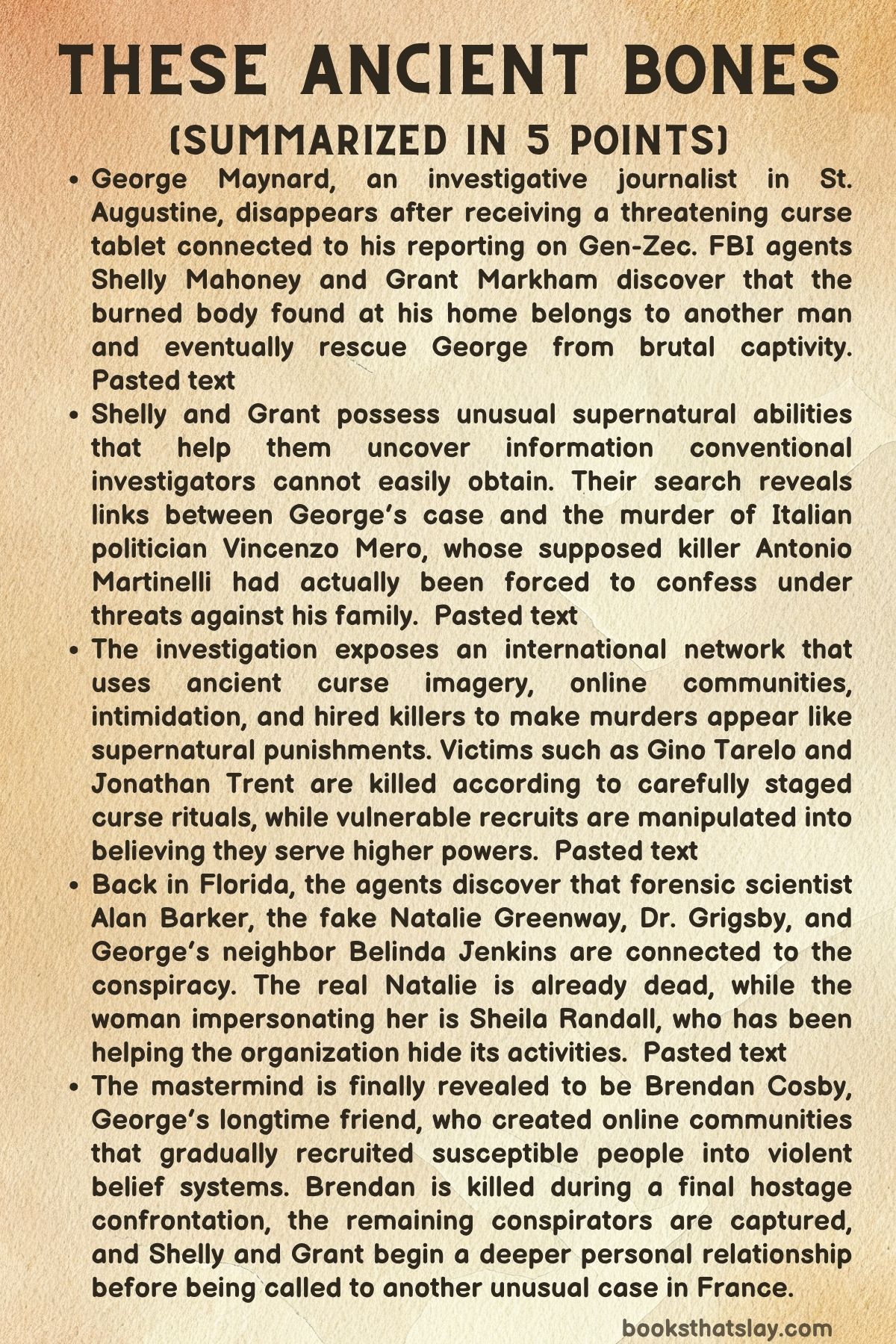
Summary
Investigative journalist George Maynard returns to his historic St. Augustine home after publicly challenging Gen-Zec, a powerful technology company that he believes has been involved in cyberattacks from which it later profits. Waiting outside is a stone tablet carrying a threatening message about flames consuming his body and soul, but George treats it as another attempt to intimidate a journalist accustomed to making powerful enemies.
George is more concerned about protecting his fiancée, Ainsley Drake, whom he has kept away while his investigation attracts attention. Once inside the house, however, he is attacked by a large unidentified figure, covered with a burlap bag, struck unconscious, and taken away.
FBI Special Agent Shelly Mahoney soon arrives at George’s property, where authorities have discovered a human body almost completely destroyed by fire. FDLE agent Perry Banyan is handling the local investigation, while Jackson Crow, leader of the FBI’s Special Circumstances Division, brings Shelly together with Grant Markham, the man he wants as her new partner.
The crime scene suggests careful preparation. The attacker entered without obvious forced access, understood the alarm system, moved the victim outside, concealed physical traces, and burned the body, yet Shelly notices something others have missed: the threatening tablet near George’s porch. Grant recognizes it as a modern version of an ancient curse tablet and connects it to an earlier murder in Rome.
Jackson then reveals why he has deliberately paired Shelly and Grant. Grant possesses the ability to touch certain recently deceased people and experience fragments of what happened during their final moments, while Shelly can mentally call to spirits who remain near the living and sometimes communicate with them.
Their gifts cannot immediately establish the identity of the burned corpse. George’s spirit does not appear to Shelly, while Grant cannot use his ability effectively on what remains, creating the first serious possibility that George may not actually be dead.
Suspicion initially centers on Gen-Zec. CEO Cecil Cartwright and his hostile assistant Andy Jeter both had reasons to resent George’s accusations, while Ainsley also tells the agents about influencer Patricia Norton and an earlier anonymous warning telling George to beware the eleventh hour.
Cecil voluntarily speaks with the investigators and argues that George’s murder would only intensify suspicion against his company. Shortly afterward, Cecil crashes directly into a power pole, and the absence of signs that he attempted to stop makes the accident suspicious.
A search of Cecil’s vehicle produces another curse tablet concealed inside the rear seat. The discovery changes his position in the investigation because its wording presents him as another target rather than necessarily the person directing the violence.
The medical evidence produces an even more significant discovery: the burned corpse found outside George’s home is not George. Someone killed a different man and burned him in a manner designed to make investigators believe George had been murdered.
Electronic clues lead Shelly and Grant to an isolated recreation area containing cabins. Inside one of them they find George alive but horribly tortured, restrained to a chair after repeated beatings, stabbing, damage to his fingers, and other carefully controlled injuries.
The attackers have intentionally kept him alive, suggesting that they wanted information rather than merely his death. George is taken to the hospital, where doctors believe he can survive, while Ainsley immediately remains near him.
Grant’s supernatural contact with the unconscious George provides only fragments: fear, a large shadow, darkness, intense physical suffering, and George’s refusal to surrender. The investigation also identifies the burned victim as an especially vulnerable man whose death was used to create the false appearance of George’s murder.
When Grant and Shelly return to the campground, three men attack Shelly in the woods. The agents capture them, but their behavior convinces the investigators that these men are not central organizers and may instead be expendable participants serving a much larger system.
The agents begin considering whether vulnerable or fanatical individuals are being recruited through claims involving curses and ancient powers. Their suspicions resemble Grant’s concerns about the murder of Italian politician Vincenzo Mero, whose supposed killer, Antonio Martinelli, confessed before taking his own life.
Grant never believed Antonio was truly responsible. The growing similarities between the cases lead Jackson to send Shelly and Grant to Rome while Zach Erickson and Skye McMahon continue the Florida investigation.
Zach and Skye also possess unusual abilities, allowing the expanding team to work without hiding aspects of themselves that conventional colleagues might dismiss. During the trip to Italy, Grant and Shelly discuss the origins of their own supernatural experiences and become increasingly comfortable with one another, establishing personal trust alongside their professional partnership.
In Rome they join investigators Alfredo Durso and Salvatore Giordano and meet members of Vincenzo’s family. Shelly successfully contacts Vincenzo’s spirit, who confirms that Antonio did not kill him.
Vincenzo recalls a shorter attacker wearing a baseball cap and mask who ambushed him, stabbed him repeatedly, and cut his throat. His testimony cannot be introduced as ordinary evidence, but it gives the agents vital knowledge and confirms that the official solution to the murder was false.
Shelly later contacts Antonio’s spirit at the Martinelli family burial place. Antonio explains that he confessed because conspirators had gathered information about his wife, son, and grandchildren and threatened to murder them unless he accepted responsibility for Vincenzo’s death and then permanently silenced himself.
His explanation reveals a system based on modern surveillance, anonymous electronic communication, coercion, and psychological terror. The ancient imagery is therefore not proof of supernatural punishment but a disguise placed over deliberate human violence.
The danger continues when broadcaster Gino Tarelo, a public supporter of Vincenzo’s ideals, is murdered. His throat is cut and the scene is staged to resemble suicide, but the physical circumstances make that explanation doubtful.
Grant’s contact with Gino’s body reveals another memory of a large dark figure, while Shelly finds another curse tablet hidden inside the fireplace. Its wording again corresponds symbolically to the victim and the method of death.
The investigators begin to suspect an online marketplace or hidden community where people can request curses while organizers secretly arrange real violence so that supernatural punishment appears to have occurred. Their progress makes them targets: someone shoots at Shelly, and later automatic gunfire strikes their supposedly secure Roman residence.
Their increasingly close partnership also becomes romantic during this period. The personal development does not remove the danger surrounding them; instead, each realizes how much the other’s survival has come to matter.
The gunman who attacks their residence survives and identifies himself as Sam Smith. Vincenzo’s spirit recognizes Sam as his real murderer, enabling Shelly and Grant to use carefully chosen questions and ordinary evidence to pressure him without revealing their supernatural source of information.
Sam eventually admits killing Vincenzo and confirms that Antonio was forced to confess. He believes himself to be part of a sacred tribe guided by gods, receives assignments through an online network, and describes participants as instruments carrying out higher commands.
Sam also mentions a woman in an “ancient city” who participates in directing the network. At first this might suggest Rome, but another ritualized murder in Florida changes the interpretation.
Professor Jonathan Trent, a public supporter of Vincenzo’s political principles, is burned to death near Jacksonville Beach. Grant and Shelly return to the United States and begin considering St. Augustine itself, famous for its long history, as the ancient city Sam described.
The Florida investigation increasingly suggests that the organizers may be local and familiar. George’s neighbor Belinda Jenkins attracts Shelly’s instinctive suspicion despite presenting herself as an affectionate elderly neighbor, while Brendan Cosby, George’s longtime friend and a restaurant owner, continues to appear cooperative.
Danger reaches Shelly directly when an attacker enters the agents’ protected house. He attempts to kill her with a knife but takes his own life when escape becomes impossible.
The dead man is Alan Barker, a trusted forensic scientist whose job gave him access to sensitive law-enforcement information. A curse tablet directed at Shelly is discovered beneath a bed, and Alan’s electronic history connects him to an elderly woman named Natalie Greenway.
At Natalie’s care facility, the agents meet a woman who appears confused and speaks about gods, curses, online believers, and people supposedly chosen to perform divine missions. Shelly later contacts Alan’s spirit, who explains that exposure to increasingly extreme internet groups changed his thinking until he accepted the idea that the gods demanded murder.
Angela Crow’s cyber investigation discovers offshore financial movements and communications linking several parts of the conspiracy. Messages indicate that members intend to meet at the campground where George was tortured.
George eventually wakes and explains that his captors were disguised and repeatedly questioned him about material he had discovered online. Although his public investigation centered on Gen-Zec, he had also encountered unusual information connected with Vincenzo’s murder, explaining why the larger organization considered him dangerous.
George additionally remembers a sweet fragrance, possibly night-blooming jasmine, around the location where he was held. Before investigators can fully exploit that clue, Natalie Greenway disappears from her care facility under circumstances suggesting that the apparently helpless elderly patient was never what she seemed.
Skye reconstructs the escape with her supernatural ability and discovers that Natalie removed a disguise, washed color from her hair, dressed as a nurse, and left unnoticed. Shelly then contacts the real Natalie’s spirit and learns that the genuine woman is dead.
The impostor is Sheila Randall, who has been assisted by Dr. Donald Grigsby. Evidence leads the team back to the campground, where they overhear Sheila and Grigsby discussing the organization and the burial of the real Natalie.
Another spirit then appears to help them. Henry Beacon, a former Marine who had become homeless, explains that members of the conspiracy offered him food before murdering him and burning his remains at George’s property, making Henry the innocent man whose body was used to create the false impression that George had been killed.
The final revelation exposes Brendan Cosby as the central organizer. George’s apparently loyal friend had created online communities capable of attracting susceptible people and gradually leading them toward more extreme spaces, where mythology, manipulation, money, coercion, and murder were combined into one system.
Belinda Jenkins is also involved and has helped finance Brendan while sincerely embracing the curse mythology. Rather than merely exploiting supernatural language, she appears to believe in the ideology surrounding the organization.
When confronted, Brendan flees and takes a young boy, Russ Clark, hostage. Grant, Shelly, Zach, and others surround him, and Brendan is killed after attempting to shoot, while Russ is rescued and Belinda, Sheila, and the wounded Grigsby are taken into custody.
The real Natalie’s body is recovered, Henry is finally able to move on, and federal investigators begin dismantling the wider cyber network. What first appeared to be a series of supernatural punishments is revealed as a system in which human beings deliberately turned belief, technology, fear, and social isolation into instruments of murder.
Shelly and Grant receive time away from work and remain together, first exploring St. Augustine and later traveling to Rome. Their shared experiences allow them to stop treating their supernatural abilities as secrets they must bear alone, while their professional partnership develops into a committed personal relationship.
Their peace does not last indefinitely. Jackson contacts them about another investigation in Brittany, France, involving bodies discovered near a castle with tunnels and a violent historical legacy, and the pair accepts that their unusual work will continue.
Characters
Shelly Mahoney
Shelly Mahoney is one of the central investigators in These Ancient Bones, combining strong conventional instincts with an ability to call spirits who remain close to the living. Her supernatural gift is important, but the book repeatedly shows that she does not treat it as a replacement for evidence; instead, information from the dead gives her directions that must then be translated into lawful investigative action.
Her strongest characteristic is perception. She notices the displaced curse tablet at George’s home, senses that Belinda Jenkins deserves attention before evidence proves it, and repeatedly recognizes connections that are easy to overlook.
Shelly also demonstrates considerable emotional discipline. Communicating with murdered people exposes her to fear, regret, grief, and unfinished obligations, yet she remains capable of functioning under direct physical threat, including the attacks in the campground, Rome, and the secure St. Augustine house.
Her relationship with Grant gives her character another dimension. She begins as a woman accustomed to hiding an essential part of herself, but membership in the specialized team allows her to work among people who understand that experience, and her growing trust in Grant eventually becomes both romantic and deeply personal.
Grant Markham
Grant Markham is Shelly’s investigative partner and one of the emotional anchors of These Ancient Bones. His ability allows him, under certain circumstances, to touch the recently dead and experience fragments of their last sensations, memories, or fears, a power that first emerged during his grandfather’s death.
Grant’s experience with Vincenzo Mero’s case has also made him resistant to convenient conclusions. Long before he can prove it, he doubts Antonio Martinelli’s confession because the official explanation does not fit his understanding of the murder.
He combines skepticism with openness in an unusual way. Grant accepts supernatural evidence because of his own experiences, but he still requires practical investigation, interrogation, forensic work, and electronic evidence before a case can be completed.
His connection with Shelly grows through honesty rather than sudden attraction alone. Sharing the stories of their abilities gives both characters a rare opportunity to be fully understood, and their romance becomes an extension of the trust already required by their dangerous work.
George Maynard
George Maynard serves as the crime that initially drives These Ancient Bones, but he is much more than a passive victim. He is an investigative journalist whose willingness to expose powerful organizations has made intimidation an expected part of his professional life, which explains why he initially dismisses the curse tablet on his doorstep.
His torture reveals the scale of his determination. Even after prolonged physical abuse intended to force information from him, he survives because the conspirators need answers and because George refuses to surrender completely.
George is also important because his investigation unknowingly crossed boundaries between apparently unrelated subjects. He publicly pursued Gen-Zec but had also encountered unusual online material connected to Vincenzo’s murder, putting him dangerously close to the hidden network before he fully understood what he had discovered.
His devotion to Ainsley provides the personal side of his character. Protecting her influences his decisions before the abduction, while his feelings for her remain clear even during his recovery.
Ainsley Drake
Ainsley Drake represents George’s strongest personal connection to ordinary life. She is devastated by his disappearance and apparent death, yet she provides investigators with useful information about George’s enemies, professional conflicts, Patricia Norton, and the mysterious warning involving the eleventh hour.
Her conduct throughout the investigation supports Grant’s eventual confidence that she has nothing to do with the crimes. She remains close to George after his rescue and functions as a reminder of the future he hoped to build before the conspiracy invaded his life.
Jackson Crow
Jackson Crow leads the unusual FBI division to which Shelly and Grant belong. His importance lies partly in recognizing that unconventional abilities can have investigative value when used responsibly instead of dismissed or exposed recklessly.
Jackson deliberately pairs Shelly and Grant because he understands both their abilities and their isolation. He also approaches the international connection seriously enough to send the agents to Rome when the similarity between cases becomes impossible to ignore.
As a leader, he creates a structure in which extraordinary information can support conventional law enforcement without replacing it. His final call concerning the Brittany investigation confirms that the events in St. Augustine and Rome are part of the team’s continuing work rather than an isolated exception.
Perry Banyan
Perry Banyan is the FDLE investigator initially responsible for the Florida case. He works alongside the specialized federal agents without allowing their arrival to become a jurisdictional conflict, which makes him a practical and dependable law-enforcement partner.
Perry helps maintain George’s hospital security and responds quickly when Shelly is attacked at the safe house. His presence gives the investigation a strong conventional foundation while the Blackbird team follows leads that cannot always be explained through ordinary sources.
Amos McGrath
Medical examiner Amos McGrath plays a relatively limited but crucial investigative role. His forensic work proves that the burned corpse found outside George’s house is not George, a finding that completely changes the direction of the case.
Without that identification, investigators might continue treating George as dead rather than searching for him as a living kidnapping victim. McGrath therefore provides one of the clearest examples of conventional science correcting a deliberately manufactured appearance.
Miranda Drake
Miranda is Ainsley’s sister and supports her during the early uncertainty surrounding George. She also contributes useful information by drawing attention to Patricia Norton’s obsessive interest in George.
Her role is smaller than Ainsley’s, but she demonstrates how personal observations from people close to a victim can broaden an investigation beyond obvious professional enemies.
Cecil Cartwright
Cecil Cartwright initially appears to be an obvious suspect because George has publicly accused Gen-Zec of serious misconduct. His calm argument that murdering George would only worsen the company’s position does not clear him, but his subsequent near-fatal crash changes the way investigators view him.
The curse tablet hidden in his vehicle suggests that Cecil has become another target within the same system. His character therefore illustrates how an obvious conflict can mislead investigators when a criminal organization deliberately creates overlapping motives and appearances.
Andy Jeter
Andy Jeter, Cecil’s assistant, appears more openly hostile toward George than Cecil does. Ainsley remembers that Andy wanted Gen-Zec to respond aggressively to George’s accusations, and his disappearance increases suspicion during the early stages of the investigation.
The supplied material does not ultimately identify Andy as one of the conspiracy’s leaders. His importance is therefore primarily investigative: he represents a plausible early suspect whose behavior helps obscure the much less obvious people actually directing the crimes.
Patricia Norton
Patricia Norton is an influencer whose obsessive interest in George initially makes her another possible source of hostility. Ainsley believes Patricia’s resentment would more likely be directed at her than at George, already limiting the likelihood that Patricia is responsible for the central crime.
Her hospital appearance reinforces her self-centered public persona. Rather than respecting George’s condition and Ainsley’s distress, she arrives with a cameraman and attempts to transform the crisis into content, forcing Grant and Shelly to remove her.
Brendan Cosby
Brendan Cosby is the central human antagonist of These Ancient Bones because he hides his role behind ordinary friendship and community respectability. As George’s longtime friend and a popular restaurant owner, he initially presents himself as cooperative, concerned, and completely separate from the violence.
His eventual exposure reveals how deliberate that performance has been. Brendan created online communities that attracted vulnerable individuals and gradually directed them toward increasingly extreme beliefs, turning digital social spaces into recruitment systems for manipulation and murder.
He understands how to exploit mythology without depending on literal supernatural forces. Ancient gods and curses give recruits a grand explanation for their actions, while Brendan and his associates supply targets, money, information, and practical direction.
His final decision to seize Russ Clark as a hostage strips away the respectable persona he has maintained. Once exposure becomes unavoidable, control matters more to him than friendship, community standing, or innocent life, and his violent death follows his attempt to continue using another person as a means of escape.
Belinda Jenkins
Belinda Jenkins becomes one of the more unsettling antagonists in These Ancient Bones because she appears completely harmless during the early investigation. She is George’s elderly neighbor, speaks affectionately about him and St. Augustine, and behaves like someone whose connection to the case is merely social.
Shelly’s uneasiness around Belinda proves justified. Unlike Brendan, who creates and controls the online mechanism, Belinda helps finance the operation and appears genuinely invested in its curse-based belief system.
That distinction matters because it shows two different forms of evil operating together. One person can cynically build a manipulative structure while another sincerely accepts its mythology, yet both can become equally responsible for the violence the structure produces.
Belinda’s age and ordinary neighborhood presence also challenge assumptions about what a dangerous conspirator looks like. Her involvement demonstrates how the organization survives by hiding behind people and settings that attract little suspicion.
Angela Crow
Angela Crow is the investigation’s major cyber specialist. While other agents interview witnesses, examine crime scenes, and communicate with spirits, Angela works through concealed sites, electronic messages, offshore accounts, and digital connections.
Her breakthroughs prove that the conspiracy is not simply a group of isolated believers. Financial transfers and online communications reveal an organized infrastructure connecting people across national boundaries, giving investigators the practical evidence needed to understand what supernatural language is concealing.
Zach Erickson
Zach Erickson joins the expanded special team when Shelly and Grant travel to Rome. His psychometric ability allows him to obtain information through contact with objects, making him another investigator whose supernatural gift operates differently from those of his colleagues.
Zach’s presence also reduces the isolation that Shelly and Grant have experienced. Together with Skye, he demonstrates that their abilities belong within a broader team where unusual experiences can be acknowledged without ridicule.
Skye McMahon
Skye McMahon possesses the ability to witness scenes from the past with remarkable clarity. Her gift becomes decisive when Natalie Greenway disappears, because she reconstructs the supposed elderly woman’s transformation and escape from the care facility.
Skye therefore helps expose one of the conspiracy’s most effective deceptions. What appears to be an impossible disappearance becomes an intelligently planned escape involving disguise, timing, and manipulation of expectations.
Alfredo Durso
Alfredo Durso is one of the Italian investigators who assists Grant and Shelly in reopening Vincenzo Mero’s murder. He is willing to reconsider a case that was officially solved because Antonio Martinelli’s confession never completely satisfied him.
His cooperation is important because the American agents could accomplish little in Rome without local investigators prepared to question established conclusions. Alfredo’s relief after the conspiracy is exposed also emphasizes how long the false solution to Vincenzo’s murder has troubled those who worked the case.
Salvatore Giordano
Salvatore Giordano works alongside Alfredo in the Italian investigation and shares his doubts about the supposed resolution of Vincenzo’s murder. His willingness to collaborate makes the Roman investigation a joint effort rather than a foreign intervention by Grant and Shelly.
Although the supplied material gives him less individual development, his role reinforces the importance of investigators being willing to reopen conclusions when new evidence exposes inconsistencies.
Vincenzo Mero
Vincenzo Mero is a murdered Italian political figure whose death provides one of the earliest known examples of the conspiracy’s method. Even after death, his concern is directed toward his daughter Valeria and nephew Dante rather than toward revenge alone.
Through Shelly, Vincenzo confirms that Antonio Martinelli was innocent and describes the masked attacker who actually killed him. His spirit becomes a source of truth that corrects an official narrative constructed through coercion and false confession.
Valeria Mero
Valeria is Vincenzo’s daughter and one of the surviving family members affected by the unresolved murder. The continuing danger surrounding her family shows that the original killing did not end when Antonio confessed.
Vincenzo’s concern for Valeria helps motivate stronger protection around the family. She therefore represents the continuing human cost of a conspiracy that treats relatives as either leverage or potential future targets.
Dante Mero
Dante is Vincenzo’s nephew and may follow him into public life. That possibility makes him particularly important because the conspirators have already targeted people associated with Vincenzo’s political values.
His presence demonstrates that the network does not merely eliminate individuals. It attempts to frighten families, allies, and potential successors, extending violence into the future by making public participation itself dangerous.
Antonio Martinelli
Antonio Martinelli is one of the story’s most tragic victims because the public record originally identifies him as a murderer. In reality, conspirators threaten his wife, son, and grandchildren until he agrees to confess to Vincenzo’s murder and destroy himself afterward.
His decision is not presented as weakness but as coercion operating through love and fear. Antonio sacrifices his own reputation and life because he believes compliance is the only way to protect his family.
Even after death, his first concern is that investigators should not clear him too soon if doing so might expose his family to renewed retaliation. His character shows the enormous power criminals gain when they can collect private information and convincingly threaten the people their target loves.
Armand Martinelli
Armand is Antonio’s son and one of the family members whose safety was used to control him. Once he learns more about the circumstances surrounding the confession, Armand cooperates by giving investigators access to his father’s computers and passwords.
His participation helps transform Antonio’s private suffering into useful evidence. Armand also illustrates how the consequences of coercion continue for surviving relatives long after the immediate crime has been completed.
Gino Tarelo
Gino Tarelo is a prominent broadcaster who publicly supported Vincenzo and his political ideals. His murder proves that the conspiracy remains active even after investigators return to the old Roman case.
The killers stage Gino’s death as suicide and leave another curse tablet connecting symbolic language to the method of killing. His death demonstrates the organization’s desire to control both the physical crime scene and the narrative investigators are expected to accept.
Sam Smith
Sam Smith is the disturbed gunman who attacks the agents’ Roman residence and is later identified by Vincenzo’s spirit as Vincenzo’s actual killer. Unlike Brendan, Sam appears to have genuinely absorbed the ideological system surrounding the conspiracy.
He describes himself as part of a sacred tribe, sees killers as mortal instruments, and believes assignments come from higher powers even though they are distributed through a human online network. His language shows the degree to which recruitment has transformed criminal instructions into religious or mythological obligations.
Sam is therefore both perpetrator and product of manipulation. His instability does not erase responsibility for murder, but it demonstrates how the central organizers identify people susceptible to extreme narratives and give their violent impulses a sense of divine purpose.
Jonathan Trent
Professor Jonathan Trent is another supporter of Vincenzo’s ideals and becomes a victim when he is burned to death near Jacksonville Beach. His murder brings the investigation decisively back to Florida and helps change the meaning of Sam’s reference to the ancient city.
Trent’s death also reinforces the network’s international reach. People connected through political ideas rather than direct personal relationships can still become targets once the organization decides their public speech or influence deserves punishment.
Alan Barker
Alan Barker is especially dangerous because he is a forensic scientist trusted by law enforcement. His professional access helps him penetrate protective systems and approach Shelly in a place that should have been secure.
After his death, Alan’s spirit explains that he became involved in increasingly extreme online communities until he accepted their claims about gods demanding human deaths. He had not yet become an experienced murderer; Shelly was intended to be his first actual victim.
Alan demonstrates the conspiracy’s capacity to radicalize someone whose career should have made him familiar with evidence and criminal consequences. Expertise does not protect him from psychological manipulation once belonging, belief, and repeated exposure replace ordinary judgment.
Natalie Greenway
The real Natalie Greenway is an elderly woman whose identity is stolen after her death. She has no meaningful opportunity to participate in events herself, but her stolen identity becomes one of the conspiracy’s more elaborate protective disguises.
Shelly’s communication with Natalie’s spirit establishes that the woman interviewed at the care facility is an impostor. Recovery of Natalie’s body eventually restores the truth about what happened to her and exposes another innocent life consumed by the organization.
Sheila Randall
Sheila Randall impersonates Natalie Greenway and initially performs the role of an elderly, confused woman. Her references to Egyptian deities, internet groups, gods, and curses appear at first to be the fragmented speech of someone suffering from cognitive decline.
The disguise is instead calculated. Sheila changes her appearance, dresses as a nurse, and walks out of the facility after investigators become interested in her, showing both preparation and confidence in people’s tendency to see what they expect to see.
Her involvement connects the online network to the physical infrastructure supporting its crimes. She is not merely a believer communicating from a computer but an active participant capable of sustaining a false identity and assisting the conspiracy directly.
Dr. Donald Grigsby
Dr. Grigsby uses the authority and trust attached to medical care to protect Sheila’s impersonation of Natalie. His position makes the deception far more believable because investigators initially have little reason to assume that a professional responsible for vulnerable residents is participating in a criminal conspiracy.
His cooperation with Sheila and involvement in discussions about the real Natalie’s burial demonstrate active complicity rather than accidental assistance. He becomes another example of the organization’s ability to place useful participants inside respectable institutions.
Henry Beacon
Henry Beacon is the man whose burned body is used to make investigators believe George has been murdered. A former Marine who later becomes homeless, he is targeted because his vulnerability makes him easy for the conspirators to exploit.
They offer him food, kill him, and reduce his remains to a tool in someone else’s deception. His treatment exposes the contempt at the center of the conspiracy, where a human life can be reduced to a convenient substitute body.
Henry’s spirit remains long enough to assist investigators and identify what was done to him. Once the organization is exposed and the truth about his death is known, he is finally able to move on.
Russ Clark
Russ Clark is the young boy Brendan takes hostage during the final confrontation. He has no role in the conspiracy itself, which makes his sudden involvement particularly revealing of Brendan’s character.
When trapped, Brendan is willing to endanger an innocent child simply to preserve his own chance of escape. Russ’s rescue prevents the final confrontation from producing yet another victim and emphasizes the agents’ determination to protect life even while pursuing the person behind the murders.
Geoffrey Gainer
Geoffrey Gainer appears only through a strange electronic message found in Antonio Martinelli’s records. The message mixes his name with references to monsters, alternate worlds, gods, and supposedly higher truths, placing him somewhere within the network’s disturbing ideological environment.
The supplied material does not establish his exact role, responsibility, or fate, so he cannot be treated as a confirmed organizer or killer. His significance lies in showing how broad and confusing the digital mythology surrounding the conspiracy has become.
The McFadden Brothers
The McFadden brothers appear during the final confrontation at the campground, helping surround Brendan after he seizes Russ Clark. The supplied material provides little individual characterization, but their involvement demonstrates that the final operation depends on coordinated teamwork rather than on Shelly and Grant acting alone.
Themes
Belief, Manipulation, and the Manufacture of Supernatural Power
The apparent power of ancient curses in These Ancient Bones comes not from proof that gods are killing people but from human beings deliberately arranging events so that supernatural punishment appears real. Curse tablets are placed at crime scenes, inscriptions are matched to victims and methods of death, and vulnerable recruits are encouraged to believe that they are carrying out divine instructions.
This system works because belief can influence behavior even when the supernatural claim behind it is false. Sam Smith sees himself as a sacred instrument, Alan Barker becomes convinced that gods require murder, and Belinda appears sincerely committed to the curse mythology.
Brendan understands how to turn those beliefs into a controllable structure. By constructing online communities that gradually move susceptible people toward more extreme spaces, he creates an environment where violence can be reframed as service, destiny, or divine judgment.
The theme therefore concerns more than gullibility. It examines how identity, loneliness, fear, ideological certainty, and the desire to belong can make a fabricated belief system socially powerful even when its supernatural promises are manufactured by human organizers.
The investigators ultimately defeat that structure by separating appearance from mechanism. Once they identify the money, communications, recruitment methods, disguises, threats, and actual killers behind the supposed curses, the illusion of supernatural inevitability collapses into evidence of coordinated human crime.
Ancient Symbols and Modern Technology
The conspiracy gains much of its effectiveness by combining very old imagery with modern technological systems. Curse tablets evoke societies in which people asked gods to punish enemies, thieves, political opponents, rivals, and lovers, but the modern network does not wait for supernatural forces to answer those requests.
Instead, online communities, anonymous messaging, electronic surveillance, financial networks, altered identities, cyber research, and concealed websites make the “curses” happen. A client or believer can therefore perceive a connection between ritual language and a later death without seeing the human infrastructure that connects them.
Technology also gives the conspirators the ability to operate internationally. Antonio’s family can be monitored and threatened, assignments can be distributed remotely, money can move through offshore accounts, and people in Florida and Italy can participate in the same organization without publicly appearing connected.
At the same time, technology becomes essential to destroying the conspiracy. Angela’s cyber work reveals financial trails and communications, while ordinary electronic records repeatedly turn strange events into traceable human actions.
The contrast suggests that modern tools do not automatically produce rational behavior. Technology can distribute ancient fears and mythological thinking as efficiently as it distributes factual information, giving very old ideas an entirely new scale and speed.
Truth, Evidence, and Hidden Forms of Knowledge
The investigators repeatedly encounter truths they cannot simply place in an official report. Shelly learns facts from spirits, Grant experiences fragments of the dead through physical contact, Skye witnesses the past, and Zach obtains information from objects, yet none of these abilities removes the need for evidence that other people can verify.
That tension becomes central to the investigative method. Vincenzo can tell Shelly that Antonio was innocent, but the agents still need testimony, digital evidence, interrogation, and connections between participants before the legal case can move forward.
The same pattern appears when Vincenzo identifies Sam as his killer. Grant and Shelly cannot announce that a ghost solved the murder, so they use the information to ask better questions until Sam supplies a confession that conventional investigators can use.
These Ancient Bones therefore treats supernatural knowledge less as a shortcut than as another investigative burden. Knowing something privately and proving it publicly are different problems, and the agents must respect that distinction.
The theme also applies beyond paranormal evidence. George’s burned substitute body, Gino’s staged suicide, Natalie Greenway’s false identity, Antonio’s confession, and Brendan’s performance as a loyal friend all demonstrate that visible appearances can be deliberately engineered.
Truth emerges only when investigators compare different kinds of evidence and remain willing to question the explanation that seems easiest. That approach makes skepticism and openness complementary rather than contradictory qualities.
Vulnerability, Coercion, and Human Responsibility
The conspiracy repeatedly succeeds by finding vulnerable people and turning their circumstances into sources of control. Antonio Martinelli is forced to confess because his family is threatened, Henry Beacon is targeted because homelessness leaves him exposed, and recruits such as Sam and Alan are drawn into communities that transform emotional or psychological vulnerability into obedience.
These situations create an important distinction between being exploited and being innocent of every later action. Antonio is an unmistakable victim because he is coerced into accepting blame for a murder he did not commit, while Sam and Alan eventually become perpetrators even though manipulation contributes to their development.
Brendan’s organization depends upon erasing those distinctions. By telling recruits that they are instruments of higher powers, the network encourages them to surrender personal judgment and treat responsibility as belonging to gods, destiny, or the tribe.
The investigators’ work restores individual responsibility by identifying who chose, financed, organized, manipulated, threatened, and killed. The supernatural language may influence participants, but it does not erase the human decisions required to create the violence.
At the same time, the story repeatedly protects the dignity of people whom the conspirators treat as disposable. Henry is not allowed to remain an unidentified substitute corpse, Antonio’s false guilt is uncovered, Natalie is distinguished from the woman who stole her identity, George survives an attempt to erase his true fate, and Russ is rescued before Brendan can turn another innocent person into a tool for his own survival.