The Wound Is Where the Light Enters Summary and Analysis
The Wound Is Where the Light Enters by Chris Young is a memoir about childhood poverty, family addiction, neighborhood violence, incarceration, grief, education, and the possibility of rebuilding a life through knowledge and self-understanding.
Young traces his development from a frightened child in Clarksville, Tennessee, into a teenage drug dealer, a federal prisoner serving life without parole, and eventually a man whose intellectual transformation helps create an unexpected path toward freedom. At its center is his relationship with his older brother Robert, whose love, addiction, and suicide become the deepest emotional force in Young’s life.
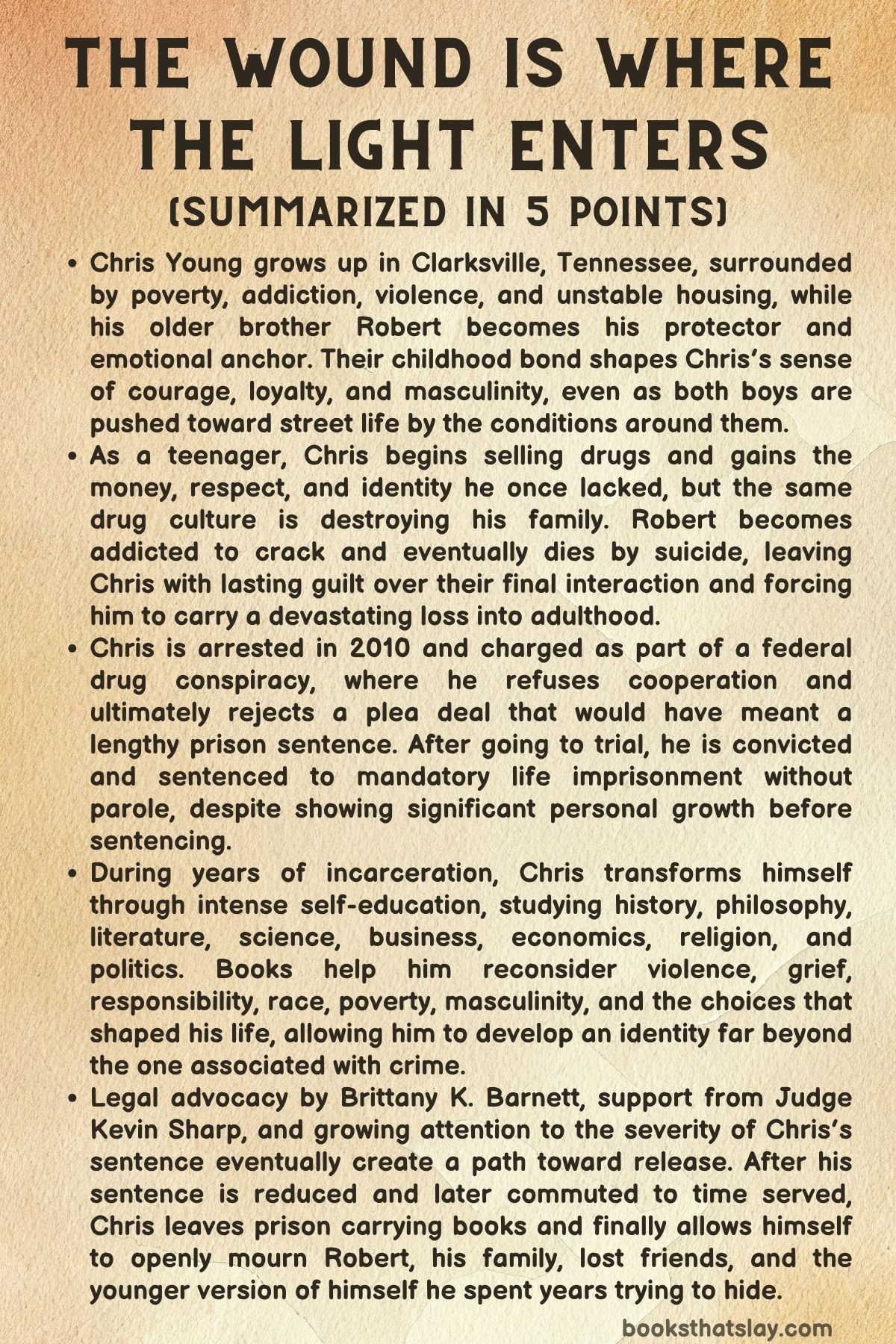
Summary
The Wound Is Where the Light Enters begins with Chris Young remembering childhood adventures with his older brother Robert in Clarksville, Tennessee. Robert is daring, impulsive, and seemingly fearless, while Chris is more cautious and frequently embarrassed by his own fear, establishing a contrast that will shape how Chris understands himself for many years.
Their childhood initially contains a period of relative stability with their mother, Penny, and her husband Mickey. Mickey provides a dependable income, a comfortable home, food, bicycles, and a sense of order, but violence and instability already exist beneath the surface because Penny teaches her sons that respect must always be defended and that physical retaliation is necessary when someone attacks them.
Robert repeatedly assumes the role of protector. He defends Chris, cares for him during painful sickle-cell attacks, and intervenes when Penny is threatened, while Chris often freezes during dangerous situations and later judges himself harshly for reacting differently.
Penny’s growing crack addiction gradually destroys the household. She begins disappearing for long periods, leaving her sons with relatives or taking them into dangerous neighborhoods while she searches for drugs, and arguments between her and Mickey become increasingly severe.
The marriage finally collapses after Penny stabs Mickey during a violent confrontation and Mickey retaliates by attacking her. Robert rushes toward the violence to protect his mother, while Chris runs for help and calls the authorities, reinforcing Chris’s belief that Robert possesses a courage he lacks.
The family eventually returns to a house on Vine Street that becomes known as the Boulevard. Chris and Robert become deeply connected to the surrounding Southside community, their extended family, neighborhood friendships, and the group of boys known as the Main Boys.
Chris also admires his older cousin Cudas, whose confidence and street reputation seem to represent everything Chris believes a respected young man should possess. Cudas nevertheless warns the younger boys that prison and gangster culture are not glamorous, but his warning competes with the powerful examples Chris sees around him every day.
Poverty becomes increasingly severe. Electricity, running water, clean clothes, regular meals, and basic household necessities become uncertain, while Penny’s addiction repeatedly removes her from her responsibilities and forces Robert to behave more like a parent than a child.
Neighbors become essential to the brothers’ survival. People such as Ms. Donnell provide food and practical help, but Chris experiences receiving charity as both necessary and humiliating because it reveals how visible his family’s desperation has become.
Chris and Robert eventually spend periods living with Big Mama, a strict woman who takes in children affected by addiction, incarceration, and family instability. Although she provides food and shelter, Chris longs for Penny and the Boulevard because emotional belonging matters to him as much as physical safety.
His despair becomes severe enough that he considers suicide while staying with his grandfather. Thoughts of Robert and the emotional destruction his death would cause ultimately help stop him from using his grandfather’s gun.
Loss soon becomes another defining force in the brothers’ lives when Cudas is shot and killed at eighteen. Robert openly breaks down at the funeral, while Chris responds by withdrawing from school, fighting more often, spending additional time in the streets, and embracing the toughness that seems expected of boys in his environment.
School briefly offers alternative possibilities. Chris discovers that he enjoys learning, and his teacher Ms. Groves gives him Harry Potter books that awaken his imagination and help him recognize aspects of himself in a child who feels unwanted yet eventually discovers his value.
Still, poverty gives money enormous symbolic power. Chris begins to see wealth as the means to obtain clothing, dignity, independence, respect, and the ability to care for his family, while the drug trade presents the most visible path toward earning money quickly.
As a teenager, Chris begins selling drugs. He becomes increasingly skilled at the business, acquires money and status, and creates the Soulja C identity that allows him to appear strong while hiding insecurity, grief, illness, and fear.
The same drug economy that gives Chris financial power is destroying the people he loves. Penny remains addicted, and Robert eventually begins using crack himself, creating an unbearable reversal in which the brother who once protected everyone becomes increasingly vulnerable.
Robert struggles against addiction, depression, criminal charges, employment barriers, and inadequate treatment options. Chris refuses to give him drugs but does not fully recognize the seriousness of Robert’s emotional collapse, partly because Chris is absorbed in dealing, music, and his own ambitions.
In January 2007, Chris angrily confronts Robert after finding him searching for cocaine residue. Chris leaves to complete a drug transaction and later returns to discover that Robert has killed himself with Chris’s handgun.
Robert’s death becomes the central wound around which much of Chris’s later identity forms. He carries guilt about their final interaction and about his failure to recognize how desperate Robert had become, yet he continues dealing while attempting to support Robert’s daughter and pursue a music career.
Federal agents arrest Chris in 2010 in connection with a drug conspiracy. In pretrial detention, he initially believes the government cannot establish that his dealings make him part of the larger conspiracy and refuses to cooperate against others because loyalty remains fundamental to his sense of honor.
Prosecutors offer him a lengthy plea deal, but Chris rejects it. He sees other defendants begin cooperating when confronted with enormous sentencing exposure, causing some of his earlier beliefs about street loyalty to collapse.
Confinement unexpectedly reconnects Chris with education. After encountering books and encyclopedias in jail, he begins reading obsessively about mythology, philosophy, religion, art, history, politics, science, economics, literature, and racial inequality.
The intellectual expansion gradually changes the way he interprets himself. Rather than seeing his childhood only as a collection of personal failures and bad decisions, he begins examining the relationship between individual responsibility and larger forces such as poverty, racism, unequal opportunity, drug policy, neighborhood disinvestment, and the criminal justice system.
His transformation remains incomplete and difficult. Chris still reacts violently to perceived disrespect and spends time in solitary confinement after attacking another prisoner, but reading Hamlet and other works forces him to confront grief, suicide, revenge, and Robert’s death in ways that street culture never allowed.
Huey P. Newton’s experiences with self-education in prison become especially important because they show Chris that intellectual development inside confinement can have meaning beyond escape. Reading increasingly becomes a form of freedom that prevents prison from completely determining who he is.
Meanwhile, his criminal case continues. Attorney Hallie McFadden helps him understand the dangers created by conspiracy law, cooperating witnesses, recordings, and prior convictions, but Chris continues resisting a plea agreement because he believes accepting decades in prison would mean surrendering his right to challenge the government’s interpretation of his conduct.
Prosecutors increase the consequences after he chooses trial by applying sentencing enhancements connected to his prior convictions. Chris understands that losing could mean mandatory life imprisonment, yet he proceeds because exercising the choice to fight the case becomes psychologically connected to reclaiming control over a life in which his options have often been determined by circumstances and institutions.
His 2013 trial ultimately ends badly. Recorded conversations provide stronger evidence than he expected, and the jury convicts him on every count placed before it, turning the possibility of mandatory life imprisonment into an approaching certainty.
After conviction, Chris briefly feels himself returning to anger and violence, but education once again redirects him. He studies business and investing, begins viewing himself as a developing organization with strengths and weaknesses, and imagines possibilities that would once have seemed completely foreign to the teenage dealer on the Boulevard.
Chris prepares an extensive sentencing statement despite being warned that nothing he says can change the mandatory sentence. He memorizes the speech because he wants the court to encounter him as a thinking person rather than merely as a criminal record or case number.
At sentencing in 2014, Chris speaks about his childhood, Robert, Cudas, poverty, addiction, history, philosophy, business, economics, science, and the extraordinary education he has created for himself in jail. Judge Kevin Sharp listens seriously and recognizes Chris’s transformation, but mandatory sentencing law leaves him without authority to impose a different punishment.
Chris receives life in federal prison without parole. The sentence devastates his family, yet his decision to speak ensures that his intellectual growth and humanity become part of the official record.
At USP McCreary, Chris enters a dangerous environment governed by racial divisions, gangs, threats, weapons, and strict codes of survival. Severe sickle-cell complications also damage his hips, eventually leaving him with major mobility problems.
He builds structure through exercise, reading, teaching GED classes, and helping others. Even in a violent institution, he notices acts of creativity, education, friendship, and compassion that challenge the idea that incarcerated people can be reduced to their crimes.
Journalistic attention eventually brings public scrutiny to Chris’s sentence and Judge Sharp’s discomfort with the mandatory punishment. Chris is later transferred for medical treatment, receives hip replacements, continues his education, and becomes increasingly interested in technology, programming, business, mental health, and ways of creating opportunities for young people whose circumstances resemble his own.
Repeated legal disappointments test his ability to maintain hope. Clemency and appellate efforts fail, while the deaths of Mickey and Big Mama add to his accumulated grief.
Attorney Brittany K. Barnett eventually becomes a central advocate in his case. She develops a post-conviction challenge based on ineffective legal representation and helps connect Chris’s circumstances with broader public advocacy involving Judge Sharp and other prominent supporters.
Chris is eventually transferred to USP Beaumont, where extreme violence, lockdowns, isolation, and uncertainty create additional psychological pressure. There he increasingly learns that strength does not require emotional suppression and finally allows himself to mourn Robert more openly.
In 2020, Chris receives extraordinary legal news: the government agrees that ineffective assistance affected his case and that his punishment should be reduced to the fourteen-year sentence originally offered. His mandatory life sentence is therefore removed, although his physical freedom does not immediately follow.
He spends months in solitary confinement while awaiting transfer, enduring broken plumbing, repeated cell moves, sensory deprivation, and false promises from officials. Books, scientific ideas, and communication with other prisoners become essential methods of protecting his identity and keeping his mind active.
Eventually Lieutenant Franks unexpectedly tells Chris that he has received presidential clemency. President Donald Trump commutes his sentence to time served, and after nearly eleven years of incarceration Chris finally walks out of prison carrying a bag of books.
Brittany Barnett is waiting for him outside. As Chris rides away from Beaumont, the emotional restraint that has followed him since childhood finally collapses, and he cries for Robert, Cudas, Penny, Mickey, Granddaddy, Big Mama, lost friends, imprisoned men, and his younger self.
Freedom therefore becomes more than release from a building. Chris has spent years learning that courage can include grief, that strength can include vulnerability, and that circumstances can restrict a person’s choices without completely eliminating the possibility of intellectual and moral change.
Key People
Chris Young
Chris Young is the central figure and narrator of The Wound Is Where the Light Enters, and his development is shaped by the conflict between the person his environment encourages him to become and the person he gradually discovers he might become. As a child, he is sensitive, imaginative, intellectually curious, and deeply attached to Robert, but he interprets his fear during violent situations as personal weakness.
That insecurity contributes to the creation of Soulja C, an identity based on toughness, retaliation, status, and emotional control. Drug dealing later gives Chris money and social recognition, yet those achievements cannot resolve the shame, grief, abandonment, and fear beneath the persona.
Robert’s suicide becomes the emotional center of Chris’s adult life because it forces him to confront the limits of toughness as a survival philosophy. His later incarceration initially appears to confirm the path that poverty and street culture prepared for him, but prison unexpectedly provides the conditions for a radical intellectual expansion.
Reading allows Chris to question both his own decisions and the structures surrounding them. His growth is significant because he eventually rejects the idea that personal responsibility and social context must cancel each other out, accepting that he made destructive choices while also asking why certain choices appeared far more available than others.
His final transformation is emotional as well as intellectual. The man who leaves prison can mourn openly, recognize vulnerability as a form of strength, and imagine using education, business, technology, and advocacy to create opportunities rather than simply accumulating status.
Robert Young
Robert is the emotional heart of The Wound Is Where the Light Enters, particularly because Chris’s memories of him contain both admiration and unbearable regret. As the older brother, Robert frequently functions as Chris’s protector, defending him from neighborhood threats, caring for him during sickle-cell attacks, seeking food during periods of deprivation, and intervening when Penny is attacked.
Chris idealizes Robert’s courage because Robert seems to act immediately in situations that cause Chris to freeze. Yet the book gradually reveals that Robert’s fearlessness does not make him invulnerable, and the burden of becoming protector, substitute parent, son, brother, and survivor at such a young age carries severe emotional costs.
His addiction represents one of the story’s cruelest reversals. The person who once recognized the destruction caused by Penny’s drug use eventually becomes addicted himself, while his criminal record and lack of access to effective treatment make recovery increasingly difficult.
Robert’s suicide destroys the illusion that toughness can indefinitely contain pain. Chris spends years examining their final interactions because he eventually understands that Robert’s visible behavior concealed a despair that neither brother possessed the language to discuss openly.
Penny
Penny is one of the most complicated figures in The Wound Is Where the Light Enters because she is simultaneously a loving mother and a major source of instability. Chris remembers her as intelligent, funny, capable, protective, and an excellent cook, making her addiction especially painful because the drugs do not erase the mother he loves but repeatedly make her unavailable.
Her central philosophy is that her sons must fight back rather than accept mistreatment. That lesson helps Chris develop persistence, but it also connects dignity with physical retaliation and contributes to an understanding of masculinity and survival in which surrender appears shameful.
Penny’s relationships with Mickey and Roger repeatedly become violent, exposing her sons to situations they are emotionally incapable of processing. Her own use of weapons further complicates Chris’s understanding of victimhood because Penny can be endangered by a partner and still be treated as the legal aggressor after retaliating.
Even when her addiction prevents her from providing a stable home, Chris remains intensely loyal to her. That loyalty demonstrates how children can understand a parent’s failures while still craving the emotional bond that no substitute household can completely replace.
Mickey
Mickey occupies an important place in The Wound Is Where the Light Enters because he represents both an early period of stability and one of Chris’s unresolved family relationships. Although he is not Chris’s biological father, he works consistently, provides materially for the boys, and creates a home in which they temporarily experience ordinary comforts.
His violent relationship with Penny complicates that positive memory. The confrontation in which Penny stabs him and he brutally retaliates exposes Chris to the frightening reality that someone can occupy both caring and harmful roles within a child’s life.
Chris later regrets minimizing Mickey’s importance after their household collapses. Mickey’s eventual death forces him to acknowledge that love and resentment can coexist, and that a damaged relationship does not automatically erase the genuine security and affection once associated with it.
Samuel Eugene Hooker
Granddaddy represents achievement, discipline, economic independence, and generational aspiration within The Wound Is Where the Light Enters. A veteran and successful businessman, he shows Chris that Black prosperity and entrepreneurship are possible even though those possibilities often feel distant from the young people growing up around the Boulevard.
His relationship with Penny creates tension because his disappointment in her addiction can appear harsh to Chris and Robert. Yet he repeatedly assists the family, provides shelter, pays expenses, arranges bail, and intervenes when instability becomes overwhelming.
For Chris, Granddaddy therefore represents both security and judgment. His death during Chris’s incarceration removes another important male figure and intensifies Chris’s awareness that prison prevents him from repairing relationships in his own time.
Granddaddy’s business accomplishments also gain new significance when Chris begins studying finance and entrepreneurship. What once seemed simply like his grandfather’s personal success eventually becomes evidence of an alternative tradition Chris wishes he had understood more fully as a teenager.
Big Mama
Big Mama is a practical caregiver whose importance grows precisely because she does not offer Chris an idealized substitute family. She provides food, electricity, shelter, discipline, and stability to children whose parents are affected by addiction or incarceration, but she refuses to disguise painful realities with comforting language.
Chris initially resents her rules because living with her feels like proof that Penny cannot care for him. His repeated attempts to return to the Boulevard demonstrate that safety without the people he considers home cannot immediately satisfy his emotional needs.
Big Mama’s later confrontation with Chris about rejecting the plea agreement reveals the depth of her attachment to him. Her anger comes from years of watching incarceration and death consume people around her, so accepting decades in prison appears preferable to risking a life sentence if it guarantees that he might someday return.
Her death before Chris is released becomes another devastating example of incarceration stealing opportunities for reunion. Chris had imagined surprising her by coming home, making her absence from his eventual freedom particularly painful.
Cudas
Cudas is Chris’s charismatic older cousin and one of his earliest models of masculine status. Stylish, confident, admired, and affectionate toward the younger boys, he embodies the neighborhood respect Chris eventually tries to reproduce through the Soulja C identity.
Yet Cudas also understands where street prestige can lead. His warning that prison is frightening rather than glamorous offers the younger boys a truth that their environment makes difficult to absorb because the visible rewards of toughness remain immediate while future consequences seem distant.
His murder at eighteen is therefore both personal tragedy and symbolic turning point. Chris and Robert lose someone they admire just as they are becoming more vulnerable to the culture Cudas tried to warn them against.
The funeral also reveals the cost of emotional repression. Robert finally breaks down openly, while Chris increasingly responds to grief through anger, fighting, truancy, and deeper involvement in street life.
Ms. Donnell
Ms. Donnell represents the informal community care that repeatedly keeps Chris and Robert alive when family and institutions fail them. A transgender woman and former military cook, she feeds the boys without requiring them to explain or justify the desperation of their household.
Her kindness matters because food in Chris’s childhood is never merely food. Accepting a meal can carry embarrassment, dependence, gratitude, and relief at the same time, and Ms. Donnell offers assistance that preserves a measure of dignity.
Her murder reinforces Chris’s growing belief that gentleness and vulnerability can be dangerous in his environment. Losing someone associated with nourishment and generosity contributes to the pattern through which positive adults repeatedly disappear from his life.
Roger
Roger initially offers Penny and the boys another possibility of stability, even helping give the Boulevard its name through the sign he creates. That promise deteriorates as his own crack use and violent relationship with Penny become increasingly apparent.
His physical attacks on Penny force Robert once again into the role of defender and Chris into the role of seeking outside assistance. The repetition matters because it teaches both boys that domestic violence is not an isolated crisis but something that can reappear across relationships.
Roger also demonstrates how addiction can affect entire domestic systems rather than only individual users. His presence brings shelter at one stage while later creating danger, showing how quickly apparent security can become another unstable environment.
Ms. Groves
Ms. Groves plays a comparatively brief but crucial role because she recognizes intellectual potential in Chris at a time when poverty and behavioral problems threaten to define him completely. By giving him Harry Potter books, she reconnects him with imagination, curiosity, and the possibility that a neglected child might possess abilities others have failed to notice.
Her influence foreshadows the enormous importance reading will later have during incarceration. Long before Chris constructs his own prison education, Ms. Groves demonstrates what can happen when an adult responds to a struggling child with intellectual opportunity rather than simply punishment.
Da Hero
Da Hero is an older figure connected to Chris’s street life and later becomes central to the federal case that results in Chris’s conviction. Chris respects him, values his opinion, and associates him with the older male authority figures whose approval once strongly shaped his decisions.
That dynamic becomes especially clear when Da Hero discourages Chris from delivering his ambitious sentencing speech. Chris is hurt because he expects recognition and support, but the disappointment forces him to recognize that personal growth cannot depend upon authorization from admired men.
Chris’s decision to speak anyway marks an important shift in their relationship. Da Hero remains significant, but his judgment no longer determines the limits of what Chris believes he can become.
Hallie McFadden
Hallie McFadden becomes important because she gives Chris the experience of feeling that a lawyer is genuinely listening to his reasoning. She participates in attempts to challenge government evidence and later explains the extraordinary risks created by conspiracy law, recorded calls, cooperating witnesses, and sentencing enhancements.
Her advice does not ultimately persuade Chris to accept a plea, but she helps clarify the consequences of the decision before him. Through Hallie, the legal process becomes something Chris can intellectually examine even though he remains emotionally determined to resist what he considers an excessive punishment.
Sunny Koshy
Sunny Koshy represents prosecutorial authority within Chris’s experience of the federal justice system. He offers plea arrangements but also possesses the power to increase sentencing exposure when Chris continues toward trial.
From Chris’s perspective, Koshy’s actions demonstrate how plea bargaining can create a massive difference between the punishment available through negotiation and the punishment imposed after conviction. The character therefore functions less as a private emotional presence than as the human face of institutional power.
Chris’s conflict with him becomes part of a larger argument about agency. The prosecution sees a defendant making legally available choices, while Chris experiences those choices as occurring under conditions where refusing the offered outcome can result in catastrophic punishment.
Judge Kevin Sharp
Judge Kevin Sharp becomes one of the most consequential people in Chris’s later life because his response at sentencing confirms that Chris’s transformation can be recognized even within a system that still requires his imprisonment. Rather than dismissing the lengthy statement, Sharp listens carefully, engages with Chris’s reading, and responds to him as a person.
The tragedy of the sentencing scene comes from the judge’s lack of discretion. Even after hearing evidence of intellectual development and potential, Sharp is required to impose life imprisonment because of the mandatory law governing the case.
Sharp’s later departure from the bench and public criticism of the sentence transform him from the official who imposed the punishment into an advocate for Chris’s release. That reversal demonstrates how a legal actor can follow existing law while later questioning whether the outcome produced by that law is just or useful.
Brittany K. Barnett
Brittany K. Barnett becomes one of the most important figures in Chris’s struggle for freedom. She combines legal advocacy with genuine personal commitment, treating his case not as an abstract sentencing problem but as the life of a person whose growth continues to matter.
Her investigation produces evidence supporting a post-conviction challenge based on deficiencies in Chris’s earlier representation. She also helps connect his case with Judge Sharp and other influential supporters, keeping legal and public pressure alive after earlier appeals and clemency efforts have failed.
Brittany’s presence is especially meaningful because Chris has experienced many important relationships ending through death, addiction, imprisonment, or separation. When he finally leaves Beaumont, she is physically waiting outside, making her the person who bridges the final distance between incarceration and freedom.
Jeanne Schmitzer
Jeanne Schmitzer supports the intellectual life Chris builds during incarceration by sending books and educational materials from outside. Her contributions matter because access to knowledge in prison is limited by institutional restrictions, finances, library availability, and physical location.
Through Jeanne, the world beyond the prison continues entering Chris’s life in the form of ideas. Her support strengthens the connection between education and freedom that becomes increasingly central to his identity.
Polo
Polo is important during a period when repeated legal disappointments finally break through Chris’s emotional defenses. Their conversations help Chris reconsider what it means to be a “Soulja,” moving the idea away from suppressing pain and toward transforming suffering into something constructive.
This reinterpretation reaches beyond prison survival. It challenges the identity Chris developed as a teenager and gives him another language for courage, one in which acknowledging grief does not make a person weak.
Yennier
Yennier helps expand Chris’s understanding of money by teaching him basic concepts involving stocks, corporations, dividends, short selling, and investment. The lessons are striking because Chris already possesses extensive experience with an illegal economy but has had remarkably little exposure to the mechanisms of legal wealth creation.
Through Yennier, Chris realizes that intellectual curiosity can be directed toward practical economic knowledge. This contributes to his growing belief that young people from neighborhoods like his require access not only to warnings about crime but also to credible models of legitimate financial opportunity.
Eclipse
Eclipse represents the continuing pressure of prison codes after Chris has begun changing internally. Conflict with him presents a test because retaliation might protect Chris’s standing inside the institution while simultaneously threatening the possibility of future release.
Chris’s increasing refusal to sacrifice his long-term goals for immediate reputation shows how far he has moved from the logic that shaped Soulja C. The struggle is important precisely because transformation does not eliminate external pressure; it changes how he decides to answer it.
Themes
Pain, Grief, and the Transformation of Vulnerability
Pain functions as both an injury and a source of self-knowledge throughout The Wound Is Where the Light Enters. Chris grows up believing that fear, tears, helplessness, and emotional exposure threaten the image of strength necessary for survival, while Robert becomes his model of the person who reacts rather than freezes and protects rather than retreats.
That belief becomes increasingly destructive as deaths accumulate. Cudas’s murder, Robert’s suicide, Granddaddy’s death, Mickey’s death, Big Mama’s death, and the loss of friends create enormous grief, but Chris repeatedly tries to convert pain into anger, toughness, work, hustling, intellectual activity, or emotional silence.
Robert’s suicide becomes the clearest demonstration of the danger created when suffering cannot be spoken. Chris eventually recognizes that the brother he considered fearless was carrying despair that toughness could not resolve, and this realization changes the meaning of vulnerability for him.
His final tears after leaving prison therefore carry enormous thematic significance. Crying no longer signals the frightened child who has failed to imitate Robert’s courage; it becomes proof that Chris can finally accept love, grief, regret, relief, and joy without treating emotional openness as defeat.
Individual Responsibility and Structural Constraint
Chris’s intellectual development repeatedly returns to a difficult question: how much of a person’s life comes from personal choice, and how much is shaped by circumstances established long before that choice is made? He refuses to reduce his story to either explanation.
He openly accepts responsibility for selling drugs, carrying weapons, participating in violence, and continuing criminal activity after earlier arrests. At the same time, he examines why drug dealing appeared economically realistic while investment, technology, entrepreneurship, and professional careers remained largely invisible during his adolescence.
Poverty, parental addiction, housing instability, hunger, racial inequality, community violence, inadequate rehabilitation, criminal records, sentencing policies, and unequal educational opportunities all narrow the range of possibilities surrounding Chris and Robert. These forces do not mechanically determine their decisions, but they influence what choices seem available and what consequences follow.
The theme becomes especially important during Chris’s prison education. Writers emphasizing personal agency initially appeal to him, but history teaches him that determination alone cannot explain inherited disadvantage or institutional inequality.
His mature position combines both insights. Human beings possess responsibility for their actions, yet meaningful discussions of responsibility must also examine the social conditions under which those actions are made.
Education as a Form of Freedom
Education becomes the central force of liberation in The Wound Is Where the Light Enters, beginning long before Chris physically leaves prison. His curiosity appears during childhood through imagination, school subjects, and the books Ms. Groves gives him, but poverty and street culture gradually redirect his attention toward survival and money.
Prison unexpectedly restores intellectual curiosity on a much larger scale. Mythology, philosophy, art, science, history, economics, literature, religion, finance, business, and political thought allow Chris to build an identity that cannot be completely contained by a criminal conviction.
The importance of education lies not simply in accumulating information. Reading gives Chris concepts through which he can reconsider masculinity, grief, race, economic opportunity, responsibility, punishment, mortality, identity, and the meaning of freedom.
Learning also exposes how little access he once had to certain forms of knowledge. He knew the mathematics of drug sales before understanding dividends or investments, making education inseparable from his later desire to create opportunities for younger people.
Even solitary confinement cannot completely remove that freedom. When almost every physical choice is taken away, Chris continues memorizing scientific concepts, reading whatever books reach him, and protecting an intellectual world larger than the cell.
Identity, Masculinity, and the Meaning of Strength
Chris spends much of his life trying to determine what strength actually means. Childhood experiences teach him that a man should defend himself, protect loved ones, retaliate against disrespect, conceal fear, and endure pain without visibly breaking.
Robert appears to embody this ideal, while Chris sees his own tendency to freeze as evidence of weakness. The Soulja C persona becomes an attempt to correct that insecurity by creating a version of himself associated with money, street credibility, aggression, loyalty, and emotional control.
Experience gradually exposes the limitations of that definition. Robert’s suicide proves that appearing strong cannot protect someone from internal despair, while incarceration demonstrates that constant readiness for violence may preserve reputation in the immediate moment while destroying opportunities for a different future.
Chris’s transformation therefore requires more than acquiring knowledge. He must redefine courage itself, learning that restraint can require greater strength than retaliation, that independent thought may require rejecting the approval of respected men, and that grief can be expressed without surrendering dignity.
By the end, strength includes reading, teaching, mourning, imagining, accepting responsibility, questioning institutions, surviving disappointment, and maintaining hope without denying reality. The mature Chris does not simply abandon the identity of a fighter; he changes what he believes is worth fighting for.


