The Women in White Summary, Characters and Themes
The Women in White by Sarah Pekkanen is a psychological suspense novel that connects a modern investigation with a disturbing experiment conducted at a Virginia university in 1964.
At its center are Riley Bell, a woman rebuilding her life after her husband’s gambling destroyed their marriage, and Betty Sadler, an elderly widow who has spent more than sixty years isolated from the modern world. Their growing friendship opens the door to the buried history of four young women used in parapsychology research. The novel examines female friendship, coercion, trauma, intuition, institutional power, and the dangerous consequences of treating vulnerable people as experimental material.
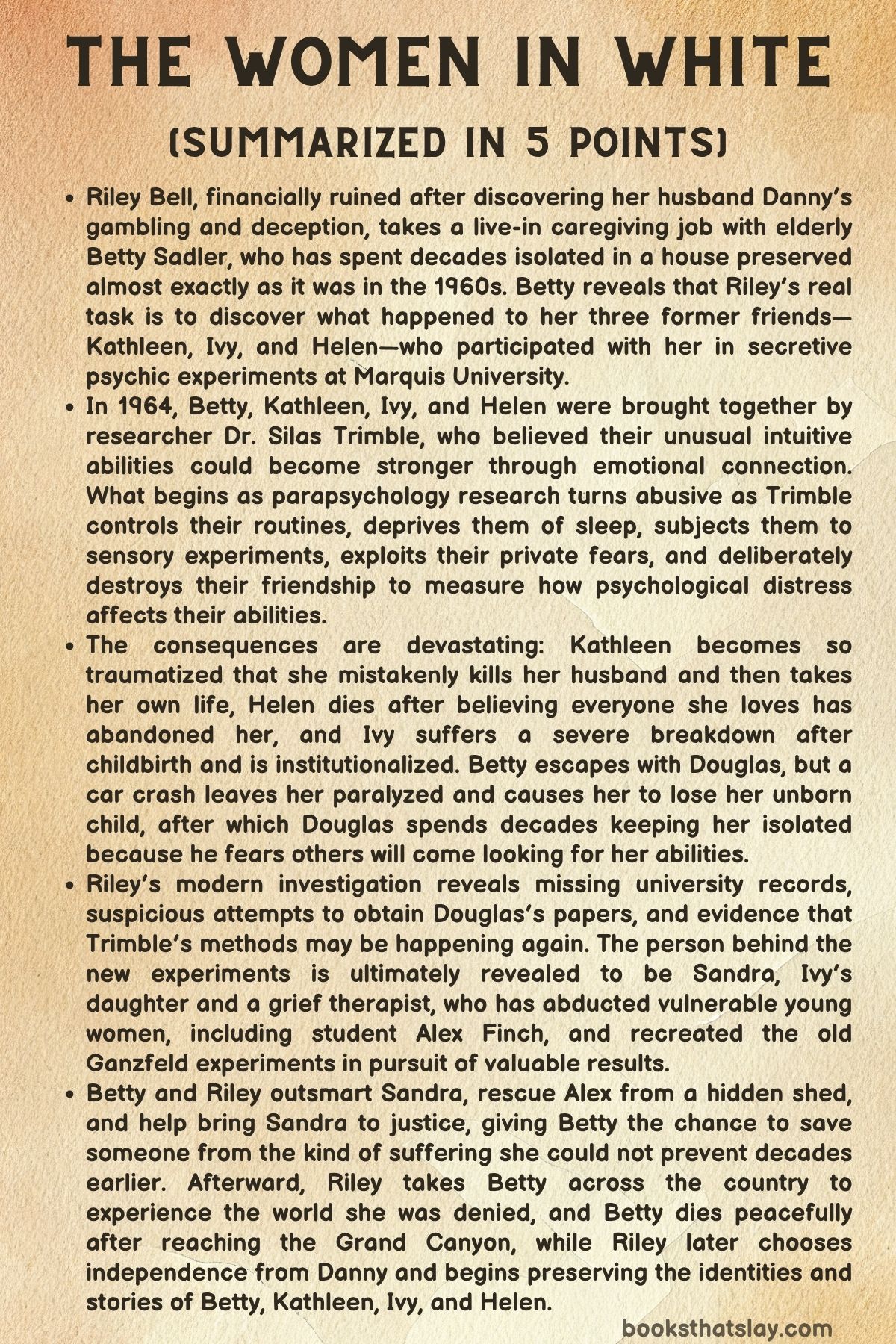
Summary
Riley Bell arrives at the Virginia home of eighty-one-year-old Betty Sadler hoping to become her live-in caregiver. Riley badly needs the position because her marriage to Danny has recently collapsed after she discovered that his gambling addiction left them bankrupt, cost them their house, and burdened them with debts she never knew existed.
Betty immediately appears unusual. She lives in a house preserved almost perfectly in the style of the 1960s, seems unfamiliar with smartphones and Wi-Fi, and is surprisingly independent for someone supposedly hiring a caregiver; stranger still, she seems to know things about Riley that Riley never told her.
The story then moves to 1964, when nineteen-year-old Betty is married to Douglas Sadler, a graduate student associated with the Trimble Institute at Marquis University. Douglas casually tests Betty with Zener cards used in experiments involving extrasensory perception and becomes fascinated when she guesses an extraordinary number of symbols correctly.
Douglas brings Betty to his mentor, Dr. Silas Trimble, a parapsychology researcher whose scientific curiosity quickly becomes an obsession. Betty initially performs poorly under pressure but soon demonstrates enough unusual ability to interest Trimble, who categorizes her as Girl Four and begins treating her less as a person than as valuable research material.
Trimble eventually places Betty with three other young women who have shown unusual intuitive or psychic abilities: Kathleen Moore, Ivy Lennox, and Helen. The women are required to follow controlled routines, participate in increasingly invasive experiments, and even wear matching white dresses intended to eliminate external differences among them.
Each woman has been drawn into the institute through a different vulnerability. Kathleen once enjoyed independence as an airline stewardess but surrendered her career when she married Ronald Moore; Ivy has experienced powerful premonitions throughout her life and was effectively manipulated into moving to Virginia after Trimble engineered a job opportunity for her husband David; Helen comes from poverty and accepts Trimble’s offer because it promises money, housing, education, and a sense that she matters.
The four women become exceptionally close. Their friendship gives them emotional security as Trimble demands more of their time, subjects them to sensory-deprivation tests, disrupts their private lives, and increasingly places his research above their physical or emotional welfare.
Betty becomes especially disturbed when Ivy goes into premature labor during an isolated experiment. Betty, Kathleen, and Helen somehow sense Ivy’s distress and find her despite being separated, but Trimble responds with excitement about the experimental implications rather than immediately focusing on Ivy’s medical emergency.
Ivy gives birth to Sandra, who survives, yet Trimble expects Ivy to return to research almost immediately. Meanwhile, Betty’s marriage deteriorates because Douglas has become devoted to Trimble’s work and increasingly sees Betty’s unusual abilities as something that must be preserved for research rather than as one part of the woman he married.
In the present, Betty finally explains why she hired Riley. She wants Riley to discover what happened to Kathleen, Ivy, and Helen, the three friends she has not seen or spoken to in more than sixty years.
Riley travels to Marquis and begins investigating. She finds that the women are missing from old yearbooks and that archival folders relating to the institute’s crucial 1964 research period have been emptied, suggesting that someone deliberately removed the historical evidence.
Riley eventually locates Ivy’s daughter Sandra, now a grief therapist. Sandra tells her that Ivy was committed to a psychiatric institution after Sandra’s birth, received a diagnosis of schizophrenia, and died when Sandra was very young, although Sandra has long questioned whether postpartum illness and other circumstances may have played a larger role.
Another source, Silas Trimble’s grandson Samuel, reveals an even darker pattern. Kathleen apparently killed Ronald with a baseball bat before taking her own life, Helen died after jumping from a bridge, Ivy was institutionalized, and Betty vanished from university life—all within an extremely narrow period.
The past explains why these disasters occurred. After suffering a heart attack, Trimble becomes even more determined to prove that the women possess a shared psychic connection and confines all four in a controlled section of the university library basement, where he regulates their food, sleep, surroundings, communication, and contact with the outside world.
The women initially believe that deeper trust among them may strengthen their abilities enough to satisfy Trimble and win their release. They share private fears and secrets, including Kathleen’s longing for the freedom of her former career, Helen’s fear that no one will ever love her, Ivy’s insecurities, and Betty’s fear that Douglas is attracted to another research subject named Emily.
Trimble uses those secrets against them. He isolates Ivy and falsely tells her that her friends agreed she deserved punishment, tells individual women that the others voted to subject them to painful extended Ganzfeld sessions, and strategically exposes Helen’s private attraction to Douglas.
Kathleen suffers especially severe damage because Trimble’s sensory experiments reactivate memories of sexual abuse from her adolescence. The combination of sleep deprivation, isolation, fear, restraint, and psychological manipulation leaves her unable to separate traumatic memory from present reality.
Eventually Trimble reveals what he was actually testing. Having observed that the women performed unusually well when they trusted and cared about one another, he deliberately destroyed their relationships to determine whether weakening their emotional bond would also reduce their experimental results.
The women are sent home psychologically exhausted and believing their closest friends betrayed them. Ivy becomes severely disoriented after returning to her infant daughter and emotionally unsupportive husband, crashes her car, and is eventually institutionalized.
Kathleen awakens from a traumatized state to discover that she has struck Ronald with a baseball bat after mistaking him for her childhood abuser. Unable to endure the realization that she killed the husband she loved, she takes her own life.
Helen fares no better. Trimble has withdrawn the housing, money, purpose, and community he offered her, and she believes her friends have rejected her; feeling entirely alone and unable to imagine a future, she reaches a bridge and ends her life.
Douglas finally recognizes the scale of what Trimble has done and urgently attempts to flee Virginia with Betty. During their escape, their car is struck by a truck, leaving Betty permanently paralyzed and causing her to lose the child she had secretly conceived.
After the accident Douglas becomes obsessed with keeping Betty safe. He creates the isolated household Riley eventually enters, controls access to the outside world, avoids modern technology, and spends decades believing that governments, scientists, or others interested in Betty’s abilities might discover her.
In the present, Riley realizes the danger has not ended. Someone attempts to obtain Douglas’s private papers, Betty’s study is searched, the university archives have been stripped of important records, and a young hospital patient reacts with terror to the obscure term Ganzfeld, raising the possibility that Trimble’s methods are being repeated.
Suspicion initially turns toward Samuel Trimble because his home contains extensive materials associated with his grandfather, including research papers, Zener cards, Ganzfeld equipment, and photographs. When Alex Finch, a Marquis student connected to the missing archival records, disappears, Riley fears Samuel may be reproducing his grandfather’s work.
Sandra helps Riley escape from Samuel’s house and brings Riley and Betty to her secluded home, apparently offering them safety. Riley initially admires Sandra, but small inconsistencies gradually trouble her, particularly a lie about a piece of furniture, Sandra’s suspiciously fast arrival when Riley needed help, her security system, her proximity to recent events, and the possibility that Alex is one of her therapy clients.
The truth is far worse than Riley expected. Sandra stole the university records, recreated Trimble’s experiments, abducted vulnerable young women, and used psychological and sensory manipulation in pursuit of results she believes could be valuable to governments and other powerful organizations.
Sandra drugs and restrains Riley while attempting to frame her for Alex’s disappearance. Betty protects Riley by claiming Riley possesses exceptional telepathic ability, persuading Sandra to keep them alive long enough to perform another experiment.
During the test, Betty subtly directs Riley toward objects that can be used as weapons. Riley understands the message, and the two women attack together, injuring Sandra and taking control of her gun.
They then learn that Alex is still somewhere on the property undergoing a prolonged Ganzfeld experiment after being restrained and drugged. Riley runs into the surrounding woods to search for her but becomes lost and overwhelmed until she finally stops relying only on conscious reasoning, quiets herself, and follows an unexpected sense of direction.
Riley discovers a concealed shed where Alex is bound to a chair in sensory-deprivation equipment. She frees and comforts her, reaches a road to summon emergency help, and eventually returns with rescuers while Betty prevents Sandra from escaping.
Police arrest Sandra, and Alex survives. Riley remains uncertain whether her success came from psychic ability, ordinary intuition, unconscious observation, or coincidence, while Betty believes Riley has finally learned that instinct deserves to be heard.
After Sandra is sentenced to life imprisonment, Riley gives Betty something she has been denied for most of her life: freedom of movement. They travel across the United States with Sandra’s elderly dog Hank, eventually reaching the Grand Canyon, a place Betty had known for decades only through a painting.
Betty experiences the world that fear and isolation kept beyond her door, while her relationship with Riley becomes that of a grandmother and granddaughter. At the Grand Canyon, after dreaming of Kathleen, Ivy, and Helen together as young women again, Betty dies peacefully in her sleep.
Riley inherits Betty’s home and begins rebuilding her own future. She refuses Danny’s plea to resume responsibility for his recovery, helps Alex continue her education, considers training as an EMT, and agrees to tell Betty’s story publicly so that Betty, Kathleen, Ivy, and Helen will no longer exist merely as forgotten research subjects identified by numbers.
Characters
Riley Bell
Riley is the present-day emotional center of The Women in White, beginning the book at a point when nearly every structure she trusted has collapsed. Danny’s gambling, lies, hidden debts, and possible criminal behavior have left her financially ruined, living in her car, ashamed of herself, and uncertain whether her judgment can be trusted.
Her investigation gradually becomes a process of recovering that judgment. Riley repeatedly notices suspicious details before consciously accepting their meaning, and her development depends on learning that loyalty should not require her to explain away evidence, silence discomfort, or assume responsibility for another adult’s destructive choices.
Her bond with Betty gives Riley both purpose and a model of endurance, while her rescue of Alex proves that she can act decisively when someone else is in danger. By the end, rejecting Danny’s attempt to make his recovery dependent upon her marks one of her most important victories because she finally distinguishes compassion from self-sacrifice.
Betty Sadler
Betty is the historical and emotional core of The Women in White, carrying more than six decades of friendship, guilt, trauma, love, fear, and unanswered questions. Her psychic experiences begin in childhood, but early reactions teach her to hide them, leaving her vulnerable when Douglas and Trimble later transform those abilities into objects of scientific interest.
As a young woman, Betty is strongly shaped by expectations surrounding marriage and obedience. She repeatedly worries about pleasing Douglas even while her independence, education, privacy, reproductive decisions, and friendships are being pushed aside by the research.
The elderly Betty is considerably sharper and more self-aware. Although decades of isolation have left her unfamiliar with modern life, she possesses exceptional observational skill, emotional intelligence, courage, and the ability to act under pressure.
Her final journey completes a life interrupted in youth. Betty cannot undo what happened to Kathleen, Ivy, and Helen, but helping rescue Alex allows her to prevent another young woman from suffering the same fate, while traveling with Riley finally lets her experience a world that had remained beyond locked doors.
Douglas Sadler
Douglas occupies one of the most morally complicated positions in The Women in White because love, ambition, guilt, fear, and control all influence his treatment of Betty. As a young graduate student, he is fascinated by her unusual abilities and desperate for Silas Trimble’s approval, allowing his admiration for his mentor to overpower his responsibility toward his wife.
He participates in manipulative efforts to recruit gifted women, including the scheme used to bring Ivy to Marquis. He also accepts Trimble’s growing control over Betty’s time and becomes more concerned about protecting her usefulness to the research than supporting her education, desire for children, or autonomy.
After recognizing the damage Trimble has caused, Douglas changes dramatically. His attempt to save Betty contributes indirectly to the crash that paralyzes her, and his subsequent guilt and terror develop into obsessive protection.
Douglas genuinely loves Betty, but his protection becomes another form of confinement. His tragedy is that he ultimately understands the danger posed by Trimble yet responds by constructing a life in which fear still determines Betty’s choices.
Dr. Silas Trimble
Silas Trimble functions as the central historical antagonist of The Women in White, representing the danger created when intellectual ambition becomes detached from ethical responsibility. He presents himself as a serious researcher exploring parapsychology, but his behavior steadily reveals that producing extraordinary results matters more to him than the dignity or safety of his subjects.
His greatest cruelty is psychological rather than openly physical. Trimble identifies the women’s vulnerabilities, controls their environment, deprives them of sleep, manipulates their perceptions, lies about their friends, revives traumatic memories, and deliberately destroys their relationships because he wants to measure the effect on their performance.
The women are valuable to him only as experimental material. Even Ivy’s premature labor becomes exciting data before it becomes a medical emergency in his mind.
Trimble’s legacy demonstrates why scientific language cannot excuse abuse. His experiments leave Kathleen and Helen dead, Ivy institutionalized, Betty permanently marked by the experience, and later generations vulnerable to someone willing to repeat his methods.
Kathleen Moore
Kathleen initially appears glamorous and confident, particularly beside the more sheltered Betty, but much of that confidence has been deliberately constructed in response to a painful childhood. Becoming a stewardess allows her to escape her mother’s unstable environment, earn independence, travel, and imagine herself as someone entirely separate from the girl who was sexually abused by Mac.
Marriage to Ronald gives Kathleen affection and family security but requires her to abandon the career that represented freedom. Her friendship with Betty, Ivy, and Helen therefore becomes another important space in which she can feel understood rather than controlled.
Trimble destroys that security by using the Ganzfeld procedure and sleep deprivation in ways that reactivate Kathleen’s buried trauma. When she later mistakes Ronald for Mac and fatally attacks him, the tragedy reflects the extent to which her perception has been destabilized.
Kathleen is not presented as secretly violent. Her fate demonstrates how deliberate psychological harm can transform an old survival response into a catastrophic action against the person she loves most.
Ivy Lennox
Ivy is naturally warm, optimistic, and unusually intuitive, often experiencing impulses or premonitions that help herself or others. From childhood, however, she is taught that these experiences should remain hidden because difference might make her socially unacceptable or prevent her from finding a husband.
Her recruitment into the institute is especially disturbing because it is engineered without her informed consent. Trimble and Douglas learn of her strong experimental results, observe her, and arrange circumstances that draw her and David across the country.
Pregnancy and motherhood make Ivy particularly vulnerable during the later experiments. She is exhausted, separated from her premature infant, inadequately supported by David, and deliberately convinced that her closest friends have rejected her.
Her eventual collapse therefore cannot be understood solely through the psychiatric label later applied to her. The book presents her deterioration within a wider context involving childbirth, exhaustion, coercion, isolation, emotional manipulation, and institutional power.
Helen
Helen enters the institute from a position very different from Betty, Kathleen, or Ivy. Poverty, limited opportunities, insecure housing, and a deep desire to belong make Trimble’s offer of money, accommodation, and recognition extraordinarily powerful.
Her psychic experiences initially seem to give meaning to a life in which she has often felt unnoticed. The institute makes her feel chosen, while her friendship with the other women gives her the family-like connection she has long wanted.
That same need for belonging becomes the vulnerability Trimble exploits. Helen’s private attraction to Douglas produces guilt, and when her note about him is exposed after Trimble has already damaged the women’s trust, she assumes she has destroyed one of the few relationships that mattered to her.
Once the experiment ends, Trimble withdraws the security he once offered. Feeling abandoned by her friends and unable to imagine another future, Helen reaches the bridge in a state of profound isolation, making her death one of the clearest consequences of his manipulation.
Sandra Lennox
Sandra becomes the modern antagonist of The Women in White through a transformation that initially remains hidden behind professional success and apparent compassion. As Ivy’s daughter, she grows up carrying the consequences of her mother’s institutionalization and early death, eventually becoming a grief therapist whose career seems to suggest that she has turned personal suffering into service.
Her discovery of Ivy’s diaries changes the way she understands her childhood. Instead of interpreting Ivy primarily as a traumatized and severely distressed woman, Sandra increasingly treats her mother’s inability to care for her as personal rejection.
That resentment combines with ambition and a desire for control. Sandra steals historical records, reconstructs Trimble’s methods, and targets young women whose vulnerability makes them easier to manipulate or less likely to receive immediate attention.
Her profession makes her crimes particularly disturbing because she understands psychological weakness and trust. Rather than using that knowledge to protect vulnerable people, she uses it to identify and control them.
Danny
Danny shapes Riley’s development even though much of his importance comes from events that occurred before the central investigation. His gambling addiction is accompanied by elaborate deception, hidden debts, suspicious possessions, lies about money, and behavior suggesting that his desperation extended into theft.
Riley’s love for him teaches her to distrust herself. Whenever she notices something inconsistent, Danny provides an explanation, and Riley repeatedly chooses the explanation that allows her marriage to continue.
Even after their divorce, Riley feels responsible for protecting him from dangerous creditors. Her eventual recognition that Danny’s consequences belong to Danny is therefore essential to her growth.
His final request that she return because he cannot recover without her repeats the same pattern in emotional form. Riley’s refusal shows that she has finally learned that loving someone does not require becoming responsible for saving them.
Samuel Trimble
Samuel is Silas Trimble’s grandson and initially becomes one of Riley’s strongest suspects. His fascination with his grandfather is extensive, and his house contains preserved research material, equipment, photographs, Zener cards, and other objects associated with the historical experiments.
His enthusiasm is unsettling because he treats the past partly as fascinating material for a book or screenplay. Riley therefore has good reason to wonder whether admiration has developed into imitation.
Ultimately, Samuel functions partly as misdirection. The evidence surrounding him is suspicious, but his possession of historical material does not make him the person abducting modern women.
His character also raises questions about inherited legacies. Descendants may preserve, romanticize, investigate, reject, or misunderstand the actions of earlier generations, and possessing another person’s history is not the same as understanding its human cost.
Alex Finch
Alex is a modern parallel to the women harmed in the 1960s. She is intelligent but emotionally vulnerable after personal loss, and her relationship with married professor Joshua Woods places her in a situation where institutional authority can easily outweigh her credibility.
After the relationship ends, Woods accuses her of plagiarism, and her previous emotional difficulties make it easier for others to describe her as unstable. Riley recognizes this pattern because she has already seen how distress can be used to discredit women rather than encourage people to investigate what happened to them.
Alex becomes Sandra’s captive after discovering information that threatens Sandra. Her rescue allows the present generation to achieve what Betty could not achieve for Kathleen, Ivy, and Helen.
Her survival changes the pattern from repetition to interruption. She leaves Marquis and begins rebuilding elsewhere, suggesting that trauma can alter a life without necessarily determining its entire future.
Joshua Woods
Joshua Woods represents a contemporary form of institutional power operating on a smaller scale than Trimble’s but through similar inequalities. As a married psychology professor, he begins a relationship with Alex while occupying a position of professional authority and later helps create a narrative in which she appears unreliable.
The accusation of plagiarism becomes especially significant because it threatens Alex’s academic identity while shifting attention away from his own conduct. Riley initially suspects him of removing the archive material because Alex’s missing student ID could potentially have provided access.
Although he is not revealed as the architect of the new experiments, his conduct reinforces the novel’s concern with whose testimony institutions are prepared to believe. The later emergence of another accusation against him suggests that Alex’s claims were not an isolated conflict and leaves his professional behavior under investigation.
Ronald Moore
Ronald represents the life Kathleen genuinely wants to preserve. She is initially attracted not only to him but also to the affectionate family surrounding him because that family offers a form of warmth and stability missing from her childhood.
Their marriage costs Kathleen her career as a stewardess, yet Ronald himself is not presented as the equivalent of Trimble or Mac. Kathleen loves him and sees him as part of the safe adult life she created after escaping her past.
That is why his death is so devastating. Trimble’s manipulation causes Kathleen to perceive Ronald through the memory of her abuser, turning the person associated with safety into the imagined source of danger.
His death demonstrates how the consequences of unethical experimentation extend beyond official research subjects. Innocent family members also become victims.
David Lennox
David is Ivy’s husband and the father of Sandra. His coaching opportunity at Marquis is secretly connected with Trimble’s desire to obtain Ivy as a research subject, meaning his career becomes one of the mechanisms through which Ivy is brought under institutional control.
David does not fully understand that arrangement at first, but he repeatedly fails Ivy when she becomes vulnerable. After childbirth and the library experiments, she needs patience, medical support, rest, and emotional protection, yet David is often more concerned with domestic expectations, appearances, or his own frustration.
His inability to recognize the severity of Ivy’s distress contributes to her isolation. While Trimble is responsible for deliberately destabilizing her, David illustrates how ordinary expectations within marriage can worsen a crisis when suffering is treated as inconvenience or failure rather than as a need for care.
Emily Robinson
Emily is an eighteen-year-old research subject whose strong experimental results attract the attention of Douglas and the institute. Her importance comes partly from what she represents rather than from extensive direct participation in the central events.
To Betty, Emily becomes connected with fears that Douglas is losing interest in her, fears that Trimble later exploits during the breakdown of the women’s relationships. Documents identifying Emily as Girl One for a new phase also reveal that Trimble’s ambitions were not limited to the original four women.
Emily therefore shows the potential continuation of the research program. Even after Betty, Kathleen, Ivy, and Helen have suffered severely, the system is already preparing new subjects rather than reconsidering whether the methods themselves are ethically indefensible.
Elizabeth Harris
Elizabeth Harris is Joshua Woods’s wife and another psychology professor. When Riley approaches her, Elizabeth strongly defends Joshua and portrays Alex as emotionally unstable, obsessive, and unreliable.
Her response is significant because it demonstrates how institutional authority can be reinforced not only by the person accused of wrongdoing but also by respected people around that person. Alex’s grief and history of therapy become evidence used against her credibility instead of reasons to investigate carefully.
Elizabeth is not shown to possess complete knowledge of every event, which makes her reaction more complex than simple villainy. She may genuinely believe her husband, but her certainty illustrates how loyalty can contribute to a system in which the more socially powerful version of events receives automatic preference.
President Sherman
President Sherman represents the senior institutional structure surrounding Trimble’s research. His awareness of Trimble’s interest in Ivy and his connection to the effort that brings her to Marquis indicate that the institute’s power does not exist in complete isolation.
His presence broadens responsibility beyond one obsessive researcher. Trimble can control subjects, influence husbands, manipulate academic arrangements, and devote substantial university resources to his experiments partly because respectable institutional structures give him room to operate.
Sherman therefore represents the danger of authority that enables harmful behavior without necessarily performing every harmful act directly. The women’s experiences become easier to erase because the institution surrounding the researcher possesses greater power over records, reputations, employment, and accepted versions of events.
Mac
Mac, one of Kathleen’s mother’s boyfriends, sexually abuses Kathleen when she is fourteen. Although he belongs to her past rather than the main timeline, the psychological damage he causes becomes central to understanding her later fate.
Kathleen survives the abuse by pretending to sleep and mentally withdrawing from what is happening. She then builds an adult identity centered on independence, travel, beauty, romance, and distance from the household in which she was harmed.
Trimble’s experiments destroy that distance. By recreating helplessness, restraint, darkness, sleep disturbance, and fear, he brings Kathleen back into the emotional state associated with Mac.
Mac therefore remains present through traumatic memory long after leaving her physical life. Kathleen’s tragedy occurs when Trimble makes past danger feel more real than present safety.
Charlie
Charlie appears in Ivy’s earlier life and helps demonstrate that her unusual intuition is not presented only as something frightening. Ivy experiences a powerful sense that an opportunity is approaching and deliberately places Charlie where a university track scout can see his exceptional running ability.
Her intervention helps him obtain a scholarship and escape an abusive home. The episode reveals Ivy’s instinctive generosity because she uses what she believes may be an unusual gift not for status or profit but to improve another person’s future.
Charlie also gives context to Ivy’s later exploitation. The ability Trimble treats as scientific property had previously functioned within Ivy’s life as an intimate form of perception connected with compassion and action.
Hank
Hank, Sandra’s elderly rescue dog, becomes a small but meaningful symbol near the end. Sandra’s ownership of a vulnerable rescue animal initially helps convince Riley that she is compassionate, demonstrating how easily isolated acts of kindness can become part of a misleading picture of someone’s character.
After Sandra is arrested, Riley worries that Hank may spend his remaining life in a shelter because older dogs can be difficult to place. Betty immediately agrees to take him home.
Hank later travels with Riley and Betty across the country. His presence during Betty’s final adventure adds domestic warmth to a journey centered on freedom, companionship, and the creation of a new family after the destruction of older ones.
Themes
Power, Control, and the Ethics of Experimentation
Scientific curiosity becomes dangerous when the people conducting research begin treating human beings as instruments rather than individuals with rights. In The Women in White, Trimble repeatedly justifies increasing levels of control through the language of discovery, but his methods eventually include deception, sleep deprivation, sensory manipulation, isolation, psychological pressure, interference with personal relationships, and the deliberate exploitation of trauma.
The matching white dresses illustrate this loss of individuality particularly well. Betty, Kathleen, Ivy, and Helen have distinct backgrounds, fears, marriages, ambitions, and personalities, yet the institute reduces them to subjects who can be standardized, numbered, observed, and manipulated.
Sandra later repeats the same moral failure. She believes extraordinary results could have immense financial or governmental value, allowing the possible importance of the research to become her justification for abducting and harming vulnerable women.
The novel therefore distinguishes the pursuit of knowledge from the ethical right to pursue knowledge by any method. Neither scientific ambition nor the possibility of an extraordinary discovery gives researchers ownership over another person’s body, mind, private history, or freedom.
Female Friendship as Protection and Vulnerability
The friendship among Betty, Kathleen, Ivy, and Helen begins as something Trimble cannot fully manufacture. The women understand one another because they share the unusual experience of being studied, controlled, doubted, and treated as different from everyone around them, and their closeness provides emotional safety within an increasingly hostile environment.
That friendship becomes powerful enough that they appear able to sense Ivy’s premature labor even while physically separated. Whether the connection is supernatural or psychological, their care for one another produces practical action when one of them is in danger.
Trimble realizes that the bond is central to their strength and therefore attacks it directly. Instead of merely separating them, he lies about votes, punishments, secrets, and betrayals so that each woman begins seeing the others as responsible for her suffering.
The modern relationship between Riley and Betty reverses that process. Their trust becomes a source of survival rather than material for manipulation, allowing them to communicate under pressure, expose Sandra, rescue Alex, and create a family-like bond that neither expected.
Intuition, Perception, and Trusting Oneself
Riley’s personal development revolves around the difference between irrational suspicion and information the mind has noticed before conscious reasoning catches up. Throughout her marriage, she sees evidence of Danny’s deception—unusual credit cards, suspicious possessions, financial inconsistencies, strange explanations—but repeatedly teaches herself to dismiss discomfort because acknowledging it would threaten the life she wants to believe she has.
Betty encourages Riley to stop treating every instinct as something embarrassing or foolish. The psychic element expands that idea beyond ordinary perception, but the story carefully leaves room for more than one interpretation.
Riley’s discovery of Alex illustrates this ambiguity. She experiences a sudden certainty about where to walk, yet she also later recognizes that her senses had registered subtle environmental information without her consciously processing it.
The Women in White never requires intuition to be understood entirely as supernatural. Instead, it argues that people become vulnerable when they are trained to reject their own perceptions automatically, particularly when someone more powerful benefits from convincing them that what they noticed cannot be trusted.
Trauma, Memory, and Reclaiming a Life
Trauma in the novel does not disappear when the immediate source of danger ends. Kathleen carries memories of childhood abuse into adulthood, Ivy’s psychological collapse extends through Sandra’s childhood, Douglas organizes decades of marriage around fear after the crash, and Betty spends most of her life physically safe but separated from the wider world.
The past also changes meaning depending on who controls the story. Official records can describe Kathleen as a murderer, Helen as a woman who died by suicide, and Ivy as a psychiatric patient without recording the experiments that immediately preceded those outcomes.
Recovery therefore requires more than surviving. It requires recovering context, restoring names, understanding what happened, and creating choices that trauma once removed.
Betty’s final journey expresses this most clearly. She cannot regain her youth, her pregnancy, her lost friends, or the decades spent inside Douglas’s protected world, but she can still travel, form a new family with Riley, help save Alex, and see the places she once believed would remain permanently inaccessible.
Riley carries that reclamation forward after Betty’s death. By telling the story of Betty, Kathleen, Ivy, and Helen as women rather than numbered research subjects, she restores individuality to people whose identities had been reduced to experimental data.