These Vile Hearts Summary, Characters and Themes
These Vile Hearts by Melody Robinette is a dark fantasy romance centered on survival, manipulation, loneliness, and the dangerous bargains people make when ordinary life leaves them without options.
Maddox Sinclair enters the hidden world of the fae because she cannot afford the medication that keeps her alive, only to become trapped between rival kingdoms and competing schemes. Her connection with the feared prince Castor complicates a mission that initially seems simple: kill a king and earn freedom. The novel gradually reveals that nearly every character is acting under false assumptions, while love, family, power, and trust repeatedly become instruments of both salvation and control.
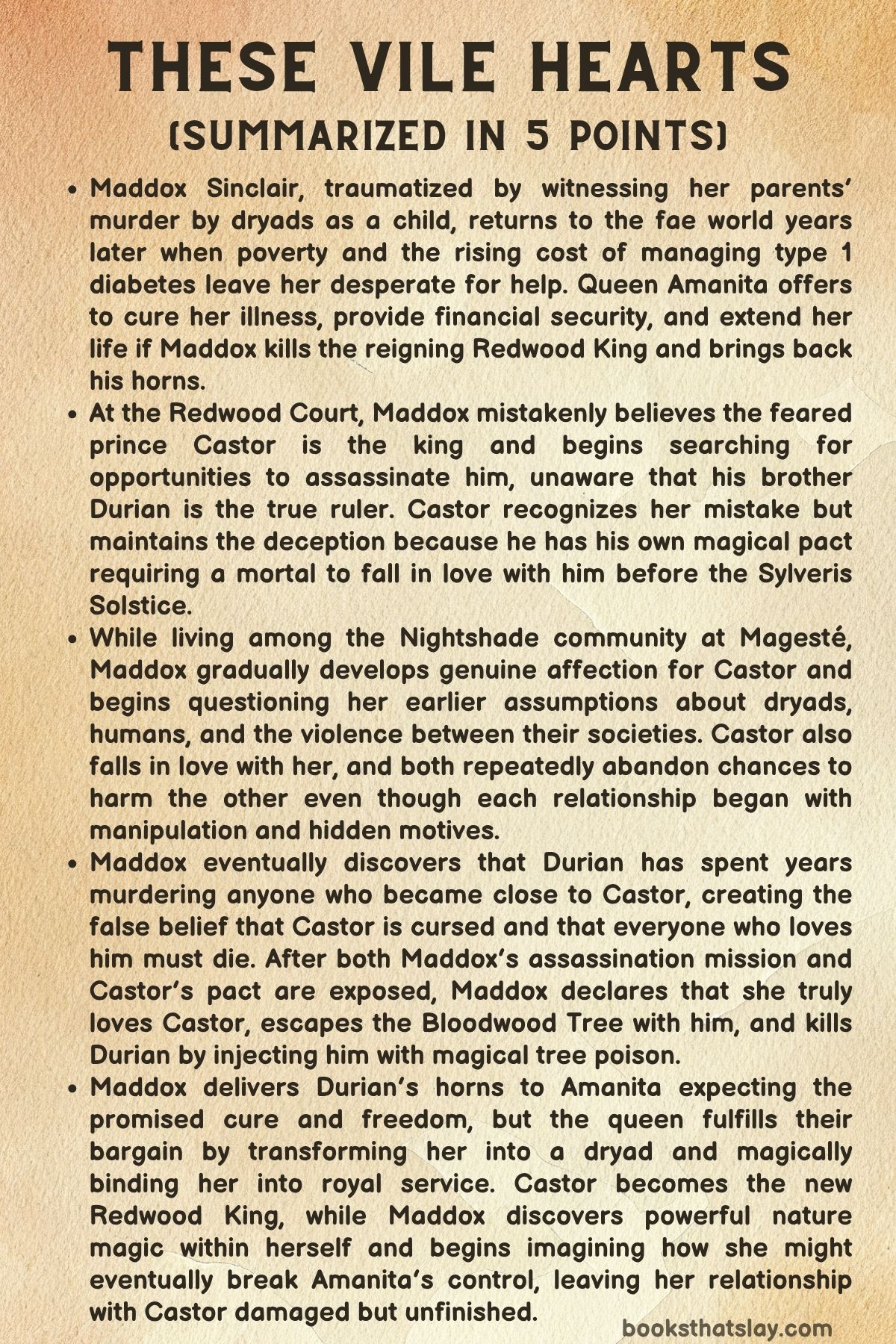
Summary
Maddox Sinclair’s relationship with the fae begins in childhood with catastrophe. At ten years old, she accompanies her parents, Deacon and his wife, along Myrtle Tree Trail, where Maddox and her father can see magical creatures hidden from ordinary humans.
Deacon has secretly documented fae behavior for years, but the outing ends when armed dryads suddenly attack. Maddox watches helplessly as her father’s throat is cut and her mother is repeatedly stabbed, leaving her alone beside their bodies and permanently changing her fascination with magic into terror and hatred.
Sixteen years later, Maddox is twenty-six and barely surviving. Her closest friend, Javen, leaves Oregon for San Francisco believing she will eventually join him, but Maddox hides the truth: she has lost her job, has no stable housing, is living in her Jeep, and is dangerously rationing food and insulin because she can no longer afford adequate treatment for type 1 diabetes.
After losing access to Medicaid coverage for former foster youth, Maddox becomes desperate enough to consult Deacon’s old journal. His notes mention Queen Amanita of the Myrtlewood Kingdom, a fae ruler willing to make bargains with desperate mortals, although every favor comes with a price.
Maddox returns to the forest where her parents died and summons Amanita. Dryads capture her and take her underground, where the queen recognizes her immediately as Deacon Sinclair’s daughter and reveals that Maddox’s father had a far more complicated relationship with the magical world than she knew.
Maddox asks to be cured of diabetes, financially secure, independent, and granted a long life. Amanita agrees only if Maddox kills the reigning Redwood King before the Sylveris Solstice and returns with his horns as proof.
The bargain becomes magically binding. Amanita also tells Maddox that Deacon once served as an axman and participated in previous agreements involving Redwood royalty, including the death of King Cyperus.
Meanwhile, Prince Castor Sempervirens is living under what he believes is a terrible curse. His magic causes living things to decay, but the greater horror is his conviction that anyone who truly loves him will die.
Castor has spent years driving others away, including Tamarind, his childhood friend and permanent guard. His adopted brother Durian, now the Redwood King, repeatedly reinforces Castor’s belief that he is dangerous and responsible for the deaths surrounding him.
Castor has made his own heartwood pact. If a mortal sincerely declares love for him before the Solstice, the supposed curse will be removed; if he fails, he must spend a year imprisoned within the psychologically torturous Bloodwood Tree.
Maddox enters the Redwood Court during a masquerade, armed and determined to complete Amanita’s assignment. She sees Castor wearing a small crown and observes the fearful way others treat him, leading her to conclude that he is the Redwood King.
Castor quickly realizes her mistake. Rather than correct her, he pretends to be king because he sees a possible solution to his own problem: Maddox has already tried to kill him, so he can persuade himself that manipulating her into loving him would be less immoral than sacrificing an innocent mortal.
He arranges for Maddox to live and work at Magesté, a cabaret, pleasure house, refuge, and community center in the neglected Nightshade District. Evodia, who runs the establishment, reluctantly participates in Castor’s deception, while Maddox receives the alias Oleander and begins bookkeeping.
Living in Nightshade complicates Maddox’s hatred of the fae. Fern and the other residents reveal how mortal logging has displaced dryads, destroyed magical forests, and killed families, forcing Maddox to reconsider her belief that humans are simply victims and fae are simply monsters.
Her relationship with Castor also becomes harder to categorize. He brings her coffee, speaks openly about loneliness, gives her a carefully chosen weapons belt for her birthday, helps her during dangerous blood-sugar episodes, and reveals pieces of the pain he normally disguises with sarcasm, intoxication, and cruelty.
Maddox repeatedly gets opportunities to kill him but cannot follow through. At one point she retrieves a dagger while he is vulnerable, only for a hypoglycemic episode to interrupt her attempt, and later she creates poisoned wine when stabbing him directly becomes emotionally impossible.
Castor’s feelings are also becoming genuine. What begins as calculated courtship changes as he becomes jealous, protective, emotionally honest, and increasingly frightened that Maddox might actually love him and therefore die because of his supposed curse.
The deception grows more complicated when Maddox meets Durian. Because she believes he is Castor’s cursed brother, she fails to recognize that she has finally reached the man she actually needs to assassinate.
Durian encourages the misunderstanding because manipulating both Maddox and Castor entertains him. During a royal feast, he arranges for the court to treat Castor as king and himself as the lesser prince, maintaining the lie while deliberately provoking Castor’s jealousy.
Maddox and Castor eventually kiss passionately and later become physically intimate, but their relationship continues to contain hidden intentions. Maddox has not confessed her assassination pact, while Castor has not admitted that he originally brought her into his life because he needed her love.
The truth about the brothers is finally exposed after Maddox is captured by Lorelai, a predatory tree siren. Under magical influence Maddox reveals her mission, and Durian arrives to fight the creature.
Lorelai openly identifies Durian as the Redwood King and mocks Maddox for being deceived. Once the siren is killed, Maddox realizes that she has spent nearly her entire deadline trying to murder the wrong brother.
A second crisis follows almost immediately. Maddox learns that the poisoned wine she prepared for the supposed king has accidentally been delivered to Castor.
She rushes to him believing she has killed him, only to discover that oleander merely puts dryads to sleep. Relief turns into anger as Castor admits that he knowingly allowed her to believe he was king.
Their confrontation gives way to intimacy because each understands the other’s loneliness more deeply than either wants to admit. Castor then tells Maddox why he believes in his curse: Cyperus, Laurel, his mortal lover Jace, and others died after expressing affection for him.
Yet Maddox begins noticing inconsistencies. Cyperus supposedly died because of Castor’s curse, but Maddox knows Deacon killed him under Amanita’s orders.
After woodlings attack Tamarind, Maddox finally reveals her mission, her diabetes, and Deacon’s connection to Cyperus. She and Tamarind realize that the deaths around Castor have always occurred through outside causes and that the wood sprites constantly watching him may actually have been reporting to Durian.
Their conclusion is devastating. Castor was never cursed.
Durian has spent years arranging the deaths of anyone who grows close to his adopted brother. By making Castor believe love itself is fatal, Durian has kept him lonely, unstable, politically isolated, and convinced that he could never become a legitimate rival for the throne.
Tamarind attempts to reveal the truth before Castor willingly enters the Bloodwood Tree for failing his pact. Durian intervenes, imprisons Castor, and admits that jealousy drove his actions.
Cyperus had adopted Castor partly because he saw him as a potential alternative heir. Durian therefore destroyed Castor’s relationships one by one, manufactured the image of a cursed prince, and allowed his brother to blame himself for deaths Durian had engineered.
Maddox, meanwhile, obtains tree poison from Mondo by sacrificing the possession with the greatest value to her: her remaining insulin. By giving away the medication keeping her alive, she makes the assassination an all-or-nothing mission.
She also discovers Castor’s heartwood pact and realizes that his original interest in her was strategic. Feeling betrayed, she nevertheless proceeds toward Durian because her own survival and Castor’s freedom now depend on stopping him.
Her first attempt to poison Durian’s heartwood fails when the poison shatters. Durian captures her and brings her to the Bloodwood Tree, where he exposes both Maddox’s and Castor’s secrets.
Castor learns that Maddox entered Redwood territory intending to kill the king and repeatedly tried to murder him while believing he held that title. Maddox learns that Castor intentionally courted her while believing that her love might kill her.
Their relationship is therefore revealed as a strange mirror: both entered it expecting to exploit the other, both withheld life-threatening truths, and both nevertheless developed genuine feelings.
The Bloodwood Tree forces Maddox to confront one of her deepest traumas. She relives childhood memories of her mother manipulating her diabetes care, withholding insulin or glucose, blaming her for dangerous blood-sugar levels, and teaching her to treat her illness as a personal failure.
Recognizing this treatment as abuse changes Maddox’s understanding of her childhood. It also helps her see that her lifelong determination to depend on no one developed partly because the people responsible for caring for her repeatedly made dependence dangerous.
Maddox finally tells Castor that she loves him. The declaration fulfills his pact and opens his prison, despite the fact that the curse itself was fraudulent.
When Durian enters her cell to kill her, Maddox reveals that she kept one final dose of Mondo’s tree poison hidden inside an insulin syringe. She drives the syringe into Durian’s neck, injecting the poison directly into him and killing the Redwood King.
Castor is now free, but neither he nor Maddox can simply ignore what they did to each other. He insists that his feelings became genuine, while she points out that he originally pursued her while believing love might cause her death.
Castor in turn reminds Maddox that she entered the kingdom intending to kill him when she thought he was king. Their love therefore survives, but trust does not immediately recover.
Castor removes Durian’s horns so Maddox can satisfy Amanita’s pact. He also frees Tamarind, and Durian’s death leaves Castor as the surviving Sovereign heir, making him the new ruler of Redwood.
Maddox returns to Amanita with the horns while dangerously ill from lack of insulin. She expects the queen to cure her diabetes, give her financial security, extend her life, and allow her independence.
Instead, Amanita fulfills the bargain through cruel literalism. Maddox is transformed into a dryad, which removes her mortal illness and gives her a longer life, but the transformation also binds her magically to the Myrtle Queen as a servant.
Amanita then reveals the fuller truth about Maddox’s parents. Deacon had worked for her for years and used his position to redirect logging away from Myrtlewood territory, but his loyalties eventually changed.
When Maddox became dangerously ill because of her mother’s abusive handling of her diabetes, Deacon asked Amanita to save his daughter. The queen technically granted that request by having Maddox’s parents killed, ensuring that Maddox would be removed from the dangerous home.
The revelation forces Maddox to reconsider the event that defined her life. Amanita did not merely take advantage of Maddox’s desperation as an adult; she had shaped Maddox’s history long before their latest bargain.
Now a dryad, Maddox becomes Amanita’s new lady-in-waiting and attends Castor’s coronation. Redwood remains uncertain about Castor because Durian’s crimes are not publicly known, yet the Sovereign Tree accepts Castor and formally recognizes him as king.
Amanita demonstrates that she can magically control Maddox’s movements, proving that Maddox has exchanged one form of dependence for another. Maddox outwardly submits while privately deciding that she will eventually find a way to destroy the queen.
Then an unexpected power reveals itself. In anger, Maddox crushes a sugarberry tart and transforms it into sharp black obsidian.
The ability suggests that becoming a dryad has given her nature magic powerful enough to change her future. Rather than seeing herself as permanently defeated, Maddox begins imagining how that power might eventually break Amanita’s control.
Castor finally recognizes Maddox at the Solstice celebration despite her transformation. Their conversation remains awkward because the hurt between them has not disappeared, but their connection is clearly unfinished.
Maddox suggests they may meet again at the Iron Court, while Castor falls back on an old joke by asking whether the tart she carries contains poison. She leaves him with a small smile and a warning perfectly suited to everything they have survived together: trusting a dryad is dangerous.
Characters
Maddox Sinclair
Maddox is the emotional and narrative center of These Vile Hearts, shaped by childhood violence, foster care, chronic illness, financial insecurity, and a fierce belief that depending on anyone eventually leads to pain. Her practicality can look ruthless, yet much of that hardness is a survival strategy developed after losing her parents and growing up without permanent security.
Her diabetes is fundamental to understanding her decisions because it turns poverty into an immediate threat to her life. Amanita’s bargain becomes tempting not because Maddox naturally wants power or wealth, but because she has reached a point where medicine, housing, food, and independence all feel uncertain.
Maddox constantly tries to contain fear through her mental “locking down” technique. She treats emotions as dangerous forces that must be shut behind imaginary doors, but her growing relationship with Castor gradually demonstrates that control cannot protect her from every form of pain.
Her moral development is equally important. She begins with a simple division between cruel fae and victimized humans, only to discover the destruction caused by logging, her father’s secret dealings with Amanita, her mother’s abuse, and the political complexity of the magical kingdoms.
Maddox is capable of violence, deception, and attempted murder, yet the story repeatedly shows the limits of her ruthlessness. She cannot kill Castor when confronted with his humanity, and eventually she risks her own survival to save him even after discovering his deception.
Her transformation into a dryad creates an intentionally complicated ending. Maddox gains freedom from diabetes and discovers extraordinary magic, but she also loses bodily autonomy under Amanita’s control, leaving her final position suspended between empowerment and captivity.
Castor Sempervirens
Castor is one of the most psychologically damaged figures in These Vile Hearts, a prince who has spent much of his life believing that affection itself is fatal. Because people close to him repeatedly die, he interprets every relationship as a threat to the person offering him love.
His cruel humor, drinking, drug use, casual sexuality, and frightening reputation become defensive performances. Castor wants other people to stay away because isolation appears safer than watching another person die.
The tragedy is that his self-image has been manufactured by Durian. Castor is not cursed at all; he has been subjected to a long campaign of psychological manipulation in which his brother murders people around him and allows Castor to interpret each death as supernatural punishment.
His treatment of Maddox therefore contains a major moral contradiction. He initially chooses her as the mortal who might break his supposed curse precisely because she has tried to kill him, allowing him to convince himself that endangering her is acceptable.
Yet calculated seduction changes into sincere attachment. His coffee visits, jealousy, emotional disclosures, concern during Maddox’s blood-sugar emergencies, and eventual willingness to enter the Bloodwood Tree rather than risk her life all show that he stops viewing her as a means to escape his pact.
Castor’s coronation does not magically repair him. Becoming king gives him institutional power, but he still has to rebuild his identity after discovering that years of guilt, loneliness, and self-hatred were based on a lie.
King Durian
Durian is the central political antagonist of These Vile Hearts, but his most destructive power lies less in physical violence than in his ability to control how others understand reality. He manipulates court etiquette, spies, family history, public reputation, and private relationships until Castor accepts a completely false explanation for his suffering.
His jealousy begins with Cyperus’s adoption of Castor and the possibility that the adopted prince might someday become a legitimate alternative heir. Instead of competing openly, Durian attacks Castor’s ability to form relationships and gradually turns emotional isolation into a political weapon.
Durian understands that repeated unexplained deaths will create their own mythology. By murdering people after they express love for Castor, he does not need to convince the kingdom through formal evidence; fear and coincidence do the work for him.
His treatment of Maddox reveals the same personality. He quickly recognizes her mistaken understanding of the royal brothers and chooses to preserve it because watching her attempt to kill Castor amuses him and destabilizes his brother.
Durian’s eventual confession shows how thoroughly he has confused possession with power. He cannot tolerate Castor receiving love, loyalty, or admiration because each relationship challenges the hierarchy Durian has spent years constructing.
His death through Maddox’s poisoned syringe is particularly fitting because the instrument associated with her vulnerability becomes the weapon that ends his control. The means by which Maddox has stayed alive in the mortal world becomes the means by which she kills a king.
Tamarind
Tamarind provides one of the clearest examples of durable loyalty in These Vile Hearts. He knew Castor before royal status, curses, court rumors, and years of emotional distance transformed their friendship.
Castor attempts to push Tamarind away for his protection, but Tamarind refuses to reduce their relationship to the prince’s fear. His decision to remain beside Castor demonstrates a form of love based not on idealization but on seeing another person’s worst behavior and still recognizing the frightened individual underneath it.
His training as a healer reinforces this role. Tamarind understands physical vulnerability in ways many dryads do not, which enables him to respond more intelligently to Maddox’s medical needs and eventually work with her rather than dismissing her as merely dangerous.
Tamarind also becomes essential to exposing Durian. His memory of the wood sprites, combined with Maddox’s knowledge of Cyperus’s true death, allows them to recognize that Castor’s supposed curse is a constructed pattern rather than supernatural fate.
His confession that he loves Castor like a brother is one of the most dangerous acts of affection in the novel because Tamarind makes it while believing that love may kill him. The confession therefore represents loyalty without any guarantee of safety.
Queen Amanita Umbellularia
Amanita operates as both rescuer and captor in These Vile Hearts, embodying the dangerous precision of magical bargains. She rarely needs to lie directly because she can manipulate people through incomplete truths and technically accurate promises.
Her relationship with Maddox stretches back much further than their adult bargain. Amanita knew Deacon, used him for political purposes, and eventually ordered the deaths of Maddox’s parents after Deacon asked her to save his daughter from a dangerous home.
That history makes Amanita particularly frightening. She does not simply exploit desperate people at isolated moments; she creates arrangements in which one favor produces future dependence, allowing obligations to travel across generations.
Her final treatment of Maddox demonstrates this perfectly. She cures Maddox’s diabetes, grants longevity and financial security, and provides a permanent place in the fae world, but fulfills those promises by transforming Maddox into a magically controlled servant.
Amanita regards contractual precision as sufficient morality. Whether the recipient actually experiences the promised outcome as freedom matters less to her than whether the literal terms can be defended.
Her control sets up Maddox’s next struggle. Durian represents manipulation through lies, while Amanita represents domination through promises that are technically true.
Javen
Javen is Maddox’s closest human connection and the person who most strongly represents the family she built rather than inherited. They share the experience of foster care, giving him an understanding of instability that distinguishes him from most other people in her life.
Maddox’s decision to conceal her financial and medical crisis from him reveals both how much she loves him and how deeply she fears dependence. She lies precisely because she knows Javen would stay or return if he understood how desperate her situation had become.
His departure for San Francisco therefore creates more than ordinary loneliness. It removes the one relationship Maddox has trusted consistently, helping push her toward Amanita when every practical support system appears to have failed.
Although Javen remains outside much of the fae conflict, his importance continues through Maddox’s comparisons between him and the community at Magesté. Her growing attachment to Fern and the others becomes possible because they begin providing the kind of chosen-family security she associates with him.
Fern
Fern initially appears to be one of Magesté’s welcoming workers, but she gradually becomes one of Maddox’s closest relationships in the magical world. Her kindness gives Maddox a social connection independent of Castor, making Magesté feel like a genuine home rather than merely part of the prince’s plan.
Fern also changes Maddox’s understanding of fae history by describing what mortal logging did to forests and dryad families. Through her experiences, Maddox confronts suffering that her father’s world helped create.
Her effort to find a mortal medical book so she can understand Maddox’s diabetes is especially meaningful. Rather than demanding that Maddox adapt entirely to fae life, Fern attempts to learn how Maddox’s body works and how she might be supported.
The revelation that Fern is secretly a tree siren adds another layer to her character. Unlike Lorelai, she does not use her abilities primarily for predation, showing again that species and magical nature do not determine morality.
Evodia
Evodia is the authority figure within Magesté and one of the few people willing to challenge Castor consistently. She knows his reputation, understands his pain, and still refuses to let either excuse him from responsibility.
Her protection of Magesté’s workers establishes her ethical boundaries early. When Castor seeks a mortal for his pact, Evodia refuses to let him treat the people under her care as disposable solutions to his problem.
She also criticizes Castor for ignoring Nightshade’s political suffering. In her view, royal status creates obligations even when the person holding that status feels powerless, forcing Castor to confront the difference between personal despair and public responsibility.
Although Evodia eventually helps maintain Castor’s false identity around Maddox, she remains uncomfortable with the deception. Her participation reflects the compromises people make when trying to protect a damaged friend without fully approving of his choices.
Deacon Sinclair
Deacon initially exists in Maddox’s memory as the loving father murdered by dryads, but later revelations transform him into a morally complicated figure. He possessed the Sight, studied the fae secretly, worked as an axman, and maintained a long relationship with Amanita.
He also participated in major political events, including the killing of Cyperus’s heartwood. Maddox therefore inherits consequences from decisions she knew nothing about as a child.
His most important pact concerns Maddox herself. Faced with the danger created by his wife’s treatment of their daughter’s diabetes, Deacon asks Amanita to save Maddox, apparently without anticipating the terrible literal method the queen will choose.
Deacon’s story reinforces the danger of desperate bargains. Like Maddox, he turns to Amanita when ordinary options appear inadequate, and the consequences extend far beyond the original request.
Maddox’s Mother
Maddox’s mother first appears primarily as a victim murdered before her daughter’s eyes. The Bloodwood Tree later forces Maddox to remember aspects of childhood that radically alter this image.
Her management of Maddox’s diabetes included withholding insulin or glucose and blaming Maddox for dangerous blood-sugar readings. These memories reveal a pattern of medical abuse hidden beneath the authority of parental care.
Maddox has spent years idealizing her murdered parents partly because their deaths froze them inside a traumatic childhood memory. Recognizing her mother’s abuse therefore becomes painful but necessary, allowing Maddox to separate grief for a dead parent from the reality of how that parent behaved.
Atlas
Atlas stands apart from many Myrtlewood dryads through his willingness to recognize Maddox’s vulnerability. When she is imprisoned without insulin, he listens to her explanation instead of assuming she is exaggerating or trying to manipulate her captors.
By secretly returning her medical supplies, Atlas may literally save her life. His compassion introduces an important distinction early in the story: Maddox’s fear of dryads cannot accurately account for the moral differences among individual fae.
His relatively small role therefore has substantial thematic value. He is one of the first magical beings to challenge Maddox’s assumption that every dryad resembles the creatures who killed her parents.
Drosera
Drosera serves Amanita and initially treats Maddox with suspicion, hostility, and little understanding of mortal fragility. Her willingness to lock Maddox away without insulin demonstrates how dangerous ignorance becomes when a powerful group dismisses unfamiliar needs.
She also represents Myrtlewood’s resentment toward mortals and axmen. Maddox enters the kingdom carrying the legacy of her father’s profession, meaning Drosera responds not simply to an individual woman but to generations of conflict over forests and logging.
Her behavior contrasts strongly with Atlas’s compassion. Together they show that the Myrtlewood court is not morally unified even when its members share political loyalties.
Archer
Archer initially seems like a minor court figure, but his proximity to the royal brothers repeatedly makes him important to Maddox’s mistaken understanding of Redwood politics. He becomes one of the pathways through which she tries to reach the person she believes is king.
His private encounter with Maddox at Magesté is deliberately anticlimactic. She expects seduction and manipulation but discovers that Archer mainly wants privacy and a foot rub, undermining her tendency to assume every fae interaction hides immediate danger.
Later, Archer unknowingly takes Maddox directly to Durian when she asks to see the king. The moment illustrates how accurately spoken requests can still produce disastrous misunderstandings when the person asking has built the request on a false assumption.
Mondo
Mondo is an intimidating ironfae associated with dangerous substances and transactions, but his role becomes crucial when Maddox needs poison capable of killing Durian. He refuses ordinary money and demands something that carries genuine value for her.
Maddox’s first offer, her dagger, does not satisfy him because the weapon lacks sufficient personal importance. Mondo understands that sacrifice is meaningful only when losing the object actually costs the person surrendering it.
His acceptance of Maddox’s remaining insulin raises the stakes dramatically. She obtains the weapon needed to attack Durian by giving up the medication required for her own survival, making the exchange one of the clearest demonstrations of her desperation.
Lorelai
Lorelai is the Erlking’s daughter and a tree siren whose beauty and song conceal predatory violence. She attacks not merely through physical force but by altering Maddox’s perception, making danger feel safe and surrender seem reasonable.
Her interrogation forces Maddox to reveal her pact with Amanita. Ironically, Lorelai also becomes the person who finally destroys Castor’s false identity as king by openly naming Durian as the actual Redwood ruler.
She therefore acts as both threat and accidental truth-teller. Maddox nearly dies because of her, yet the encounter corrects the misunderstanding that has controlled almost the entire assassination mission.
King Cyperus
Cyperus is dead before the main conflict, but his choices continue shaping the Redwood royal family. His adoption of Castor gives the abandoned child status, family, and a possible political future.
That act also intensifies Durian’s jealousy. The possibility that Cyperus saw Castor as an alternative heir becomes one of the primary reasons Durian begins systematically destroying his brother’s relationships.
Cyperus’s death is especially important because Castor interprets it as proof of his curse. Learning that Deacon deliberately killed Cyperus under Amanita’s orders becomes the first major contradiction capable of exposing Durian’s larger deception.
Dahlia Redfern
Dahlia represents the consequences of criticizing royal authority under Durian’s rule. She publicly protests her sister Mahonia’s imprisonment and challenges the Crown’s treatment of Nightshade residents.
Her subsequent death reinforces Castor’s belief that affection for him is fatal because she had recently become emotionally close to him. Durian can therefore convert a politically useful death into another piece of evidence supporting the invented curse.
Dahlia’s fate also helps establish the fear surrounding the monarchy. For residents such as Evodia, her death is part of a broader pattern showing that the Crown protects its image more readily than its vulnerable subjects.
Mahonia Redfern
Mahonia remains important largely through her imprisonment and its political consequences. Her treatment becomes evidence for Nightshade residents that the Crown uses punishment selectively and does not provide equal justice across the kingdom.
Dahlia’s attempt to defend her sister ultimately contributes to her own destruction. The sisters therefore illustrate how authoritarian power can widen harm by punishing not only targeted individuals but also those who challenge their treatment.
Mahonia’s situation is one of the grievances Evodia uses when pressing Castor to recognize his responsibilities. Her imprisonment makes his claim of political helplessness increasingly difficult to defend.
Jace
Jace is one of the most important people in Castor’s history despite being dead before Maddox enters his life. As Castor’s mortal lover, he believed he might be protected from a dryad curse and therefore allowed himself to love Castor openly.
His later death, with his body found hanging from Castor’s heartwood, becomes one of the most horrifying pieces of evidence supporting the supposed curse. The brutality of the scene leaves Castor with little emotional space to question what he has been told.
Once Durian confesses the truth, Jace’s death becomes evidence of deliberate psychological torture rather than supernatural fate. Durian did not merely remove someone Castor loved; he staged the death in a place guaranteed to deepen Castor’s guilt.
Laurel
Laurel is another person whose affection becomes weaponized against Castor. After admitting that she loves him, she is found dead soon afterward, strengthening his belief that emotional closeness inevitably ends in death.
Her fate demonstrates how Durian constructs the curse through repetition. Any single death might raise questions, but a succession of carefully timed deaths creates a pattern that Castor becomes psychologically unable to challenge.
Laurel therefore matters less through extensive presence than through the emotional scar she leaves. Her death helps teach Castor that pushing people away is an act of protection.
Iron King Wolfram
Wolfram appears late in the story as ruler of the Iron Court and immediately notices Maddox after her transformation. His interest suggests that the political world beyond Redwood and Myrtlewood will become increasingly important.
His invitation regarding the Iron Court Games also gives Maddox a possible future route outside Amanita’s immediate environment. Because she is already thinking about gaining power capable of resisting the Myrtle Queen, contact with another court may prove significant.
Wolfram consequently functions as a bridge toward the larger political landscape. His presence makes clear that Durian’s death and Castor’s coronation have not ended the broader struggles surrounding Maddox.
Themes
Survival, Illness, and the Cost of Independence
Survival in These Vile Hearts is never treated as a purely physical instinct; it is tied to money, medicine, housing, dignity, and access to other people. Maddox’s diabetes means that financial instability can become fatal very quickly, turning the loss of employment and health coverage into immediate threats rather than abstract economic problems.
Her desire for independence grows from repeated experiences in which dependence becomes dangerous. Foster care taught her that homes could disappear, Javen’s departure reminds her that even loving relationships can change, and childhood memories eventually reveal that her mother used control over medical care abusively.
This history explains why Maddox continually hides the severity of her situation. Asking Javen for help might save her from homelessness, yet admitting need feels emotionally more dangerous than sleeping in her Jeep and rationing insulin.
The novel repeatedly questions whether absolute independence is actually possible. Maddox survives because Atlas returns her medicine, Castor assists during hypoglycemia, Tamarind applies medical knowledge, Fern seeks information about diabetes, and an entire community gradually begins caring about her.
Her final transformation makes the issue even more complicated. She receives freedom from the illness that made her dependent on insulin but becomes magically dependent on Amanita, demonstrating that escaping one vulnerability can create another form of captivity.
Love as Vulnerability, Manipulation, and Choice
Love repeatedly creates danger because powerful characters learn how easily affection can be weaponized. Durian’s entire campaign against Castor depends on transforming love into evidence of death, teaching his brother that anyone who cares about him must eventually suffer.
Castor responds by treating emotional isolation as moral responsibility. If affection kills, then cruelty becomes a form of protection, which allows him to interpret pushing Tamarind away and rejecting intimacy as acts of care rather than fear.
His heartwood pact corrupts love in a different way. Castor initially approaches Maddox with the specific goal of producing a declaration of love, reducing what should be freely given into a condition that must be engineered before a deadline.
Maddox’s own actions mirror his manipulation. She flirts with Castor, kisses him, gathers information, and repeatedly searches for opportunities to kill him, meaning neither person enters the relationship honestly.
What gives their connection significance is that genuine attachment develops despite those motives rather than because of them. Castor eventually prefers imprisonment to the possibility of Maddox dying for his pact, while Maddox risks everything to save the man she originally intended to murder.
Her eventual declaration of love is therefore powerful because it comes after the deception has been exposed. She does not confuse love with forgiveness; she can still love Castor while remaining angry, distrustful, and unwilling to erase the harm he caused.
Control, Manipulation, and False Realities
Much of These Vile Hearts concerns people who control others not simply through force but through carefully constructed versions of reality. Durian dominates Castor by creating a believable curse narrative, while Amanita controls others through contracts whose literal wording conceals consequences they never imagined.
Durian’s scheme succeeds because he manipulates patterns rather than isolated facts. He arranges deaths, uses wood sprites as spies, controls court behavior, exploits Castor’s existing insecurity, and allows his brother to build the false conclusion himself.
Maddox is similarly trapped by incomplete information. Her belief that Castor is king survives because nearly everyone around her performs the lie, while Durian deliberately behaves in ways that make the false identity appear plausible.
Amanita uses a colder version of the same principle. Her statements may be technically accurate, but she understands that the desperate people bargaining with her imagine outcomes very different from the ones she intends to provide.
The Bloodwood Tree adds an internal form of control by forcing characters into psychologically constructed realities based on fear. Maddox’s childhood bedroom becomes a prison because memory itself can be manipulated into an environment she cannot immediately escape.
Against these forces, truth becomes valuable but insufficient. Discovering the truth about Durian frees Castor from false guilt, yet it cannot restore the dead or instantly repair his emotional damage, just as Maddox learning the truth about Amanita does not immediately break the queen’s magical authority.
Family, Belonging, and the Creation of Home
Family throughout the novel is unstable, chosen, imposed, and repeatedly redefined. Maddox begins with the memory of murdered parents, but later revelations show that the family she mourned contained secrets, abuse, magical bargains, and decisions whose consequences continue governing her adult life.
Foster care makes permanence feel almost impossible, while Javen becomes proof that family can be created through shared experience rather than blood. His importance lies not in legal or biological connection but in the consistency of their loyalty to one another.
Castor faces a different version of the same problem. Cyperus adopts him and offers him a place within the royal family, but Durian interprets that inclusion as a threat and spends years ensuring Castor experiences belonging as something dangerous.
Magesté offers both protagonists an alternative model. Evodia, Fern, and the Nightshade community form a household based on protection, acceptance, work, conflict, and everyday care rather than ancestry or political obligation.
Maddox’s attachment to that community explains why Castor’s deception hurts so deeply. She has not merely been fooled romantically; she feels that the first home she has found in years was partly built around a lie.
By the ending, neither Maddox nor Castor possesses a simple home. He inherits a kingdom shaped by his abuser, while she is forced into service within Amanita’s court, yet both have begun recognizing that belonging is created through relationships rather than granted automatically by parents, crowns, bloodlines, or magical contracts.