Somewhere Beyond the Sea Summary, Characters and Themes
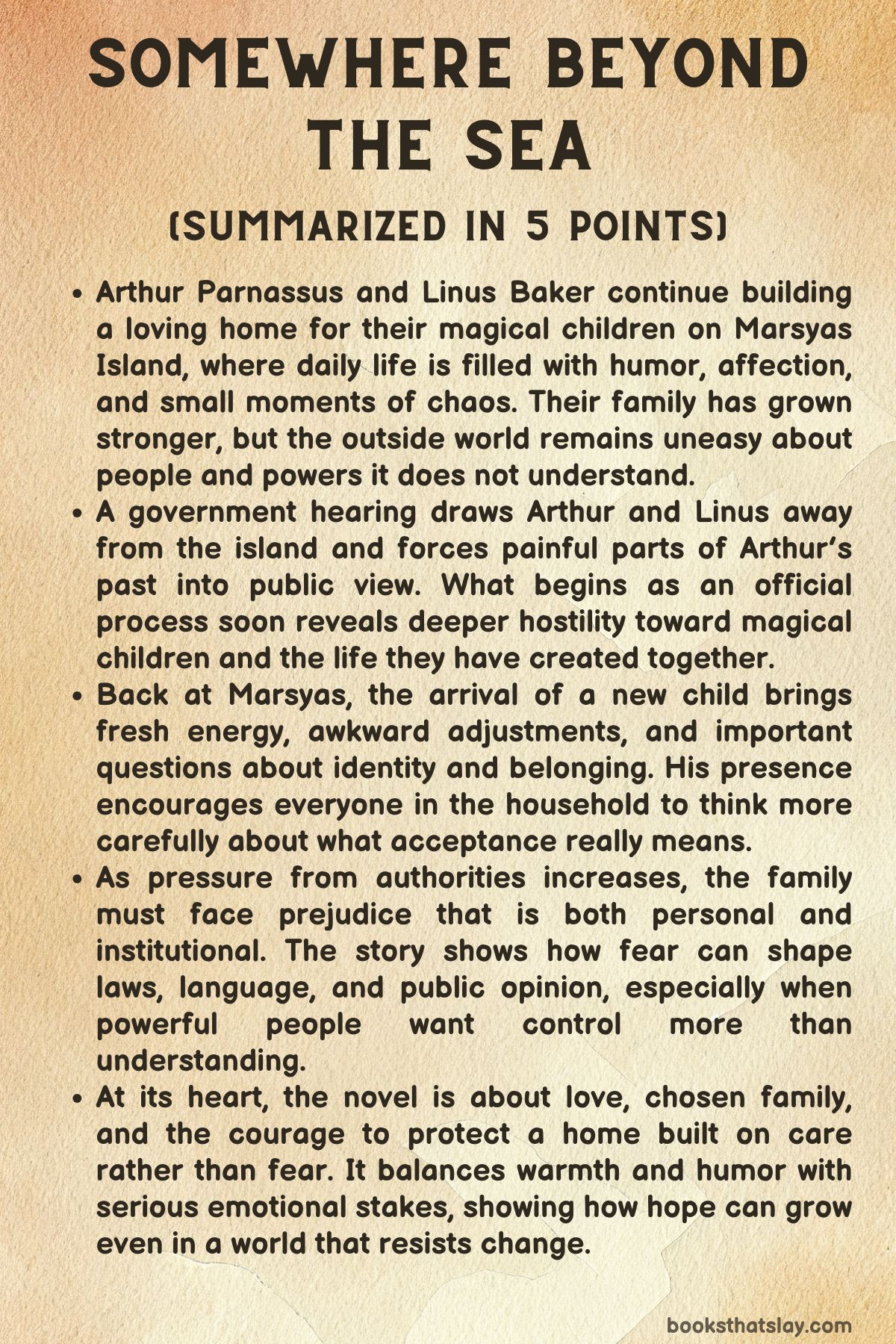
Somewhere Beyond the Sea by T.J. Klune is a fantasy novel about family, belonging, and the fight to protect children from systems built on fear. Set after the events of the first book The House in the Cerulean Sea, it returns to Marsyas Island, where Arthur Parnassus and Linus Baker are raising a group of magical children in a home shaped by care rather than control.
When the government turns its attention toward the island once again, the family is forced to defend not only their future together but also their right to exist on their own terms. The book mixes humor, tenderness, anger, and hope while asking what real safety and love look like.
Summary
Arthur Parnassus first came back to Marsyas Island years earlier with a hard purpose: to reopen the orphanage where he had once suffered cruelty and neglect, and to turn it into something better. The island held painful memories, especially of the cellar where he had been locked away as a child, but he chose to stay.
With help from Zoe, the island’s powerful sprite, he restored the house and built a life centered on giving magical children the kind of protection he had never received. That choice shaped everything that followed.
In the present, Arthur shares that home with his partner, Linus Baker, and the children they care for: Lucy, Chauncey, Talia, Phee, Sal, and Theodore. One morning, Arthur and Linus wake late to an unusual silence and discover the children downstairs trying to prepare a surprise breakfast.
The kitchen is a disaster, Theodore has learned how to breathe fire, and the banner meant for the occasion is partly burned. The meal turns out to be for Linus’s birthday, but it is also a goodbye party because Arthur and Linus are about to leave the island for a government hearing.
They will speak publicly about Arthur’s childhood abuse and argue for a better future for magical children. The children are proud, but they are also afraid.
They know the outside world still judges them harshly, and they worry the trip could put the family at risk.
Before leaving, Arthur learns that the children intend to listen to the radio broadcast of his testimony. On the train to the city, he struggles with being away from them, while Linus tries to steady him.
In the city, they discover that their hotel room has been bugged, a sign that the authorities are already working against them. At the government building, they face crowds of protesters and reporters.
A sympathetic insider warns them that the hearing is not a fair inquiry at all. Powerful officials, especially Jeanine Rowder, intend to ruin Arthur’s reputation.
Arthur begins by speaking honestly about what happened to him as a child. He describes the abuse he suffered and the way magical children were treated as less than human.
At first, some members of the committee seem willing to listen, but the hearing quickly changes. Arthur is questioned not as a survivor but as a threat.
The officials focus on the children at Marsyas, especially Lucy, and suggest that Arthur is turning them into weapons. Rowder pushes hardest.
She accuses Arthur of building an anti-government force and uses his past, his relationships, and his own powers against him. She announces that she will send an inspector to Marsyas to decide whether the children should be removed from his care.
When Arthur hears this, his rage breaks through and he transforms into a phoenix in front of everyone. Linus manages to bring him back, but the damage is done.
They now know the attack is personal and dangerous.
That evening, after calling home and hearing how upset the children were by the broadcast, Arthur and Linus talk about what may happen next. Then Linus proposes marriage.
In the middle of fear and uncertainty, Arthur accepts. Their joy, however, is tied to urgency, because they still plan to bring another child to Marsyas: David, a young yeti who has been living in hiding.
They visit David with Jason and Byron, who have been protecting him. David is dramatic, suspicious, imaginative, and lonely.
He thinks Arthur and Linus have come to judge whether he is worthy of their home. Instead, they tell him that the choice is his.
He asks careful questions because he is used to rejection and cannot easily trust kindness. He also reveals that he is the last living yeti, a fact that deepens his sense of isolation.
After reflection, he agrees to come with them.
David’s arrival at Marsyas is awkward, funny, and emotional. He meets the children, sizes them up, and slowly begins to relax.
The house has prepared a special room for him, cold and icy, built out of the place that was once the orphanage cellar. This transformation from prison to refuge matters deeply to Arthur.
It signals that old harm can be remade into safety, even if the scars remain. That same night, the children notice Arthur’s engagement ring, and the whole family bursts into celebration.
Still, David’s adjustment is not simple. Arthur reads his file and learns that David’s parents were killed by a hunter, and that the world has treated his grief and survival with shocking indifference.
When Arthur asks what David wants to be, David says he wants to be a monster. Arthur at first misunderstands this as self-loathing or danger.
David, however, means something more complicated: he wants the freedom to scare, perform, and exist in the role others project onto him, but on his own terms. Arthur realizes he has not listened closely enough and apologizes.
He promises to help David become whoever he truly wants to be.
This question of identity echoes in Lucy as well. During one family outing, David delights in the fact that “monsters” are allowed at Marsyas, and Lucy becomes upset because Arthur has often tried to steer him away from behaving like the Antichrist others expect him to be.
Arthur later explains that the difference is not species or title but choice. What matters is whether a person respects the freedom of others.
Lucy is moved by this. He begins to think more carefully about what kind of person he wants to become.
The family then receives notice that the inspector will soon arrive. Arthur and Linus try to prepare the children to behave cautiously, but the children understand better than the adults that the inspection itself is unjust.
When Harriet Marblemaw appears, she proves immediately hostile, cold, and eager to find fault. She criticizes the home, the lessons, the children’s behavior, and the very idea that magical children might deserve ordinary happiness.
She sees separation as natural and hope as dangerous. She also instantly reacts with hostility to Zoe, whose existence lies outside government control.
Marblemaw’s stay becomes a steady series of insults and provocations. She tries to shame Talia about her beard, treats Sal differently when he is in dog form, speaks of Lucy as a threat instead of a child, and grabs David in public during a harmless game.
The villagers, however, do not respond as they once might have. They stand with the children.
Arthur sees that change, slow as it has been, is real. He also sees that the people who fear magical beings depend on humiliation and force.
Then Arthur overhears Marblemaw speaking secretly with Rowder. He learns the real plan: the government wants to remove Lucy from Marsyas and use him as a weapon by threatening the people he loves.
This revelation pushes Arthur toward a breaking point. His long-buried anger surges up.
He nearly gives in to destructive thoughts and lashes out at Linus before flying into the night in phoenix form. After falling into the sea and being saved by Frank the fish and a great swirling school around him, Arthur finally collapses into tears.
On the beach, Linus finds him, comforts him, and reminds him that he does not have to carry everything alone. Arthur finally allows himself to grieve not just for others, but for himself.
Once he returns, the family insists on hearing the full truth. Arthur tells them everything, and the children make their own choice: they will stand together and fight together.
They name themselves the Baker-Parnassus family and begin calling Arthur and Linus Dad and Papa. David joins them fully.
This is one of the book’s turning points. The family is no longer simply a household under threat.
It is a united force built on loyalty, honesty, and shared purpose.
They begin pushing back against Marblemaw in small but meaningful ways. The children refuse to let her define them.
Her authority shrinks each day until Arthur finally tells her to leave. Zoe places a banishment on her and sends her back across the sea.
But the conflict is not over. Soon afterward, Rowder arrives in town with agents to take the children.
This time the confrontation is public. Reporters, villagers, and visitors all witness what happens.
Rowder admits that the orphanage had originally been treated as an experiment, especially where Lucy was concerned. Lucy, with unusual gentleness, sees through her anger and recognizes the hurt inside her.
She has been shaped by loss and fear, but she has chosen to turn that pain into cruelty. When she still orders the agents forward, the people of Marsyas move to shield the family.
Then Zoe reveals the truth of her own history. She is the last of her royal line, and Marsyas belongs to her by ancient right.
She declares it a haven for magical beings and uses her power to cast out the government forces. In a final act of renewal, she joins the island and the village into one shared land, ending the physical separation that had mirrored social division.
Marsyas becomes a refuge and a community.
Months later, Marsyas is thriving. Magical beings have come there for safety, new institutions are being built, and even the government has begun to change.
Rowder is gone, replaced by leadership willing to do better. On Arthur and Linus’s wedding day, surrounded by their children, friends, neighbors, and hundreds of guests, the future they fought for feels real.
The story closes not with the end of struggle, but with a home made stronger by love, truth, and the decision to face the world together.
Characters
The characters in Somewhere Beyond the Sea are shaped by love, fear, memory, prejudice, and choice. Each of them carries a distinct emotional weight in the story, and their relationships with one another matter as much as the plot itself.
What follows is a close analysis of the major and supporting figures, written through their actions, conflicts, and growth.
Arthur Parnassus
Arthur stands at the emotional center of the novel. He is a man built from contradiction: powerful yet vulnerable, loving yet furious, protective yet deeply unsure of himself.
His history explains much of this tension. As a child, he was abused at Marsyas, and that past never becomes something neat or finished.
Instead, it continues to shape how he sees himself, how he responds to authority, and how fiercely he tries to protect the children in his care. He does not simply dislike the system that harmed him; he has built his entire adult life around creating the opposite of it.
The orphanage under his care is not just a home but an act of moral resistance.
One of Arthur’s most striking qualities is the way tenderness and anger live side by side within him. He is patient with the children, attentive to their needs, and usually able to guide them without crushing their spirit.
At the same time, his anger is immense, and the story makes clear that this anger is not only political but personal. He is enraged by injustice because he knows what it costs, especially when it is inflicted on children who cannot protect themselves.
His phoenix form becomes more than a magical trait; it reflects the danger of emotion that burns too hot. Arthur’s struggle is not whether anger is justified, because it clearly is, but whether he can keep anger from consuming the rest of him.
His development in the novel comes through a difficult internal reckoning. For much of the story, he behaves as if he alone must bear the burden of saving everyone else.
He sees himself as protector first and person second. That instinct makes him admirable, but it also isolates him.
When he begins to break under pressure, the story pushes him toward a necessary truth: care cannot flow in only one direction. He must allow himself to be supported.
His breakdown is therefore not a failure of character but a turning point in self-recognition. By finally grieving for himself and letting Linus and the children stand beside him, he grows into a more complete version of fatherhood.
He remains fierce, but he is no longer defined only by endurance. He becomes someone who can accept love as fully as he gives it.
Linus Baker
Linus is the stabilizing force in the household, but he is far more than a gentle counterweight to Arthur. He represents the possibility of transformation through conscience.
Once a government worker who operated within a deeply harmful system, he now understands both the cruelty of that world and the seduction of its rules. This gives him a special role in the novel.
He is not innocent in the sense of being untouched by institutional harm, yet he is sincere in trying to do better. His growth is grounded in humility.
He does not present himself as morally pure; instead, he learns, listens, and changes.
Linus’s love is expressed through steadiness. He notices details, provides reassurance, and often acts as the emotional anchor when Arthur is in danger of spiraling.
His support never feels passive. He is practical, alert, and quietly brave.
When he senses that the hotel room has been bugged, when he reads the motives behind the hearing, when he pulls Arthur back from destructive anger, he shows that care can be active and intelligent. His tenderness is matched by a real ability to assess danger.
At the same time, Linus is still learning. He makes mistakes in how he understands magical identity, especially in his attempts to think in terms of goodness, safety, and restraint.
Those instincts come from a human moral framework shaped by the very society the family is resisting. What makes him compelling is that he is willing to be corrected.
He does not cling defensively to being right. He listens when Arthur or the children show him that acceptance means more than kindness; it means allowing people to define themselves.
This is what makes him a believable father figure. He is not perfect, but he is teachable, and his love is strong enough to survive revision.
His proposal to Arthur reveals another core truth about him. In the middle of crisis, he chooses commitment.
He does not wait for circumstances to improve before offering his future. That gesture shows how he understands love: not as escape from difficulty, but as a promise made within it.
By the end, he is not just Arthur’s partner or the children’s caregiver. He has become part of the moral structure of the home, someone whose loyalty is quiet but unshakable.
Lucy
Lucy is one of the most layered characters because his outward identity carries such frightening symbolic weight. As the Antichrist, he has been defined by others before he can define himself.
Fear arrives before personality. Prophecy arrives before choice.
This is the central challenge of his character: how does a child become himself when the world has already decided what he means? The novel refuses to treat him as either a harmless joke or a lurking threat.
Instead, it presents him as a child with enormous power, emotional sensitivity, mischief, longing, and a very real moral intelligence.
His humor is an important part of his characterization. Lucy is dramatic, theatrical, and often delightfully outrageous, but his jokes are not empty.
They are often ways of testing the world, coping with expectation, or reclaiming language meant to control him. He understands that others fear him, and at times he plays with that fear because it is better than being crushed by it.
Yet beneath that playfulness is a serious emotional need: he wants to know whether he will still be loved if he is fully himself.
His conflict with Arthur over what it means to be a monster is therefore essential. Lucy senses inconsistency and responds not only with hurt but with thoughtfulness.
He is not asking for permission to be cruel; he is asking whether his identity must always be edited to make others comfortable. Arthur’s eventual answer matters because it offers Lucy something far more meaningful than reassurance.
It gives him moral agency. He is told that who he becomes is his decision, as long as he respects the freedom of others.
This allows Lucy to imagine a future in which he is neither doomed by destiny nor sanitized into acceptability.
One of Lucy’s finest moments comes when he understands Jeanine Rowder more clearly than anyone else does. He sees the grief and emptiness inside her, and instead of answering hatred with hatred, he responds with a strange kind of sorrowful honesty.
That moment shows extraordinary emotional depth. Lucy may be the character others fear most, but he often sees most clearly into the human heart.
His first use of “Dad” for Arthur is equally significant. It marks trust freely given, not demanded.
By the end, Lucy emerges as a figure of enormous promise: powerful, yes, but more importantly, self-aware, loving, and capable of choosing compassion without surrendering who he is.
Sal
Sal occupies a crucial position within the family because he often functions as the eldest sibling in spirit, even when he is still clearly a child himself. He is observant, thoughtful, and unusually good at reading emotional currents.
The others often look to him for steadiness, and he frequently steps into the role of interpreter between adults and children. This does not make him less wounded; rather, it highlights how early pain can sometimes produce maturity that is useful but costly.
His shapeshifting ability mirrors a deeper concern in his character: the relationship between identity and perception. Sal understands what it means to be seen differently depending on form, and the novel suggests that he also understands broader forms of discrimination that others around him cannot fully grasp.
This gives him a particularly sharp moral voice. When Arthur tries to protect the children by withholding information, Sal pushes back.
He insists that suffering and prejudice are not abstract ideas from which children can be shielded indefinitely, especially children who already live under those pressures. In this sense, Sal often becomes the truth-teller of the household.
His intelligence is not only emotional but political. He can identify the way power works through language, institutions, and fear.
He is one of the first to recognize that the inspection is not a neutral process. Later, he also understands that resistance requires thought, not just outrage.
His suggestion that Marblemaw should be frightened rather than immediately expelled shows strategic thinking. He is not reckless; he knows that timing matters.
Yet Sal is not reduced to wisdom. He is still affectionate, funny, and deeply attached to his family.
His poem for Linus reveals the tenderness beneath his composure. He values belonging intensely, perhaps because he understands what it means to have that belonging threatened.
By the end, Sal represents a child becoming a young moral force, someone who does not merely survive the world’s injustice but learns to challenge it with clarity.
David
David arrives later than the others, but he quickly becomes one of the most important characters because he reframes the family’s understanding of identity, performance, and fear. He is eccentric, theatrical, and guarded, and his strangeness is not presented as a surface trait but as a defense, a language, and a survival strategy.
His detective play, his dramatic costumes, and his way of speaking all indicate a child who has learned to manage loneliness by turning life into performance. He is trying to control how others see him before they can reject him.
His claim that he wants to be a monster is central to his characterization. On the surface, it sounds alarming, but the story reveals that he is speaking about spectacle, emotion, and self-naming.
David understands that monsters can frighten, entertain, and command attention. In a world that has already cast him as one, he would rather define that role for himself than have it imposed on him.
This makes him a deeply interesting study in reclaimed identity. He does not want to be told that he is secretly normal or harmless.
He wants to know whether he can be accepted without being rewritten.
David is also marked by loss. As the last yeti, and as a child whose parents were killed, he carries grief that is both personal and cultural.
He is not just orphaned; he is almost species-alone. This gives his entrance into the family enormous significance.
Marsyas offers him not biological kinship but chosen belonging. His room, carefully built for his needs, becomes a symbol of recognition.
He is not merely tolerated; he is anticipated.
At the same time, David is brave in a very specific way. He does not become fearless, but he acts through fear.
He joins the household despite uncertainty, meets children he expects may reject him, and slowly starts to trust. His growth is not about becoming less strange.
It is about becoming more secure in being strange among people who love him. By the end, his role as officiant at Arthur and Linus’s wedding signals how fully he has entered the family.
He begins as someone who thinks he must audition for love and ends as someone authorized to speak in its name.
Chauncey
Chauncey brings humor to the story, but his character should not be mistaken for comic relief alone. He is one of the clearest examples of how gentleness can exist alongside insecurity.
His physical form makes him highly visible in a world that reacts with discomfort or ridicule to anything outside the expected norm. Because of this, his longing for ordinary social acceptance carries unusual emotional force.
His dream of working and belonging in public life is not small; it is an attempt to insist that he deserves a place in the world exactly as he is.
His conversation with Phee early in the story reveals how deeply external rejection affects him. A cruel reaction at work wounds him, and he needs to be reminded of his own worth.
That scene captures something essential about Chauncey: he is loving and enthusiastic, but he is not invulnerable. He feels slights keenly.
His optimism therefore becomes admirable because it is chosen in spite of evidence that the world can be unkind.
His “yachting” adventure highlights both his absurdity and his imagination. He creates joy through commitment to a ridiculous idea, and in doing so he offers the family an experience defined by play rather than fear.
His ability to talk to fish, and his strange handling of Frank, fit his larger character pattern: he is chaotic, sincere, and often touching without fully understanding how funny he is. There is innocence in him, but there is also a desire to lead, to contribute, and to be taken seriously.
Chauncey’s importance lies in the way he expands the emotional texture of the family. He reminds the others that dignity does not require solemnity.
He wants to be admired, useful, and loved, and the novel treats those desires with respect. His oddness is never something the story asks him to overcome.
Instead, it becomes part of the warmth he offers the people around him.
Phee
Phee combines bluntness, loyalty, and surprising emotional insight. She is direct in a way that can be funny, but her bluntness often serves as a form of moral clarity.
She says what others hesitate to say, especially when the issue concerns dignity or injustice. Her fierce defense of Chauncey and later of David shows how quickly she responds when someone she loves is belittled or threatened.
She does not intellectualize cruelty; she identifies it and rejects it.
As a forest sprite, Phee is tied to growth and natural force, and that connection suits her personality. She appears small and young, but she is repeatedly described as more powerful than outsiders assume.
This mismatch between appearance and strength becomes part of her thematic function. She represents the danger of underestimating those whom society dismisses.
Marblemaw’s condescension toward her only proves how little she understands.
Phee also has a notable ethical seriousness. After threatening Marblemaw, she later talks with Arthur about whether that threat was right.
This shows that she is not simply aggressive or impulsive. She thinks about the use of power, about consequences, and about what justice should look like.
That complexity gives her depth. She is capable of rage, but she does not want rage to become her only language.
Her relationship with Arthur is especially meaningful because it includes admiration without idealization. She trusts him, but she also reflects his lessons back to him.
In this way, she becomes part of the novel’s pattern of children holding adults accountable. Her desire to fly with Arthur also suggests a wish not only for protection but for shared freedom.
She is one of the characters who most clearly expresses that strength and tenderness can exist together without canceling each other out.
Talia
Talia’s defining trait is her refusal to shrink. She is sharp-tongued, proud, funny, and entirely uninterested in making herself pleasing to others.
Her beard becomes an important symbol in the story because it marks the collision between her own cultural identity and a narrow human standard of femininity. When Marblemaw attacks that beard as improper, Talia’s offense is immediate and justified.
For Talia, the beard is not a flaw but a sign of health, tradition, and selfhood. The insult is therefore not cosmetic; it is an attack on who she is.
Her confidence gives the family a certain energy. Talia does not soften truth for comfort, and she often says what others are too polite to say.
Yet her abrasiveness does not make her cold. She is attached to the household, participates fully in family rituals, and contributes to the group in practical and emotional ways.
Even her poisons, while comic in context, reflect competence and capability rather than malice. She is someone who likes to be prepared.
Talia also matters because she broadens the novel’s exploration of identity. She is not simply asking to be accepted despite being different.
She rejects the assumption that difference needs explanation or apology. Her presence insists on a stronger form of belonging, one in which no one gets to define her better than she defines herself.
This makes her a particularly effective foil for characters like Marblemaw, who believe social order depends on rigid categories and controlled presentation.
Beneath her bluster, Talia is deeply loyal. She celebrates the family’s joys and joins its acts of resistance without hesitation.
She is one of the children most likely to sound combative, but that combativeness is rooted in love and self-respect. She shows that dignity can be loud.
Theodore
Theodore might speak in a language not everyone can understand, but he is not opaque as a character. He embodies innocence, emotional honesty, and the wonder of being cared for in ways that make development possible.
His newly discovered fire-breathing ability reflects his ongoing growth. What might alarm outsiders is treated within the family as something to guide rather than fear.
This is a key aspect of his role in the novel. He shows what becomes possible when children are met with patience instead of suspicion.
His relationship with the others reveals how community works beyond conventional speech. They know him, read him, respond to him, and make space for his way of being.
This matters because Theodore’s characterization argues that understanding does not require sameness. Belonging can be built through attentiveness and love rather than through standard forms of communication.
He also carries a sense of delight that brightens the emotional world of the story. Whether through chaos in the kitchen, his part in the family’s improvised adventures, or his dramatic defense of others, Theodore contributes to the household’s feeling of shared life.
His action against Marblemaw when David is threatened is especially important. It shows that he is not merely sweet or amusing; he is protective and brave.
Theodore’s role may be quieter in terms of spoken analysis, but he matters symbolically. He represents the vulnerable child whom hostile systems would fear or classify, while the family instead sees possibility, joy, and personhood.
His existence strengthens the novel’s argument that what many institutions label dangerous is often simply unfamiliar life in need of care.
Zoe Chapelwhite
Zoe is one of the most powerful figures in the novel, both magically and symbolically. She begins as a being shaped by grief and retreat.
The massacre of her people led her to withdraw from humanity and to bury herself in isolation and bitterness. Her long distance from the world is understandable, but it also means that Arthur’s return to the island changes not only the house but Zoe herself.
Through him, and later through the children, she rediscovers purpose in community rather than in hiding.
Her power is immense, but what makes her compelling is the way that power is tied to memory, land, and responsibility. She is not simply a magical guardian.
She is the living continuity of Marsyas, carrying history that predates current governments and their false claims to authority. When she finally reveals herself as queen, the moment works because it has been quietly prepared through her protectiveness, her knowledge, and her refusal to let outsiders define the island.
Her authority feels ancient and earned.
Zoe also acts as a counterpoint to Arthur. Both have been wounded by the past, both are capable of immense force, and both must decide whether pain will harden into permanent isolation.
Arthur chose to rebuild; Zoe gradually follows. Her eventual declaration of Marsyas as a haven is therefore not just a political act but a personal transformation.
She moves from survival to stewardship.
Her relationship with the family is marked by affection, teasing, and profound loyalty. She is not sentimental, but she is committed.
She helps create the material and emotional safety the children need. By joining the island and village into one land, she turns healing into geography.
The division that sustained fear is physically undone. Zoe becomes the figure through whom refuge becomes reality.
Helen Webb
Helen provides one of the clearest examples of change among the non-magical adults. As mayor of the nearby village, she represents the human world that once treated Marsyas with fear.
Her development matters because it shows that prejudice is not inevitable or fixed. She has learned from proximity, from relationship, and from the example of Arthur, Linus, Zoe, and the children.
She is not presented as flawless, but she is willing to revise herself, and that willingness gives her importance.
Her role in the story is often practical. She helps with the children, supports the household, and serves as a bridge between Marsyas and the village.
But her symbolic role is just as significant. She proves that solidarity from outside the magical community is possible and meaningful.
She is not trying to lead the struggle; she is choosing to stand with those most affected.
Helen’s connection with Zoe also strengthens her characterization. Through that relationship, the novel presents love across difference not as exceptional but as natural.
Her care for the children and her place in the household’s extended circle reinforce the idea that family can grow through chosen ties. She helps embody a version of civic life rooted in welcome rather than exclusion.
Harriet Marblemaw
Marblemaw functions as the immediate antagonist for much of the novel, but she is more than a cruel bureaucrat. She is the embodiment of dehumanizing authority presented as procedure.
She does not see children; she sees categories, risks, and opportunities for control. Her language repeatedly reveals this.
She speaks as though regulation is kindness and separation is wisdom. In her worldview, magical beings are safest when limited, monitored, and stripped of aspiration.
What makes her disturbing is not only her prejudice but her self-conception. She takes pride in being beyond fear, as though emotional numbness is a qualification for power.
Yet the story gradually shows that her lack of fear is not strength but failure of recognition. She cannot imagine the full humanity of the people before her, and so she cannot understand the home she is trying to judge.
She expects dirt, danger, and disorder because those are the categories her ideology allows.
Her cruelty often appears in small, intimate acts: insulting Talia’s beard, grabbing David, speaking of Lucy as a thing, treating Sal differently in dog form. These moments matter because they show how oppression works in everyday humiliation, not just in official policy.
She also reveals the corruption of the state’s moral language. Courtesy points and inspection standards become grotesque when set against the obvious love and safety of the household.
Even so, Marblemaw is not as ideologically complete as Rowder. When Arthur overhears her conversation, it becomes clear that she is wavering, at least slightly, about the plan to take Lucy.
This hesitation does not redeem her, but it suggests that even enforcers can crack under the pressure of reality. She is a figure of harm, yet also a sign that the system depends on people who may begin, however late, to see its ugliness.
Jeanine Rowder
Rowder is the novel’s most dangerous human antagonist because she combines personal grief, political power, and deliberate manipulation. She is not merely prejudiced in the vague social sense.
She is strategic. She understands fear as a political tool and uses it with purpose.
Her attack on Arthur during the hearing reveals her method clearly: discredit the witness, weaponize the children’s identities, and transform a conversation about abuse into an accusation against the survivor.
What deepens her characterization is the revelation that her hatred is connected to personal loss. Her father was killed by a magical being, and she has built her worldview around that wound.
The novel does not use this to excuse her. Instead, it shows how grief can become ideology when a person chooses vengeance over understanding.
Lucy’s insight into her emptiness is devastating because it identifies the moral core of her character: she has allowed pain to become the center of her identity.
Rowder’s particular fixation on Lucy reveals the extremity of her worldview. She wants not merely to neutralize him but to possess and weaponize him.
That desire exposes the logic beneath supposedly protective institutions. The state fears what it cannot control, and so it seeks either destruction or ownership.
Rowder is the clearest face of that logic. She believes she is acting for order, but in truth she is prepared to terrorize children to maintain power.
Her confrontation with Lucy near the end is one of the most revealing moments in the story because she is faced with a child who sees her clearly and does not answer her hatred in kind. That failure to provoke the response she expects weakens her.
She can command agents, hearings, and inspections, but she cannot command moral truth. Her removal from power at the end matters because it signals that institutional cruelty, while powerful, is not untouchable.
Charles Werner
Charles Werner is mostly an offstage figure, but his influence is significant because he represents betrayal in a quieter, more intimate form than Rowder or Marblemaw. His history with Arthur and his later rise within the system complicate the past.
He appears to have once been close to Arthur, yet his statement is later used to support accusations against him. This makes Werner a figure through whom personal connection is shown to be vulnerable to ambition, cowardice, or self-protection.
He matters less as a fully developed present-tense character and more as part of Arthur’s emotional history. His involvement reminds the reader that the system does not operate only through open enemies.
It also works through compromised allies and people who once seemed to care. Werner’s willingness to help frame Arthur as manipulative or dangerous deepens the sense that Arthur has been repeatedly forced to survive not just overt abuse but also abandonment and distortion.
Merle
Merle appears briefly but serves an important structural purpose. As the ferry operator in the early part of Arthur’s history, he represents the suspicion with which ordinary mainland people view Marsyas.
His attitude helps establish the social climate Arthur is returning to. Merle is not the central source of harm, but his manner shows how prejudice circulates through everyday behavior.
He contributes to the sense that fear of magical beings is not limited to high officials; it exists in ordinary local life as well. This makes later change in the village more meaningful.
Larmina
Larmina is a small but notable character because she represents moral dissent from within the machinery of government. Her help at the hearing indicates that institutions are rarely monolithic, even when they are oppressive.
She is motivated by personal connection, since her wife is magical, but her actions also show courage. She risks her position to get Arthur and Linus information they need.
In narrative terms, she is a reminder that solidarity can emerge in hidden places and that systems of harm often rely on the silence of people like her, silence she chooses to break.
Doreen Blodwell
Doreen occupies a supporting role for much of the novel, but her importance grows by the end. Her existence as an ally within DICOMY suggests that change is possible not only through resistance from outside but through transformation inside institutions as well.
The later revelation that she is a satyr adds another layer to her role. She has evidently been operating in concealment within a hostile structure, which makes her eventual emergence into leadership especially meaningful.
Her appointment at the end signals hope, though not naïve resolution. The novel does not suggest that one good leader will heal everything at once.
What Doreen represents is the opening of a different future, one in which magical beings are no longer spoken about only by others but can shape policy themselves. She stands for reform that is grounded in lived experience rather than paternal control.
Jason and Byron
Jason and Byron are important because they are guardians in a world where guardianship is risky. They have protected David when the authorities would not.
Their home becomes a temporary sanctuary, and through them the novel expands its picture of chosen family beyond Marsyas itself. Jason is practical and alert to danger, while Byron’s easy acceptance of their own identity is quietly significant.
Arthur and Linus’s respect for Byron’s pronouns helps establish the kind of world the household is trying to build: one where recognition is immediate, not reluctant.
These two characters also help frame David’s vulnerability. The fact that he has been hidden with them underscores how unsafe the larger society remains.
They are part of the network of care that exists in the margins, made necessary by an unjust state. Their presence strengthens the novel’s argument that survival often depends on people willing to create small refuges before larger change becomes possible.
J-Bone
J-Bone gives the village cultural warmth and moral credibility. As the owner of the record shop, he is associated with music, personality, and local life, but his deeper importance lies in how naturally he treats the children.
He is one of the human figures who participates in their world without exoticizing them. His playful interaction with David, which Marblemaw interprets with hostility, becomes a powerful contrast between ordinary affection and institutional prejudice.
He also embodies the village’s evolution. Through characters like J-Bone, the outside world stops being a flat symbol of danger and becomes a site of possible friendship.
He helps make visible the social changes Arthur has long hoped for. His easy presence suggests that acceptance is not always grand or ideological; sometimes it is as simple as welcoming someone into a shop and meeting them without fear.
Calliope
Calliope, though a cat, is an important presence because she functions almost as a household authority. Her placement in the family dynamic adds humor, but it also reinforces the sense that this home has its own internal order, loyalties, and rituals.
Her rivalry with David is funny on the surface, yet it also becomes part of David’s initiation into the family. Even conflict can be domestic when it happens inside a space of belonging.
Calliope’s reactions often serve as emotional punctuation. She is the quiet witness to the family’s routines, a sign that this house is lived in, layered, and real.
In a novel full of magical beings and political conflict, her presence adds texture to everyday intimacy.
Frank
In Somewhere Beyond the Sea, Frank the fish begins as a comic element through Chauncey’s odd relationship with him, but he returns in one of Arthur’s darkest moments and unexpectedly becomes part of the novel’s emotional structure. When Arthur falls into the sea after losing control, Frank helps save him.
This turns a previously absurd detail into a sign of grace. The world Arthur has helped nurture responds to his pain.
Even the fish are part of a wider network of belonging.
Frank’s importance lies in that shift from joke to rescue. He helps the novel suggest that care can come from unlikely places, and that life around Arthur has become interconnected in ways he does not always see.
He is a small figure with a surprisingly large symbolic impact.
Themes
Chosen Family as an Act of Resistance
Family in Somewhere Beyond the Sea is not treated as a soft private comfort that exists apart from politics. It is something built deliberately in defiance of a world that classifies, separates, and controls.
Arthur and Linus do not merely shelter the children; they create a home that rejects the logic of the institutions that have harmed them. That difference matters.
The state sees magical children as categories to be managed, threats to be neutralized, or experiments to be studied. Arthur and Linus instead see them as full people with humor, fears, tempers, talents, and desires.
The home on Marsyas becomes powerful because it replaces surveillance with trust and punishment with care. The children are not asked to earn belonging by becoming easier, quieter, or less strange.
They belong first, and from that belonging they grow.
This theme gains force because the family is not idealized into something unreal. The household is noisy, messy, and full of disagreement.
The children challenge Arthur and Linus, misbehave, test limits, and question adult decisions. Yet these tensions do not weaken the family structure; they prove that it is alive.
Real belonging is shown as something strong enough to contain frustration, correction, and conflict without collapsing into rejection. That is why the moment when the children choose to call Arthur and Linus Dad and Papa carries such weight.
It is not simply sentimental. It marks the point at which the emotional truth of the household becomes openly claimed.
They are no longer only a group living together under threat. They are a family naming itself in the face of a society that would deny its legitimacy.
The novel also connects chosen family to safety in a deeper sense. Safety here does not mean the absence of danger, because danger is always close.
It means a place where identity is not constantly under attack. David’s arrival makes this especially clear.
He does not need only food and shelter; he needs a place where he can ask who he is without being forced into someone else’s answer. Lucy needs the same freedom.
Sal, Talia, Phee, Chauncey, and Theodore all in different ways need a home where they are not reduced to public fear. Family becomes the structure that makes this kind of selfhood possible.
By making family collective, noisy, and chosen, the novel argues that love is not passive. It is a way of organizing life against cruelty.
The household does not withdraw from the world to preserve its peace. It stands together and answers the world’s violence with loyalty, truth, and mutual defense.
In that sense, family becomes both refuge and refusal.
Identity, Self-Definition, and the Refusal to Become Legible for Power
A central concern in the novel is the right to define oneself without surrendering to the labels imposed by fear. Many of the characters live under identities that others have already turned into symbols.
Lucy is seen as the Antichrist before he is seen as a child. David is treated as a monster before anyone asks what he means when he uses that word for himself.
Talia’s beard becomes a target because it does not fit narrow human expectations. Sal’s shifting forms draw different reactions depending on how closely he resembles what others consider acceptable.
Again and again, the story returns to the pressure to become more understandable to authority, more reassuring to prejudice, more manageable to systems that confuse legibility with morality.
What makes the treatment of identity especially strong is that the novel does not answer this pressure by asking characters to prove they are harmless in conventional terms. Instead, it insists that personhood does not depend on being aesthetically familiar or emotionally comfortable to outsiders.
David’s wish to be a monster is one of the clearest examples. At first, that statement sounds alarming, even to Arthur.
But the novel gradually shows that David is talking about performance, fear, spectacle, and self-possession. He wants to claim the image others project onto him and give it his own meaning.
He does not want to be translated into something softer in order to deserve care. This is crucial.
The novel does not present acceptance as a reward for successfully approximating normalcy.
Lucy’s arc deepens this theme further. His conflict is not whether he has power but whether he is allowed to imagine a future that is not already written for him.
Others fear what he might become, and even the adults who love him sometimes fall into the trap of guiding him away from parts of himself for the sake of safety. The book resists that impulse.
Arthur eventually recognizes that true care cannot mean editing a child into acceptability. What matters is not identity in the abstract but choice, ethics, and respect for the freedom of others.
Lucy is allowed to keep his complexity. He is not cleansed of darkness to make him lovable.
This theme also works at the level of language. Government officials constantly try to control reality through words such as registration, inspection, courtesy, suitability, and voluntary separation.
These terms sound orderly, but they conceal domination. In contrast, the children and the adults who love them insist on naming themselves.
That insistence becomes a way of resisting capture. Identity here is not a fixed essence nor a bureaucratic category.
It is a lived truth that must remain in the hands of the person living it.
Trauma, Anger, and the Work of Healing Without Erasure
The novel treats trauma as something that remains active in the present rather than as a backstory detail meant only to explain behavior. Arthur’s childhood abuse is not sealed off in the past.
It shapes his instincts, his fears, his need for control, and his overwhelming protectiveness toward the children. He rebuilt the orphanage in order to transform a site of cruelty into a site of care, but rebuilding does not erase what happened there.
The past continues to live inside him, sometimes as memory, sometimes as rage, sometimes as exhaustion. This gives the novel a serious emotional foundation beneath its humor and warmth.
Love can create healing, but it does not magically dissolve old wounds.
Anger is one of the most important parts of this theme. The novel refuses to present anger as a moral failure in itself.
Arthur’s anger is justified. It grows from abuse, loss, and from watching institutions continue to harm children in the present.
The problem is not that he is angry, but that he has been carrying that anger alone for too long. Because he thinks of himself primarily as protector, he rarely allows himself to be vulnerable.
He can advocate, defend, and comfort, but he struggles to admit when he himself is in danger of breaking. That pattern drives him toward collapse once he learns what the government plans for Lucy.
His near-destruction is not caused by weakness. It comes from the unsustainable belief that love means standing between everyone else and pain without ever asking others to stand beside him.
The novel’s treatment of healing is compelling because it rejects quick resolution. Arthur’s breakdown does not cure him.
It exposes what has been buried. His tears on the beach matter because they represent the first time he fully grieves for himself rather than only for others.
That shift is essential. Healing begins when he stops imagining that his value lies only in what he can carry.
Linus’s role in this moment is not to fix Arthur but to remind him that being loved means he no longer has to survive in isolation.
The same pattern appears, in different forms, across other characters. David carries grief over the murder of his parents and the loneliness of being the last of his kind.
Lucy lives under projected fear that becomes a kind of inherited wound. Sal’s maturity suggests the cost of surviving prejudice too early.
The novel therefore frames healing as communal, imperfect, and ongoing. It is not forgetting.
It is the gradual creation of relationships strong enough to hold pain without letting pain determine the future. That makes the emotional movement of the story feel earned rather than decorative.
Power, Prejudice, and the Politics of Fear
The conflict in the novel is driven not only by individual cruelty but by systems that convert fear into policy. The government does not simply dislike magical beings; it organizes itself around regulating them, classifying them, and deciding what forms of life are acceptable.
This structure is maintained through official language, public spectacle, and the constant suggestion that control is necessary for safety. Hearings, inspections, registrations, and approved curricula all appear as instruments of order, but the novel steadily shows that these processes are built to preserve hierarchy rather than protect the vulnerable.
Fear is not a side effect of governance here. It is one of its core tools.
Jeanine Rowder and Harriet Marblemaw embody different dimensions of this politics. Rowder operates at the level of strategy.
She understands that if she can make Arthur seem unstable and Lucy seem dangerous, she can justify almost any intervention. Her goal is not truth but permission.
Marblemaw works at the everyday level of enforcement. She humiliates, judges, and intrudes under the cover of professional duty.
What links them is their belief that magical beings are never fully persons but always potential risks. This is why even ordinary joy troubles them.
A child at play, a public outing, a home full of affection, a classroom discussion about power, all of these become threatening because they contradict the state’s narrative that magical lives must remain limited and supervised.
The novel is especially effective in showing how prejudice survives by pretending to be reasonable. Marblemaw’s phrase “voluntary separation” is a perfect example.
It dresses segregation in the language of choice and public good. Likewise, regulations about reading, conduct, and registration are framed as responsible governance while actually enforcing inferiority.
This gives the story a sharp political edge. It is not only condemning obvious hatred.
It is exposing the smoother, more bureaucratic forms of dehumanization that many institutions prefer.
At the same time, the book does not leave power uncontested. One of its most hopeful claims is that fear can be interrupted when people refuse to accept official definitions of danger.
The villagers who stand with the family, the insiders who leak information, and Zoe’s final declaration of Marsyas as a haven all show that authority depends on compliance more than it admits. Once enough people choose solidarity over obedience, the performance of inevitability begins to crack.
That is why the ending matters beyond personal victory. The defeat of Rowder is not just the downfall of one antagonist.
It signals a larger challenge to the idea that institutions have the right to determine whose lives are valid. By bringing the island and village together physically, the novel gives this political hope a concrete form.
Separation has been the geography of prejudice. Connection becomes the geography of a different future.